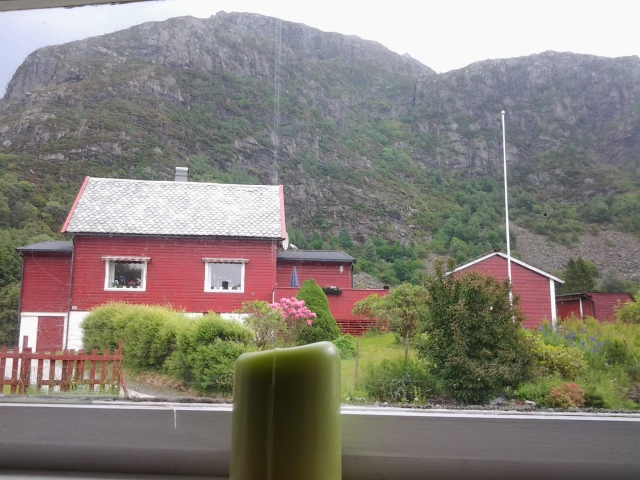
Bergen, Norway, 9 am
Bergen, Norway, 9 am
Alexis Madrigal thinks niche social networks can survive the age of Facebook:
Social networking is not, it turns out, winner take all. In the past, one might have imagined that switching between Facebook and “some other network” would be difficult, but the smartphone interface makes it easy to be on a dozen networks. All messages come to the same place—the phone’s notifications screen—so what matters is what your friends are doing, not which apps they’re using. Take a look at the rise of apps that exploit the desire for anonymity, ephemerality, and the unknown—roughly the opposite of Facebook’s founding desire to connect real people (under their real names) on the Internet. … “I think we’re shifting in a weird way to one-on-one conversations on social networks and in messaging apps,” says Shani Hilton, the executive editor for news at BuzzFeed, the viral-media site. “People don’t want to perform their lives publicly in the same way that they wanted to five years ago.”
Taken together, these trends pose a direct challenge to Facebook’s supremacy. After all, Facebook is built around a trade-off that it has asked users to make: Give us all your personal information, post all your pictures, tag all your friends, and so on, forever. In return, we’ll optimize your social life. But this output is only as good as the input. And it turns out that, when scaled up, creating this input—making yourself legible enough to the Facebook machine that your posts are deemed “relevant” and worthy of being displayed to your mom and your friends—is exhausting labor. These new apps, then, are arguments that we can still have an Internet that is weird, and private. That we can still have social networks without the social network.
Ryan L. Cole reflects on the persona that led Bruce Springsteen to fame and fortune:
His 1973 debut album, Greetings from Asbury Park, N.J., and its follow-ups, The Wild, The Innocent & The E Street Shuffle (also 1973), and Born to Run (1975), featured songs about Jersey boardwalks, open roads, slamming screen doors, and other assorted bits of romanticized American life, written with a verbosity that would make Bob Dylan tip a leopard-skin pillbox hat … . But around the time of his fourth LP, Darkness on the Edge of Town (1978) … the songs increasingly turned to blue-collar angst, and the singer was progressively positioned as the culmination of rock ’n’ roll: Elvis Presley with a social conscience.
Springsteen embraced the imagery, iconography, and gestures of the genre. He threw on a leather jacket, sculpted his sideburns, and posed broodingly in Corvettes and Cadillacs. Then he name-checked John Steinbeck and Flannery O’Connor, sang of American decay and inequality, and rebuffed Ronald Reagan, whose reelection campaign had the nerve to assume that “Born in the USA”—a gloomy song about a homeless Vietnam veteran dolled up with a misleadingly anthemic chorus and sold with imagery of Springsteen draped in Old Glory—was actually a statement of patriotism. Which is not to say that Springsteen isn’t a patriot. It’s just that he articulates progressivism’s brand of national pride: America is noble in theory, nightmarish in reality; cool around the edges, but rotten to the core.
Previous Dish on Springsteen here.
Tom Angell points out an international agricultural effort to preserve weed after the apocalypse:
By preserving genetic material in an insulated, underground facility, the Svalbard Global Seed Vault hopes to guard against the permanent loss of plants that humanity relies on for food and medicine. According to a Marijuana.com analysis of Svalbard’s database, there are 21,500 cannabis seeds being held for safekeeping in the vault. That’s more weed seeds than there are asparagus, blueberry or raspberry seeds stored at the facility. There are more marijuana genetics in the “Doomsday Seed Vault” than there are for artichoke, cranberry and pear combined. …
The vault’s location, about 800 miles from the North Pole, was selected because of its permafrost and lack of tectonic activity. That means the seeds will stay cold even in the event of a power failure, and the bunker they’re contained in is unlikely to be cracked open by an earthquake or volcanic eruption. And, because it’s located 430 feet above sea level, the facility will stay dry even if global climate change causes the ice caps to melt.
Keating flags some odd news out of China, which is planning to do away with its 2,600-year-old state monopoly on table salt:
The salt monopoly began during in the Qi state on the Shandong peninsula around the seventh century BC and may have been the first ever state-controlled monopoly. During the third century BC, the Chinese imperial state sold salt at a markup, effectively levying a tax used to pay troops and, perhaps, the early stages of the Great Wall of China.
Several centuries, dynasties, and revolutions later, the world’s oldest monopoly is still in place. Under the policy’s current incarnation, the China National Salt Industry Corp. designates who is authorized to produce salt and is the only entity allowed to sell it to consumers. These consumers often pay three to four times more than what the CNSIC does. The new plan will liberalize the industry and scrap price controls starting in 2016.
Some Chinese netizens, Bethany Allen-Ebrahimian observes, are concerned that opening the salt market will just lead to more food safety scandals:
“There will soon be frequent cases of industrial salt” — far cheaper than table salt — “being mixed with edible salt,” went one popular comment on Weibo, China’s huge, Twitter-like microblogging platform. Another userwrote, “Soon the media will be putting out articles called ‘How to tell industrial salt from table salt.'” The topic seemed to resonate; “salt monopoly abolished” became a top-trending hashtag on Weibo, and one related post on CCTV’s official Weibo account quickly garnered over 1,300 comments. One user commented cynically, “I’ve eaten all kinds of fake products; now I will finally have the opportunity to eat fake salt!”
But Austin Ramzy notes that ending the monopoly might actually help fix this problem:
Some scholars have argued that the state monopoly system actually contributed to the phenomenon of tainted salt, and that overhauling the system while enforcing food quality laws should help improve safety. In a 2010 paper, Sun Jin, Fan Zhou and Qin Li of Wuhan University noted that the monopoly meant that the price consumers paid for salt was three to four times higher than the price the China National Salt Industry Corporation paid for salt from authorized producers.
While the average consumer does not feel the price difference because salt makes up such a small portion of a typical grocery bill, the markup supports a vast and pernicious underground market, the authors wrote. Such salt often does not contain iodine and can have harmful impurities, they noted.
Chelsea Wald reflects on Benjamin Wallace Wells’s argument:
[H]ow can we justify keeping animals in zoos? Wallace-Wells asks. His conclusion is that we can’t, and that we won’t continue to try for much longer. I’m not sure I agree. But there are certainly bits and pieces of zoos that could be handed over to technology. The educational aspect of zoos would be relatively easy to make virtual. And since zoo animals don’t really act as they would in nature (even when they’re not psychotic), it’s hard to argue that zoos can convey much about the animals other than how they look. And while many zoos attempt to share a lot of material about conservation, it’s not clear how much of that is getting through to visitors. Certainly, technology that connects people to animals in the wild could reveal far more about the animals’s actual behaviors as well as the need for conservation. If kids just want to see an animal up close, they can go to a farm or get a pet.
But we do lose something, if we lose physical zoos.
The world’s best zoos go to great lengths to help save threatened species. Some animals—like the northern bald ibis—are safe from looming extinction precisely because zoos have developed captive breeding programs. It seems to me that we should at least let the good zoos keep on with that good work (and encourage them to do it better); then we could see some wild animals close up from time to time. The rest of the wild kingdom we could keep in contact with on our devices. Bye-bye, sweet guilty feeling.
Yet I wonder: Even if a nearly zoo-less world would satisfy me ethically, would it satisfy me emotionally? What about that desire to feel something? Could I really make a connection through a GPS tracker or a live cam? Certainly my friends and I have gotten mesmerized by video feeds of animals (think panda cam), but my heart melts extra when I make eye contact with the monkeys at the zoo.
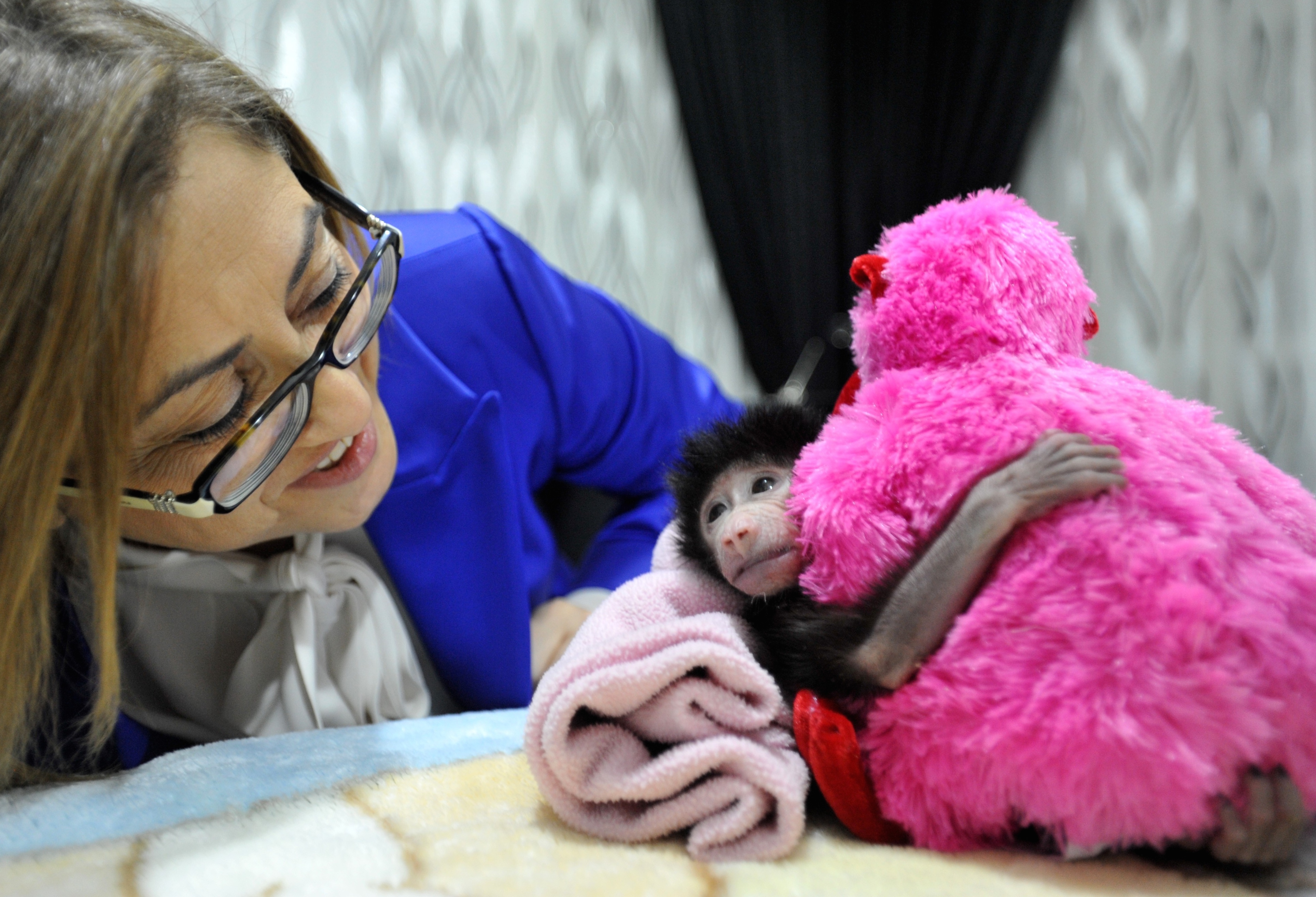
(Photo: A newborn baboon cuddles a plush monkey presented by Fatma Sahin, the mayor of Gaziantep, a southeastern city in Turkey, on November 23, 2014. The newborn baboon was rejected by its biological mother. By Kerem Kocalar/Anadolu Agency/Getty Images)
When Black Friday gets dark – real dark:
Pamela Stewart, a former private investigator, describes how moral qualms led her out of the profession:
I talked to a few friends in the industry this week and asked if they were considering using drones. They are excited about the possibility. Legislation doesn’t keep pace with technology, so there are grey areas in that blue sky. A private investigator cannot observe you in any place you have a reasonable expectation of privacy, but that doesn’t mean they won’t try. Years ago, a colleague followed a subject to a nudist colony and got video of the subject and others playing volleyball. Everyone in the office watched that video. …
Most of the people who do this work don’t care about you or your privacy. Most of the people being surveilled don’t know how to protect their personal information. And most of investigating bodies don’t care. You are just data. And even if you are doing nothing wrong, you’re just collateral damage in the search for the “truth.”
I want to say I am done. I helped many people get the information they needed to make decisions about their lives or their businesses, but in doing so I devalued myself. While focusing my camera on others, I blurred my own definition of right and wrong. I was a licensed liar and a snoop. It’s a judgmental, and soul-destroying world. From now on, I’ll stick to reading Raymond Chandler and sign off with the words I used in every investigation report: “Surveillance discontinued.”

Chicago, Illinois, 3.20 pm
Derek Thompson notes that “many of the most successful new brands have been looking to an unusual but powerful source of inspiration – religious cults”:
Cults like the Moonies are built on the paradox that we feel most like ourselves when we’re part of a group, says Douglas Atkin, the global head of community at the room-sharing company Airbnb, and the author of the 2004 book The Culting of Brands: Turning Your Customers Into True Believers. “The common belief is that people join cults to conform,” Atkin wrote. “Actually, the very opposite is true. They join to become more individual.”
A number of Bay Area companies have come to incorporate this insight into their marketing strategies.
In 2004, shortly after launching the restaurant-review site Yelp, the founders were struggling to grow the company. They decided to convene a gathering of about 100 power-users. The get-together “was a big success,” Ligaya Tichy, who later served as Yelp’s senior community manager, told me. “Bringing users together to share what they loved about the site led to a huge spike in activity. What we realized is that people aren’t really motivated by companies. They’re motivated by other people. We needed to get the message across: you are what makes this product cool.” The number of reviewers on the site grew from 12,000 in 2005 to 100,000 in 2006.
Even today, Yelp still holds exclusive events for its most prolific reviewers, the Yelp Elite Squad, which a 2011 Bloomberg Businessweek article noted for its “cult influence.” “People have been thinking about the similarities between cults and brands for years,” Tichy says. “Only now you’re really seeing people start to codify these practices with evangelists and groups like Yelp Elite.”
 The Dish