
Sergio Rodriguez clears snow from sidewalks in downtown Denver on November 12, 2014. A storm has moved into the are bring cold temperatures and snow. By RJ Sangosti/The Denver Post via Getty Images.
Sergio Rodriguez clears snow from sidewalks in downtown Denver on November 12, 2014. A storm has moved into the are bring cold temperatures and snow. By RJ Sangosti/The Denver Post via Getty Images.
Fossil fuel subsidies continue to rise:
In 2009, G20 leaders agreed to phase out fossil fuel subsidies by 2020. But it’s clear that most countries are going in the opposite direction, especially the U.S. The government provided $2.6 billion in subsidies for exploration in 2009, which nearly doubled to $5.1 billion by 2013, thanks to a boom in domestic oil and gas production. That means American drilling and investment tax breaks outrank subsidies in Australia, Russia, and China—countries not generally known for their aggressiveness on climate change. And yet, President Barack Obama has adopted climate change as a part of his agenda and hopes to convince the rest of the world to do the same.
In fact, according to the International Energy Agency’s World Energy Outlook, released today, governments worldwide spend a mind-boggling $550 billion on fossil fuel subsidies each year. As Chris Mooney notes, that’s four times the amount of subsidies directed toward renewables:
[That] partly explains why despite an overall greening of world energy patterns in the next 25 years, the IEA says we are going to miss climate goals and end up with quite a lot of warming (barring a very significant course correction). The agency cites “the failure to transform the energy system quickly enough to stem the rise in energy-related CO2 emissions (which grow by one-fifth to 2040) and put the world on a path consistent with a long-term global temperature increase of 2°C.” (It was not immediately clear how much the just announced U.S.-China deal to jointly reduce greenhouse gas emissions changes this picture.)
We have some 1000 gigatonnes of carbon left to emit to the atmosphere before locking in a dangerous amount of warming above 2 degrees, and on the current course we’ll use it all up by 2040, says the IEA. In order to stop that, we’ll need four times the current investment in renewable energy — an increase up to $ 1.5 trillion annually around the world
David Roberts shakes his head:
It’s a little crazy. As the Carbon Tracker Initiative has shown in some detail, if the world is to have a chance of limiting temperature rise to 2C, 60 to 80 percent of current fossil fuel reserves have to stay in the ground. That means companies and countries with fossil fuel assets face an enormous potential devaluation, a “carbon bubble.” Exploration for new fossil fuels at this point is just stockpiling stranded assets, at great cost, with money that could far more profitably be spent accelerating the energy transition. Or maybe, as this kind of insane-but-routine set of facts demonstrates, the world won’t get serious about climate change. Then stranded assets could be the least of our problems.
And naturally, it’s already tweeting:
.@ESA_Rosetta See for yourself! ROLIS imaged #67P when we were just 3km away! Glad I can share. #CometLanding pic.twitter.com/b6mcid2fsn
— Philae Lander (@Philae2014) November 12, 2014
Gautam Naik details the exciting news:
Rocket scientists at the European Space Agency’s mission control here erupted in cheers as they received the first signal that the Rosetta mission’s probe, called Philae, had touched down more than 300 million miles away on the forbidding landscape of a small comet known as 67P/Churyumov-Gerasimenko. There were even more cheers, hugs and handshakes when it became clear that it had done so safely.
The landing follows a decade long trek through the solar system to get the up-close-and-personal visit with a comet for a lengthy period of time as it hurtles closer to the sun. “We made history today,” said Matt Taylor, project scientist for the Rosetta mission, who sported a pair of shorts revealing a tattoo on his thigh depicting a successful Philae landing. “I can’t see anyone doing this again anytime soon.”
But Victoria Bryan and Maria Sheahan have some sobering details:
[A]n anchoring system problem may hamper planned investigations into the origins of Earth and the solar system. The 100-kilogram (220-pound) lander – virtually weightless on the comet’s surface – touched down on schedule at about 11 a.m. ET after a seven-hour descent from its orbiting mothership Rosetta, now located a half-billion kilometers (300 million miles) from Earth. But during the free-fall to the comet’s surface, harpoons designed to anchor the probe, named Philae, failed to deploy. Flight directors are considering options to ensure the lander does not drift back into space.
Meanwhile, Dave Gilbert describes the probe:
Built by a European consortium, led by the German Aerospace Research Institute (DLR), the landing probe has nine experiments. According to details on ESA’s Rosetta website, sensors on the lander will measure the density and thermal properties of the surface, gas analyzers will help to detect and identify any complex organic chemicals that might be present, while other tests will measure the magnetic field and interaction between the comet and solar wind. Philae also carries a drill that can drive 20 centimeters (8 inches) into the comet and deliver material to its on-board ovens for testing.
Joseph Stromberg voxsplains the landing’s potential significance:
[T]he comet is believed to have formed 4.6 billion years ago, from material leftover as Earth and the solar system’s other planets were coalescing. As a result, understanding the composition of comets could help us better model the formation of the solar system. Moreover, many scientists believe that in the period afterward, when the solar system was still a chaotic, collision-filled system, comets and asteroids were responsible for bringing water and perhaps even organic molecules to Earth. If water ice is present on this comet, as scientists hope, Philae will calculate the ratio of different sorts of hydrogen isotopes present in it — information that could provide an important clue as to whether the hypothesis is correct.
In other words, data collected by a tiny robot on this lopsided, spinning comet, millions of miles away, could provide a window into the history of all life on earth.
Rachel Feltman and Terrence McCoy discuss the mission’s circuitous journey to the comet:
It’s no easy thing to land on a comet’s surface: These chunks of rock and ice are constantly spinning, and Comet 67P/Churyumov-Gerasimenko, which was discovered in 1969, orbits the sun at a speed of about 85,000 mph. It’s irregularly shaped — like a toddler’s play-dough impression of a duck, or something — and its surface is uneven and pitted. And in a universe of unimaginable proportion, Rosetta’s target is just 2.5 miles in diameter — smaller than Northwest Washington’s Columbia Heights neighborhood.
So Rosetta has taken an onerous journey to get in sync with the comet’s orbit, which would allow it to drop down a lander. In 2004, the spacecraft began what would be three looping orbits around the sun, altering its trajectory as it skimmed Mars, just 150 miles from the surface, and enduring 24 minutes in the planet’s shadow to align with Churyumov-Gerasimenko. The cumulative distance traveled by the craft – with all its looping and gravity assists – is a stunning 4 billion miles. “When the Rosetta signal reappeared after the passage behind Mars, shortly after the end of the ‘shadow’ period, there was a collective sigh of relief,” ESA said. At one point in 2011, the spacecraft even had to hibernate for nearly three years. It flew so far from the sun — nearly 500 million miles — that its solar panels couldn’t leech enough energy to keep the spacecraft operational. But in January of this year, Rosetta woke up, and quickly approached its target.
Meanwhile, Victoria Turk perks up her ears:
We recently found out what [the comet] smells like: space farts. And now we know that it’s “singing” this percussive little ditty as it goes. As one commenter put it, it kind of sounds like a dolphin. ESA announced the observation on its Rosetta blog, and explained that the “music” is produced “in the form of oscillations in the magnetic field in the comet’s environment” picked up by the mission’s magnetometer experiment from a distance of around 100 kilometers.
Scientists were delighted by the discovery:
“This is exciting because it is completely new to us. We did not expect this and we are still working to understand the physics of what is happening,” Karl-Heinz Glaßmeier, head of Space Physics and Space Sensorics at the Technische Universität Braunschweig, Germany, explained on the RESA Rosetta blog. The “song” – as the scientists themselves refer to it – was in fact outside the normal range of human hearing range and has to be boosted in volume by a factor of 10,000. According to scientific theory, the comet releases neutral particles into space where they collide with high-energy particles and that’s what makes the sound. However, “the precise physical mechanism behind the oscillations remains a mystery,” according to the blog.
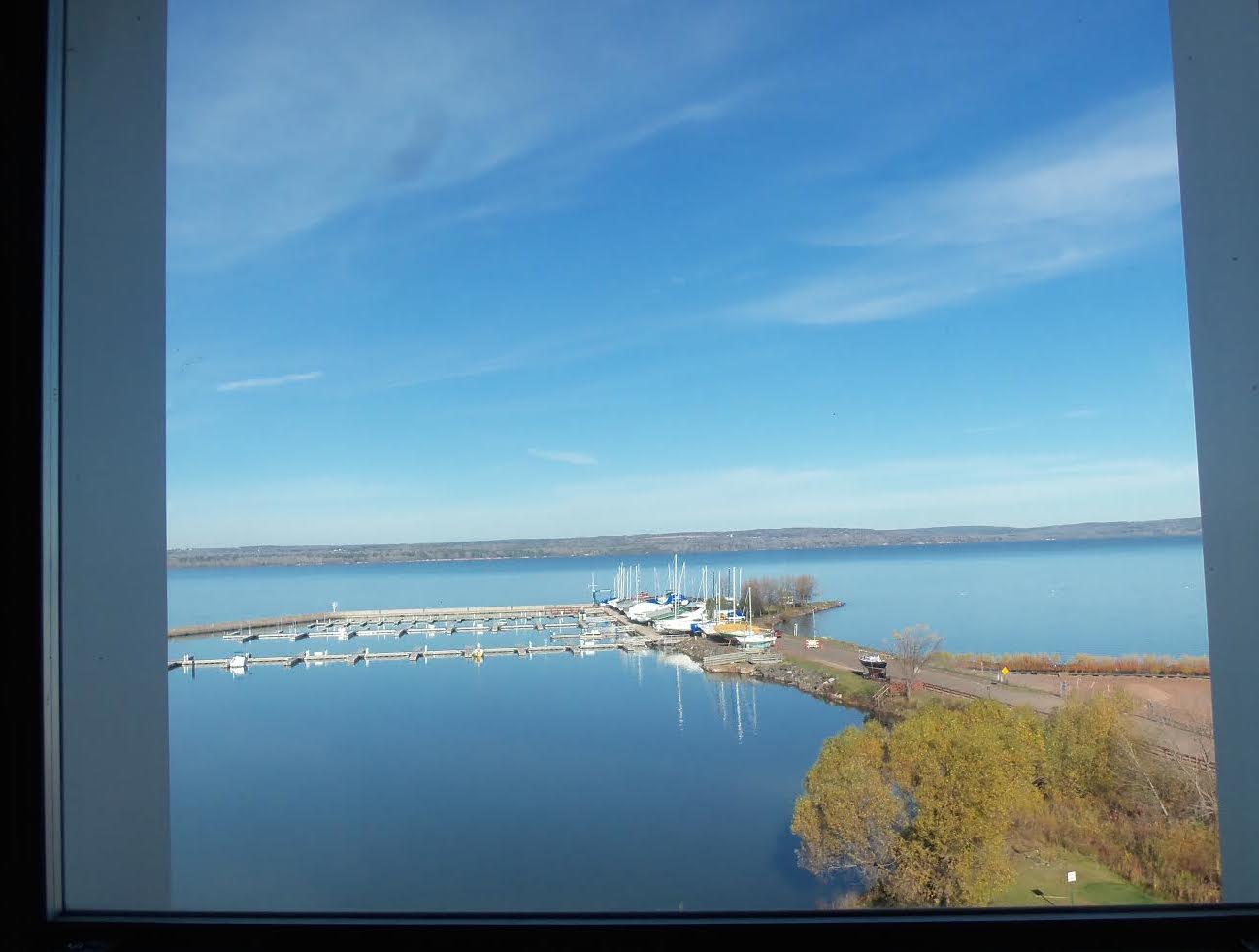
Ashland, Wisconsin, 12 pm
Michael Sokolove wonders how new safety regulations could change football:
It’s possible that the very thing meant to protect [student] players – new protocols that define how they should be evaluated for a possible brain injury, and how long they should be kept out of play if one is diagnosed or suspected — will actually put school districts, administrators and coaches at more legal risk. Now that they have, in a sense, been forewarned, what happens if they don’t follow the protocols or don’t have certified athletic trainers on staff or coaches smart enough to deal with possible concussions while they are also deciding on the right third-down play?
What’s more, insurers may in time deem the sport too risky. Health insurers might treat it as a costly risk factor like smoking or a bad driving record. As football becomes more and more regulated, many districts may reasonably conclude that it’s more than they can handle. … Rates of smoking plunged and the industry declined because tobacco use could not be made safe. The N.F.L. may be at a similar juncture now.
Much more Dish on concussions in football here.
Probably the best parody yet of that Hollaback video:
If a foreign power were to do such harm [from the food system], we’d regard it as a threat to national security, if not an act of war, and the government would formulate a comprehensive plan and marshal resources to combat it. … So when hundreds of thousands of annual deaths are preventable — as the deaths from the chronic diseases linked to the modern American way of eating surely are — preventing those needless deaths is a national priority.
A national food policy would do that, by investing resources to guarantee that: All Americans have access to healthful food; Farm policies are designed to support our public health and environmental objectives; Our food supply is free of toxic bacteria, chemicals and drugs; Production and marketing of our food are done transparently; The food industry pays a fair wage to those it employs; Food marketing sets children up for healthful lives by instilling in them a habit of eating real food; Animals are treated with compassion and attention to their well-being; The food system’s carbon footprint is reduced, and the amount of carbon sequestered on farmland is increased; The food system is sufficiently resilient to withstand the effects of climate change.
Elizabeth Nolan Brown is more than a little skeptical:
The good news, they tell us, is that “solutions are within reach”—and it’s here that this piece really start to get amazing. The authors acknowledge that many of the problems with America’s food economy are not market failures at all but “largely a result of government policies.” So the solution surely must be to get government meddling out of food and farm policy as much as possible, no?
Ha!
“We know that the government has the power to reshape the food system because it has already done so at least once—when President Richard Nixon rejiggered farm policy to boost production of corn and soy to drive down food prices,” they write. And because government can, it should, apparently. The authors are somehow able to see the corrosive effect of previous government overreach on our food system, but they feel confident that this time! they’ll get it right.
“As Obama begins the last two years of his administration facing an obstructionist Republican Congress, this is an area where he can act on his own—and his legacy may depend on him doing so,” they suggest, urging Obama to “announce an executive order establishing a national policy for food, health and well-being.”
The idea that cooking, eating, and enjoying nutritious foods is elitist is a silly and destructive one, and I’ve never been one to mock folks like Bittman and Pollan for their kale chips or food philosophies. But it doesn’t get much more elitist than thinking the U.S. food system as a whole would be better off by circumventing not just markets but also any Congressional debate. Just relax and let the top men take care of it…
Word awaits as to whether the Obama administration will join forces with Vogue in promoting the Pollan family’s quinoa burgers. Update from a reader:
I’m all for improving U.S. food policy, but like Elizabeth Nolan Brown, I’m skeptical. Grocery stores are fairly sensitive to customer demand, and I think if people change their food choices then the foods being sold to them will change. When I’ve wanted particular products at grocery stores, I’ve found managers have been willing to try to get me what I want.
I’d like to see every child take one or two years of nutrition, food safety, sanitation and food preparation instruction in school during the middle school years. It would give students some practical skills and indirectly help them exercise problem-solving skills. They can learn to prepare familiar and unfamiliar foods and learn how to shop and begin to learn menu planning and budgeting skills. Kids don’t need self-esteem as much as they need to know they can feed themselves and cope with daily life.
The other place where I’d like to see government muscle exercised is in the restaurant and fast food industry. I want the salt levels taken down significantly – I can always add salt – so I don’t have to cook a lot and can eat more takeout. Cooking isn’t real thrilling for me now that my spouse has died and I live alone. Being able to go to a restaurant without sending my blood pressure off the charts would be nice. I am eating out less than I was, and I do tell restaurant servers and managers that I’d prefer less salt. The response is often polite commiseration for the sake of being polite (indifference in a socially acceptable guise), but no change. I’m more willing to use government force on restaurants because the managers seem to be less responsive.

Last week, Ukraine’s military claimed that Russian tanks, artillery, and soldiers were pouring across the border between the two countries yet again. Today, NATO and the OSCE confirmed that they had seen the same thing:
Speaking in Sofia on November 12, the alliance’s top commander, U.S. General Philip Breedlove, said the columns included Russian tanks, artillery, air-defense systems, and combat troops. “We do not have a good picture at this time of how many. We agree that there are multiple columns that we have seen,” Breedlove said. Breedlove made the comments after a report from the Organization for Security and Cooperation in Europe (OSCE) said its monitors had seen a convoy of unmarked military trucks — some towing howitzer artillery pieces and multilaunch rocket systems — travelling into the rebel stronghold of Donetsk on November 11.
Shane Harris passes along an assessment from another analyst, who believes “there are as many as 7,000 Russian troops inside Ukraine now, and between 40,000 and 50,000 amassing on the country’s eastern border”:
Phillip Karber, a former Pentagon strategy adviser who has worked closely with the Ukrainian government, said in an interview that he had just returned from Ukraine, where he spoke with commanders at the front. Karber said that in addition to the thousands of ground troops, as many as 100 tanks are inside Ukraine now, more than 400 armored vehicles, and more than 150 self-propelled artillery and multiple rocket launchers. Another 350 to 400 tanks are poised along the border, along with more than 1,000 armored vehicles and 800 self-propelled artillery, Karber said. …
“Clearly something is up. The question is what,” Karber said. He speculated that Russia could be envisioning a number of scenarios, including pushing further into Eastern Ukraine; attempting to create a land bridge to the Crimea peninsula in order to resupply force there; or making a large land grab further into the country.
Anna Nemtsova suspects that the Russians are there to back up eastern Ukrainian separatists in a push to regain territory from which Kiev had driven them out. Accordingly, she fears that Ukraine is on the verge of all-out war again,
“I admit that without Russian multi-layered support, Donbass [the eastern Ukraine region] would have never handled aggression by the Ukrainian army,” says Sergei Markov at a pro-Kremlin think tank close to Russian President Vladimir Putin. Markov tells The Daily Beast he expects the situation in eastern Ukraine to explode in the coming two days. He blames Ukrainian officials for violating the ceasefire agreement and shelling the outskirts of Donetsk city.
“Novorossia soldiers would not initiate the battle,” says Markov, “but I believe their plan is to gradually take control over Piski, Avdiivka, and Schastye, a town with a central heating station.” Markov also added that rebels might make an attempt to take back control of their former strongholds in Sloviansk and Kramotorsk, “symbolically and strategically important towns for them.”
If this is indeed a Russian invasion – and it sure looks like one – James B. Barnes isn’t surprised at the timing. After all, winter is coming:
Winter has long been Russia’s ally, the siege of Leningrad for just one example, but using the modern economics of Winter as an offensive strategy strikes me as both new and absolutely old school. … Doing this now is also very calculated and smart on the part of Russia. Since Europe depends on Russian gas there’s literally nothing the Europeans can do to dissuade the Russian leadership from driving every tank they want straight into Donetsk for later deployment and the U.S. knows that action on their part could lead to action by Russia against Europe. It’s Machiavellian, and while I don’t approve of it (free nations should be free) I’m absolutely impressed by it.
News of these machinations in eastern Ukraine comes at the same time as Russian planes have been making threatening maneuvers in Northern Europe and the Arctic, including simulated attack runs on American and European targets. Now, Russia plans to step up patrol missions by its long-range strategic bombers:
Russian nuclear-capable strategic bombers were making regular patrols across the Atlantic and the Pacific Oceans during Cold War times, but the post-Soviet money crunch forced the military to cut back. The bomber patrol flights have resumed under President Vladimir Putin’s rule and have become increasingly frequent in recent years. Earlier this year, Shoigu said Russia plans to expand its worldwide military presence by seeking permission for navy ships to use ports in Latin America, Asia and elsewhere for replenishing supplies and doing maintenance. He said the military was conducting talks with Algeria, Cyprus, Nicaragua, Venezuela, Cuba, Seychelles, Vietnam and Singapore.
Developments such as these, coupled with increasingly bellicose rhetoric from the Kremlin, have led to chatter about a new Cold War. Brian Whitmore downplays that comparison, but adds a huge, frightening caveat:
No, this isn’t a Cold War. But guess what? It’s even scarier and more dangerous. During the Cold War the Kremlin had a stake in — and was interested in maintaining — the existing international system. Despite its ideology and rhetoric, the Soviet Union after Stalin wasn’t revolutionary at all. It was a classic status-quo power. But in the past 25 years, a new international order has taken shape to replace the bipolar superpower rivalry — and Moscow doesn’t like it. It wants the old 20th-century bipolar world back, or a 19th-century concert of great powers, each free to act in their own spheres of influence. And if it doesn’t get it, it is going to do its best to disrupt the existing order.
Bershidsky psychoanalyzes Putin and wonders if the Russian president might actually be sincere when he says he wants things to get back to normal:
Amid all the anti-American, anti-Western rhetoric, Putin always leaves the door open to a resumption of dialogue. … It’s even possible that Putin’s behavior is a mixture of intimidating swagger and a craving for the restoration of normal, pre-Crimea relations with his Western “friends and partners,” as he likes to call them. It’s only prudent to react to Putin’s threats by shoring up defenses, but it might be smart for the West to exploit his apparent desire to be given a place at the table again. He is only a human being, but Russia and its neighbors are disproportionately dependent on his psychological condition. Perhaps Western leaders ought to consult with psychologists and try to figure out how to handle him rather than continuing to demonstrate their angry rejection, as Obama does.
Regardless of these provocations, new sanctions on Russia don’t seem to be in the offing, at least not from the EU, which could really make them sting:
Speaking in Berlin, German Chancellor Angela Merkel ruled out imposing new economic sanctions, the European Union’s main source of leverage over Moscow now that gas supplies are in place for the winter. On Thursday, Russia signed a deal with Ukraine and Europe to resume gas shipments to Ukraine, which — if fully implemented — would remove the possibility that Moscow could cut off gas supplies mid-winter.
However, Merkel floated the possibility of issuing travel restrictions on pro-Russian politicians recently elected in the Crimean peninsula, which Russia has annexed. The West has refused to recognize the polls, and Merkel said that the EU could prevent Crimean politicians from attending a meeting of foreign ministers in Brussels next week.
(Photo:A column of tanks drive from a rebel-territory to Donetsk near the town of Shakhtarsk, eastern Ukraine on November 10, 2014. By Dimitar Dilkoff/AFP/Getty Images)
Roberto A. Ferdman flags some research on children’s lunches:
A new study (pdf) carried out by researchers at Virginia Tech concluded that preschoolers and kindergartners tend to eat healthier lunches when the food is chosen by their school, not their parents. The study, which surveyed more than 1,300 lunches at three schools in Virginia, found that parents frequently pack things like chips, sweets, and sugary drinks—all of which are not allowed under the National School Lunch Program. “I wasn’t expecting there to be such a strong difference between school meals and lunches packed by parents,” said Alisha Farris, one of the study’s authors. “We thought that parents would send lunches that reinforced the sort of healthy habits we hope they are trying to establish at home.”
Parents, it turns out, appear to do just the opposite. More than 60 percent of meals packed at home had one dessert (nearly 20 percent had two or more); just under 60 percent had savory snacks, like chips; and roughly 40 percent had a soda or sugar-added juice. School meals, meanwhile, were more likely to contain fruits, vegetables, naturally sweetened juices, and milk.
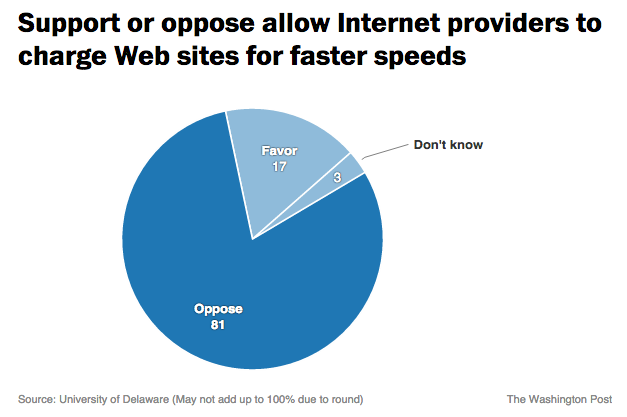
President Obama’s proposal to classify broadband Internet service as a Title II utility cheered advocates of net neutrality, but FCC Chairmam Tom Wheeler has his own ideas for how to handle the issue, which don’t quite square with the president’s:
The dissonance between Obama and Wheeler has the makings of a major policy fight affecting multibillion-dollar industries. The president wants clear rules to prevent Internet service providers from auctioning the fastest speeds to the highest bidders, a scenario that could favor rich Web firms over start-ups. Wheeler, a former lobbyist for the cable and telecommunications industry, has floated proposals that aim to limit the ability of service providers to charge Web companies, such as Netflix or Google, to reach their customers. But critics have argued that his approach would give the providers too much leeway to favor some services over others.
While Obama and Wheeler may disagree on how, chances are the FCC will get there one way or another, since the general principle of net neutrality is overwhelmingly popular:
In a new survey, the University of Delaware’s Center for Political Communication found that support for neutrality is strong and widespread — regardless of gender, age, race and level of education. About 81 percent of Americans oppose allowing Internet providers like Comcast and Verizon to charge Web sites and services more if they want to reach customers more quickly, that is, allowing what are often called “Internet fast lanes.” Most surprising of all, given comments by Republican lawmakers over the past couple of days, is that support for net neutrality is bipartisan. Indeed, Republicans were slightly more likely to support net neutrality than Democrats. Eighty-one percent of Democrats and 85 percent of Republicans in the survey said they opposed fast lanes. The poll’s margin of error was 3.2 percentage points.
Another survey, albeit by a pro-net neutrality outfit, finds similar levels of support among self-described “very conservative” voters. Jason Koebler, meanwhile, goes after Comcast, which claims to be totally on board with Obama’s proposal:
In a blog post titled “Surprise! We agree with the president’s principles on net neutrality: Reiterating our strong support for the open internet,” Comcast exec David Cohen notes that the company practices Obama’s proposed rules against blocking, throttling, paid prioritization, and that it supports increased telecom industry transparency. On the first three, he’s technically right, at the moment. On the last one, he’s dead wrong.
It’s true that Comcast practices those three principles of net neutrality— because it is legally obligated to under the terms of its last mega merger, the deal in which it acquired NBC. … Meanwhile, before the NBC merger, Comcast actively lobbied against net neutrality. In the past, it violated [since overturned] FCC rules on net neutrality by throttling customers. It has helped put into place anti municipal broadband laws all throughout the country with the help of organizations like ALEC and the National Cable & Telecommunications Association. It has run fear mongering campaigns about municipal broadband competitors.
“It seems inevitable,” Katie Benner writes, “that at some point in the future we’ll decide that Internet access is as essential to civilized life as running water, electricity and phone calls.” Thus, she concludes, it’s equally inevitable that we’ll decide to treat it as a public utility:
Messaging and self-driving car apps and health records will reside on your phone, along with the videos of panda cubs wrestling with zoo keepers. And you won’t be able to live without any of it. When that realization hits, it should follow that the Internet service providers –companies such as Comcast and Time Warner Cable now, and likely a company like Google in the future — will be regulated like utilities. They should be held to a different standard if they provide services that are essential to daily life. Water prices, for example, stay within certain bounds so that wild market swings don’t force swaths of the population to live without the ability to bathe, drink and cook. Remember the debacle of the Enron energy traders and the California power crisis and unnecessary brownouts? Regulating services as utilities is designed, in part, to keep things like that from happening.
Bershidsky observes that for all the appeals to “innovation” among proponents and opponents of net neutrality alike, actual innovations in the Internet economy will likely be so disruptive as to upturn both sides’ premises:
[T]he combatants mean two different kinds of “innovation.” Providers are talking about their ability to upgrade networks so they can carry more traffic at faster speeds. Their opponents focus on new services for consumers that might require a lot of bandwidth. In both cases, the i-word is applicable, but it’s not the type of innovation that could change the face of the industry. Not the disruptive kind. …
If the government leaves the Internet alone — letting broadband and content providers hatch whatever devilish plots they feel are in their interest — some startup, or a few of them, will inevitably come up with the next idea that will be far outside the current debate. It might involve advances in compression technology, making all talk of fast and slow lanes irrelevant because they could suddenly allow the existing infrastructure to carry more traffic, or breakthroughs in mesh networking, which might allow people to get broadband connections without using much of that infrastructure. Whatever the game-changing innovation might be, both sides in the current dispute would be forced to deal with it, pitching in with incremental innovations.
 The Dish