
Philadelphia, Pennsylvania, 12.23 pm
Philadelphia, Pennsylvania, 12.23 pm
If you run a public accommodation and use it to refuse service to a minority, you’re on the wrong side of the law (at least since the Civil Rights Movement). So why am I concerned by the latest case of a lesbian couple suing a family business that refused to rent out their property for a same-sex wedding? Simply because they got married elsewhere, with no problems, and because it makes sense to me – as someone interested in a civil society – not to press conflict on culture war issues when a less aggressive and counter-productive strategy is perfectly possible. Also because you deny the New York Post and the victimhood-right a chance to crow about gay suppression of religious freedom. We are winning the argument; we are winning the culture. There’s no point on forcing our opponents to lose face as well as losing the debate. Magnanimity, restraint and gradual progress. It’s gotten us a very long way already. We should trust this strategy to the end.
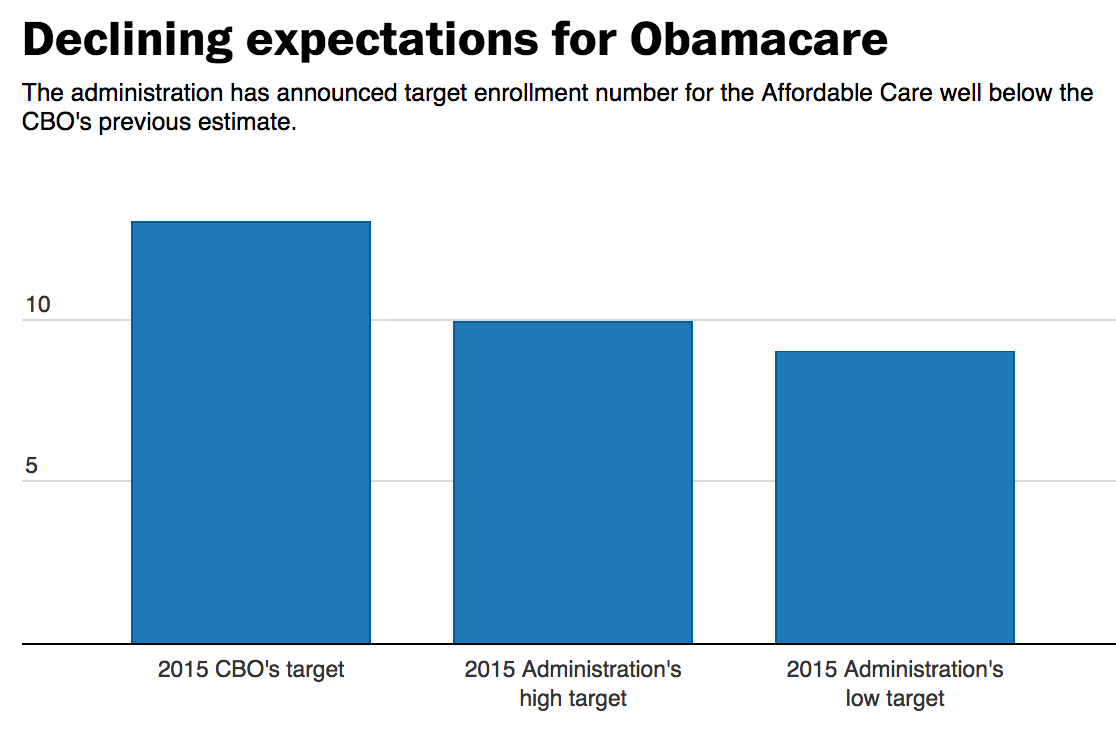
Amy Goldstein passes along the latest enrollment predictions for next year:
Health and Human Services Secretary Sylvia Mathews Burwell announced that, by the end of 2015, 9 million to 9.9 million Americans probably will be in health plans sold through the federal and state insurance exchanges created under the health-care law. The administration’s expectations are as much as roughly 30 percent beneath the most recent prediction of the Congressional Budget Office that 13 million people will have health coverage through these exchanges next year.
Weissmann judges that the “the announcement is probably a wise move politically”:
Whether the issue was the effect of stimulus spending or the pace of Affordable Care Act sign-ups, the Obama administration has never exactly benefited from setting high expectations. During last year’s open-enrollment period, it had to deal with the endless media speculation over whether it would hit the CBO’s projection of 7 million sign-ups. It’s better to keep the bar low and clear it than trip over a nice-sounding but maybe overly ambitious target.
Suderman agrees that the administration may be “lowering the bar so that an underperformance looks like a relative success.” But, to him, it also “suggests that the administration is anxious about enrollment trends for year two”:
The second year of enrollment was always going to be somewhat more difficult, because the people most motivated to purchase plans through Obamacare’s exchanges were likely to have bought in year one. The task of year two would be to motivate even more people, those who weren’t already interested in purchasing coverage through the exchanges.
What this announcement indicates, then, is that the administration thinks it’s going to have a hard time motivating many people to purchase plans, which is another way of saying fewer people than expected seem to want or believe they need insurance under the law. For whatever reason or reasons, the demand isn’t there, and Obamacare is now expected to underperform as a result.
Jason Millman identifies a more mundane reason for the lower prediction:
One of reasons the projection is shifting downward comes from uncertainty over the number of people expected to leave employer coverage or individual health plans purchased outside the marketplaces, or exchanges. The CBO, for example, projects 7 million fewer people will have employer-based health insurance by 2016, creating a new pool of people potentially eligible for marketplace coverage. The administration says it’s still not clear how dramatic the shift in employer coverage will be.
Joseph Antos lists other possible explanations. Among them:
The administration’s 7.1 million figure is the number of people who chose a plan on the exchanges. Although many of those people paid their premiums and remain enrolled, others may have paid for a month or two before deciding that the value of Obamacare coverage is not worth the cost. We will never know how many people selecting exchange plans actually followed through for the full year.
Derek Thompson flags a new study (pdf):
Jumping between jobs in your 20s, which strikes many people as wayward and noncommittal, improves the chance that you’ll find more satisfying—and higher paying—work in your 30s and 40s. “People who switch jobs more frequently early in their careers tend to have higher wages and incomes in their prime-working years,” said [Henry] Siu, a professor at the Vancouver School of Economics. “Job-hopping is actually correlated with higher incomes, because people have found better matches—their true calling.”
“True calling” is a messy term, since (a) job mastery, (b) job satisfaction, and (c) compensation don’t always line up. There are talented yet miserable investment bankers (a and c, not b), talented and fulfilled public-school teachers (a and b, not c), and several shan’t-be-named general managers of professional sports teams (b and c, not a). But overall, Siu said, adults who switch jobs multiple times are more likely to find a position in their prime-work years where they earn a higher wage and have a lower chance of quitting. (As always, causality is difficult to prove: Perhaps pro-active behavior leads to both higher wages and a greater likelihood of quitting.)
(How does one describe being good at sucking at something?)
— Clive Thompson (@pomeranian99) October 28, 2014
After noticing that his snarky or critical tweets tended to get more social media mileage than his more positive ones, Clive Thompson got to wondering if there was an explanation for this disparity:
Indeed, there is. It’s called hypercriticism. When we hear negative statements, we think they’re inherently more intelligent than positive ones. Teresa Amabile, director of research for Harvard Business School, began exploring this back in the 1980s.
She took a group of 55 students, roughly half men, half women, and showed them excerpts from two book reviews printed in an issue of The New York Times. The same reviewer wrote both, but Amabile anonymized them and tweaked the language to produce two versions of each—one positive, one negative. Then she asked the students to evaluate the reviewer’s intelligence.
The verdict was clear: The students thought the negative author was smarter than the positive one—“by a lot,” Amabile tells me. Most said the nastier critic was “more competent.” Granted, being negative wasn’t all upside—they also rated the harsh reviewer as “less warm and more cruel, not as nice,” she says. “But definitely smarter.” Like my mordant tweets, presumably. This so-called negativity bias works both ways, it seems. Other studies show that when we seek to impress someone with our massive gray matter, we spout sour and negative opinions.
Maybe I should just go back to being a complete asshole again
— Blue (@DowdenDmax09) November 10, 2014
Detroit’s bankruptcy plan was approved last week. Jordan Weissmann focuses on the role played by the city’s art museum, which had been instructed “to contribute at least $500 million to paying off Detroit’s debts, even if meant selling off paintings at auction”:
Instead, the museum essentially went on an ambitious fundraising drive, in which it managed to raise more than $800 million, including $330 million from nine different philanthropic foundations. Another $200 million came from the state of Michigan, which, despite Gov. Rick Snyder’s protestations that he wouldn’t bail out Detroit, did apparently feel compelled to preserve some of its cultural heritage.
In return for the money, the deal will essentially “ransom the museum from city ownership,” as the New York Times puts it, placing it in control of an independent charitable trust. So Detroit gets to keep its art collection. Pensioners get to keep a little more of their income. And the museum never has to worry about municipal finances ever again. A nice bargain all around.
The Economist ponders the city’s post-bankruptcy future:
The big question is whether Detroit will manage to become an attractive city again where people want to live, invest, work—and pay taxes. At the moment this seems a long way off: roads are in disrepair; more than one-third of city lights don’t work; public schools are failing the pupils who bother to turn up; ambulances break down; thousands of households don’t have water and there are 84,000 blighted and vacant parcels of property. (The city is demolishing 200 houses a week at a cost of, on average, more than $8,000 each.)
The adjustment plan approved by the judge sets aside $1.7 billion over the next nine years for investment in basic services and infrastructure. It is a vast sum for a city that has trimmed investments to a minimum in recent years, but Detroit’s needs are such that this pot could run out in as soon as five years.
Claire Groden digs into the specifics of the exit plan:
Fewer than 700,000 people live in Detroit after decades of white flight into the surrounding suburbs. They are mostly poor, with 38 percent living below the poverty level. Last year, half of Detroit’s property owners were unable to pay their taxes, which are the highest in the state for cities with a population over 50,000. The combination of high taxes and poor residents puts the city and its residents in a lose-lose cycle. “Part of the goal of the exit is making Detroit attractive to people who are not poor, who can pay taxes,” says Wayne State University bankruptcy law professor Laura Bartell.
But making the city a desirable place to live is going to take a lot of money—maybe even more than the approximately $1.7 billion set aside in the plan. It’s no secret that Detroit is a difficult place to live. The bankruptcy trial put the inner workings of the city in the harsh spotlight, methodically detailing all of the ways the Detroit no longer works for its residents.
A 2013 report by Emergency Manager Kevyn Orr found that 15 percent of all “parcels” of land in the city were vacant, and 38,000 vacant structures were in potentially dangerous condition. Response times for highest priority crimes took an average of 58 minutes. Around 40 percent of streetlights were out. All of these problems will have to improve for Michiganders to start looking at Detroit as a reasonable place to open a business or raise a family, Bartell said.
Songwriter Aloe Blacc supports Taylor Swift’s high-profile decision to yank her music from Spotify:
The abhorrently low rates songwriters are paid by streaming services – enabled by outdated federal regulations – are yet another indication our work is being devalued in today’s marketplace. Consider the fact that it takes roughly one million spins on Pandora for a songwriter to earn just $90. Avicii’s release “Wake Me Up!” that I co-wrote and sing, for example, was the most streamed song in Spotify history and the 13th most played song on Pandora since its release in 2013, with more than 168 million streams in the US. And yet, that yielded only $12,359 in Pandora domestic royalties— which were then split among three songwriters and our publishers. In return for co-writing a major hit song, I’ve earned less than $4,000 domestically from the largest digital music service. If that’s what’s now considered a streaming “success story,” is it any wonder that so many songwriters are now struggling to make ends meet?
But Bill Wyman argues that Swift was unwise:
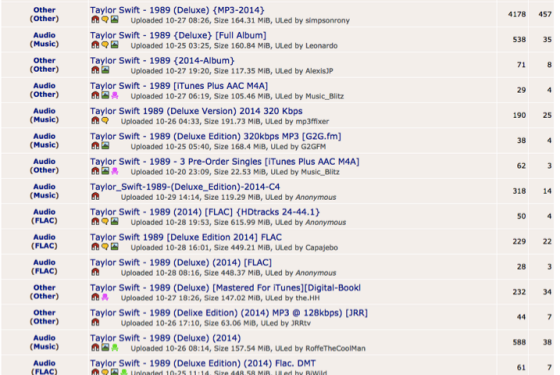
Why? Because we can already see where folks are going to get their music if they decide a streaming option like Spotify doesn’t give them the service they want. Here’s what Swift’s — and Spotify’s — real competition is:
That’s a screenshot of just part of a Pirate Bay page dedicated to 1989 torrents. I count about 7,000 folks sharing the thing right then, a week after the album came out. (With that many seeds, downloading an album takes about 45 seconds, so you can imagine the churn.) A single page on a different BitTorrent site, Kick Ass Torrents, said that just one particular torrent of many for the album had been downloaded close to 110,000 times. And remember that this comes in the face of what I’m sure was a strong behind-the-scenes campaign by her label to keep the thing off the illegal networks.
Spotify’s per-stream payout seems small, all right, but it’s a lot bigger than the Pirate Bay’s.
Meanwhile, Felix Salmon takes the opportunity to make a case for oligopoly:
The fact that there are only three major record labels is a godsend to the world of digital music. It means that if you’re trying to do anything innovative with digital music, you basically only need to deal with three counterparties. Once Spotify or Rhapsody gets three contracts signed, for instance, they can effectively tell the world that they’re offering all the music you might ever want to listen to. Sure, there will always be a few exceptions here or there. But, as anybody with one of these services knows, you can generally play just about any album you want to listen to. It’s an amazing, magical thing— and it’s a service which, to boot, is generally offered on a freemium basis. To have the world’s music at your fingertips, these days, you don’t need to do anything illegal, and you don’t need to pay a penny.
In contrast, he says, small record labels such as Swift’s Big Machine are “a real headache for digital music services, especially when they have ulterior motives“:
The majors can be counted on to drive a hard bargain but ultimately to act in their own best interest; with independents, that’s not always the case. What’s more, streaming contracts with big labels generally operate on a Most Favored Nation basis: whatever the label offers to one streaming service, it has to offer to everybody else. That’s good for competition and innovation — but again, it’s not necessarily something which happens as a matter of course with independent labels.
Joshua Gans disagrees:
Salmon fears instead that what Swift might do is strike an exclusive deal with just one retailer (or broadcaster or streamer or what have you) and we won’t be able to get our music in one place. This happens with video but the consequences aren’t too bad there – after all, we have always had to switch channels and I think in a little while our devices will make that easy too. … [And] that remark Salmon makes about ‘most favored nation’ clauses being for competition and innovation is completely and utterly wrong. They are terrible because they drive all these services towards a common business model and diminish experimentation. When someone who does a deal with Pandora is forced to offer the same terms to Spotify, that doesn’t give Spotify room to move. It means the first service to strike a deal can mould the entire industry going forward.
Rachel Fishman finds that people who don’t complete college are driving a huge increase in debt delinquency:
Students who haven’t graduated are more than four times as likely to default on their student loans as those who have, according to a study by the think tank Education Sector.
Recent research from the economist Beth Akers shows that borrowers with less than $5,000 in student debt are the most likely to be late on payments. In fact, the more college debt a student incurs, the less likely he or she is to default. This may seem counterintuitive, but it’s not—a low loan balance is indicative of a borrower who didn’t complete school, and is therefore less likely to repay. According to Department of Education statistics, defaulters also tend to be older (the median age is thirty-eight), from low-income backgrounds, with poor financial literacy, and with no degree to show for their efforts. A disproportionate number of them attended for-profit colleges.
This is all evidence of a large crisis in American higher education: we have a big college completion problem. More than thirty-one million adults have earned college credit within the last twenty years but left without any post-secondary credential. By 2012, only 59 percent of students seeking a bachelor’s degree graduated within six years. For students seeking a certificate or degree at a two-year institution, the completion rate was 31 percent.

A reader sends the above diagram:
I’m bored at work, so made you this.
Cheers. Jesse Walker also came up with a Venn Diagram for states where you can legally smoke weed and carry a gun. I think he’s trying to reassure us.
Today I focused on attempts to police or control free speech: the move by Twitter to employ some crusaders against patriarchy to improve its prevention of harassment and bile; and the much more serious move by the British government to stamp out extremist thought and speech even if it has nothing to do with inciting violence. We noted the classic mission creep of the new US war in Iraq and Syria; the power of the Greater Israel lobby in bringing together two of the biggest money-men in Republican and Democratic party circles; and featured a baffled Canadian’s response to the mid-terms. The Canadian isn’t the only one puzzled. A reader writes:
Watching the German news I was fascinated by their framing of the American elections. They talk about the “alternative reality of American politics” in which Democrats are on the defensive and Obama is considered such a failure that most Democratic candidates don’t want to be seen with him. I paraphrase the correspondent: “Obama a failure?! With solid economic growth, declining unemployment, and his major program in healthcare reform now an obvious success notwithstanding Republican predictions of catastrophe? Yes, that’s the political alternate reality of America, in which right-wing extremists dominate the airwaves and the political dialogue and most citizens are convinced of ‘facts’ that are political propaganda and not reality.” Sums it up pretty well.
Also: rats in New York City! And a beat-boxing lyre bird!
Many of today’s posts were updated with your emails – read them all here. You can always leave your unfiltered comments at our Facebook page and @sullydish. 20 more readers became subscribers today. You can join them here – and get access to all the readons and Deep Dish – for a little as $1.99 month. Gift subscriptions are available here. Dish t-shirts are for sale here, including the new “Know Dope” shirts, which are detailed here.
See you in the morning.

A self-portrait (with father) by former president George W Bush. Well, he got the necks right.
 The Dish