An Open Mind In A Secular Age

We’ve featured the work of poet and critic Michael Robbins on the Dish before – notably, this broadside against the New Atheists, which spurred a few rounds of debate over Nietzsche and religion. In an interview about his new volume of poetry, The Second Sex, Robbins explores how his engagement with philosophy informs his poetry, and much else:

I return often to those who recognize that there are historical and cultural constraints on what it is possible for us to believe—“a background,” as [philosopher Charles] Taylor says, “to our thinking, within whose terms it is carried on, but which is often largely unformulated, and to which we can frequently, just for this reason, imagine no alternative”: Marx and Freud, despite their unsophisticated views of religion (the result of just such a background, which no one’s thinking can entirely escape), and Heidegger and Lacan. Such thinkers teach us that people like [Jerry] Coyne are not only mistaken that their beliefs are “obvious” and “rationally grounded” but literally incapable of imagining that they could be wrong about the nature of reality.

They always demand “evidence” for God’s existence, but, as Stanley Hauerwas puts it in a discussion of Thomas Aquinas, “if we could have the kind of evidence of God the evidentialist desires, then we would have evidence that the God Christians worship does not exist.” It’s not simply that the evidentialist doesn’t grasp basic theology and epistemology, but that the notion that the concept of “evidence” is itself not neutral or ahistorical could never occur to him, given the picture that holds him captive. And of course I’m not denying that the language of evidence is proper to its sphere or that my own thinking (or anyone’s) is not subject to all sorts of constraints I don’t recognize. But even if we cannot attain to a view from nowhere, we can recognize that we cannot, which allows us to avoid, to some extent at least, the epistemic arrogance that characterizes scientism. I do not know that God is the creator of heaven and earth, or that Jesus Christ is his only son, our Lord.


Face Of The Day

dish_singh

The Singh Project by British photographers Amit and Naroop depicts members of the Sikh community:

These intimate images highlight two very important symbols of the Sikh lifestyle – the beard and the turban (Dahar). The turban in particular is a representation of honor, self-respect, courage, spirituality, and piety. Sikh men (and women) wear the turban to cover their long, uncut hair (kesh), and are also seen in this series brandishing a traditional Sikh sword (kirpan).

Originating in South Asia – primarily in India, Singh was a popular middle name or surname for lords and warriors. Meaning Lion (from the Sanskrit word Simha/Sinha), it was later adopted by the Sikh religion, and today is compulsory for all baptized Sikh males. The sense of pride connected with the history of the name Singh is evident on the faces of these men.

See more images from the series here.

Fighting Stigma On Facebook

Lauren Hoffman revisits her “coming out” as an alcoholic:

It was five days after my last drink, four days after I told my parents, and three days after I started treatment. “I read a marathon training book once that said you should always tell people you were training for a race; that way, you’d have extra incentive to not abandon your goal midway through,” I wrote on Facebook. “In the spirit of that: I’m a (newly sober) alcoholic. I’m exhausted and overwhelmed but mostly profoundly relieved to not be trying to keep a giant secret anymore.” …

There’s absolutely something self-serving about that openness. I speak as honestly as I do because it’s always been a way for me to connect with others with similar struggles or to reach out to my friends and family, both of which are essential to my sanity and recovery. But I also talk about my alcoholism and bipolar disorder as frankly as I do because I see and want to contribute to a decrease in the level of stigma associated with addiction and mental illness. For as great as large-scale educational campaigns or Partnership for a Drug-Free America ads can be, I don’t think stigma can truly be broken down with sweeping gestures. Those misunderstandings and prejudices are demolished at a personal, individual level.

The Gift That Stopped Giving

Ruth Margalit recently reread The Giving Tree, Shel Silverstein’s classic children’s book, and was dismayed to find that the feel-good appeal doesn’t quite hold:

The beginning of the story is innocuous enough: a boy climbs a tree, swings from her branches, and devours her apples (I’d never noticed that the tree was a “she”). “And the tree was happy,” goes the refrain. But then time passes, and the boy forgets about her. One day, the boy, now a young man, returns, asking for money. Not having any to offer him, the tree is “happy” to give him her apples to sell. She is likewise “happy” to give him her branches, and later her trunk, until there is nothing left of her but an old stump, which the old man, or boy, proceeds to sit on.

Margalit continues:

“The Giving Tree” might be read as … a cousin to a song Silverstein wrote, called “Fuck ’Em,” in which he cheerfully exclaims, “Hey, a woman come around and handed me a line
/ About a lot of little orphan kids sufferin’ and dyin’
/ Shit, I give her a quarter, cause one of ’em might be mine.” … The dismay I felt on rereading the book soon gave way to something else. Finding that a childhood favorite wasn’t at all what I remembered carried with it a peculiar thrill, a kind of scientific proof that I’d grown up and changed. And, if I’ve changed, perhaps “The Giving Tree” has, too.

What, for example, does Silverstein mean with his injection of the flat, repetitive “happy”? He wasn’t one for happiness. In fact, the book’s illustrations seem to undermine this very conceit. “And the tree was happy,” we are told, but all we see is a sorry stump and a hunched old man staring forlornly into the distance. Is she happy? We have to ask. Is he? Or maybe the book isn’t about love or happiness at all, but a lament about the passing of time, an unsentimental view of physical decay, a withering away. Maybe it’s enough to take Silverstein’s own reading of it. “It’s about a boy and a tree,” he once said. “It has a pretty sad ending.”

What’s Your Spirit Animal?

7950378728_b0154fde04_o

Megan Garber traces how a metaphysical question became an ironic meme:

The concept of the spirit animal comes, most directly, from Native American spirituality. In that tradition, though there are variations across tribes and cultures, the spirit animal—otherwise known as a “totem animal” – generally takes the form of a single animal with which a person or a clan shares a certain set of characteristics, and therefore a kinship. The animal acts as a guide and protector for humans. In death, the humans’ spirits are absorbed into the animal.

The Internet– whose principal spirit animals include Taylor Swift, Jonathan Swift, and the KFC Double Down– has taken that metaphysical tradition and turned it into LOLs. That transformation happened gradually, and then quickly. As the Internet librarian Amanda Brennan told me, news groups and chat boards dedicated to wiccanism, paganism, and shamanism discussed sprit animals – unironically – in the 1990s. By the mid-2000s, personality quizzes offering to help people find their spirit animals began emerging. These were also earnest. The first ironic use of “spirit animal” may date back to August 2006, on one of the Shroomery.org message boards. As Brennan put it in an email,

While the thread began as an honest inquiry into animals people have formed bonds with through tripping, the user weathereporter88 claimed their spirit animal was Samuel Jackson. This one-off comment was not acknowledged by the other posters. This usage appeared online again in October 2007, when a blogger from This Recording asserted the Mad Men character Peggy Olsen was their spirit animal for being “off the hook awesome.”

So, yep: Samuel L. Jackson may have been the first of the Internet’s spirit animals. Peggy Olson may have been the second.

(Photo by Neil Girling)

A Poem For Sunday

3727970809_14383ee409_b

“Swimming in the Woods” by Robin Robertson:

Her long body in the spangled shade of the wood
was a swimmer moving through a pool:
fractal, finned by leaf and light;
the loose plates of lozenge and rhombus
wobbling coins of sunlight.
When she stopped, the water stopped,
and the sun re-made her as a tree,
banded and freckled and foxed.

Besieged by symmetries, condemned
to these patterns of love and loss,
I stare at the wet shape on the tiles
till it fades; when she came and sat next to me
after her swim and walked away
back to the trees, she left a dark butterfly.

(From Sailing the Forest: Selected Poems by Robin Robertson © 2014 by Robin Robertson. Used by permission of Farrar, Straus and Giroux. Photo by Justin Henry)

War-Torn Verse

In March we featured three selections from Eliza Griswold’s I am the Beggar of the World: Landays from Contemporary Afghanistan, a collection of folk couplets from the women of that country. In an interview about the project, Griswold reflects on how her dual perspective as a journalist and poet informed her work:

I see the world in both ways—and at the same time. The book arose from being in Kabul and knowing that so much of the meaning of daily life gets missed in the headlines. News isn’t designed to talk about daily life in its nuances, but poetry is.

With the photographer Seamus Murphy, I came across this book of landays that had been gathered by Sayd Majrouh in the ’80s, during the Soviet war in Afghanistan. These were poems told by women in refugee camps on the Pakistan side of the border. In English, the book’s title translates to Songs of Love and War, but the French title—which is closer to the Pashto title—is Songs of Love and Suicide. There is this reality for many Afghan women whereby suicide is a form of self-expression.

For many years, I would sit and Google the word “landays,” thinking nobody was ever going to send us to Afghanistan to collect poetry. But one day I came across this story of a young woman who had killed herself, and she killed herself because her family wouldn’t allow her to write poems. That’s as much as this little news squib said, and the one poem that survived her was one of these landays. The reason it survived was because they are anonymous. They’re collective, they’re oral, there is no crushing or burning. Her father had ripped up her notebooks, but he couldn’t destroy this poem.

Seamus and I set off to tell the story of this young woman, but at the same time to figure out if it was feasible to collect these poems. And what we found was that it was indeed feasible. These poems were more alive and prevalent in Afghan life than we had understood.

Beyond Hellfire And Brimstone

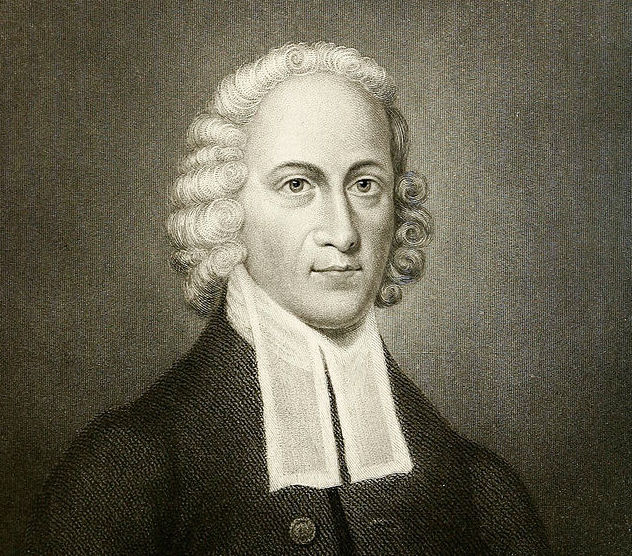
Jonathan_Edwards_engraving

Jonathan Edwards, the great 18th century American theologian and preacher, exists in the popular imagination mainly as a dour purveyor of God’s judgment, famous for his sermon “Sinners in the Hands of an Angry God.” Marilynne Robinson rises to his defense, praising his understanding of sin as “a kind of unawakened experience or perception that is blind to the glory of God and therefore to the glory that pervades being”:

For Edwards, sin was the state everyone was in, in the absence of a conversion experience, which was a kind of religious ecstasy that began with a profound awareness of guilt and a sense of utter dependency on God’s grace. Religion without conversion was almost a kind of Pharisaism, the enactment of faith and virtue without the substance of either. It was, at the same time, where the predisposition to conversion was formed. Edwards meant by his preaching and teaching to lift his hearers into the realm of spiritual light, where they would be capable of true faith, true hope, true love. They would be raised to a heightened esthetic experience, beside which the manifest natural glory of the world would seem a poor thing. Minus the theological frame, the same impulse to apprehend reality through a vision of it that is both higher and truer is present in much American poetry, from Whitman to William Carlos Williams and Wallace Stevens.

Again, for Edwards as for Emerson, this was not contempt for the world but transcendence of a kind that allowed the world and being itself to be seen in its real glory.

Given his very fixed association with hellfire preaching, it is important to remember that it was not particular transgressions that interested Edwards finally, though of course from the pulpit he deplored failures of honesty and charity. Nor was he much concerned with meritorious acts, since these were equally beside the point in the matter of personal salvation. Salvation was for him a revolution of consciousness that opened on an overwhelming sense of the beautiful, the glory of God in all its manifestations. In Edwards’s view, fallenness, the natural state of any human being, as blindness, takes no specific form as behavior and is not to be mitigated by any act of will. But the ontological nearness of humankind to God means that, through grace, perception of the purest, highest and truest kind, itself a kind of ecstasy, can be enjoyed by them, eternally and in this life.

(Image: An 1855 engraving of Edwards, via Wikimedia Commons)

Borges On God

A new collection of radio “dialogues” the late Jorges Luis Borges recorded with the poet and essayist Osvaldo Ferrari in March 1984 have been translated and published as Conversations, Volume 1. Here’s an excerpt from one of them, which details the Argentinian writer’s thoughts about God:

Osvaldo Ferrari: Many people still ask whether Borges believes in God, because at times they feel he does and at times that he doesn’t.

Jorge Luis Borges: If God means something in us that strives for good, yes. If he’s thought of as an individual being, then no, I don’t believe. I believe in an ethical proposition, perhaps not in the universe but in each one of us. And if I could I would add, like Blake, an aesthetic and an intellectual proposition but with reference to individuals again. I’m not sure it would apply to the universe. I remember Tennyson’s line: “Nature red in tooth and claw.” He wrote that because so many people talked about a gentle Nature.

Ferrari: What you have just said confirms my impression that your possible conflict about belief or disbelief in God has to do with the possibility that God may be just or unjust.

Borges: Well, I think that it’s enough to glance at the universe to note that justice certainly does not rule. I recall a line from Almafuerte: “With delicate art, I spread a caress on every reptile, I did not think justice was necessary when pain rules everywhere.” In another line, he says, “All I ask is justice / but better to ask for nothing.” Already to ask for justice is to ask for much, too much.

Ferrari: Yet, you also recognize in the world the existence of happiness—in a library, perhaps, but other kinds of happiness too.

Borges: That, yes, of course. I would say that happiness can be momentary but that it also happens frequently, it can happen, for instance, even in our dialogue.