“What Exactly Is An Unusual Sexual Fantasy?”

Screen Shot 2014-11-05 at 5.12.10 PM

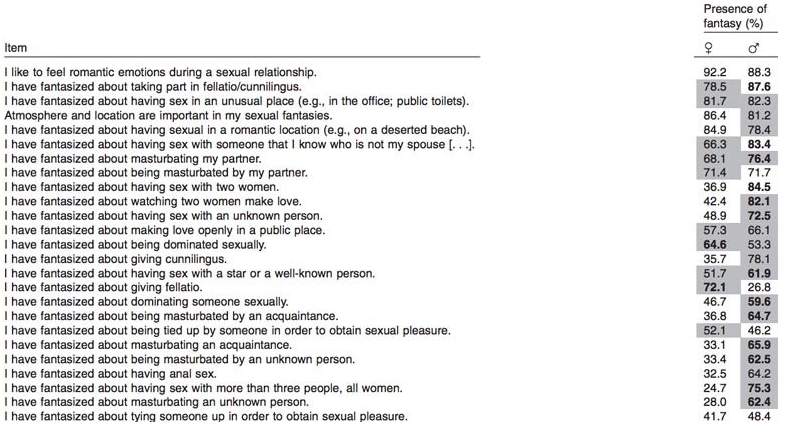
That’s the refreshingly straightforward title of a recent study in the Journal of Sexual Medicine. Andy Cush sums up its findings this way: “The bad news: you’re probably a freak. The good news: everyone else is, too”:

Researchers from University of Montreal presented 799 men and 718 women—85.1 percent of whom identified as heterosexual, 3.6 percent homosexual, and 11.3 percent somewhere in between—with a long list of statements regarding fantasy scenarios, asking them to rate their agreement with each on a scale of one to seven. Anything rated over three was counted as a fantasy.

Some notable trends: women were far more likely to fantasize about sex with strangers or in particular locations, while men were more interested in oral and anal, as well as sex with acquaintances. Men also tended to describe fantasies that weren’t on the list more vividly and expressed more interest in actualizing their fantasies than women.

Jessica Orwig has more:

Interestingly, both sexes were about equal when it came to participating in group sex, although more men reported wanting to have an active versus passive role during group sex. When it came to whom the subjects thought about, men reported fantasizing more about people they were not currently involved with. Of particular interest to the researchers was the high number of fantasies that were mostly unique to men, for example, fantasizing about anal sex and watching their partner have sex with another man. “Evolutionary biological theories cannot explain these fantasies,” researcher [Christian] Joyal said.

Check out the researchers’ full chart of common and rare fantasies here.

Supper For Socialists

In a wide-ranging essay about food culture, Jeff Sparrow makes the case that takeout meals have an ideological bent:

“The abolition of the private kitchen will come as a liberation to countless women,” proclaimed August Bebel in his extraordinarily influential 1879 Woman and Socialism (a book that went through 53 German editions in his lifetime). “The private kitchen is as antiquated an institution as the workshop of the small mechanic. Both represent a useless and needless waste of time labor and material.”

Collective cooking as liberation to the tyranny of the private oven remained a progressive orthodoxy into the first half of the 20th century. The Bolshevik Alexandra Kollontai explained: “Instead of the working woman having to struggle with the cooking and spend her last free hours in the kitchen preparing dinner and supper, communist society will organize public restaurants and communal kitchens.” …

The rhetoric might sound antiquated but, in a sense, we now take for granted Bebel’s communal kitchens, albeit in private form. The ubiquity of cheap, almost instant takeaway meals represent a transformation almost unimaginable to the 19-century women whose daily routine still involved plucking fowls and skinning rabbits and other tasks now only performed in factories.

What’s In A Title?

F. Scott Fitzgerald almost went with Trimalchio in West Egg; Edward Albee got Who’s Afraid of Virginia Woolf? from bathroom graffiti in a Greenwich village bar. In a piece for The Millions, Chloe Benjamin talks to five authors about how they came to name their novels. Among them is Matthew Thomas, who found the title for his book We Are Not Ourselves in the pages of King Lear:

While re-reading Lear in preparation to teach it, I came to the line in Act 4, Scene 2, where Lear is wondering why Cornwall won’t appear, even though he’s been ordered to. To explain away the offense to his ego, Lear says, “Infirmity doth still neglect all office/Whereto our health is bound”—i.e., sickness prevents us from doing the duties we’re required to do when healthy. The next line elaborates on this theme: “We are not ourselves/when nature, being oppressed, commands the mind/to suffer with the body.” Lear justifies Cornwall’s flouting of his authority by appealing to the universal experience of being beholden to our bodies: when the body isn’t working, the mind doesn’t work perfectly either. I found rich resonance in the idea of locating both the mind and the body in Lear’s formulation in the brain, so that the body that isn’t working is the mind, in fact — and then positing the mind in Lear’s formulation as what we think of as the spirit, the soul, the personality. When the brain isn’t working at its optimal best — when there’s an obstruction of function through illness, or a fixation or obsession that springs from traumatic early childhood experiences — the animating spirit of the person, what we think of as personality, is impaired as well.

The phrase struck me immediately as being at the heart of my concerns in the book.

We Are Not Ourselves suggests characters who are not at their best, who by dint of circumstances are not allowed to be themselves. It also suggests that we’re always learning and evolving, that we’re works-in-progress. We are not ourselves yet, in a sense; there’s hope in that. In a different vein, we are not reducible to whom we appear to be in our biographies. We contain multitudes in our rich internal lives that our lived lives don’t reveal. Another resonance for me is that we need each other to experience the full flowering of our humanity and our greatest happiness. We are not only ourselves; we are not islands unto ourselves. I liked that the phrase opened up fields of interpretation that would extend beyond the more circumscribed concerns of my original title, so I grabbed it and didn’t look back. As soon as I knew it was the title, it was as if it had been the title all along.

The Art Of Opulence

This week, “Chariot,” a sculpture by Alberto Giacometti, sold for $100,965,000. Felix Salmon marvels that, because “Chariot” comes from an edition of six, “when Giacometti made this sculpture, he didn’t create a hundred million dollars in present-day value; he created six hundred million dollars“:

It’s entirely rational to think that value goes down as edition size goes up—that if a sculpture is in an edition of six, then it will be worth less than if it dish_chariot were unique or in an edition of two. But the art market is weird, and doesn’t work like that—or, at least, it doesn’t work like that anymore, since it has become an extension of the luxury-goods market. In order for an artist to have value as a brand, he has to have a certain level of recognizability—and for that he needs a critical mass of work. Artists with low levels of output (Morandi, say) generally sell for lower prices than artists with high levels of output—the prime example being Andy Warhol. The more squeegee paintings that Gerhard Richter makes, the more they’re worth.

In the case of “Chariot,” the other versions of the sculpture don’t dilute the value of the art so much as ratify it. Just look at the list of institutions that own a copy: the Nelson-Atkins Museum in Kansas City, the National Gallery in Washington, the (wonderful) Giacometti Museum in Zurich, and MoMA. (The other two copies, including the one Sotheby’s just auctioned, remain in private hands.) You might want to own the “Desmoiselles d’Avignon,” but you can’t, because it’s in MoMA. With “Chariot,” however, you can own a sculpture that is treasured, and owned, by the world’s greatest museums. That makes it more valuable, not less. At the margin, increasing an edition size can increase the value of a work, so long as the other versions end up in high-prestige collections.

(Image of “Chariot” in Washington, D.C. via Flickr user Jerk Alert Productions)

A Closer Look At Larkin

Largely unimpressed by James Booth’s efforts “to present a warmer, kinder, more admirable Larkin” in his new book, Philip Larkin: Life, Art, and Love, Jonathan Farmer finds the poet something of a misanthrope:

His personality seems to have been, to a large extent, a kind of jerry-rigged response to his awkwardness, and it’s a measure of his extraordinary inventiveness that his manufactured persona endeared him to so many who knew him in so many ways. The poems, at their frequent best, transform those same impulses into art with even greater skill. …

Andrew Motion, whose earlier biography—both more critical of and more sympathetic toward Larkin—will thankfully remain the definitive work, has written of the “number of moments” in Larkin’s work which “manage to transcend the flow of contingent time altogether.” Those moments rarely involved other people. Famously death-obsessed, Larkin seems to have craved such freedoms, but they didn’t come easily to him, probably for the same reasons he so needed them: Life scared him, too. Too long withheld from the company of people outside his family, Larkin sharpened his wit in learning how to please others, but as with so many who invest so much in performing, he rarely found pleasure in others beyond his ability to please them. Company exhausted him, even though he grew lonely in its absence.

Peter J. Conradi, on the other hand, appreciates the complexity of Booth’s portrait:

Booth’s psychology is subtler than Motion’s and more convincing. His achievement is to paint a satisfying and believably complex picture. Larkin the nihilist also wrote: ‘ The ultimate joy is to be alive in the flesh.’ Larkin the xenophobe loved Paris and translated Verlaine. Larkin the racist wrote the wonderful lyric ‘For Sidney Bechet’ and dreamt of being a negro. The Larkin who wrote ‘They fuck you up, your Mum and Dad’ loved his own parents.

As for Larkin the misogynist, it is mysterious how the character painted by Motion could have had any love life at all, let alone a highly complex and fulfilling one. True, Larkin himself once wrote incredulously and comically of sex as ‘like asking someone else to blow your nose for you’: he sometimes experienced a Swiftian horror at being incarnate. Yet he was also very attractive to women and for excellent reasons: he liked women and was a tolerant, patient listener and a wise soulmate. He regretted never marrying. In one mood he indeed described his life to Motion as ‘fucked up’ and ‘failed’ as a result. But this was one mood; and he had others.

And Jeremy Noel-Tod notices that, whatever his churlishness, Larkin managed to have a robust, if complicated, love life:

Outside the precious space of his writing, his complicated, indecisive love life kept him busy. Booth provides new material drawn from interviews with the various women involved, all of whom are cited in support of the view that Larkin the man has been maligned: ‘Typically, they found him “witty”, “entertaining”, “considerate” and “kind”.’ These qualities are abundantly present in the poems too. But so is unkindness, and the writing wouldn’t be as acute as it is without that unsentimental self-knowledge.

Previous Dish on Larkin here.

It’s The Pain Talking

In a review of Joana Bourke’s The Story of PainArthur Holland Michel considers how we find words for our suffering:

We “can express the thoughts of Hamlet,” wrote Virginia Woolf in 1930, “but let a sufferer try to describe a pain in his head to a doctor and language at once runs dry.” Even acute agony is so shifty, vague, embodied, and (at times) transcendental, it defies meaningful description. Stub your toe and it’s hard not to be hyperbolic, if not blasphemous. People say a pain “feels like getting stabbed,” even if they have never been stabbed and therefore have no idea what it actually feels like to be stabbed. …

People in Japan have “musk deer headaches,” and a hurting person in India might invoke “parched chickpeas.” The British “splitting headache!”—which was my mother’s go-to when we made a fuss—is no less peculiar. When trying to describe my shingles, I settled, in my delirium, to calling it “a jaunty hat of pain.” My uncle, who is fighting (bravely) against Lymphoma, says he feels that a cuckoo is trapped in his body, trying desperately to escape. I’m pretty sure he has never swallowed a live bird, and yet, like so many of Bourke’s sufferers, that’s as close as he can get to describing what he feels. As she points out, these descriptions, however bizarre and hyperbolic, still matter. By verbalizing how a pain feels, we are informing the way we feel it.

On a related note, Alana Massey movingly relates the challenge of articulating her experience of depression:

The English language has a great deficit in words to describe the impenetrable hopelessness that mental illness visits upon those afflicted with it. I’ve spent embarrassing amounts of time seeking out words in other languages that give form and substance to this lifetime of experiences. Germans have Verzweiflung, it is the direct translation of despair but it is aslo accompanied by fear and pain. The Czech litost is the torment of suddenly seeing the extent of one’s own misery. Toska is what Nabakov said could never be fully expressed in English words and described as “a sensation of spiritual anguish, often without any specific cause.” …

[E]ven in possession of a reasonably sophisticated grasp of the English language, it is exceedingly rare that I speak of the ever-present sense of dread at having to go about a day, day after day, in more than a few words. Clever metaphors and well-crafted sentences have many merits but few palliative functions. Literary history is littered with the corpses of suicidal writers whose extensive catalogs dedicated primarily to pain demonstrate that to articulate suffering is not to be relieved of it. And so instead of giving a name or a shape to it with words, I have communicated suffering with personal absences and incomplete gestures and tasks since I was very small.

The View From Your Window Contest

VFYWC-230

You have until noon on Tuesday to guess it. City and/or state first, then country. Please put the location in the subject heading, along with any description within the email. If no one guesses the exact location, proximity counts.  Be sure to email entries to contest@andrewsullivan.com. Winner gets a free The View From Your Window book or two free gift subscriptions to the Dish. Have at it.

Last week’s results are here. You can browse a gallery of all our previous contests here.

A New World War

Last month, the Pentagon released a new report on climate change (PDF). In his foreword to the report, Defense Secretary Hagel cautions that a warming earth “will have real impacts on our military and the way it executes its missions”:

The military could be called upon more often to support civil authorities, and provide humanitarian assistance and disaster relief in the face of more frequent and  more intense natural disasters. Our coastal installations are vulnerable to rising sea levels and increased flooding, while droughts, wildfires, and more extreme temperatures could threaten many of our training activities. Our supply chains could be impacted, and we will need to ensure our critical equipment works under more extreme weather conditions. Weather has always affected military operations, and as the climate changes, the way we execute operations may be altered or constrained.

A WSJ op-ed responding to the report mocked Hagel’s characterization of climate change as a “threat multiplier” for the military:

The principal threats being multiplied here are hype and hysteria. Current fears about the Ebola virus notwithstanding, the last century of increasing carbon-dioxide emissions has also been the era of the conquest of infectious disease, from polio to HIV. No one has made a credible link between Ebola and climate change, though no doubt somebody will soon try.

As for terrorism, the Pentagon’s job is to defeat jihadist forces that are advancing under the flag of Islamist ideology. Maj. Nidal Malik Hasan did not murder his fellow soldiers at Fort Hood because the heat got to him, and Americans who might die at the hands of the Islamic State won’t care that Mr. Hagel is mobilizing against melting glaciers.

Scott Beauchamp criticizes the WSJ column for “willful misunderstanding of defense policy, faux pious indignation, and an appeal to irrationality that’s dressed up as common sense”:

Of course, Sec. Hagel isn’t sending Green Berets to the rain forest—at least not to save the trees. Most of the concerns that the Pentagon is trying to address in this report are kind of mundane issues here at home—things like management of all the land that houses military bases and training facilities. Hagel writes in the report:

We are almost done with a baseline survey to assess the vulnerability of our military’s more than 7,000 bases, instillations, and other facilities. In places like the Hampton Roads region in Virginia, with houses the largest concentration of U.S. military sites in the world, we see recurrent flooding today, and we are beginning work to address the projected sea-level rise of 1.5 feet over the next 20 to 50 years.

So, this plan is not really about mobilizing against melting glaciers; it’s more like making sure our ships have viable facilities from which to launch bombs against ISIS. And the report doesn’t just focus on home, though. It casts a wider eye towards how a changing climate will affect defense missions in the future. Here’s another excerpt:

The impacts of climate change may cause instability in other countries by impairing access to food and water, damaging infrastructure, spreading disease, uprooting and displacing large numbers of people, compelling mass migration, interrupting commercial activity, or restricting electricity availability.

Critics like the Journal’s editorial board may try to miscast this roadmap as partisan posturing, but it’s fairly obvious that the opposite is the case. The Defense Department has offered up a clear-eyed plan that both acknowledges the dangers that climate change poses to our military and extrapolates the changes it should make in response, all based on the most current and reputable evidence.
A Poem For Saturday

Dish poetry editor Alice Quinn writes:

I introduced the Scottish poet Robin Robertson at the 92nd Street Y this past Monday, where he read with another wonderful poet, Carolyn Forché. Reading his poems beforehand for days and days (and I’ve been reading his work for years) reinforced my sense that he is writing some of the best poems we have in English today—musical, stirring, and beautifully conceived. We’ll feature several this weekend from his newest book, Sailing the Forest: Selected Poems.

“Artichoke” by Robin Robertson:

The nubbed leaves
come away
in a tease of green, thinning
down to the membrane:
the quick, purpled,
beginnings of the male.

Then the slow hairs of the heart:
the choke that guards its trophy,
its vegetable goblet.
The meat of it lies, displayed,
up-ended, al dente,
the stub-root aching in its oil.

(From Sailing the Forest: Selected Poems by Robin Robertson © 2014 by Robin Robertson. Used by permission of Farrar, Straus and Giroux.)