Obama Takes The War To Congress

Literally. Laying out his agenda for Congress’s lame duck session yesterday, Obama announced that he would finally ask for a new AUMF to cover the ongoing war against ISIS:

He said the goal was to update an authorization narrowly tailored to the fight against al-Qaida to be more applicable to the current mission against IS extremists in Iraq and Syria. “It makes sense to make sure the authorization from Congress reflects what we perceive to be not just our strategy over the next two or three months, but our strategy going forward,” Obama said. The conversation was to start Friday, when Obama said he’d update congressional leaders about the fight against IS during an Oval Office meeting. Obama said he wanted the process of crafting the new authorization to start now, but that finalizing it could carry over into next year, when a new Congress will usher in GOP control of the Senate.

This is something that should clearly have been done long before now. The decision to go to war should never be punted until after national elections. Such a decision should precisely be made before elections so that voters have a better sense of what they’re voting for. But there I go again – insufficiently cynical to understand how Washington works these days.

Nonetheless, now it is going to the Congress, let’s have a debate. On this question particularly, the GOP needs to put up or shut up. They need to make an argument as to what their foreign policy would be. Let newly-elected Senator Tom Cotton make the explicit case for a renewed invasion of Iraq and a new war against Iran. Let them show us what further domestic programs will be cut to release the Pentagon from the sequester’s constrictions. Alternatively, let’s hear from those Republicans more leery of more war, and disdainful of further attempts to retain hegemony in the Middle East. Let’s see the divisions of the GOP on these questions laid bare – between fiscal hawks and defense aggressors, between neocons and libertarians and realists.

Again: why Obama didn’t force them to make this positive case before now is beyond me. It would have clarified a lot.

Juan Cole lists more pragmatic reasons why he thinks Obama is making this move now:

1. Obama may be trying to mollify Republicans so that they’ll cooperate with an extension of the aid program to train Syrian rebels, which runs out in December.

2. Obama is taking ISIL off the table as an issue during his last two years (and into the next presidential campaign) by this step. If the GOP Congress gives him the authorization, they will bear the blame if anything goes wrong. If they refuse, then everything that goes wrong will be their fault.

3. If they vote for an authorization for the use of military force, the GOP Congress won’t easily be able to blackmail Obama by threatening to withhold funding for the military effort against ISIL unless he gives in on some issue.

But, like me, Jens David Ohlin has no idea why he waited until after the elections:

If he had sought authorization before the election and received it, this would have strengthened his image as a foreign policy president dealing with the most pressing and emerging threats. Furthermore, thinking of this as a “new” war helps his image. If it is viewed as an “old” war, he is open to criticism that the situation was caused by his failure to deal with the Iraq War appropriately. On the other hand, if Congress had denied him the authorization, he could have used that denial as a sword against the Republicans going into the mid-term elections.

I guess the Democrats believed that the “war on women” and never mentioning the economy’s success and the ACA was going to do all their work for them. For his part, Larison wishes Congress would vote it down, even though he knows they won’t:

At the very least, the debate over authorization should subject the administration’s policy to the kind of close scrutiny that it has so far escaped. Obama embarked on this open-ended intervention without debate or real consultation with our representatives. Meanwhile, gutless members of Congress from both parties have been more concerned to jump on the pro-war bandwagon or to demagogue the threat from ISIS than they have been to question the wisdom of the intervention and the likelihood of its success. Now is the time for Congress to debate whether the ostensible goal of the intervention is even possible at an acceptable cost, and if it isn’t the president and Congressional leaders should be prepared to acknowledge that the intervention can’t succeed on its own terms.

But if there’s one thing we know about Washington’s debate about these questions: no one ever wants to ask whether what we want to do is even doable. No one wants to concede that the Iraq intervention was a catastrophe from which we have still not recovered. No one wants to point out that Pentagon spending is not compatible with a saner fiscal future. No one wants to point out that American power is on the wane, that intervention is becoming progressively less legitimate, and that the sensible response is to retrench. In fact, in a Clintons vs Republicans death match, both will be angling for the crown of intervener-in-chief – and the cost and feasibility of intervention will scarcely be on the table.

Walker 2016? Seriously?

Gov. Walker And Democratic Challenger Mary Burke Debate In Milwaukee

In John Dickerson’s interpretation, Wisconsin Governor Scott Walker’s victory last night – his third in four years – “isn’t just a win for Walker, it’s a win for a theory of governing”:

After Walker became the first governor to defeat a recall attempt, he argued that he had found a way to appeal to Obama voters by governing as a conservative. He said that almost 10 percent of the electorate voted to re-elect President Obama and keep him in office, too. In the Wall Street Journal, he argued he was a model for the Republican Party—someone who could govern as a conservative and still win in a purple state. The midterm electorate is much different than in a presidential year, but Walker won some new ammunition for his argument. Walker won 11 percent of the “liberal” vote and, while he lost those who self-identified as “moderates” by six points, that’s a small margin for someone who has been considered as enemy number one for liberals. Walker will now return to the top of the presidential speculation, arguing that he knows how to win and govern as a true conservative in a purple state. Oh, and 34 percent of union households voted for Walker.

On the presidential front, I can only say he seems to me utterly unprepossessing. He has the same problem some other GOP hopefuls have: he just doesn’t seem presidential. He looks like a product of a college debating club, his appeal is very tied to the governor’s role and to the fight with organized labor – which are not federal issues. Foreign policy? No idea. You need something more – either the charisma of an Obama candidacy or broader national exposure or a distinct image. Maybe this will come, but it doesn’t pass the sniff test to me at this point in the cycle. Philip Klein differs:

Although Walker polls in the single digits in most surveys, the 2016 field has no clear front-runner and a number of attributes put him in a unique position. There is well-publicized split within the Republican Party between its conservative and pragmatic wings, and of all the potential candidates out there, Walker is the one who is most likely to unite the two.

In an interview with the Washington Examiner in March, Walker rejected the idea that there was a tradeoff between conservatism and pragmatism. “You don’t have to compromise one for the other, meaning you can stand up for your principles, you can push your core beliefs, and you can still govern effectively,” Walker said. The fact that he demonstrated this in Wisconsin is what makes him such a potentially strong candidate. His fight for limited government reforms in the face of a ferocious assault from national liberals endeared him to activists on the right. At the same time, his ability to successfully govern and get re-elected in a blue state is comforting to Establishment Republicans.

But Ana Marie Cox damps the enthusiasm over Walker’s victory:

Nothing about the exit-poll results besides Walker’s win itself suggests that Wisconsin voters are especially enamored of conservative ideals. They were evenly divided over how Walker handled the Affordable Care Act (or didn’t handle it, really); they were almost evenly divided in their view of government unions (slightly more with an unfavorable view); they were almost evenly divided over whether “government is doing too many things that should be left to individuals.” About half of voters had a negative view of the Democratic Party. About half had a negative view of the Republican Party. The only policy issue that rallied a significant majority of Wisconsin voters was the minimum wage—two-thirds favored raising it.

None of this sounds like proof that Walker has succeeded in making conservative arguments more appealing to more voters, or that he’s gained more voters because he’s made conservative arguments. (The same rich, white, married, male church-going coalition pushed him over the top this time as last.) Rather, Scott Walker may have succeeded because he’s been able to make all of his races about Scott Walker.

Update from a reader:

Here’s a factoid: If Walker were elected, he would be the first president since Harry Truman not to have graduated from college. It would be curious to look back at contenders over recent decades, and leaders of other foreign countries, to see if there is any other example of this. Certainly not the UK or France. Italy or Australia? Russia, China certainly possible.

Another:

UK? Surely not. Two of the last six UK Prime Ministers did not go to college: Jim Callaghan and John Major. That is two since 1976.

Another:

Funny that UK and Australia had Prime Ministers in the 1990s without tertiary educations – John Major and Paul Keating. The last Russian/ Soviet example was Chernenko.


(Photo by Darren Hauck/Getty Images)

The GOP’s Plan To Do Nothing

As I pointed out yesterday, National Review’s response to GOP majorities in both Houses was to tell Republicans not to bother with governing. Friedersdorf pushes back:

If you’ve ever wondered why the Founders were so wary of political parties and factionalism, consider how dysfunctional American government would be if both major parties agreed to govern only when they controlled all of Congress and the White House. It’s impossible to say with certainty that National Review’s long game will fail. It’s conceivable that the GOP could retain Congress and win the White House in 2016, and that all the politicians now setting aside substance to focus on future electoral gains will suddenly become principled conservative legislators eager to improve America once a member of their party retakes the White House.

But come on.

Most politicians are inclined to delay or forgo the tough business of governing to preserve their electability. When encouraged to postpone governing until a later date by the very intellectuals who are supposed to be urging substantive results, the most likely result is that the long-anticipated time for actually governing will never arrive.

My own view is that this complete nihilism in terms of governing is actually quite emblematic of the most powerful forces in the GOP today. Fox News and the entire conservative media-industrial complex have no real interest in Republican governance. They thrive on conflict and on opposition. How many ratings-rich shows are they going to produce on tax reform? They have created an alternate cultural universe for the right where the craziest tub-thumpers get the most attention and where the boring, necessary act of governing is anathema. Ponnuru defends his magazine’s editorial:

It’s worth recalling that the Democrats, after taking Congress in 2006, did not announce en masse that they now needed “to prove they could govern.”

They cut a few deals with President Bush, but certainly did not base their political strategy on earning public support thereby. (They didn’t engage in a lot of veto showdowns, either, or base their strategy on that.) They did, more or less, what the editorial recommends: lay out their own approach on the main issues of the day and try to build support for a governing majority that could implement that approach.

Danny Vinik, for once, agrees with National Review:

Liberals are mocking the piece on Twitter, but the reasoning makes a lot of sense. If Republicans set high expectations for themselves, they are bound to fail. After all, Democrats can block legislation at will by using the filibuster. As we’ve seen from the past few years, the media will not report that Democrats blocked legislation that had support of more than 50 senators. They’ll report that Congress failedand the blame will fall squarely on the GOP. Democrats learned this the hard way over the past few years.

So neither party should attempt anything until they control both House, Senate and White House? I’d say that if there is one categorical sentiment from Tuesday it is that voters want an end to that gamesmanship. I’m sorry but even though I can see the brutal logic of this politically, I refuse to acquiesce to the cynicism behind it. Drum’s take:

Republicans probably are better off doing nothing for the next two years except mocking President Obama and throwing out occasional symbolic bits of red meat to keep the rubes at bay. Usually, though, this is the kind of thing you talk about quietly behind closed doors. It’s a little surprising that we’ve gotten to the point where apparently this level of cynicism is so routine that no one thinks twice about spelling it out in public in explicit detail. Welcome to modern politics.

It’s a politics in which voters are denied the chance to compare varying responses to particular challenges and expect their representatives to reach an agreement. It’s a politics designed to make deliberative self-government close to impossible. It’s factionalism gone mad. Waldman sees no political incentives, in our current climate, for the GOP to govern:

The incentives for them to continue fighting Obama on anything and everything are everywhere. The strategy of maximal obstruction got them where they are today. Twenty-four Republican senators will be up for re-election in 2016, and every last one will be looking over their right shoulder, worrying about a primary challenge and knowing that the only way to avoid it is to be as venomous as possible in their opposition to Obama. And next year’s House will also become even more conservative than it is now, with the addition of a group of new Tea Partiers.

A Republican party in the flush of a sweeping victory isn’t exactly going to be looking for areas where it can dial back its demands. If someone would like to explain how a GOP caucus in Congress even farther to the right than the one whose antics we currently enjoy would be more inclined to compromise with Barack Obama than it is now, I’m all ears.

And the beat goes on.

“The Country’s Most Competitive State”

NC Detail

Thomas Mills nominates North Carolina:

Tillis won the most expensive U.S. Senate race in history; the campaigns and outside groups spent more than $100 million on the contest. More than 100,000 political ads ran in North Carolina this election cycle, the most of any Senate race. And the state is relatively evenly split among Democrats, Republicans and independent voters.

In other words, North Carolina is the country’s most competitive state. But 2014 might have been just a preview of what’s to come. In 2016, besides GOP Senator Richard Burr’s reelection bid, the state will have competitive gubernatorial and presidential contests.

How the might 2016 play out?

North Carolina had the second-closest presidential race in both 2008 and 2012Democrats won the former, Republicans the latter. 2016 will be a tie-breaker of sorts, a test of the Democratic coalition’s strength. Republicans believe that Democrats stayed competitive because of an African-American turnout that might not return without Obama on the ticket. Democrats believe that changing demographics in the state are turning it bluer each election cycle.

Jason Zengerle analyzes Thom Tillis’s defeat of Kay Hagan:

Tillis’s most important move might have been in the race’s final days, when he went positive. After months of both candidates (and the outside groups supporting them) demonizing each other in 30-second TV spotsover 100,000 of which aired in the stateTillis’s final ad of the race was this one which, while still tying Hagan to Obama, did so in a less slashing fashion and actually put forward an affirmative case for Tillis. …

For a long time, it looked like the North Carolina Senate race would hinge on whether voters were more angry at Raleigh or Washington when they finally went to the polls. If it was the former, Hagan would win; if it was the latter, Tillis. Obviously, the national climate was such that it may have been impossible for any Democrat to win in North Carolina this year. But anger wasn’t the whole story, and, in the end, Tillis gave North Carolina voters just enough of a reason to vote forrather than againstsomeone that it made a difference.

(Screenshot from the Upshot’s detailed Senate maps.)

Another Reason For The Democrats’ Rout

Alec MacGillis blames the Dems’ gubernatorial defeats on bad candidates, not the Republican wave:

[W]hy would [Massachusetts’s Martha] Coakley and [Maryland’s Anthony] Brown go down, while [Colorado’s John] Hickenlooper and [Connecticut’s Dannel] Malloy survived? Here one has to consider the ultimate local context, the quality of the candidates. Hickenlooper and Malloy provoked plenty opposition in their states, not least with their signing of sweeping gun control legislation after the Newtown, Connecticut, massacre. But voters also had a clear sense of where these men stood. The same could not be said for the lackluster Coakley and, especially, for Brown, who ran one of the worst campaigns I’ve ever observed up close.

The son of a Jamaican father and Swiss mother, a colonel in the Army Reserve and former JAG officer whom [former Maryland governor Martin] O’Malley plucked out of relative obscurity in the Maryland House of Delegates to be his running mate in 2006, Brown is an amiable enough fellow but gives off the distinct vibe of a second-stringer. His big chance to show his stuff, the launch of the Maryland insurance exchange under Obamacare, was a total fiasco.

Massachusetts is the kind of place that periodically elects moderate Republican white dudes to positions of power—Republicans had held the governor’s mansion for 16 years before Deval Patrick won in 2006.

But he admits, “She probably shoulda won, though.” One piece of Dougherty’s advice to Democrats:

[J]ust like the GOP in 2012, a big part of your problem was candidate selection. GOP victories in the statehouses do have a way of thinning the bench. But Democrats should be able to do better than Martha Coakley in 2016. That’s solvable.

Obama Promises To Act On Immigration

What he said at his press conference last night:

Zeke J Miller summarizes Obama’s remarks:

On immigration reform, Obama vowed to plow ahead with unilateral action. On minimum wage, he pledged to keep up the fight despite GOP opposition. Shaking up his White House staff? “Probably premature,” he said. He called, for the umpteenth time, for Congress to take up the banner of additional transportation infrastructure spending, which has fallen on deaf ears in each previous iteration.

Dickerson imagines how Obama taking executive action on immigration will play out:

If the president goes forward, he weakens House Speaker John Boehner and McConnell’s leverage with their members. House and Senate leaders are never going to get their members to agree to any future deals on immigration (or any other issues that require trusting the president) if he takes unilateral action on immigration. That’s because their voters are going to think individual Republicans are turncoats for working with a president who would act like that.

Maybe the president wants to exacerbate existing tensions within the GOP by playing hardball on the executive orders. But that’s a pretty aggressive bet. And since Republicans are most irritated by the president’s unilateralism, it’s safe to say that action in advance of legislation would swamp any more happy talk.

Jonathan Alter somehow still believes that the GOP and Obama can hammer out a deal on immigration:

Of course the odds against achieving anything more than bills on Ebola, ISIS, and maybe infrastructure are steep. Lots of Republicans feel they were sent to Washington to beat up on immigrants. That’s where old-fashioned backroom deal-making comes in. During the 1940s and 1950s, House Speaker Sam Rayburn hosted an informal gathering in a Capitol hideaway office that was dubbed “The Board of Education.” No panderers or demagogues allowed.  Many of the great bills of the post-war era emerged from those sessions.

David Corn isn’t counting on such bipartisanship:

The fundamental political dynamic of the Republican Party has not shifted; it’s advance has been fueled by its Obama-hating tea party wing. Joni Ernst of Iowa and Cory Gardner of Colorado will be two new GOP stars in the Senate, and they both hail from the far-right region of their party. Their model senator will likely be Ted Cruz of Texas, who on election night refused to endorse the newly reelected Mitch McConnell of Kentucky as Senate majority leader, signaling his intention to lead what might be called the Monkey Wrench Caucus. And in the House, the tea party club—which blocked House Speaker John Boehner’s deal-making with the White House and pushed for government shutdowns and a debt ceiling crisis—will likely have a few more members when the new Congress convenes in January. The lesson the House tea partiers will probably draw: Obstruction pays off, big-time.

Eleanor Clift highlights other parts of Obama’s presser:

Now that the Republicans are in charge, Obama said he’s looking for them to put forward a very specific governing agenda, so they can find areas of agreement. He singled out the rebuilding of the country’s infrastructure, an area where in the past Republicans and Democrats have found easy agreement. And he listed three specific items he wants from the lame-duck Congress: more resources for U.S. troops and the medical community to combat the spread of Ebola; a new authorization to use military force against ISIL; and a budget. Congress passed short term legislation in September to keep the government open. they’ve got five weeks to pass a budget, he said, adding that he hopes they will do it in a “bipartisan no drama” way. “We don’t want to inject any new uncertainty” into the economy, he said.

“What Do The Democrats Stand For?”

Frank Rich is asking:

If the GOP’s only overriding strategy was to run against Obama, the Democrats’ only coherent national message was to run away from Obama, including his signature achievement, the Affordable Care Act. It’s only on social issues that the Democratic party has a clear profile, and as was seen last night most spectacularly in Mark Udall’s defeat in Colorado, running a narrowcasting campaign focused on the GOP “war on women” is not a blueprint for victory.

Yuval Levin calls the election “a warning about [the Dems’] overwhelming intellectual exhaustion”:

They have very nearly nothing to say to or offer the country at this point, and their approach to politics has been reduced to little more than a series of tired rote gestures and slogans disconnected from the present and the future. The cupboard is bare and the energy is depleted. That is President Obama’s fault in part, but it is also the fault of the Left’s broader failure (shared in common with the Right to some extent of course) to think seriously about some basic realities of 21st-century America.

This exhaustion is powerfully evident in the Democrats’ preparations for 2016, which at this point are astonishingly lacking in energy and intensity. The Democrats appear to have just one reasonably plausible presidential contender and may be embarking on an essentially uncontested and content-free primary in a non-incumbent year. This kind of extended yet empty process — no excitement and no tussle, just the long, grim coronation march of an uninspiring leader whose followers dearly hope is in fact “likable enough” — could seriously exacerbate their problems.

Scott Shackford argues along the same lines:

Up until this point in Obama’s presidential career the party has rallied around him and served him. Whatever Obama stood for is what the party stood for. Without Obama, the party is left with a bunch of progressive platitudes and outcomes that they find desirable (raise the minimum wage, reduce college debt) and no strategy on how to get there, especially now. When identity politics play much less of a role in an election outcome—note the lack of gay marriage issues on the ballot—they’re struggling. Illinois Democrats manufactured some progressive-friendly “advisory” votes in order to try lure out voters, and yet their incumbent governor still lost.

Prowlers And Perennials

In light of this year’s theft of an ultra-rare water lily from London’s Kew Gardens, Sam Knight examines the world of horticultural lawlessness:

One big problem with plant crime is that it is so difficult to distinguish from the act of botany itself. Many of those who stand tallest in the annals of plant science – Joseph Dalton Hooker (Kew’s most celebrated director), André Michaux (who introduced 5,000 trees to France), Robert Fortune (who brought tea out of China) – spent years traveling the world and uprooting tens of thousands of plants that they liked the look of. …

Even the acts that were recognized at the time as larcenous have rarely been remembered that way. The Dutch tulip industry was more or less founded on the repeated theft of bulbs from the gardens of Carolus Clusius, a botanist in Leiden, in the 1590s. In the summer of 1876, Kew paid £700 to Henry Wickham for thousands of rubber seeds that he smuggled out of the Amazonian rainforest and were subsequently planted in Singapore and Malaysia. In Brazil, Wickham became known as the príncipe dos ladrões (prince of thieves) and the carrasco do amazonas (executioner of the Amazon). In 1920, he was knighted by George V for services to the rubber industry.

But while plant theft is now decidedly against the law, its incidence seems likely to grow:

In this late, degraded chapter in our planet’s conservation, it is possible to see plant theft as part of a general, depressing quickening: as more plants become endangered, because their habitats are destroyed, they become more desirable to collectors, because they are rare, and so on. Around 20% of the world’s 380,000 plant species are now thought to be threatened by extinction, the same proportion as for mammals. (The only order of life in more trouble are the amphibians). We treasure things in the last second before the lights go out. That is certainly the case with the Nymphaea thermarum.

Update from a reader:

Here is a water lily theft story with a happy ending.

The Blowback Against Mindfulness

Melanie McDonagh not only warns against divorcing meditation from its religious context, she’s skeptical of what it really teaches its modern practitioners:

Sitting concentrating on your breathing is a good way to chill out and de-stress, but it’s not a particularly good end in itself. Radiating compassion is fine, but it doesn’t obviously translate into action. Where’s the bit about feeding the hungry, visiting the prisoner, all the virtues that Christianity extols? Where in fact is your neighbour in this practice of self-obsession? Given a toss up between going to church, where you rub shoulders with the old, the lonely, the poor, and anyone who cares to pitch up, and a mindfulness session where, for about 25 quid a pop, you can mingle silently with congenial souls in flight from stress, I know which seems more good and human to me. Mindfulness may be the new religion — but it’s no substitute for the old one.

Meanwhile, Jay Michaelson takes note of the tensions running through last weekend’s International Symposium for Contemplative Studies (ISCS):

“We risk being swept up in a marketing mania that is orthogonal to objectivity,” said former Wellesley President Diana Chapman Walsh at the event’s opening keynote, arguing for rigorous “norms, procedures, and evidence” as a corrective to potential enthusiasm.

… [S]cholars/practitioners’ enthusiasm may be tilting the data in exactly the way that Walsh worried about. For example, a “systematic review and meta-analysis” of 47 mindfulness studies that was published in the Journal of the American Medical Association earlier this year “found no evidence that meditation programs were better than any active treatment (i.e., drugs, exercise, and other behavioral therapies).”

Ouch. Mindfulness is now big business—a drop in the bucket compared to mainstream medicine, to be sure, but still hundreds of millions of annual dollars in government grants and significant investment by corporations and capitalists as well. And it’s no more effective than jogging?

Some scholars, notably Willoughby Britton of Brown University (in whose department I am a visiting scholar), even argued at ISCS that meditation can be bad for you, especially if you dive into the advanced methods without a reliable teacher.

But Michaelson admits that “not everyone agrees with this review of the data” and that there “have been more than 1,400 studies of mindfulness, showing significant effects on problems like memory, immune response, self-control, attention, recovery from addiction, and emotional resilience.”

Check out our Book Club exchanges about Sam Harris’ Waking Up, which grapples with some of these very issues, here.

The Stale Gaze

12790452674_d46b12265f_z

Photographer John Rosenthal explains how taking photos of people, “strangers especially, can be a very tricky thing to do, ethically tricky”:

A photograph can extract people from the flow of their lives (and to some people that flow is everything). It can crop them from the lively space in which they live and have their being. A photograph can also secretly juxtapose people and objects in a highly suggestive way. Sometimes that’s a form of cruelty.

I recall a photograph I saw many years ago—I won’t say who took it—of a woman in a mink coat staring into a glittering jewelry store window on Madison Avenue.

She may have been idling away her time, as the rich often do, or she may have been returning home from a hospital visit to a friend who was ill. Her expression was haughty. The mink coat made it so. The photographer, of course, knew nothing about this woman, but she had turned her into a symbol of the bored rich. She’d played into a collective hunch about women in mink coats on Madison Avenue, and many viewers have undoubtedly nodded their heads at this faux profundity.

Of course, there are many occasions in which a stranger is the person you photographed, but that’s because they’ve already been reduced. They are holding a sign. They are angry. They want attention badly. And sometimes strangers simply want or need a photographer to tell their story. But, generally speaking, we need to be careful about what our photographs claim to know. The knowledge is often, as Susan Sontag once pointed out, “unearned.”

I rarely photograph people anymore.

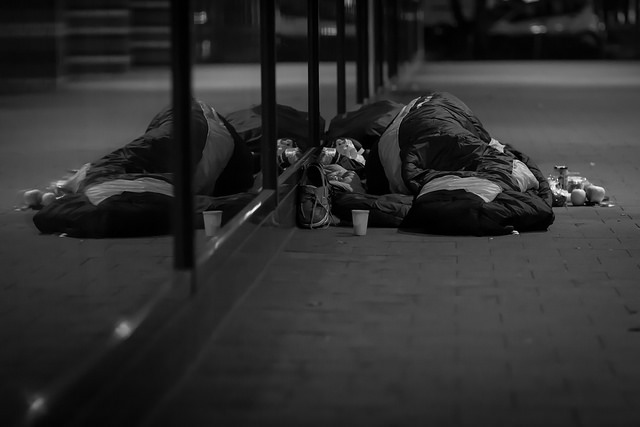
(Photo by Marc Brüneke)