Landrieu The Longshot

Residents of Louisiana can expect another month of nonstop political ads:

Landrieu officials say they believe she can win given her history of consolidating support and beating her opponents in runoffs — in 1996 she was down by 11 points in the general election and went on to win by 1 point. In 2002, she was down by three points in the general election and won the runoff by 3 points. But the national political headwinds in this election could hurt her. President Barack Obama and his signature health care law remain largely highly in the state. Landrieu will have to bridge the racial divide to gin up support among whites, who have been unenthusiastic about her reelection bid, and rally a significant number of black voters to win.

Republican operatives have long thought their best chance at ousting Landrieu was through a runoff. A recent NBC/Marist poll showed that in a head-to-head match up Cassidy would get 50 percent of the vote while Landrieu is expected to draw just 45 to 46 percent.

Harry Enten doesn’t like Landrieu’s chances:

The problem for Landrieu is that Louisiana’s political environment in 2014 doesn’t look at all like it did in 2002. The state was only about 8 percentage points more Republican than the country in the 2000 presidential election. In the 2012 presidential election, it was about 21 percentage points more Republican than the nation. Moreover, the combined Democratic candidates’ vote in the 2002 Senate election in Louisiana was 47.9 percent versus 50.6 percent for the Republicans. In other words, it was a much closer primary than what occurred on Tuesday. If Landrieu is able to gain 3.8 percentage points in December, like she did in 2002, she’d still only take 47.3 percent of the vote in the runoff.

No matter how you look at it, Landrieu is in deep trouble in a month.

Nicholas Lemann notes that after yesterday’s elections, Landrieu is the only Democratic senator remaining in the Deep South. He mulls over this state of affairs:

To attract white votes, which winning statewide office necessarily entailed, a Democrat required either Olympic-level political skill (think of Bill Clinton in Arkansas) or the trust that comes from bearing a famous political-family name (think of Al Gore in Tennessee, or, almost, Michelle Nunn in Georgia, or, for that matter, Landrieu) or a powerful orientation toward delivering for the folks back home mixed with a partial disavowal of the national Democratic Party. Landrieu had all three in some measure, and still perceived every campaign as a political near-death experience.

Political realities can and do change. Formerly Confederate states such as Virginia, North Carolina, and Florida are regularly capable of casting their electoral votes for Democratic Presidential nominees, and it’s not impossible that Tennessee, Arkansas, and Georgia might, as well. Even Louisiana went Democratic in the 1996 Presidential election. Those who care about how this goes in coming years should take note, though: if there is a future for Southern Democrats running statewide, it will belong to people who don’t get angry on television and who don’t yell at Republican Presidents or applaud Democratic ones. Republican candidates can get away with all of that; Democrats can’t.

A Victory For What?

That’s my question after this relentlessly negative and vacuous campaign. And the striking thing about it is that it’s hard to detect an issue or platform around which the GOP constructed a victory. I watched Kevin McCarthy on Fox last night attempt to describe what his party now wants to do with its majority in both House and Senate – and it was so pathetic even the Fox News crowd could barely hide their dismay. He said he wanted to kickstart the economy. No serious ideas as to how, except  the same tired 1980s boilerplate. Tax reform? I’m all for it – but we shouldn’t kid ourselves it was an issue of even faint relevance in this campaign. Immigration? Again, it’s much much easier to say what they don’t want to do, rather than what they do.

Foreign policy? It will be fascinating to see if the Republican party really wants to fight another Iraq War – and what would happen to its unity if it tried. On Iran, they simply want to scupper the only conceivable way forward absent another war. Obamacare? McConnell seems to be arguing against an attempt at repeal – merely a series of nitpicks to try and unravel it. If I could see any constructive policy agenda, I could have a serious opinion about it. But I don’t. I see pure negativity and bile against the president. And it seems to me that that is not a strategy to win over a majority for the presidency in 2016.

National Review today actually urges the GOP majority to do nothing for the next two years but prep for 2016. I kid you not. They worry about the “governing trap.” Here you see the cynicism that has pulsed through the right for the last six years, in which everything is about politics and nothing is about governance:

A prove-you-can-govern strategy will inevitably divide the party on the same tea-party-vs.-establishment lines that Republicans have just succeeded in overcoming. The media will in particular take any refusal to pass a foolish immigration bill that immediately legalizes millions of illegal immigrants as a failure to “govern.”

Fourth: Even if Republicans passed this foolish test, it would do little for them. If voters come to believe that a Republican Congress and a Democratic president are doing a fine job of governing together, why wouldn’t they vote to continue the arrangement in 2016?

And that would be just terrible, wouldn’t it?

In some ways, this election also strikes me as a vote by the elderly almost entirely against the Obama coalition and what it represents for America, rather than for anything. You can see it in this screenshot from NBC News:

us_age_trend_cc_561_1_1ecd2d7c1de506201727d540941b9e50.nbcnews-ux-720-440

That’s a staggeringly high percentage of the vote for the over-60s. If anyone doubts the potency of Fox News’ relentless campaign to remind anyone over 50 that the world is coming undone and Obama is entirely the reason, then those numbers should be definitive. So what this represents is a backlash against a change that is coming anyway – a vote by the older generation against the America that the younger generation seems to represent and want. Or a rising up of white America against the browns and blacks. This is too crude, of course. But it captures something important about this moment of vacuous retrenchment.

Sane conservative pundits remind us that 2016 will be different. And it will. The Clintons remain the favorites to recapture the White House next time around, with a coalition that was still in place this year but representing a much smaller a slice of the electorate. But this only means that the polarized paralysis of the last four years is likely to become a durable fixture of our politics for quite some time. The GOP’s dominance in the House means any Democratic president will be constrained and harassed and pilloried. And I don’t see any Republican candidate on the horizon capable of putting together the kind of triumph that Obama secured in 2008.

So this is a victory in favor of more governing paralysis. Most voters don’t really want that; but their actions belie it. History twists and turns, of course, and any number of events or surprises could upend our expectations for the better. But yesterday, it seems to me, was the definitive moment when Obama’s promise to forge a pragmatic purple center ceded to the grim, polarized reality of a deeply and evenly divided country. This was the GOP’s strategy from the start; but it leaves them with a strangely ill-defined, if emphatic, victory.

Southern Democrats: An Endangered Species

Southern Democrats

Nate Cohn spotlights the Dems’ huge problem in the South:

The inability of Southern Democrats to run well ahead of a deeply unpopular Mr. Obama raises questions about how an increasingly urban and culturally liberal national Democratic Party can compete in the staunchly conservative South. It raises serious doubts about whether a future Democratic presidential candidate, like Hillary Clinton, can count on faring better among Southern white voters than President Obama, as many political analysts have assumed she might.

The Democrats running in the South on Tuesday night were not weak candidates. They had distinguished surnames, the benefits of incumbency, the occasional conservative position and in some cases flawed opponents. They were often running in the states where Southern Democrats had the best records of outperforming the national party. Black turnout was not low, either, nearly reaching the same proportion of the electorate in North Carolina, Louisiana and Georgia as in 2012.

Joel Kotkin examines the demographics of last night’s electorate:

The Republicans actually won among white voters under 30, 53% to 44%, even as they lost 30- to 44-year-olds, 58 to 40. If these trends hold, the generation gap that many Democrats saw as their long-term political meal ticket may prove somewhat less compelling.

If they are losing the middle and working classes, and even some millennials, what are the Democrats left with? They did best in states like California and New York, where there is a high concentration of progressive post-graduates and non-whites, and where many of the sectors benefiting most from the recovery have thrived, notably tech, financial services, and high-end real estate.

Yet these areas of strength could also prove a problem for the Democrats. A party increasingly dominated by progressives in New York, Los Angeles, the Bay Area and Seattle may embrace the liberal social and environmental agenda that captivates party’s loyalists but is less appealing to the middle class. Unless the Democrats develop a compelling economic policy that promises better things for the majority, they may find their core constituencies too narrow to prevent the Republicans from enjoying an unexpected, albeit largely undeserved, resurgence.

(Screenshot from the Upshot’s detailed maps of yesterday’s results)

Where Did Obama Go Wrong? Ctd

Several readers sound off on my big Obama post from yesterday:

Right the fuck on, Andrew. When I was canvassing for the president in my swing area of California’s Inland Empire in 2012, an older white blond retired policewoman was our precinct captain. I’ll never forget her speech at the end of our last convening, “and aside from politics, this president just strikes me as a decent man who is trying and I think he deserves our help.”

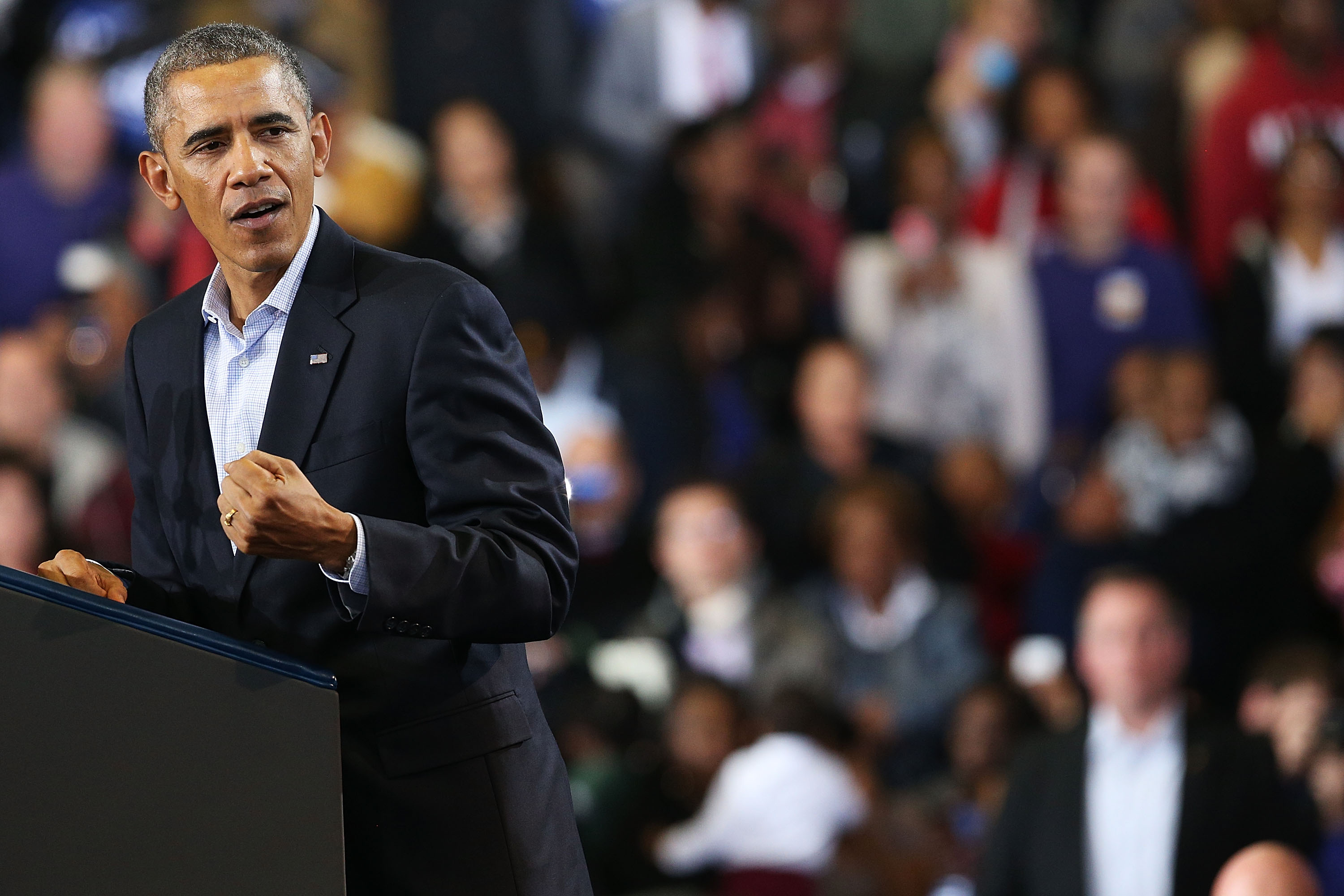
President Obama Attends Rally For The Re-Election Of Connecticut Gov. MalloyI hear few people talk about what Barack Obama deserves, but I’m glad that every once in a while someone does. I have owned a home for a couple years now (thanks Obama economy!) and I have roommates. Just balancing the interests of four people under one roof is EXHAUSTING. The fact that this president has passed laws that have helped my working-class family while dealing with pressures from 350 million people is a staggering thought that too many people don’t have. I appreciate you talking about what President Obama deserves. There are all too many out there, who don’t lead shit, who would blisteringly criticize any train of thought that humanizes the president or paints him in a sympathetic light. Those cats never got my sister health insurance though.

Another reader:

Two things. Obama didn’t really “go wrong” or suddenly become unpopular. There is a great piece from Media Matters that points out that Obama’s approval ratings have held steady for years. Not only didn’t his approval numbers drop this month or this year, or the last few years, but at times have gone up slightly. No matter. The press for some reason latched on to this narrative, and so it is.

So, what is really happening? TheScreen Shot 2014-11-05 at 12.01.47 PM national divide is vivid. Where are Obama/Dems losing? Alabama, Mississippi, South Carolina, Arkansas, Tennessee, Georgia, Louisiana, Texas, Kentucky, etc. You have written about this before – about our “Cold Civil War” and the Southernization of Republican politics. But this obvious fact seems impolite to mention in most venues. America is hip-deep in its long regional/ideological divide, and increasingly so. Attempting to analyze today’s likely results rationally – was it Ebola or the botched roll out of Obamacare? – misses the point entirely. Alabama wasn’t going to vote differently today if Obamacare had rolled out smoothly. Texas, Mississippi or South Dakota wouldn’t vote differently if the stock market under Obama had increased from 7,949.09 to 17,366.24, a growth of 218% in less than six years (it has), or unemployment fell below 6% (it has), or average gas prices were $3/gallon (it is), or GDP was growing at 3.5% (it is).

In the meaningful sense, this isn’t a divided country “across the dinner table.” This is a regional division, and it is growing.

Another:

I work on Wall Street and am one of those dreaded one-percenters.  I have always supported Obama and I still do.  But I am utterly confounded by the lack of support for an administration that has presided over an insanely successful economic recovery.  In 2008-9, we were on the verge of a true disaster, which could easily have resulted in Depression-era unemployment and devastation, and would have if the Republicans in Congress had their way.  This latter statement is not conjecture: does anyone else recall that the markets dropped over 7% when the House Republicans blocked the bailout?  And austerity programs have been proven to be abject failures.  The recovery here has many issues, the most worrying is the wealth gap.  But I am not aware of any time in history when consumer sentiment surveys are at seven-year highs, and the president’s popularity is at close to a six-year low.  Simply put: what the fuck is going on?

But several readers are critical of the president:

You are right to pinpoint the events of the fall of 2013 as the key turning point. You mention healthcare.gov and Syria as the two key developments at that time – yet each of those failures resonated with those who had already decided that they disapproved of the president, the Tea Party and the necons, respectively. The third major development of the fall of 2013, which you do not mention explicitly, was the Edward Snowden story. I think you underestimate its impact by dismissively lumping it with other complaints about the “disillusionment of some on the left.” Obama’s defense of the NSA’s illegality was of a different order than his support for the health insurance industry or his rejection of populism on Wall Street. The Snowden revelations, in my opinion, led, for the first time, to the disillusion of key parts of his coalition: it is that defection, not the energized opposition of those who were already inclined to oppose him anyway, that pushed his approval ratings irreversibly under water.

Another is succinct:

During a campaign, Obama is a great communicator. In office, he’s a rather poor one. Since he took office, he’s ceded the messaging initiative to the GOP, has failed to respond effectively, and it has hurt him, badly.

Another elaborates along those lines:

Where did Obama go wrong? One word: messaging. You’ve hit on this before, and at several points during his administration you’ve laid out the case for his presidency better than he or his team ever has.

Letterman touched on this point by mentioning these three factors: cost of gas, unemployment, stock market. When was the last time you went into Election Day with all three of those trending towards the good and the incumbent administration getting beat up? For whatever reason, possibly it just isn’t native to his skill set, Obama has never done a good job of selling his achievements or the general trajectory of “where we were vs. where we are” that defines his presidency. I’d say it was because he no more elections to run, but he didn’t sell this well during his first term either.

And so in the absence of a sales pitch in defense of himself, the Fox megaphone and its subsidiaries resonate even louder, and the reasonably smaller (not to discount any one) missteps or problems during his presidency seem bigger than they would otherwise be. His response to Syria was off somewhat? How much weight are we supposed to give that? Add in a few new and largely unsolvable hysteria issues (Ebola, ISIS) in the run-up to the election, and here we are.

For the record, you keep asking what this election is supposed to mean. From a mandate standpoint, there isn’t one. But when the GOP owns both houses, it means an invocation of the dare we’ve secretly been muttering to ourselves for some time now: Fine, You Do Something. With full control of Congress, and under the constraints of the veto pen, show us just what it is you claimed you would have done the last six years, if only you’d had the means.

One more reader:

As a classic liberal in FLA’s bloody-red spleen (Lake County), I can honestly say that I am not the least bit surprised how things went down yesterday. Of course I am disappointed that Proposition 2 did not pass and I’m pretty bummed that Rick Scott still has a job, but I’m not shocked at all. I watched the variety of ads that all of this new dark money bought and I sized up the people next to me at the voting booth. I knew that I was voting to stop the bleeding and I waited until midnight before I checked the results.

Reading Democrats’ reactions this morning is a different story. Blaming the President exclusively for the party’s weakness has me utterly bewildered. How limp-dicked has my party become? Obama’s administration has really let me down in a lot of ways (protecting the FBI, keeping Guantanamo open, drone assassinations, sucking up to Wall Street), but to say that the White House lost the mid-terms for Democrats is proof that my party has also lost its mind. Everyone knows the GOP’s playbook and now we also know how effective it can be when the populist side of the Left is ignored for political strategy as well as the need for big money in elections.

We are in for a bumpy ride but at least now Republicans will have to own their legislation and the Democrats can figure out who the fuck they are.

(Map of the 2014 Senate results from Politico. Photo by Spencer Platt/Getty Images))

The Rise Of The “Cruz Wing”

Sahil Kapur heralds it:

Cruz telegraphed his strategy in a post-election interview Tuesday night on Fox News, calling on Republicans to do whatever it takes to repeal Obamacare and and prevent Obama’s upcoming executive actions on immigration. “The two biggest issues nationwide were, number one, stopping the train wreck that is Obamacare; number two, stopping the president from illegally granting amnesty,” Cruz said. He also appeared on CNN and declined to voice support for McConnell as majority leader, calling that “a decision for the conference to answer next week.”

Molly Ball is unsure who will join Cruz’s ranks:

The new Republican senators are quite conservative, perhaps more so than any previous class, but they are capable of sounding reasonable and staying focused on issues voters care about. The question yet to be answered is one of tactics: When these new players come to Washington, will they seek pragmatic accommodation? Or will they team up with the likes of Cruz, putting new faces on the same old gridlock?

John Aravosis sees Cruz’s increased power as a gift to Hillary:

Cruz, as you’ll recall, was the architect of the very-unpopular Republican shutdown of the federal government. Cruz was able to whip the House Tea Party contingent into a furor, and effectively overrule House Speaker John Boehner. Cruz did all that in the minority. Imagine the damage he can do in the majority.

And that helps Hillary, and hurts the GOP overall. Hillary now has someone to run against: The GOP Congress. Up until now, Hillary Clinton had to figure out how to distance herself from a somewhat unpopular president, while having spent the last many years working for him. Now, instead, she can focus her attention, and divert ours, towards all the bad things the Republicans are going to cook up over the next two years.

The Return Of The Hawks, Ctd

Following the victories of pro-war candidates like Tom Cotton and Joni Ernst, Rosie Gray looks ahead to how the Republican Senate is likely to muck up Obama’s foreign policy agenda:

Most immediately and maybe most importantly, Republicans will try to nix any Iran deal that they deem unsatisfactory — and on this, they have the support of plenty of Democrats. The deadline for the nuclear talks is Nov. 24. The new Senate will have the will and the manpower to push through new sanctions legislation if it chooses, and the fight over Iran policy could prove to be one of the defining battles of the waning Obama presidency.

It’s unclear where exactly the new Republican conference will be when it comes to foreign policy, but Tom Cotton and Joni Ernst, the new senators from Arkansas and Iowa, have seemed to exhibit a fairly hawkish foreign policy instinct. Foreign policy isn’t the top issue voters care about, but their election could represent a cooling of enthusiasm for the anti-interventionist policies of libertarian Republicans that have garnered much attention in the past few years.

Fairly hawkish? Cotton’s view is that the Iraq War was a fantastic moral cause and we should be on the look out for more opportunitiees to spread “democracy” at the barrel of a gun. Juan Cole braces for the worst:

Barack Obama was convinced or bamboozled by the Pentagon to do the Afghanistan troop escalation in 2009, and he has conducted drone wars in Afghanistan, Pakistan, Somalia, Yemen and some other countries. The GOP may see him as not ultimately committed to keeping US troops out of Iraq and Syria, and will almost certainly attempt to force him to put more boots on the ground (John McCain will be chairman of the Armed Services Committee). If the GOP Senate objected to the withdrawal from Afghanistan, it could refuse to fund it (getting out will be expensive). And, if Obama manages a breakthrough in negotiations with Iran that requires a reduction in US economic sanctions, the Republican House might be able to find ways to block that reduction, so as to go back on a war footing with Iran (war is good for the arms industry, which funds a lot of congressional campaigns).

Karlyn Bowman observes what the exit polls showed about foreign policy-minded voters:

55% of voters who chose foreign policy as the most important issue facing the country voted for Republican candidates: about 4 in 10 of them voted for Democrats. The issue ranked behind the economy and health care as the top issue and tied with immigration. 58% of voters in House races approved of the US military action against ISIS in Iraq and Syria. In another question, seven in ten said they were very worried about another major terrorist attack in the US, including 28% who were very worried.

But Larison notes that the voters who elected the hawks aren’t necessarily hawks themselves:

[Cory] Gardner won 52% among those that disapproved of the military action despite launching the most shamelessly demagogic attacks on his opponent on this very issue. This pattern was repeated nationwide: opponents of the war against ISIS tended to vote for Republican House candidates (55-43%), most of whom have been reliably in favor of the intervention, and a slim majority of supporters of the war (51%) voted for Democratic candidates. It is no wonder that the more hawkish candidates prevail when relatively dovish voters back them regardless of their positions. Nonetheless, this also gives us another reason to be skeptical when hawks claim that these election results are proof that aggressive foreign policy is a political winner.

The Democrats’ Loss Is The Clintons’ Gain

That’s among Ezra’s takeaways:

Hillary Clinton is arguably also a winner here. A more Democratic year could have led to some new stars who might have been able to challenge her in 2016. Instead, some potential challengers were cut down. Gov. Martin O’Malley, for instance, saw Anthony Brown, his lt. governor and handpicked successor, defeated in Maryland. That’s not going to help him make the case that he can appeal to voters she can’t.

Tomasky wonders whether Hillary can win back some of blue-collar white voters Democrats have lost:

Maybe with Hillary and Bill, the Democrats can get back some of these voters. Maybe it really is that simple. You get people with white skin and the man has a drawl and reminds them of a time when they were younger and thinner, and some of these voters feel more comfortable with Democrats again. Not enough that Democrats can win Arkansas, God knows, but maybe enough that they can nail down North Carolina again. The media will be full of stories in the next few days about whether Obama will drag Hillary Clinton down for 2016. Could be, but I doubt it. She’s her own brand. As long as the economy isn’t awful, and Benghazi is still a punch line for Jon Stewart, she can survive this.

A Major Night For Marijuana

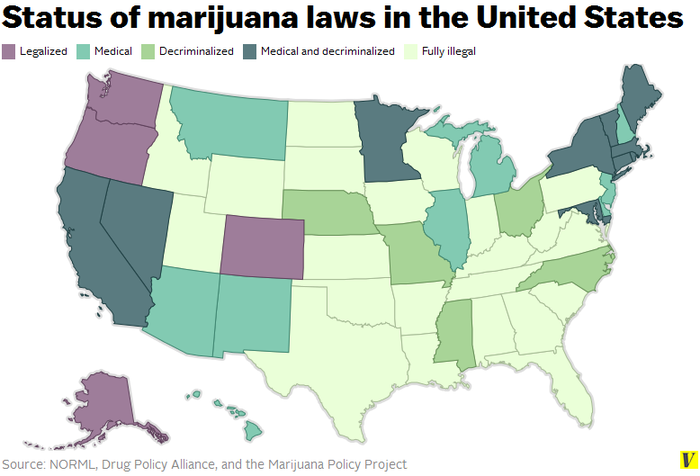
Marijuana Map

Friedersdorf deduces that “the 2014 losers least likely to regain ground in future elections are marijuana prohibitionists”:

“With marijuana legal in the federal government’s backyard it’s going to be increasingly difficult for national politicians to continue ignoring the growing majority of voters who want to end prohibition,” says legalization advocate Tom Angell. “We can expect to see many more ambitious national politicians finally trying to win support from the cannabis constituency instead of ignoring and criminalizing us.”

That last bit may be too optimistic. I would be surprised to see any contender in the 2016 presidential field endorse legalization. I do expect more candidates to take the position that this is a matter that ought to be left up to the states and the people.

Rand Paul already took that position:

“I’m not for having the federal government get involved. I really haven’t taken a stand on … the actual legalization. I haven’t really taken a stand on that, but I’m against the federal government telling them they can’t,” Paul said.

Sullum wonders if Congress will block legalization in DC:

Initiative 71 legalizes home cultivation of up to six plants by adults 21 or older, along with possession of up to two ounces and transfer of up to an ounce at a time “without remuneration.” Residents who are not horticulturally inclined and do not have friends who are will be out of luck unless the D.C. Council approves a system for commercial production and distribution. The council heard testimony on that issue last week, and The Washington Post reports that “a majority…has vowed to also take up legislation early next year that would establish a system to sell and tax marijuana.”

Whatever D.C. voters and legislators do can be undone by Congress, which has 30 days to overturn Initiative 71. Congress also can block Initiative 71 by forbidding D.C. to spend money on implementing it, as it did for years with the medical marijuana initiative that D.C. voters approved in 1998. One possibly hopeful sign: When the D.C. Council made possessing up to an ounce of marijuana a citable offense subject to a $25 fine earlier this year, Congress let the law take effect.

Kleiman, a longtime opponent of fully commercialized weed, hopes that DC won’t allow sales:

District residents will be able to grow a limited number of plants, possess a limited amount of the resulting cannabis, and give away—but not sell—whatever they don’t want to smoke themselves. The system is called “grow and give.”

… D.C. should try “grow and give” and see how it works. It wouldn’t generate any tax revenue, or offer consumers the same convenience or product variety as a commercial system, and of course policing the boundary between “giving” and “selling” would be virtually impossible. But it might be a big improvement on the current prohibition. Eliminating organized marketing would likely lead to a much smaller increase—if any—in cannabis abuse than we would expect if we sell pot the way we now sell beer.

Sullum compares Alaska’s legalization law to those that have come before it:

Alaska’s tax will be $50 per ounce, collected from growers. From the government’s perspective, the advantage of that approach, which is similar to the way alcohol is taxed (by volume),  is that proceeds from a given quantity of marijuana remain the same as prices drop, which is what will happen as the market develops unless something goes terribly wrong. The disadvantage, from a social engineer’s perspective, is that a tax based on weight does not take potency into account (unlike alcohol taxes, which fall more heavily on liquor than on beer).

In fact, a weight tax might encourage higher potency, especially as it becomes a larger and larger component of the retail price. If production costs fall as expected, Alaska’s weight tax could amount to a rate of 100 percent or more within a few years, giving consumers an even bigger incentive to buy the strongest pot they can find.

Sullum turns to one aspect of Oregon’s new law:

One distinct advantage of the Oregon initiative is that it does not change the standard for driving under the influence of intoxicants (DUII, a.k.a. DUID). Under current law, convicting someone of DUII requires showing that he was “affected to a noticeable degree” by marijuana or another controlled substance, based on the “totality of the circumstances.” By contrast, Washington’s current rule, established by I-502, says any driver whose blood contains five or more nanograms of THC per milliliter is automatically guilty of DUID, a standard that in effect prohibits driving by many daily consumers, including patients who use marijuana as a medicine, even when they are not actually impaired.

German Lopez looks ahead:

The big year, experts and advocates say, is 2016, when legalization will likely be on the ballot in California, where medical marijuana is already legal, and several more states. “It’s an uphill battle, but we see support growing at the state and federal level,” Tvert said. “We’ve filed committees to support initiatives in Arizona, California, Maine, Massachusetts, and Nevada.”

A reader sounds off:

I voted in DC yesterday, proudly and happily for Ballot Initiative 71. My boss, a white guy in his late forties with two kids, also voted for it, and we freely talked about it at work.  How awesome is it when a 20-something single woman of color and a 40-something married white dad can high five about getting to legalize marijuana?

Know dope.

(Chart from Vox)

The Obama Coalition Didn’t Show Up

Republicans Take Control Of Senate After Midterm Elections

Douthat takes stock:

In this particular case, what was overestimated and misjudged was the permanent effectiveness of the Democratic blueprint from 2012, whose mix of social-issue appeals and tech-savvy voter targeting was supposed to work in tandem with demographic trends to cement a new socially-liberal, multicultural coalition, and render the G.O.P.’s position entirely untenable absent a major ideological reboot. That blueprint really was effective in ’12, and the underlying demographic trends are real, and one bad midterm election does not prove that the coalition cannot hold together, as Republicans may learn to their cost two years from now. But from a lot of the commentary after Obama’s re-election, you would have thought that the combination of ethnic-interest appeals on immigration policy, “war on women” rhetoric on social issues, and brilliant get-out-the-vote operations run by tech-savvy Millennials (who, we were told, were too liberal to ever build a website for a Republican) posed a kind of immediate and existential challenge to the G.O.P., requiring immediate capitulation on a range of fronts, with no time for finesse or calculation and no room for resistance.

No so, as it turned out. Events have intervened, Republican politicians and their party have managed to adapt, and — as often happens —  issue appeals that resonated in one political context have turned out to be less important than the fundamentals in another.

Marin Cogan contends that the “election has some potentially serious consequences for 2016”:

A sweep this year makes it much less likely for Democrats to take back the Senate in 2016, even if they win the presidency. But it doesn’t mean that voters should be girding themselves for President Ted Cruz in 2016, either. For the last two decades, neither party has held control of the Senate for more than eight years. For all the rhetoric you’ll hear in the coming days from Republicans that this is a mandate, it isn’t. Republicans still have a real challenge putting together a winning coalition in presidential campaign years. Democrats still have a hard time putting one together in the midterms. None of that appears to have changed on Tuesday night.

Ponnuru tackles related issues:

Obama’s popular majority, much of it concentrated in urban areas, gave him an electoral majority. But it was not distributed in a way that made for a majority in the House or, as we have just seen, a stable one in the Senate. And it also appears to have been dependent — even to an extent in blue states — on voters who do not show up in midterm elections. Accusing Republicans of hostility to contraception, for example, may work as a way of motivating marginal voters in presidential years, when they just need a little nudge to go to the polls. Not so in the midterms.

Cassidy thinks “it would be premature to call the 2014 election a major turning point”:

In short, this was a big protest vote, and a big defeat for President Obama. To that extent, it was a big victory for the Republicans. Mitch McConnell, the Senate Majority Leader-elect, earned his moment of glory. (“It’s time to turn this country around—and I will not let you down,” McConnell told a group of cheering supporters relatively early in the evening, following his thumping of Grimes.) But if a “wave election” is one that signifies important changes in the underlying dynamics of the American electorate, then this wasn’t a wave election.

Judis tries to find some good in the bad:

If there is a silver lining in the awful results of this year’s election, it lies in the fact that if the turnout had been similar to 2012 or 2008, the Democrats would have done much better. As The New York Times’ Nate Cohn has argued, that could bode well for 2016, which is not only a presidential year, but a year when the Republicans’ vulnerable Senate class of 2010 will come up for re-election. If you look at how the different groups voted, the Democrats preserved their edge among younger voters, African Americans (whose turnout seems to have been pretty good), Hispanics, single women, and professionals. Almost all the Democratic candidates did well, for instance, among voters with post-graduate degrees. In Georgia, Michelle Nunn won these voters by 53 to 46 percent. So that’s a consolation of sorts.

But in 2016 and in future midterm elections, the Democrats will still have to do better among those parts of the electorate that have flocked to the Republicans: older voters and white working-class voters. The numbers for the latter in this election were singularly dispiriting. In Florida, Democratic gubernatorial candidate Charlie Crist lost whites without college degrees by 32 to 61 percent; in Virginia, Senator Mark Warner’s near-death experience was due to losing these voters by 30 to 68 percent. In Colorado and Iowa, they held the key to Republican Senate victories. In 2012, the Democrats benefited by facing a Republican who reeked of money and privilege and displayed indifference toward the 47 percent. Romney lost the white working class in states like Ohio. Democrats may not have that luxury of a Mitt Romney in the next election. And in that case, they will have to do considerably better among these voters, or else 2016 could turn out to be another nightmare election for the Democrats.

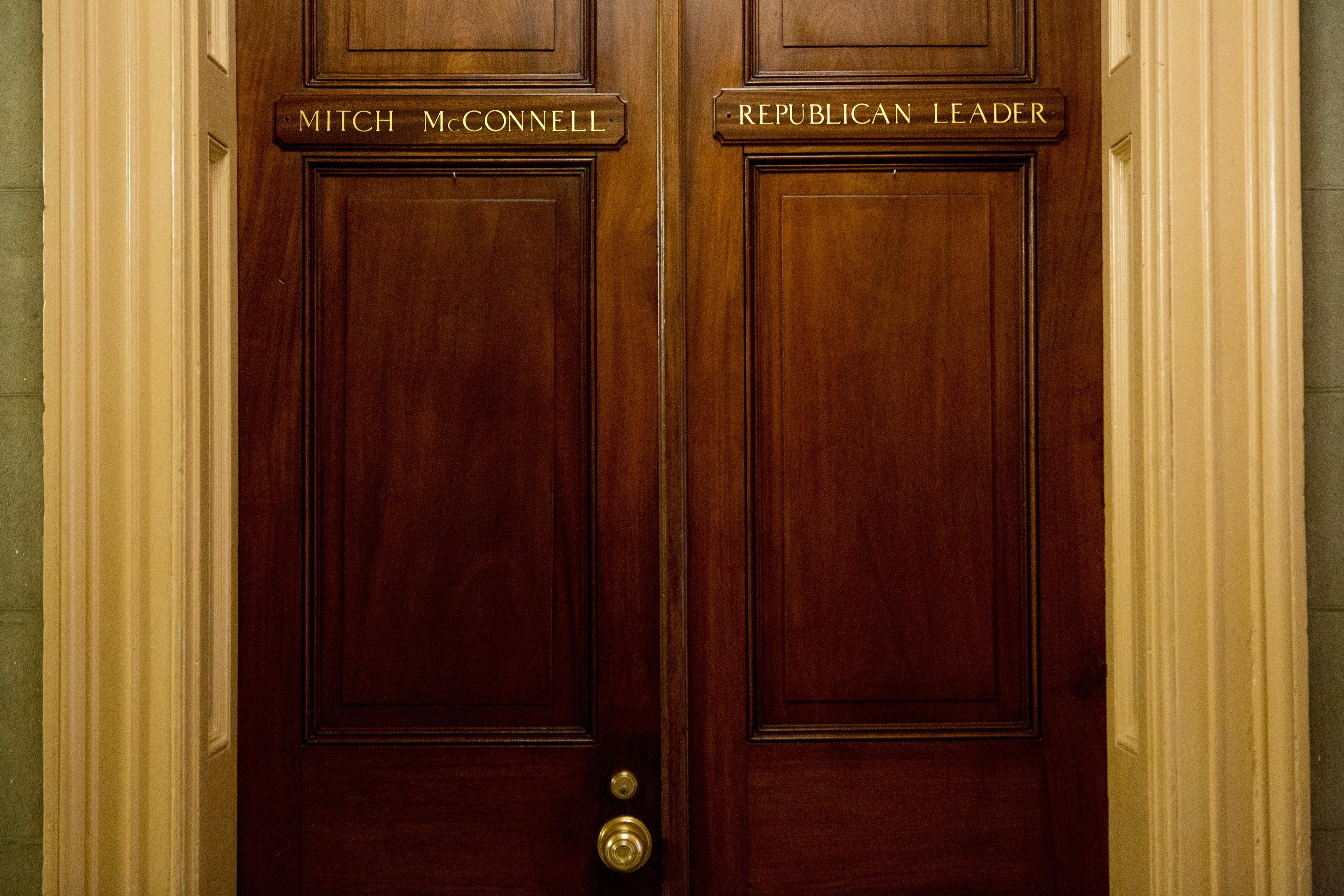
(Photo: The Senate office of Sen. Mitch McConnell (R-KY). By Allison Shelley/Getty Images)