Robot Of The Day

1415054716680338

Becky Ferreira gushes, “In what may well be the cutest scientific study ever conducted, ecologists dressed a rover up as a baby penguin in order to infiltrate the notoriously shy bird’s ranks”:

The study, published Sunday in Nature Methods, argues that undercover robots are able to monitor and extract information about animals without causing them stress – which both is a bummer for the animals, and affects the validity of the science itself. “Investigating wild animals while minimizing human disturbance remains an important methodological challenge,” the authors, led by Yvon Le Maho of the University of Strasbourg, wrote in the paper. “Approaching wild animals to collect data on their phenotypic traits induces stress, escape behavior and, potentially, breeding failure and therefore jeopardizes the quality of the collected data.”

Answer: undercover robot penguin baby.

(Photo: Frederique Olivier/John Downer Productions, Le Maho, et. al., Nature Methods)

The Invention Of The Chapter

Nicholas Dames reflects on it:

The unassuming quality of the chapter, its way of not insisting on its importance but marking a transition nonetheless, turns out to be its most useful, if also its most vexing, quality.

It is a vocabulary for noting the way we can organize our pasts into units. Some things stop; others begin. We note these shifts, in relationships or jobs or domiciles, reassured that the environing story itself – our lives – are still ongoing. But how do we know when we are starting a new chapter? How are we justified in picking a moment out of fluid passing time and declaring a pause?

This is the ambiguity that the novel learned to love. As Thomas Mann wrote in The Magic Mountain, “Time has no divisions to mark its passage, there is never a thunder-storm or blare of trumpets to announce the beginning of a new month or year. Even when a new century begins it is only we mortals who ring bells and fire off pistols.” …. Those subsequently applied divisions, which seem so distant from the actions performed within the story, ironize the very act of dividing up time even while providing a model for doing so. How could anyone in those stories have known when a new chapter was beginning? How can we?

“Let Photographs Be Photographs”

Morgan Meis celebrates Paul Strand – subject of a current retrospective at the Philadelphia Museum of Art – as “the first truly great master of photography as the art of detached observation”:

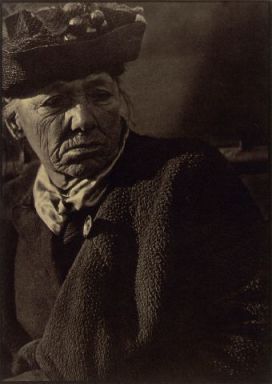
Paul_Strand-_Portrait,_Washington_Square_Park,_1917You can see, in the exhibit, Strand’s first photographic pictures from the very beginning of the 20th century. Strand was, at the time, heavily influenced by a movement called Pictorialism. Pictorialists wanted to take the rough edges out of photographs. They wanted photography to be more like painting. They used soft focus techniques. They sometimes added color, brushstrokes, and other effects to their prints to enhance the sense that these photographs could be paintings. They made pictures that were moody and diffuse.

Strand showed some of his Pictorialist photographs to the influential and older photographer Alfred Stieglitz. Stieglitz told Strand to ditch the Pictorialism. He advised Strand, in so many words, to let photographs be photographs. That’s a central tenet of Modernism. Don’t be afraid of the medium. Embrace it. If photographs produce harsh, extremely detailed images, so be it. The harshness, the detail, the inherent realism – these can all be strengths. With Stieglitz and Strand, photography stopped trying to be like painting and started truly to become its own art form.

(Image: Paul Strand’s Portrait, Washington Square Park (1917) via Wikimedia Commons)

War And Peace, Between War And Peace

In her new book, No Man’s Land: Preparing for War and Peace in Post-9/11 America, West Point literature professor Elizabeth Samet reflects on the experience of teaching moral and critical wisdom to soldiers who, in Elliot Ackerman’s words, “are not challenged by the imminent combat they will face upon graduation, but by a middling sort of peace, serving a nation at war but not at war”. Ackerman praises the book, calling it an “expertly rendered meditation on a decade of war through the lens of the literature she teaches”:

In the next decade, the U.S. military’s greatest challenge won’t likely be the Islamic State in Iraq and Syria, or the draw down in Afghanistan, but how it navigates the no man’s land Samet references. When reflecting on the plebes Samet has taught and seen off to war she writes: “I know from their e-mails and letters that some of my former students cling to the memory of their classroom experience as to a kind of life raft when they find themselves confused or numbed in places of true peril.” Clearly the study of literature, if not directly transferable to a hard military skill, has armed Samet’s students against the vagaries of war. But she also notes that in the coming no man’s land, such pursuits might prove essential in cultivating the type of intellectual flexibility required to meet our muddled peace, and the uncertain challenges of the next war. “It takes patience and courage to carve out space for self-examination. … If you’ve waited until you are a general to develop it, it will be too late.”

In an interview with Francis Wilkinson, Samet touches on the unique role that literature has come to play in many of her former students’ lives as soldiers:

The exigent circumstances of war somehow stimulate a hunger for imaginative literature and sharpen the ability to recognize correspondences between art and life. Those are meaningful correspondences, and often contradictions or collisions, rather than the sometimes facile analogies and identifications readers tend to make in the less generous and curious moods that come upon us when living life at a more normal pace.

Perhaps we can experience, in attenuated fashion, something of what it means to be a reader in war when we travel to new places or find ourselves in uncomfortable circumstances. That’s why I can remember where and when I have read certain books: all of the novels of Evelyn Waugh while living on my own in Scotland for a year; or “Madame Bovary,” on tape during a surreal car ride with a 103-degree fever, in a kind of delirium, begging Emma, “Please, take the arsenic.” The swirling dynamics of chance that dominate war, and the long stretches of unaccountable boredom, have turned many soldiers of my acquaintance into voracious readers.

The Republican Wave: Tweet Reax


https://twitter.com/freddoso/status/529887759490908160

https://twitter.com/EWErickson/status/529852388816195584


The Republican Wave: Blog Reax

Democrat party eletion night

Sam Wang observes that Republican Senate candidates outperformed late-campaign polls by a surprising margin:

Tonight’s performance by the GOP has been quite remarkable. In close Senate races, Republicans seem to be outperforming polls by around 5 percentage points. That goes a long way toward explaining what is happening in Virginia. In close gubernatorial races, Republicans are outperforming polls by about 3 percentage points. I did say that historically, midterm polling can be off in either direction by a median of 3 percentage points – far worse than Presidential years. Tonight is certainly consistent with that.

Harry Enten highlights the gubernatorial races, in which the GOP also had “an amazing night”:

The GOP won all the close races in which its candidates were favored, such as Michigan and Wisconsin. Republicans won the vast majority of close races in which they were slight underdogs, such as Florida, Illinois and Maine. They won in Kansas, where we gave the GOP incumbent, Sam Brownback, only a 20 percent chance. And Republicans have even taken Maryland, where they had only a 6 percent chance of winning according to our last pre-election forecast.

In Josh Marshall’s opinion, that’s the big news:

To me, in evaluating the significance of the night’s results, the governors’ races are the bigger tell than the senate seats. The truth is that the Democrats were fighting for the Senate on a merciless, largely red-state terrain. They had some key retirements on top of that. The governors’ races are quite a different matter. Scott Walker wins – three election victories in four years, an undeniable credential for national office. Sam Brownback holds on in Kansas, a state which he’s basically run straight into the ground and torn apart the state GOP. That can only be explained by a tide bringing him over. Illinois, Florida, Connecticut (possible), Colorado (possible), Maryland. These results aren’t about terrain or candidates. They’re about the national political climate.

Larison is a bit surprised at the Republican wave:

All of this suggests that most observers, myself included, underestimated the extent to which Republicans would dominate this election. The GOP ran an almost purely negative campaign and said almost nothing substantive about policy, and they have been rewarded with one of the biggest gains in Senate seats they have ever achieved in a midterm vote. Republicans can’t claim a mandate for anything, but with control of both houses of Congress they don’t need to have one to stymie and thwart the administration on any issue they choose. Now that they have just won a major victory running on nothing, that is what I assume they will do.

But Yglesias just shrugs:

There’s no need to over-interpret the election. If there’s anything we’ve learned watching the see-saw of 2008 followed by 2010 followed by 2012, it’s that the American electorate has no problem turning on a dime. But let’s not under-interpret it, either. Democrats were dealt a bad hand this year, but they lost even worse than that. You can tell a complicated story about why, but the fact that Obama’s approval ratings are stuck in the low forties summarize it pretty well. Right now, the country isn’t happy with the Democratic Party or its leader. And on Election Day, Democrats paid the price.

Saletan tries to cheer up Democrats by pointing to Republicans who campaigned on traditionally liberal issues:

1. Poverty. Democratic incumbents spent a lot of time talking about new jobs, economic growth, and other aggregate numbers that have been going in the right direction. Republican challengers undercut that message by focusing on people at the bottom. From California to Georgia to Virginia, Republicans called attention to high or rising poverty rates.

2. Minorities. Republicans also zeroed in on blacks and other underserved populations. In Louisiana right-wing candidate Rob Maness pointed out, “Unemployment for young black men in this state is three times the rate of unemployment for anybody else.” In Georgia, Republican Gov. Nathan Deal emphasized the state’s progress toward reducing the number of black men in jail.

3. Equal pay. Republicans researched how much money Democratic officeholders paid their male and female staffers. Any Democrat who paid women less was called out for it, regardless of circumstances. Republicans used this tactic in at least five states: Colorado, Illinois, Louisiana, New Hampshire, and Oregon.

Ambers asks what tonight’s results and exit polls tell us about the electorate:

First, the electorate was not overwhelmingly Republican or conservative, even though it was relatively more conservative than the country as a whole. In fact, from the national exit poll: 58 percent of those surveyed believe that undocumented immigrants should receive a legal pathway to citizenship. Fifty-three percent say that abortion should be legal in all or most circumstances. A majority support a rise in the minimum wage for hourly workers.

The big numbers show the economy is improving as a whole. But real wages and personal income aren’t growing while wealth inequality is. We may put too much faith in predicting elections based on the gross domestic product or unemployment rate, especially in the hangover (Ben White’s phrase) from the Great Recession. I’m looking for hard figures to back this up, but the combination of anti-government sentiment, a sense that when government does intervene, it intervenes in ways that mess things up, and a sense that the economy is not improving adds up to an electorate that does not believe that the administration is competent enough to handle the big problems of the day. That’s a referendum on President Obama’s governing.

David Corn recommends a little Democratic soul-searching:

Perhaps it is nearly impossible for a president and his aides to govern well in difficult times (crafting complex and often not fully satisfying responses to knotty problems at home and abroad) and promote clear political messaging that consistently cuts through the chaff and connects with stressed-out voters freaked out about the future. Yet elections work… for those who use them. And angry Republicans have once again taken advantage of Democratic disaffection, disappointment, apathy, or whatever. Now, in part because Obama could not convince voters in Iowa, Colorado, and elsewhere to stick with him and the policies he champions, many of his accomplishments are at risk, and the nation faces the prospect of more gridlock and chaos in Washington. But Democrats ought not to blame him alone. When it comes to saying who is at fault, they need to say, “We are.”

Beinart identifies “one big takeaway from tonight’s Republican landslide that should worry Democrats a lot”:

The GOP is growing hungrier to win. It’s about time. As a general rule, the longer a party goes without holding the White House, the hungrier it becomes. And the hungrier it becomes, the more able it is to discard damaging elements of party orthodoxy while still rousing its political base. … Republicans in 2014 combined candidate impurity with grassroots passion, which is what they’ll need to do to win in 2016. Achieving this combination is tougher in presidential elections. It’s hard to deviate from Limbaughesque orthodoxy when you’re competing for the hard right voters who dominate the Iowa caucuses and the South Carolina primary. … But if the 2010 midterms revealed a GOP fixated on ideological purity, 2014 has showcased the party’s new tolerance, and even enthusiasm, for pragmatism.

(Photo: Senator Mark Udall gives his concession speech at the Democrat’s Party at the Westin November 4, 2014 in Denver. By John Leyba/The Denver Post via Getty Images)

Live-Blogging The Mid-Terms 2014

US - VOTE - MIDTERMS - EMPIRE STATE BLDG

11.45 pm. I direct you now to Comedy Central, where the Internet has obviously been working, but don’t tell anyone. See you on the tube.

11.43 pm. It’s a wave. Nate:

The GOP could finish with as many as 55 seats. Alaska has yet to close its polls. Louisiana will go to a runoff on Dec. 6, and Republicans will be favored there — unless Democrat Mary Landrieu’s campaign benefits from the fact that control of the Senate is no longer at stake. Virginia Democrat Mark Warner still looks more likely than not to hold his seat, but the fact that his race was so close speaks to how awful a night it has been for Democrats. Jeanne Shaheen’s win in New Hampshire looks like a minor miracle now.

11.39 pm. Perfectly timed: Oregon votes for legal weed by 55 – 45 (with over 50 percent of the vote in.)

11.29 pm. It’s over:

Thom Tillis has won the race for Senate in North Carolina, clinching Republican control of the body.

Kay Hagan ran a strong campaign. She used the powerful Democratic voter-turnout machine. She successfully linked Thom Tillis to a conservative, unpopular state legislature. And in the end, Kay Hagan lost.

And the denouement: Ernst wins in Iowa.

11.24 pm. Scott wins in Florida; medical marijuana lost. Bad night for stoner Dems. Ben Jacobs’ take:

Scott, a former hospital CEO whose company was fined over $1.7 billion by the federal government over a massive Medicare fraud scheme, had eked out a victory in 2010 in a Republican wave, relying heavily on his own personal wealth. His good will with Floridians evaporated quickly with his support for strict voter ID regulation and his opposition to Medicaid expansion. Scott made matters worse when he pushed back against environmental protections to the Everglades supported by Jeb Bush; his record in office was labeled an environmental disasterby the Tampa Bay Tribune’s editorial board.

Crist, for his part, was viewed even by many supporters as an amoral professional politician, uninterested in any ideology or political party save his own personal advancement. Butterflies emerging from cocoons underwent metamorphoses far less dramatic than the political one Crist underwent in the past four years. Crist, who was once a pro-life and anti-gay marriage Republican, now claims to be a socially liberal Democrat who supported a woman’s right to choose and same-sex unions.

Stuck trying to choose between the lesser of two evils, Florida voters narrowly backed the socially distant Republican who bore a resemblance to Skeletor than warm, sociable orange-colored Democrat of convenience.

11.22 pm. This is the weirdest election night I can remember. I’m trying to concentrate and live-blog while the Colbert studio audience is going wild.

11.21 pm. Even truer:

10.53 pm. So true:

10.49 pm. Georgia looks like Perdue has it; North Carolina and Virginia remain extremely tight – but the GOP seems to have a good chance in both. We’re headed to a 52 – 54 Republican majority.

10.47 pm. Well, the Independent hope in Kansas just faltered in the final stretch. That’s actually a surprise.

10.43 pm. Chuck Todd, running the math, says the Dems won’t have a shot at winning the House until 2022. So that’s a permanent veto an anything any Democratic president might ever want to do. How is our system so fixed and our country so polarized that this has come to pass?

10.40 pm. So far, the results seem pretty blah to me. It looks like a deeply normal swing away from the president’s party. There are a few outlier results – Virginia, for example. But so far: no huge shift, no clear message, except widespread discontent.

10.38 pm. This graphic really does expose what’s going on in this country:

One political party is simply peddling mass delusion – and the media echoes it.

10.35 pm. Ezra’s take on Udall’s loss:

The Colorado race had two unique features. One was that Udall focused like a laser on the “war on women” theme. He argued, almost endlessly, that Gardner wanted to ban over-the-counter sales of birth control — a charge that Gardner denied, and countered by releasing a proposal for birth control to be sold over-the-counter (which is, for the record, an excellent idea). If Udall loses what was clearly a winnable race, it suggests that perhaps the war-on-women theme wasn’t such a good move.

The other interesting wrinkle in the Colorado race was that the state had recently moved to a vote-by-mail system. The Democrats who passed the plan thought it would help them hold the younger, more diverse voters who show up for presidential elections but tend to melt away during midterms. But it looks like it really boosted voting among senior citizens, who tend to vote Republican.

10.30 pm. Because we need some light relief:

https://twitter.com/j_fuller/status/529837378803105792

For shame!

10.28 pm. Udall’s loss means we have one fewer Senator able to challenge the CIA on the torture program.

10.27 pm. Heh:

10.24 pm. Scott Walker’s victory is another real result, it seems to me. Not that he is, to my mind, even the slightest bit presidential. And the same goes for Kasich.

10.20 pm. Karl Rove is disappearing into his own neck. And yes, I’m watching Fox. Couldn’t take any more drums and Wolf Blitzer.

10.15 pm. An important thing to know about Tom Cotton: he’s a completely unreconstructed neocon. Tim Murphy on this Kristol protegé:

[I]t’s foreign policy where Cotton could make his biggest impact in the Senate. “Groups like the Islamic State collaborate with drug cartels in Mexico who have clearly shown they’re willing to expand outside the drug trade into human trafficking and potentially even terrorism,” Cotton said during a September tele-town hall. “They could infiltrate our defenseless border and attack us right here in places like Arkansas.” Three weeks later, he put his money where his mouth was, airing an ad featuring footage pulled straight from an ISIS propaganda film called Flames of War.

This is what you can expect more of from Cotton, an Army veteran who first rose to fame after writing a letter to the editor of the New York Times demanding that everyone who worked on a story on a top-secret terrorist tracking program be tried for treason. During his brief tenure in the House of Representatives, he was one of the few House Republicans to vocally back an intervention in Syria.

10.09 pm. I have to say I’m surprised by how well Roberts is doing. Warner looks as if he could pull it out. So far: an underwhelming night after an underwhelming campaign. And we may not even know the final result tonight.

10.07 pm. On his way to hang with yours truly, a certain Seattle resident tweets:

10.03 pm. Why I still love Ron Paul:

10.01 pm. It’s crazy tight in Florida. Ambers’ take:

10 pm. Fox just called Colorado for Cory Gardner. That’s the first real news of the night, if you don’t count Shaheen in New Hampshire. It looks as if medical marijuana has failed to make the 60 percent margin to win.

9.29 pm. Weird stat – did it have something to do with medical marijuana on the ballot? – but here it is:

Legal weed is leading by big margins in DC, but the Florida vote is still shy of the crucial 60 percent.

9.24 pm. The Obama coalition lives, but is slightly weaker. The exit polls show that 12 percent of the vote was African American – and the Dems won 90 percent of them. Latinos split for the Democrats by 64 – 34. But white men voted Republican by a whopping 63 – 35 percent.

9.20 pm. The demographics look familiar. The under-30s almost perfectly mirror the over-65s: the young vote Democrat by 55 to 42 percent; the old vote Republican by 56 – 43 percent. But there are many more older voters than young ones.

9.09 pm. One small historical nugget from this evening: the first popularly elected black Senator from South Carolina, Tim Scott. In fact, he’s now the first African-American ever elected to the Senate in the South. Yes, he did once was campaign co-chairman for Strom Thurmond. But you can’t win ’em all.

9.05 pm. If you wonder, as I do, why Democrats never actually defend their policies or even achievements in power, and run solely on some poll-tested social issues, then your bafflement will likely only increase tonight, as mine has:

9.04 pm. And Cotton beats Pryor – not a huge surprise, but Cotton really is a darling of the neocon intellectual right. A little goofy but thoroughly uncomplicatedly orthodox on every GOP position. Yes, Harvey Mansfield still produces more Straussian politicians.

9.03 pm. So Scott Brown didn’t make it. Hard to beat this for a tweet:

9 pm. Never quite done it like this before. I’m still rehearsing some comic bits for Colbert as I blog. So bear with me for a bit – and see you on the TV at 11.30 tonight.

(Photo: A vertical LED illuminated meter located atop the spire of the Empire State Building in New York shows the preliminary results of the midterm US Senate elections on November 04, 2014. By Mladen Antonov/AFP/Getty Images.)

Where Did Obama Go Wrong?

President Obama Attends Rally For The Re-Election Of Connecticut Gov. Malloy

[Re-posted from earlier today]

That’s the headline for a Washington Post piece today trying to come up with an answer for the president’s drag on the Democratic fortunes tonight. And, to my mind, it really doesn’t come up with a decent answer. It offers a mere chronology of events and never quite shows what Obama could have done that he didn’t, or what the alternatives truly were. Maybe you’ll find it otherwise. But I found it oddly empty of meaning.

For me, the most persuasive answer to the question was the botched roll-out of healthcare.gov. No one else can be blamed for this, and it hit the president’s ratings like a ten-ton truck, as well it might. October 2013 is when his disapproval rating first clearly topped the approval rating with some daylight and stayed there. And the fall of 2013 was also when he pivoted away from striking Syria – which brought a chorus of disapproval from the Washington bigwigs and, of course, the GOP.

These two events dented his image of competence. Both seemed amateurish to most people. And when an image is altered like that with clearly understandable and very public fuck-ups, it’s hard to regain momentum. Both also followed another nightmarish confrontation with the GOP over the debt limit and a very public failure to pass any gun control legislation even after Sandy Hook.

But what this superficial version of events misses is what happened next. The truth is: the Obama team subsequently achieved a near-miraculous rescue of Obamacare, achieved real success in enrollment, and have seen core healthcare costs slow down in such a way that could yet shift our long-term fiscal liabilities for the better. Obamacare is almost certainly here to stay – surviving one pitched battle after the next. As for Syria, Obama turned that crisis into opportunity, by seizing a compromise brokered by Russia which managed to locate, transport and destroy all but a few traces of Assad’s chemical stockpile. This remains a huge, and hugely under-appreciated achievement – and if you think I’m exaggerating, imagine what the stakes would now be in that region (and the world) if ISIS had a chance to get its hands on that stuff.

The same can be said of the economy. No other developed country has achieved the growth that the US has after the stimulus – including austerity-bound Germany. No other administration has presided over a steeper fall in the deficit. The brutal facts of the twenty-first century global economy has meant this has not been felt very much among the beleaguered middle class. But who is offering on either side a real solution to that by-product of globalization, trade and technology? Again, on the actual substance, Obama has a strong record – dented by the avalanche of hostility from the right and disgruntlement from everyone but the very rich.

Crisis-management? Well, what would the GOP have done with respect to Russia? As it is, that country is more isolated internationally than ever and is being punished economically by sanctions and a tumbling oil price. Ebola? Tell me when we have an outbreak in this country. IS? Again, I dispute the idea that this could have been avoided if the US had entered the Syrian civil war earlier – by funneling arms to rebels who have recently folded or joined al Qaeda. And Obama’s pragmatic response has been a form of containment at IS’ borders – again the least worst option available.

Behind all this has been a fanatically obstructionist and increasingly extreme GOP.

They judged early on that the real promise of Obama – his ambition to transcend the old politics in favor of pragmatic reform – could be killed if they simply refused to play along. That they denied an incoming president any support for a stimulus package in the middle of a spiraling economy was eloquent enough – but we now know of course that this was the strategy hatched privately before Obama even took office.

Then there is the disillusionment of some on the left who regard any use of surveillance against Jihadist terrorism as outrageous (even as they also oppose all other means of fighting the menace), who see Obamacare as a sell-out to the insurance lobby, who wanted much more populism against Wall Street, and who loathe drone warfare and the new campaign against IS. They have the right to object on all these grounds, and I’m sympathetic to some. But they have too often missed the tough reality of protecting American security in the age of global jihad, and no one gives him credit for the remarkable absence of major terror attacks on his watch. They also tend to miss substantive shifts Obama has made in other areas – the toughest emissions standards ever imposed by the federal government, for example, or the astonishing acceptance of marriage equality or openly gay servicemembers – and under-estimated the difficulty of governing in such a deeply polarized electorate.

And so, while I can easily find fault in many areas, I cannot see any substantive reason why Obama has lost altitude. And this – rather than endless accounts of how his popularity has fallen – is what should matter. And I say that particularly to those who supported him with such fervor in 2008 and grit in 2012. If you have real substantive disagreements with his policies, fine. But if this presidency was worth fighting for six years ago, it is worth fighting for again today. He never promised us perfection – merely endurance and persistence in substantively changing the nation and the world for the better. He has easily demonstrated that persistence against truly vitriolic demonization. The easy cynicism and cheap piling on are not, in my view, what he deserves. What he deserves is our support – while we are still lucky to have him in the White House. And that support should not end as the GOP wins tonight and as the Clintons hover in the wings. It should begin again in earnest – and make his actual substantive achievements as durable as they possibly can be.

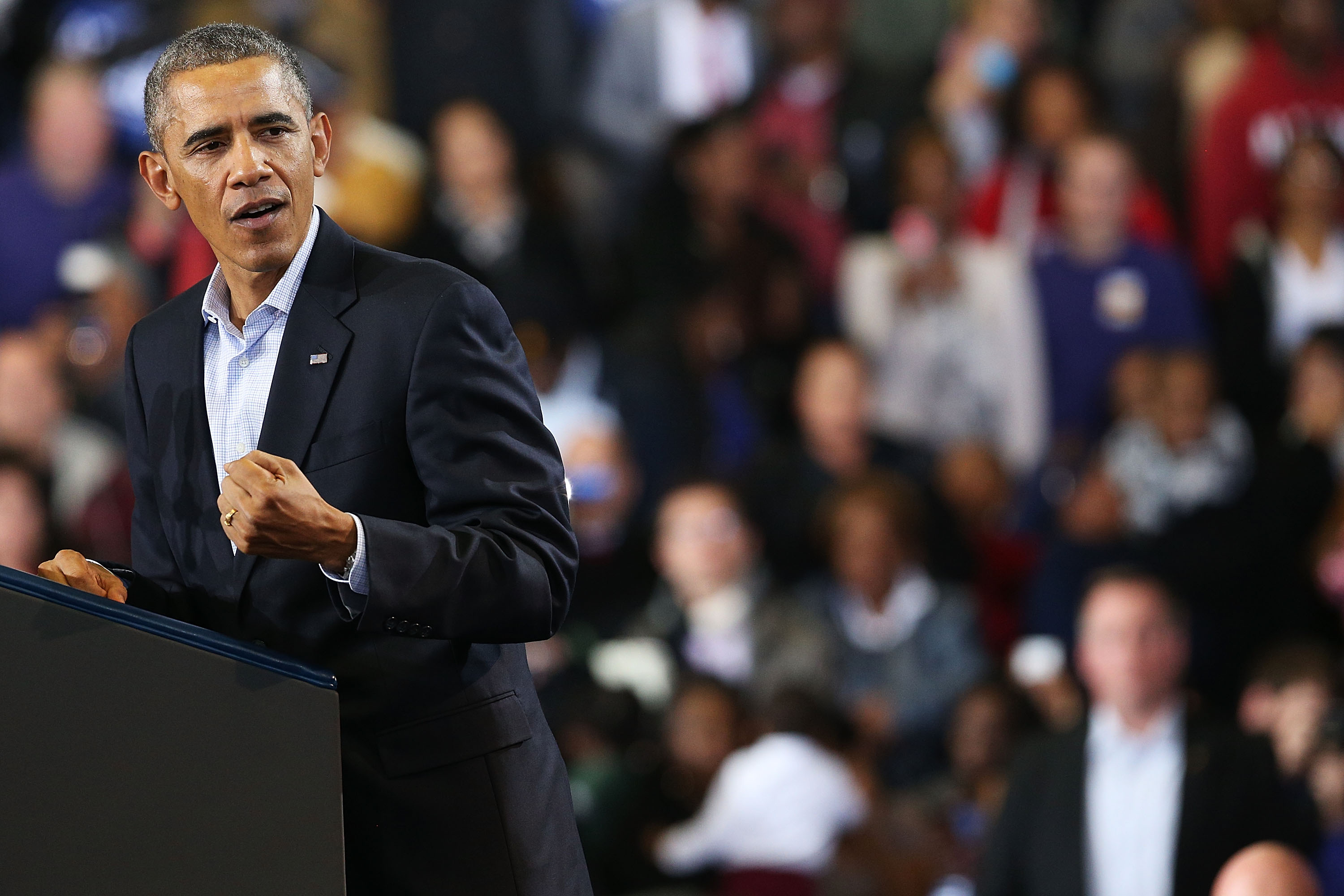
(Photo:  U.S. President Barack Obama speaks in support of Connecticut Governor Dan Malloy on November 2, 2014 in Bridgeport, Connecticut. By Spencer Platt/Getty Images.)

Face Of The Day

Sen. Mitch McConnell (R-KY) Casts His Vote In Midterm Elections

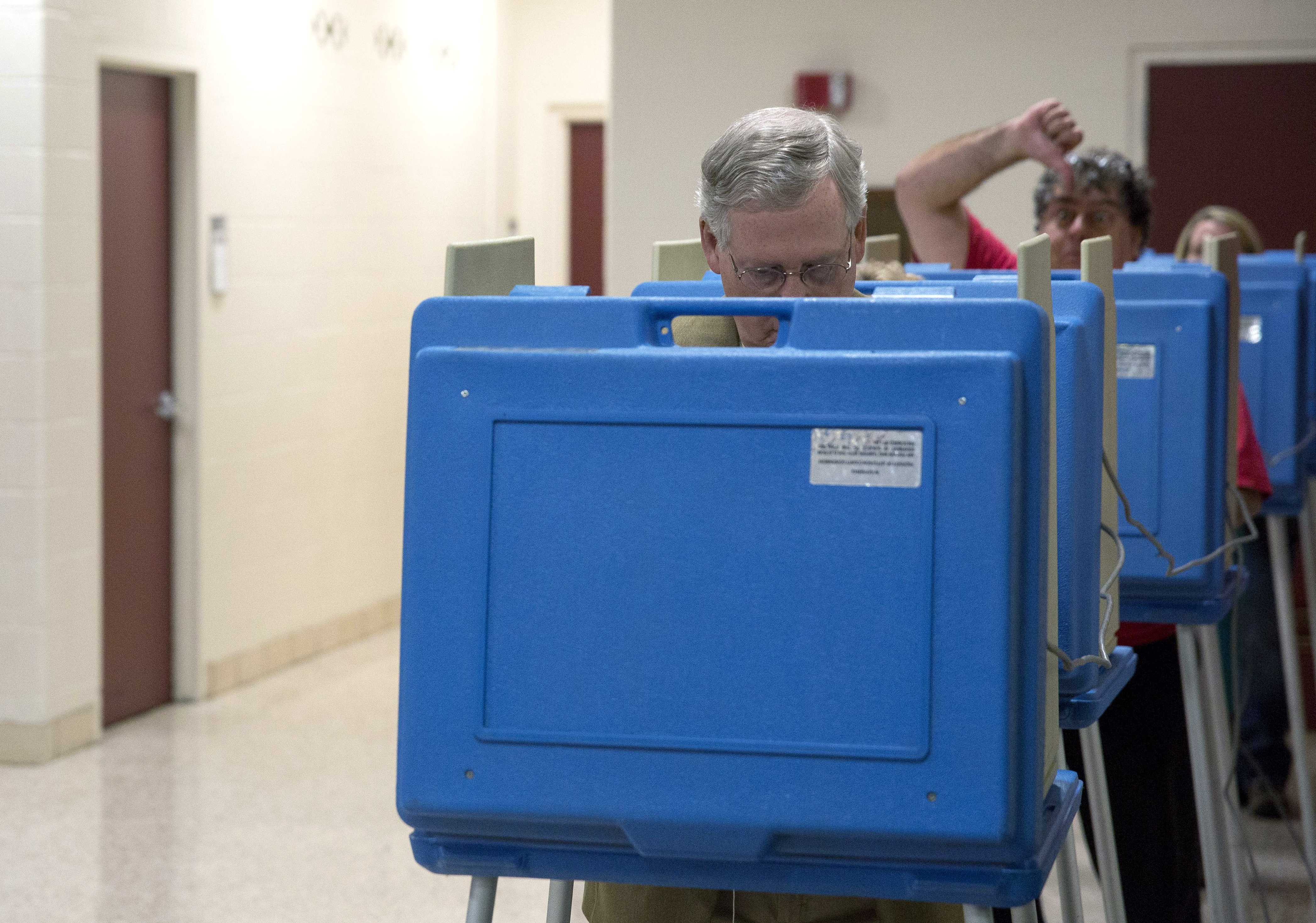
A voter gestures as Senate Minority Leader Mitch McConnell (R-KY) votes in the midterm elections at Bellarmine University in Louisville, Kentucky on November 4, 2014 . McConnell is running in a tight race against opponent Kentucky Secretary of State Alison Lundergan Grimes. By Aaron P. Bernstein/Getty Images.

The Return Of The Hawks

Michael Brendan Dougherty is depressed by the hawkish Republican candidates on the ballot:

The election may have real consequences for foreign policy, as the deadline for negotiations on an Iranian nuclear deal comes in just a few weeks. These throwback Republicans do not agree with a more libertarian or non-interventionist re-think of the GOP after the Bush presidency. If anything, they are likely to see the drawdown in Iraq after the surge as part of the ongoing problems in the region. They will pick fights with Obama over Israel now that the administration has made its displeasure with the government of the Jewish state so obvious and public. In many ways, this revival of GOP hawkishness is an attempt to re-run the 2004 campaign against John Kerry: They portray their opponents as weak on defense, and not fully committed to the national interest abroad.

If you believed, as I once did, that the Iraq War and the last years of the Bush presidency would change the GOP for decades to come, a Joni Ernst victory will highlight just how naive it was to think so.