Divided Government Down The Ballot

Tim Storey predicts more divided state governments:

U.S. states are at historic lows of divided government. Only three legislatures have chambers controlled by opposite parties (not factoring in the coalitions in New York and Washington). The last time that there were only three split legislatures was in 1944. When matched up with control of governors to determine full partisan control of state government, there are only 11 divided states headed into the election — the lowest number since 1952. With at least 11 close gubernatorial contests and about 10 legislative chambers that are truly toss-ups, it looks certain that at least some states will move from unified government to divided. That is almost guaranteed to happen in Pennsylvania, where incumbent Gov. Tom Corbett (R) trails badly in the polls. In several traditionally Democratic states like Massachusetts and Illinois, Republican gubernatorial candidates have a shot at winning, so those states could end up with divided governments as well.

Earlier Dish on the importance of state legislatures here.


The Governor Races Could Go Either Way

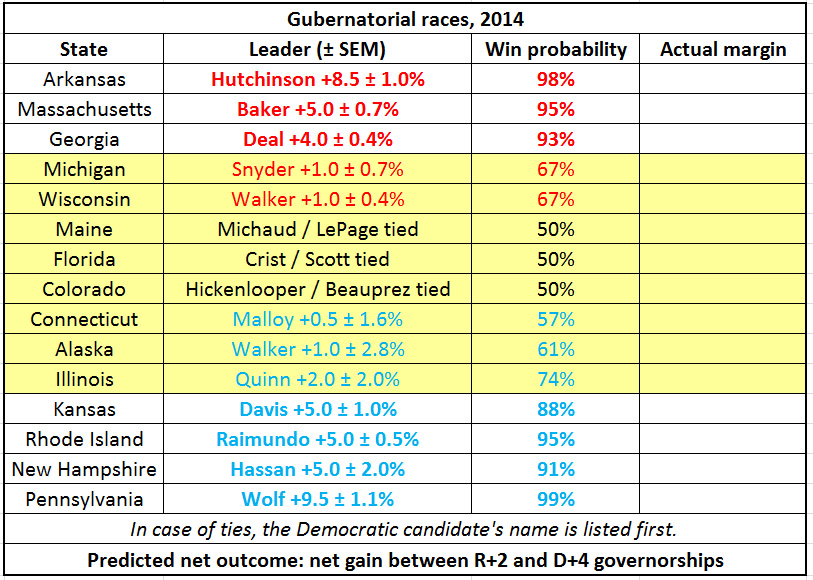
Sam Wang provides “final polling snapshots for gubernatorial races that are either close or likely to switch party control”:

gubernatorial-races-2014

Enten explains the lay of the land:

There are a lot of tight races. Five seats are forecasted to flip from Republican to Democratic or independent control: Alaska, Florida, Kansas, Maine and Pennsylvania. Two seats are projected to flip from Democratic to Republican control: Arkansas and Massachusetts. If all the FiveThirtyEight favorites win, Republicans will have 26 governorships in 2015, Democrats will have 23 and independents will have one.

Dickerson wonders about the lessons taken from the results:

Drawing a conclusion will be more complicated than simply waiting to see if Republican governors are re-elected.

If Gov. Scott Walker wins in Wisconsin and Gov. Sam Brownback holds on in Kansas, they will both be able to argue that they survived even after taking political risks to govern as proud conservatives. If, on the other hand Ohio Gov. John Kasich cruises to a big victory, that might show something different. Kasich, and Gov. Rick Snyder of Michigan, opted to take the federal Medicaid money as a part of the Affordable Care Act. Doing so was once considered heresy in conservative ranks. But now people like Newt Gingrich point to Kasich as a model for expanding the Republican Party with black voters. In Gingrich’s election-eve predictions, he cites that Kasich won the endorsement of a black newspaper. The Ohio governor won that endorsement because he took the Medicaid money. Almost all of the vulnerable Republican governors this cycle did not. Will their victories or defeats render a verdict on that decision?

Larison cautions against over-hyping the Walker result:

If Walker does end up losing, as I am predicting he will, it shouldn’t come as a great shock, nor should it be treated as such a huge setback. Let’s remember that Walker was first elected in an unusually good year for Republicans in a state that had not made a recent habit of electing Republicans to statewide office. In that extraordinarily Republican year, Walker won with 52% of the vote. In a less lopsided election year, it’s possible that Walker might not have won the first time. Considering the controversy in his first term and the attempted recall, it wouldn’t be so strange if the electorate of a normally Democratic-leaning state grew tired of Walker and chose someone else to replace him. It does Republicans no favors to exaggerate the importance of any one governor’s race, and it would be a mistake for anyone to read too much into a Walker loss.

Will The GOP Block Obama’s Judges? Ctd

Sarah Binder isn’t so sure:

[E]ven in recent periods of divided control, the opposition party has been willing to confirm roughly half of a president’s appointees to the bench — not least because such nominees are often favored candidates of opposition party senators. (And as I noted here, even after Democrats banned judicial and executive filibusters, Republican senators voted to confirm most judges even after opposing them on cloture.) This fall, for example, Obama nominated a Utah judge to a federal district court bench with the glowing support of Republican Sen. Orrin Hatch of Utah. Perhaps a Republican Senate will leave advice and consent in tatters, seeing little gain to filling seats better left open for a Republican president.  Still, I wouldn’t be surprised to see Republicans leverage their majority power to continue to secure lifetime spots on the bench for judicial candidates well known back home.

Jeffrey Rosen imagines what would happen if a Supreme Court justice dies or retires. His “optimistic” scenario:

Democrats can point to bipartisan Supreme Court confirmations, like justices Clarence Thomas and Antonin Scalia, where they have voted for nominees with whom they disagree. And there is next to zero historical evidence of gridlock causing extended vacancies (although that could be plausibly chalked up to the fact that we didn’t experience divided government very often in the early years of the republic). Even Obama himself, in a recent interview with The New Yorker, suggested there would be pressure for Republicans to approve a nominee, saying that intense media coverage of SCOTUS nominations “means that some of the shenanigans that were taking place in terms of blocking appointments, stalling appointments [to the lower courts], I think are more difficult to pull off during a Supreme Court nomination process.”

On the other hand, there’s no particular grounds for optimism with a Democratic president and Republican Senate. With their vitriolic obstruction throughout the Obama presidency, including a fight over the debt ceiling and a government shutdown, some Senate Republicans have shown a willingness to paralyze the basic functions of governmentand might be comfortable with an evenly divided Court of eight justices, which could mean repeated 4-4 deadlocks and opinions that lack precedential value.

Earlier Dish on the subject here.


Senate Democrats Are In Hostile Territory

Senate Elections

Patrick J. Egan illustrates the advantage Republicans have in this year’s Senate races:

A good measure of the parties’ relative strength in the states holding Senate elections is the share of the state vote each earned in the most recent presidential election. The figure above plots (in blue) the Democratic share of the two-party presidential vote in the median state of those holding Senate elections from 1950 through 2014. For comparison, it also displays (in gray) the share of the national popular vote the Democrats received in the most recent presidential election. For most of the past six decades, these two trends tracked each other very closely: the parties’ relative strength in the set of Senate seats up for election was no different from their strength nationally. But that changed after the 2000 presidential election, in which the Republican Party’s dominance in the South emerged in full force.

His bottom line:

Simply put, this year’s Senate elections are unrepresentative of the nation to an extent that is unprecedented in elections held in the post-war era. So when we begin to sift through the results on Election Night, the number of Senate seats won and lost will tell us less than we might like about where the two parties stand in the minds of American voters.

Jonathan Cohn adds a qualifier:

Of course, it’s not simply geography that’s undermining Democratic strength this time around. If it were, Democrats wouldn’t be struggling to hold seats in places like Iowa, which Obama won. But the electorate for this Senate race is a lot more conservative than America as a whole. That has surely made a huge, and maybe decisive, difference.

Ben Highton highlighted the Republicans’ structural advantages back in February:

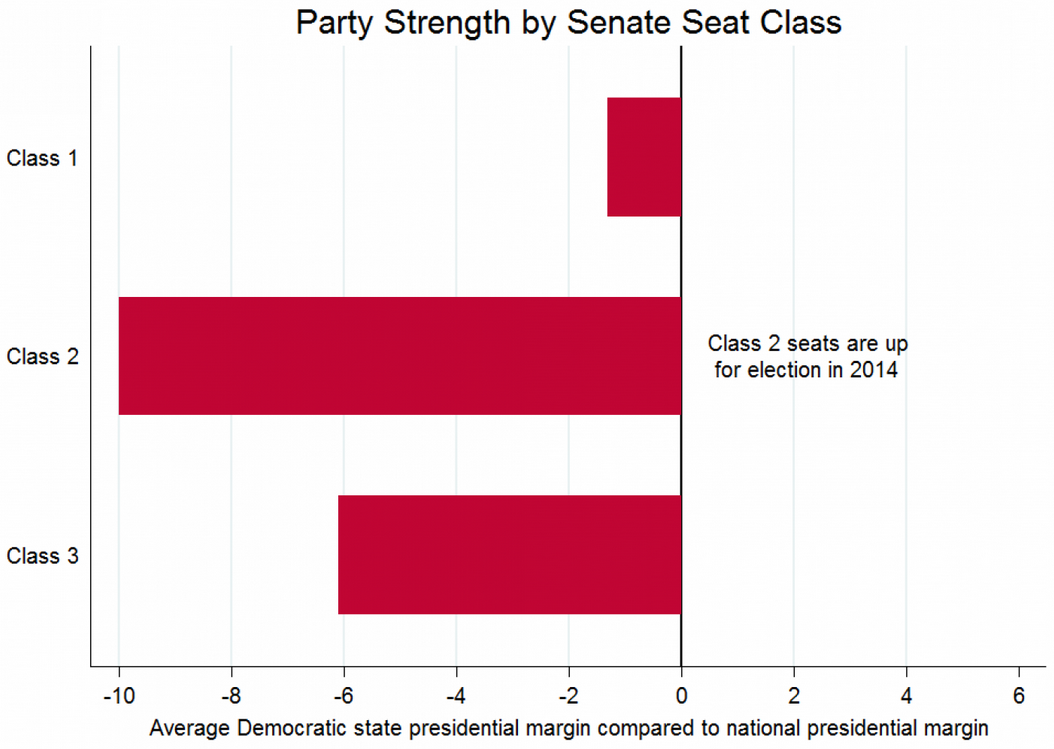
[T]he Senate treats states as equal – irrespective of population – and this gives the Republicans an advantage because on average, less populous states are more Republican than more populous ones.  What about the states that fall into each of the three Senate classes?  Compared to the national two-party presidential vote margin in 2012, class 2 states are 10 percentage points more Republican on average.  Of the three classes, this is the largest skew toward the Republicans.  The average margin in class 3 states is 6.1 points more Republican than the national presidential margin; and, the average margin in class 1 states is just 1.3 points more Republican.   Here’s a graph showing this:

Senate Seat Class

The Final Midterm Predictions

Silver gives Republicans a 76 percent chance of taking the Senate. But be prepared for a long night:

Even if Republicans win, the outcome may not be determined quickly. David Perdue, their candidate in Georgia, has gained in the polls — but the model still has the race going to a runoff about half the time. Louisiana will almost certainly require a runoff. Alaska’s vote may take days or weeks to count, as it has in the past. The FiveThirtyEight model — even with its optimistic forecast for Republicans overall — estimates there’s just a one in three chance that the election will be called for them on Tuesday night or early in the day on Wednesday. For Democrats, meanwhile, there’s almost no chance to win without going to “overtime;” the party will hope to extend the race for as long as possible.

There are two Republican wins, however, that could end the race quickly. Pay attention to races in North Carolina and New Hampshire. Both states have early poll-closing times (7:30 EST for North Carolina and 8:00 EST for New Hampshire) and a Republican win in either state would require Democrats to run the table in almost every other competitive race. But Republican wins would simultaneously indicate that the polls might be biased toward Democrats rather than against them, making a Democratic sweep the rest of the night very unlikely.

Cassidy’s guess is 53-47 for the GOP:

In a post on Friday, I pointed to evidence that late deciders appear to be breaking to the Republicans, particularly in the South. In states like Arkansas, Georgia, Kentucky, and Louisiana, that trend is clearly visible in the latest polls. Alarmingly for the Democrats, something similar may well be happening in Colorado and Iowa, two seats they currently hold. Of the ten battleground states, the Democrats’ best bets are now North Carolina and New Hampshire, where their candidates are holding on to narrow leads. Then there is Kansas, where the contest between Greg Orman, an independent businessman, and Pat Roberts, the three-term G.O.P. incumbent, remains a toss-up.

Sabato also forecasts 53-47. On the close races:

The Kansas race between embattled, weak Sen. Pat Roberts (R) and independent Greg Orman is perhaps the closest, most difficult-to-predict Senate race in the country. However, at the end of the day, a Republican has not lost a Senate race in this state since 1932. It may happen, but we just can’t pull the trigger and predict it. LEANS REPUBLICAN

We’ve been calling Georgia and Louisiana “Toss-up/Leans Runoff” in recent weeks because we expected both to eventually go to runoffs. Louisiana will, and Georgia might, but we now believe Republicans are favored to eventually win both. So we’re just going to call both LEANS REPUBLICAN going into Election Day: If both do in fact go to runoffs, then the Leans GOP ratings will apply, at least initially, to the overtime contests.

John Sides joins the chorus:

[W]hen we debuted Election Lab on May 5, we estimated at that point that the GOP had a 77 percent chance of winning and was predicted to win 53 seats.  We predict 53 seats again today.  The only change is that Michigan and Colorado are flipped relative to that earlier forecast.

Morrissey bets that a “Republican wave will run the table”:

And even if Republicans only manage to win six seats while not keeping Kansas, another dynamic will come into play, which is the desire to be part of a majority. Orman might end up caucusing with Republicans, although that seems temperamentally unlikely, but that’s not as true for Angus King of Maine. King endorsed Lamar Alexander in Tennessee last week, so he’s not hostile to the Republican caucus. If the GOP ends up with 51 or more seats, King may cut a deal to strengthen Republican numbers even further. Whether he’d do that in case the GOP wins only 50 seats is anyone’s guess, but the Maine Sun-Journal thinks that would be unlikely.

Waldman doesn’t expect a “wave,” much less a mandate, for the GOP:

If they manage to take the Senate, it will be because most of the incredibly close races this year tipped their way in the end. Which would undoubtedly be a victory, but it would be hard to argue that the GOP squeaking out wins in deep-red states in the South and adding a couple in swing states like Iowa or Colorado represents some huge shift in public sentiment. New polling data suggests that even if Republicans do take the Senate, we’re hardly looking at a “GOP wave.” The final pre-election poll from NBC News and the Wall Street Journal was released today, and it shows the two parties nearly deadlocked (46-45 in Republicans’ favor) in the generic ballot test among likely voters. Democratic voters’ interest in the campaign has risen to match Republicans’, and approval of the GOP as a party remains abysmal. There’s also evidence to suggest that turnout will be low.

Charlie Cook calculates that “a seven-seat gain would seem the most likely outcome for the GOP, with eight a bit more likely than six, but either highly possible.” What would qualify as a wave?:

The first test of the existence of a political wave is whether the benefiting party avoids losing many of its own endangered seats. The second is whether it wins an overwhelming number of the purple, competitive or, in this case, light blue Democratic-tilting but still endangered seats. So, if Republicans limit their own losses to just one of their own competitive seats (for example, Roberts in Kansas) and win at least three of the four key purple states (the open seat in Iowa and the three seats held by Democratic incumbents—Kay Hagan in North Carolina, Jeanne Shaheen in New Hampshire, and Mark Udall in Colorado), that starts qualifying as a wave. Just winning one or two out of the four neutral-site contests might well help the GOP secure the majority, but it hardly qualifies as a wave. These are seats where it is the political environment and President Obama, not the map itself, that are the cause of Democratic pain. Obama carried all four states in both 2008 and 2012; losses in these would mean voters who voted for him have officially reversed course.

The third test of a real wave is the ability of a party to pull off real upsets, knocking off incumbents who were not on the lists of first- or second-tier vulnerable seats. If, for example, someone like Mark Warner in Virginia, Al Franken in Minnesota, or Jeff Merkley in Oregon were to lose, that would be a wave in the sense of 1980, 1994, 2006, or 2008. These years saw wins that were way more than just a result of the map. There now appears to be little chance that any of these three will lose their races.

Update from a reader:

Cook says that Obama carried Iowa, North Carolina, New Hampshire, and Colorado in 2008 and 2012. This is not correct, as Mitt Romney won North Carolina in 2012.
Much Ado About A White President

When Zambian president Michael Sata died last Tuesday, his vice president, Guy Scott, stepped in to take his place until new elections are organized, thus becoming the first white head of state in a post-colonial African democracy. Alexander Mutale calls this “a remarkable moment” that “says a lot about this particular country’s remarkable success in navigating the complexities of post-colonial ethnic politics”:

Despite its temporary character, Scott’s appointment still marks a watershed for post-colonial Africa. It’s a sign of how Zambia has managed to move beyond the divisive racial politics that has dominated the continent for five decades — in sharp contrast to, say, neighboring Zimbabwe, where the colonial past still weighs heavily on the political present. Zambia’s unique position attests to the enduring legacy of its first post-independence leader, President Kenneth Kaunda, who strongly advocated policies that encouraged ethnic, religious, racial, and regional integration. Despite more than 70 different tribal groups, the country’s reputation for stability has made it something of a model for other African democracies.

Scott can’t run in the elections for Sata’s permanent successor because Zambia’s constitution requires that presidential candidates have Zambian-born parents. Scott’s parents emigrated from, well, Scotland, but if he were eligible, Stephen Chan doubts that voters would reject him simply on account of his race:

In fact, Scott would have made a very good president – and he would have been accepted by the voters, who would even have boasted about their taste for irony and the good race relations their country had accomplished. The world might raise its eyebrows, but this 90-day caretaker period will be a footnote in African history. A footnote, but a meaningful one nonetheless: even after an atrocious colonial history in which white rulers earned themselves an appalling reputation, Zambia is showing how a majority black nation can be rather more mature about these things than most of the old colonial powers.

Namwali Serpell rolls her eyes at how foreign media have made Scott’s race the headline of the story, noting that Zambians, by and large, have more important things on their minds:

Zambians have been more focused on another constitutional change, to electoral policy: from a simple majority to a “50% plus one vote” majority, with a run-off between two finalists if necessary. This makes a big difference in a democracy that evinces a true commitment to a multi-party system (the last election had 10 parties with statistically significant votes). With this kind of complexity, the wisest move on PF’s part is to allow white Guy Scott, the man least likely to run, to hold the reins until the real contenders have wrangled it out. What’s on people’s minds isn’t the colour of Scott’s skin; it’s which candidate PF will select among the range of other possible successors to Sata

This African scholar also downplays the race thing:

What Giving Gives You

Christian Smith and Hilary Davidson elaborate on their finding that “only 3 percent of American adults give away 10 percent or more of their income”:

We find a strong and highly consistent association between generous practices and various measures of personal well-being like happiness, health, a sense of purpose in life, and personal growth. In our book [The Paradox of Generosity] we discuss the various causal mechanisms that produce this association. While greater well-being can encourage generosity, practices of generosity also enhance well-being.

The causal mechanisms we identify involve everything from reinforcing positive emotions to developing a sense of self-efficacy to expanding social networks to increasing physical activity. Generosity, for example, often triggers neurochemical systems that increase pleasure and reduce stress. It also has the capability of reducing the maladaptive self-absorption that many ungenerous Americans experience. By giving away some of our resources for the well-being of others we can enhance our own. By clinging to what we have, we shortchange ourselves. …

Our interviews with Americans who do not practice generosity reveal that they are deeply unsettled by individual and social problems. Yet they do not think they have any obligation to respond, and even if they do, they feel inadequate to make a difference without sacrificing their ability to care for their own needs. Feeling vulnerable to broader societal problems, the instability of the marketplace, material scarcity, and the challenges that come with relational intimacy, they respond by hunkering down, either alone or with immediate family members, to simply try to weather the storm. They imagine other people as restrictions on their autonomy.

When The Right Fell For Ronnie

Last week marked the 50th anniversary of Ronald Reagan’s “A Time for Choosing” speech, which he gave on prime-time television in late October 1964 in support of Goldwater’s presidential campaign. Jeff Shesol takes us back to that pivotal speech, which made Reagan a darling of the conservative movement:

“I don’t have but one speech,” Martin Luther King, Jr., once said. “I don’t have but one message as I journey around this country.” Few of King’s contemporaries took this notion to heart more fully than Ronald Reagan.

Beginning in 1954, when Reagan became, in effect, the in-house motivational speaker for General Electric, he delivered, many hundreds of times, what was known as “The Speech.” From plant to plant, from one year to the next, Reagan honed his script, reshuffled his note cards, and updated his anecdotes, but his theme—the threat of an encroaching, expanding government—did not vary. It was less a speech than a sermon, as Reagan himself understood—a malediction against the evils of income taxes, federal spending, central planning, godless Communism, and government controls on commerce and freedom. “We’ll preserve for our children this, the last best hope of man on Earth, or we’ll sentence them to take the last step into a thousand years of darkness,” Reagan said. If there is such a thing as a feel-good jeremiad, Reagan invented it. … The Speech—rechristened, for that occasion, as “A Time for Choosing”—helped to define the G.O.P. and conservative politics for more than a generation.

Watch the whole speech here.

The State Of The Race In Kansas

Last night a reader wrote from the Sunflower State about being “beaten to a pulp … on my phone”:

Hey Andrew & Co., I don’t know if you’re getting any traffic/messages on this, but the robocalls here in Kansas are incessant, demoralizing, and one-sided … at least if my experience, and the experiences of my friends and colleagues, are any sort of indicator. I have used my mobile device to record four calls today – to my office phone. I work at a state university here in Kansas. Pat Roberts has decided to beat people into submission. Here’s Newt GingrichRand Paul, Ted Cruz [embedded above], and Dr. Milton Wolf (he was the biggest threat to Roberts during the primaries and was exposed for sharing autopsy photos on his Facebook account and blog … and making jokes about them).

Again, this is ONE WORK DAY … so far.

My message light has been blinking all morning, which means there are messages from the weekend and Friday night. I’m sure I have more. I averaged about one or two per evening last week, just before Halloween. Tim Huelskamp’s wife called one evening. I think that’s the only state candidate I’ve heard from – all the other calls have been stumping for Pat Roberts.

I can’t wait for Wednesday morning.

Join the club. Update from a reader with some crucial perspective:

I’ve worked on two Congressional campaigns and managed a state legislative campaign.

Every campaign manager with any sense knows robocalls have no effect whatsoever. This has been known, and proven over and over, for at least 10 years. Money quote:

Don Green, a political science professor at Yale, subjected robo-calls to 12 randomized experiments for his 2004 book “Get Out the Vote: How to Increase Voter Turnout.” The results, he says, were revealing. “These calls never raise voter turnout. They have no mobilization effect, and no persuasion effect either. What matters is whether they change the probability of voting, and robo-calls have proven they do not.”

Never. Raise. Turnout. No Persuasion Effect. Ever. Any campaign sending out even one robocall is wasting its money and hurting its own cause.

Previous reader dispatches from Massachusetts, South Dakota, and Texas.

The Best Of The Dish Today

First up, this:

Next up, a reader sends this image:

Screen shot 2014-11-01 at 4.03.17 PM

And writes:

The ad in the attached screenshot popped up on the BBC site. My subconscious just assumed it was you all. Took a couple minutes before the reality registered.

And what exactly about a saving of $420 reminded you of us?

Anyways (big sigh), today we entered the final, depressing, brutal day of the midterms in a brutally polarized polity. Some thoughts: what it means for 2016 (not much); how the fear factor may be decisive; why Ted Cruz could spoil the GOP’s after-party; and how the one thing that really hangs in the balance is the composition of the judiciary in Obama’s last two years.

Plus: those moderate Syrian rebels? They just capitulated to al Qaeda. As Obama suspected they would (and McCain didn’t). And just in case the news was not completely dispiriting, remind yourself that we have probably passed the point of no return on climate change.

My personal favorite of today’s posts: another fascinating, colorful reader thread on cat-calling.

The most popular post of the day was The Significance Of A Smile; followed by New Feminism; Old Moralism.

Many of today’s posts were updated with your emails – read them all here.  You can always leave your unfiltered comments at our Facebook page and @sullydish. 26 more readers became subscribers today. You can join them here – and get access to all the readons and Deep Dish – for a little as $1.99 month. Gift subscriptions are available here. Dish t-shirts are for sale here, including the new “Know Dope” shirts, which are detailed here.

See you in the morning.