A Mild Republican Wave

political tide

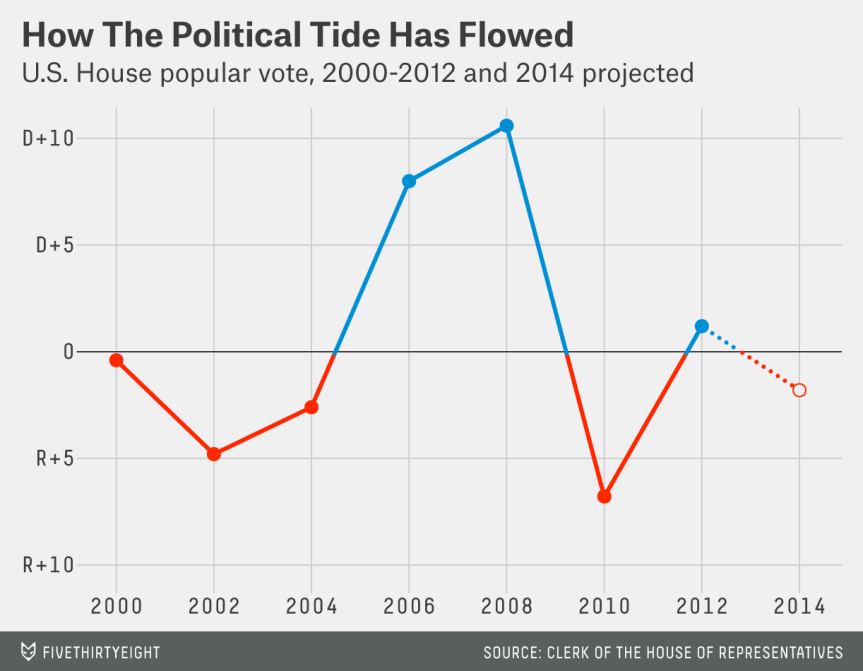
Silver compares 2014 to past elections:

The data point for 2014 reflects this year’s generic congressional ballot, a poll-based projection of the national House vote. There’s been huge variation from survey to survey on the generic ballot, but the average currently favors Republicans by about 2 percentage points. If the average is about right, it would tell us the same thing we inferred a few paragraphs ago: 2014 is a better year for Republicans than 2012 and a much better year than 2008 but not as good as 2010.

So maybe this isn’t so complicated, after all. The polling data we have tells a pretty consistent story. The challenge is in the different interpretations it will enable, all of which will feature prominently in the post-election spin.

Sam Wang largely blames the gains Republicans are likely to make in the House on gerrymandering:

The House is, in many ways, a predictable game: a modest gain in the popular vote will very likely lead to even further seat gains. Roughly speaking, gaining one percentage point in a popular-vote victory should translate to approximately three more seats. A popular-vote tie would lead to a gain of four seats, and a two-percentage-point win would lead to a gain of ten seats. If the G.O.P. gains eight seats—well within the realm of possibility—they will make up all their losses of the 2012 election. This would put the House back to where it was after the election of 2010, a so-called wave year, when voter opinion swung strongly to the right. Using the tool of redistricting, they have successfully tilted the political playing field to secure a large majority for at least the next two years without the same popular appeal.

The governor’s races are a different story. Wang checks in on them:

At this point, races fall into the following categories:

Incumbents headed for probable defeat (>3 percentage point margin): Brownback (R-KS), Corbett (R-PA).

Incumbents under threat (<3 percentage points): Parnell (R-AK), Deal (R-GA), Snyder (R-MI), Walker (R-WI), LePage (R-ME), Scott (R-FL), Quinn (D-IL), Malloy (D-CT), Hickenlooper (D-CO).

Open governorships, clear lead (>3 percentage points): Raimondo (D-RI), Baker (R-MA), Hutchinson (R-AR).

The expected net range of outcomes (1 sigma, about 68% of possibilities) is D+0.4 ± 1.3 governorships, which translates to between 1 net gain by Republicans to 2 net gains by Democrats.

A Defense Of Occasional Voters

 Sendhil Mullainathan mounts one. He discovered that voting increases polarization, that it “effectively committed people to a candidate or party”:

A combination of neutrality and persistent voting would be ideal. But our psychologies are complicated. If they override our narrow self-interest and lead us to vote instead of free-riding, the very act of voting may make us more partisan. Sporadic voters can provide an antidote: Their previous lack of engagement may serve as a counter to partisanship.

There is a line between apathy and neutrality. People who sit out all elections provide little value to a democracy. People who sit out some elections, jumping in at crucial times, serve an important role as a reserve army of the uncommitted.

Where There’s A Will (And There Is)

Stains

You have more willpower than you think, according to Jason Hreha:

Recent studies have failed to replicate the finding that willpower is, indeed, a limited resource. Other research, done in 2013 by Carol Dweck and colleagues, has shown that one’s beliefs about willpower affect how much willpower one has. Far from being a limiting factor, willpower seems to be a reflection of one’s beliefs and biology. Beliefs are things, and they can change how we survive and thrive within the world. If you see yourself as containing a limited amount of self control, it’s unlikely that you’ll make the extra effort to forgo dessert, or hit the gym, since you’ll “burn out anyways.”

Even though a substantial amount of research has challenged the idea of limited willpower, millions of people throughout the world have incorporated this spurious idea into their mental models of themselves and people in general. … There is no greater shackle than a false idea and, as the willpower field shows, ideas once “true” can become questionable, even false, in due time.

Malkin Award Nominee

“I’m sure Pius XII would have denied that signing a Concordat with Hitler’s Germany meant he approved of Nazism. But it conferred legitimacy and dramatically undercut any basis within the Church for resistance. The same goes for the concordat many Catholic institutions are signing with gay marriage. It confers legitimacy on the sexual revolution and undercuts resistance.

I can understand why Pius XII sought the Concordat with Hitler. He hoped to secure a stable basis for the Church’s ministry in Germany. I can also understand why many Catholics (including, perhaps, Pope Francis) want to make their peace with the sexual revolution, putting “divisive” culture-war issues behind them so that they can go on with the work of the Gospel and so forth. Moreover, Hitler in 1933 didn’t look so bad—and respectable gay couples don’t seem a threat to marriage or anything else,” – R.R. Reno, First Things.

(Hat tip: Alan Jacobs)

A GOP Senate Gets More Likely

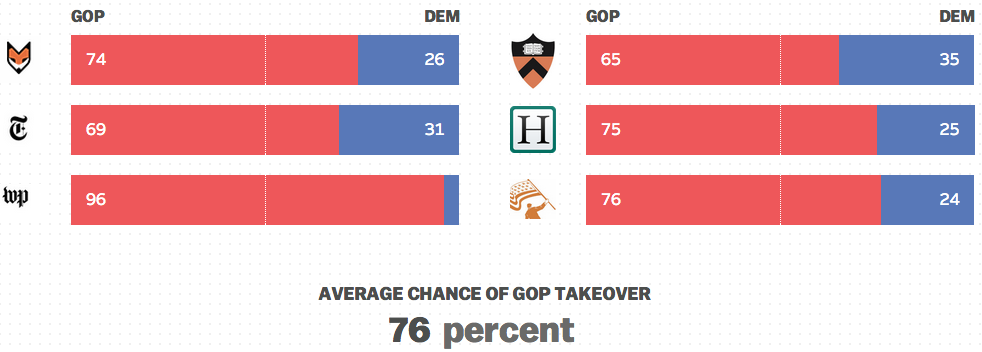
The forecasts increasingly favor Republicans:

GOP Chances

At this point, Democrats hoping for an upset are largely banking on the polls being wrong. Nate Silver explains:

The FiveThirtyEight model accounts for the possibility that the polls could be systematically biased — in either direction. If I instead tell the model to assume the polls have no overall bias — even though they might be off in particular states — the Democrats’ chances of keeping the Senate would be just 17 percent. Democrats are becoming increasingly dependent on the possibility that the polls will prove to be “skewed.”

But Silver notes that the polls “could be biased against Republicans, too”:

Historically, that’s been the case often than not in red states like the ones where some of the most crucial Senate races are being held.

Enten thinks “the more pressing question now may be the size of the Republican majority come next Congress”:

New polls out this weekend suggest that Republicans may not just win the six seats they need for control, but quite possibly eight seats — Republicans now have a 41.4 percent chance of doing just that. … If we add up all the states where Republicans lead, they will win eight seats for 53 seats in the next Senate. Sure, Democrats still have chances in Alaska, Colorado, Georgia and Iowa. But the Republican position is holding steady, if not improving, in all the states they need for a majority.

Chris Cillizza examines the toss-up Senate races:

* Alaska (Democratic controlled): Election Lab 79 percent Republican, LEO 67 percent Republican, FiveThirtyEight 71 percent Republican

* Georgia (Republican controlled): Election Lab 67 percent Republican, LEO 58 percent Republican, FiveThirtyEight 68 percent Republican

* Iowa (D): Election Lab 89 percent Republican, LEO 68 percent Republican, FiveThirtyEight 71 percent Republican

* Kansas (R): Election Lab 97 percent Republican, LEO 51 percent Independent, FiveThirtyEight 54 percent Independent


What 2014 Means For 2016

Not much, according to Sean Trende:

Any outcome we’ll see is likely to be roughly consistent with the underlying electoral fundamentals — a Democratic president’s low job approval rating, a tepid economy, a bad playing field for Democrats in the Senate and a good one in the House.  Back in the winter, when “fundamentals”-based models were being produced, people were predicting Republican gains in the Senate in the range of six-to-eight seats, with error margins putting us in something of the four-to-10 seat range.  This seems to be where we are headed.

But the upshot of this is that we can’t make grand predictions about 2016 and beyond.  If 2014 was well-predicted by fundamentals (as were 2008 and 2012), we should continue to expect that elections will be well-predicted by fundamentals; we should prefer a parsimonious explanation to a more complex one.  It is Republicans substantially over-performing or under-performing that might be meaningful, not Republicans getting what we’d expect, given the circumstances.

But, in Nate Cohn’s estimation, if Tuesday “night ends with tight races in Iowa, North Carolina, Colorado and Georgia, as the polls suggest, then the results will not be as great for Republicans as many analysts will surely proclaim”:

If there were a time when the Republicans ought to be making inroads into the Obama coalition, this should be it. The economy remains mediocre in many respects; there is turmoil in much of the world; and the American public is decidedly downbeat about the state of the country under Mr. Obama. His approval ratings have sagged into the low 40s. A significant proportion of Democratic-leaning voters say they disapprove of his performance.

Historically, presidential ratings like these have permitted the party that does not hold the White House to make substantial gains. This year, however, Democratic Senate candidates in the battleground states have largely reassembled the coalition that supported Mr. Obama two years ago. Democratic candidates would probably win Colorado, North Carolina, Iowa and Georgia — along with control of the Senate — if those who vote were as young, diverse and Democratic as they were in 2012 or will be in 2016.

A Major Setback For Space Tourism

Virgin Galactic SpaceShipTwo Crashes During Test Flight In Mojave Desert

Kenneth Chang brings us the latest on the Virgin Galactic tragedy:

The Virgin Galactic space plane that broke apart over the Mojave Desert on Friday shifted early into a high-drag configuration that was designed to slow it down, federal accident investigators have said. The accident killed the co-pilot, Michael Alsbury; the pilot, Peter Siebold survived after parachuting out of the plane.

Clive Irving puts the disaster in perspective:

From the beginning in 2004 there has always been a credibility gap between the fairground hyperbole of [Virgin Group founder Richard] Branson’s formidable publicity machine and the scientific reality of the enterprise. Somehow, probably because he is such a consummate showman, Branson has been able, year after year, to override the story of continual delays, flagrant over-promises and a voracious, seemingly open-ended budget. This time it’s different. A National Transportation Safety Board investigation will deliver a forensic rigor that has been so far lacking. It will strip away the vocabulary of the promoter. And it will reveal the world as lived daily by the engineers and test pilots who knew how much was left to be understood among the hazards of the dream.

Adam Rogers predicts that, following this crash, “we’re going to hear a lot about exploration, about pioneers and frontiers. People are going to talk about Giant Leaps for Mankind and Boldly Going Where No One Has Gone Before.” He recommends we “call bullshit on that”:

SpaceShipTwo—at least, the version that has the Virgin Galactic livery painted on its tail—is not a Federation starship. It’s not a vehicle for the exploration of frontiers. This would be true even if Virgin Galactic did more than barely brush up against the bottom of space. Virgin Galactic is building the world’s most expensive roller coaster, the aerospace version of Beluga caviar. It’s a thing for rich people to do: pay $250,000 to not feel the weight of the world.

Jazz Shaw focuses on the financing of such projects:

The problem I’m wondering about here is that there are really only two target customer markets for these ventures. The government is the only viable buyer for services to ferry materials and astronauts to the space station. And while the government is a very regular customer, one change in administration or shift of a few decimal places in a budget committee report can dry up your sales overnight. The only other customers for an entity like Virgin Galactic are very high end, wealthy tourists. Initial ticket sales – even at a quarter million a seat – have been brisk, but one or two explosions can dampen the enthusiasm of your target audience. And even if everything had gone perfectly, there is surely a limit to the number of buyers for a service like this once the novelty has worn off.

Mataconis calls Virgin Galactic “little more than a Richard Branson vanity project that was unlikely to lead to a viable business in the near future.” But he is more optimistic about “the side of commercial space travel represented by companies like SpaceX, Boeing, and Orbital Sciences”:

For the time being, there’s obviously not going to be the kind of free market in space that some evangelists for commercial uses of space have talked about in the past. One imagines, for example, that Branson’s “space tourism” idea is pretty much dead for at least the next decade in much the same way the civilians in space program was put on hold after the Challenger disaster, but the involvement of private companies in the space program is likely to increase. Don’t be surprised, for example, to see things like SpaceX, Boeing, and other companies contracting directly with private companies for launches rather than going through the Federal Government. In other words, there is a future for the commercialization of space to some degree, but much of most of our efforts to “slip the surly bonds of Earth,” it is still at the point where we are moving slowly.

Wilson da Silva, who pre-purchased a Virgin Galactic ticket, is still excited about going into space. He compares the histories of space and air travel:

The pioneers of powered flight, brothers Wilbur and Orville Wright – who gave birth of the modern age of flying – experienced a fatality in September 1908, on their third demonstration flight for the US Army before a crowd of 2,000 people in Fort Myer, Virginia. Orville took up one passenger with him, and the third of these – 26-year-old Lieutenant Thomas Selfridge – became the first passenger to die in an aircraft accident: the propeller came off, and the plane nosedived 23 meters; Selfridge died from a fractured skull, and Orville suffered a broken leg and ribs.

Aviation become important in World War I, but despite some advances in the 1920s, it was still dangerous and fatal accidents were routine. Pilots flew 100m above ground, navigating by roads, railways and compasses. It took years of flying and experimentation before air travel became safe. Between 1920 and 1926, one in every four pilots was killed annually; in the 1930s, one in 50. By 1966, it was one in 1,600.

Alex Tabarrok remarks that “the safety of rockets continues to be far too low to support significant tourism”:

Virgin Galactic’s VSS Enterprise, which crashed [Friday], was just on its 23rd powered flight suggesting a failure rate of perhaps 5%, in line with expected values. An earlier tragedy involving tests of the rocket motor killed 3 people. As I said ten years ago, even a failure rate of 1 in 10,000 is far too high to support space tourism of the “fat guys with camera” variety and we are not yet close to a failure rate of 1 in 10,000.

Dish’s coverage of last week’s other aerospace accident, the Antares rocket explosion, is here.

(Photo: Debris from Virgin Galactic SpaceShip 2 sits in a desert field north of Mojave, California on November 2, 2014. By Sandy Huffaker/Getty Images)
“The Emerging Age Of Inheritance”

Joel Kotkin contemplates it:

The Social Welfare Research Institute at Boston College estimated that a minimum of $41 trillion would pass between generations from 1998 to 2052. This huge transfer, the researchers believe, will usher in what they call “a golden age of philanthropy.” Even as most younger Americans struggle to obtain decent jobs and secure property, the Welfare Institute concluded, America is moving toward an “inheritance-based economy” where access to the last generation’s wealth could prove a critical determinant of both influence and power.

He realizes that “the biggest long-term impact may come from the nonprofit institutions that the wealthy fund”:

Nonprofit foundations have been growing rapidly in size and influence since the late ’20s, paralleling the expansion of other parts of the clerisy like the universities and government. Between 2001 and 2011, the number of nonprofits increased 25 percent to more than 1.5 million. Their total employment has also soared: By 2010, 10.7 million people were employed by nonprofits—more than the number of people working in the construction and finance sectors combined—and the category has expanded far more rapidly than the rest of the economy, adding two million jobs since 2002. By 2010, nonprofits accounted for an economy of roughly $780 billion and paid upwards of 9 percent of wages and 10 percent of jobs in the overall economy.

Nonprofits, due to their accumulated wealth, are able to thrive even in tough times, adding jobs even in the worst years of the Great Recession. In the past these organizations might have tended to be conservative, as inherited wealth followed the old notions of noblesse oblige and supported traditional aid to the poor, such as scholarships and food banks. But the new rich, particularly the young, tend to be more progressive, or at least gentry liberal.

“The Internet Of The Enlightenment”

The leading lights of the Enlightenment weren’t as worldly as we imagine they were, according to recent research from Stanford:

CESTA’s biggest project is Mapping the Republic of Letters, a catch-all title for a series of studies, including [Giovanna] Ceserani’s, that aim to shed light on the internet of the Enlightenment: the network of correspondence that linked intellectuals in the 17th and 18th centuries. “We’re like the NSA,” says Dan Edelstein, a professor of French. “We look at who wrote to whom, when and where.”

An obvious target for this form of surveillance was Voltaire.

Among his many contributions to the Enlightenment was his “Lettres Philosophiques”, published in 1734, which he claimed introduced Locke to a French readership. Voltaire had lived in Britain for three years and spoke English. So when Edelstein first looked at the visualization of his correspondence, “what jumped out at me was that Voltaire wrote so little to Britain. There were only 140 letters out of a total of around 15,000—less than 1 percent.” …

This is a recurrent theme in the Republic of Letters project. The networks of the intellectuals of the Enlightenment were far more restricted than the academics had imagined. Paula Findlen, a professor of Italian history, says the same was true of Galileo. “We think of him today as perhaps the first scientific celebrity. But he lived in a relatively local world until he was forced not to.” It was only after this great polymath came under the menacing gaze of the Inquisition that he reached out for help to non-Italian intellectuals.