Victoria Coates asserts that throughout history “democracies have demonstrated a special capacity to produce extraordinary self-referential works of art.” Her examples:
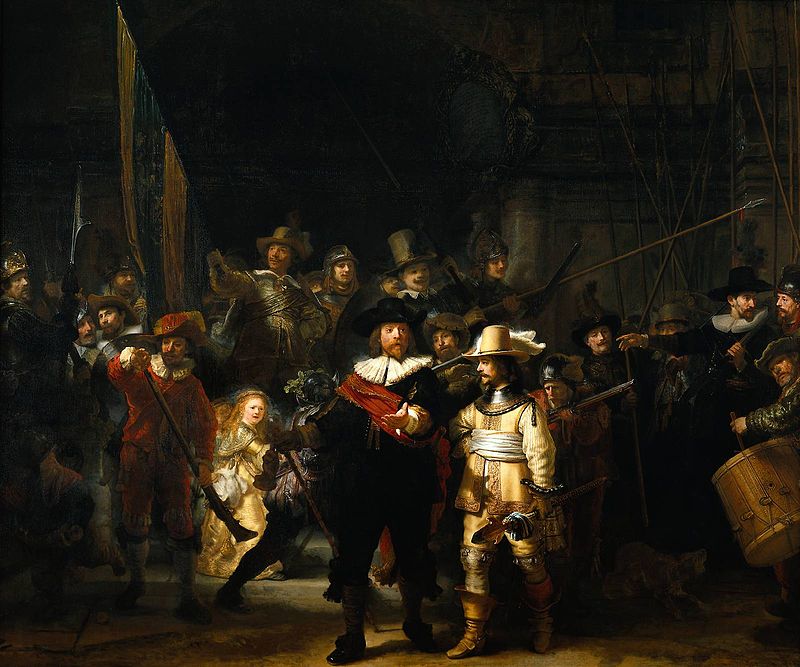
The Parthenon and David are examples from a larger series of works of art and architecture inspired by democracy. There is the bronze portrait of Brutus that legendarily portrays the founding hero of the Roman Republic’s stern features. St. Mark’s Basilica in Venice is a splendid jewel adorning a city-republic that built its own solid ground and grew fabulously wealthy through maritime trade. Rembrandt’s Night Watch honors the citizen militias that proudly defended the liberty of the Dutch Republic, which, like Venice, reclaimed land from the sea and prospered far beyond its size. InThe Death of Marat, Jacques-Louis David memorialized the tragic sacrifice of the revolutionary “Friend of the People” in the turmoil surrounding the first effort to establish a French republic. By salvaging the marble sculptures from the decaying Parthenon and putting them on permanent display in London, Thomas Bruce, Seventh Earl of Elgin converted the work of Phidias into a proclamation that the British constitutional monarchy was the worthy modern heir of democratic Athens.
Albert Bierstadt’s Rocky Mountains, Lander’s Peak conveys the huge potential of a young democracy in the untamed spaces of the New World, even while a brutal civil war threw the whole American project into doubt. Claude Monet offered his Nymphéas (“Water Lilies”) to the French Third Republic to commemorate the hard-won victory of his friend, Prime Minister Georges Clemenceau, over imperial German aggression. Finally, Picasso’s harrowing Guernica is a stark reminder of the existential threats to democracy, such as Fascism, that gathered in the twentieth century.
Each object is part of its own nationalistic narrative and gives us a snapshot of a particular point in the trajectory of the state. All of them provide tangible pieces of historical evidence that are in some ways more reliable than texts (although texts abound in this line of study) and offer powerful insight into successive efforts to establish and sustain a democracy. They are not isolated aesthetic objects; part of their value as historical evidence derives from their active roles in the public life of the communities that produced them.
(Rembrandt’s The Night Watch, 1641, via Wikimedia Commons)
 The Dish
