Tastefulness is just small-mindedness, pretending to be art. And Christmas isn’t tasteful, isn’t simple, isn’t clean, isn’t elegant. Give me the tacky and the exuberant and the wild, to represent the impossibly boisterous fact that God has intruded in this world. Give me churches thick with incense and green with pine-tree boughs, the approach to the altar that feels like running an obstacle course through the poinsettias, and a roar from the bell towers so ground-shaking that not even the deaf can sleep in. See these spires aspire to heaven, as I wrote in one of my new Christmas carols this year. Hear these bells rejoice to ring.
A follower once asked St. Francis—oh, so prissily—whether it was licit to eat meat on the Feast of Christmas, and he shouted in reply, “On a day like this, even the walls eat meat. And if they cannot, then let them be spread with meat.” Now there’s a picture that won’t make House Beautiful any time soon: the walls of the dining room dripping with smeared meat. Such an image will not be subsumed by any attempt to tidy up the holiday and make Christmas manageable. St. Francis points toward something about the wonder and the mess of the Incarnation: the shattering of ordinary life that the Nativity declares. …
In other words, embrace the madness of the season. Bellow out the off-key carols. Smile at the silly reindeer. Empty your pockets into the Salvation Army kettles as the Santas ring their bells. Slip on icy walks with your arms full of presents. Load the tree with lights. Pray not in despair or supplication but in wild thankfulness.
Anna Leyland suggests that meditation could improve your day today:
From the time you wake up on this Christmas morning, take time to fully notice the little things, the smells, textures and tastes of Christmas. Each chocolate, cuddle and gift. Take time to savor it. How do the sweets look in your hand? How do they smell? How does it feel in your mouth? Notice the effort others have made to give you gifts. Look at the way they are wrapped. How it feels to pull off the paper. Consider that many other people you do not know have made effort to grow, make or transport parts of your present too. Be kind and compassionate to everyone you have contact with – including yourself. And if things don’t quite go as planned or you are feeling overwhelmed by the celebrations, just take your seat by the side of the road and spend a few moments focusing your attention on your breath.
I know you are not prone to posting Norwegian music-videos, but this Santa exposé from a children’s program in 2005 caused some turmoil when every five year old in the country was told at the same time that “Santa does not exist”. The video is quite self-explanatory – and very funny! The refrain goes something like “Santa does not exist, it’s just bullshit.”
Another perpetuates that theme:
I love the reader’s stories on learning about Santa Claus. Mine’s probably not as interesting as some of the others, but here it is anyway. I was eight and was deeply fascinated by science. I had just learned about the experimental method and decide to see if I could apply it. The test was simple: I asked Santa for one set of things and told my parents that I had asked for a different set. I then waited to see which I would get. As I suspected, I got the second set and that was that.
Another reader:
It just happened an hour ago with my two kids. We went to a department store to see Santa. After they saw him, the older one said that “If Santa kept us waiting for half an hour, then how can he be clever enough to deliver presents to a million children?”
Another pins the blame on a Muslim:
I think I hung on to the Santa myth a little longer than most kids around me. One day, as I was playing on the floor, I noticed that Muhammad Ali was being interviewed on TV. I had no idea what he was talking about, but I distinctly remember him saying something was a lie, that it was a lie just like Santa Claus. At that moment, it all came to me – the flying reindeer, giving toys to every child in the world in one night, climbing down the chimney even though we didn’t have a fireplace. All of it was exposed as conspiratorial fraud.
Another got greedy:
I was maybe 7 years old, and my dad told me that if you put a list of what you want in your stocking, Santa will bring it for you. I remember that I wrote down every possible toy I could think of and put it in my stocking. My mom took the list out and gave my dad the dirtiest look ever – that was when I knew.
How another’s consciousness was raised:
When I was 7 years old, I got a Super Nintendo for Christmas, and I was probably the most excited boy in the entire world. A lot of my friends wanted Super Nintendos that Christmas, but I and maybe one other kid actually got one. But for some reason, I didn’t think that was fair. Why did I get one when ALL my friends wanted one too?
I decided to ask my mom why Santa wasn’t fair in gift giving. All of my friends, at least to my knowledge, were “good” too, so why did Santa not give them Super Nintendos too? It was then that my mom decided to tell me how Santa worked.
As I got older, this was a lesson that stuck with me when I had kids of my own. It was a sort of realization that what we are doing is equating “being good” with our parents’ socioeconomic status. My wife and I talked a lot about it and decided that we wouldn’t “do Santa” with our kids. We didn’t want our kids thinking that they were “better” than other kids because we could afford to give them a nice Christmas and other kids’ parents might not be able to. Our kids know of Santa and what he represents at Christmas time, but we prefer for our kids to appreciate that their gifts come from love and, to an extent, our financial capabilities, and not equating these things to their behavior.
Another gets a bit morbid, even for us:
It’s good to teach children to believe in Santa Claus, because they need to learn, early on, that those they love and trust will conspire to deceive them.
Another ends on a cheerier note:
One Christmas, when we had no money because I was unemployed, I spent hours out in the barn in my workshop building a dollhouse for our two girls, aged four and six. It was a replica of our house. We got them scaled people and furniture to go with it. It turned out really nice.
On Christmas morning, I did the whole “Waltons” thing, stolen from “The Homecoming.” I whipped a big rock on to the roof above their bedrooms and made a lot of noise downstairs until they came pounding down. I told the girls that I had just caught a burglar in the house, a fat guy in a red suit with a bag of our stuff. I told them that I had whipped a rock at him and that he had run away and jumped in a sled. I told them that some packages had fallen out of his bag when he ran. They saw the dollhouse and the people and the furniture and their eyes went wide. Merry Christmas.
I am getting to the point. A couple years later, when they were about six and eight years old, the older neighbor girl clued our girls in on the Santa thing. They came back for dinner and asked us directly whether Santa was real. I don’t lie to my kids, so I told them that no, there was no Santa.
“Then who made the dollhouse?”
My wife pointed at me.
Their eyes went wide again. I was Santa. Merry Christmas times two.
Scientists at the Goddard Space Flight Center in Maryland and Yale University in Connecticut used satellite imagery to track light patterns in 1,200 cities over two and a half years. They found that increased light correlated perfectly with the holiday seasons for Ramadan in the Middle East, as well as Christmas and New Year’s Eve worldwide. They also saw variations in how cities and neighborhoods within those cities celebrate these holidays, the team announced this week at the American Geophysical Union’s annual meeting in San Francisco.
“What’s happening during the holidays is our patterns are changing,” says Miguel Román, a physical scientist at NASA Goddard. In the West, we’re staying up late drinking eggnog and going home from work early. “Those changes in behavior are changes in the locations of demand for energy services.” Understanding such seasonal shifts might ultimately tell us what’s driving carbon emissions at a local level.
Chris Mooney elaborates on the findings about Ramadan:
[The researchers] examined three years, from 2012 through 2014, and saw a marked lighting increase in Cairo:
This time, of course, the lighting isn’t Christmas lights. Rather, it’s people changing their schedules due to the religious holiday. “It’s a change in the timing of human activity, because people are fasting from dawn to dust,” says Yale’s Eleanor Stokes. “So activity, commerce, heating, family gatherings are all being pushed later into the night.”
The Cairo picture shows something else interesting as well, notes Stokes — economic differences. The researchers found that in poorer areas, people were still celebrating Ramadan but were not using more energy at night, presumably instead choosing to conserve and save money.
Matt Novak looks into how humans would feed themselves following an apocalyptic disaster:
In the event of a super-volcano, asteroid impact or nuclear winter, the sun would be completely blocked out and it could be up to five years of darkness before we might start up agricultural systems again. A five-year supply of food would take up an enormous amount of space and cost about $12,000 for a family of four, according to the researchers. So what will be our options? “We came up with two primary classes of solutions,” [Feeding Everyone No Matter What co-author Joshua] Pearce said in a release. “We can convert existing fossil fuels to food by growing bacteria on top of it—then either eat the bacterial slime or feed it to rats and bugs and then eat them.” Rats and bugs can also consume wood products, which would likely be plentiful in a disaster scenario. The researchers also included ideas about creating tea out of pine needles, which they insist would “provide a surprising amount of nutrition.”
Pearce and co-author David Denkenberger admit to having tried out these post-apocalyptic provisions:
A lot of it was just to make sure that the taste wasn’t so bad that it would never happen. Stuff like pine needle tea is really not that bad. Many insects are, I would even go so far as to say, tasty? If you get by the initial sort of gag reflex. Let’s say we grow mushrooms on logs and everybody’s eating mushrooms. Of course, that’s not too scary. And then the waste product from that goes to feed ruminants like cows, and then [you’ve got] beef so you know, you can still have hamburger. It’s not that bad. We might be eating more of the cow than we do now, but it’s not that bad.
Matthew Dennison argues that painting snowy scenes poses a particularly vexing challenge even for great artists, suggesting that a “sense of something lacking characterises much ‘snowy’ art”:
It’s as if the technical challenges of recording the fluffy white stuff convincingly are so debilitating, there’s no room left for inspiration.
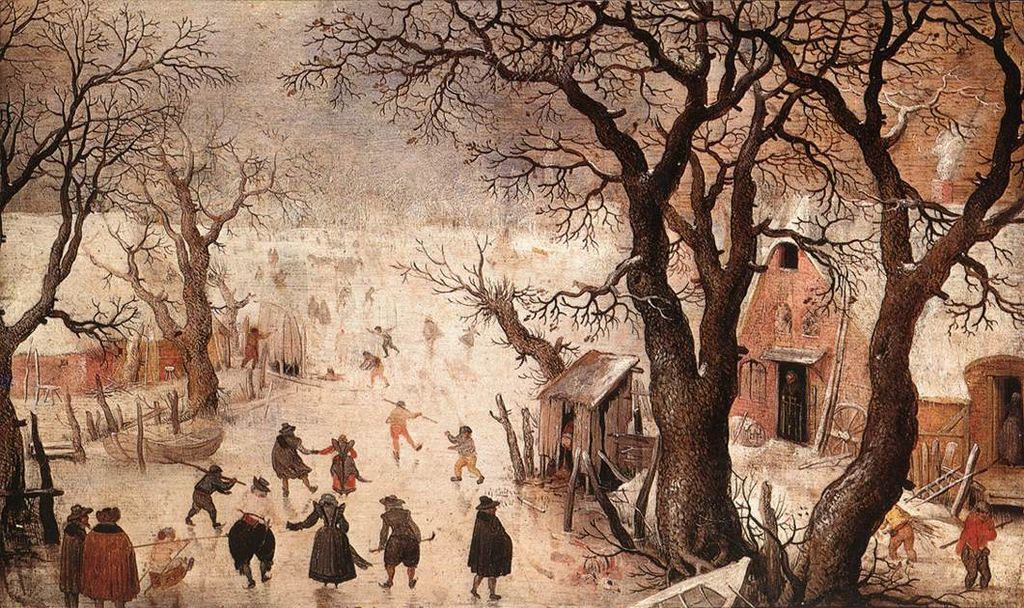
For Dutch artist Hendrick Avercamp, who painted landscapes teeming with ice-skaters early in the 17th century, unusual climatic conditions liberate a holiday spirit among his stolid burghers. Avercamp’s snow is theatrical backdrop, much as in the ballet Les Patineurs, and every bit as tinselly. Invigorated by the freeze, his skaters do not reflect on the irony that what temporarily quickens their pulses is itself a deadening force: trees stand black-branched, birds wheel in search of non-existent food. Later in the century, Dutch landscapists explored the stillness snow imposes, sometimes by moonlight. Such scenes invite reflection, as if the association of snow and Christmas were firmly established 400 years ago, the snow a metaphor for the physical hardships of the Nativity. Alternatively these images may simply be exercises in tonality, like the later wintry cityscapes of Childe Hassam.
Monet painted more than 100 snow paintings, including ‘The Magpie’ of 1868–9, Argenteuil views and, inevitably, soggy haystacks. Several surprise on account of the breadth of the artist’s palette. Snow proved an ideal foil for ‘impressions’ of light, sunshine that is pink, blue-grey, palest buff or white. Yet, while many successfully capture aspects of the reality of the snowy experience, it is the artist’s prowess, rather than a deeper profundity, that impresses the viewer.
(Image: Hendrick Avercamp’s “Winter Scene on a Canal,” early 17th century, via Wikimedia Commons)
This summer, we notedresearch that found a significant percentage of subjects preferred to suffer an electric shock rather than be alone with their thoughts. Alva Noë revisits the results, asserting that “there is good reason to doubt some of the findings of the study”:
Take, for example, the most widely discussed result: that some significant percentage of subjects administered a minor non-painful shock to themselves — like familiar household static electricity — when they might otherwise have spent six to 15 minutes quietly in the presence of their own thoughts alone. Notice, to begin with, that the subjects were wearing a self-shocking apparatus. Under those conditions, it strikes me that exploring the effects of shocking oneself, testing and reflecting on one’s responses, simply indulging in curiosity about it, should be counted as a form of engagement with one’s thoughts rather than a flight from them.
He zooms out to consider thinking’s complicated relationship with pleasure:
We tend to think of thinking as cerebral and inward looking and we contrast that with a kind of selfless outward orientation to what is going on around us. But this is confused. Is the mathematician working out a problem on paper looking out or in? And what about the visitor to a gallery concentrating on a painting. Isn’t this kind of looking (at the painting) or doing (writing on the paper) one of the forms that thinking can take for us?
And something similarly goes for the idea that we can simply range complex human psychological attitudes and choices along a spectrum from aversive to extremely pleasurable. As Fox et al. explain, “just thinking” can be valuable, meaningful and important in ways that are tied to, but not the same as, being simply pleasurable. The same is true, perhaps, of any form of what we call exercise. It can be hard to make yourself do your work out. But that doesn’t mean that it isn’t highly pleasurable. And even when it is, in some sense, aversive, that doesn’t mean that you don’t value it highly.
Will Wilkinson recently shared why, as an atheist, he plans to teach his son to believe in Santa. Rob Stennett, a man of faith, also weighs the pros and cons. He argues that believing in Santa is good for kids, but notes that “many of my Christian friends don’t look at it this way”:
They think teaching about Santa can damage your child when it comes to believing in God. It’s not a stretch to see why. We teach our kids to believe there is a bearded man in the sky who knows you by name and cares about how you act. I think that’s why it’s so important to be careful about how I talk to my kids about Santa Claus. But I’m just never sure what to say. This year, I’ve decided to say nothing at all.
This morning, my daughter asked, “Dad, how does Santa get in our house when we don’t have a chimney?”
I was searching for the words when I decided I didn’t need to answer. I asked, “How do you think he comes in?” She gave me an elaborate answer, and I said, “That’s a very good theory.” It was a good theory. I didn’t lie to her — I just gave her room to discover the answers on her own.
Meanwhile, Michael Brendan Dougherty calls himself “unpersuaded by the more principled anti-Claus chorus.” He suggests that “there is something too flatly literalistic, even Puritanical, about their arguments”:
Radical Protestants of an older stripe thought holy days like Christmas were offensive because God is with us every day, and because they hated the “mass” in Christ’s Mass. How this translated in practice was that around the time other people began making merry, the dour low churchman marked the time with especially strenuous sermons against holy days.
Similarly, just as parents are conjuring a model of abundant generosity and joy, today’s killjoys make it a season of rote sermonizing against materialism. This misses the point entirely. A materialist looks under the tree and sees the year’s economic surplus, badly invested. It takes a spiritual person to see it as the work of St. Nick, as a recurrence of the Magi, or an imitation of the great generosity of the God-child born to us. Only the devil wants your Christmas to be just like all the other days. Save the mortifications for Lent. …


 The Dish
