Excuse Me, Mr Coates, Ctd

This is a striking way to frame the debate over IQ and race. And it genuinely grieves me that this is how Ta-Nehisi Coates views it. All I can say is that if I thought this was what this debate were about for a millisecond, I would completely agree. The absolutely equal humanity of every single soul on this planet is axiomatic to me. It is about as foundational an idea as I have ever held. It is the bedrock of any Christian faith, including mine. It is non-negotiable. As is the formal equality of all citizens, regardless of race or any other immutable characteristic. The idea that I was asserting the lesser humanity of a single human being, let alone a race, by airing a debate about race and IQ, is not how I saw it at all.

Now perhaps I should have. Perhaps the knowledge of the hurt that even airing these ideas would bring to many people would have persuaded me to try a different tack on the book. And if there had been an African-American staffer at the time, maybe the hurtfulness of this Screen Shot 2014-12-22 at 1.29.49 PMwould have been brought much more powerfully home to me. I think on those counts, TNC has a strong case.

All I can say is that, for me, the debate about IQ and inequality wasn’t about that. Many debates in the past (and present) were; arguments about racial intelligence undoubtedly rang through the American centuries as a justification for pure evil, and still do. From the original sin of genocidal slavery to the eugenics of the Progressive Movement (championed by TNR in the 1920s!), these tropes undoubtedly contributed to monumental injustice and oppression. Was I tone-deaf with respect to this very dark and very American history as a young, English, Tory immigrant? I’m afraid I was. I’ve learned a lot since then, some of it because of Ta-Nehisi’s own work, which I championed from the moment I came upon it.

But an editor’s job is not, in my view, to suppress intellectual debate because of the social discomfort or even pain it might cause. So, for example, in Love Undetectable, I devoted a whole chapter to the literature and science of reparative therapy for homosexuals. It’s available here. Many readers found it deeply uncomfortable because I was much more sympathetic to some aspects of the argument – and even made a strong case for them – than is currently fashionable. The point is: I took the argument seriously, and, while criticizing large swathes of it, refused to dismiss it as mere “hate”. I even thought it had some real insights into the gay experience. Did this theory crush the souls and self-esteem of countless gay men over the last century? Absolutely. Was it the source of stereotypes and the argument that gay people were somehow just sick? You bet. Was it therefore all the more important to address head-on? That was my belief.

And the debate about race and IQ, for me, was never about someone’s humanity. It was and is about empirical evidence about a testable thing – IQ – that is one small sliver of what it is to be human, and a variety of competing explanations for it. The question was a relatively simple one: what can account for the clear differentials in IQ between the racial categories used by the US in its vast data sets?

Like many of Ta-Nehisi’s followers today, I assumed, before I had read the book, that all such evidence was made up, non-existent or peddled only by unreconstructed racists. I had had a good liberal education in which these subjects were simply never discussed. It was only by reading – and checking – the actual data in The Bell Curve that I discovered what my educators had withheld from me. These differences really do exist; they exist outside the black-white paradigm (for example, the resilient IQ differentials between Ashkenazi and Sephardic Jews); the bell curve for Asian-Americans is higher on the IQ level than whites; and these differences are not entirely dismissed by accounting for socio-economic class or culture. A huge amount can be attributed to environment. But not all – unless IQ was a trait unlike any other in human experience.

I was genuinely puzzled and fascinated by this; and still am. No one doubts that it is the case, and that it remains resilient. I really don’t understand why liberals are not engaged on this. The explanations for it might be utterly different than assertions about genetics. Here, for example, is Freddie DeBoer, actually addressing the undisputed data, and making just such an argument from the left:

These differing outcomes are the result of massive and entrenched disadvantages that reflect this country’s legacy of hideous racism and its ongoing, massive racial inequality in economic and sociological factors that impact quality of life. Often, race science types will say that a particular piece of research “controlled for poverty.” But such controls are typically limited to income level or parent’s wealth. Because racism is such a pervasive and all-encompassing phenomenon, these controls are never remotely adequate.

In order to really assess these differences, I’d have to feel comfortable accounting for cultural biases in the nature of the questions, parent’s income, parent’s wealth, parent’s level of education, family stability, exposure to crime, exposure to drug abuse and alcoholism, the psychological and social impact of explicit and implicit racism, the Matthew Effect ... Take exposure to lead. We know that black children have significantly higher exposure to lead than white children even after controlling for poverty level. This is what I mean when I say that saying “we controlled for social class” is so inadequate.

So for Freddie, the data underlines his racial progressivism. It’s proof of the very “white supremacy” that TNC believes defines modern America. The data, in other words, can cut in many different ways.

And at some point, we’re going to have to grapple more honestly with it. It’s a huge challenge for a liberal technocratic society that the skills it increasingly rewards are unevenly distributed across racial groups. It’s equally a huge challenge for our society that the kind of intelligence IQ measures is so strongly correlated with economic success, regardless of race, and that the rewards to the most gifted in these areas are growing, not shrinking. The Bell Curve was one of the great prophetic books of our current crisis of inequality. It raised very troubling questions about this country’s ability to advance economically and not stratify into two, increasingly separate and mutually uncomprehending nations. And yet the important thing to say about it, according to so many who have never read it, is that it should never have been published and no one should have responded to it.

Where do I stand on the core question of what lies behind these intractable differences in bell curve distributions? I don’t know. I feel pretty confident that a huge amount of it can be ascribed to the kinds of factors Freddie cites. My deepest objection is to the very concept of “race” as we measure it. It’s far too crude and too vague a term to be of much use as an empirical matter. But am I convinced that genetics has nothing whatsoever to do with IQ? Sadly no. Genetics have a role in explaining all human activity and experience. It would be bizarre if IQ were the only exception to this general rule.

One small remaining factual point. Ta-Nehisi on Twitter keeps asserting that The Bell Curve argued that all African-Americans are somehow subhuman or intellectually inferior to all white Americans, when it did absolutely nothing of the kind. What the very title of the book refers to is a distribution curve, which proves that on the limited measure of IQ, many many African-Americans have far higher IQs than many, many whites, but that the bell curve peaks at a higher level for whites and even higher for Ashkenazi Jews and Asians. The book is also clear that the overlaps between all racial groups are far more striking than the gaps. More to the point, it insists – and did so repeatedly in the excerpt – that no moral quality can be attached to such a culturally specific measurement as IQ. So much of TNC’s rhetoric against this book is not actually about the book at all. He is debating imaginary arguments in his head because he refuses to debate the actual ones in the data.

What, to paraphrase Freddie, is he afraid of? And what happens when liberalism chooses not to challenge its own shibboleths, not to debate certain troubling ideas, not to explore forbidden fields of inquiry? It becomes a tired and tiresome orthodoxy – like much of modern conservatism – preferring feelings over facts, and solidarity over reason.

So yes, I will miss TNR. For all the reasons so many on the current, homogeneous, identity politics left will not.


The Secret To Selling Christmas Trees

dish_christmastreesforsale

In a look at the “weird and secretive world of Christmas tree salesmen,” Patrick Wensink asserts that the lots where the trees are sold, which “are awkward by design,” are a key factor in why we flock to buy them:

They normally spring up where rent is cheap: vacant buildings across from the train tracks, offseason fruit markets directly under a flight path, seedy parking lots adjacent to the downtown freeway. Try looking up one of these independent stands in your town. You can’t. They don’t exist online, except for a few regional chains like Jimmy Coan’s Papa Noel lots. The fact that they suddenly appear in these strange places is meant to grab your attention.

It’s a sales tactic that must work. Over 30 million Christmas trees are sold each year in America. At about $50 to $200 a pop, it’s become a billion-dollar industry. Those are quite likely just sales that are on the books because there’s something decidedly off-the-grid about tree slingers. You get the impression these guys probably have some bizarre resumes, if they have one at all.

(Photo by Flickr user *Bitch Cakes*)

About Those Criminals We’re Deporting

Edward Delman shares the story of how his brother Saul was nearly deported for “a misdemeanor—check fraud—that Saul had committed at the age of 19”:

You could be a wife and mother to U.S. citizen children, contributing to your community and working to support your family, and they could deport you because of a shoplifting conviction you committed 15 years ago, despite years of rehabilitation in the meantime,” says Heidi Altman, an attorney and legal director of the Capital Area Immigrants’ Rights (CAIR) Coalition. And that’s exactly what seems to be happening to many immigrants.

A Human Rights Watch report shows that between 1997 and 2007, 77.1 percent of legal immigrants who were deported were deported for non-violent offenses, such as immigration crimes, DUIs, and illegal entry. Moreover, according to a report from the Transactional Records Access Clearinghouse at Syracuse University, the number of deportees who have been convicted “of any criminal offense apart from an immigration or traffic violation has actually declined.” Despite the administration’s claim that it is targeting threats to the public, the numbers tell a different story.

The good news is that if the government files deportation proceedings against you, you have the ability to appeal. The bad news is that if you can’t afford representation or aren’t lucky enough to get your case taken on pro bono, you’re on your own in court. Unlike in criminal court, where anyone—citizen and non-citizen alike—is entitled to counsel, there is no such right in immigration law. As a result, 60 percent of detained immigrants and 27 percent of non-detained immigrants lack any legal representation when facing removal. The importance of having representation cannot be overstated: Immigrants with lawyers are six times more likely to successfully appeal deportation, according to CAIR.

A Poem From The Year

6186207976_b29da5e9a6_b

“1 Corinthians 13” by Spencer Reece:

How long do we wait for love?
Long ago, we rowed on a pond.
Our oars left the moon broken—
our gestures ruining the surface.
Our parents wanted us to marry.
Beyond the roses where we lay,
men who loved men grew wounds.
When do we start to forget our age?
Your husband and I look the same.
All day, your mother confuses us
as her dementia grows stronger.
Your boys yell: Red Rover!
We whisper your sister’s name
like librarians; at last on the list,
her heart clapping in her rib cage,
having stopped now six times,
the pumps opened by balloons,
we await her new heart cut
out from the chest of a stranger.
Your old house settles in its bones,
pleased by how we are arranged.
Our shadow grows like an obituary.
One of us says: “It is getting so dark.”
Your children end their game.
Trees stiffen into scrapbooks.
The sky’s shelves fill with stars.

Please consider supporting the work of the Poetry Society of America here.

(From The Road to Emmaus © 2014 by Spencer Reece. Reprinted by permission of Farrar, Straus & Giroux. Photo by Jenny Downing)

The Perks Of Being A Worrywart

According to Christian Jarrett, they’re considerable:

Psychologists are recognizing the strengths of people who are prone to anxiety. For example, there’s research showing that people more prone to anxiety are quicker to detect threats and better at lie detection. Now Alexander Penney and his colleagues have conducted a survey of over 100 students and they report that a tendency to worry goes hand in hand with higher intelligence.

The researchers asked the students to complete measures of worry, anxiety, depression, rumination, social phobia, dwelling on past social events, mood, verbal intelligence, non-verbal intelligence, and test anxiety. This last measure was important because the researchers wanted to distinguish trait anxiety from in-the-moment state anxiety and how each relates to intelligence. The key finding was that after controlling for the influence of test anxiety and current mood, the students who reported a general habit of worrying more (e.g. they agreed with survey statements like “I am always worrying about something”) and/or ruminating more (e.g. they said they tended to think about their sadness, or think “what am doing to deserve this?”) also tended to score higher on the test of verbal intelligence, which was taken from the well-known Wechsler Adult Intelligence Scale.

The Best Of The Dish Today

Winter Solstice Celebrated At Stonehenge

Today, a beleaguered Mayor De Blasio called for an end to the recent protests at the racial bias of the criminal justice system in America:

“It’s time for everyone to put aside political debates, put aside protests, put aside all of the things that we will talk about in due time,” Mr. de Blasio said in a speech. “That can be for another day.” The mayor’s call came a few hours after the police commissioner, William J. Bratton, said that the killing of the officers on Saturday was a “direct spinoff of this issue” of the protests that have roiled the nation in recent weeks.

There’s more Dish on the brutal murder of two cops here, and, from a cop’s point of view, here. A few simple things. It is appalling that some demonstrators used vile anti-police language as shown in this video. But it is also appalling that police officers would turn their backs on their own mayor and that their own union leader can place the blame for the murder of two cops on Mayor De Blasio. The reason? That De Blasio had to tell his own bi-racial son to be very careful when dealing with the police, and that he used the word “alleged” to describe a bunch of demonstrators attacking the police. Please. The NYPD needs an attitude adjustment. They’re not the CIA. They remain under democratic control.

A reader adds:

I haven’t to spoken about this to anyone of my family and friends because of a simple reason. I have several close family members who are (white) police officers, and I also have several family members (my adopted daughter and others) who are black.

I understand that police officers often work in very dangerous situations, and I totally abhor what those protesters said and what that murderer did. And nothing excuses either, but this statement by your previous reader about racist cops doesn’t ring true to me: “Good cops despise those cops.”

I’ve heard the stories from black family members and friends about how endemic harassment and profiling are. But I don’t need to take their word for it; I’ve watched my (very young) daughter being profiled by white officers and managers (white, Asian and others) all the time and the data supports those stories.

And yet I’ve heard very little from the police acknowledging that. Instead, I have watched both my relatives and police spokesmen double down on the defense of racist cops and racism. They all immediately come to the defense of the very racist cops your reader says they despise. Rarely have I seen a police chief or spokesman say “We despise what this officer has done.” But worse still is watching my family members defend these obviously racist cops and poston social media racist stuff as some kind of defense. I’ve had to block them from my feeds. I am not sure I am able to explain to my daughter that some of the people she loves are racist … and cops.

I respect and love what the police do for our society, but even I am starting to worry they are becoming militarized group feeling they are in a war.

What I worry about even more is the polarization that makes all this worse. You already know what Fox will be doing with this – as well as MSNBC, to much less effect. And when the police start to form a monolithic bloc within only one camp – and when that has a racial component, we’re in very troubled waters. They key here is de-escalation – from the extreme rhetoric of some protestors to the incendiary blame-assigning of Pat Lynch. And reform – to ensure that what passes for justice is not so racially skewed. What we have instead of either is tribal warfare, in which moments where we should all be in complete agreement – the cold-blooded execution of two NYPD cops – become moments for further polarization. Another reason this year was such an almighty bummer.

Today, I defended airing the Bell Curve debate. Because liberalism. I also lamented the end of some illusions I once held about America’s commitment to freedom as a core principle of its identity. We celebrated an ISIS defeat and watched some cows get into festive cheer.

My question: why are there no trigger warnings for Christmas?

The most popular post of the day was Excuse Me, Mr Coates; followed by We’ll Meet Again – on Stephen Colbert’s genius. You can always leave your unfiltered comments at our Facebook page and @dishfeed. 35 more readers became subscribers today. You can join them here – and get access to all the readons and Deep Dish – for a little as $1.99 month. Gift subscriptions are available here (you purchase one today and have it auto-delivered on Christmas Day). Dish t-shirts are for sale here and our new mugs here.

See you in the morning.

(Photo: A couple embraces as revellers take part in celebrations to mark the winter solstice at Stonehenge prehistoric monument in Amesbury, England on December 22, 2014. About 1,500 revelers, druids and pagans gathered at the monument to celebrate the solstice, a tradition believed to date back thousands of years. By Rufus Cox/Getty Images.)

The Best Poems From The Year

MartinLutherKingMalcolmX

There isn’t another political or current affairs blog I know of that has poems suddenly poking up all over the place. It’s one of the things I’m proudest of here at the Dish – because it makes the implicit point that wisdom comes in many guises and that there are more ways to understand life than explainer-journalism. All of this is very fine and dandy in theory, but none of it would be possible in practice without our Poetry Editor, Alice Quinn. In the world of poetry, Alice is a legend. Her impeccable taste and depth of knowledge, her passion for the form, and her dedication to its survival and its necessity are the stuff of literary lore. And sometimes it seems not only that she knows a poet’s work, but that she actually knows him or her, and is or was a friend. So when I think of how we can sustain the kind of culture that the now-dying liberal arts magazines once did, I hope the integration of poetry into blogging is one small sally into the prevailing winds.

Alice was Knopf’s poetry editor from 1976 – 1986 and the New Yorker’s poetry editor for the next twenty years, and is now the executive director of the Poetry Society of America. And, every Christmas, we invite our poetry-loving readers to express their appreciation by joining the Society. This year, they are running a special year-end membership campaign from now until January 2nd. While supplies last, anyone who joins at the basic membership level gets a signed, limited-edition broadside of “Frogs” by Gerald Stern with an extra $10 donation. Any donation is tax-deductible – and for a short time, you also get a beautiful broadside in the bargain. Sign up for your membership here.

In the week ahead, we’ll also be looking back at a few of the poems offered this year, chosen by Alice and Matt Sitman, our literary editor – think of it as an idiosyncratic “greatest hits” of Dish poetry. Each of these poems will include a link to the Poetry Society of America’s membership drive. The first poem we’re revisiting is below.

“For Malcolm X” by Margaret Walker:

All you violated ones with gentle hearts;
You violent dreamers whose cries shout heartbreak;
Whose voices echo clamors of our cool capers,
And whose black faces have hollowed pits for eyes.
All you gambling sons and hooked children and bowery
bums
Hating white devils and black bourgeoisie,
Thumbing your noses at your burning red suns,
Gather round this coffin and mourn your dying swan.
Snow-white moslem head-dress around a dead black face!

Beautiful were your sand-papering words against our skins!
Our blood and water pour from your flowing wounds.
You have cut open our breasts and dug scalpels in our
brains.
When and Where will another come to take your holy place?
Old man mumbling in his dotage, or crying child, unborn?

(From This is My Century: New and Collected Poems by Margaret Walker © by Margaret Walker Alexander. Reprinted by kind permission of the University of Georgia Press. Photo of Martin Luther King, Jr. and Malcolm X, March 26, 1964, from the United States Library of Congress‘s Prints and Photographs division via Wikimedia Commons)

Quote For The Day

“We have been silent witnesses of evil deeds; we have been drenched by many storms; we have learnt the arts of equivocation and pretence; experience has made us suspicious of others and kept us from being truthful and open; intolerable conflicts have worn us down and even made us cynical. Are we still of any use? What we shall need is not geniuses, or cynics, or misanthropes, or clever tacticians, but plain, honest, and straightforward men. Will our inward power of resistance be strong enough, and our honesty with ourselves remorseless enough, for us to find our way back to simplicity and straightforwardness?” – Dietrich Bonhoeffer, “Letters and Papers From Prison.”

Citizen Canine

3004027422_392296ac9b_o

Zack Beauchamp interviews philosopher Will Kymlicka:

ZB: So what’s wrong with just saying we’ll take a number of steps to protect animal rights without going so far as to declare them citizens?

WK: As I’ve said, the core of our theory is the idea of membership. It’s a rich concept if you think about it seriously: it’s the idea that domestic animals belong here. It’s where we disagree with one strain of animal rights theory, which says we should extinguish domesticated animals because it was a mistake ever to bring them in.

We need to create a shared interspecies society which is responsive to the interests of both its human and animal members. That means that it’s not just a question of how you ensure that animals aren’t abused. If we view them as members of society — it’s as much their society as ours — then it changes the perspective 180 degrees. The question is no longer “how do we make sure they’re not so badly treated?” We instead need to ask “what kind of relationships do they want to have with us?”

That’s really a radical question. It’s one we’ve never really bothered to ask. I think there are some domesticated animals that enjoy activities with us — I think that’s clearest in the case of dogs, but it’s also true of other domesticated animals whose lives are enriched by being part of interspecies activities with us. But there are other animals who, if we took what they wanted seriously, would probably choose to have less and less to do with us. I think this would be true of horses.

(Photo by Flickr user alaindemour)

Face Of The Day

El Gordo Christmas Lottery

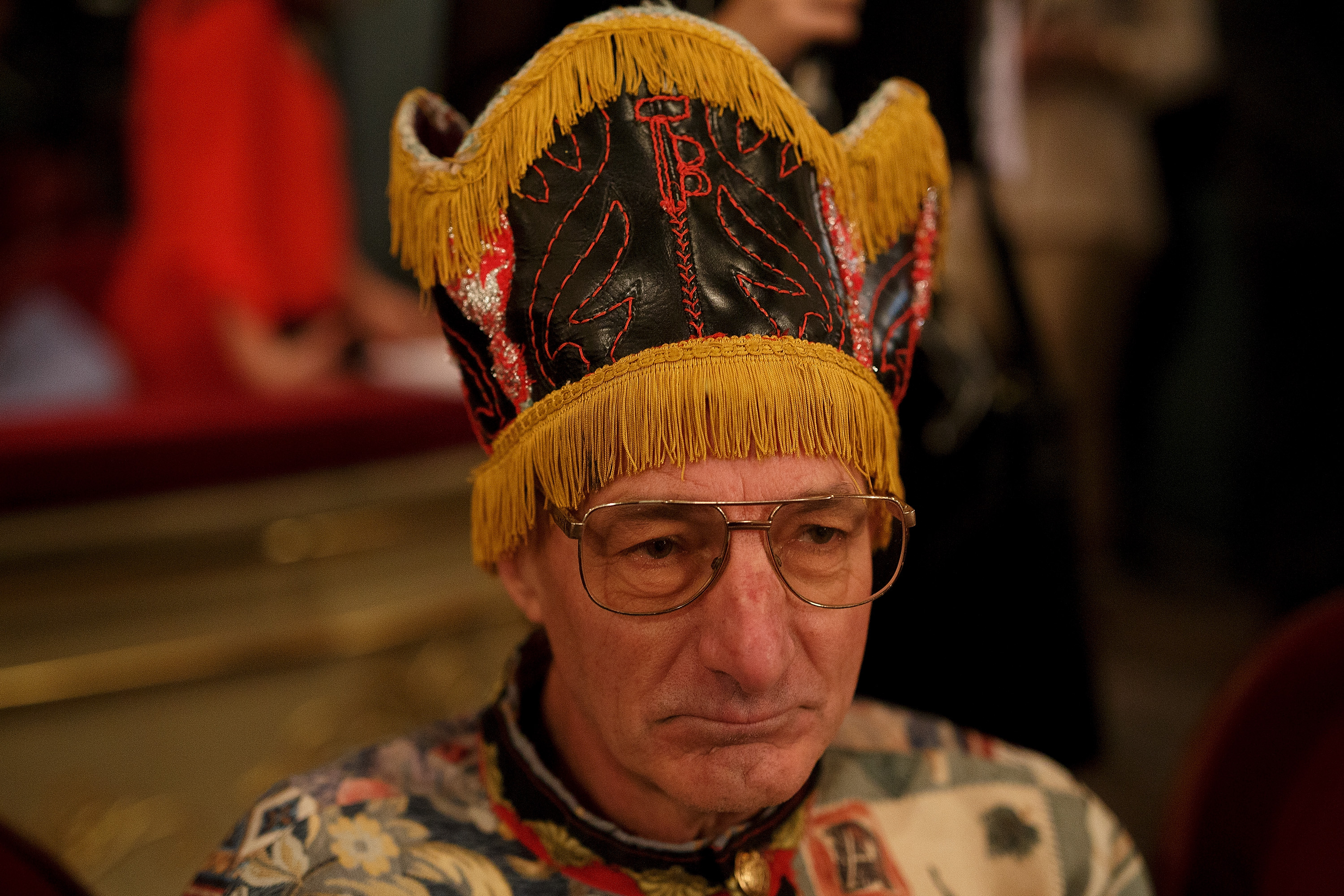
A man wears a costume as he attends the draw of Spain’s Christmas lottery, which is named ‘El Gordo’ (Fat One) at Teatro Real in Madrid, Spain on December 22, 2014. This year’s winning number is 13437. The top prize of 4 million euros will be shared between ten ticket holders. The total prize fund is worth 2.24bn euros. By Pablo Blazquez Dominguez/Getty Images.