Losing Your Faith In Santa, Ctd

Readers continue the popular thread:

I remember the moment I knew for a fact that Santa wasn’t real. All my life, Santa used different wrapping paper than my mom. Gifts from my parents were in one style and Santa’s gifts looked completely different. One July, when I was 11 or 12, I was helping my mom clean out the garage and I came across Santa’s wrapping paper. I was old enough that I had a good idea that Santa wasn’t real, but I remember the look my mom and I exchanged. Mom said, “Well, that’s that. Don’t tell your little sister.” And I didn’t.

The next Christmas, when Santa used the special paper again, I felt like I was in on some big secret. I knew the truth! My sister figured it out logically a year later. She was 8. I am clearly the slow one of the family.

Another’s reason for disbelief was pretty simple:

Santa had the same handwriting as my parents.

Another reader:

I had been suspecting Santa was a myth for a few years, but when I was 10 I cornered my dad because he somehow couldn’t lie to me when asked a straight question. (As an 8 year old who had just i-want-to-believefinished D.A.R.E., I caught him burning incense and smoking, I thought, a cigarette. Being the smart ass I was, I asked, “are you smoking marijuana?” His answer was, “Yes, don’t tell your mother.” I didn’t.)

I asked him if Santa was real, and he told me no – it was him and my mom. To this day he says my face dropped, my heart broke, and that he’s always regretted telling me. I remember it differently. I remember being glad he told me the honest truth and didn’t keep lying to me like all the other adults. Of course I WANTED Santa to be real, I still do! That’d be awesome! But I had already found their stash of presents and he was just confirming what I already knew.

Another confesses:

I should probably keep this to myself, but what the Hell:

I held on to a belief in Santa until an embarrassingly late age. I may have been as old as 12, certainly over 10, but either way much too old to still be believing in Santa. I don’t recall arguing with other kids who told me the truth, just an iron-clad confidence they were wrong. Besides, I remain to this day much too gullible and trusting.

I was in the kitchen with my mother when my oldest sister, who was six years older than me, walked into the kitchen and asked my mother for help writing a paper for school about the reaction children have upon learning that Santa is not real. I was stunned and crestfallen. I responded with “you could just watch me” or something to that effect and left the room.

I wasn’t angry at my parents or siblings for allowing me to continue to hold onto such a childish belief. I was more embarrassed that I had allowed myself to believe in such a ridiculous idea for so long. The Santa concept falls apart even under mild questioning that it was deflating to think I had never pressed it.

Another can relate:

I love this thread, please keep it up! Like several others have mentioned, I also believed in Santa for a longer time than I probably should have. I, too, hung on due to some clever lies from my parents and my certainty of their own human nature.

My first picture with Santa from my first Christmas was actually my dad in a Santa suit.  I of course didn’t know that at the time, and I guess when “Santa” was holding me, being an 8 month old, I grabbed his beard and PULLED.  Out came a tuft of rental Santa beard fluff, and my parents saved it in one of those hinging jewelry boxes.

When I started to doubt Santa at an early age due to some school kids who brought me to tears by telling the truth, my parents pulled out my picture with Santa and the beard fluff as proof of his existence.  That’s all I needed to defend Santa for years: “I have a piece of his beard!” (By the way, Andrew, to this day I have profound respect for beards and love that my husband has one.)

Another reader:

I found out when I was eight. I don’t recall exactly what tipped me off, probably the logistical impossibility of visiting so many kids on a single night. Whatever my reasoning, I confronted my mother with my suspicions and, after some hemming and hawing about it, she finally admitted the truth. Far from being disappointed, I was indignant that I had been lied to, not only by my parents but every other adult, as well. This was an injustice that had to be remedied.

So the next day at school, my teacher started saying something about Santa. I raised my hand, and proudly informed everyone in my third grade class what I had learned. I honestly thought (1) they would be happy to learn the truth and (2) they would be as upset with adults as I was. This is not what happened.

Every single kid in my class, including my best friend, Jimmy, was outraged, all right, but not with our teacher, their parents, and every other lying adult, but with me. Pretty much everyone in class started yelling at once, saying I was wrong, stupid, etc. I had to be sent out of the room so the teacher could placate my classmates, probably by telling them I was a kook and of course Santa is real.

I was flabbergasted. I thought I would be hailed as a hero for uncovering the sordid truth, but instead I was a pariah. No one played with me at recess that day, nor for a number of days thereafter. Jimmy and I finally reconciled after I made some mealy-mouthed concession about how I was wrong and there really was a Santa Claus. Everyone else eventually forgot about it after Christmas passed, but I never did. Third grade was a long time ago, but I can still see the hateful looks on their little faces after I spouted off about Santa.

I can’t say this changed my life or anything, but it was a pretty damn good lesson about human nature, though it took me a few years to fully absorb that. But now that I have kids of my own, I’m all in on filling their heads full of Santa nonsense. So clearly I didn’t learn that lesson.

Another confronted another kind of spite:

Back in the early 1950s, I was in kindergarten and a neighbor girl who was a couple of years older offered to help me write to Santa.  We were upstairs in my house, both writing our letters, and she misspelled “from” as “form”.  Even then I was a stickler for accuracy, so I informed her that she had misspelled it.  Probably irked at being corrected by a younger child, she snapped back, “So what!  There’s no Santa Claus anyway – it’s your parents.”

I rushed downstairs to check with my mother, but as soon as I heard my neighbor’s words, I knew they were true.  My mom’s face (probably a long time before she thought she would have to confront this question) just confirmed it.

Another reader ends on a brighter note:

My sister did it the best way. Her son was simply not disbelieving despite being like 10 years old – way too old to still believe in Santa. So last Christmas Eve, she woke him up at 2am and told him: “I have something to tell you. Me and your Dad are Santa Claus. He’s not real. But we have exciting news! Now, YOU get to be Santa for your little sister.”

And my nephew has kept that secret now. And he relishes his role as his sister’s secret-keeper.

Terminating A Pregnancy Based On A Test

Beth Daley recently reported on prenatal screening errors:

Two recent industry-funded studies show that test results indicating a fetus is at high risk for a chromosomal condition can be a false alarm half of the time. And the rate of false alarms goes up the more rare the condition, such as Trisomy 13, which almost always causes death. Companies selling the most popular of these screens do not make it clear enough to patients and doctors that the results of their tests are not reliable enough to make a diagnosis. …

Now, evidence is building that some women are terminating pregnancies based on the screening tests alone. A recent study by another California-based testing company, Natera Inc., which offers a screen called Panorama, found that 6.2 percent of women who received test results showing their fetus at high risk for a chromosomal condition terminated pregnancies without getting a diagnostic test such as an amniocentesis.

Libby Copeland summarizes Daley’s findings:

The problem with the new class of prenatal screenings, which look at placental DNA in the mother’s bloodstream, is that these companies’ tests are not regulated by the FDA due to a loophole that dates back to the 1970s, Daley writes. So there’s no one evaluating their claims of accuracy. Many doctors appear not to understand how predictive the tests they’re giving are, since they often get information about a test’s purported accuracy from the salespeople selling them the tests.

Genetic counselors should be stepping in to explain the tests’ limitations to patients, Daley writes, but that’s not always happening. She points to an apparently smaller but growing group of women who gave birth to severely ill babies—some of whom died within days—after screens showed their fetuses at minimal risk. (In a separate story, she outlines one of these stories, and another about a healthy baby born after a prenatal screen predicted, supposedly with 97 percent accuracy, that he would be born with a fatal chromosomal disorder.)

The companies that make these tests say they’re studying the false positive rate, but they’re also poised to push back on the FDA’s looming efforts to regulate them. For now, the industry is policing itself, which doesn’t seem to be working out so well for a number of American women.

However, Emily Oster defends the tests as “a huge leap in accuracy over what was previously available”:

The problem may not lie in the claims made by the companies who make the tests, but in the interpretation of these results by doctors and patients. The earlier versions of the screening tests were so inaccurate that no one would think of acting on their results by terminating a pregnancy. The enhanced accuracy here may, perversely, encourage acting on this information when it is still not certain. But that problem can’t be fixed by the test manufacturers; it requires greater statistical literacy among doctors and patients.

And Everybody Hates The Gays

Earlier this month, 26 men were arrested at a Cairo bath house. Scott Long attended the first day of their trial:

The lawyers still hadn’t seen the prosecutors’ or police reports, so we don’t know definitely what the charges are. It seems likely, though, that 21 men were customers at the bathhouse; they will be charged with the “habitual practice of debauchery” (article 9c of Law 10/1061), or homosexual conduct, facing up to three years in prison. The owner and staff probably make up the other five prisoners. They’re likely to be tried for some combination of:

  • keeping a residence for purposes of debauchery (article 9a, three years),
  • or facilitating the practice of debauchery (article 9b, three years),
  • or profiting from the practice of debauchery (article 11, two years),
  • or “working or residing in premises used for debauchery” (article 13: one year).

That could add up nine years in prison. Contrary to [Egyptian journalist] Mona Iraqi’s lies, there was no mention of “sex trafficking.”

Shortly after the arrests, Brian Whitaker compared this latest incident with “a similar crackdown by the Mubarak regime around 2001”:

The exact reasons for the 2001 crackdown are still debated, and probably several factors were involved. Writing about this at the time, Hossam Bahgat saw it as an attempt by the Mubarak regime to undercut Islamist opposition by portraying the state as the guardian of public virtue: “To counter this ascending [Islamist] power, the state resorts to sensational prosecutions, in which the regime steps in to protect Islam from evil apostates. The regime seems to have realised that suppression and persecution of Islamists will not uproot the Islamist threat unless it is combined with actions that bolster the state’s religious legitimacy.”

He also noted the regime’s practice of using sensational trials to divert public attention from the worsening state of the economy and similar issues.

Ursula Lindsey doubts President Sisi and his underlings are trying to “bolster their religious credentials”:

There are other explanations. First of all, the mercenary ones. What happened to the wallets and cell phones of the men arrested in the raid on the bathhouse? I would bet you they never saw them again. What does a cafe or bar in Downtown Cairo have to pay in bribes to operate freely, to take over the sidewalk, to have the noise complaints of neighbors ignored, let alone to keep a liquor license? Businesses that exist on the edge of social approval are easy pickings for extortion.

Furthermore, the way I see it, in the summer of 2013 a terrible mechanism was put into motion. In this mechanism, the media generates hysteria, and the security sector produces repression. This mechanism now continues to run, although its primary target — taking the Muslim Brotherhood out power, putting the military into it, and undermining the aspirations of January 25 2011 — has been accomplished. But journalists still have to report about something, and the country’s economic problems, human rights abuses, and the conduct of its war on terrorism are all out of bounds.

Excuse Me, Mr Coates

Some apologies for getting around to this so late. The torture report came out shortly after Ta-Nehisi’s excoriation of TNR as some kind of “neo-Dixiecrat” rag which had the equivalent of a “Whites Only” sign on it, and, well, first things first. Then I wasn’t blogging last week. So please don’t consider my recent silence some kind of tacit concession to TNC’s incendiary and hurtful critique. Au contraire.

A few brief points about his general argument. From the intensity of his rhetoric, you might infer that Ta-Nehisi was writing about National Review, an opponent of civil rights laws, or even about a neo-Confederate rag, as opposed to The New Republic, a longtime champion of the civil rights movement. But it appears he sees no difference. You’d think he were writing about a magazine filled with bigoted white Southerners, as opposed to an overwhelmingly Jewish set of writers and editors engaged in a long and internecine debate about what it means to be liberal. And the racial politics of TNR from the 1970s through the 1990s cannot be understood without grappling with the bitter and intense struggle between Jewish and African-American civil rights activists in the late 1960s and beyond. Surely Ta-Nehisi knows this. Screen Shot 2014-12-22 at 1.29.49 PMHe grew up in this atmosphere. Maybe he believes TNR’s deviations from the Black Power party line were even worse because of its proclaimed liberalism. But he should at least diagnose it with a modicum of the sophistication he usually applies to American racial history.

As for the case that there was a “Whites Only” sign on the door: Has Ta-Nehisi really never read the extraordinary coverage of black history, literature, intellectual life, and poetry that TNR routinely published? Leon’s back-of-the-book was filled with such essays and reviews. Has it even occurred to him either that the campaign for welfare reform in the front of the book, for example, was conceived by liberals who believed the existing system was hurting black America? That it was a good faith effort precisely to care about an underclass “beyond the barrier”? You can debate its effectiveness and rationale. (President Obama, for the record, has said it was one subject on which he had changed his mind. Is he a neo-Dixiecrat as well?) But to assume that it was not done in good faith – or fueled by cheap racism – is not an argument. It’s just a smear.

Did we fail to find and nurture and promote African-American staffers? We did – along with almost every other magazine and newspaper at the time. I regret this. I tried – but obviously not hard enough. I’m no believer in affirmative action, but I’m a deep believer in the importance of differing life experiences to inform a magazine’s coverage of the world. And I tried mightily hard to find young black writers to contribute to the magazine. Did we fail because we were racists? I’ll leave that up to others to judge. But did we try to include black writers and intellectuals in the magazine’s discourse? Of course we did.

Which brings me to the issue we published on Race & IQ, of which I remain deeply proud and which has been distorted over time to appear as something I don’t recognize at all. Some of this may simply be bad memory or insufficient research (the issue is not online). Ta-Nehisi, for example, hasn’t actually read the issue he excoriates in the two decades since it was published. He is writing about his “feelings” about his memories, which he is perfectly entitled to do. But allow me to explain, with the full issue in my hands, why I think his account is flawed.

The current story-line would lead you to believe that TNR published “The Bell Curve.” But of course we didn’t. It was published by the Free Press, with a huge publicity and marketing budget. TNR wasn’t even the first magazine to weigh in on the controversy. The New York Times Screen Shot 2014-12-22 at 1.47.24 PMMagazine had Charles Murray on its front cover before our issue came out – “The Most Dangerous Intellectual In America” – making the book even more of a hot topic. Every editor of every paper and magazine had to make a call about how to deal with the book. And as the editor of one of the country’s primary journals of opinion, which had already published Murray many times, I decided we should tackle it head on. We should air its most controversial argument and expose it to scrutiny and criticism. These were not, after all, marginal authors. One was a celebrated Harvard professor; the other was, at the time, the most influential social scientist in America. In my view, ducking this issue was not an option and even seemed cowardly. And I had read the entire book in great detail in manuscript to determine if there was a smidgen of eugenics in it, something that I, as a Catholic, find repellent in every way. This was my job as an editor. It passed my own test. Maybe I was wrong. But it was an honest call and one with which (unlike some others) I remain comfortable with today.

And look: I completely respect those who believed that the right approach was to ignore the book entirely and treat it as a pariah text; or to publish only definitive, devastating take-downs. But I hope that an issue-long, 28-page debate on the subject can also be seen as a legitimate alternative option, especially if you’re on the liberal part of the left. Several quick books were published on exactly that model – and no one is accusing those editors of favoring white supremacy. TNR, moreover, had a long history of this kind of diversity. It published, for example, Robert Bork’s early and famous critique of the 1964 Civil Rights Act, while simultaneously supporting its passage.

And Dish readers know how comfortable I found myself in that liberal tradition. Airing taboo stuff and examining and critiquing it has been a running feature of this blog from its beginnings. It is an axiom of mine that anything can be examined and debated – and that the role of journalism is not to police the culture but to engage in it forthrightly and honestly. Again: I respect those who believe the role of a magazine is to bless certain opinions and to stigmatize others, to indicate what is a socially acceptable opinion and what is not. It’s just not the way I have ever rolled on anything. So I responded to the race and IQ controversy exactly as I would any other: put it all on the table and let the facts and arguments take us where they may. In fact, I couldn’t understand why those who loathed the book didn’t leap at the chance to debunk it. If it were so transparently dreck, why not go in for the kill?

As it was, several leading black writers and intellectuals, with ties to the magazine, were eager to. Among them: Henry Louis Gates, Jr., Glenn Loury, and Randy Kennedy. They were among the finest African-American minds of the era; and they did not hold back. Henry Louis Gates Jr analogized Murray to a slavery-defender:

By making the enslaved a character fit only for slavery, they excuse themselves for refusing to make the slave a free man.

Hugh Pearson wrote:

Murray and Herrnstein sound like two people who have found a way for racists to rationalize their racism without losing sleep over it. One could call what they are facilitating Racist Chic.

Glenn Loury wrote:

Murray and Herrnstein’s declarations of intent notwithstanding, the fact is one cannot engage in such a discourse without simultaneously signaling other political and moral messages. These other messages bear on the worth of the disadvantaged “clans” and the legitimacy of collective ameliorative efforts undertaken on their behalf. … I would have thought, and have always supposed, that the inherent equality of human beings was an ethical axiom and not a psychologically contingent fact.

The white contributors were just as caustic. Andrew Hacker, whose racial politics echoes TNC’s and who wrote another cover-story on racial justice under my editorship, deconstructed the IQ argument by applying it to ethnic sub-populations among whites:

Yet no one really wants to discuss the question of inherited intelligence as it might apply, say, to individuals of Irish and Italian stock. And when Americans of Russian origins (who are predominantly Jewish) place a premium on higher education, it is attributed to cultural roots rather than an inborn aptitude for this kind of endeavor. Better, for white sensibilities. to focus on presumed black deficiencies. But this is neither surprising nor new.

Legendary psychologist Richard Nisbett wrote:

This is not dispassionate scholarship. It is advocacy of views that are not well supported by the evidence, that do not represent the consensus of scholars and that are likely to do substantial harm to individuals and the social fabric.

Here is a passage from Randy Kennedy’s piece in the same issue:

Those who strongly disagree, as I do, with [Murray’s] analysis and prescriptions should not attempt to prevent Murray from stating his and his late collaborator’s, views. Attempting to muzzle him will only give the book additional, bankable publicity. Nor should critics feel that they must disagree with everything the authors say. Sometimes the authors make good points, as when they discuss anxieties surrounding the question of environmental versus genetic determinants of alleged racial differences in intelligence. Readers interested in evaluating the Murray-Herrnstein enterprise should show patience by engaging in and waiting for careful siftings of its intellectual merits and demerits. They should resist having their agendas set and their minds made up on terms prescribed by cultural entrepreneurs who exploit controversiality for the purpose of financial and political profit.

Is that erudite neo-Dixiecratism? I simply refuse to feel ashamed for publishing this debate, for showing that liberals need not be afraid of any set of ideas or empirical claims, and for believing that the best response is to air all of it, confident that the truth will ultimately win. That, in my view, is the essence of liberalism and I make absolutely no apologies for it. And the space granted to the critiques of the book was almost twice the space given to Murray and Herrnstein, and laid out at the beginning of the magazine, with the extract at the very end. It doesn’t get any fairer than that, which was why it was no surprise that this electric, passion-filled issue sold more copies than any in the magazine’s history.

For Ta-Nehisi, none of this mattered or matters:

I knew that TNR’s much celebrated “heterodoxy” was built on a strain of erudite neo-Dixiecratism. When The Bell Curve excerpt was published, one of my professors handed out the issue to every interested student. This was not a compliment. This was knowing your enemy.

Kennedy and Loury and Gates were the enemy? Open, spirited debate was the enemy? That, it seems to me, tells you a lot more about Ta-Nehisi than them or me.

(For an update on this post, see here.)

Why Police Feel They’re Under Siege

Reflecting on the senseless murder of two officers, a reader passes along the disgusting video seen above:

I follow my local precinct on Twitter, to get neighborhood news. And a week or so before the murders, they posted a link to a video with protestors chanting for cops to be killed. I think it was going around in police circles.

I think we have to understand the police response in this context. They felt very much under attack by the mayor, who didn’t have their back against the protestors. And they saw this video, and many of them said someone was going to kill a cop. And then someone killed two cops.

My sympathies are very much with the protestors in general (though not these protestors). When I saw the video, I thought the cops were being hysterical. I thought, of course no one is going to do anything to the cops; no one ever does anything to the cops. And I was totally wrong.

Another reader is disappointed with our coverage of police issues:

I’ve been a cop since 2006 and will be the first to admit that some cops are evil and have no right wearing the badge, but good cops despise those cops. In the aftermath of the Michael Brown and Eric Garner deaths, a narrative was pushed painting all cops as racists bent on murdering black males. While you haven’t been as anti-cop as others, you have contributed to the narrative.

With every other topic you examine, you report or post emails from as many different points of view as possible. Most times you post emails from readers or professionals directly involved in the topic; however, I’ve yet to see a single point of view from a cop.

Additionally, after a grand jury failed to indict Darren Wilson, you published articles stating how rare it is for grand juries to not indict people. It gave the perception that police get away with murder because of their position. You completely ignored the fact that at the very same time in South Carolina, three white cops were indicted for shooting unarmed black men.

I have no issue with questioning police tactics or use of force policies. In fact, I believe it’s an important component of a free society. What I take issue with is not giving an equal voice to the overwhelming majority of cops who are good people. This leads me to my last point.

On Saturday, two NYPD cops were executed simply because of the uniform they wore. They were sitting in their patrol car when they were ambushed. The murderer, whose name doesn’t deserve mentioning, killed those cops to “avenge” Michael Brown and Eric Garner.

It had taken almost two days for you to post about the shooting. I read the post and realized it’s not a condemnation of the shooting; the deaths of two cops is almost secondary to its point. The article is a condemnation of Giuliani and Union President Lynch for suggesting an anti-cop attitude may have contributed to the murders. The rebuttals to Giuliani and Lynch argue that they have no right to feel that way because the protestors are just expressing themselves.

You referred to police turning their backs on de Blasio as “antics.” Lynch has been accused of smearing, ranting, and being divisive to the point of savagery. In one fell swoop, you and your fellow journalists defend de Blasio’s and the protestor’s right to free speech while condemning Giuliani’s and Lynch’s use of it. You haven’t taken a second to allow a cop or their representatives to explain why they feel the way they do. I can tell you for a fact that every cop I know feels there is an anti-cop movement taking place.

Update from a reader, “Are you SURE that video is real?”, pointing to another viral video of protesters allegedly chanting violent anti-cop messages:

A Fox affiliate in Baltimore aired a segment on Sunday showing footage from a “Justice For All” demonstration in Washington, D.C. in which it edited a chant to sound like protestors were shouting “kill a cop.”

“At this rally in Washington, D.C. protestors chanted, ‘we won’t stop, we can’t stop, so kill a cop,'” the WBFF broadcast said.

But the full footage, flagged by Gawker on Monday via C-SPAN, revealed that the chant was “we won’t stop, we can’t stop, ’til killer cops are in cell blocks.”

The Biggest State To Ban Fracking

New York’s ban was announced last week:

At a cabinet meeting Wednesday morning, acting state Health Commissioner Howard Zucker released the results of a years-long study into the public health implications of hydraulic fracturing, or fracking. Zucker said the benefits of tapping natural gas deposits in western New York did not outweigh the potential risk to public health.

Jay Michaelson reads through that report:

[T]he shortest summary of A Public Health Review of High Volume Hydraulic Fracturing for Shale Gas Development (PDF) is: We don’t know if it’s safe or not.

As the title implies, the New York report is not a study, but a review of existing studies—dozens of them, from around the country—as well as conversations with officials in other states who are also studying the issue. In addition to the tens of detailed studies, the report identifies 13 comprehensive, systematic ones that might settle the matter once and for all. “These major study initiatives may eventually reduce uncertainties regarding health impacts of HVHF [fracking] and could contribute to a much more complete knowledge base for managing HVHF risks,” the report says. “However, it will be years before most of these major initiatives are completed”

Sigh. Even the most eagerly anticipated study, the EPA’s analysis of fracking’s potential effects on drinking water, begun in 2011, is not due to be complete until 2016.

Chris Mooney compares New York’s actions to those of Maryland, which recently approved fracking. He concludes that the biggest difference “may be that unlike Maryland’s research, the New York health report pretty clearly hews to an approach known as the ‘precautionary principle‘”:

It is important to recognize that the precautionary principle is not a purely scientific position — nor is it an anti-scientific one. Rather, it represents a risk-aversive orientation towards scientific uncertainty — a conscious decision that unknown risks are too serious to ignore.

That’s why criticisms of New York’s move on “scientific grounds” don’t make much sense. For instance, one blog post at the pro-fracking site Energy in Depth sought to individually critique some of the health-related studies that fed into the New York report. But that’s kind of missing the point: These studies don’t need to be the unassailable “truth” in order for New York to justify its precautionary position. Rather, the state simply needs to be able to point to a body of evidence that, on the whole, raises concern.

Ronald Bailey rejects this reasoning:

A simpler formulation of the precautionary principle is: Never do anything for the first time. Basically, ignorance can be used as an excuse to stop anything of which one disapproves.

Bloomberg View’s editors also argue that “answer isn’t to ban fracking”:

It’s to regulate it more carefully and intelligently. Stronger casing requirements for wells, for example, can prevent wastewater from escaping into the ground, and there must be strict rules about how to dispose of the wastewater that reaches the surface. Companies that don’t follow the rules should face meaningful fines.

These principles haven’t always been applied in other states that allow fracking, which is why the practice has a mixed reputation. If Cuomo believes that current best practices in other states aren’t sufficient to protect public health, he would do more good by issuing rules that are — and then challenging drillers to meet them.

Sean Collins points out that that the “areas of New York with the most potential for fracking, such as those in the ‘southern tier’, are also among the most economically depressed regions in the entire United States”:

The question of moving forward with fracking, as with other forms of industrial development, is not simply a technical, scientific one. People’s livelihoods and prosperity are at stake, and the science doesn’t tell us what value we should place on lifting people out of poverty. The decision to ban fracking in upstate New York is based on flimsy ‘it’s possible something bad could happen’ grounds, at a time when such drilling is being deployed successfully and safely elsewhere. The decision was made in the context of grinding poverty and over the heads of the local people who want it.

But Philip Bump found that even regions which might benefit economically from fracking were divided:

The Finger Lakes region, a bit further north, depends heavily on tourism. In 2012, I spoke with the Chamber of Commerce in Penn Yan, N.Y., at the tip of Keuka Lake, to gauge how the business community felt about the possibility of fracking. A representative said they were split: businesses that depended on tourism were worried about pollution in the lake, other businesses supported the possibility of job growth (which is very real; three cities in North Dakota were among the fastest-growing in the country in 2013, thanks to the boom in the Bakken shale formation in that state).

That was 2012. Over the past year, unemployment rates in the state have fallen, just as they have broadly across the country. Where the Finger Lakes were peppered with pro- and anti-fracking signs two years ago, this year, the signs dealt more often with Cuomo’s also-contentious gun control bill. While a lot of people upstate are still out of work, the urgency has faded a bit.

Americans Learn To Stop Worrying And Love Torture

12.20.14

Those are tough statistics to absorb:

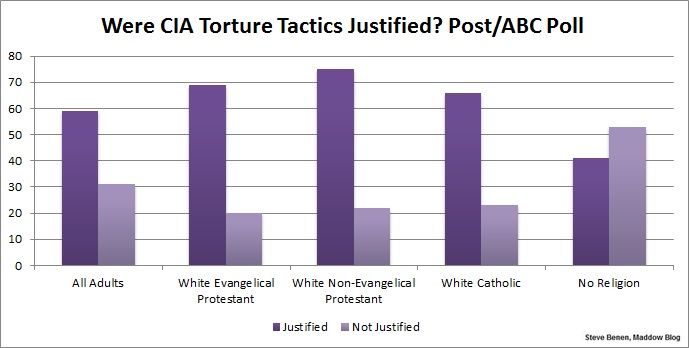
A majority of Americans think that the harsh interrogation techniques used on terrorism suspects after the Sept. 11, 2001, attacks were justified, even as about half of the public says the treatment amounted to torture, according to a new Washington Post-ABC News poll. By a margin of almost 2 to 1 — 59 percent to 31 percent — those interviewed said that they support the CIA’s brutal methods, with the vast majority of supporters saying that they produced valuable intelligence. In general, 58 percent say the torture of suspected terrorists can be justified “often” or “sometimes.”

This is neoconservatism’s biggest victory since the invasion of Iraq. It means, first of all, a culture immune to fact. The Senate Report concludes from a mountain of CIA documents that no good intelligence was procured through torture – and yet by 2 – 1, Americans prefer to believe a fantasy, peddled only by the torturers themselves. The only fantasy many are prepared to abandon is that the CIA’s program was not somehow “torture”. For that admission, those of us who have tried to exhume and explain the grisly facts can receive some credit. But that credit is instantly wiped out by the fact that even when it is torture, most Americans support it.

In this struggle, we always knew we could never undo the horrors of the past. What we were trying to do was to expose a criminal conspiracy at the heart of the American government to subvert the law and adopt the tactics of totalitarian states toward prisoners – in order to prevent any of it ever happening again. We achieved the one at the expense of the other. No one can seriously doubt that there was a conspiracy, that it involved the knowing subversion of the rule of law, that it committed acts of absolute evil, and that it sunk America’s international reputation to unprecedented lows. Yet a majority of Americans endorse all of it. Because 9/11.

And the staggering levels of support for torture by Christians merely reveals that very few of them are Christians at all. Torture is not a gray area for Christians. It is the darkest stain there is. And the fact that 65 percent of white Catholics back torture tells you a lot about the terribly weak leadership of the bishops on this core and central issue. They were more interested in how to stop women getting contraceptives than standing up and being counted on torture.

Several factors play into this: the shameless and relentless campaign by the torturers to insist they did nothing wrong and even, against all the evidence, “saved lives”; the impact of CIA-blessed popular culture fantasies like “24” or “Zero Dark Thirty” which made torture seem heroic; the fathomless pragmatism of president Obama, utterly in hock to the CIA; the bureaucratic skills and sabotaging of the report by John Brennan; the broader polarization that meant that if one political party endorsed war crimes as a policy, roughly half the population would fall in line; the paranoia and panic that Bush and Cheney spread after 9/11; and the underlying American propensity for rationalizing revenge and violence, especially against anyone with dark skin and a funny name.

As an immigrant to America, this is a bit of a gut-check, to say the least. A reader channels some of what I’m feeling:

I’m a naturalized US citizen, as is my wife and kids. My wife and I were born and raised in Ireland, our kids born in London but we moved to US when they were very young. Even before this thoroughly depressing week of news on torture and politics in general, both my kids (now in college) made uncoordinated separate comments that they are now not sure if they see any future in staying in the US. My son has even opted to go to college in Canada, he feels so strongly about it.

As I read more and more of your coverage on the torture debate and the denials, it is starting to feel like I have been thrown into a dark dank pit and left to rot.

We’ve chosen this country at a moment when it has chosen to embrace torture as an instrument of policy. And that all but inverts the meaning of America.

For me, America has always been about freedom. You can criticize this country all you want, and of course it has its flaws. But that it gives countless millions a new chance at life, that it embraces hard work and new voices, that it values experimentation and exploration, that it churns with an individualism and a vibrancy found almost nowhere else is indisputable. It’s why I fell in love with America almost as soon as I got here.

But the embrace of state-enforced torture against prisoners is not just a flaw in that freedom; it is its utter negation. If a state can torture anyone – including an American citizen like Jose Padilla – limited government is over. Torture gives the torturer the ability to create fact and evidence, to enable further torture and further new “facts” to perpetuate whatever public line a government wants to propagate. It is the most extreme example of how the power of the state can utterly destroy the agency of a human being. It is tyranny in its most concentrated and totalist form. It is the negation of the Constitution. The expulsion of it from Western Europe over the last few centuries was a sine qua non for the emergence of democratic life and culture. And yet America has now reinstated it as a core part of the republic. If we ever allow a Republican to be president again, it could well return.

Despair is one option. But it is a weak one. Becoming or being an American seems to me to be to embrace a struggle, not to bask in perfection. What we have to do now is very hard. It is not to allow this to be put in the rear-view mirror, as president Obama shamelessly wants us to do; it is not to acquiesce to a government which has no effective way to regulate or control its own deep state; it is not to wallow in cheap contempt for most Americans’ comfort with barbarism, as long as it is their barbarism. It is, quite simply, to keep pursuing the facts and to keep pursuing the war criminals. What we need is a careful strategy for first firing and then prosecuting these criminals still walking the halls at Langley. There are no statutes of limitations on these grave crimes against humanity. The only limit to securing justice in this is our patience and fortitude. And we need to have copious supplies of both.

ISIS Suffers A Defeat

IRAQ-CONFLICT-KURDS

The Kurds have beat them back:

Kurdish forces in northern Iraq celebrated their biggest victory yet over ISIS on Friday after breaking, with U.S. air support, the lengthy jihadi siege of Mount Sinjar and freeing hundreds of trapped members of the Yazidi religious sect. The Kurds claimed at least 100 Islamic militants were killed in the two-day battle to lift the siege. The victory by about 8,000 Peshmerga fighters will boost the Kurds’ confidence in their efforts to roll back the territorial gains made in northern Iraq by the fighters for the so-called Islamic State.

But the fighting isn’t over:

While Kurdish fighters in Iraq have pushed deeper into the town of Sinjar, held by ISIS group, they are facing stiff resistance from the Sunni militants who captured it in August, the Associated Press reported.  One of the fighters, Bakhil Elias, described the overnight clashes which continued till Monday as “fierce” and that ISIS militants are using snipers.

Dexter Filkins puts the news in context:

For the Kurds, regaining control of Sinjar would restore most of the territories they lost to the ISIS summer offensive. And while that would place them in control of the highway that runs into western Mosul, it’s unclear whether the Kurds would send troops there. Western Mosul, like the rest of the areas under ISIS control, are overwhelmingly Arab; the Kurds, who ultimately have independence on their minds, may be reluctant to try to take control of non-Kurdish lands.

Eli Lake observes that “the question of a Kurdish state is getting harder to avoid”:

The peshmerga own some tanks, some rifles and have in the past worked very closely with American special-operations forces in Iraq. But they are still organized like a militia, with various commanders more loyal to local Kurdish political leaders than to the Kurdistan Regional Government, or KRG. Between 1994 and 1997, forces loyal to the two major Kurdish parties fought one another in a civil war.

On a visit to Washington last month, Fuad Hussein, Barzani’s chief of staff, told reporters that his government was now beginning the process of creating a centralized Kurdish army. And this is where U.S. training of three Kurdish brigades could make a major difference. If the peshmerga transforms from a localized guerilla militia into a modern army, then one of the remaining pieces necessary for Kurdish independence will fall into place.

And Walter Russell Mead recommends that, “for now at least, keep our gloating in check”:

ISIS has so far demonstrated a knack for repeatedly solving problems that others assumed were insoluble. It has conquered much more territory much more quickly than anyone expected, it has established a global presence and a successful brand, it has attracted and organized huge numbers of foreign fighters and has made inroads among rival Sunni tribes in both Syria and Iraq. We can hope that the stresses under which it now labors will cause it to fragment and fail, but we should certainly not count on it. This is an extremely dangerous organization, and the problems it now faces are, we should not forget, the results of its startling successes.

(Photo: Fighters of Kurdish Peshmerga forces get ready for an operation in the town of Sinjar on December 20, 2014 at Mount Sinjar, west of the northern Iraqi city of Mosul. By Safin Hamed/AFP/Getty Images)

For Richer, For Poorer

Philip Cohen explains the impact of the recession on US marriages:

In the case of divorce, the pattern is counter-intuitive. Although economic hardship and insecurity adds stress to relationships and increases the risk of divorce, the overall divorce rate usually drops when unemployment rates rise. Researchers believe that, like births, people postpone divorces during economic crises because of the costs of divorcing—not just legal fees, but also housing transitions (which were especially difficult in the Great Recession) and employment disruptions. My own research found that there was a sharp drop in the divorce rate in 2009 that can reasonably be attributed to the recession. But, as is suspected will be the case with births, there appears to have been a divorce-rate rebound in the years that followed.

Meanwhile, Andrew Gelman flags a “recent research report from M.V. Lee Badgett and Christy Mallory,” indicating that divorce is less of a threat to same-sex couples:

The first wave of same-sex marriage is not necessarily typical of what will happen in future years, and in other states. So it will be interesting to see this go forward. It would also be interesting to see the age distribution of the newlyweds. I’d expect that in the first years of same-sex marriage we’d see a lot of older couples and then the average age of marriage would settle down to a lower level, comparable to that of traditional wives and husbands.

Finally, Aran reports that “female couples make up 51% of all same-sex relationships, but 64% of legally formalized relationships” but the data in the linked report does not separate out the dissolution rate by sex (a data partition that can be done with same-sex marriage but not, of course, with traditional marriage data). Many more interesting things to look at.