
Sacramento, California, 7.04 am
Sacramento, California, 7.04 am
Last week, Rand Paul voiced his support for normalizing relations with Cuba. Harry Enten expects Paul to pay a price for doing so:
In [Florida International University]’s 2008 survey — which had similar overall results to their 2014 poll — John McCain supporters favored the embargo 73 percent to 27 percent. Obama voters were almost exactly the opposite: 70 percent against and 30 percent for. The embargo’s biggest supporters are older Cuban-Americans, who are quite Republican-leaning, compared to younger Cuban-Americans, who are quite Democratic-leaning.
These Cuban-American Republicans could easily swing a relatively close Florida Republican primary. Cuban-Americans make up a sizable 8 percent of the primary vote in Florida, which is greater than the 6 percent Cuban-Americans make up in the general election. More importantly, though, Cuban-Americans have voted in a bloc in the past two presidential primaries.
Allahpundit agrees that Rand is in dangerous territory:
It’s not even Cuba per se that’s risky for Paul; it’s the perception that he’s so much different from other Republican candidates on foreign policy that he’s more inclined to agree with — gasp — Barack Obama than he is with Marco Rubio and the rest of his own party’s candidates. Opposing the Cuba embargo might please libertarians but it probably won’t him many extra conservative votes, especially in the primaries. Being seen as simpatico with Obama’s approach to international relations could hurt him, though, with exactly the sort of righties he’s targeting for votes.
Larison differs:
Paul’s position may not help him with that many voters in the Florida Republican primary electorate, but it’s the obvious position that he would have been expected to take. It’s also the obvious move for anyone who identifies as a conservative realist as Paul does. Had he not come out in favor of normalization, it would have given would-be supporters a new reason to doubt him, and he would have missed an easy opportunity to distinguish himself from the rest of the party’s likely 2016 field on an important new foreign policy issue. And Paul is far from being the only Republican inclined to support normalization. Not only are there other members of Congress that take the same view, including Jeff Flake and Justin Amash, but according to at least one survey taken this year more Republicans nationally support this position than oppose it. Republicans are far from monolithic on this question, and most don’t share Rubio’s hard-line views.
Josh Rogin tries to understand North Korea’s reasons for hacking Sony:
For Kim, it’s all about himself and his ongoing effort to consolidate power. Therefore, his image is the one thing he cannot afford to take chances on.
“This is a signal of the fragility of Kim Jong Un’s rule,” said James A. Lewis, a senior fellow and long time North Korea watcher at the Center for Strategic and International Studies. “We can take a joke, Kim can’t because he doesn’t want his people to get any ideas. The last thing he wants is his subjects to see him as an object of ridicule, much less able to be assassinated.”
Max Fisher, on the other hand, contends that North Korea “wants us to see them as crazy, irrational, volatile — and dangerous”:
Kim Jong Un isn’t stupid: he knows that his weak, impoverished state is much weaker than the US and South Korea and Japan, all of whom would just love to see his government collapse. North Korea can only deter those enemies by being more threatening and dangerous; it will never be stronger, so it has to be crazier instead, always more willing to escalate. This convinces the US and other countries, even if they see through Kim’s game, that it’s just easier to stay away from North Korea than to risk provoking the country into another flamboyant attack. …
This strategy of portraying itself as crazy is remarkably effective at securing North Korea’s strategic goals. But it is also quite dangerous. By design, the risk of escalation is high, so as to make the situation just dangerous enough that foreign leaders will want to deescalate. And it puts pressure on American, South Korean, and Japanese leaders to decide how to respond — knowing that any punishment will only serve to bolster North Korean propaganda and encourage further belligerence. In this sense, the attacks are calibrated to be just severe enough to demand our attention, but not so bad as to lead to all-out war.
The Sony hack certainly demanded out attention. Though he fully admits that the hack was “a far smaller thing” that 9/11, Drum sees some similarities in terms of “bang for the buck”:
Despite what press reports say, it wasn’t really all that sophisticated. It was, to be sure, a step up from box cutters, but it’s not like North Korea tried to hack into a nuclear power plant or the Pentagon. They picked a soft target. In fact, based on press reports, it sounds like even in the vast sea of crappy IT security that we call America, Sony Pictures was unusually lax. Hacking into their network was something that probably dozens of groups around the world could have done if they had thought about it. And like al-Qaeda before them, North Korea thought about it. And they realized that a Sony Pictures hack, done right, could have an outsized emotional impact. Like 9/11, it was a brilliant example of using a relatively crude tool to produce a gigantic payoff.
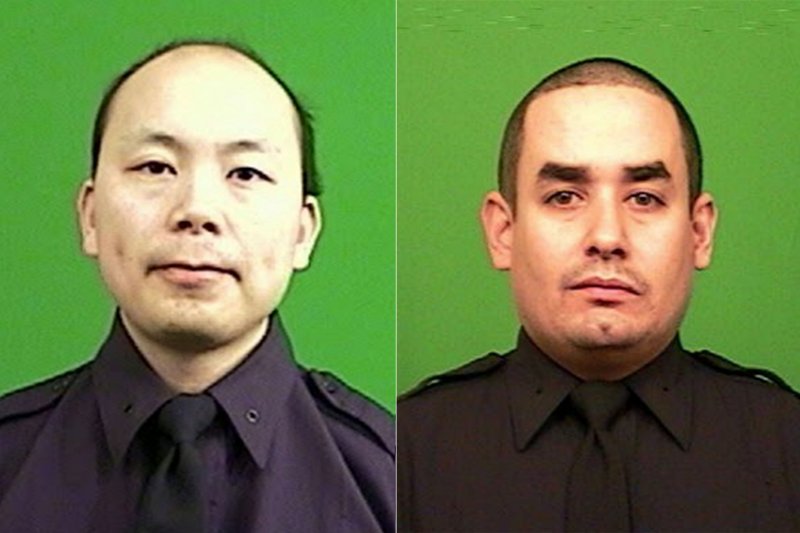
Two NYC police officers were shot and killed on Saturday while sitting in their patrol car:
[Ismaaiyl Abdulah Brinsley] approached a marked police vehicle parked in the Bedford-Stuyvesant neighborhood around 2:45 p.m. He “took a shooting stance” and fired a handgun several times through the window, New York Police Commissioner William Bratton said at a news conference.
Officers Wenjian Liu and Rafael Ramos were struck in the head, and taken to a hospital, where they were pronounced dead. Police said Brinsley, 28, ran into a subway station, where he shot himself in the head.
Caroline Bankoff runs through what we know about the shooter. Rudy Giuliani was quick to blame the recent protests against police abuse:
Giuliani went out of his way to be clear that he’s not blaming a handful of bad apples. He thinks the culprits are everyone protesting police misconduct everywhere. “The protests are being embraced, the protests are being encouraged. The protests, even the ones that don’t lead to violence — a lot of them lead to violence — all of them lead to a conclusion: The police are bad. The police are racist,” said Giuliani. “That is completely wrong. Actually, the people who do the most for the black community in America are the police.”
Along the same lines, NYPD union president Pat Lynch ranted about the mayor having “blood on the hands” and officers turned their backs on de Blasio at a presser. Bouie pushes back on such antics:
Despite what these police organizations and their allies allege, there isn’t an anti-police movement in this country, or at least, none of any significance.
The people demonstrating for Eric Garner and Michael Brown aren’t against police, they are for better policing. They want departments to treat their communities with respect, and they want accountability for officers who kill their neighbors without justification. When criminals kill law-abiding citizens, they’re punished. When criminals kill cops, they’re punished. But when cops kill citizens, the system breaks down and no one is held accountable. That is what people are protesting. …
The idea that citizens can’t criticize police—that free speech excludes scrutiny of state violence—is disturbing. Since, if free speech doesn’t include the right to challenge the official use of force, then it isn’t really free speech.
In a Dec. 21, 2014 article about the shooting, the Los Angeles Times referred to the New York City protests as “anti-police marches,” which is grossly inaccurate and illustrates the problem of perception the protestors are battling. The marches are meant to raise awareness of double standards, lack of adequate police candidate screening, and insufficient training that have resulted in unnecessary killings. Police are not under attack, institutionalized racism is. Trying to remove sexually abusive priests is not an attack on Catholicism, nor is removing ineffective teachers an attack on education. Bad apples, bad training, and bad officials who blindly protect them, are the enemy. And any institution worth saving should want to eliminate them, too.
And Tomasky defends de Blasio against the NYPD’s smears:
Pat Lynch, by speaking of officers’ blood on the steps of City Hall and urging his cops to sign an online petition that de Blasio not attend their funerals should they be killed in the line of duty, is doing… what? His behavior is divisive to the point of savagery. He is actively trying to make the people who follow him not only despise de Blasio but despise and oppose any acknowledgement that police can be faulted in any way, that black fear of police has any basis in reality. If Al Sharpton did the same with regard to police departments tout suite, which he does not anymore—he denounced the murder of the two cops immediately—he’d be drummed out of society.
Still, de Blasio should find ways to rise above all this. That’s part of the responsibility that comes with being mayor. But he should not back down from what he said.
(Photo: Officer Wenjian Liu (left) and Officer Rafael Ramos (Right). From the NYPD.)
I hope to be doing some more torture blogging this week (and a Merry Christmas to you too!) but a couple of quick notes for tonight. The first is that, of course, no one at the CIA will suffer any consequences for their astonishing attempt to spy on their Senate overseers:
The five C.I.A. officials who were singled out by the agency’s inspector general this year for improperly ordering and carrying out the computer searches staunchly defended their actions, saying that they were lawful and in some cases done at the behest of CIA director John Brennan.
So we discover that it was Brennan himself who directed that the CIA spy on the Senate staffers! And it’s worth recalling why he resorted to that violation of the basic constitutional order. He did so because the staffers had come upon the CIA’s own internal report on the torture program, and it came to the exact same conclusions as the Senate Report, i.e. that the progam was obviously torture and completely ineffective. The so-called “Panetta Report” utterly devastated Brennan’s continuing view that torture provided good intelligence and all but proved that the CIA had no utilitarian defense of their barbarism whatsoever. And so Brennan panicked.
He needn’t have. It’s clear that the CIA’s place in our “democracy” will not be dislodged any time soon. President Obama has not the slightest qualms about employing war criminals and working closely with them. He never has. Opponents of torture are, for the president, “self-righteous.” And the system, in any case, ensures that the CIA always polices itself and will therefore always exonerate itself:
A panel investigating the Central Intelligence Agency’s search of a computer network used by staff members of the Senate Intelligence Committee who were looking into the C.I.A.’s use of torture will recommend against punishing anyone involved in the episode, according to current and former government officials … While effectively rejecting the most significant conclusions of the inspector general’s report, the panel, appointed by Mr. Brennan and composed of three C.I.A. officers and two members from outside the agency, is still expected to criticize agency missteps that contributed to the fight with Congress.
Notice that the “panel” has a built-in CIA majority. And the CIA will never allow anyone in its employ to be held accountable for his or her actions – least of all the chief conspirator in this attack on the Senate, Brennan himself.
There is one person missing in all this: the president. He has allowed his own CIA director to violate the constitution and to lie to the public in defending the torture program’s effectiveness. After a report proved that American torture was sadistic and useless, the president allowed his CIA director to stand up and say the answer to the latter question is “unknowable”. This is not a neutral stance, and never has been. It is a classic example of truthiness versus the truth. It is a stance that reaffirms that we live in only the appearance of a democracy, but that the deep state of the US is a law unto itself. It is a position that one agency in government is beyond any accountability. It is a recognition that this president, like all the others, reports to the CIA and not the other way round.
Watching this truth unfold in front of my eyes these past ten years has been a revelation to me and a bitter rebuke to whatever naivete about American democracy and decency I once held. I don’t think anyone can truly believe in either American decency or democracy as long as the worst war criminals are not just left unpunished, but celebrated, defended and even promoted. And what the CIA will learn from this is surely that it can get away with anything. It can allow 9/11 to happen and war crimes to be committed and have nary a single soul so much as fired. The greatest intelligence failure in modern times and the greatest moral failure in modern times … and no one will ever be so much as demoted.
That’s absolute power. And it corrupts absolutely.
Some posts worth revisiting from the weekend: the Internet hoax of Pope Francis’ endorsement of animals in heaven; the existential life of an acorn; Wilkinson on how Santa is “an exercise in losing your religion“; and Dean on being a writer on the web today.
The most popular post of the weekend was Glenn Beck: Better Than Marina Abramovic, followed by Santa Is A Lie I Will Tell My Son.
I’d like to thank Michelle and Will for filling in for me last week, and all the Dish staff for their hard work while I was on a listening tour of new media experiences in NYC. If you were not fully aware of how deeply a group effort this blogazine is, I hope you are now. Or as this new subscriber artfully puts it:
I fucking love you. I fucking love your website. I fucking love what your staff does. You’re all fucking invaluable. Great fucking year, and keep up the good fucking work.
Which leads me to one Christmas request: we exist on subscriptions alone. So if you are a constant reader but haven’t yet subscribed, this is your moment. You can also give a Dish subscription as your last-minute gift, timed to arrive by email on Christmas Day.
And see you in the morning.
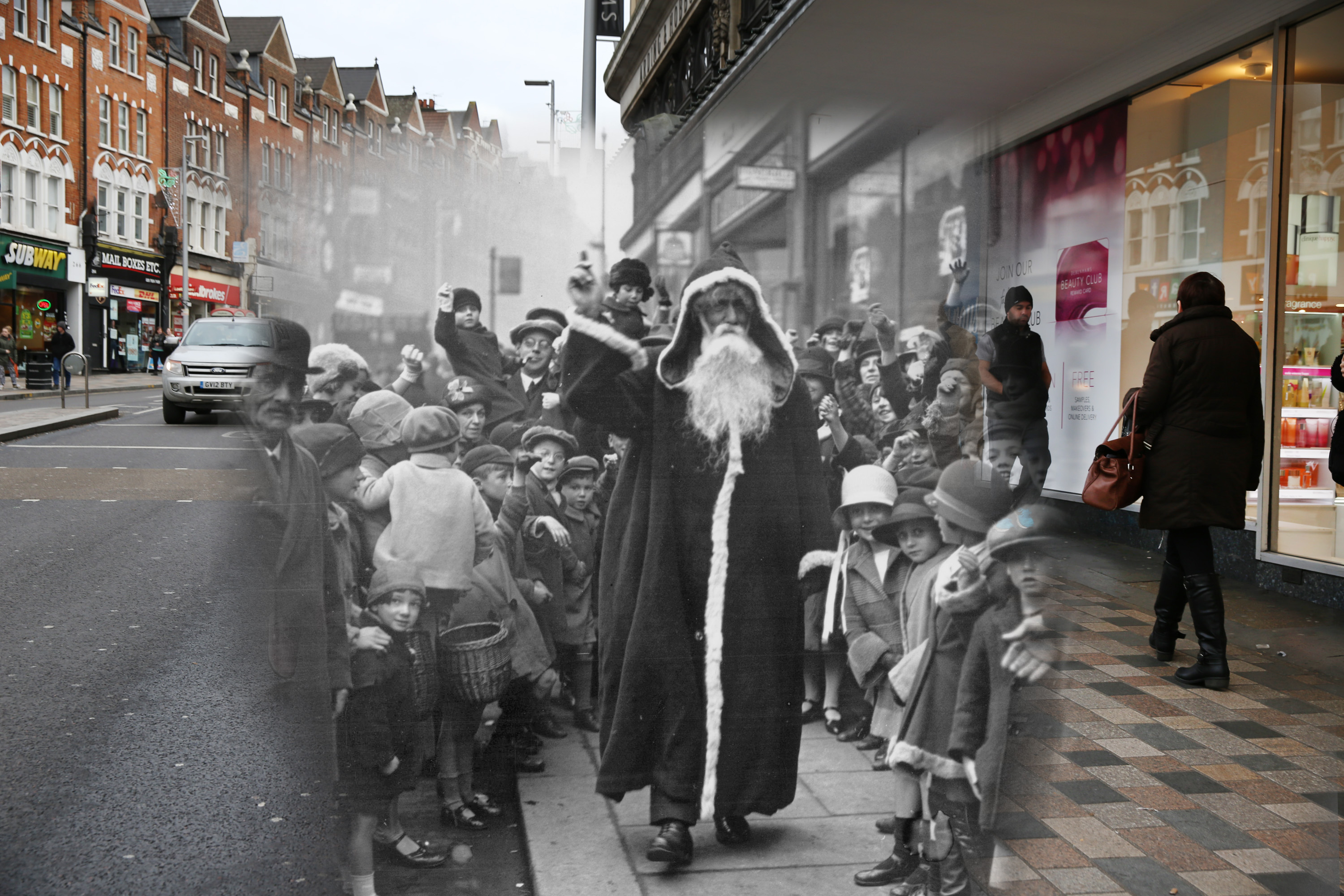
(Photo: In this digital composite image a comparison has been made of London at Clapham Junction in 1926 (Archive, Topical Press Agency) and Modern Day 2014 (Peter Macdiarmid) at Christmas time.)
So I arrived at the usual spot on 54th Street without knowing quite what to expect (and not for the first time). The clue – we were told to memorize the tune and lyrics of “We’ll Meet Again” – didn’t require much prep on my part. The song is close to a national anthem in England – which may be why Samantha Power and I seemed to be the only ones really belting it. So I arrived a little lubricated and was assigned to “Group 4” in an office on the second floor. Meandering up the stairs, I stumbled in and realized, the way you do, that since all my fellow Group 4’s were sitting in a row and not saying much, that I was going to have to shake hands with every single one of them, and introduce myself. Like some strange dream set in someone else’s office, Charlie Rose, Katie Couric, Mark Cuban, Peter Frampton, and Jeff Bridges were the openers. Eventually I said hi to the dude sitting on the desk nearby – Michael Stipe. Then, just like at Studio 54, Kissinger, the tiny, reptilian war criminal, showed up, merging into the cocktail hour like a lizard on a sun-drenched rock. Next door, I could see the “face” of Barry Manilow. Around the corner, I saw a woman get out of a Big Bird costume. And what do you say exactly when Terry Gross just wanders up and says hi? That you’re busy hiding from Paul Krugman?
I had one obvious option – the beautiful and long-limbed ballet dancer, David Hallberg. Maybe I could talk to him. Even though an injury had robbed us all of the sight of him in tights, at least I could talk with him. And so we made jokes most of the night, and bonded in the face of so much celebrity wattage. It is, in case you’re wondering, impossible to interact with any of these people in any natural way. What on earth am I going to say to Mark Cuban, for Pete’s sake? Meeting the super-famous, in a context where you have nothing in common but a very gifted booker, is at first bewildering and then really boring. A reader writes:
Andrew, you were on the spot: did David Hallberg ever take his hands off Katie Couric? I’m sure she was cool with it, but I’m curious. :)
My impression was that Couric couldn’t take her hands of Hallberg. But I got the last dance.
And, of course, I choked up a little in the rehearsal. I fell in love with Colbert the first night of the show. Even blogged it:
Pure Genius: Last night’s Colbert Report, of course. O’Reilly fileted. My only worry is: how can he keep it up?
But he did, of course, and then some. Which is worth noting in and of itself. This was an unprecedentedly sustained act of character improvisation. I wasn’t crazy to doubt he would pull it off. I just didn’t realize how deeply brilliant and able he is. No one interviewed a politician as freshly as he did, or took down a pretentious author with more finesse. His writers were and are the best on television – deeply read, darkly funny. His professionalism was staggering. Nothing was ever phoned in – night after night. I saw him meticulously prepare performances, tweaking props, finessing green screens, hitting every note (he re-taped his final song before we left the studio that night), and almost never flubbing a line – while making sure to compliment you if you got yours right.
I was a part of Colbert nation in two ways: his most frequent guest but also a pathological viewer. The show lasted almost as long as I’ve been together with Aaron, and it became part of our married life. We’d watch it without fail – and it became an act of adultery for either of us to watch it without the other. Even last week, I waited to get home to watch the last four shows (Aaron gets a pass for shows I’m actually on). I joked to Stephen that we would soon see if my marriage could survive the end of his show. I guess there’s always South Park.
I also have to say Colbert remains a Catholic role model for me – a deeply humane and kind man, a generous soul, someone so totally at peace with this modern cacophony, and yet also committed to a way of life that could not be more opposed to it. For so many who regard our faith as a cramped anachronism, he was a real beacon of what a modern Catholic can be: open, funny, decent, humble. He helped keep my faith alive in a dark decade. And made me laugh at the same time. Of whom else on television could I say such a thing?

“The Oxen” by Thomas Hardy (1840-1928):
Christmas Eve, and twelve of the clock.
“Now they are all on their knees,”
An elder said as we sat in a flock
By the embers in hearthside ease.We pictured the meek mild creatures where
They dwelt in their strawy pen,
Nor did it occur to one of us there
To doubt they were kneeling then.So fair a fancy few would weave
In these years! Yet, I feel,
If someone said on Christmas Eve,
“Come; see the oxen kneel“In the lonely barton by yonder coomb
Our childhood used to know,”
I should go with him in the gloom,
Hoping it might be so.
(From Christmas Poems, copyright (symbol) 2008 New Directions Publishing Corporation. Image: Piero della Francesca’s unfinished painting of the Nativity Scene, via Wikimedia Commons)
Andrew asked me to guest-blog here the day before The New Republic hit the skids. Both events came out of the blue for me, so they’re linked in my mind now. All week I’d meant to getting around to commenting on the weirdness of it, but then the Sony hack and North Korea came crashing into the news cycle, and here we are at my last post.
What I want to say has little to do with TNR. It’s more about about how that entire mess, as it unfolded, made me feel as someone who writes online but has aspirations to do more than just blogging with her life. And the way it made me feel was: shitty. And shitty primarily because many of the people who were railing on about the loss of the magazine – and for whom it seemed to be no answer that the thing had not yet shut down – could not hide their contempt about people who came to writing in any way other than a staff job at one of these intellectual magazines.
I know many ex-TNR staffers who walked out said they were totally open to the internet. I don’t think they are lying, per se, though I think it’s having your cake and eating it too. Nonetheless, it does not excuse the unconscious snobbish clubbiness about what felt like everyone else on the Internet. Primarily, their contempt emerged in asides. It emerged in the snide mentions of Gawker and Buzzfeed, the former of which has employed me, the latter of which employs many (great) writer and reporter friends of mine. Julia Ioffe, one of those staffers, was insistent that for her Buzzfeed was not “a slur” but it did rather get used that way. It felt telling she had to defend against it. And the contempt also emerged in the rhetoric about the greatness of the magazine, specifically the argument of the open letter the staffers wrote about how “the promise of American life has been dealt a lamentable blow.”
I like high-flown rhetoric as much as the next ex-law-student who spent a lot of time studying Martin Luther King Jr. and Hannah Arendt. On the other hand, the rhetoric covered up for a sort of argumentative disconnect that the TNR staffers never quite seemed to see. It was this: For people outside the magazine to feel the full effect of the “lamentable blow,” we would have had to agree that merely by being online, by writing for outlets less august, less focussed on longform than TNR, we were somehow locked out of this whole discussion of “the promise of American life.”
Unsurprisingly, I and others had trouble doing this. And I still feel pretty awful, if I am honest.
There is still a prevalent myth out there that writers totally choose the form they write in. To some extent that can be true. You can choose to write a novel instead of a blog. You can choose to write about political theory instead of celebrities. But what you cannot generally choose, these days, is not to write for the internet unless making a living is a matter of total indifference to you. There are some very fancy novelists who manage to avoid the churn. There are also a few exceptionally fancy reporters who do. For literally everyone else, this is where you have to start. This is where the entry-level jobs are, and the editors with a slightly more liberal approach to what they’ll publish.
The only way out of being an online writer these days, for some period of time, is to be exceptionally lucky. You can be the person who was hired out of college to the New Yorker or Harper’s or the New York Times. Or the NYRB, though I’m not sure they’re much for very green hires. It will probably take you an Ivy League degree’s worth of debt first to get that job, by the way. But other than finding yourself a spot in that small-membership guild, you will start out writing online. And you will end up working for places that evidently, people will wield as reasons you shouldn’t get to work at others.
This is depressing. Journalism was not always like this. Writing was not always like this. Credentials and connections used to be somewhat less important in large part because the people in charge of general interest publications didn’t have them themselves. Harold Ross, the man who founded the New Yorker, dropped out of high school. William Shawn, who succeeded him, dropped out of the University of Michigan. I’m not saying that made either of them warriors for diversity in their pages. I’m saying I long for such a thing to be possible, now.
Which brings me back to Andrew asking me to blog here. Life is strange. I have this self-serving myth about how I’m a bit of a Llewyn Davis type as a writer. I can’t seem to fit in most places. But this is among the most pleasant gigs I’ve had. “you get to write whatever you want,” he wrote me, “on any topic that grabs your fancy.” (I hope he won’t mind my revealing that he writes in low-caps.) So I did. I hope you liked it, even if it struck you as odd or off-putting. I hope it was sort of like that Queen Jane song Davis plays in the middle of the movie.
“[T]he close unity of Incarnation and Cross should be kept in view. Christ came first as a baby, one totally dependent, a pure recipient (and rather like the adopted child example above – unplanned in the extreme). As receiver of the gifts of material comfort, human love and approval, and earthly power, Christ’s reception is marked by self-abnegation at every turn. The truest receptivity of the gifts of others will take the form of suffering; suffering a gift which redefines the form of one’s life completely. A gift, which comes unbidden and may wreak change upon the recipient, finds its most extreme form in death, which Christ accepted with open arms, even while acknowledging its conflict with his own desires: ‘My Father, if it is possible, may this cup be taken from me. Yet not as I will, but as you will.’ The Incarnation, the voluntary stripping of the Word’s divine prerogatives, foreshadows and even anticipates the Cross, the stripping of life itself, a surrendering posture of utter receptivity which creates the passive material of Resurrection.
For human gift-giving, there’s actually not that much of a practical parallel I can draw here, except that we should feel a little unburdened from the twin Laws of giving the perfect present and perfectly defining one’s taste. We tend to see the season merely as an affirmation of the lives or identities we have chosen, but there’s a disruptive element, too. We identify both with the one whose gift was rejected and as those who did (and still do, at least partially) the rejecting. It’s a time which aims to celebrate not reciprocity in relations, but asymmetry – that oddly-apportioned set of shoes from an uncle, for instance. We can’t live too much in that world now, but we think back on a story of an absolute gift, one beyond the logic of return and exchange, and we look for the new in Advent, too: new beginnings, unexpected gifts, even an intrusive houseguest or two,” – Will McDavid, “Gifts Beyond Reciprocity.”

Sara Barnes captions:
Photographer Rebecca Rütten is interested in the paintings from the Renaissance period and contemporary fast food culture like Taco Bell and McDonalds. You wouldn’t think that the two would intersect, but in Rütten’s series Contemporary Pieces, they do. The German artist combines elements of the traditional with greasy burgers and fries. ”I became enamored with the eroticism, presentation and charisma of paintings from the Renaissance Period. In the Late Renaissance, Italian and Dutch painters dealt with the middle and lower classes,” she writes in a statement about the work. To Rütten, fast food represents the two social groups. “To eat healthy is expensive,” she continues. “However, one can buy large amounts of food at a fast food restaurant for a comparatively low price.”
Rütten asked tattooed and pierced friends to model for her and recreate the poses of laborers, gypsies, and prostitutes in Caravaggio paintings. The exquisite and dramatic images are simultaneously beautiful and repulsive. For every flower or fancy goblet there are mounds of saturated fat. It’s not only a culture clash, but a fusion of foodstuffs associated with lower class and fine items for the upper crust of society.
 The Dish
