Reinventing The Bio

by Dish Staff

Stuart Kelly wonders what would happen if biographers were as formally innovative as novelists:

There have been various attempts at experimental biographies. Although it’s an “academic” book, Samuel Schoenbaum’s Shakespeare’s Lives, published in 1970, is remarkable: a life told through attempts to tell the life, a source book for how legends arise and myths solidify into facts. More recently, Jonathan Coe’s Like a Fiery Elephant, about the avant-garde novelist BS Johnson, deploys a range of tricks – meandering footnotes, choruses of comments, an intrusive and sometimes indolent narrator – which would be recognizable to readers of the novels of BS Johnson. It is a fine example of form being determined by the subject itself.

He goes on to argue that “for literary biography to survive as a genre, it ought to take its lead from literature and go even further”:

The decline of written diaries and paper correspondence … means that future biographers may have to either resign themselves to lost sources, or spend hours with computer boffins recapturing every email, tweet and keystroke from Salman Rushdie’s iPhones and laptops: a kind of archaeology which might reveal nothing more than a penchant for Patience. But a life told innovatively and imaginatively holds out a lifeline to the form. I’ve read biographies of Dickens by John Forster and Peter Ackroyd, Claire Tomalin and Robert Douglas-Fairhurst, GK Chesterton and Edgar Johnson. I know the story. But I’d love to hear how Ali Smith or Jonathan Franzen might tell it.

The Best Of The Dish Today

by Chris Bodenner

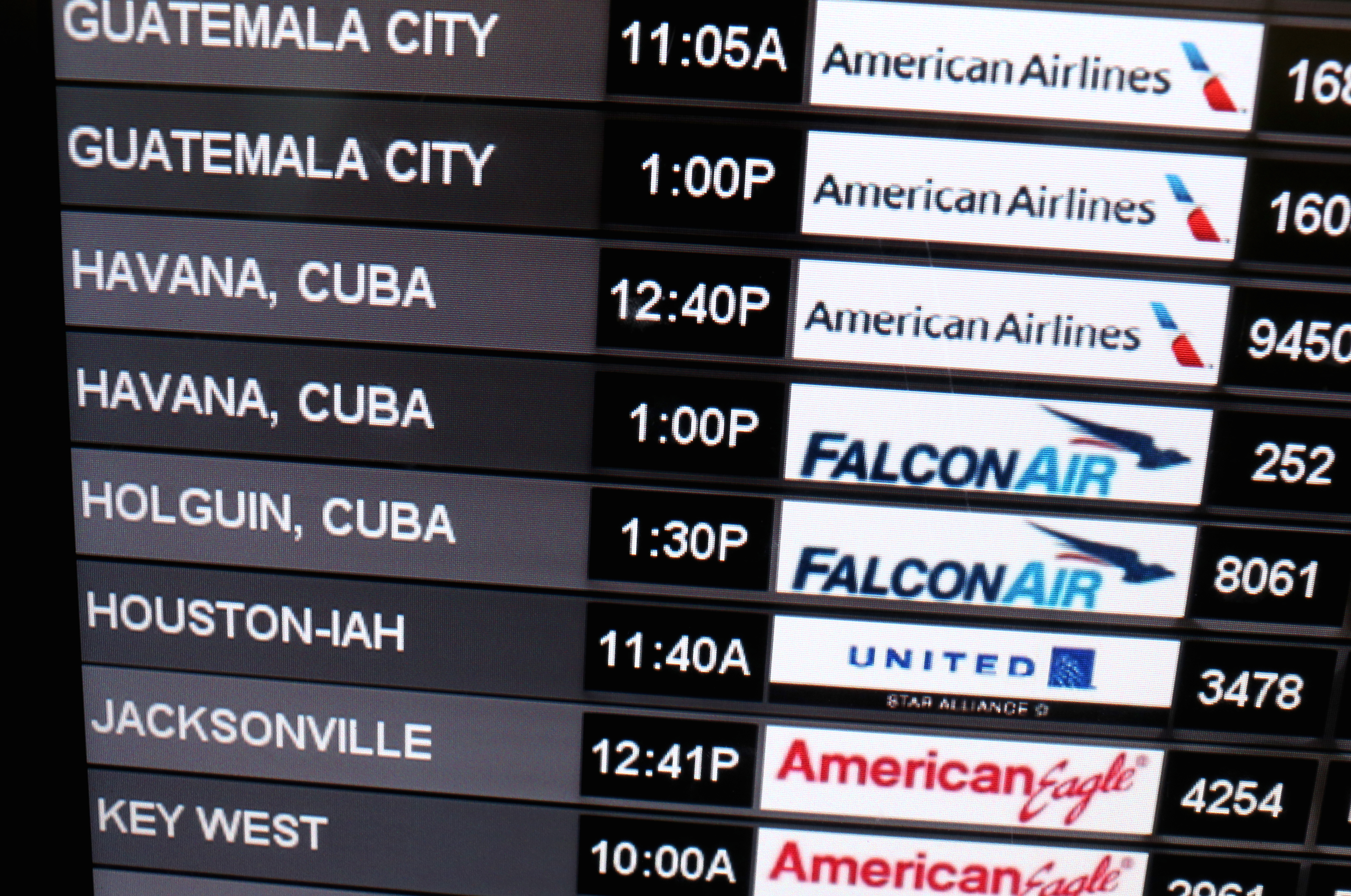
Travelers Check In To Flight To Havana, Cuba From Miami

Today on the Dish, Michelle shook her head at the long-overdue exoneration of a black teenager executed in 1944, reflected on a perceived sexist remark made during her J-school days, and added her final thoughts on the Serial finale. More from Michelle on Dorothy Parker tomorrow and a sign-off post with reflections on TNR’s collapse on Sunday.

Our most popular posts today were Howard Roark and the Hacker’s Veto and On The Right Not To Be “Triggered”. Two other posts from Will included his musings over the rapid acceptance of same-sex marriage and his hatho-induced awe over Glenn Beck’s newest video.

Phoebe, our wonderfully bright intern leaving the Dish soon, examined the evolving ways we look at gentrification, highlighted French author Éric Zemmour’s look at his nation’s decline, and joined Vanessa Vitiello Urquhart in considering the role of masculinity in their lives and literature.

Be sure to check out Andrew’s cameo in the Colbert finale and this hilarious story from a reader who ran into the senior Senator from Colbert’s home state of South Carolina. More Santa-crushing stories from readers here.

We’ve updated many recent posts with your emails – read them all here. You can always leave your gifting-cartoonunfiltered comments at our Facebook page and @dishfeed. 20 more readers became subscribers today. You can join them here – and get access to all the readons and Deep Dish – for a little as $1.99 month. Gift subscriptions are available here (you purchase one today and have it auto-delivered on Christmas Day). Dish t-shirts are for sale here and our coffee mugs here.

One of our newest subscribers has been a regular emailer since 2010:

The Dish staff photo finally prompted me to subscribe today. I had been dodging the pay-meter on a daily basis since its inception, but seeing the staff photo helped humanize the team, replacing my mental image of a gaggle of flaming liberals – though if I squint real hard, I think I do see a few sparks coming off a couple of you. Happy holidays!

Andrew will be back on Sunday night and likely torture-blogging throughout the week, so be sure to tune in for more on waterboarding, rectal feeding, and war criminals … Merry Christmas!

(Photo: A sign shows the departure times for flights to Cuba at Miami International Airport on December 19, 2014 in Miami, Florida. By Joe Raedle/Getty Images)

Glenn Beck: Better Than Marina Abramovic

by Will Wilkinson

I won’t say that this is the greatest thing that I have ever seen, but neither will I say that it is not glorious to behold. Glenn Beck, American, offers a voice of warning … from the future:

Kyle Mantyla of Right Wing Watch (I’d rather watch grass grow) writes:

The best thing about Glenn Beck owning his own network is that he answers to nobody and so there is nothing to stop him from indulging every insane idea that he has, resulting in hour-long programs like last night’s end-of-the-year recap in which a 90-year-old Glenn Beck recorded a dire message from the future about how 2014 was the year in which the whole world fell apart.

Living alone in an abandoned building with only a few tiny candles and a small fire for light and heat, future Beck somehow managed to scrounge up some batteries and video cameras with which to record his message. And even though the world in 2054 is apparently short on food and fuel and energy and everything else, future Beck still somehow managed to obtain stockpiles of footage from news programs that aired forty years earlier and even had the capacity to edit those clips into his dire message about how everything from Ebola, to ISIS, to the Federal Reserve all brought about the complete collapse of capitalism and society starting in 2014.

Glenn Beck, in my opinion the world’s greatest performance artist, has built a fortune on the crackpot credulity of extreme conservative. This video is just delightfully bats. Will Menaker tweets:

It’s like he wants us to know he’s pulling our leg. But then he’s totally not! Glenn Beck is a living magic eye poster. You squint and you see the winking irony, but you try to pull it into focus and it vanishes! All you see is the authentic wild-eyed paranoid ideologue. But then you catch the wink! Agh! The mercury-blooded cipher! I love him so much I wrote down what he said:

Forty years ago, 2014, your history books claim, that was the year of the dawn of progressivism! The dawn of a new beginning! The end of capitalism! I’ll tell you know that it was that. That this new era of equality, and diversity and tolerance … I beg to differ with your history book! Forget your books! I was there! I saw it! I remember 2014, I remember four words that came to me… There was a clash of the “evil” tea partiers. There was a clash on a ranch in the middle of the country. A man said he had a right to his own land. It was at that time that I heard, and I’ll never forget it in my prayers, four words: “And. So. It. Begins.” Over and over again I saw it, over and over again I heard it. I was like Nebuchadnezzar without Daniel… Sorry. You probably don’t even know what that means. Right. I’m not crazy. I was naive, but I was not crazy.

Not crazy … like a fox! So the turning point in American history is the standoff at Cliven Bundy’s ranch? Of course. And the bewhiskered ghost of Glenn Beck future apologizes for his biblical reference because … why? Because the Bureau of Land Management was not brutally overthrown, and so the Bible has become illegal? Who knows! Who cares! This is art, people. Beck’s historical-reenactor-from-the-dystopian-future scenery-chewing raises the bar for avant garde thespians everywhere. In twenty years, when Beck steps out for his bow, I’ll be first in line for the MoMa retrospective celebrating this luminous American original and his mind-bending decades-long post-modern meta-satire of unhinged populist demagoguery. Who needs spineless Hollywood? The bleeding edge of culture is happening at The Blaze.

The Gentrification Of “Gentrification”

by Phoebe Maltz Bovy

Emily Badger suggests chucking the word:

Even researchers don’t agree on what “gentrification” means, let alone how to identify it. (And this is to say nothing of its even more problematic derivative, the “gentrifier.”) … The definition matters… not purely for linguistic nit-picking, but because we seldom talk about gentrification in isolation. More often, we’re talking about its effects: who it displaces, what happens to those people, how crime rates, school quality or tax dollars follow as neighborhoods transform. And if we have no consistent way of identifying where “gentrification” exists, it then becomes a lot harder to say much about what it means.

Badger has me convinced, but I’d push further: “Gentrification” has taken on a life of its own as a lifestyle-section problem. The same language gets used to discuss concerns that a neighborhood has become unaffordable for poorer residents as to lament the fact that a favorite (pricey) coffee shop or boutique has closed its doors to make way for a chain store. NIMBY complaints hide out under the socially-acceptable – noble, even – guise of anti-gentrification advocacy.

This conflation of problems is not new, but when I read a NYT op-ed over the summer by a prominent restaurant owner, who was pointing out that because of rising rents, he may have to… change the location of one of his high-end Manhattan restaurants, I started to think that perhaps it’s gotten out-of-hand in recent years. Of course, The Onion was on the case in 2008, with its “Report: Nation’s Gentrified Neighborhoods Threatened By Aristocratization.” At any rate, Benjamin Schwarz addressed the phenomenon with great precision in 2010:

It’s entirely reasonable—in fact, humane—to argue that the state must ensure decent living conditions for its citizens (and God knows we are terribly far from that situation). But it’s a wholly different proposition to argue that, in the name of what [Michael] Sorkin calls “the protection of … the local” and to forestall “a landscape of homogeneity,” the state should create the conditions necessary for favored groups—be they designers, craftspeople, small-batch distillers, researchers, the proprietors of mom-and-pop stores—to live in expensive and fashionable neighborhoods or boroughs. That effort would ultimately be an aesthetic endeavor to ensure that the affluent, well-educated denizens of said neighborhoods be provided with the stage props and scenery necessary for what [Jane] Jacobs and her heirs define as an enriching urban experience.

So these are really two additional problems with “gentrification” – that it’s used by the rich to protest the arrival of the even-richer, and that it’s sometimes code for saying that a neighborhood has gone tacky, touristy, mall-ish, i.e. that it’s become more accessible. I’m not sure any of this is reason for scholars of urban planning to abandon the term, but the time has probably come to treat it with skepticism in magazine articles, social-media posts, and the like.

Faces Of The Day

by Dish Staff

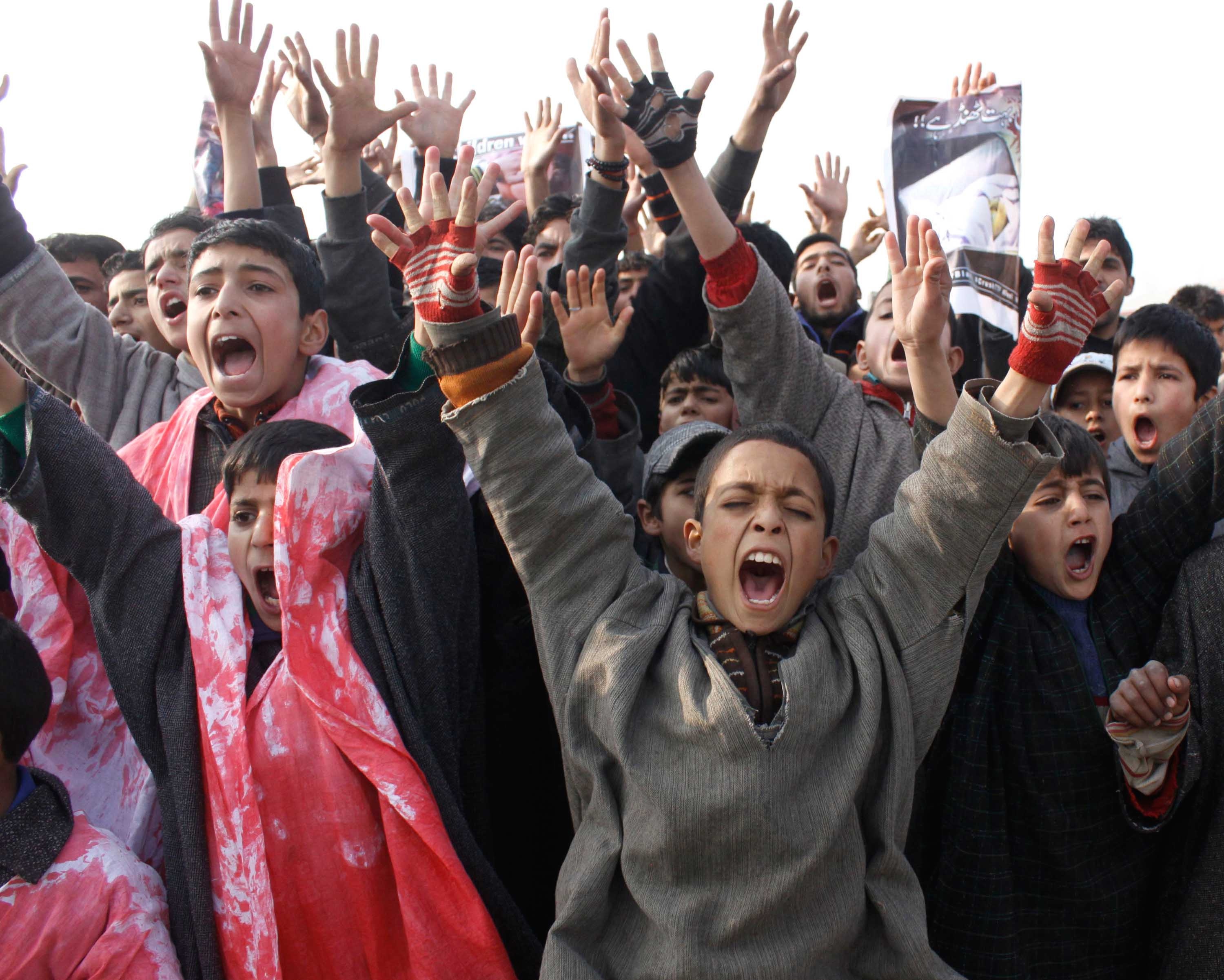
Kashmiri Shiite Boys Protest Over Peshawar Terror Attack In Pakistan

Kashmiri Shiite boys wear blood stained shrouds on December 19, 2014 in Srinagar, India as a sign of protest against the recent killing of the schoolchildren in the terror attack in Peshawar, Pakistan. The Pakistani Taliban killed 141 people, including 132 children, at an army-run school, and it was the deadliest in Pakistan’s history. By Waseem Andrabi/Hindustan Times via Getty Images.

Leaning In, Tumbling Down

by Dish Staff

Reacting to a story about Yahoo’s Marissa Mayer, Annie Lowrey reflects on “the ‘glass cliff,’ a relative of the ‘glass ceiling’ that holds back businesswomen, the ‘glass closet’ that stifles the ambitions of gay executives, the brick walls facing many managers of color, and the ‘glass elevator’ that helps so, so many white bros up to the top”:

The term comes courtesy of two psychologists, Michelle K. Ryan of the University of Exeter and S. Alexander Haslam of the University of Queensland. In a pioneering study published a decade ago, they found that women were often promoted to board positions after a company had started faltering. Women weren’t picked to lead companies on an upswing, in other words. They were promoted to help manage turbulence and decline.

To show it, the researchers looked at the performance of firms before and after the appointment of a male or female board member. “During a period of overall stock-market decline those companies who appointed women to their boards were more likely to have experienced consistently bad performance in the preceding five months than those who appointed men,” they found. …

Why might companies gravitate toward female executives during times of turbulence and distress? The explanations tend to boil down to gender essentialism. Women are perceived to be more nurturing, and thus better at healing a broken business. It also might be easier for a corporate board to scapegoat a female executive than a male one, some researchers have theorized, given that women are expected to be worse managers in the first place. But perhaps that is just correlation and causation, as indicated by the glass-cliff theory itself.

Lowrey then pinpoints why the “glass cliff” matters:

The problem with the glass cliff is that it might cement the stereotype that women are worse managers and executives than men, all because they are asked to manage worse businesses then men. “Women who assume leadership offices may be differentially exposed to criticism and in greater danger of being apportioned blame for negative outcomes that were set in train well before they assumed their new roles,” the original study’s authors conclude. “This is particularly problematic in light of evidence that directors who leave the boards of companies which have performed poorly are likely to suffer from a ‘tarnished reputation.’” That might be why the stock of a company drops after the announcement of a female chief executive, but not a male executive.

Playing Ball With Cuba

by Dish Staff

bialik-datalab-cubamlb

As Carl Bialik’s chart shows, Cuban baseball players are on the rise here in the US, and now with the thaw in US/Cuba relations, many are wondering about the implications for their shared national pastime:

Baseball has long been the most popular sport in Cuba and the island has long been a hotbed of baseball talent. Cubans have been playing professional baseball in the United States for nearly 150 years and even the embargo hasn’t stopped star Cuban players like Aroldis Chapman of the Cincinnati Reds and Jose Abreu of the Chicago White Sox from coming to the U.S. to play in the major leagues. But the embargo has meant that players who come to the United States have had to defect and suffer all sorts of risks to escape out of the country—including falling prey to smuggling rings.

But reforming the current, broken system will be complicated:

Fixing the smuggling problem, or at least mitigating it in some way, would likely require fully normalizing relations not just between the two governments, but between each nation’s baseball leagues as well. That first requires major policy changes between the American and Cuban governments. And even if that happens, Major League Baseball and Cuba’s government-run baseball federation would need to set up a system that allows Cuban players to transition from their league to the Majors in a way that is advantageous to both.

Ricky Doyle has the same concern:

[While] hundreds of professional-level Cuban players could become more readily available to MLB teams[, don’t] expect a free-for-all featuring open free agency, though. A more likely scenario would be the implementation of a new system that would allow Cuban players to make the jump to MLB while also ensuring that Cuba is properly compensated for what ultimately could be an exodus of talent. The system could be similar to how MLB clubs currently obtain players from Japan and Mexico.

Meanwhile, Buster Olney examines the possibility of an MLB franchise ending up in Cuba:

Cuban nationals who have defected describe a rabid appetite for baseball in their homeland, and you do wonder if many years from now — say, 25 years or so, depending on how the economy of the country evolves — if Havana might be a natural spot for expansion.

“While having an MLB team in Havana is a fascinating idea, it’s hard to imagine it happening within the next 15 or 20 years,” [agent and Cuban baseball expert Joe] Kehoskie wrote. “Even if Cuba were to become a capitalist country and then do everything it could to welcome foreign investment, it would likely take decades for the Havana area to build up enough wealth to support an MLB team. Adjusted for PPP (Purchasing Power Parity), Cuba’s per capita GDP (Gross Domestic Product) is currently estimated to be only one-third to one-fifth of that of the United States. In terms of the Caribbean region, Cuba is substantially less wealthy than Puerto Rico, Venezuela and Panama, none of which are remotely considered ready to support an MLB team.”

Dan Rosenheck considers how Cuba might look to benefit, as well:

To be sure, the government would salivate over the prospect of tax revenue from MLB contracts so large they can be measured in percentage points of Cuba’s GDP. Moreover, a rapprochement would in theory offer the SN [Serie Nacional, the Cuban baseball league], whose season is centred around winter months when MLB teams do not play, the opportunity to welcome back prominent defectors.

However, MLB has wielded an increasingly heavy hand with other Latin winter leagues, prohibiting high-priced players from participating or strictly limiting their usage to minimise the risks of injury and fatigue. If Cuba maintains its rule that players be available for the full SN season in order to approve contracts with foreign teams—a policy that would sharply reduce their value to MLB clubs—the best Cubans might still choose to follow the money and defect. That would exacerbate the devastation that defections have already wrought on the once-vaunted SN: in order to continue offering fans a quality product, it recently split its season into two halves, and lets the best teams draft players from the worst ones (which then disband) at midseason.

It will probably take years of fraught negotiations to devise a system for Cubans to play in America without defecting that satisfies MLB as well as the governments of both countries[.]

Sounds Vichy

by Phoebe Maltz Bovy

My project for the holidays is clearly going to have to be reading as much as possible by and about Éric Zemmour, author of a bestselling French book about that nation’s decline, which we covered earlier this week. Elisabeth Zerofsky has more on Le Suicide Français and its significance:

Once Zemmour has identified the source of the rot at the center of everything, it is easy for him to unpack each successive social and legal development that whittled away at France’s glory. The legalization of abortion was a “collective suicide,” because the demographic heft of the French children who were never to be born amounted to “lost power, gone forever more.” The emergence of “triumphant homosexuality” is tied to “the decisive evolution of capitalism,” because Western capitalism has an insatiable need for consumerism, and “the homosexual universe, especially the male one, embodies the temple of unbridled pleasure, sexuality without restraint, hedonism without limit.” The sexual revolution led to a “feminine Bovaryism that is sanctified as a supreme value in relations between the sexes.” The normalization of divorce revealed the “paradoxical destiny of feminists to accomplish the dream of absolute irresponsibility, for which they railed against generations of predatory males.”

Zemmour goes on and on:

the rise in delinquency in the nineteen-eighties and nineties came mostly from “immigrant families that France had welcomed,” and has been so twisted around by the left that “gangs of traffickers, thieves, and rapists are sanctified, eternal victims of a neocolonial and racist order. What we call delinquency, they call victims; what we call victims, they call guilty parties.” And, of course, once de Gaulle was gone, France was faced with the choice of “bowing down before the American empire or drowning itself in Europe.”

The runaway sales of Zemmour’s book mirror the astonishing rise, over the past year, of Marine Le Pen, who is the president of the far-right National Front Party. The National Front’s first-place win in the European Parliament elections last May brought it out of the shadows—where it had hovered as a fringe movement since Le Pen’s father founded it, in 1972—and gave it the imprimatur of legitimacy. France’s two main political parties are in shambles. The right-leaning Union for a Popular Movement, immobilized by scandal and infighting, has just reinstated as its leader Nicolas Sarkozy, who was voted out of office as President of France in 2012. The left-leaning Socialist Party’s major problem is François Hollande, the most unpopular French President of the modern era, who has presided over a contentious split in his Party over the question of whether France’s economic troubles call for a move to the right.

What neither New Yorker piece mentions is that Zemmour is Jewish. Specifically, of Algerian-Jewish origin. I point this out not to conspiracy-theorize (as, I realize as I type, the phrase “… is Jewish” comes across, without context), but as a Jew myself, and – more relevant – as someone whose doctoral study focused on French-Jewish history and literature. I was especially surprised to see Zemmour’s Jewishness absent from Stille’s article, which delves deep into the connections between Zemmour’s writings and those of self-proclaimed anti-Semites of earlier eras. Stille also mentions Max Nordau, but refers to this major Zionist leader only as a Paris-dwelling Hungarian who wrote about decadence in the late 19th century.

It seems implausible to me that the New Yorker omitted Zemmour’s background out of ignorance, so this must have been an editorial decision. Perhaps – and I might be projecting – the trouble was that examining the relationship between Jewish identity and French nostalgist conservatism (not to mention the legacy of the Crémieux Decree) would simply take too long, because it’s so fascinating. Or maybe it’s that an American publication is projecting American ideas of Other-ness onto France – making Zemmour just another white guy. At any rate, while as a rule I think leaving out an author’s ancestry is fine, if someone stands accused of writing in the tradition of “authors like Édouard Drumont,” France’s most famous anti-Semite, it does seem relevant that the author in question is Jewish. What it all means, however, I’ll wait to weigh in on until after having, at the very least, read the book.

Why Not Open Up To Cuba? Ctd

by Dish Staff

Perhaps the most persuasive argument from skeptics of Obama’s historic opening with Cuba is that he didn’t extract enough concessions on democratization from the Castro regime. That’s the reason why Yoani Sánchez isn’t celebrating just yet:

What we have yet to hear is a public timeline that commits the Cuban government to a series of gestures in support of democratization and respect for differences. We must take advantage of these announcements to extract a public promise from the government, which must include, at a minimum  four consensus points that civil society has been developing in recent months: The release of all political prisoners and prisoners of conscience; the end of political repression; the ratification of the United Nations covenants on Civil, Political, Economic, Social and Cultural Rights, and the consequent adjustment of domestic laws; and the recognition of Cuban civil society within and outside the island.

Extracting these commitments would begin the dismantling of totalitarianism. As long as steps of this magnitude are not taken, many of us will continue to believe that the day we have longed for is still far off. So, we will keep the flags tucked away, keep the corks in the bottles, and continue to press for the final coming of D-Day.

Morrissey wonders why Obama didn’t demand more reforms:

It’s true that our 52-year embargo has failed to do anything to deflect the Castros from their oppression. The price signals from the American embargo may not have had the impact we hoped, but changing policies sends a signal, too. In this case, the signal seems to be weakness, or at least indifference to the regime’s continued oppression. We didn’t get very much out of this except our own people out and a handful of dissidents momentarily let out of prison. For that kind of shift, we should have demanded more reform from Cuba. Instead, we got an embassy and a likely return of Cuban cigars to American tobacco shops. With that in mind, small wonder most Republican contenders to replace Obama reacted negatively.

Chuck Lane expresses similar sentiments:

The one thing [Raúl Castro] does have is a clear goal, keeping himself and Cuba’s Communist elite in power, and a time-tested approach for doing so: permitting the minimum economic and political liberalization consistent with total control, and nothing more.

Greater engagement with the United States does indeed pose risks to the regime, not the least of which is that incoming tourists and businessmen will start to erode a pervasive system of social and political control. But Cuba’s authorities have years of experience manipulating foreign investors from Latin America, Canada and Europe, and with controlling Cubans’ interactions with foreign visitors, who tend to be more interested in exploiting the local population than liberating it.

Continetti, brimming with unreconstructed neocon absolutism, takes that criticism to the next level, calling Obama “a dictator’s best friend”:

The China option—foreign direct investment from America—is Raul and Fidel’s only play to sustain power over the society they have impoverished. And Obama says yes, yes to everything: an embassy, an ambassador, diplomatic relations, travel and exchange, status among nations, removal from the list of state sponsors of terror, and a serious opportunity to lessen the embargo that has kept the dictators caged for decades. In return, the Castro brothers give up … well, what? Alan Gross, a political prisoner and persecuted religious minority who shouldn’t have been imprisoned in the first place? A second man who has been in captivity for decades? Thin gruel. …

This isn’t giving away the store. This is giving away the shopping mall, town center, enterprise zone. And it is entirely in character with President Obama’s foreign policy.

But Drezner pushes back hard on this line of criticism:

[A]nyone who tells you that the sanctions just needed more a little time to work is flat-out delusional. After more than a half-century, they were never going to work.

By switching course, the United States reaps a few benefits. First, the odds of orderly liberalization and democratization in Cuba have increased. Not by a lot — maybe from 2 percent to 10 percent. But that’s still an improvement. Even if full-blown regime transition doesn’t happen, economic liberalization does make a society somewhat more free. Today’s Post editorial points to Vietnam as the worst-case outcome for the Cuba policy. But Vietnam now has a considerably more liberal climate than before the US opening, so I don’t think that’s the best example.

Moisés Naím offers another obvious counterpoint – i.e., that political reform doesn’t always happen by proclamation, and that the Castros may have a hard time maintaining their vice-grip on a more open economy and society:

Cuba is unlikely to embark on a political opening any time soon, unless the current regime suddenly implodes. Cuba’s dictatorship has proven very resilient to political pressures, and systematically and brutally clamps down on dissidents. The government will surely try to maintain its chokehold on the population; at times, the repression may even become harsher as the need to reassert the regime’s power mounts.

But in the long run, it will be hard for the Castro regime to maintain a tightly controlled political system if it allows more freedom of communication, travel, commerce, and investment. It’s easier to keep a lid on politics when a country is closed, hungry, and isolated than when it’s more open to the world.

In the aftermath of the agreement, the Cuban government will no longer be able to blame the island’s bankruptcy on U.S. policies. Throughout Latin America, the embargo has been perceived as a relic of heavy-handed U.S. intervention in the region. But that symbol is now fading for critics of the United States.

Email Of The Day

by Dish Staff

A reader writes:

I live in the very small town of Pendleton, SC, which means I see Lindsey Graham on the reg. We both frequently go to 1826, a tiny little restaurant in the center of town (it was built in 1826 – clever, no?) I am a stand-up comedian. My dad was my comedic mentor from the get, even though he was a special agent with the IRS and therefore his stand-up was constrained to toasts and such … the man is a brilliant comic. We are all loud, very, very loud Irish Catholics, with zero ability to whisper.

The first time I saw Butters in town, he was seated very close to me in the Pendleton Cafe and I didn’t yet know he lived in town. I said, in a very loud voice in that very loud restaurant, “That man looks like Lindsey Graham. That IS Lindsey Graham. Oh, my gosh! They put so much make-up on him on TV!” I turned to my dining companions, all of whom stared at me with their mouths wide open. I said, in the same voice, “Did I say that in a normal voice?” And then I realized Butters was sort of cringing, and I was mortified. MORTIFIED.

Cue five years later.

Dinner at 1826 with my parents. My dad is a cheery sort, and oblivious of a lot of things. He watches the evening news and takes it as gospel, votes Republican, etc. (Benedict had a very negative impact on my parents political thinking, FYI.) Lindsey Graham comes in and my dad’s just real, real excited to see somebody from the TV and he’s all, “Senator Graham! Here are some of your constituents!” Lindsey glad hands around, then sits down.

This restaurant is TINY. I mean to say, TINY. Ten tables, tops. Now, I no longer have any recollection of how we got to this point in conversation – it’s like alien abduction, I suffer missing time. I just know my memory kicks in with my dad, in his very loud normal voice, saying, “Of course Lindsey Graham is gay.” To which I say, “Dad, shut up.” But for some reason, my dad misinterprets the shut up and says, “Everybody knows Lindsey Graham’s gay!” And I’m like, SHUUUUT UUUUP! As I’m saying shut up, I’m meaning shut up, Lindsey Graham is five feet behind you and is listening, but my dad hears something else, and says, “Carrie, just because a man is homosexual does not in any way affect his performance as a senator or anything else!” And I’m like, “I AGREE WITH THAT, PLEASE SHUT UP.” But no, my dad is on the warpath, there to defend Lindsey Graham’s sexual orientation against all attackers, completely oblivious to the fact that literally every single person – including Lindsey Graham – can hear him in this tiny restaurant.

My mom just sat with her face in her hands the entire time.

But it’s progress, right? Defending a possibly gay man in public life … in South Carolina.