Is Obama Due For A Comeback?

by Dish Staff

Earlier this week, Beinart made the case that Obama is bouncing back:

This year’s dominant storyline was about Obama and the midterm elections. Most key Senate races took place in red and purple states where Democratic candidates distanced themselves from Obama, thus magnifying the media’s perception that he was a political pariah.

Next year, however, the story won’t be 2014 but 2016. And the Democratic story, in all likelihood, will be Hillary Clinton’s march toward her party’s nomination. While Obama was certainly unpopular this fall in states like Kentucky, he remains quite popular among the liberal activists who play an outsized role in Democratic primaries. In fact, Obama retains a connection to many them that Hillary Clinton has never enjoyed. The closer she comes to the nomination, the more nostalgic some of those grassroots liberals will become about Obama. And this new context—Obama versus Hillary among Democratic activists—rather than Obama versus Alison Lundergan Grimes among Kentucky midterm voters—will cast him in a more favorable light.

That may be true, but Waldman isn’t expecting Obama to win the approval of many Republicans:

[P]artisan identification has sorted and sharpened, and people on both sides are even less willing to give the other side’s guy credit for anything. Bush’s approval among Democrats was in the single digits for most of the last three years of his presidency, and Obama’s approval among Republicans has hovered around 10 percent (sometimes even lower) since 2010.

What that means is that if Obama has a revival in approval, it’ll look not like the 65 percent Clinton had at the end of his term or Reagan had just before Iran-Contra, but more like 50 or 55 percent. That represents most everyone from his party, and a little over half of independents. There are actually very few true independents; most lean to one party or another. Obama won’t get approval from the Republican-leaning ones, but he can get the Democratic-leaning ones, and if things are going well, most of the true independents (who represent maybe 10 percent of the population). Add that all up and it’ll come out to something like that 55 percent number.

“Stephen Colbert” Signs Off

by Dish Staff

A reader writes:

I didn’t know before I saw the episode last night that Andrew was going to be in the star-studded finale of the Colbert Report.  When I saw him there, it felt like a friend had made it into the inner circle.  I was more excited to see him than any of the other guests, like he was “one of us”.  Just sending this because I wonder if other Dishheads felt the same way.

In his review of the series finale, James Poniewozik calls Colbert “America’s greatest, most genuine phony”:

That Colbert was able to be “Stephen Colbert” at such a high level for some nine years was the 56-game-hitting-streak of American comedy, a feat we may not see equalled again. He kept it up in part by taking the show on the road. He brought his act to the White House Correspondents’ Association Dinner, got Doritos to sponsor his favorite-son run in the 2008 South Carolina primary, and — in what was probably his high-water mark — in 2011 went through the process of founding a real SuperPAC. It was simultaneously an epic work of performance-art satire and genuine public-service education.

Before the finale, Colbert was already in the process of letting go of “himself”; on Wednesday’s show, he held a yard sale of Report memorabilia, unloading a copy of his correspondents’ dinner speech to a crying baby, selling a bottle of “Ass Juice” to a lucky bargain hunter. He seemed at peace, and why shouldn’t he be? He’s going on to something new, taking over for David Letterman at CBS. And while that’s generated much interest in what Colbert will do as himself, I’m not too concerned.

Update: A reader flags this post of Andrew’s from October 18, 2005, titled “Pure Genius”:

Last night’s Colbert Report, of course. O’Reilly fileted. My only worry is: how can he keep it up?

Making It About Gender

by Michelle Dean

The news about humanity is never very good when it comes from Reddit, is it? Today’s contribution comes via an editorial at WIRED. Its authors, Elena Glassman, Neha Narula and Jean Yang, are scientists at MIT. They described the gendered horror show that was their Reddit AMA:

Within an hour, the thread had rocketed to the Reddit front page, with hundreds of thousands of pageviews and more than 4,700 comments. But to our surprise, the most common questions were about why our gender was relevant at all. Some people wondered why we did not simply present ourselves as “computer scientists.” Others questioned if calling attention to gender perpetuated sexism. Yet others felt that we were taking advantage of the fact that we were women to get more attention for our AMA.

The interactions in the AMA itself showed that gender does still matter. Many of the comments and questions illustrated how women are often treated in male-dominated STEM fields. Commenters interacted with us in a way they would not have interacted with men, asking us about our bra sizes, how often we “copy male classmates’ answers,” and even demanding we show our contributions “or GTFO [Get The **** Out]”. One redditor helpfully called out the double standard, saying, “Don’t worry guys – when the male dog groomer did his AMA (where he specifically identified as male), there were also dozens of comments asking why his sex mattered. Oh no, wait, there weren’t.”

“Oh, it’s just Reddit,” you might be saying to yourself. As a seasoned 4chan conspiracy theorist myself –at this point I think “4chan prank” whenever some weird story begins to break, at first even wondering if the whole Sony leak could be a 4chan hoax, if they could have made up the whole document stash – I understand the impulse to brush this sort of thing off as trolling. It is that, and undoubtedly some of these comments come from the sort of pure unmitigated jerkery commonly found in the underbelly of the internet.

But it’s also something else. Because their comments aren’t all that far from ones I have heard myself, said with utter sincerity. Men don’t respond very well, still, to the notion that gender might be relevant. They might be a little meaner about it in anonymous spaces online, but you can see the problem everywhere.

One of the slim, ephemeral benefits of being publicly identifiable as a feminist is that I don’t tend to be in male-dominated or even male-only spaces very often. There is one giant exception to that. Years ago, I spent some time in a journalism school. An admissions fluke had me in a class that was overwhelmingly male. There was one other woman, but she dropped out early.

I knew I was in for it when in a very early class, one of the other students starting waxing philosophic about fact-checking and John D’Agata. And towards the end of this digression, he referred to the magazine The Believer. And then he referred to its editor as “Ben Marcus’s wife.” Full stop.

I’m polite. I’m Canadian. I waited for the discussion to come around to me. I said something like, “You know, her name is Heidi Julavits. I wouldn’t call her Ben Marcus’s wife, if I were you.” I meant it rather benevolently at the time. I was amused.

Now, to be clear, at the time the student registered chagrin. As I recall, he said something like, “Oof, that probably sounded sexist, didn’t it.” It did. There he had it. We moved on.

But the incident hardened into a parable within our small class. Mea culpa: I participated in this hardening by sometimes teasing the other student about his use of the phrase.

The parable didn’t come to be about him, though. It came to be about me, about what I was like, meaning that I was the kind of person who’d insensitively attack a man for making an inadvertently sexist comment. And gradually, the story became a way for the other male students to express their frustrations with my views of the world. I remember very clearly one of them bringing it up – it seemed to come up way too often – months later and saying, “There was nothing wrong with what he said. Ben Marcus is more famous than Heidi Julavits.”

Now, you could be forgiven for not wanting to do the fine filigree work of parsing reputations here. Suffice to say that I don’t think either Marcus or Julavits would be upset if I said that neither of them was particularly famous. I do, actually contend, that even within the kind of meager fame literary circles bestow on writers and editors like them, that Julavits is likely better known. This may only be true because Marcus writes experimental fiction and she is involved with more widely accessible work. (The latter is not an insult in my world.)

But that isn’t the point. The point is it’s odd to classify a woman as someone’s wife, particularly in a professional context, and no, your gut feeling that someone is more famous does not get us away from the problem with the phrase. Even if you didn’t “mean” to be sexist, the identifier “somebody’s wife” is a remnant of sexism. Women take it personally. They should. It was long used as a way to inform women that, as in Rebecca Solnit’s phrase, “This is not their world.”

The tossed off remark was only the spark of the larger problem, though. When I said something that day, and even later when I teased the student, I wasn’t trying to be a warrior for gender justice. I was trying to gently remind a bunch of young men that they, too, should pay attention to the names of women. It was almost friendly professional advice, because it was quite possible that they’d end up pitching stories to her.

Nonetheless, it labelled me as the person in the class who “made things” about gender. It made me the butt of these young men’s jokes. Which eventually had the result of making me angry with most of them, because there are only so many times you can hear from people that your apprehension of reality is incorrect before you start to get angry with them. I realize they might have felt the same way about me. But they outnumbered me at the time. Which they still do, by the way, just about everywhere in journalism that I’d actually like to go.

That’s another way of saying that besides injured feelings, I had history and statistics to be angry about. As do those MIT science professors.


A Legal Threat To Legalization

by Dish Staff

Marijuana Colorado

Nebraska and Oklahoma are suing Colorado for legalizing marijuana:

Two of Colorado’s neighboring states, arguing that the legalization of marijuana for Coloradans is causing crime problems across state borders, asked the Supreme Court on Thursday to allow them to file a lawsuit directly before the Justices.  If the suit goes forward, Nebraska and Oklahoma’s filing said, the Court should rule that the commercial part of the Colorado scheme is unconstitutional and could no longer be enforced.

Josh Harkinson explains the states’ grievances:

Evidence has been mounting that Colorado can’t contain all of its weed. In June, USA Today highlighted the flow of its marijuana into small towns across Nebraska. Since 2011, the paper reported, felony drug arrests in Chappell, Nebraska, a town just seven miles north of the Colorado border, have jumped 400 percent.

Colorado has vowed to defend its laws:

Colorado Attorney General John Suthers isn’t backing down. In a statement, he said he intends to defend the state’s marijuana laws. “Because neighboring states have expressed concern about Colorado-grown marijuana coming into their states, we are not entirely surprised by this action,” Suthers said. “However, it appears the plaintiffs’ primary grievance stems from non-enforcement of federal laws regarding marijuana, as opposed to choices made by the voters of Colorado. We believe this suit is without merit and we will vigorously defend against it in the U.S. Supreme Court.”

Sullum doubts the prohibitionists will prevail:

As Deputy Attorney General James Cole explained to the Senate Judiciary Committee last year, the Justice Department decided against trying to block marijuana legalization in Colorado and Washington after concluding that there was no viable legal strategy to stuff the buds back into the jar. It is well established that Congress cannot compel states to punish activities they decide should not be treated as crimes. Although the federal government might have more success in challenging a state’s licensing, regulation, and taxation of marijuana businesses, Cole said, the upshot of such a victory would be a legal but completely unregulated market. Given the way the Supreme Court has interpreted the Commerce Clause with reference to the ban on marijuana, the feds might force Colorado and Washington to scrap their rules for growing and distributing marijuana. But they cannot constitutionally force Colorado and Washington to arrest, prosecute, and imprison marijuana growers and distributors.

(Photo: A tourist purchases marijuana at La Conte’s Clone Bar & Dispensary during a marijuana tour hosted by My 420 Tours in Denver on December 6, 2014. By Craig F. Walker / The Denver Post)

Howard Roark And The Hacker’s Veto

by Will Wilkinson

The hacking of Sony and the studio’s subsequent decision to halt the release of The Interview is incredibly weird and it’s left me pretty well stumped. First of all, I’m not 100% positive North Korea is the culprit. I’m not aware of dispositive evidence (maybe the government has it) and it’s more than a little surprising that the North Koreans could do anything so competently. I guess they could pay somebody to do it. In any event, the idea that the North Korean dictator gets to decide what Americans are allowed to watch is outrageous. What leaves me baffled and vexed is what to do about it.

Jonathan Chait wants to the feds to step in and backstop the studios:

The federal government should take financial responsibility. Either Washington should guarantee Sony’s financial liability in the event of an attack, or it should directly reimburse the studio’s projected losses so it can release the movie online for free. The latter solution has the attractive benefit of ensuring a far wider audience for the film than it would otherwise have attracted.

I don’t think this is a bad idea at all, but it’s not clear to me that it gets us far toward solving the problem of the hacker’s veto. What if the Guardians of Peace threaten to blow up Amazon or Netflix server farms, or Comcast HQ, and once again the studio, or the distributors, with perfectly understandable myopic capitalist prudence, capitulate? I mean, when several theaters resolved to show Team America: World Police in the place of The Interview, Paramount said “Nope, shut it down” – a move, in the words of Peter Suderman, that “can really only be described as next-level cowardly bullshit.”

It would seem to me that, in the end, the only real answer is spine. It’s hard not to agree with George Clooney:

We should be in the position right now of going on offense with this. I just talked to Amy an hour ago. She wants to put that movie out. What do I do? My partner Grant Heslov and I had the conversation with her this morning. Bryan and I had the conversation with her last night. Stick it online. Do whatever you can to get this movie out. Not because everybody has to see the movie, but because I’m not going to be told we can’t see the movie. That’s the most important part. We cannot be told we can’t see something by Kim Jong-un, of all f*cking people.

Quite so. But, again, how do you ensure that all the players down the distribution chain don’t get the jitters? As Jonah Golberg notes:

The only problem: At least one cable company preemptively surrendered to North Korean intimidation, too, reportedly saying it would not air the film. Now, even if Sony had a backbone transplant, it couldn’t release the movie.

Sony could still dump it on the Internet and let it spread virally. It would lose ticket sales, but the company would strike a defiant blow nonetheless.

Don’t hold your breath. Sony would rather go the way of appeasement. And so would everyone else, it seems.

Clooney worries, and I think he’s right to worry, that our lack of spine is going to lead to insipid, bland, inoffensive, a political film-making. Freddie de Boer observes that we’ve got that problem already:

What I wonder is why people aren’t a little more put off by a form of censorship that is more insidious, and will likely affect far more movies in the long run: the soft censorship of appealing to the Chinese government in order to reap the Chinese box office. There have been widespread claims that recent blockbuster movies like the latest Transformers have been written so as to appease Chinese censors. There’s nothing wrong with writing movies to reach out to a particularly huge foreign box office– why wouldn’t you want your movie to play to Chinese moviegoers?– but appealing to the Chinese government is a whole other ball of wax. That’s where you  can see genuine self-censorship coming in. And while I imagine that this whole thing will blow over before long, without a great deal of long-term damage, I think the urge to play in China -and for the Chinese government —  will only grow over time.

The problem of willingly selling out to the Chinese reminded me of Ayn Rand, whose bracing moral lessons I’m sure Freddie had in the back of his mind. Rand’s finest novel, The Fountainhead, is an anti-capitalist screed about the spiritual and cultural evil of catering to market demand. Forget the problem of giving the commie censors what they want. It’s wrong to give the free market what it wants, when what it wants is aesthetically debased, which it always is. The architect hero of The Fountainhead, Howard Roark, is the ultimate in spine, the patron saint of never selling out. When one of his perfect, austere modernist buildings is bowdlerized the better to suit the public taste, he blows it up. That’s right, Howard Roark is a terrorist, a jihadi for artistic integrity. Maybe Howard Roark is the answer. Maybe can show us the way. Maybe Sony needs to feel that it is unsafe not to release The Interview. Maybe Seth Rogen needs to blow something up! Or maybe Brian Beutler is on to something, and the best we can do is call on Anonymous to steal the movie and make sure that, in this case at least, market-based American spinelessness can’t put a gag on our precious stoner auteurs.

Obama Gives The Gift Of Clemency, Sparingly

by Dish Staff

Obama Pardons

Maya Rhodan passes along news of Obama’s “Christmas clemency”:

Obama granted 12 pardons to people convicted of various crimes from 1964 to 1997: possession of an unregistered distillery, counterfeiting, and conspiracy to transport a stolen car. Obama also commuted the sentences of eight federal prisoners serving lengthy sentences for drug crimes. None claim to be innocent, but they argued that they’ve served their time. In many cases, the crimes would not have received the same punishment if they were committed today. …

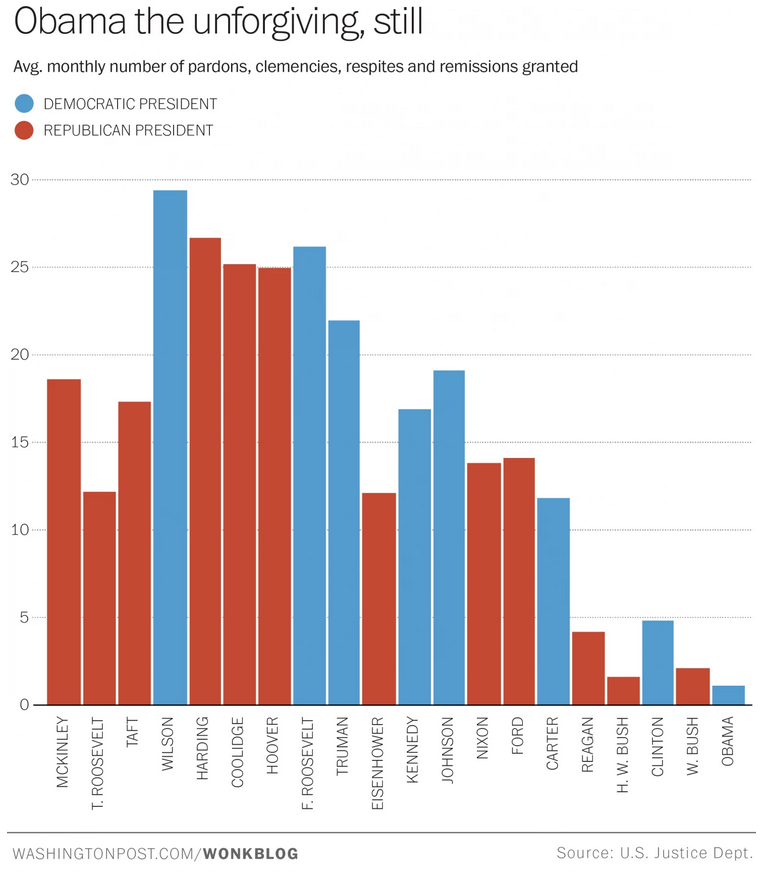
Matt Ford highlights Obama’s reluctance to exercise his pardoning power:

Presidential pardons have declined since World War II, excluding cases of mass amnesty like Jimmy Carter and the Vietnam draft-dodgers, but Obama’s sparing use still stands out: Until Wednesday, one in seven of his pardons had beenissued for Thanksgiving turkeys.

A 2012 investigation by ProPublica found that an applicant’s chance of receiving a pardon under Obama was only one in 5,000, compared to one in 1,000 under George W. Bush and one in 100 under Ronald Reagan. Obama seldom grants pardons beyond the traditional holiday-season batch. His April 15 commutation of Ceasar Huerta Cantu’s sentence is a rare exception. A typo had accidentally lengthened Cantu’s sentence by 42 months, and a court ruled that only presidential clemency could correct the error.

Christopher Ingraham chimes in:

[C]lemency reform has never been a truly comprehensive approach to fixing the problems of our justice system. The president is unlikely to grant relief to tens of thousands of inmates. Rather, true reform will only happen by reworking sentencing rules so that we’re not locking people up for low-level crime to begin with.

The Smarter Sentencing Act would have been a modest step in this direction. It would have reduced, but not eliminated, mandatory minimum sentences for drug offenders. But despite bipartisan support, Congress left it on the table unfinished this year.

Torturing Her Way To The Top

by Dish Staff

Matthew Cole reports on a key torture apologist at the CIA who “repeatedly told her superiors and others – including members of Congress – that the ‘torture’ was working and producing useful intelligence, when it was not”:

The expert was not identified by name in the unclassified 528-page summary of the [torture] report, but U.S. officials who spoke with NBC News on condition of anonymity confirmed that her name was redacted at least three dozen times in an effort to avoid publicly identifying her. In fact, much of the four-month battle between Senate Democrats and the CIA about redactions centered on protecting the identity of the woman, an analyst and later “deputy chief” of the unit devoted to catching or killing Osama bin Laden, according to U.S. officials familiar with the negotiations.

Jane Mayer comments:

Her story runs through the entire report.

She dropped the ball when the C.I.A. was given information that might very well have prevented the 9/11 attacks; she gleefully participated in torture sessions afterward; she misinterpreted intelligence in such a way that it sent the C.I.A. on an absurd chase for Al Qaeda sleeper cells in Montana. And then she falsely told congressional overseers that the torture worked.

Had the Senate Intelligence Committee been permitted to use pseudonyms for the central characters in its report, as all previous congressional studies of intelligence failures, including the widely heralded Church Committee report in 1975, have done, it might not have taken a painstaking, and still somewhat cryptic, investigation after the fact in order for the American public to hold this senior official accountable. Many people who have worked with her over the years expressed shock to NBC that she has been entrusted with so much power. A former intelligence officer who worked directly with her is quoted by NBC, on background, as saying that she bears so much responsibility for so many intelligence failures that “she should be put on trial and put in jail for what she has done.”

Instead, however, she has been promoted to the rank of a general in the military, most recently working as the head of the C.I.A.’s global-jihad unit. In that perch, she oversees the targeting of terror suspects around the world. (She was also, in part, the model for the lead character in “Zero Dark Thirty.”)

Will That Cohiba Taste The Same Without The Mystique?

by Dish Staff

27976290_c0a57df452_b

Roberto Ferdman deflates some of the hype surrounding Cuban cigars, which Americans will soon be able to buy more easily:

Each year, Cigar Aficionado, the leading industry magazine, publishes a list of the top 25 cigars in the world. Last year, the number one cigar was the Montecristo no. 2, which is made in Cuba. But only two of the remaining 24 also came from the country. By contrast, 11 were from the Dominican Republic, and 10 were made in Nicaragua. The magazine has yet to reveal its top pick for 2014, but among the remaining 24 the vast majority are once again from countries other than Cuba. And a similar pattern can be seen in virtually every year that the publication has issued its rankings. “The playing field has been leveled,” said David Savona, executive editor of Cigar Aficionado.

Alison Griswold suspects that the storied tobacco derives its reputation from scarcity as much as from anything else:

“It’s a forbidden fruit,” explains Eric Newman, president of Tampa, Florida-based J.C. Newman Cigar Company, a cigar manufacturer. “The biggest market in the world prohibits them from entering the marketplace.” Rather than deterring U.S. consumers, that ban may have in fact proved the biggest selling point for Cuban cigars over the last 50 years. People in the industry compare their allure to that of Coors beer before it became easily available beyond the American west. So great was the East Coast’s unrequited love for Coors in the 1970s that the quest to bring the beer from West to East was depicted in the popular 1977 film Smokey and the Bandit.

With both Coors and Cuban cigars, the question has been whether the product is ultimately worth the hype surrounding it. “Coors isn’t a bad beer, but is it the best beer in the world?” [president of Corona Cigar Company Jeff] Borysiewicz asks. “Cuban cigars are kind of the same way.”

But Dylan Matthews relays some evidence that Cubans really are superior:

So Cuba produces some excellent cigars. But do they, on average, surpass those of other countries? A 2003 paper in the Quarterly Journal of Economics and Finance suggests yes. The University of Virginia’s David Freccia and Wesleyan’s Joyce Jacobsen and Peter Kilby collected Cigar Aficionado quality ratings and price data for 689 different cigars, and sought to identify determinants of both high prices and high ratings. They took into account a battery of subjective factors — did the Cigar Aficionado review describe the cigar as mild? as well built? as smooth? was it nutty or cocoa-y or creamy? — as well as national origins.

They found that the single most important determinant of both prices and ratings was whether or not the cigar originated from Cuba. Being from Cuba bumped up a cigar’s rating by 4.05 points on a 100-point scale, on average; by contrast, being described as “well built” only gained a cigar 1.28 points, and being “leathery” only resulted in a 1.87 point gain.

(Photo by Alex Brown)

Masculine Energy

by Phoebe Maltz Bovy

I can’t stop thinking about Vanessa Vitiello Urquhart’s essay identifying with macho or misogynistic male authors and protagonists:

I’d always understood I was a she, and I never wanted to be otherwise. And yet somehow I was convinced that the disparaging things my male heroes said about women didn’t apply to me, not because they were untrue about females generally, but because I must not be the sort of female they were talking about. Being a strange kid helped—I had the overdeveloped intellect and underdeveloped social skills that precocious children of all genders seem to share. Since I was comfortable with being different, the masculine aspects of my personality were one more oddity among many. These oddities allowed me to nod comfortably along with sections of a novel where the author paused a moment to explain that women were like such-and-so, and then got back to the important parts, which had men in them. …

It took high school and part of college before I began to grow out of this mentality, but eventually I appreciated that the basic difference between me and other women wasn’t that they were dumber and more frivolous than I was. Dating other women helped—unlike straight men, lesbians aren’t allowed to get away with the assumption that they’re superior beings compared with the objects of their affections.

It also dawned on me, albeit slowly, that the rest of the world largely saw me as a woman like any other. I mourned this, wishing for the first time that I’d been born a boy so my combative conversational style and my impulse to dominate and destroy all comers could be met with approval, rather than dismay, from peers, teachers, and family members. But, I also recognized that the same disapproval and dismay was squelching the self-expression of women generally, not just butch lesbians.

While the headline reads, “A Lesbian Dilemma,” as Urquhart herself notes, there’s nothing specifically lesbian about the feelings she describes. Identifying with the man and not the woman in a story is, I suspect, a common female experience. That’s because – as comes up somewhere in the comments to the piece – male characters in fiction are just characters, whereas female ones are woman characters. Indeed, the sense that one is somehow different from all those silly females is its own meme: “other girls.” And one that’s readily obscured by contemporary discussions of gender identity. While there are certainly unique experiences of masculine identification among transmen, butch lesbians, and other gender-non-conforming biologically-female individuals, there’s also plenty feeling-the-guy among feminine-seeming straight women and girls. Remember Simone de Beauvoir’s famous line, “One is not born, but rather becomes, a woman”? That’s what she was getting at.

And that sense of oneself as an agent in one’s own life isn’t merely something that can be experienced by a straight woman or girl. It can extend to a female experience of heterosexuality. I think back to my own experiences as a girl who knew from a fairly young age she liked boys. I remember experiencing my crushes the way I was told – from books, movies, society – that a boy who liked girls should be experiencing this. I’d think, gosh, he’s gorgeous. I wasn’t particularly interested in being thought gorgeous myself. I saw how being thought attractive would be useful for a crush to be reciprocated, of course, but it was never the main hope. The gaze that interested me was that of the protagonist. Was my gaze, then, a male gaze, or just a human one? Whatever the case, I had to learn not to pursue. Which can be a tough thing to unlearn later in life, in other arenas.

I have no interest here in delving into exactly how much of gender is socially constructed and how much comes down to biology. But I have some interest in mentioning a recurring theme on “The Millionaire Matchmaker,” a reality show about a high-powered businesswoman who sets up rich men with trophy wives. On the occasions when the client being set up is a (straight) woman, the entire project of the show will be to rid the “millionairess” of her “masculine energy,” which is off-putting to men, or at least to the hyper-masculine men that (surely) a woman would prefer. Now, these are not masculine-of-center women by any means. One, I believe, ran a hair salon, another a clothing company. They’ve got long hair, heaps of makeup – the Bravo usual. “Masculine energy,” in this context, means the will to run a company, to be a boss, to get things done.

It could well be that fewer women than men have the “energy” in question. But it seems unavoidably true that many women have experience learning to tone theirs down.