I got a little unlucky with the timing of yesterday’s post about Sony, which went up right before we learned that Sony was pulling The Interview from release. And also before we learned that federal officials believe North Korea really is behind the hacks. My frustration with James Franco movies seems rather less funny in retrospect. In any event I guess I don’t have to worry about being forced to watch it, since apparently it won’t even appear on VOD at this moment.
I’ve been trying to muster up some fire to write about how chilling this all is for people who want to write outré speech. I wish I could write something incandescent about how unjust it is to suppress a film – even one that I’m about as allergic to as a person could be – over physical threats and privacy violations. But I haven’t been able to. I’m exhausted. I’m exhausted just contemplating how we’re going to describe this one in the history books. (“Seth Rogen, a Hollywood star of Canadian extraction…” “And then Aaron Sorkin, who was not a journalist but who wrote a fictional show about journalism, which he said was more journalistic than journalism…”)
Suffice it to say, it’s all terrible, though honestly this incident doesn’t seem half as bad to me as other events in this proto-dystopia we call America in late 2014.
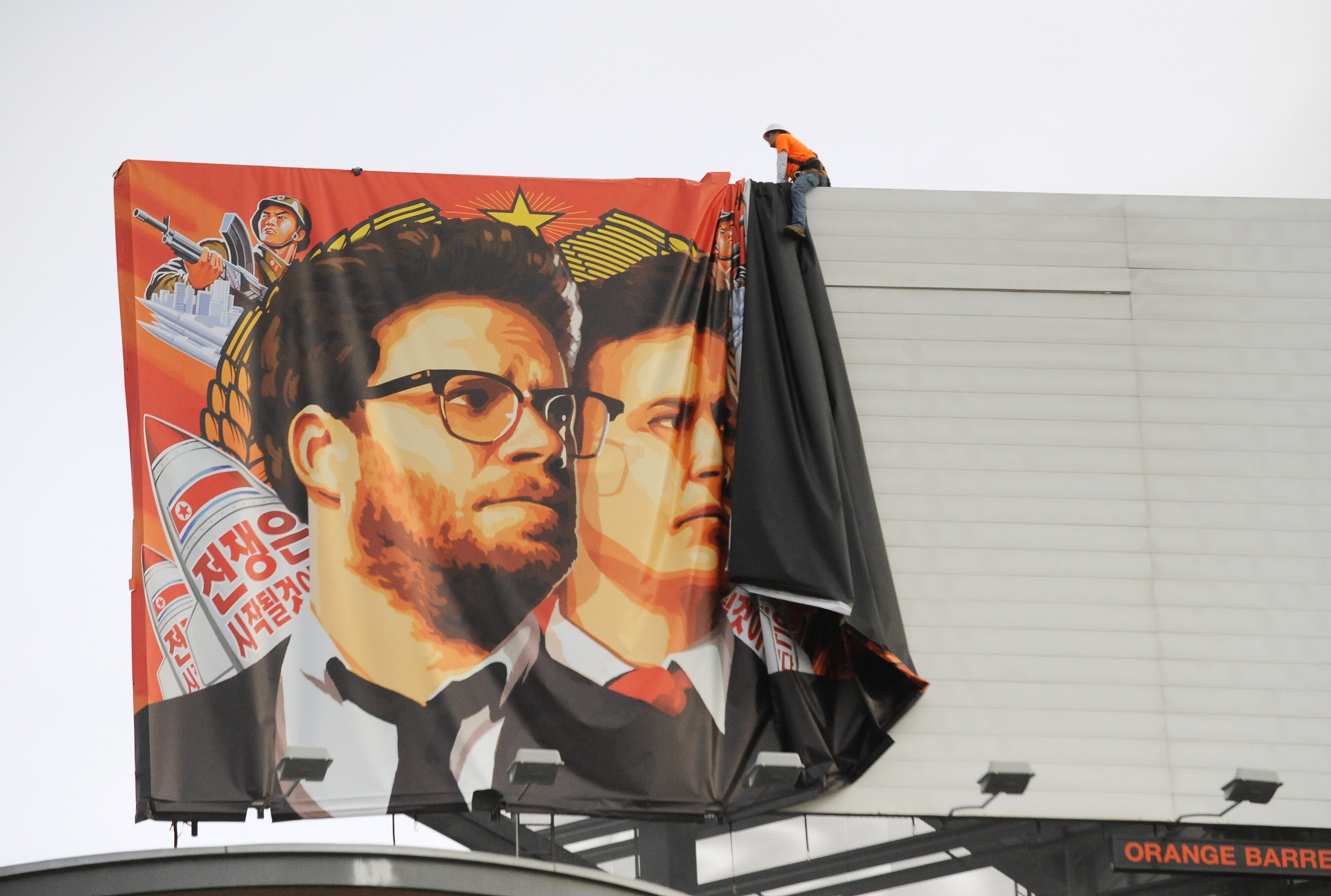
(Photo: Workers remove a poster-banner for The Interview from a billboard in Hollywood, California, on December 18, 2014, a day after Sony announced it was canceling the movie’s Christmas release due to a terrorist threat. By Michael Thurston/AFP/Getty Images)
“It’s been a half century now. Unless and until someone can show me something besides political talking points to the contrary, the embargo was simply not working. The Castros remain in power and the government has not significantly changed. And as we have repeatedly demonstrated in our negotiations regarding sanctions and punishment of other nations such as Iran, Iraq or Russia, sanctions and embargoes do not work unless you can get significant buy-in from your allies. Nobody is joining us on this. Canadians regularly vacation in Cuba. Nearly every other western nation trades with them. We simply don’t have any backup here,” – Jazz Shaw, Hot Air.
Responding to that clip, Allahpundit finds that notion entirely fatuous:
This is exactly what it sounds like, a guy seemingly willing to trade away greater prosperity for Cubans if it means Americanizing the island in return for preserving the quaint, simple culture that decades of authoritarianism and economic retardation have produced. It’s basically the “noble savage” view of economics. What doth it profit a Cuban to gain a middle-American depot for cheap building materials if he lose his cheap-rum-making soul? Where are we going to go to watch people riding around in 60-year-old Studebakers now?
Ryan Kearney accuses those afraid of “spoiling” Cuba of fetishizing poverty:
When Americans daydream about visiting Cuba before it’s “spoiled,” they’re implying that the island today is some kind of paradise. I have been there. It is not a paradise.
The buildings in Havana are literally crumbling, many of them held upright by two-by-fours. Even the cleanest bathrooms are fetid, as if the country’s infrastructural bowels might collectively evacuate at any minute. And the streets are riddled with potholes, some large enough to swallow a Russian Lada. The country isn’t so much frozen in time as in a state of perpetual rot, which is exactly what the 1961 embargo was designed to do.
But the cars! Yes, let’s talk about those cars. Cubans don’t drive American antiques because they love American antiques as much as we do, but because they have no choice.
There is, however, a real argument to be made that opening up the Cuban economy could have negative consequences. As Neil Irwin elaborates, “one of the biggest risks might be moving too fast”:
That is a conclusion of some scholars who very much favor economic liberalization of Cuba — but want it done right. Gary Clyde Hufbauer and Barbara Kotschwar, scholars at the Peterson Institute for International Economics, published a book this spring looking at the hard task of reintegrating the two economies as Fidel and Raúl Castro fade from the political scene. Their conclusions suggest it would be foolhardy to imagine a rapid return to the days when American tourists frequented the Tropicana, and the Federal Reserve Bank of Atlanta had an office in Havana.
There is, they argue, a model for how not to make the transition, a prime example being Russia’s “shock therapy” approach to privatizing industries and introducing democratic government after the demise of the Soviet Union. … Cubans — and Americans wanting to do business there — will be better off if they instead emulate Vietnam and China, two countries that have migrated from Communism to a hybrid system that is nominally Communist but practices free-market capitalism to a large degree. That has allowed them to become more fully integrated into the global economy and helped millions of their citizens escape poverty over the last generation without bloodshed or revolution.
Likewise, Dougherty warns that embracing free markets – which Cuba hasn’t exactly signed on to anyway – won’t magically heal the damage done by half a century of communism:
Law and order can make markets appear. But it is civil society and a culture of social trust that make free markets tolerable. And it is precisely this social trust that communism so effectively destroys. “We pretend to work, and they pretend to pay us,” became a de facto motto for the late Soviet Union. Cuba, like East Germany or the Czech Republic, has a memory of a modern civil society before communism. Some even remember when it was a relatively wealthy nation. But the memory is an ever-more distant one. The news of normal diplomatic relations is to be welcomed, as is the end of a useless American policy. But Cuba’s restoration will require something that an army of policy experts cannot provide.
Clive Irving, meanwhile, focuses on the environmental drawbacks of opening up Cuba to more tourism:
[B]efore a new tide of tourists can flow from Miami to Havana, Cuba will need to build more runways. The two airports taking the most tourist traffic, Havana and Varadero, are already at near capacity in peak season with flights from Canada, Europe and Latin America. More runways, more hotels, more roads, more infrastructure? The island faces an environmental challenge of huge proportions. With more than 3,000 miles of coastline, Cuba is the Caribbean’s largest island and the most ecologically diverse. There are six UNESCO biosphere reserves and nine UNESCO World Heritage sites.
Although tough environmental controls were put in place in 2000, enforcement has been haphazard. Surging coastal development has destroyed natural protection—mangroves and wetlands, just at the time when Cuban scientists calculated that climate change would wreak havoc.
It’s also worth noting that the possible transformation of Cuba into an tourist mecca for Americans may not come about due to the baleful depredations of free-market capitalism, but might just as well come about through centralized state planning. Responding at length to Jeremy Scahill’s tweet that “I’m glad I got to visit several times before US tourists try to turn it into Cancun,” Josh Barro observes:
Cancun isn’t a symbol of free market capitalism, and American tourists didn’t make the place what it is today. An arm of the Mexican central bank did, in perhaps the largest and most successful example of central economic planning in North American history. Cuba should be so lucky as to have made its planned economy work as well as Cancun’s.
Barro’s account of the way Cancun got to be Cancun is fascinating, but it seems he missed Scahill’s gist.
The point is I don’t want the infant mortality rates to go up, free eduction and health care to be abolished in Cuba
This is point worth taking very seriously. Socialists have a terrible habit of romanticizing the Cuban dictatorship, and whitewashing its crimes. Still, as repressive totalitarian regimes go, the quality of life in Cuba is remarkably high.
According the United Nation’s Human Development Index – which takes into account a life-expectancy, education, and per-capita GDP – Cuba ranks 44th in the world, while Mexico ranks a 61st. 61st isn’t bad (there are 187 countries in the index), but 44th is pretty good! One might reasonably wonder about the credibility of Cuba’s national statistics, but if they’re in the neighborhood of the truth, this level of human development is a remarkable achievement for such a low-income country, a real outlier, and it would be a pity if opening up Cuba led to a reversal health and education. But I’m not too worried. I think I also agree with Scahill about this:
The assumption that Cuba–with or without the Castros–will overwhelmingly embrace neoliberal economic policies is laughable
Neoliberal or not, opening up Cuba ought to make it a good deal wealthier. If the Cubans are able to use that extra money to shore up the policies and institutions that already work surprisingly well, then loss of a little undeveloped shoreline, and a little Cancunification, will be a small price to pay.
Slate has a big package today about “The Year In Outrage.” It’s thought-provoking, worth your time and effort.
I’d rather talk about it laterally, though, than re-litigate old social media controversies. There’s plenty enough of the latter in the Slate thing. Let’s, instead, consider the outrage manufacturing process, which I think is more complicated than usually described. You can do it half by accident. You know, by joking on Twitter.
For example: Last night I was reading Twitter when a link came into my feed. It was to an Los Angeles Review of Books essay about Joan Didion. I clicked.
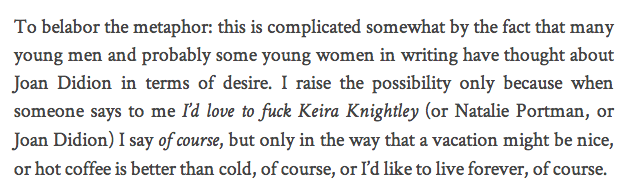
The first sentence of the piece was a run-on sentence. Then it made proud reference to the author’s attendance at literary parties. I persevered. I was then rewarded with this paragraph:
I hope I don’t seem too outraged to you when I say that this is not a good paragraph about Joan Didion. It tells you nothing about Didion. It also doesn’t tell you much about the writer, Emmett Rensin, other than his lack of apparent shame. It would be a pretty embarrassing paragraph to record in your private journal. But there it was, published by the Los Angeles Review of Books. The Los Angeles Review of Books is edited. An editor read this paragraph, and published it.
I have, in the course of researching a book that touches on Didion, read a great deal of writing about her. It is worse than you’d expect, and a lot of people expect bad writing about Didion. I like to point out a 1970 Los Angeles Times profile that called Didion a “haunted elf.” There are a lot of reasons why this writing is bad, but one is certainly the strong personal feelings Didion’s work seems to evoke. These personal feelings – say, “desire” – then run away with whatever self-control the writer-about-Didion ordinarily possesses.
There is probably a good, self-aware piece to be written about all of that. This Didion piece is plainly not that piece.
I found this paragraph so bad, in a funny way, that I took the screenshot you see above. Then I posted it to Twitter. People responded. My friends and I made some jokes. I decided to add, “My cat just threw up. I think she saw the paragraph about Joan Didion.” I felt momentarily better after a long day. I went to bed.
Because now, waking up this morning and watching everyone chatter about outrage, I feel culpable. In fact, I’ve now deleted that second tweet because it feels mean, the morning after. Obviously we’re talking about a much smaller scale than social media controversies tend to reach. But I’ve done just what everyone typically describes as a gesture of outrage: I’ve found something I think is bad, I’ve lifted it out of context, and I’ve explained why. As a data point, I don’t feel particularly angry about it. More… bemused.
But someone else might think I’m stoking outrage. And then write an editorial about what a terrible person I am for posting this out of context. And then: here I am, who with my laughter at this bad paragraph about Joan Didion, am participating in a force that is destroying culture.
“The Afternoon According to Saint Matthew” by Mary Ruefle:
There’s the black truck
with orange flames
on its hood. There’s the girl
in the pink pajamas. There’s her sister
in a bumblebee suit.
They are playing with dirt.
When they find bugs
they scream
but no one hears them.
Their minds are growing though.
In the late afternoon light
they scoop the dirt into tin cans
so they can bury it
in the backyard.
I think we have a case
of two women grinding at the mill—
one will be taken and one
will be left,
but it’s way too early
to tell.
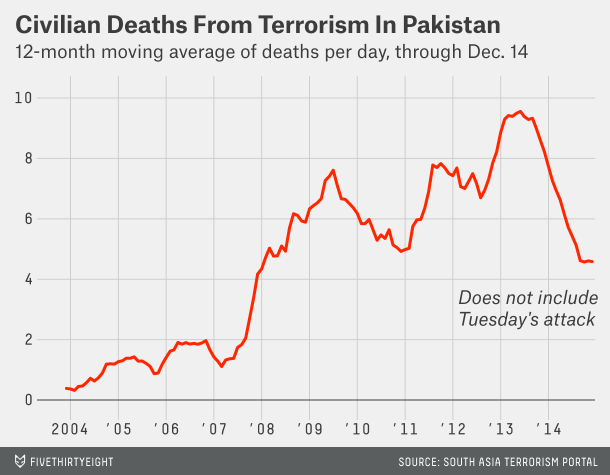
Before Tuesday’s horrific attack on an army school, Carl Bialik grimly notes, Pakistan’s terrorism problem was on a downward trend, from utterly horrifying to just god-awful:
More than 3,000 Pakistani civilians died in terrorist attacks in both 2012 and 2013, according to the South Asia Terrorism Portal, which monitors violence in the region. This year, through Sunday, 1,595 civilians had died, including 26 this month. Twenty-six is a horrific total for most countries in a year — 20 more than the number killed in all of 2013 in the U.S., which has roughly 75 percent more residents than Pakistan. But it’s also a monthly rate of about 58 civilians, the fewest killed in a month in Pakistan since 56 civilians died in August 2007. Tuesday’s attack reversed that modest progress; December now is the deadliest month since February.
So how did Pakistan become so unmanageably violent? In part, Matthew Green blames the government’s longstanding policy of cultivating ties with some militants in order to fight others:
First, and most important, Pakistan’s security establishment has to make a permanent break with its decades-long romance with jihadi proxies. The distinction that some in the nation’s security apparatus draw between “good Taliban” — shorthand for groups who serve their regional interests — and “bad Taliban” — militants at war with the state — must end. … The upshot is that religious extremists and allied Kalashnikov-toting thugs now wield a far greater degree of influence over Pakistani society than their small constituencies might otherwise project. As long as nobody is quite sure where the military and its feared intelligence agencies stand in relation to jihadis, liberal politicians, community leaders and moderate religious voices rightly assume they will live longer by keeping quiet.
“When a government coddles and finances terrorist groups for this long,” Omer Aziz argues, ” it is only a matter of time before the jihadists start attacking their masters and eventually their fellow citizens”:
It was not always so. In the 1970s, Pakistan was a fairly liberal society. When Paul McCartney landed in Pakistan in 1964, he was swarmed. That there was once a vibrant Jewish community in Karachi has all been forgotten. The same Peshawar where militants roam freely was even once part of the famous ‘Hippie Trail’ that brought adventurous Westerners to South Asia. Muhammad Ali Jinnah, a barrister trained in England who founded what was then named the Dominion of Pakistan, told his newly independent nation: “You are free to go to your temples. You may belong to any religion or caste or creed.” This imagined community of liberal Muslims has been extirpated in favor of a conservatively Islamic state.
While successive Pakistani governments supported terrorist groups, so they also embarked on the politically expedient but morally criminal mission of Islamizing the country, transforming Pakistan from a state for Muslims into a Muslim state. … An entire generation was born into a society coarsened by years of religious fundamentalism where it remains a widely-held opinion that Malala Yousefzai is a CIA spy.
It’s also high time, in Juan Cole’s opinion, for Pakistan to take real responsibility for governing and developing its dirt-poor, lawless northwest:
[T]he Federally Administered Tribal areas or FATA need to be made a province and integrated into the Pakistani state. The standard of living of people in Waziristan is extremely low. Maybe some of the investment of China in Pakistan could be slotted for FATA. This is an area where some 800,000 people have been displaced by the Pakistani military campaign against militants in North Waziristan. There are torture facilities and bomb-making workshops. These need to be rolled up and FATA needs to be developed.
In response to the massacre, Pakistan will step up its anti-terror operations:
“We cannot take a step back from this war against terrorism,” Nawaz Sharif said, addressing a hastily called meeting of political parties in Peshawar, where Tuesday’s horrific school attack occurred. The fight would spill over “on the Afghan side of the border,” he added, after speaking with Afghan President Ashraf Ghani. It was not clear what actions that might entail. But such a cross-border offensive would mark a significant shift in Pakistan’s tactics against Taliban militants, whose strongholds and supply lines straddle the frontier.
Rogin and Lake expect the US to deepen its involvement:
Inside the Obama administration, officials have been divided between those who believe that the TTP represents primarily a threat to Pakistan and those who believe the U.S. has a real national-security interest in helping the Pakistani military destroy the group. But due to the seriousness of this attack, the Obama administration will now feel compelled to more heavily support the Pakistani military as the war against the TTP escalates and the implications for the entire country’s future become more pronounced.
That may be especially true now that the TTP, as Sami Yousafzai and Christopher Dickey report, claims to be coming for us next:
In fact, the terror networks to which the TTP is linked have grown more complex and treacherous than ever, with some factions connecting not only to al Qaeda but to the so-called Islamic State (ISIS or ISIL) that now controls large swathes of Syria and Iraq. And while analysts think it is unlikely the TTP can mount an attack against American targets inside America again soon, the TTP said it butchered the children in Peshawar specifically because of the U.S.-backed campaign against it.
Amanda Taub, meanwhile, offers another possible explanation for Tuesday’s carnage, namely internal power struggles within the Taliban:
The TTP has split into multiple factions in recent months. A number of moderate factions have made peace with the government, Staniland explained, so that what is left behind is an increasingly radical core that is splintering into different groups. That process was accelerated when Maulana Fazlullah, an outsider who formerly headed a group of militants in Pakistan’s Swat district, took command last year. He has been a divisive leader, causing the powerful Messud family to leave and form its own organization. Competition for power within an armed group or between different splintering factions often leads to increased violence, as leaders jockey to prove their authority and improve their reputations by carrying out ever more audacious or brutal attacks.
But Saim Saeed can’t imagine how the TTP will score PR points by butchering innocent kids:
the Taliban have just taken on the unenviable task of explaining how murdering scores of innocent children is a good thing for Islam. No one, no one, will support the Taliban after this. The attack was even condemned by Hafiz Saeed, whose Jama’at-ud-Da’wah is the subject of United Nation’s sanctions. Hardline mullahs may have twisted and contorted Islam to endorse blasphemy laws, child marriages and jihad against America and India, but even they will have a tough time arguing that this attack somehow fulfills their purpose. They could perhaps argue this was an Indian or American conspiracy, but that argument is also slowly losing credibility, not least by the Taliban’s own desperate attempts to claim this attack.
The depressing situation leaves Pankaj Mishra at a loss:
Something more than just economic and political distress must explain the worldwide proliferation of men who espouse spine-chilling convictions and fantasies of mass murder. We cannot afford to renounce the possibility of achieving a more democratic, free and just society through political change. Yet we can no longer believe that the enabling conditions of nihilistic violence or the apocalyptic mind-set can be removed by reform or modification of public policy alone, let alone by military retaliation.
The blood of innocent children rouses us to drastic action. But it is not cowardly to acknowledge problems to which there are no stock sociopolitical remedies, and to grasp the unprecedented nature of the threats in our time to human life, freedom and dignity. Certainly, however deep our revulsion to atrocities perpetrated by all sides — sectarian or secular, governments or terrorists — it won’t help to blame religion for a phenomenon that is so clearly rooted in a catastrophic loss of the religious sense.
Wilkinson’s argument amounts to saying that a president with personal connections in government (via a dynasty for example) would be a good counter to overly independent, unaccountable bureaucracies such as the CIA. The Bush dynasty is the perfect example of the reverse. George HW Bush was the director of the CIA. Before Dick Cheney was George W. Bush’s vice-president and man behind the curtain, he worked in the White House under Nixon and was GWHB’s Secretary of Defense. Does Wilkinson think that Dubya’s personal connections made the CIA more accountable? Probably not. And Dubya would be one more personal connection between Jeb and war crimes. All that would make torture and CIA unaccountability more likely, not less.
He closes with the glib pontification, “And the enormous, deadly, often malign power of the sprawling American security state makes it worth asking whether a decent president who isn’t really in charge is better than an odious one who is.” To which the answer is yes. Of course. I’ll take things not getting better over things actively getting worse any day. As depressing as a Jeb vs. Hillary race may be, the personal connections to the CIA are one of the best reasons there is to vote for anybody but Bush.
At best, Wilkinson could argue that personal connections in government amount to more power (but if that’s what he meant, it’s so obvious it’s trivial). But that only makes it more important to critically examine what those connections are.
These are all great points. As I said, these were speculative thoughts, and I’m not at all happy about where they lead. But I think the possible strengths of dynastic presidents are worth taking seriously.
It had occurred to me that George W. Bush puts a hitch in the argument. With W., I think we have a case of a president who is somewhat oddly idealistic and ideological, given his father’s very realpolitik background, who really believes his own airy nonsense about the axis of evil and the universal desire for democracy, that America really is an agent of providence in history. In his case, I think his starry-eyed softness was exploited by flinty Bush-machine consiglieri, such as Cheney. So it may well be that a slightly oblivious dynastic president, by bringing with him so many well-connected Machiavellian old hands, is more likely than an inexperienced but shrewd newbie, such as Obama, to get played by his team. But Jeb is the smart Bush, right?
And what about Obama’s dismal failure to make good on his campaign promises about Guantanamo and the wars and transparency and torture and on and on and on? I don’t think Obama was insincere in those promises. I think he got into office without much of an independent network in place and the doyens of the security state were able to scare him into believing that the only responsible thing to do was what they wanted to do. Now, it may well be that Hillary or Jeb would want to do what the generals and spies want, anyway. But if they don’t, they’ll be in a better position to do it.
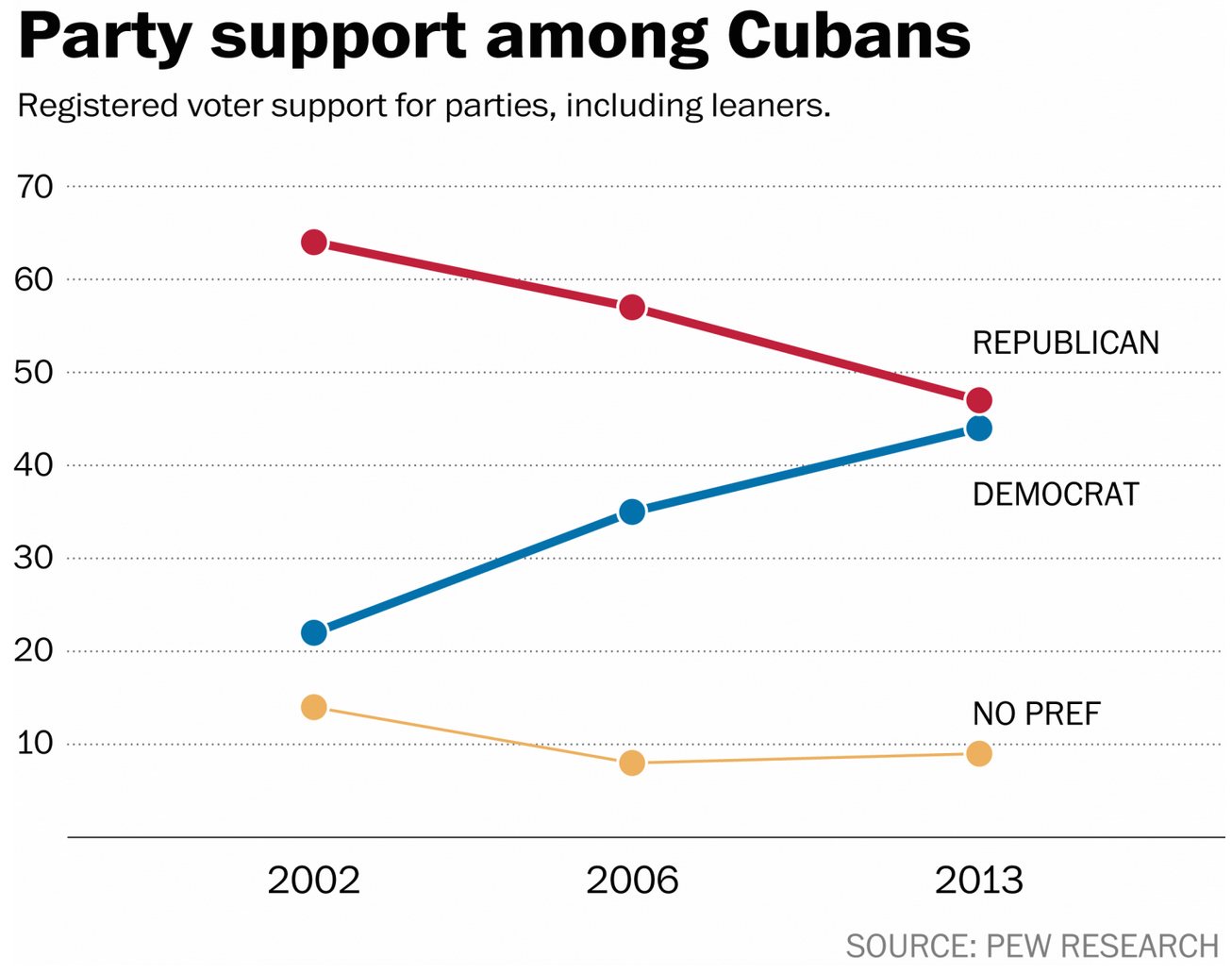
The supposedly implacable, politically powerful bloc of Cuban exile voters in southern Florida has long been one of the obstacles to a rapprochement with Cuba, but Annie Lowrey points out that this bloc isn’t as solidly Republican or pro-embargo as it used to be:
Is there a chance that President Obama’s policy might swing some Cuban-Americans back towards the Republican Party? Certainly, and we won’t know for sure until we get new polling data, likely in a number of weeks. But it is worth noting that those younger Cuban-Americans tend to be much more supportive of diplomatic normalization than their older counterparts. A recent Florida International University poll found that 90 percent of young Cuban-Americans in Miami-Dade County — 90 percent! — favor having diplomatic relations with Havana. A similar proportion support lifting the travel ban, and just more than 60 percent of young Cuban-Americans support ending the embargo.
Nate Cohn looks at some other evidence that Cuba just isn’t that much of a political flashpoint in Florida anymore:
It’s hard to know whether Mr. Obama’s decision will move the needle among Cuban-American voters. Polling data reflecting Mr. Obama’s decision, which will arrive in a few weeks, will tell us more. Nonetheless, the available polling data suggests that many Cuban-American voters are receptive to restoring diplomatic relations with Cuba, including 68 percent in an F.I.U.poll and 79 percent in an Atlantic Council poll (although the sample was extremely small).
Perhaps the more telling evidence, though, is that Mr. Obama managed to make substantial gains among Cuban-Americans even though he was open to revising Cuba policy. Mr. Crist also ran on a more open Cuba policy and won the Cuban-American vote in the exit polls last month. The fact that Mr. Crist’s advisers thought it strategic to emphasize the issue may be an indication of what their polling data showed. The uninspired Republican response in prior campaigns may be telling in its own right. Republicans didn’t exactly blanket the Miami media market with ads about Mr. Obama’s Cuba policy, which might also be an indication of how they think the issue plays.
Tell that to Marco Rubio, who could very well run for president wearing this issue on his sleeve. Russell Berman doubts such a strategy would get him very far, though:
Polls show more and more Americans support normalizing relations with Cuba, and the trend even extends to Rubio’s cohort of Cuban-Americans. Rubio dismissed talk of the 2016 race on Wednesday, “out of respect for the gravity of the issue,” he said. And he didn’t have much to say about the polling, either. “This is not a political thing,” he said. “I don’t care if polls say the 99 percent of the people support normalizing relations with Cuba.” It’s a principled stand, sure, but it probably won’t make his increasingly arduous journey to the White House any easier.
Larison shakes his head at Rubio’s insistence that opening diplomatic channels with Cuba is beyond the pale:
It’s important to repeat again and again that establishing normal diplomatic relations is the bare minimum of engagement with another country. The U.S. maintains normal relations with all kinds of governments, including some of the very worst in the world. That isn’t because we approve of everything they do, nor is it because we are doing them any favors by having normal relations, but because this is the kind of relationship all governments seek to have with each other except in times of crisis or war. There is no good reason for the U.S. and Cuba not to have normal relations today, and so we should have them. If the U.S. refused to have normal relations with every state because of its authoritarian character or the abuses it has committed, as Rubio claims to want, it would have to shut down its embassies in half the countries around the world.
When did you stop believing in Santa Claus? Email us your tales of childhood disillusionment and we’ll post the most interesting ones. To start us off, here’s a handful of stories from Dish staffers. Managing editor Chas:
Through a stroke of creative genius, my parents delayed my realization about Santa by at least a few years. When I was 4 or 5, they forged a letter from Santa in which they not only thanked my sister and me for leaving some food, pizza, for the reindeer, but they actually printed, in pizza sauce, a single hoof print on the letter. This became irrefutable evidence of the existence of Santa and his reindeer, which I held tight to for years as more and more classmates and friends learned the truth and attempted to convince me. I remember actually citing the letter in one particularly contentious debate around the lunch table in 4th grade. Finally, as with many, it was my own snooping around for presents that finally exposed the lie. I found a Sega Genesis box with a price tag in my parent’s closet, and then on Christmas morning it was one of the gifts I’d received from Santa.
Thinking back I think the hoof print was actually from one of our cats, so how I mistook it for a hoof I have no idea. Also, you’d think the similar handwriting would be a dead-giveaway too.
Dishtern Phoebe:
As a child – not sure how old – I was at a Christmas party for my father’s work, and I confessed to the Santa that I was Jewish. The man in the Santa suit, a colleague of my father’s, told me not to worry – he was Jewish, too.
Associate editor Tracy:
As a four-year-old, I had the bright idea of asking Santa to sign the note I left out with his milk and cookies. So with my parents’ help, I drafted an entreaty along these lines:
Dear Santa:
Are you real? If so, please sign below.
Love,
Tracy
No signature, I reasoned, no Santa. So I was delighted to see the letter signed in big block letters on Christmas Day.
It wasn’t long before I realized that I could use the same method to determine whether God existed. And since God was a) invisible and b) knew everything, I decided to hide my letter in the bottom of a stationery drawer, telling no one. So I crossed out “Santa,” wrote “God,” and waited overnight for the Big Guy to work his magic.
When I saw the letter unsigned the next day, I handled it with aplomb. I was less disappointed that God evidently didn’t exist – even then I had my doubts – and more pleased that my little experiment had worked. And besides, I still had Santa.
Literary editor Matt:
My fall from faith in Santa began with a simple question: how did Santa deliver my gifts if our house didn’t have a chimney? A chimney was necessary, of course, because Santa and his reindeer landed on the roof, not in the street. It didn’t make sense for Santa to shimmy down the side of the house and walk through our (presumably locked) front door. My parents told me Santa handled it by touching his nose – a move that magically placed the presents under the tree. I was placated for awhile, but the seeds of doubt were sown.



 The Dish