A Colorful History

by Dish Staff

Leann Davis Alspaugh revisits the mauve craze that swept Europe in the mid-19th century:

In the 1850s, the color mauve was discovered by a young chemist who was trying to synthesize Godey's Lady's Book May 1872 Fashion Plateartificial quinine. The residue from one his experiments became the world’s first aniline dye, guaranteed not to fade with time and washing. Queen Victoria wore a mauve gown to her daughter’s wedding, and Empress Eugénie of France cooed that the color matched her eyes—and an epidemic of “mauve measles” swept Europe. As cultural historian Simon Garfield noted in his 2001 book on the history of mauve, the color’s popularity led to burgeoning interest in the practical applications of chemistry and advances in the fields of medicine, weaponry, perfume, and photography. Mauve became indelibly associated with the elaborate, overstuffed décor of the Victorian period; when mauve returned in the 1980s, it was billed as “dusty rose,” a name much more congenial with that era’s other favorite color: hunter green.
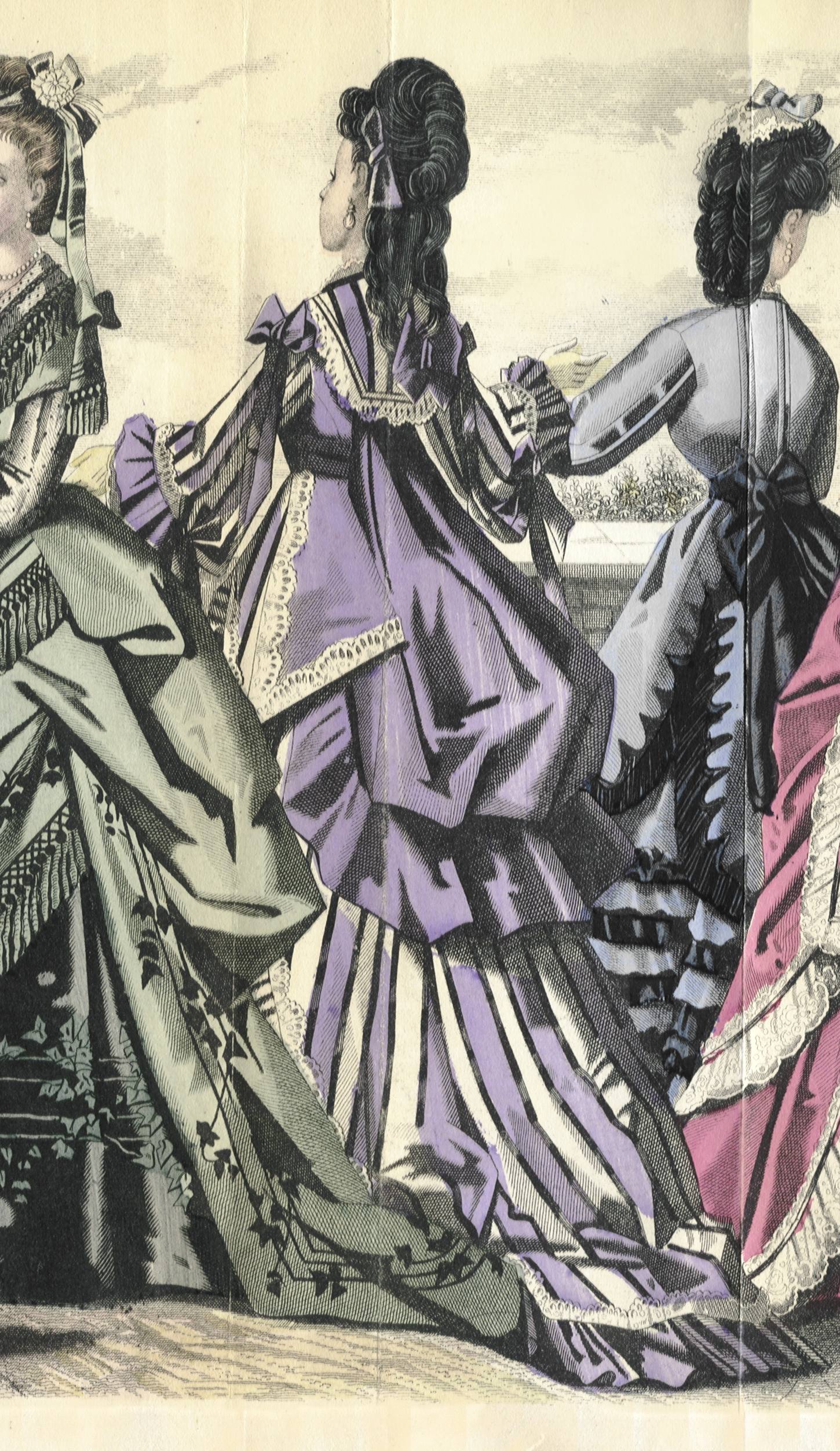
(Image: Fig. 3 from a Godey’s Lady’s Book fashion plate, May 1872, via Flickr user clotho98)
What’s On Jeb’s Agenda?

by Dish Staff

Ambinder sees an opening:

Bush’s biggest opportunity corresponds to the biggest hole in the GOP platform: its radio silence on practical economic solutions for the middle class, which, it turns out, corresponds to the biggest bread-and-butter concern that Americans repeatedly chastise Washington for not addressing.

If he can move beyond supply-side economics and invent or adopt policies that directly benefit middle class voters who aren’t big savers, if he can speak to their concerns, if he can draw for us a picture for how a governing conservative president might function, then everything I’ve ever said about him — namely, that he’s a Bush and he can’t win the presidency, much less the nomination — goes out the window. If he can square THIS hexagon, and if he can get people to forget that he’s a Bush, he might be able to win both.

Republicans certainly don’t need a replay of Romney 2012, where the candidate focused too much on big macro issues like tax and entitlement reform — issues that failed to connect with voters struggling with everyday, middle-class problems. But that’s what a Bush candidacy could well look like. In an October fundraising letter for an education group he founded, Bush put forward a broad-strokes economic agenda that once again argued America needs to “radically simplify our tax and regulation structures to be fairer and more practical” and “reform our entitlement programs, which are now ballooning government beyond taxpayers’ means to pay for it.” That’s just GOP boilerplate that many voters will tune out.

But don’t fret quite yet, conservative reformers. There are still signs that Jebonomics has the potential to be smart and important. For instance, Bush also spent a lot of time in that letter discussing K-12 and higher education challenges and reform, both of which are crucial to improving middle-class fortunes. Anyone remember the Romney education plan, or him even talking much about student debt? The candidate actually had a plan, but it was a mystery to voters. Bush sounds like he could focus on these middle-class issues far more than Romney did.

Obama Just Ruined Cuba!

by Will Wilkinson

Not really! Obama’s decision to normalize relations with Cuba (which does not yet include lifting the embargo) is a giant step toward fixing Cuba. Nevertheless, people are already worried that Cuba will no longer remain a zoo of human inmates dwelling in picturesque shabbiness – already complaining about the prospect of Cubans no longer trapped on a prison island, no longer oppressed by a totalitarian regime, and therefore free to buy a Big Mac. Seriously. This is a real thing on Twitter:

Look, I totally understand the sentiment. There is something singular and vivid about a vibrant, tropical ruin frozen in the 1950s. Cuba is a showcase of dilapidated anti-commercial mid-century nostalgia, and I too sort of wish I had gone to see it, just as I wouldn’t mind having seen Soviet Leningrad. Come to think of it, it would be pretty interesting to see the slave ships coming into harbor in prebellum Savannah. What a scene those auctions must have been! But the human part of me, the moral part, as opposed to the aesthetic and amorally curious tourist part, can only regret that slaving Savannah and communist Russia lasted as long as they did, and today I can be nothing but hopeful that something like freedom is finally coming to the Cubans. If it does, and I make it to Havana, and see a McDonald’s, I will walk into that McDonalds, buy a large Diet Coke, and pour a little on the ground in half-sincere mourning for the pretty, impoverished theme park of tyranny I never had the chance to see.

America’s Pro-Torture Cult

by Dish Staff

Ambinder bets that “Cheney would still have us torturing innocents, even today”:

I can only think of Cheney now as the personification of the Cult of Terror, that September 11th, 2001 political construct that gave Americans license to act outside the stream of history instead of at its headwaters, and to suppress dissent in the name of state security. What makes this scarier, even, and why I feel justified in calling it a cult, is that it also suppresses, denigrates, and stigmatizes the moral and political foundations that it seeks to protect. It’s an American cult, because it plays to our own biases about what makes us special. It is not unique or exceptional.

Chait also examines the pro-torture mindset. He contends that “admiration for the methods used by totalitarian states is … embedded in the torture program created by the Bush administration”:

Three decades ago, right-wing French intellectual Jean-François Revel published a call to arms entitled How Democracies Perish, which quickly became a key text of the neoconservative movement and an ideological blueprint for the Reagan administration. Revel argued that the Soviet Union’s brutality and immunity from internal criticism gave it an inherent advantage over the democratic West — the United States and Europe were too liberal, too open, too humane, too soft to defeat the resolute men of the Iron Curtain.

“Unlike the Western leadership, which is tormented by remorse and a sense of guilt,” wrote Revel, “Soviet leaders’ consciences are perfectly clear, which allows them to use brute force with utter serenity both to preserve their power at home and to extend it abroad.” Even though Revel’s prediction that the Soviet Union would outlast the West was falsified within a few years, conservatives continue to tout its wisdom. And even as Revel’s name has faded further into the backdrop, recent events have revealed the continuing influence of his ideas.

Faces Of The Day

by Dish Staff

Cuba Releases Alan Gross, Held In Prison For 5 Years

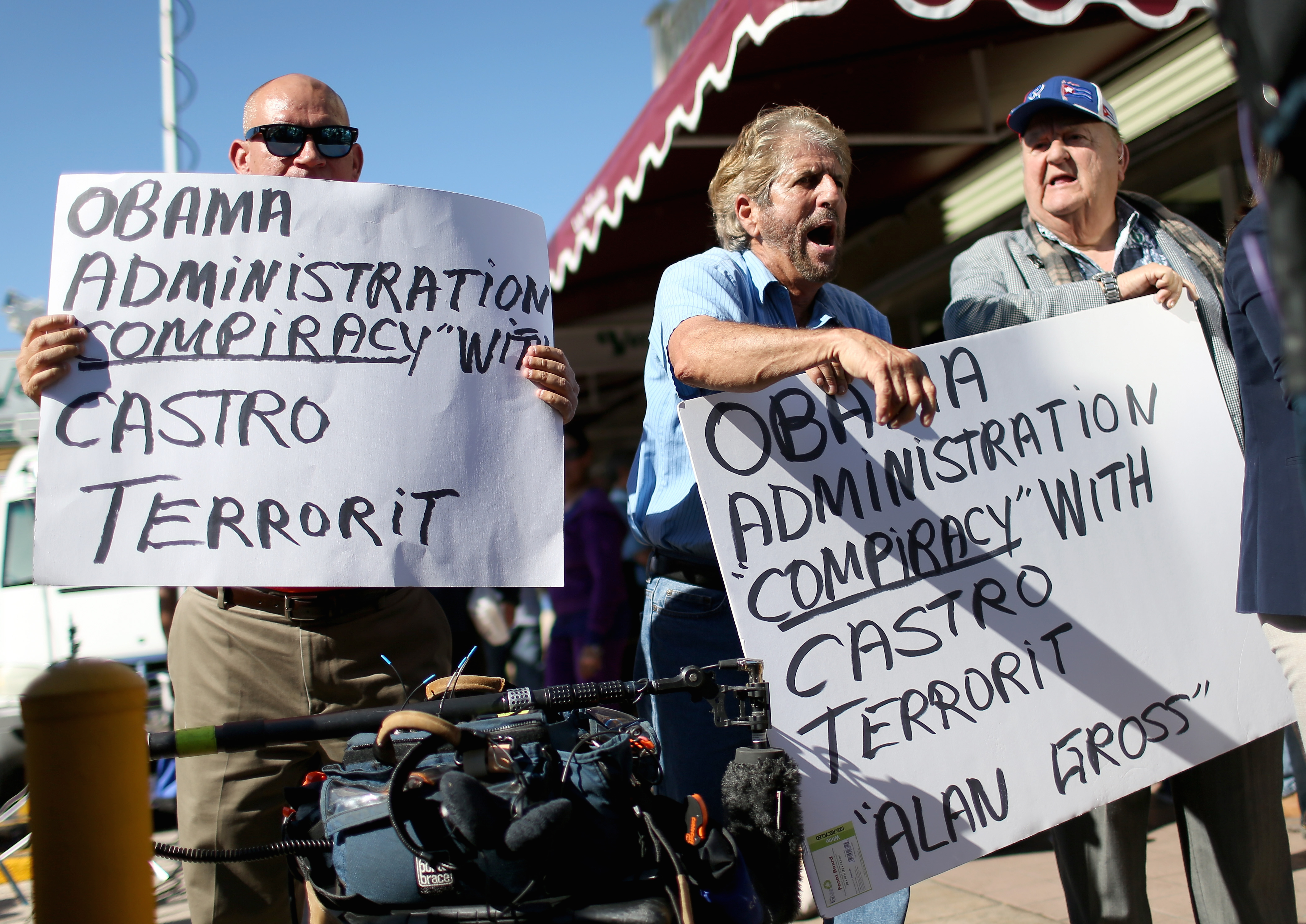
Osvaldo Hernadez, Miguel Saavedra and Carlos Munoz Fontanillehas (L-R) react to the news, outside the Little Havana restaurant Versailles in Miami, that Alan Gross was released from a Cuban prison on December 17, 2014. Gross, an American contractor, had spent five years in Cuban jail and reports indicate he is on his way back to the United States. By Joe Raedle/Getty Images.

The End of Serial, Part One

by Michelle Dean

Tomorrow morning will see the airing of the very last episode of Serial. At this point everyone’s spilled so much ink on the podcast you might be feeling some fatigue, but I’ll throw my own writing on the subject your way anyway. I’ve been following closely and also doing some reporting on the subreddit that became a sort of second character on the show as things moved along. It has been a strange, sad, and oddly moving to experience and observe this phenomenon. I’m still trying to figure out what to make of it all.

I’ll write more in the morning once I’ve heard the episode, but it seemed worth recording my last-Serial-eve feelings of trepidation with you. I am not expecting fireworks tomorrow. I am expecting a whimper.

I may be wrong to do so. It’s of course possible Koenig will announce that she has found evidence either that Adnan Syed is either innocent or guilty of the murder he is now in prison for. But more likely, I think, is that we’ll get a kind of meditation on how weird this whole experience has been for Koenig herself. And then she’ll sign off. And we’ll all be left looking at each other, wondering exactly what it is we’ve done by opening this whole case up to rabid public attention if there was no endgame in sight.

It may sound like I’m condemning Koenig there. I’m not. I’m oddly sympathetic to her. I don’t think she could have predicted the rabid attention this podcast got, and I especially don’t think she could have predicted that the last episode of this show would come freighted with so many feelings. Tonight has got to be a strange night of her life.

And you know, I’ve done enough of my own reporting to know that this is the way things are, if you do non-fiction. Sometimes stories don’t pan out. Life doesn’t offer happy endings. Telling stories about other people involves, all too frequently, hurting them. It most certainly involves leaving them to their own devices after you’re done reporting, to live on their lives as people who were once written about. I think most of my weird feelings amount to that, actually: what will happen to Adnan Syed now, one the white hot spotlight of national obsession leaves him?

Designing A Less Deadly Police Force

by Dish Staff

Outrage In Missouri Town After Police Shooting Of 18-Yr-Old Man

Seth Stoughton wants police training to “emphasize de-escalation and flexible tactics in a way that minimizes the need to rely on force, particularly lethal force”:

Police agencies that have emphasized de-escalation over assertive policing, such as Richmond, California, have seen a substantial decrease in officer uses of force, including lethal force, without seeing an increase in officer fatalities (there is no data on assaults). It is no surprise that the federal Department of Justice reviews de-escalation training (or the lack thereof) when it investigates police agencies for civil rights violations. More comprehensive tactical training would also help prevent unnecessary uses of force. Instead of rushing in to confront someone, officers need to be taught that it is often preferable to take an oblique approach that protects them as they gather information or make contact from a safe distance. Relatedly, as I’ve written elsewhere, a temporary retreat—what officers call a “tactical withdrawal”—can, in the right circumstances, maintain safety while offering alternatives to deadly force.

Officers must also be trained to think beyond the gun-belt.

The pepper spray, baton, Taser, and gun that are so easily accessible to officers are meant to be tools of last resort, to be used when non-violent tactics fail or aren’t an option. By changing officer training, agencies could start to shift the culture of policing away from the “frontal assault” mindset and toward an approach that emphasizes preserving the lives that officers are charged with protecting. Earlier this year, officers took just that approach in Kalamazoo, Michigan, relying on tactics and communication rather than weaponry to deal with a belligerent man carrying a rifle. As a result, a 40-minute standoff ended with a handshake, not an ambulance. The Seattle Police Department offered an even more dramatic example in 1997, when they eventually ended an 11-hour standoff with a mentally ill man wielding a samurai sword by making creative use of a fire-hose and a ladder. The suspect was apprehended with only minor bruises, and no officers were injured.

Finally, police executives need to move beyond the reflexive refusal to engage in meaningful review of police uses of force. Police may act in the heat of the moment, although not nearly as often as is commonly believed, but that should not insulate their choices from review.

(Photo: A police officer watches over demonstrators in Ferguson, Missouri protesting the shooting death of teenager Michael Brown on August 13, 2014. By Scott Olson/Getty Images)

Hackers Now Forcing Us to Defend The First Amendment By Way of James Franco

by Michelle Dean

Sony has more or less given up on The Interview, it seems, in light of threats from the shadowy collective that’s claimed credit for hacking them. They’re telling theatres they don’t have to run the film. They have done so even though DHS seems not to find the threats particularly credible. A large number of theatres, apparently, have taken them up on the offer. Naturally, this is inspiring consternation.

Judd Apatow is fulminating about the cowardice of the theatres: “Will they pull any movie that gets an anonymous threat now?” I doubt it. Because the problem here is really that the theatres are faced with an anonymous threat everyone knows about. Whatever substance of the threats might or might not have, no one wants to be the movie theatre chain that took the risk in full view of the American public. Post-Aurora, it is regrettably easy to imagine how things might happen, and it would only take one person to cause a serious problem. I bet those theatres feel their hands are tied.

Theirs aren’t the only ones, by the way. All over Twitter I’m suddenly seeing calls to see The Interview as a matter of defending freedom of speech. And you know, I’ve been skeptical of the way that Sony executives have been defending the privacy of their business records in the aftermath of the hack. But I take the point that it’s infuriating to be held hostage to this sort of thing. We don’t yet know whether we’re talking about fourteen-year-olds in someone’s basement or people who are actually dangerous.

I just think that the most infuriating thing of all might be that we’re going to feel the tug of civic obligation to see what looks like a very terrible movie. And all in the name of the First Amendment. That’s #democracy2014 for you.

The Case For Mass Transit, In One Image

by Dish Staff

manhattan-crossings.0

This is what Manhattan would look like if everyone had to drive to work:

According to Vancouver highway engineer Matt Taylor, the island would need 48 new bridges that would each have to carry eight lanes of traffic … Taylor arrived at that number by noting that 2,060,000 people commute to Manhattan daily. Under ideal conditions, a single lane can convey about 2,000 vehicles per hour, so to let 2.06 million cars on to the island within a four-hour period, you’d need at least 380 additional bridge lanes — or roughly 48 new eight-lane bridges. Of course, you’d also need somewhere to put all those extra cars. Taylor calculates that they’d require about 24 square miles in total, which is exactly the land area of Manhattan. In other words, you’d need to build a layer of underground parking that takes up the entire borough to fit all the cars driven in by commuters.

America’s Tortured Conscience, Ctd

by Dish Staff

Earlier today, Will pondered the roots of American support for torture. Keating suspects more gory details would change minds:

Whether you use the word or not, Americans are OK with torture because they believe it’s effective at gaining information that couldn’t be obtained by any other means. The fact that the Senate report knocked down that argument doesn’t seem to have gotten much traction.

If not torture, what do Americans oppose? Things start to change when you get really specific. A recent post on the Washington Post’s Post Everything site by three political scientists notes that when you ask specifically about techniques like “waterboarding,” “sexual humiliation,” and “exposure to extreme heat/cold,” most Americans do oppose them. They’re less bothered by “stress positions” or “sleep deprivation,” which I would imagine is a function of the fact that people don’t understand what they are.

Bouie isn’t so sure:

Americans like punishment. Not only do we have the world’s highest incarceration rate—716 inmates for every 100,000 people, compared to 475 for every 100,000 in Russia and 121 for every 100,000 in China—but we also have among the most draconian punishments of any nation in the developed world. … It’s not just that Americans want a system that metes out punishment, it’s that—despite our Eighth Amendment—we are accepting of the cruelest punishment. And while it’s not legal, it exists and it’s pervasive. In theory, our prisons are holding cells for the worst offenders and centers for rehabilitation for the others. Inmates can work, learn, and prepare themselves for a more productive life in society. In reality, they are hellscapes of rape, abuse, and violence from gangs and guards.

Emily Badger looks at the demographics:

A majority of nearly every group — non-whites, women, young adults, the elderly, Midwesterners, suburbanites, Catholics, moderates, the wealthy — said that torture of suspected terrorists can be often or sometimes justified. A majority of only one other group beyond liberals and Democrats disagreed: people with no religion.

Drum finds public support for torture “the most discouraging part of the whole torture debate”:

It’s one thing to learn that Dick Cheney is every bit the vicious wretch we all thought he was. But time after time since 9/11, polls have shown that the American public is basically on his side. As a nation, we simply don’t believe that a comprehensive program of state-sanctioned torture is wrong. On the contrary: we think it’s just fine as long as it’s done to other people. If we’re a Christian nation, as we’re so often reminded, we’re still an Old Testament one.