by Dish Staff
Just some Germans playing head-pong:
In a recent meditation on the language of consent, which featured in one of the Dish’s roundups on the UVA rape debacle last week, Susan Dominus searched for a “linguistic rip cord” to help young women reject unwanted sex “without the mundane familiarity of ‘no’ or the intensity demanded in ‘Get off or I’ll scream'”:
One phrase that might work is “red zone” — as in, “Hey, we’re in a red zone,” or “This is starting to feel too red zone.” Descriptive and matter-of-fact, it would not implicitly assign aggressor and victim, but would flatly convey that danger — emotional, possibly legal — lay ahead. Such a phrase could serve as a linguistic proxy for confronting or demanding, both options that can seem impossible in the moment. “We’re in a red zone” — the person who utters that is not a supplicant (“Please stop”); or an accuser (“I told you to stop!”). Many young women are uncomfortable in either of those roles; I know I was.
In an ideal world, clear consent will always precede sex, and young women (and men) who do find themselves in a tricky situation will express their discomfort firmly. But in the imperfect world in which we live, new language — if not red zone, then some other phrase that could take off with the universality of slang — might fill a silence.
But McArdle pours cold water on the idea:
I understand what Dominus is trying to do, but I don’t think it will work.
Twenty-five years after I registered for college, we’re still searching for an alternative to the stark simplicity of “No.” And unfortunately, there’s just no substitute. If you want to “teach men not to rape” — a formulation that floated around the Internet a lot in the days after the Rolling Stone story was published — then you need to give them a rule that can be clearly articulated, and followed even if you’ve had a few.
That’s why “no means no” worked so well, even if it wasn’t perfect. It’s a heuristic that even a guy who’s been sucking at the end of a three-story beer funnel can remember and put into practice. The rule obviously needed some refinement, by adding other equally clear rules — like “if she’s stumbling drunk or vomiting, just pretend she said no, because she’s not legally capable of consent.” But the basic idea, of listening to what the woman is saying, not some super-secret countersignals you might think she is sending, is exactly the sort of rule that we need in the often-confusing, choose-your-own-adventure world of modern sexual mores.
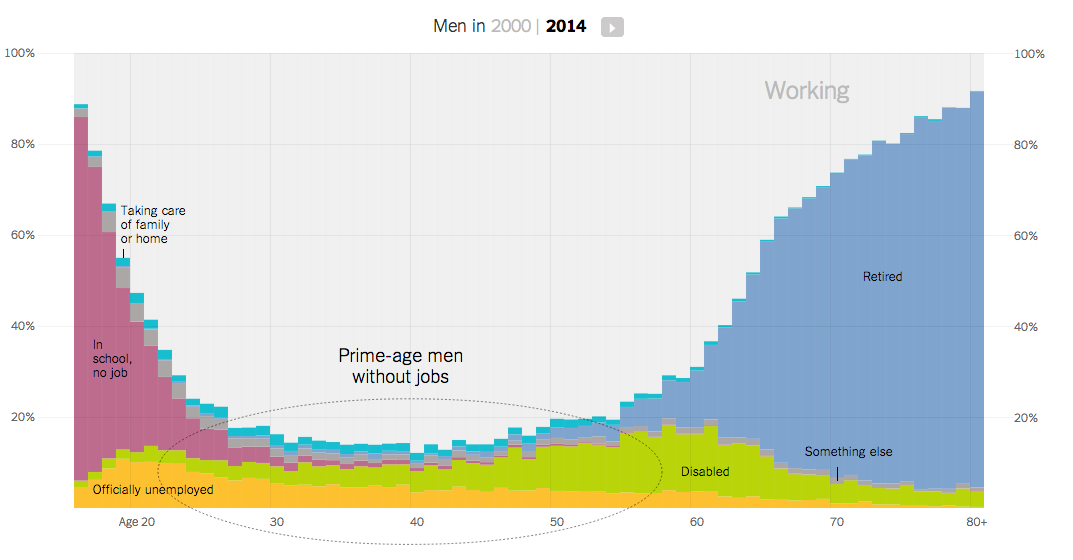
Binyamin Appelbaum looks into the causes of the decline in America’s male work force:
Working, in America, is in decline. The share of prime-age men — those 25 to 54 years old — who are not working has more than tripled since the late 1960s, to 16 percent. … Many men, in particular, have decided that low-wage work will not improve their lives, in part because deep changes in American society have made it easier for them to live without working. These changes include the availability of federal disability benefits; the decline of marriage, which means fewer men provide for children; and the rise of the Internet, which has reduced the isolation of unemployment. …
The resulting absence of millions of potential workers has serious consequences not just for the men and their families but for the nation as a whole. A smaller work force is likely to lead to a slower-growing economy, and will leave a smaller share of the population to cover the cost of government, even as a larger share seeks help. “They’re not working, because it’s not paying them enough to work,” said Alan B. Krueger, a leading labor economist and a professor at Princeton. “And that means the economy is going to be smaller than it otherwise would be.”
At the same time, Amanda Cox points out, many older men are postponing retirement:
The decline of traditional pension plans and rising education levels, which are associated with less physically demanding jobs, may both help explain why the elderly are working longer. The full retirement age for Social Security benefits also began gradually increasing in 2000.
Some countries have developed policies that encourage older people to leave the labor force, so they do not “crowd out” younger workers. But studies across countries and time suggest that crowding-out may not actually be a problem. Economies do not appear to have a fixed number of jobs. When more older people are working, they are earning money that they will then spend in ways that may create more jobs for young people, for example. Even if this is the case, though, the rise of elderly employment in recent years has not provided enough of a lift to put more young people back to work.
Derek Thompson suspects that more is at play here than employment, suggesting that the American male is having a full-on identity crisis:
Looking to the future, one aspect of the decline of work that might not receive enough attention is identity. If the future of work isn’t quite biased against men, it certainly seemed biased against the traditional idea of manliness. Construction and manufacturing, two male-dominated industries, are down 3 million jobs since 2008. Most of those jobs are dead, forever. Meanwhile, the only occupations expected to add more than 100,000 jobs in the next decade are personal care aides, home health aides, medical secretaries, and marketing specialists, all of which are currently majority female. …
The economy is not simply leaving men behind. It is leaving manliness behind. Machines are replacing the brawn that powered the 20th century economy, clearing way for work that requires a softer human touch.

I didn’t know what Elf on a Shelf was until maybe last week, and when I found out, I didn’t like it one bit. The little guy’s a spy! A spy! A gentle playtime introduction to the idea of a pervasive but ultimately benevolent surveillance state. No good! Bad for the children!
It is a comfort to discover, from Peter Holley’s charming Washington Post piece, that I am not alone in this response:
For some, the Elf on the Shelf doll, with its doe-eyed gaze and cherubic face, has become a whimsical holiday tradition — one that helpfully reminds children to stay out of trouble in the lead-up to Christmas.
For others — like, say, digital technology professor Laura Pinto — the Elf on the Shelf is “a capillary form of power that normalizes the voluntary surrender of privacy, teaching young people to blindly accept panoptic surveillance and” [deep breath] “reify hegemonic power.”
I mean, obvs, right?
The latter perspective is detailed in “Who’s the Boss,” a paper published by the Canadian Centre for Policy Alternatives, in which Pinto and co-author Selena Nemorin argue that the popular seasonal doll is preparing a generation of children to uncritically accept “increasingly intrusive (albeit whimsically packaged) modes of surveillance.”
Exactly. You might not cotton to Pinto’s academic argot, but she’s got the right idea. If you didn’t know, the way the Elf on the Shelf works, according to the massively popular accompanying story book, is that this creepy elf is Santa’s intelligence agent lurking in your house, keeping tabs on whether the kids are naughty or nice and reporting back to the jolly old goat. The kids aren’t supposed to touch the elf, a misdeed that might disqualify them from getting presents from Santa. And parents jerk the kids around by moving the elf from room to room so that the kids can’t ever be sure where it is.
In Pinto’s paper with Selena Nemorin, they write:
What is troubling is what The Elf on the Shelf represents and normalizes: anecdotal evidence reveals that children perform an identity that is not only for caretakers, but for an external authority (The Elf on the Shelf), similar to the dynamic between citizen and authority in the context of the surveillance state.
I suppose most people will think this sounds nutty. Well, you know what I think is nutty? I’ve got an infant son, and it’s damned hard to find clothes that don’t have sports balls or modes of transportation on them, and impossible to find anything intended for a boy in pink. People (and the market that caters to their preferences) seem weirdly dogged about making damn sure that their babies’ outward appearance strictly conforms to our most debased and simplified gender stereotypes. I mean, people need to know what sex your baby is so they know how to treat it, right? To know whether to buy it a tiara or a truck? To know say whether to say the tot is “pretty” or a “li’l scamp.” Who knows what confusion might ensue if the my wee tiny baby boy appears in public wearing a pink hat, or is not exposed very early to objects and clothing emblazoned with pro-sports propaganda! If it’s just normal to worry about that sort of thing, then I would submit that, logically speaking, it ought not to seem so nutty to worry that Elf on a Shelf might be preparing your child to complacently accept surveillance from an unaccountable authoritarian state.
When Felix is old enough, we’ll get ourselves an Elf on the Shelf, and I’ll tell him no presents will come until he finds the little rat and burns him alive. (This plan might need some work.)
Anyway, this video is great:
(Photo by Lisa Werner/Getty Images)

Ruling in what otherwise would have been a fairly straightforward deportation hearing, District Judge Arthur J. Schwab issued an opinion (pdf) yesterday declaring President Obama’s executive action on immigration unconstitutional. Lyle Denniston explains Schwab’s ruling, which could send the matter to the Supreme Court sooner than expected:
“The President may only ‘take care that the laws be faithfully executed’; he may not take any Executive action that creates laws.” The new policy, the judge went on, is not an exercise of presidential discretion on when to prosecute individuals for a violation of the nation’s laws, but was in fact a legislative action beyond the president’s constitutional authority.
Instead of being a form of case-by-case judgment about which individuals are to be deported, Judge Schwab found, the policy “provides a systematic and rigid process by which a broad group of individuals will be treated differently than others based upon arbitrary classifications.” Rejecting the government’s claim that the policy only delays deportation and does not create any new legal rights for those who benefit from it, the judge declared that the policy provides those who qualify with “substantive rights.” He ultimately concluded: “President Obama’s unilateral legislative action violates the separation of powers provided for in the United States Constitution as well as the Take Care Clause, and, therefore, is unconstitutional.”
As Sahil Kapur points out, Schwab is no stranger to controversy. Ian Millhiser picks apart the judge’s argument:
One case that Schwab does not cite is Arizona v. United States, where the Supreme Court said that the executive branch has “broad discretion” in matters of deportation and removal. As Arizona explains, a “principal feature of the removal system is the broad discretion exercised by immigration officials.” Executive branch officials, moreover, “must decide whether it makes sense to pursue removal at all.”
Notably, Arizona also indicates that this broad discretion flows from federal immigration law — i.e. laws that were enacted by Congress. This matters because Schwab’s opinion concludes that Obama’s “unilateral” policy “violates the separation of powers provided for in the United States Constitution as well as the Take Care Clause.” In essence, Schwab concludes that the president lacks the authority to act in the absence of authorization by Congress. Schwab does not even discuss the possibility that Obama’s actions may actually be authorized by Congress. Thus, even if Schwab’s reading of the Constitution is correct — itself a questionable proposition — the judge does not even discuss another major source of law that can justify the president’s actions.
Ilya Somin is not persuaded by Schwab:
Schwab complains that generalized “threshold criteria” will “almost wholly determine eligibility” for deferred deportation under the president’s order. But any exercise of prosecutorial discretion – no matter how “case by case” it may be, must include consideration of criteria that that end up wholly determining the outcome. That’s the whole point of using criteria in the first place. Unfortunately, Judge Schwab fails to even consider the possibility that the key distinction he relies on might be unsound.
If the Supreme Court were to adopt Judge Schwab’s reasoning, federal law enforcement agencies would be barred from issuing general systematic guidelines about how their officials should exercise prosecutorial discretion. The exercise of discretion would then become arbitrary and capricious. Alternatively, perhaps they could still follow systematic policies, so long as those policies were not formally declared and announced to the public, as the president’s order was. Neither possibility is particularly attractive, and neither is required by the Constitution.
Neither is Jonathan Adler:
It is true, as Judge Schwab notes, that the President’s announced policy identifies broad criteria for deferring removal of individuals unlawfully in the country. This would appear to make the action somewhat legislative, but I don’t think it’s enough to make the action unlawful. The new policy does not preclude the executive branch from revoking deferred action in individual cases and does not create any enforceable rights against future executive action. It’s no more unconstitutional than a US attorney telling the prosecutors in his office not to prosecute low-level marijuana possession absent other factors that justify federal prosecution.
Overall, Orin Kerr finds the opinion bizarre:
I was astonished by the legal contortions that Judge Schwab undergoes to get to the point that he can rule on Obama’s policy — and then the way he backs off the implications of his own ruling. Unless I’m just missing something unique to immigration law, it’s an exceedingly strange opinion.
As it happens, the ruling dropped on the same day as this piece by Somin, arguing that Obama’s actions are entirely constitutional:
Because of the enormous scope of federal criminal law, presidents routinely exercise extraordinarily broad discretion in deciding which violations to prosecute. Far more violators are ignored than punished—or even investigated. … Article II of the Constitution states that the president must “take Care that the Laws be faithfully executed.” But that requirement does not mean that the president has an absolute duty to prosecute all violations of federal law, or that he cannot choose which ones to pursue based on policy considerations. If it did, virtually every president in the last century or more would be in violation.
Allahpundit, for one, doesn’t buy it:
The question is this: Whom would you rather see punish O for that, the courts or the voters? In theory, there’s already a check on the president in all this — voters can simply express their disgust by refusing to vote for him or his party’s successor next time around. But that means, without a judicial or legislative counter, we’ll have to endure this power grab for two more years with no remedy. Is that tolerable?
But it’s hard to see this ruling standing when even Bushies like John Yoo oppose it:
To be clear, Yoo’s objection to Schwab’s decision is entirely procedural. Yoo, who once argued that the executive can use many forms of torture despite the fact that federal law explicitly forbids such activities, believes that President Obama’s decision to allow immigrants to remain united with their families is executive overreach. Yet Yoo also criticizes Schwab for opining on the immigration policy’s constitutionality when the issue was not properly before his court. As Yoo notes, “[t]his is not a case where the executive order applies, because the Obama administration is not allowing an illegal alien to remain in the country.” Thus, the case presents “no real dispute over the law, because regardless of whether the executive order is constitutional or not, it would make no difference in [this defendant’s] case.”
(Photo:: A Honduran immigration detainee, his feet shackled and shoes laceless as a security precaution, boards a deportation flight to San Pedro Sula, Honduras on February 28, 2013 in Mesa, Arizona. By John Moore/Getty Images)
The beleaguered currency bounced back a bit today from its epic freefall, as the Russian government took further steps to try and stabilize it:
The Finance Ministry said it was selling foreign exchange currency from its leftover stocks, of which it has around $7 billion, according to Reuters. The ministry did add in a statement that it considered the ruble “extremely undervalued,” however. … The announcement of the intervention immediately sent the ruble higher against the dollar, and after a volatile trading day was up 10 percent versus the greenback. Head of emerging markets research at Standard Bank, Timothy Ash, called the move “totally weird.“
Cassidy doubts that any of Moscow’s recent hail-Mary passes will do the trick:
Once the markets lose confidence in a currency, interest rates are no longer an effective policy tool, and foreign-exchange reserves can be depleted at an alarming rate. The reason is found in simple arithmetic. Even if the Russian Central Bank were to raise rates to a hundred per cent, which is obviously out of the question, the weekly return on ruble-denominated assets would be less than two per cent.
In the midst of a panic like the one we are seeing now, a currency can plummet by five or ten per cent in a single day, thus erasing even ultra-high interest-rate yields and leaving holders of the currency with a big loss. Foreign-exchange traders know this all too well, and that’s why they still refuse to buy ruble-denominated assets.
Matt O’Brien calls Russia’s current situation a catch-22:
Russia has gone from not having an economy and 10.5 percent interest rates to not having an economy and 17 percent interest rates. That should be enough to turn its recession into a full-on depression — and make all of this self-defeating. Think about it this way: Russia’s central banks already says its economy will shrink 4.5 to 4.7 percent next year — about as much as the U.S. did in 2008 — if oil stays at $60-a-barrel. But now that interest rates are sky-high, nobody’s going to want to borrow, either. The economy, in other words, is going to crater as households hunker down and just try to survive the double-digit inflation that the crashing ruble will bring.
Anna Nemtsova solicits the opinion of a Russian expert, who predicts an awful year to come for consumers:
[O]n Tuesday afternoon, after the ruble had fallen again to a stunning 80 to the dollar, the head of the central bank, Elvira Nabiullina, made a statement: “We have to learn to live in a new zone and count more on our own sources of finance,” she said. What? Ordinary Russians should read Nabiullina’s statement as, “Get used to being at least twice as poor next year as you were before the annexation of Crimea,” says Vladimir Ryzhkov, a prominent Russian politician and professor at the National Research University Higher School of Economy. “Now Russia does not have enough dollars to pay back billions of corporate bank debts; the payment is due before the new year. In the coming year, prices will continue to grow: Most medicine, which is mostly imported, will grow twice as expensive, as well as all electronic equipment—fridges, iPhones, computers and so on,” Ryzhkov told The Daily Beast.
And so it seems that Putin has finally met an enemy he can’t bully or buy off, Daniel Gross observes:
Putin’s successful statecraft has alternately consisted of bullying and defiance (Western Europe, the U.S.), invading neighbors (Ukraine, Georgia), depriving others of energy resources (Ukraine again, Eastern Europe), winning prestigious events through the promise of large investments (the 2014 Winter Olympics, the 2018 World Cup), forging relationships by offering sweetheart resource deals (China), or currying favor by allowing oligarchs to funnel huge quantities of money into real estate and banks (England, Turkey, Greece.) The currency markets can’t be bought off though. They are faceless, merciless, and swift. Every day, they are in effect passing judgment on regimes around the world.
Still, Max Fisher expects him to try:
As the economy sinks, Putin will only become more reliant on these sorts of shenanigans he’s used previously to stay in power. He’s not just worried about his popularity, after all, but his very legitimacy as the head of state; the 2012 election showed him that Russians could turn against him. Putin has little choice, then, but to seek legitimacy by stirring up more crises abroad, positioning himself as a nationalist hero leading the brave Russian state in a hostile world. But the only way he can maintain that image at home is if his soft conflict with the West continues. Putin can’t deescalate tensions in Ukraine and more broadly in Europe because those tensions are just about all he has left.
More broadly, the obvious move here is for Putin is to blame his country’s falling economy on American and European imperialism. By playing up the role of outside hostility in Russia’s economic crisis, Putin would shift the blame and, just as important, promote the idea that Russians have to come together and endure the downturn as a matter of national mission against a foreign enemy.
Walter Russell Mead imagines some of the crazy foreign policy decisions Putin might try:
There is one other alternative that the Dark Genius of the Kremlin may be turning over in his mind: Is there some way Russian foreign policy could create a Middle East crisis that would drive oil prices back up into the stratosphere? The most obvious way would be to bring about some kind of situation involving the Iranian nuclear talks—perhaps by offering quiet support to Iranian hardliners, increasing the chances that the talks fail. Any kind of serious war scare in the Persian Gulf would be good for Russia’s financial situation; Russian foreign policy experts are presumably thinking through their options.
So how should the West respond? Well, Bershidsky recommends that we make hay while the sun shines and rob Putin of the talking point that Western economic warfare is to blame for the crisis:
[T]he best thing the West could do now would be to lift the sanctions unconditionally. A Western leader, perhaps German Chancellor Angela Merkel or even U.S. President Barack Obama, could go on TV to say, “We stand with the Russian people in its hour of need. We support Russia, we want it to be strong and prosperous, and we have no intention to push it around.” That would leave Putin naked, faced with a weakening economy that rejects his management methods and a population increasingly wondering why it needs Putin and what he stands for anymore.
That, however, is another fairy tale. Obama will soon sign legislation calling for tougher sanctions, giving Putin more ammunition in his intensifying fight for power, and also feeding more radical nationalist elements that consider even Putin too weak in defending Russian interests. Western leaders lack the imagination to deal with the Putin problem creatively, and they are loath to admit mistakes. They will keep adding stones to the soup.
Larison likewise scolds Obama for agreeing to sign the new sanctions legislation, which Congress passed last Friday:
Obama is making a mistake by signing this bill. In addition to creating a pretext for more aggressive moves by Russia, signing this legislation will exacerbate Russia’s growing economic problems, and that will adversely affect the economies of Europe even more to the detriment of the U.S. and our allies. This could hardly come at a worse time when it appears that there is a good chance of having a genuine cease-fire in the Ukraine conflict. Piling on additional punitive and hostile measures now risks jeopardizing that fragile truce. It certainly isn’t going to make Moscow more accommodating or inclined to compromise. On the contrary, this is sure to make Russia more combative.
“So,” the Bloomberg View editors suggest, “why not cut a deal on Ukraine?”
The sanctions that the U.S. and European Union imposed earlier this year to dissuade Putin from further aggression made it hard for Russian companies to borrow on international capital markets; triggered large-scale capital flight (an estimated $130 billion this year); and shriveled inflows of foreign investment. Since then, they have acted as a multiplier on falling oil prices. The mere promise of lifting sanctions would begin to change sentiment in the currency markets.
Once that happens, Russia’s central bank would be in a better position to intervene by buying up rubles — going with the tide instead of against it. Putin would, without question, come under attack from nationalists for betraying the rebel cause in Ukraine. Yet the authorities in Kiev are under even more economic duress. The U.S. and EU should use their leverage to get Ukraine to a deal that secures the country’s independence while meeting some of Russia’s demands.
https://twitter.com/jonfavs/status/545276674846519297
How the deal came together:
The initiative comes after more than a year of secret talks, with a major impetus provided by Pope Francis, who hosted the final discussions between Cuban and U.S. officials at the Vatican in the fall. U.S. President Barack Obama and Cuban President Raul Castro spoke on the telephone yesterday for the better part of an hour, going down the checklist of measures that had been agreed in secret talks over the course of more than a year.
The agreement includes a “decision to reopen embassies, closed since 1961, and a dramatic expansion of the kinds of licenses that will allow Americans to travel legally to Cuba”:
Even if “tourism” is still barred by law, it is difficult to imagine that anyone wanting to visit the island will not be able to find some category that allows that to happen.
More on the accepted reasons for travel here. And yes, you can bring back cigars. Massie approves of Obama’s actions:
This is not – repeat not – going soft on Cuba. It’s getting tough with Cuba.
The old approach has had half a century to work and yet, golly, the Castros are still there, still running their sunshine-soaked island gulag. By any reasonable measure the old approach has failed. Every sensible person knows this. Every reasonable person knows just about any alternative policy could hardly do worse. So why not try something different? If the embargo was going to topple the Castros’ nasty little regime it would have done so by now. Perhaps capitalism should be given a chance instead.
There are other benefits to this startling eruption of sanity. American relations with the rest of Latin America have long been complicated by the stupidity of its Cuban policy. A reset here allows – in theory at least – an improvement in this area too. It is hard to see how this opening can hurt the United States anywhere in the western hemisphere.
Rubio, of course, is pissed:
“The President’s decision to reward the Castro regime and begin the path toward the normalization of relations with Cuba is inexplicable,” said Rubio in a statement. “Cuba, like Syria, Iran, and Sudan, remains a state sponsor of terrorism…Appeasing the Castro brothers will only cause other tyrants from Caracas to Tehran to Pyongyang to see that they can take advantage of President Obama’s naiveté during his final two years in office. As a result, America will be less safe as a result of the President’s change in policy.”
Goldblog dismisses such criticisms:
Critics of Obama’s Cuba initiative have a point: There is no way to guarantee the success, in human-rights terms, of this dramatic new opening. But time has discredited the alternative vision. The seemingly never-ending embargo did nothing to bring about the conclusion of the seemingly never-ending rule of the Castro brothers. After 50 years of trying one thing, and seeing that thing fail, and fail again, it was about time that the United States try something else.
Yglesias adds that “US policy towards Cuba isn’t really about human rights”:
While the Cuban government has a genuinely awful human rights record, it’s hard to argue that that explains US policy towards Cuba. While Cuba is the only country in the Western Hemisphere rated “not free” by Freedom House, it’s hardly the only such country in the world. The United States conducts normal diplomatic relations with China and Vietnam, who run similarly repressive regimes. And the United States considers not-free states such as Saudi Arabia, Bahrain, and Jordan to be close allies worthy not only of normal diplomatic relations but deep military and security assistance.
Cuba policy, in other words, has been driven by Cold War strategy and domestic politics much more than by human rights. That’s why with the Cold War issues now obsolete and the domestic politics changing, US policy is set to change too — even without significant change in Cuba’s human rights situation.
Keating provides some more important context:
[W]hile we certainly can’t say that Cuba is on the path toward democracy, Raul Castro’s government has carried out some meaningful reforms, including loosening rules on travel and private property. Even the country’s best-known anti-Castro dissident, Yoani Sanchez, thinks the embargo is now counterproductive.
Larison’s take:
The administration deserves credit for trying to make such a significant change to Cuba policy. When relations are restored with Havana, it will be a genuinely praiseworthy achievement of Obama’s second term. Normalization with Cuba is broadly popular in the U.S. and has been becoming more so over the years, but there is a dedicated core of supporters of the status quo that will presumably put up strong resistance to these changes. Let’s hope that they’re unsuccessful in any attempt to delay or derail this rapprochement.
And Noah Feldman supports Obama fighting the Cuba Lobby:
The risk that Obama carries in taking on a concentrated lobby isn’t totally unfamiliar to him. After all, he tried to take on the NRA by pushing gun control after the Newtown shootings. When he lost, the political cost to him was much less than the cost of doing nothing. With regard to Israel, Obama has tread much more carefully, limiting himself to the unmistakable message that he thinks West Bank settlements are an obstacle to peace and that Benjamin Netanyahu is, too. Many pro-Israel lobbying groups detest him for it, but they haven’t yet had the occasion to go to war against him.
With the end of his presidency in view, Obama has to take risks if he wants to score some legacy points. His gamble on Cuba may not be fully realized. But the results will have implications for the structure of American interest group politics more broadly.
Earlier Dish on the deal here.
Flagging research supporting what women already knew – wearing heels to a bar gets male attention – Ally Fogg notes that his preferences differ from those of the men in that study:
For what it is worth (ie nothing), personally I’m more attracted to a woman who looks like she can drink me under the table then carry me home, making a sturdy pair of DMs just the ticket. I live in hope that one day the human race will view high heels with the same horror with which we view foot-binding. Women would be spared innumerable podiatric agonies and men would, I think, just about cope. Until then I shall content myself with the knowledge that I’m right and the rest of the human race is a bit daft.
I don’t want to be too hard on Fogg here, because he’s basically right about heels, and he at least has the decency to precede his explanation of his tastes with a disclaimer acknowledging their irrelevance. But reading this, I couldn’t help but think of the Amy Schumer sketch, “A Chick Who Can Hang”:
The man who will have you know that prefers a woman without makeup, who’s casual and laid-back, who’s one of the guys is, at least in conversations among women, a well-established cliché.
As Schumer suggests, there’s the effortlessness many men rhapsodize about, and then there’s actual effortlessness, which consists of looking like a disheveled version of one’s usual self. The ideal woman is well-groomed, but has a shower-and-go beauty routine. She’s well-dressed, but never goes shopping. As Lauren Bans recently pointed out, that Schumer sketch works because “a supermodel going to town on a cheeseburger” is basically the straight male fantasy. (Well, the PG one, at any rate.) The perfect woman, then, is thin without dieting. Perhaps, too, she’s simultaneously in combat boots and heels.
Today is Penelope Fitzgerald’s birthday. Let’s celebrate it, because Americans don’t celebrate Penelope Fitzgerald nearly enough.
 I mentioned yesterday that one of the books that has really stuck with me this year is Hermione Lee’s biography of Penelope Fitzgerald. I was drawn to the biography in the first place because I like Fitzgerald’s books – The Bookshop is tops with me, but I like The Blue Flower too, obviously – of course. Though as someone raised on Alice Munro with general doses of Mavis Gallant, I’m probably genetically programmed to love the writings of shrewd, intelligent, but ultimately despairing British Commonwealth writers. Also, I’d been having a weird fall working on my own book. And I could justify reading the Lee as a sort of research. “I’m skimming for structure,” I told a friend. “I want to know how Lee puts these things together.” And she is, yes, a wonderful biographer and I always learn new tricks from her.
But these were excuses. I was doing the thing people write whole essays decrying: I was reading the biography out of an impulse not far from a reader of self-help. I wanted to know how Fitzgerald did it. And I loved what I found out.
Some things I already knew, of course. For example, that Fitzgerald didn’t publish her first book until the age of 58. Her first proper novel didn’t appear until she was 60. If you’re not the sort of writer who ascended to the stratosphere right away, these are cheering numbers. They represent hope. Even if you spend your whole life struggling, Fitzgerald’s trajectory suggests that late in life there might be a breakthrough. You might become a great.
There’s more hope to be found, as it turns out. Though I’d read Offshore before, I hadn’t quite cottoned on to the fact that Fitzgerald’s struggles included her houseboat actually sinking into the Thames. That put my first writing apartment, a basement affair in which the ceiling fell in twice from bad plumbing in the two years I lived there into real perspective, let me tell you.
Fitzgerald’s example also casts hopeful new light on the problem of awful people who don’t like your work. Fitzgerald won the Booker for Offshore in 1980, went on television in celebration with the other finalists and proceeded to be insulted by everyone present. She’d upset V.S. Naipaul for the prize and evidently others felt she didn’t deserve it. Quoth Fay Weldon on the announcement of Fitzgerald’s win, with Fitzgerald sitting right there: “I felt as though something had hit me very hard on the head.” It was like Twitter, except in real life. And yet Fitzgerald was the one who made the best British novelists lists. I’d say she won out.
Byron York points out that Bush last ran for office in 2002:
Bush’s 14-year gap is bigger than any general-election presidential candidate in recent memory. …Talk to political consultants and they’ll tell you that sitting out even one electoral cycle can not only make a candidate rusty but can also make him or her unfamiliar with the sometimes overwhelming ways in which campaigns change over the course of four years. Jeb Bush might be able to overcome those challenges. But it probably won’t be easy.
Tomasky focuses on the same issue:
To find a presidential candidate with as long a gap between campaigns (excluding those like Eisenhower who’d never run), you have to reach back to James Buchanan. Questions of rust will arise, of course, but more than that, we can fairly wonder whether he has a feel for the politico-culture landscape these days. The conservative movement of today is a rather fiercer creature than the one his brother held at bay with a few Scriptural dog whistles.
 The Dish