“I don’t believe these are torture at all. For instance, waterboarding, there were medical personnel present during the whole time. It creates tremendous discomfort – there’s no doubt about it. It creates tremendous fear, but the fact is there was no lasting damage to these people and we got information from them, which is very helpful. … We’re not talking about anyone being burned or stabbed or cut or anything like that. We’re talking about people being made to stand in awkward positions, have water put into their nose and into their mouth. Nobody suffered any lasting injuries from this,” – Congressman Peter King.
Month: December 2014
Michael Hayden Unravels
It took an interview on the BBC. Seriously, watch it.
The Best Of The Dish Today
I thought I’d end today with a quote from my dear, late friend, Christopher Hitchens, a dedicated opponent of Jihadist nihilism but also a civilized man who knew torture when he saw it. On the CIA:
Now we have further confirmation of the astonishing culture of lawlessness and insubordination that continues to prevail at the highest levels in Langley. At a time when Congress and the courts are conducting important hearings on the critical question of extreme interrogation, and at a time when accusations of outright torture are helping to besmirch and discredit the United States all around the world, a senior official of the CIA takes the unilateral decision to destroy the crucial evidence. This deserves to be described as what it is: mutiny and treason.
Despite a string of exposures going back all the way to the Church Commission, the CIA cannot rid itself of the impression that it has the right to subvert the democratic process both abroad and at home. Its criminality and arrogance could perhaps have been partially excused if it had ever got anything right, but, from predicting the indefinite survival of the Soviet Union to denying that Saddam Hussein was going to invade Kuwait, our spymasters have a Clouseau-like record, one that they have earned yet again with their exculpation of Mahmoud Ahmadinejad. It was after the grotesque estimate of continued Soviet health and prosperity that the late Sen. Daniel Patrick Moynihan argued that the CIA should be abolished. It is high time for his proposal to be revived. The system is worse than useless—it’s a positive menace. We need to shut the whole thing down and start again.
And that isn’t triply true today?
Some posts on torture worth revisiting today: my comparison of what Charles Krauthammer was proposing in 2005 with what the GOP is defending today; your take on the revelations; the use of anal rape as an American torture technique; Obama’s complicity in protecting the CIA; what George Will and Bill Buckley and the Weekly Standard once thought about the abuse of prisoners; and the casuistry of John Yoo.
Your well-deserved Mental Health Break is here.
The most popular post of the day was How Obama Backed Impunity For War Crimes; followed by Darkness Visible.
If you want to support the work the Dish team has been doing for the past few days, and you haven’t yet subscribed, click here – and get access to all the readons and Deep Dish – for as little as $1.99 month.
Many of this week’s posts were updated with your emails – read them all here. You can always leave your unfiltered comments at our Facebook page and @sullydish. 39 more readers became subscribers today. One writes:
After much delay, I have finally subscribed. In part, this is due to a bit more income, but it’s more directly due to the release of the torture report.
You frequently drive me crazy, Andrew, but as I find myself too often guilty of succumbing to the easy, self-filtered comfort of epistemic closure, I appreciate that you and your team cultivate this forum that challenges my preconceptions. And since I am currently writing a kids’ fantasy series that is in part about the dangers of not questioning one’s assumptions and succumbing to nationalistic fervor, I figure I would be irresponsible to not put my money where my mouth is.
Thank you for your unwavering clarity on this horrific issue of torture, and for being a model of what it means to strive for intellectual honesty and open discussion. If you aren’t occasionally driving your readers crazy and making us uncomfortable, you aren’t doing it right.
See you in the morning.
The Truth About Torture, Revisited
[Re-posted from earlier today]
Nine years ago, Charles Krauthammer wrote an essay in The Weekly Standard defending the use of torture by the United States. I responded with the essay excerpted below in The New Republic. I went back and read that debate this morning, just to see how it holds up in the wake of the mass of evidence we now have from the CIA itself about the torture that the US actually authorized and practiced under the Bush administration.
And what strikes me is how admirably emphatic Charles was about the gravity of the issue nine years ago. Here is a sentence and a sentiment I have yet to read in the various commentaries on the right since the report was published yesterday:
Torture is a terrible and monstrous thing, as degrading and morally corrupting to those who practice it as any conceivable human activity including its moral twin, capital punishment.
It seems to me that in a civilized and decent society, this is not something open to much caviling. Even if you believe, as Charles did, that torture was defensible in some very exacting circumstances, it is still a monstrous, morally corrupting evil. And yet that sentiment is strangely nowhere to be found on the current right. Which is itself proof of the statement. What we once instinctively regarded with moral horror has, over the years, become something most Americans are comfortable with. This is what torture does. In the words of Charles Krauthammer, it degrades and morally corrupts those who practice it. And so it has:
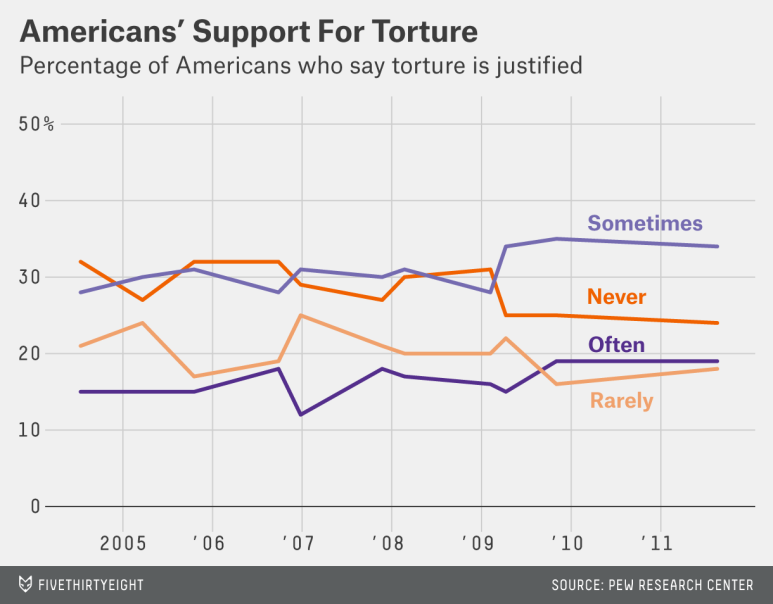
Notice that Krauthammer’s maximal position in 2005 is now dead last in public opinion: his view that torture should be used extremely rarely commands less than 20 percent support and is beaten by those Americans who now believe that torture should be employed often. Yes: often. And this, of course, is not an accident. When a former president and vice-president openly back torture, and when the CIA has been engaging in a massive p.r. campaign to argue – against what we now know are incontrovertible facts from the CIA’s own records – that it saved thousands of lives, it will affect public opinion. There are always atavist and repellent sentiments in war time. The difference now is that a huge section of the elite endorses them.
Whom should we torture? Krauthammer rules torture out of bounds for prisoners of war; permits it in the case of very few high-value terrorists; and then offers up a difficult category of torture victims – those with information about a “ticking time-bomb”:
Third, there is the terrorist with information. Here the issue of torture gets complicated and the easy pieties don’t so easily apply. Let’s take the textbook case. Ethics 101: A terrorist has planted a nuclear bomb in New York City. It will go off in one hour. A million people will die. You capture the terrorist. He knows where it is. He’s not talking … Question: If you have the slightest belief that hanging this man by his thumbs will get you the information to save a million people, are you permitted to do it? Now, on most issues regarding torture, I confess tentativeness and uncertainty. But on this issue, there can be no uncertainty: Not only is it permissible to hang this miscreant by his thumbs. It is a moral duty.
Now consider what we now know about whom we tortured under the torture program under Bush and Cheney. First off, we tortured 26 people who were cases of mistaken identity. We tortured 26 innocent people. This is so far outside any of the parameters that even Krauthammer allowed for that it beggars belief. Amy Davidson:
Footnote 32, the same one that outlines the motives for holding Nazar Ali, has a devastating litany, starting with “Abu Hudhaifa, who was subjected to ice water baths and 66 hours of standing sleep deprivation before being released because the CIA discovered he was likely not the person he was believed to be,” and including many others, such as,
“Gul Rahman, another case of mistaken identity.… Shaistah Habibullah Khan, who, like his brother, Sayed Habib, was the subject of fabrications.… Haji Ghalgi, who was detained as “useful leverage”…. Hayatullah Haqqani, whom the CIA determined “may have been in the wrong place at the wrong time”…. Ali Jan, who was detained for using a satellite phone, traces on which “revealed no derogatory information”.… Two individuals—Mohammad al-Shomaila and Salah Nasir Salim Ali—on whom derogatory information was “speculative”.… and Bismullah, who was mistakenly arrested … and later released with $[redacted] and told not to speak about his experience.”
It seems to me that proponents of torture should be horrified by this revelation. If torture is a monstrous thing, if it corrupts all who do it, as Krauthammer believes, what incalculable damage has been done by the US torturing innocents, in one case to death? Where was there any remorse – yes, remorse – expressed by the CIA yesterday for this compounding of a crime and a mistake?
Now consider Krauthammer’s view of who should be doing the torturing:
The exceptions to the no-torture rule would not be granted to just any nonmilitary interrogators, or anyone with CIA credentials. They would be reserved for highly specialized agents who are experts and experienced in interrogation, and who are known not to abuse it for the satisfaction of a kind of sick sadomasochism Lynndie England and her cohorts indulged in at Abu Ghraib.
We now know that the CIA contracted out the torture to two individuals without “specialized knowledge of al Qaeda, a background in counterterrorism or any relevant cultural or linguistic experience.” They had never interrogated anyone – yet they got a $181 million contract to run the program. They were sadists:
John Rizzo, the acting CIA general counsel who met with the psychologists, wrote in his book, “Company Man,” that he found some of what Mitchell and Jessen were recommending “sadistic and terrifying.” One technique, he wrote, was “so gruesome that the Justice Department later stopped short of approving it.”
They had a pecuniary interest in the criminal enterprise. And they were making things up as they went along:
One email from a CIA staff psychologist said “no professional in the field would credit” their judgments. Another said their “arrogance and narcissism” led to unnecessary conflicts in the field. The director of interrogations for the CIA called their program a “train wreck” and complained that they were blending the roles of doctor and interrogator inappropriately.
So the architects of the torture program also violated a core part of Krauthammer’s defense of torture. And shockingly so. Why aren’t the defenders of torture horrified by this amateurism? Where are the Republican voices of outrage that a serious torture program was handed out to amateur contractors who had no idea what they were doing and no moral compass at all?
Krauthammer also described two torture techniques he would approve of. One was the injection of sodium pentathol – which, given the rank brutality of the actual torture sessions – would have been a mercy, but was not widely used (so far as we know). The second technique was waterboarding, the torture perfected by the Communist Chinese, and for which previous US servicemembers were prosecuted. But notice what Charles says waterboarding is:
Less hypothetically, there is waterboarding, a terrifying and deeply shocking torture technique in which the prisoner has his face exposed to water in a way that gives the feeling of drowning. According to CIA sources cited by ABC News, Khalid Sheikh Mohammed “was able to last between two and 2 1/2 minutes before begging to confess.” Should we regret having done that? Should we abolish by law that practice, so that it could never be used on the next Khalid Sheikh Mohammed having thus gotten his confession?
We now know that those CIA sources were lying. KSM was waterboarded 183 times over a matter of weeks. And the waterboarding was not just 2 1/2 minutes of panic. It was full-fledged, endless, soul-breaking, body-destroying torture of a kind practiced in the past by totalitarian or authoritarian police states:
Within days of the Justice Department’s approval to begin waterboarding the prisoner, Abu Zubaydah, the sessions became so extreme that some C.I.A. officers were “to the point of tears and choking up,” and several said they would elect to be transferred out of the facility if the brutal interrogations continued. During one waterboarding session, Abu Zubaydah became “completely unresponsive with bubbles rising through his open, full mouth.” The interrogations lasted for weeks, and some C.I.A. officers began sending messages to the agency’s headquarters in Virginia questioning the utility — and the legality — of what they were doing. But such questions were rejected.
Krauthammer argued that the torture should “not be cinematic and ghoulish.” I wonder if he regards the following as non-ghoulish:
The interrogators didn’t know the languages that would have been useful for real intelligence, but they did come up with a lexicon of their own: “walling,” which meant slamming a person against a wall; “rough takedown,” in which a group would rush into a cell yelling, then drag a detainee down the hall while punching him, perhaps after having “cut off his clothes and secured him with Mylar tape”; “confinement box,” an instrument to make a prisoner feel he was closed in a coffin (the box came in large or small sizes); “sleep deprivation,” which might mean being kept awake for a hundred and eighty hours before succumbing to “disturbing hallucinations”; the ability to, as the report put it, “earn a bucket,” the bucket being what a prisoner might get to relieve himself in, rather than having to soil himself or being chained to a wall with a diaper (an “image” that President Bush was said to have found disturbing); “waterboarding,” which often itself seems to have been a euphemism for near, rather than simulated, drowning; “rectal rehydration as a means of behavioral control”; “lunch tray,” the assembly of foods that were puréed and used to rectally force-feed prisoners.
This is what the talk of family could look like: “CIA officers also threatened at least three detainees with harm to their families—to include threats to harm the children of a detainee, threats to sexually abuse the mother of a detainee, and a threat to ‘cut [a detainee’s] mother’s throat.’ ” The interrogation of Abd al-Rahim al-Nashiri included “implying that his mother would be brought before him and sexually abused.”
What this report proves – not asserts, but proves – is that the torture the US inflicted on prisoners was of an uncontrolled, nightmarish quality whose impact was so great that even the junior grunts on the night beat at Abu Ghraib knew what they were supposed to do. Remember what so many Republicans said after Abu Ghraib? They were horrified, when they could blame it on someone at the very lowest rung of the totem pole. But when it was sanctioned by the very highest levels of the CIA – and inflicted on two dozen innocents – it was kosher.
In a civilized society, there really would be no debate over this. And before 9/11, there wasn’t. Ever since, this country has slid and then fallen out of the civilized world and out of the core American traditions of humanity and legal warfare. Krauthammer can be seen as emblematic of that slide – someone whose early abhorrence at torture and defense of it only in its mildest and rarest forms has slowly succumbed to a full-fledged defense of a program that violated every rule he said should be in place to protect us from the abyss. This is not surprising. When you start to torture, the sheer evil of what you are doing requires that you believe ever more in its value. You can never admit error, because it would mean you have committed crimes against humanity without even the defense of acquiring any useful intelligence. You are revealed as monsters – and you cannot accept that of yourself or of those you know. And so you insist – with ever-rising certainty – that the torture worked – even though that’s irrelevant as a matter of morality and of law, and even though your own internal documents prove that it didn’t.
And so you become the monster you were supposed to be fighting. And if you gaze long enough into an abyss, the abyss will gaze back into you.
Katherine Bigelow, Propaganda Tool
A reader writes:
Please take a minute if you haven’t already to watch the segment on the Daily Show last night where Jon Stewart asks Zero Dark Thirty director Katherine Bigelow about the Senate report on torture (she was scheduled to be on the show to promote her new documentary on the ivory trade and terrorism – the timing was a coincidence as far as I know). When asked for her reaction to the revelation of the CIA’s lies and misrepresentations (particularly about whether the information gleaned from torture was of any use) her two word answer was: “It’s complicated.”
That’s it.
Nothing else from her. No apology for the damage her movie did in conveying the idea to the average American that torture “works”. No attempt to explain how she was deceived (of course it was public knowledge even then that the salient information came from un-tortured sources but many/most people don’t know or understand that), and no attempt at a defense by her either. And then no follow up from Jon Stewart. Just her “It’s complicated” and then on to something new (with new bad guys who aren’t us).
She was had. And she’s not strong enough to admit it. Her movie does show some of the milder torture the US inflicted on prisoners, and it has some worth for that. But its subtle attempt to say that it somehow played a role in getting bin Laden … well, we now know that is not true. Another scowls at Stewart:
I’ve never thought of Jon Stewart as a journalists. But you guys have often written about him in those terms. If Stewart is a journalist, he was David Gregory during the Bigelow segment.
Don’t be too rough on him. A reminder of the facts of the Senate report as it relates to bin Laden:
Did waterboarding and other coercive interrogation techniques that were used on al Qaeda detainees in CIA custody eventually lead to the Navy SEAL operation that killed Osama bin Laden in Pakistan early in the morning of May 2, 2011? The Senate Intelligence Committee report released Tuesday has a simple answer to that: Hell, no!
According to the Senate report, the critical pieces of information that led to discovering the identity of the bin Laden courier, Ahmed al-Kuwaiti, (Ahmed the Kuwaiti) whose activities eventually pointed the CIA to bin Laden’s hiding place in Pakistan, were provided by an al-Qaeda detainee before he was subjected to CIA coercive interrogation, and was based also upon information that was provided by detainees that were held in the custody of foreign governments. (The report is silent on the interesting question of whether any of these unnamed foreign governments obtained any of their information by using torture.)
Further critical information about the Kuwaiti was also provided by conventional intelligence techniques and was not elicited by the interrogations of any of the CIA detainees, according to the report.
Even worse for the CIA — which has consistently defended the supposed utility of the interrogation program, including in the hunt for bin Laden — a number of CIA prisoners who were subjected to coercive interrogations consistently provided misleading information designed to wave away CIA interrogators from the bin Laden courier who would eventually prove to be the key to finding al Qaeda’s leader.
Update from a reader with further media criticism:
I listened to “Morning Edition” this morning, very curious to hear their coverage on this important story. I was quite disappointed. First, they continued with the “enhanced interrogation” euphemism, refusing to call it torture. (She kept referring to it as “what some would call torture.”) But even more problematic was Renee Montagne’s interview with John Rizzo, former CIA General Counsel.
Their entire conversation centered on the specific practices that went beyond the authorized practices, with Rizzo emphasizing that when people exceeded the boundaries, they were reported (and punished). Montagne never asked him about the practices that were authorized, which is the much bigger problem at issue. Rizzo made it seem like there were two types of practices: (1) authorized practices that were effective (according to him); and (2) unauthorized, excessive practices. Montagne never asked him how or why practices like waterboarding, sleep deprivation, and keeping prisoners in stress positions were actually permitted, given that they have been legally prohibited previously. Nor did she ask if some of the other practices that were revealed in the report, such as “anal feeding,” were permitted (or were considered excessive according to the CIA guidelines he was defending).
Whitewash doesn’t even begin to capture what a lame interview it was (as most of the comments on NPR’s website point out).
Always Believe The Accuser?
Zerlina Maxwell makes the dubious argument that alleged rapists should be presumed guilty until proven innocent, at least in the court of public opinion:
We should believe, as a matter of default, what an accuser says. Ultimately, the costs of wrongly disbelieving a survivor far outweigh the costs of calling someone a rapist. Even if Jackie fabricated her account, U-Va. should have taken her word for it during the period while they endeavored to prove or disprove the accusation. This is not a legal argument about what standards we should use in the courts; it’s a moral one, about what happens outside the legal system.
The accused would have a rough period. He might be suspended from his job; friends might defriend him on Facebook. In the case of Bill Cosby, we might have to stop watching his shows, consuming his books or buying tickets to his traveling stand-up routine. But false accusations are exceedingly rare, and errors can be undone by an investigation that clears the accused, especially if it is done quickly.
Freddie is aghast at Maxwell’s belief that public opinion is entirely separate from the judicial system and that such an attitude won’t lead to serious miscarriages of justice:
I find it particularly disturbing that, in a country with a long legacy of using spurious claims of sexual aggression as a weapon against black men, many of those who consider themselves the most committed opponents of racism are endorsing a deeply simplistic and idealistic notion of how the pursuit of justice actually happens in the non-ideal real world we live in. A brief consideration of American history will show you some examples of rape claims that were automatically believed, and the consequences are a terrible stain on our country.
When we talk about carceral feminism, this is what we mean:
allowing the great moral duty to oppose rape to allow us to develop credulous attitudes towards the police state. People keep insisting to me that this doesn’t happen, but how can Maxwell’s assumption of a necessarily impartial judicial system, unmoved by public opinion, represent anything else? We’re living through righteous, mass protests of an unchecked, deeply racist police system. That so many are failing to apply that analysis consistently and thoroughly is deeply discouraging. We owe support and attention to the victims of rape. Developing a false credulity to the notion of judicial impartiality does neither them nor the rest of us any favors.
McArdle piles on, adding that Maxwell’s “always believe” approach would actually result in making all rape victims less believable:
One cost of minimizing false negatives is to the false positives who get hurt. But another cost is to the credibility of all rape reports. People who responded to the problems with the Rolling Stone story by saying that this didn’t have anything to do with the real problem — the culture of rape on college campuses — were missing something important. Actually, two important things.
First, that deciding what to do in the face of these trade-offs between false positives and false negatives is actually a vital matter of public debate in all areas of policy, and this story cast important light on how those trade-offs may have been made outside of the public eye.
And second, that by declaring that this story, which just a week before was a grave matter demanding the urgent attention of the nation, somehow became trivial and irrelevant when it started to look as if it might be false, writers and activists were suggesting that they simply didn’t care about false positives. Which undercuts the very public trust they need to advance their cause.
Brendan O’Neill sees an emerging culture of credulity gone haywire:
If Erdely nodded along to Jackie’s story while robotically thinking “I believe,” she isn’t alone. Automatically and uncritically believing allegations of rape is all the rage today. Where for most of the Age of Enlightenment it was considered civilized to believe that those accused of a crime were innocent until proven guilty, now it appears the way to show that you are a good and caring person is to do pretty much the opposite. You should believe instantly the alleged victim’s every word, and by extension to believe instantly that the accused is guilty as hell.
So when Dylan Farrow claimed she was sexually abused as a child by Woody Allen, the meme “I Believe Dylan” spread like a pox across the internet. #IBelieveDylan trended on Twitter. At Indiewire, Melissa Silverstein said “There are a few fundamental beliefs that I hold, and one of them is that I believe women.” All women? All the time? Including, say, Condoleezza Rice when she said Saddam had loads of weapons of mass destruction?
This is silly. Women are just as capable as men of making stuff up.
But Maya Dusenbery, a former fact-checker, argues that it was the biases of journalism, not feminism or advocacy, that led Rolling Stone to do Jackie the tremendous disservice of not fact-checking her story:
One of the main purposes of fact-checking is to correct journalism’s bias toward a “good story” above all else. … [I]f Rolling Stone was so eager to keep Jackie’s story in the piece that they were ready to run it against her will, that suggests their willingness to bend their fact-checking standards may have had less to do with some feminist “sensitivity” to a survivor’s request and more to do with not wanting to risk losing a particularly shocking tale of a gang rape that would help their article go viral in the way it ultimately did.
I do not know if that’s the case — perhaps Rolling Stone genuinely, if very mistakenly, believed they were doing the right thing for the right reason — but I think it’s plausible, and I’d like to see all the journalists rushing to pontificate about how to do “good reporting” on sexual violence acknowledge the possibility that it was journalism’s bias towards a good story that’s to blame here. That in chasing the “perfect victim,” Rolling Stone pressured a traumatized rape survivor to tell her story, ditched their fact-checking standards, and then threw her under the bus when the account — totally predictably — was challenged.
But, of course, the one thing that journalism refuses to question is its own ability to reveal the truth. It clings fast to its central conceit: that it has no biases of its own, and if followed correctly, its standards and conventions are enough to magically correct our cultural biases and lead us to some “objective” truth — or at least get us closer than anything else will.
Face Of The Day

A dog named Ted runs along the beach in Blackpool, United Kingdom on December 10, 2014. High winds and large waves hit the North West Coast of the UK and Northern Ireland today. By Nigel Roddis/Getty Images.
Quote For The Day II
“You can be for torture, but you can’t be for torture and then claim that it’s somehow inappropriately barbaric for ISIS to crucify the innocent. This report clearly shows that the CIA basically broke people’s feet and made them stand on them for days, repeatedly drowned/revived people, froze people to death, anally raped them, threatened to kill women and children, and did everything they could to break them; the report also makes it clear that they did this past the point where even the CIA felt they had any useful information. It was so bad that trained CIA operatives got choked up and cried when they saw it. These weren’t kale-loving hippies; these were CIA and special forces operatives and it was so intense they started crying. Many of these people were completely innocent; even the CIA admits they were in the wrong place at the wrong time. The report makes all this very, very clear.
So like I said, you can be for torture. But if you are then you lose the right to call crucifixions barbarism. Because a thousand times out of a thousand, I’d rather be crucified than what the CIA did to dozens, possibly hundreds of people. Compared to the pain those people suffered, being crucified and getting to die after a few days would be a mercy,” – a Dish reader on a reddit discussion with someone who supports the use of torture.
The View From Your Window

London, England, 3.21 pm
The CIA’s Vicious Cycle
Henry Farrell fears it will only get worse:
[T]he CIA relies on relationships with a variety of people, and in particular with academics and people with semi-academic skills in a broader ecosystem of information. Many of these relationships are likely to be badly damaged by yesterday’s revelations. Academics will be less likely to want to talk to, or work with the CIA than before. Smart and idealistic young people will be less likely to sacrifice other opportunities to work for what is at best likely to seem a flawed and problematic organization. …
[T]he CIA — like many organizations in difficult times — is likely to face social pressures that tend to reinforce its insularity. The parts of the organization that are most distant from the abuses, and most reliant on relationships with the outside world, are exactly the parts of the organization that are most likely to suffer, as they find that external actors (on whom they have previously relied) are unwilling to work with them any more. For similar reasons, the recruitment pool for the CIA (which has notoriously been far from diverse) is likely to shrink and become even less intellectually diverse than it is today.
 The Dish