Uber Comes Under Fire Abroad

Vlad Savov sums up this week’s bad news for the ride-share company:

In Madrid, a judge has ruled that Uber should cease all activities in Spain because its drivers are unregistered and thus act as unfair competition to existing taxi services. … Authorities in Thailand have reached a similar conclusion, deeming Uber’s operation of unlicensed and uninsured taxi services to be unlawful, and have also asked the company to cease business — at least until it starts using properly accredited drivers rather than private cars.

India has already instituted a ban on Uber in Delhi following the rape of a female passenger, but now the country is broadening its prohibition and advising all its state governments to enforce it. It specifically bans the use of web-based taxi-hailing apps, meaning the ban will have an impact on others beyond Uber, but the focus on the California company is intensifying with the Delhi Police “also exploring the issue of possible legal liability of the taxi service Uber in the crime committed,” according to Home Minister Rajnath Singh.

To Jason Koebler, the incident in New Delhi demonstrates that Uber doesn’t care about riders’ safety:

Uber’s entry into in India show that the corporation’s sensibilities and values—that is, to crush existing taxi services and its tech savvy competitors like Lyft—haven’t changed a bit, even if some high-profile cases (like the​ time it called a several-hour abduction of a woman an “inefficient route”) in the US have forced the company to take a modicum of responsibility for its drivers. Now, we get at least a basic background check and nonsense like the “Safe Rides Fee” (which only exists in Canada and the​ US, according to the company).

But in developing countries, Uber is making the same mistakes with rider safety that it made in the United States. It’s treating these countries like the Wild West until it’s forced to change: “If [Uber] can bully its way in the US, and not care about law and regulations there, then it has absolutely nothing to worry about in India,” wrote o​ne internet commenter who claimed to have experience with the company there. “The law enforcement is weak, to say the least.”

But Danny Vinik blames the Indian authorities, not Uber:

Uber offers a new transportation option that offers users at least some ability to hold their drivers accountable for their actions. That doesn’t mean it’s a cure-all. In many cases, Uber’s ability to ensure the safety of its user will rely on the infrastructure already in place. Ultimately, improving that infrastructure is up to the local communities and officials, not Uber. That doesn’t mean Uber is blameless, but their cars offer one of the safest traveling experiences in India. At least the company has a background check system to speak of, and users have the ability to rate their drivers. With other transportation optionsrickshaws or local taxis, for instancethat isn’t necessarily the case. Uber’s not perfect, but it’s an improvement. This brutal incident doesn’t change that.

And as Amanda Taub points out, Indian cities are often unsafe for women to get around in, whatever mode of transportation they choose:

I saw this effect firsthand during trips to India in the past year. Everyone had different advice for me about how to stay safe, which meant that in the aggregate I was warned against using every possible form of transportation. (Only use radio taxis, they’re safer, never use local taxis. Don’t use radio taxis, you don’t know who they’ll send, better to rely on these local taxi drivers, we know them. Don’t take autos during the nighttime. Don’t take autos during the daytime. Come with us in the auto, it’s safer than going on your own. Don’t walk, take a bicycle rickshaw from the train station. Don’t take bicycle rickshaws. Don’t take the train.)

Given the choice between taking all of that advice and never leaving my apartment, versus selectively ignoring it and getting on with my day, I chose the latter. But finding safe and reliable transportation where and when I needed it was still always a challenge. That challenge is of course far more significant for Indian women, who have to face it every day, usually without the resources that I had at my disposal.

That was the problem that Uber needed to solve. But the facts surrounding this alleged assault suggest that they have failed to do so.

Mallika Dutt expects the Uber ban to make that problem worse, not better:

The quick decision to ban Uber is important in that it sends a message to all companies operating in this space that they need to follow regulations with seriousness. However, it is already unsafe for women to get around in Delhi. The metro has separate compartments for women—but what do they do when they step off the train? That’s partly why Uber and other private cab companies are in demand in the first place. Decreasing access to multiple modes of alternative transportation for women is a short-term and limited solution. Rather than further limiting the options available to women, how about increasing women’s safety not only by enforcing regulations and providing safer modes of operation, but by also increasing the number of men who hold themselves and others accountable for their behavior and actions?

The way Leonid Bershidsky sees it, the incident “highlights one of the web-based car service’s biggest problems: In some places, there is little to distinguish it from the anarchic system it seeks to replace”:

Those who live in the U.S. and other rich countries find it hard to understand the near-irrelevance of Uber’s ride-sharing model in Eastern Europe, Asia and Latin America. Many countries in these regions have time-honored unregulated gypsy cab traditions. In Argentina and Uruguay, people call or text for a trucho. In Russian cities, if you raise your arm by the roadside, a car — almost never a licensed taxi — typically pulls up within minutes, unless it’s the dead of night.

His bottom line:

In emerging economies with shaky taxi regulation, Uber can’t be disruptive if it is as lax as the incumbents. Its offering can only be of value if it tries to be more like a traditional Western taxi service, obeying strict rules and convincingly projecting an image of safety and reliability. That is something it isn’t equipped to do now.
Remember When They Opposed War In Iraq?

What a difference a decade makes. As the Senate Foreign Relations Committee yesterday finally began debating an authorization for the ongoing war against ISIS, the secretary of state urged them to grant the White House a much wider berth than the draft bill would:

Specifically, Kerry asked his former colleagues not to limit the use of military force to those two countries where Obama already has launched airstrikes, nor to bar the president from deploying combat troops on the ground, despite his repeated assurances that he will not do so. “In our view, it would be a mistake to advertise to ISIL that there are safe havens for them outside of Iraq and Syria,” Kerry said. On the use of ground troops, the secretary reiterated Obama’s policy that “U.S. military forces will not be deployed to conduct ground combat operations against ISIL.”

But he doesn’t want Congress to put that in writing [in the Authorization for Use of Military Force (AUMF)]. “That does not mean,” Kerry said, “we should pre-emptively bind the hands of the commander-in-chief—or our commanders in the field—in responding to scenarios and contingencies that are impossible to foresee.” As examples, he said the administration needed flexibility to execute hostage rescues or respond if ISIS acquired chemical weapons outside the region.

And while Kerry was very clear on what the administration didn’t want in the AUMF, he had nothing to say about what powers they actually did want. The White House, after all, still refuses to put forth its own draft AUMF, so we still have no idea what constraints, if any, the administration envisions for this war. Jack Goldsmith analyzes Kerry’s testimony:

What the administration appears to be seeking is an open-ended IS AUMF akin to the one that Congress gave the President for al Qaeda and affiliates in the 2001 AUMF. In addition to the features noted above, the administration would like an “associated forces” extender but (apparently) not a reporting requirement about covered groups or places.  This would replicate the problem under the 2001 AUMF of Congress (and the American people) not necessarily knowing who we are fighting against, or where. …

Pretty amazing coming from an administration whose Chief Executive said in his NDU speech 18 months ago (i) “Unless we discipline our thinking, our definitions, our actions, we may . . . continue to grant Presidents unbound powers more suited for traditional armed conflicts between nation states,” (ii) that he “look[ed] forward to engaging Congress and the American people in efforts to refine, and ultimately repeal, the [2001] AUMF’s mandate,” and (iii) that he “will not sign laws designed to expand this mandate further.”  I view Kerry’s testimony as the final repudiation of this element of the NDU speech, and as an acknowledgment that the “Forever War” is not close to over.

Morrissey is even less charitable:

Obama got elected by promising to end the war in Iraq, and then got re-elected by bragging that he’d done so by pulling out. All he did was set the stage for the war to expand exponentially, and with it the threat to the region and the West. Now Obama wants to avoid the political consequences of the failure of his policy by trying to get Congress to step in front of him while Obama prepares to re-enter the war he left behind. Republicans aren’t going to take the bait no matter how much they see the need for a forward strategy against ISIS, and neither are Obama’s Democratic allies.

The defining characteristic of this administration’s foreign policy has always been a failure to lead. It’s just becoming a lot more obvious these days.

Karl Vick rolls his eyes at yesterday’s proceedings:

The entire exercise, in a Lame Duck session, was academic at worst, and at best a dress rehearsal for the new year, when the Republicans will take control and — given the hawkish tenor of the GOP members — likely give Obama all the freedom he asks. Except for Paul, who scolded the administration on strict constructionist grounds, the harshest words were from Sen. John McCain, who called the hearing “kind of a charade.” The Arizona Republican stormed out after refusing to concede Kerry’s suggestion that more moderate Syrian rebels the administration has promised to arm are not, in fact, being left to die — owing, Kerry hinted, to secret measures that could not be discussed in a public setting. “More is being done, and more is being done than I can talk about in this hearing,” he said.

Can Southern Democrats Still Compete?

Tomasky encourages liberals to write the South off – and he starts off in Moore Award territory:

It’s lost. It’s gone. A different country. And maybe someday it really should be. I’ll save that for another column.

Until that day comes, the Democratic Party shouldn’t bother trying. If they get no votes from the region, they will in turn owe it nothing, and in time the South, which is the biggest welfare moocher in the world in terms of the largesse it gets from the more advanced and innovative states, will be on its own, which is what Southerners always say they want anyway.

Harry Enten disagrees:

Democrats are arguably doing their best in at least 20 years in three of the five most populous southern states.

President Obama won Florida two consecutive times. In 2008, Obama was the first Democratic presidential candidate to win in North Carolina since Jimmy Carter in 1976. Even as Obama lost the Tar Heel State in 2012, Democratic House candidates there won a majority of the vote. Not only was Obama the first Democrat to win Virginia since 1964, but the state has two Democratic senators for the first time since 1973, and Terry McAuliffe was the first gubernatorial candidate of either party to win the governorship when his party held the presidency since 1973.

So maybe people really mean Democrats are hopeless in the Deep South? That’s a bit harder to rebut. Then again, you’re also talking about just a handful of states.

Jonathan Bernstein is on the same page:

Trying to shift the entire Democratic Party so its center of opinion is equal to that in South Carolina or Mississippi would be a bad idea. But accepting a diversity of candidates, with national Democrats willing to support centrists or mild conservatives in conservative states, is good politics that costs the rest of the party little. Those moderate candidates won’t be favorites to win in Alabama or Oklahoma in normal times. But they give the party a chance to capitalize when circumstances allow it.

And Cassidy finds evidence that the South is still in play:

[Demographer William] Frey notes flatly that “there has been a surge of new minorities to the South.” And he points out that it is combining with another monumental shift. The historic northward migration of African-Americans has now reversed course, turning into “a wholesale evacuation from the North—to largely prosperous southern locales,” such as the suburbs of Atlanta and Charlotte. According to Frey, this shift “encompasses all blacks, but it is most prominent among the young, the well-educated, and retirees. The greatest growth surges are occurring in economically prosperous areas of the South … and all signs point to a continuation of the trend.”

In brief, the longterm outlook doesn’t look hopeless for Democrats. By appealing to minorities new and old, plus Southern white liberals (yes, they still exist) and white moderates, particularly women, who feel alienated by the G.O.P., the Democratic Party can still put together a viable electoral coalition and, in years more favorable than 2014, hope to make some headway. Despite the recent shift toward the Republicans, the Democrats have demonstrated that they can succeed in places like Kentucky, which still has a Democratic governor, as well as in North Carolina and Florida.

Congress: Dopelessly Devoted To Disenfranchising DC

https://twitter.com/jetpack/status/542370055099789313

The “cromnibus” spending bill currently making its way through the Congressional duodenum contains some discouraging news for the 70 percent of DC residents who voted to end prohibition in the capital last month:

The sweeping omnibus appropriations bill includes a provision that appears to prohibit the District of Columbia from spending any taxpayer funds to carry out marijuana legalization. It does not, however, affect a separate decriminalization measure passed by the City Council this spring, and leaves the city’s medical-marijuana infrastructure intact. The exact meaning of the language, which Republicans and Democrats appeared to be interpreting differently, will be more clear when the House and Senate Appropriations Committees issue full reports explaining the legislation’s implications.

House Republicans had been pushing for language in the bill that would have upended legalization, decriminalization, and medical marijuana. But negotiators whittled the language down to target only the most recently passed initiative, which has yet to be implemented. The omnibus spending bill must be passed by Dec. 12 to avoid a government shutdown, so even those opposed to the measure are unlikely to scuttle the bill’s passage because of the high stakes involved if the omnibus fails.

Still, there may be a loophole allowing the initiative to proceed:

 The text of the bill says no funds “may be used to enact any law, rule, or regulation to legalize or otherwise reduce penalties associated” with recreational use of drugs illegal under federal law. “Some advocates I’ve spoken with aren’t so sure” the bill blocks legalization, Marijuana Majority chairman Tom Angell told The Huffington Post. “It all hinges on the definition of the word ‘enact.'” Angell explained that the question is whether Initiative 71, which voters approved in November legalizing recreational marijuana, should be considered “enacted” on Election Day, or whether “enacting” means the District Council transmitting the initiative to Congress for review, which has not yet occurred.

“I’ve heard good arguments on either side,” Angell said, “and I think it’s up in the air now, especially since press reports from earlier on Tuesday quoted unnamed congressional staffers as saying the bill would allow D.C. to move forward with legalization. Ultimately, it may take a court case to decide what ‘enact’ means.”

Tim Lynch fumes:

As a constitutional matter, the Congress can set policies for the District of Columbia, but this is an awful move.  No vote on marijuana reform, just override the voter-approved measure by inserting language into a gigantic spending bill. Isn’t it interesting that such tactics never seem to be used to downsize the federal government and reduce its powers?  Why not zero out the budget for the DEA or the Export-Import Bank?

“How’s that going to play politically?” Allahpundit asks:

Well, per last month’s exit polls, a majority of voters nationally favor legalizing marijuana — but that majority has dropped seven points, from 58 percent to 51 percent, since last year. Maybe the 2013 number is an outlier or maybe, as more states vote to legalize, voters think the shift is happening too fast. Only 31 percent of self-identified conservatives support legalization, so the GOP should be fine with its older, more right-wing base, even if that means irritating libertarians and younger adults. As for Washingtonians, they can still enjoy the drug publicly for now provided they can get their hands on it, which, if you’re unwilling to buy from a gang member, isn’t easy to do: If I’m not mistaken, the nearest state where sales are legal is Colorado, some 1,500 miles away.

Advocates are planning to march from the Justice Department to Capitol Hill tonight in protest. Not all of the news is bad, though: the bill also blocks the DoJ from meddling in states that have legalized medical marijuana. Phillip Smith notes the potential consequences of this provision:

If the omnibus budget bill is approved, the spending curb could well halt several pending federal criminal cases, including the case of the Kettle Falls Five, who are being prosecuted in Washington, a state where not only medical but recreational marijuana is legal, for growing medical marijuana within state guidelines. It would also severely cramp the style of the DEA, which has conducted hundreds of over-the-top aggressive raids in medical marijuana states. And it could mark an end to numerous civil asset forfeiture cases brought by US Attorneys in California against dispensaries in Berkeley, Oakland, San Francisco, and Orange County.

It’s also smart politics, unlike the baffling move to overturn the will of Capital residents. Chris Ingraham flags a new poll showing widespread public support for the federal government butting out of this issue and leaving it for the states to decide:

That’s one of the conclusions of a survey on marijuana legalization recently commissioned by Third Way, a centrist think tank. Similar to other recent polling, the survey found Americans split on the question of full legalization, with 50 percent supporting versus 47 percent opposed. But the poll found that six in ten respondents said that states, and not the federal government, should decide whether to legalize marijuana. And 67 percent of Americans said Congress should go further and specifically carve out an exemption to federal marijuana laws for states that legalize, so long as they have a strong regulatory system in place.

In short, there’s a lot of nuance here. “Even 21% of those opposed to legalization for recreational use still agreed Congress should pass” a waiver policy for the legalization states, according to the report. The waiver approach isn’t without precedent: Congress issues waivers to states all the time.

Who Profiles The Profilers?

On Monday, the Justice Department issued updated guidelines (pdf) to federal law enforcement agencies on profiling – be it by race, nationality, gender, or sexuality. But advocates of reform aren’t quite cheering, because the guidelines aren’t binding on state or local police and include some pretty broad exceptions:

“It’s better than the Ashcroft guidance, but it doesn’t go far enough,” said the ACLU’s Laura Murphy, referring to the directives issued during the Bush administration in 2003 by Attorney General John Ashcroft. Murphy said in a phone interview she had been hopeful the Obama administration would go further in cracking down on profiling of Latino and Muslim travelers (among other groups) by the TSA at airports.

In making “routine or spontaneous law enforcement decisions,” federal authorities may not use profiling “to any degree,” except if they are given a specific suspect description. In all other activities, however, the guidelines say that federal authorities may use race and other characteristics as factors “only to the extent that there is trustworthy information, relevant to the locality or time frame, that links persons possessing a particular listed characteristic to an identified criminal incident, scheme, or organization, a threat to national or homeland security, a violation of federal immigration law, or an authorized intelligence activity.”

Federal agents enforcing immigration law are still allowed to profile “in the vicinity of the border”, though it’s not clear what that means, so the guidelines don’t really address one of the most controversial uses of racial profiling:

Border agents have come under intense scrutiny for testing the limits of its use of force tactics, including using the border search exemption of the Fourth Amendment to justify searches that have nothing to do with the border. A 2008 guidance document has allowed agents to search individuals at the border who carry in electronic devices such as laptops and cell phones without “reasonable suspicion of a crime or without getting a judge’s approval.” On more than one occasion, federal investigators used their border search authority as a means to investigate U.S. citizens to get around violating the Fourth Amendment.

The guidelines would likely have little effect in Arizona, where the anti-immigration state law colloquially known as the “show me your papers” law is still enforced. Immigration advocates have long charged that Arizona police officers disproportionately and indiscriminately pull over members of the Latino community. In October, a cop threatened to “kill” or “shoot” a Latino man pulled over for a traffic violation.

Ian Thompson is pleased that the DoJ added protections for gay and trans victims of profiling, but he’s disappointed that they don’t really have any teeth:

The largest national survey of transgender people to date found that 22 percent of respondents who have interacted with the police reported harassment by law enforcement due to bias, with substantially higher rates (29-38 percent) reported by respondents of color. As important as it is that this guidance is explicitly LGBTQ-inclusive, the failure on the part of the Justice Department to fully extend it to state and local law enforcement agencies, as recipients of vast amounts of federal funding, is a significant omission.

Jazz Shaw criticizes the guidelines, casting doubt on whether racial profiling exists in the first place:

This is one of those areas where common sense is overwhelmingly trumped by politics in both government and in the coverage of the subject in narrative journalism outlets. I’ve spoken to more than a few cops in New York on the topic (including a couple of relatives, just for full disclosure) and the message is pretty consistent. It’s not always a matter of race so much as location, but particularly in New York City the two are often impossible to split apart. But the short version of the police line of thinking on this is that you do the “hard policing” (as it has often been referred to on CNN) in the places where the crime is. And where is that?

No, Torture Didn’t “Work”

It’s not surprising that John Yoo dismisses the Senate’s report and remains convinced that torture got us bin Laden:

The Feinstein report alleges that other sources had already provided the name of the courier independently. But the CIA’s rebuttal — signed by Obama’s appointee Director John Brennan — makes clear this information “was insufficient to distinguish him from many other Bin Laden associates until additional information from detainees put it into context and allowed CIA to better understand his true role and potential in the hunt for Bin Laden.”

The CIA is right. While it may have had the courier’s name, it had hundreds if not thousands of possible Al Qaeda agents in its files. Only the interrogations pinpointed his importance.

Ambinder takes down this sort of argument:

We are told, say, that a prisoner recognized a photograph of an important person that happened to be shown to him after the prisoner was tortured, and that helped the CIA put together a piece of a puzzle. To call THAT a success of the program is to imply that there was no reason to think that the prisoner would have provided the same information at the same time if he had not been tortured, and that the pre-torture rapport built by the interrogators and the captors remained intact. The CIA rebuttal goes out of its way to suggest that there is no way to know that what would have happened. An epistemological question is what one CIA officer put it.

But it should not have to be!

If the program is a success, there should be many examples where a detainee was presented with the same questions before and after “enhanced interrogation” and only provided the valuable, accurate intel after the fact. Here, absence of evidence is evidence of absence, precisely because we can say with near certainty that the detainees provided extremely valuable information before being tortured — information that, had these prisoners been truly trained to resist interrogation, they would not have easily gotten up.

Greenwald objects to the debate over torture’s effectiveness. But Drezner thinks it’s worthwhile:

The “very mushy middle” might have moral qualms about torture, but still think it’s justified in extreme circumstances. It’s possible they’ve come to this conclusion based on “24” and “Zero Dark Thirty” rather than any real policy debate. The point is, these are the people who need to be persuaded that even in extreme circumstances, torture is useless because it doesn’t work at extracting useful information. It is through developing a public consensus on this issue that a norm starts to take effect — and, hopefully, policy practitioners internalize that belief.

Larison seconds Drezner:

Torture is absolutely wrong and absolutely useless, and demonstrating the truth of both statements will make clear how completely bankrupt its defenders’ arguments really are. Proving that torture achieves nothing except the cruel degradation of human beings takes away the only argument its defenders have left. It would obviously be better if no one were willing to offer a defense for something as abhorrent as torture, but we know very well that quite a few people are prepared to do that so long as they can dress up what they’re defending in euphemisms and false claims about its efficacy. The point of insisting on torture’s uselessness is to strip away the remaining falsehoods that its defenders use to conceal the ugly reality of what they are defending.

The NYT Discovers Torture

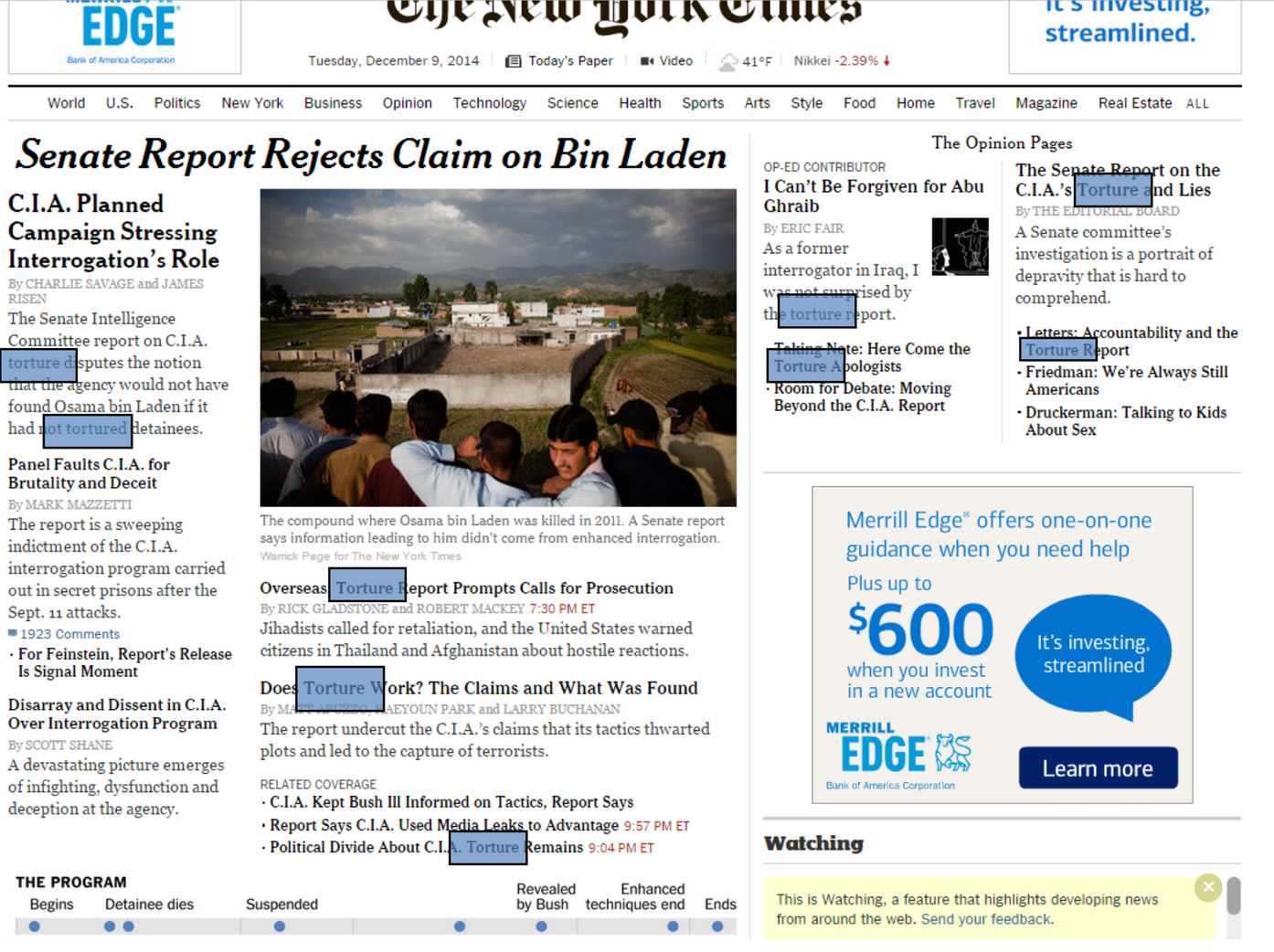
Screen Shot 2014-12-10 at 4.30.41 AM

A reader writes:

I can’t help but notice that the CIA had no problems using the word “torture” as they devised legal strategies to shield them from the consequences of using it. They knew it was “torture,” and called it such,  but how long did it take The New York Times to use the word?

Another sends the above screenshot:

What a difference a Senate report makes. While the NYT decided to start using the word “torture” again previously, I couldn’t help but be struck by how many times the word occurred on its front web page yesterday. I counted nine instances of the word “torture” on the front page (whatever counts as “above the fold” for a web page). This is a reasonably easy question for a corpus linguist with access to the NYTs archive to answer: how many times in its history has the word “torture” occurred nine times in a single edition, let alone nine times above the fold? This may be completely unique in its 153-year history.

The NYT under Bill Keller revealed itself as a mere appendage to the US government, rather than a vital check upon it. They never had a good argument. They still don’t. Every now and again, the press is presented with a real test of their integrity and independence. On this vital matter, on telling the truth, the New York Times failed.

What The Right Used To Believe

Screen Shot 2014-12-10 at 3.26.15 PM

“We admit to looking forward to a fair trial of the accused [at Abu Ghraib] followed by their harsh punishment. They have endangered any American unlucky enough to find himself at the mercy of our enemies in the war on terror. They have impeded our progress in that war. More fundamentally, they traduced their mission, betrayed their fellow soldiers, and disgraced their country. Anyone up or down the chain of command who was criminally complicit should be prosecuted, too … There’s only one way to drain this poison, and it isn’t further breast-beating, from the administration or its foes. Bring on the trials, and the punishment,” – Richard Starr, for the editors, Weekly Standard.

“What was done [at Abu Ghraib] was against 1) regulations, 2) army convention, and 3) civilized tradition. What do the reformers want? Pre-induction courses for U.S. soldiers in which they are told not to strip and torture captives and photograph them naked? Should there be, also, a course on how they should not fire guns at their own officers? Is there nothing that can be taken for granted?” – William F Buckley Jr. who at the time did not realize that these techniques had been authorized by the president himself.

“The principle is: The response by the nation’s government must express horror, shame and contrition proportional to the evil done to others, and the harm done to the nation, by agents of the government. Americans are almost certainly going to die in violence made worse in Iraq, and not only there, by the substantial aid some Americans, in their torture of Iraqi prisoners, have given to our enemies in this war. And by the appallingly dilatory response to the certain torture and probable murder committed in that prison. The nation’s response must, of course, include swift and public prosecutions. And the destruction of that prison. And punctilious conformity to legal obligations — and, now, to some optional procedures — concerning persons in American custody,” – George F Will. in a column called “No Flinching From The Facts.”

How far they have all fallen. Where is the CIA’s expression of “horror, shame and contrition” today? And what has been revealed in the Senate report is far worse than what happened at Abu Ghraib – and stems from the very same executive branch decisions.

(Illustration from Foreign Policy)

How Obama Backed Impunity For War Crimes

President Obama And Family Arrive In Berlin

Former CIA director Michael Hayden uses the DOJ not bringing charges against any interrogators as evidence of the CIA’s innocence:

John Durham, a special independent prosecutor, over a three-year period investigated every known CIA interaction with every CIA detainee. At the end of that the Obama administration declined any prosecution. [In 2012, the Justice Department announced that its investigation into two interrogation deaths that Durham concluded were suspicious out of the 101 he examined—those of Afghan detainee Gul Rahman and Iraqi detainee Manadel al-Jamadi—would be closed with no charges.] So if A is true how does B get to be true? If the CIA routinely did things they weren’t authorized to do, then why is there no follow-up? I have copies of the DOJ reports they’re using today. The question is, is the DoJ going to open any investigation and the DoJ answer is no. You can’t have it both ways. You can’t have all this supposed documentary evidence saying the agency mistreated these prisoners and then Barack Obama’s and Eric Holder’s Department of Justice saying no, you’ve got bupkis here.

This is evidence that Obama’s weakness and vacillation on the question of torture has done great damage. Hayden is using the Obama DOJ’s own white-washing report to minimize the war crimes in the Senate report. One of the ironies in this, of course, is that Hayden has been criticizing the Senate Report’s failure to interview the CIA torturers themselves, even though the Durham investigation legally precluded that for three years. But the Senate Report had an obvious alternative to such interviews: it had the CIA’s own internal documents, its very internal conversations, in which it is perfectly clear that as they were practicing torture, they knew what they were doing could not be described by anyone as “humane”.  These documents alone are more than sufficient proof of the claims made in the report. They are definitive. More to the point, no documents were included from any other source – either to buttress or to contradict the findings. But in the Durham “investigation”, the torturers were interviewed but not the victims – a clearly rigged process designed to exculpate the war criminals.

There should, in my mind, be no debate about prosecutions for war crimes. Seriously, can you imagine the US opposing such prosecutions if they were in a foreign country? Besides, the US’ clear international and domestic legal obligations admit of no exception for the prosecution of those credibly accused of torture – let alone of those, like Cheney, who have openly bragged about it. It specifically bars any exception in the case of national emergency. Not to prosecute because of such an emergency is therefore to end the Geneva Conventions  – which is what Obama has effectively done. He must not be let off the hook for that fateful step – and what it does to the core meaning of the United States.

From now on, the US is a human rights violator of the first order under international law, a rogue state that has explicitly tortured innocent people and never held anyone legally responsible. I know that sounds terribly harsh. But how is it untrue? And to refuse to prosecute war crimes is to condone war crimes. Not burglary or robbery – but the gravest crimes against humanity that we can imagine. The perpetrators walk among us, many still in the CIA, and some holding presidential Medals of Freedom. Whatever absurd self-congratulations about this report, we should be in no doubt that this makes us no better in this respect than some South American junta before the transition to democracy.

And the fact that we are the most powerful country on earth makes this about much more than just us. It casts a dark and long shadow over humanity. It makes torture everywhere more likely, and more pervasive. It legitimizes evil. It removes from us any moral standing when it comes to Americans being tortured by these very same techniques – as they already have been in Syria, and as they will be in the future. When an American prisoner is tortured by an enemy power in the future, we will have no grounds to complain. Can we just face up to that instead of engaging in so much avoidance and denial? We didn’t just break Iraq; we broke the very structure of basic human rights that this country fought two world wars to establish.

Eric Posner thinks it’s “plain that CIA agents who tortured detainees, and higher government officials who authorized torture (up to President Bush), violated the law.” But he argues that convictions would be nearly impossible:

[T]he CIA agents were told by government lawyers that the law permitted them to use waterboarding and other coercive techniques. And they were acting in the arena of national security, under conditions of great uncertainty about the extent of their powers. The Obama administration has used a legal doctrine called the state secrecy privilege to prevent victims of torture from using evidence of torture in civil actions against government officials. If secrecy concerns driven by national security justify constraints on civil actions, then they justify constraints on criminal actions as well.

David Luban agrees that the “cases would be nearly impossible to win and terrible to lose”:

The law requires proof that interrogators intended to inflict severe pain or suffering. But since the Justice Department’s discredited torture memos assured them that the suffering was not “severe,” it would be nearly impossible to prove that interrogators met the legal test of intent.

Attorney General Holder announced in 2012 that a special prosecutor who investigated 101 cases found that “the admissible evidence would not be sufficient” to convict beyond a reasonable doubt. Perhaps he felt that crucial evidence would have disclosed state secrets, or concluded that victim testimony by accused terrorists would never convince an American jury.

The greatest danger of jury trials would be a string of “patriotic acquittals” of defendants who would say they acted to save American lives, which would create terrible pro-torture precedents to haunt us for years.

That’s by far the best argument against doing so, along with much deeper partisan divisions and political polarization. I see the logic of it – but it is based on an acquiescence to and appeasement of evil.

It also means that countless torture victims – even completely innocent ones – are doubly assaulted: not only did these human beings endure unimaginable suffering, but they are now deemed beneath even a modicum of justice. This is why not prosecuting is such a grave decision. In what other context would we ever decide that an individual who tortured an innocent person to death should receive no legal consequences for it? I submit that it would be inconceivable. That such acts are protected if they are committed by those entrusted with all the might of government power and coercion makes this all the more chilling. By not prosecuting, we are creating an incentive for such awful things to be done again. We are empowering the Leviathan to torture prisoners in future knowing it can get away with anything.

Far from ensuring that these awful crimes never happen again, Obama has all but ensured that they will. That will be part of his legacy: the sounds of a torture victim crying in the dark, and knowing that America is fine with it. It is, in that sense, the end of America as much of the world has known it. As someone who has chosen this country because I revere it and love it so, it breaks my heart, and tears incessantly at my soul.