Unbelievers In The Pulpit, Ctd

A reader adds to the conversation:

There’s a book about The Clergy Project called Caught in the Pulpit: Leaving Belief Behind. One of the interesting bits about it was that the more the people in The Clergy Project studied their religion the more their doubt increased to the point of them becoming agnostic or atheist. It turns out that seminary not only produces preachers but atheists as well. Ironic.

At any rate, I have a problem with David Watkins’ characterization of clergy who stay in their positions despite their loss of faith. He leaves out an important group who stay in out of fears both financial and social. There’s the stress from living a lie, lying to your congregation, lying about what you believe and who you are. Then there’s the fact that if outed your career is ended and you may not have any recourse to alternate employment. Being outed can also end your socializing with people you have associated with for years. David Watkins seems to play down the suffering of those forced to live a lie in order keep their livelihood, family, and friends.

Another zooms out:

I’m not at all surprised that clergy have become atheists. I wonder how many unbelievers are in the pews. Because I am one of them. I’m a regular churchgoer and give substantial time and treasure to the church. Yet if someone pressed me on my beliefs, I would have to say I’m an unbeliever.

So why do I still go? Several reasons: My wife and kids are active in church groups. I enjoy attending church. I like what Christ has to say. Further, liturgy is very comforting to me and I value the weekly space that going to church provides me. It is more than belief, it is my cultural touchstone. All in all, I would miss the time I spend with my Christian community.
Poetry In Detail

Jessica Sequeira talks with Adam Feinstein, author of the biography Pablo Neruda: A Passion for Life, about the poetic disposition:

JS: Perhaps there is some relationship between poetic intelligence and attention to detail, which doesn’t always seek a grander narrative.

AF: There are poets with autism; Donna Williams is a good one. And some of them do use metaphors, which are a move from specific to abstract. People with autism aren’t supposed to be good at metaphors, but some are. But yes, you’re right that attention to detail is very common with them. They can’t see the wood for the trees, but they’re very good at seeing the trees.

I have two memories involving my son. I was doing some work on the computer and he came in and pointed at the screen. I couldn’t see what he was looking at; he was just pointing. I asked, “What’s there, Johnny? What is it?” I blew the little picture up and there was an ice cream, a tiny dot. He made out what it was, which I couldn’t until I blew it up. He loves ice cream. He hadn’t seen the overall picture, just the tiny bit. There was another example of that. The front page of the Guardian had a story about a bus bomb in Jerusalem or Tel Aviv, looking at the aftermath of the explosion. Again, he pointed. I thought, “You’ve gone all political on me or something. What’s happening here?” And there was a tiny piece of string. A tiny, tiny piece of string lying on the floor of the bus. Their minds work in different ways.

The Art Of Democracy, From Athens To America

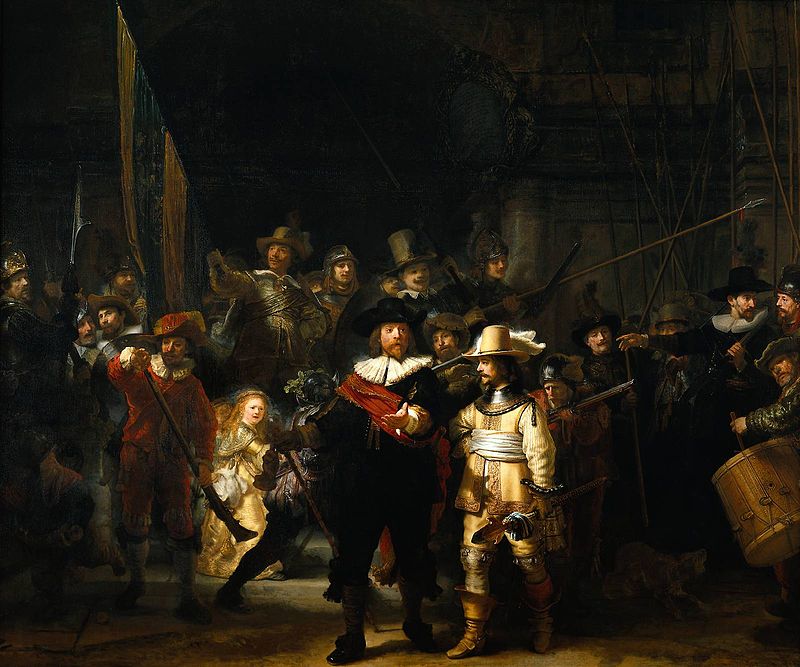
The_Nightwatch_by_Rembrandt

Victoria Coates asserts that throughout history “democracies have demonstrated a special capacity to produce extraordinary self-referential works of art.” Her examples:

The Parthenon and David are examples from a larger series of works of art and architecture inspired by democracy. There is the bronze portrait of Brutus that legendarily portrays the founding hero of the Roman Republic’s stern features. St. Mark’s Basilica in Venice is a splendid jewel adorning a city-republic that built its own solid ground and grew fabulously wealthy through maritime trade. Rembrandt’s Night Watch honors the citizen militias that proudly defended the liberty of the Dutch Republic, which, like Venice, reclaimed land from the sea and prospered far beyond its size. InThe Death of Marat, Jacques-Louis David memorialized the tragic sacrifice of the revolutionary “Friend of the People” in the turmoil surrounding the first effort to establish a French republic. By salvaging the marble sculptures from the decaying Parthenon and putting them on permanent display in London, Thomas Bruce, Seventh Earl of Elgin converted the work of Phidias into a proclamation that the British constitutional monarchy was the worthy modern heir of democratic Athens.

Albert Bierstadt’s Rocky Mountains, Lander’s Peak conveys the huge potential of a young democracy in the untamed spaces of the New World, even while a brutal civil war threw the whole American project into doubt. Claude Monet offered his Nymphéas (“Water Lilies”) to the French Third Republic to commemorate the hard-won victory of his friend, Prime Minister Georges Clemenceau, over imperial German aggression. Finally, Picasso’s harrowing Guernica is a stark reminder of the existential threats to democracy, such as Fascism, that gathered in the twentieth century.

Each object is part of its own nationalistic narrative and gives us a snapshot of a particular point in the trajectory of the state. All of them provide tangible pieces of historical evidence that are in some ways more reliable than texts (although texts abound in this line of study) and offer powerful insight into successive efforts to establish and sustain a democracy. They are not isolated aesthetic objects; part of their value as historical evidence derives from their active roles in the public life of the communities that produced them.

(Rembrandt’s The Night Watch, 1641, via Wikimedia Commons)

Different Ways Of Being Damned

In a memoir of hell’s place in her evolving Christian faith, Meghan O’Gieblyn reminds us of how the concept has changed over time:

Christian theology, as it has developed over the centuries, has functioned like a narrative gloss, smoothing the irregular collection of biblical literature into a cohesive story written by a single, 640px-Hell-fresco-from-Raduildivine author. As time went on, Satan, Lucifer and Beelzebub were consolidated into a single entity, the personification of all evil. Likewise sheol, Gehenna, hades and tartarus came to be understood as physical representations of the darkest place in the universe. By the time the King James Bible was published in the 16th century, each of these words was translated as simply “hell”.

The various depictions of hell over the centuries tend to mirror the earthly landscape of their age. Torture entered the conception of hell in the second century, when Christians were subjected to sadistic public spectacles. Roman interrogation methods included red-hot metal rods, whips and the rack. Dante’s Divine Comedy has traces of the feudal landscape of 14th-century Europe. Lower hell is depicted as a walled city with towers, ramparts, bridges and moats; fallen angels guard the citadel like knights. The Jesuits, who rose to prominence during a time of mass immigration and urban squalor, envisioned an inferno of thousands of diseased bodies “pressed together like grapes in a wine-press”. Today, biblical literalists believe hell exists outside of time and space, in some kind of spiritual fifth dimension. Contemporary evangelical churches don’t display paintings or stained glass renderings of hell. It’s no longer a popular subject of art. If hell is represented at all, it’s in pop culture, where it appears as either satirically gaudy – like animated Hieronymus Bosch – or else eerily banal. In Gary Larson’s comic The Far Side, Satan and his minions are depicted as bored corporate drones who deal with the scourge of the post-industrial Earth.

(Image: А fresco detail of hell from the medieval church St. Nicolas in Raduil village, Bulgaria, via Wikimedia Commons)

The Almighty And The Dollar

The Economist relays the research of Vincent Showers about the spending habits of the religious:

Households “with a strong commitment to faith”— demonstrated by higher spending on religious activities—are less likely to be weighed down by excessive mortgage outgoings or loan payments for cars. Compared with other households, they are more likely to be home owners but their property tax burden tends to be less—suggesting that “some moderation in [the] selection of home in terms of extravagance or location….”

Devout households seem keener on mitigating risk and therefore spend more on life insurance and health insurance; they lay out less on alcohol and tobacco and more on domestic appliances, including cooking utensils. Such homely behaviour is most heavily correlated with religious belief in the American South and Midwest, which are also the regions with “the most conservative interpretation of scripture,” Mr Showers notes, in an article in the Interdisciplinary Journal of Research on Religion. (The research more-or-less conflates the term “religious” with “Christian” or “Judeo-Christian” which in the American context is only a smallish distortion.)

But religious families do allow themselves some earthly pleasures. Indeed, they are if anything a little more likely than other households to spend spare money on clothing or jewellery, although the amount each household splurges on jewellery is a bit less. Some of that jewellery, of course, might be devotional: silver crosses or stars of David. They are as likely as anybody else to be spending money on child support or alimony—a proxy for failed marriages—and they are as inclined as other folk to incur interest payments on credit cards.

Faces Of The Day

GayCouples 045

David Rosenberg captions:

Sage Sohier’s series “At Home With Themselves: Same-Sex Couples in 1980s America,” was, in many ways, ahead of its time. Today, apart from a few dated fashion choices, the photos of gay couples in domestic settings don’t seem that shocking. But when Sohier began shooting the series in 1986, AIDS and sexual promiscuity seemed to be the only headlines about gay people.

“My ambition was to make pictures that challenged and moved people and that were interesting both visually and psychologically,” Sohier wrote via email about the project. “In the 1980s, many same-sex relationships were still discreet, or a bit hidden. It was a time when many gay men were dying of AIDS, which made a particularly poignant backdrop for the project.”

(Photo: Stephanie and Monica, Boston, Massachusetts, 1987, by Sage Sohier. Buy Sohier’s book here.)

Pope Francis, Still Complicating The Culture Wars

Last month the Vatican hosted a colloquium on “The Complementarity of Man and Woman,” during which Pope Francis asserted, to the joy of both conservative Protestants and Roman Catholics, that “Children have a right to grow up in a family with a father and a mother.” Brandon Ambrosino unpacks the nuances that make the line anything but a simplistic defense of traditional marriage:

As many theologians and commentators are pointing out, the most important part of Francis’ lecture was this:

When we speak of complementarity between man and woman in this context, let us not confuse that term with the simplistic idea that all the roles and relations of the two sexes are fixed in a single, static pattern. Complementarity will take many forms as each man and woman brings his or her distinctive contributions to their marriage and to the formation of their children — his or her personal richness, personal charisma.

According to [Fordham theologian Patrick] Hornbeck, these words signal a departure from Francis’ predecessors. For one thing, Hornbeck notes, Francis didn’t go out of his way to condemn homosexuality. Second, Francis’ comments display a certain level of openness often lacking in discussions about complementarity.

“What Francis tells us in his address is complementarity is not about a rigid demarcation of gender roles,” said Hornbeck.

In other words, Francis has displayed a more nuanced understanding of sex and gender than we’ve seen from a recent pope. He understands that human sexuality is complex and that it resists easy categorization, which is why his lecture warns against simplistic, static, reductionistic ways of looking at it.

In an interview, Hornbeck further delineated a more expansive understanding of what complimentarity can mean, especially as it connects to gay relationships:

What I like about his statement is, first of all, how he uses Scripture. He uses I Corinthians 12 to talk about spiritual gifts: “Saint Paul tells us that the Spirit has endowed each of us with different gifts so that – just as the human body’s members work together for the good of the whole — everyone’s gifts can work together for the benefit of each.” Now, there’s no gender associated with those gifts. Those are unique to each individual.

The way those gifts complement each other is the second point. Francis says, “To reflect upon ‘complementarity’ is nothing less than to ponder the dynamic harmonies at the heart of all Creation.”

When we think about the harmony of sexuality, one of the fundamental aspects that defines that harmony is sexual orientation. So heterosexual relationships are harmonious for people with a heterosexual orientation. And homosexual relationships are harmonious for people with homosexual orientations. I think it’s correct to say, as Francis does, that all complementaries were made by the Creator, and sexual orientation is part of that creation. (Even though the Church uses the language of “disordered,” I and many other theologians would challenge that language.) But I think there can be harmony for gays and lesbians in sexual relationships, just like there can be harmony for heterosexuals in sexual relationships.

A Poem For Sunday

100914strand09LS

“The Good Life” by Mark Strand:

You stand at the window.
There is a glass cloud in the shape of a heart.
There are the wind’s sighs that are like caves in your speech.
You are the ghost in the tree outside.

The street is quiet.
The weather, like tomorrow, like your life,
is partially here, partially up in the air.
There is nothing you can do.

The good life gives no warning.
It weathers the climates of despair
and appears, on foot, unrecognized, offering nothing,
and you are there.

(From Selected Poems by Mark Strand © 1979, 1980 by Mark Strand. Used by permission of Alfred A. Knopf, an imprint of the Knopf Doubleday Publishing Group, a division of Random House LLC. All rights reserved.Random House, LLC. Photo of Mark Strand with his 80th birthday cake surrounded by friends on October 9th, 2014, courtesy of Lawrence Schwartzwald.)