On the run:
Month: December 2014
A Child’s Uncertain Identity
Erin Siegal McIntyre tells the gripping story of a child caught between two sets of parents, Timothy and Jennifer Monahan of Missouri, who adopted her from Guatemala, and Loyda Rodríguez and Dayner Hernández, who say she was abducted from their home when she was a toddler. Though Guatemalan officials have ordered that the girl, known as Karen to her American parents, be returned to her Guatemalan family, she remains in the US. From McIntyre’s recounting of the legal quagmires surrounding the case:
The Monahans made it clear that they didn’t believe the results of the DNA test that showed a match between Karen and Loyda Rodríguez. They implied that the little girl in their home wasn’t the same child whose DNA had been tested in 2007. In Guatemala, Jennifer Monahan said, “DNA is sort of viewed as a title, and we strongly feel that Karen isn’t property.” … [The Monahan’s lawyer Jared] Genser … declared that the Guatemalan court ruling had no jurisdiction in the US.
Yet the original issuance of Karen’s orphan immigrant visa, necessary to enter the US, and her American citizenship both depended on the authenticity of certain identifying documents—the same documents that had been voided by the Guatemalan judge. Essentially, US citizenship had been granted to a girl whose identity was in dispute.
When asked what they would do “if it is proven that Karen is Mrs. Rodríguez’s daughter,” Timothy Monahan answered, “It’s really very difficult to say.” He added that they’d been “trying to work with authorities all through this process.” But Guatemalan authorities said they’d never been contacted by the Monahans.
The same day the Monahans made their TV appearance, thousands of miles south, two women intimately involved in Karen’s adoption were sentenced in court for human trafficking, document fraud, and criminal enterprise related to the buying and selling of the child. [Guatemalan adoption lawyer Susana] Luarca’s nursery director and the lawyer who facilitated Karen’s adoption were both found guilty of all charges, and were sentenced, respectively, to sixteen and twenty-one years in prison.
Keep reading about the case here.
The Trouble With Marrying Your Best Friend
Mark Judge ponders the state of male friendship after reading Edward Sellner’s The Double: Male Eros, Friendship, and Mentoring – from Gilgamesh to Kerouac, a book that elucidates the concept indicated by it’s title – “an idea out of Jungian psychology … a male with whom a man can share a special kind of love and intimacy”:
Saying that you love another man has become problematic today, not because of the gay rights movement, but because of our sexually infantile culture. If one man expresses love for another, there are instant jokes and comment threads on the Internet making the usually sophomoric gay jokes. But in countries outside of America, it’s not unusual at all for men to express love for each other. In The Double, Sellner quotes a researcher who traveled to India in the 1950s, where he found it was common that a man “would be married twice in his life, first to his buddy, then to his wife.” Sellner then offers this lovely observation: “the double is manifest in a variety of ways, and there is an element of eros, that spiritual power of connection, in all male relationships of intimacy – not only those which are explicitly homosexual – or there wouldn’t be the natural attraction, warmth, or sustainability that characterizes them.”
In modern Western societies, a man’s expected relationships are laid out in a specific way. He will form male friendships in school, probably even have a double in high school and college. But then he’s supposed to get married – to his “best friend” – and spend the rest of his life going to work and watching football in his suburban man cave. If he gets into trouble financially, or with drugs and alcohol, he becomes the problem of his wife, who is instantly shifted into the position of caretaker. Of course, spouses should take care of each other. But today we have spouses who are emotionally and spiritually overburdened because they become each other’s sole support system. It’s no wonder that many crack under the pressure.
The Un-tortured Artist
Harold Bloom once snarkily quipped that John Updike was “a minor novelist with a major style.” After reading Adam Begley’s biography, Updike, Daniel Ross Goodman seems to agree, noting the writer’s “lack of intense passion.” He speculates the deficit “was because Updike did not experience the deep suffering of many other literary geniuses”:
Updike was not forced to labor for a lifetime before achieving literary success, as George Eliot did. He did not face death threats (Salman Rushdie), outrage directed at him from his own ethnic group (Roth), devastating poverty (Edgar Allan Poe), crippling physical illness (Anton Chekhov), disabling mental illness (David Foster Wallace), relentless addiction (John Cheever), or a lifetime of being forced to conceal his gender (the Brontë sisters) or sexual orientation (E.M. Forster). Nor was he ever the tortured artist á la Franz Kafka, David Foster Wallace, or Virginia Woolf.
Wallace was a prodigy, but the battles he waged with his personal demons rendered his career more compelling and, on a certain level, more approachable.
While Updike was not born into literary nobility, he did not exactly grow up in a culturally impoverished family. His mother was well-read and was herself an aspiring writer who encouraged John’s artistic pursuits. Nonetheless, Begley expends copious amounts of energy recounting Updike’s alleged “challenges” and “setbacks”: he got into Harvard quite easily, but was rejected by Princeton (boo-hoo); he had to move away from his hometown (who doesn’t?); some of his stories were rejected by The New Yorker. (Whose aren’t? Well, Updike’s, that’s whose. After sending many stories to The New Yorker during college, when he graduated, not only did his stories begin to be accepted by the storied magazine, but he was given a job at the magazine. No modern writer, not even F. Scott Fitzgerald, Begley admits, landed such a plum position so early in his life.)
Updike’s setbacks were not in the league of David Foster Wallace’s clinical depression, Roth’s hellish marriage, Cheever’s alcoholism, or Shakespeare’s loss of a son. Nor did Updike ever truly grapple with the classical writerly tortures: writers’ block, tortured artistry, failed ambitions, unpopularity in his lifetime, lack of critical success, or any sort of literary demons. Updike’s literary setbacks were those of a lottery winner who stubs his toe on the way to the bank and then has to wait in line before he can cash his check.
Previous Dish coverage of the much-discussed Updike biography here.
Between Words
In a long interview about her writing, the Nobel Prize-winner Herta Müller articulates the importance of what her characters don’t say:
Silence is also a form of speaking. They’re exactly alike. It’s a basic component of language. We’re always selecting what we say and what we don’t. Why do we say one thing and not the other? And we do this instinctively, too, because no matter what we’re talking about, there’s more that doesn’t get said than does. And this isn’t always to hide things—it’s simply part of an instinctive selection in our speech. This selection varies from one person to the next, so that no matter how many people describe the same thing, the descriptions are different, the point of view is different. And even if there is a similar viewpoint, people make different choices as to what is said or not said. This was very clear to me, coming from the village, since the people there never said more than they absolutely needed to. When I was fifteen and went to the city, I was amazed at how much people talked and how much of that talk was pointless. And how much people talked about themselves—that was totally alien to me.
For me, silence had always been another form of communication. After all, you can tell so much just by looking at a person. At home we always knew about each other even if we didn’t talk about ourselves all the time. I encountered a lot of silence elsewhere as well. There was the silence that was self-imposed, because you could never say what you really thought.
The View From Your Window Contest

You have until noon on Tuesday to guess it. City and/or state first, then country. Please put the location in the subject heading, along with any description within the email. If no one guesses the exact location, proximity counts. Be sure to email entries to contest@andrewsullivan.com. Winner gets a free The View From Your Window book, a new Dish mug, or two free gift subscriptions to the Dish. Have at it.
Last week’s contest results are here. Browse a gallery of all our previous contests here.
Corporate Concubine Culture
Dan Kois praises Helen DeWitt’s 2011 novel Lightning Rods – the first selection for the Slate/Whiting Second Novel List – as “a sex comedy that pursues a single dirty joke much, much further than it ought to and, in doing so, skewers American capitalism with a purer, more invigorating hatred than any novel I can remember.” The satire figures female employees as “lightning rods” specially hired to relieve the libidos of their male coworkers:
Women were being molested in the workplace,” [character] Joe reasons, “solely because their colleagues did not have a legitimate outlet for urges they could not control.” Worse, due to expensive sexual-harassment complaints, “men who worked hard and had a valuable contribution to make were being put at risk, through no fault of their own.”
Once per day, a male employee with privileges can press a button on his computer to order a lightning rod. One of the firm’s lightning rods will then receive a discreet message on her computer; she is expected to report immediately to a stall in the ladies’ room, where she will replace whatever she’s wearing on her lower half with a short skirt and no underpants. She will then lay in a specially-designed contraption which will slide her lower half through the wall into a stall in the adjacent men’s room, where the male employee, condom on, will sate his carnal desires, the better to go back to his office refreshed and focused and ready to make money. The women, too, handsomely remunerated for their additional tasks during the workday, go back to their desks, where they can plan for the glorious futures their fat paychecks will help them enjoy. (One former lightning rod, the book tells us, is now a justice on the Supreme Court!)
In a 2012 review, William Flesch described the novel’s take on a sales-minded society:
Salesmanship is all about acknowledging, about seeing, that there are different ways to look at the world. When you tell other people how you see the world, you can hope to encourage them see it your way. Encouragement becomes the medium of social interaction. Tolerance and friendliness become synonymous, which means that not too much strain is put on tolerance. And the lightning rods — by dissipating sexual tension, turmoil, anxiety, and disgust — contribute to the sense of tolerant friendliness.
DeWitt isn’t contemptuous of that tolerance, which her novel often frames as a social achievement. We see Joe making real moral advances in the course of the narrative. There is progress to his story: “It’s important to remember that there’s more to life than being a success. Sure, if you do something it’s important to give it your best shot. But it’s also important to be a good person.” Though the lightning rods are a literalized commodification of women, these women, just as much as their uni-functional peers in the office have ways of looking at things too. Some even prove themselves to be good salesmen.
In an earlier review, Garth Risk Hallberg applauded DeWitt for “luxuriat[ing] in the eloquent dumbness of the corporate idiom.” He suggested that the novel’s satire extends far beyond corporate culture:
Lightning Rods is no more “about” sexual tension in the workplace than A Tale of a Tub is about the tub. But if Joe’s “Lightning Rods” are the vehicle, what is the tenor? What, exactly, is being skewered? By the end of the book, the answer, wonderfully, seems to be “everything”: bureaucracy, sexual politics, the objectification of the female body, the sanctification of same, political correctness, political incorrectness, etiquette, boorishness, ambition, laziness, late capitalism, and even logic itself.
DeWitt brings to satire what Roberto Bolaño’s 2666 brought to the detective story: purity of means, ineffability of ends. This is not to say that Lightning Rods shares that novel’s epic sweep. It is, by design, a minor work. (DeWitt says she began writing it, and several other books, in 1998, “to pave the way for” The Last Samurai.) But it so emphatically aces the tasks it sets for itself, and delivers such a jolt of pleasure along the way, that it reminds me of just how major a minor work can be. I wish the other leading American novelists would produce more books in this vein. Come to think of it, I wish Helen DeWitt would, too. At any rate, as one of her endearingly flummoxed characters might say, I literally cannot wait to see what she does next.
Finding Beauty In Pollution

Steven Hirsch photographed the famously fetid Gowanus Canal in Brooklyn:
Searching the surface of the water, he discovered a different kind of picture-esque canal. Wearing a mask to protect himself from the fumes, Hirsch creates a disorienting view of what is at once toxic and seductive. Hirsch’s psychedelic abstractions find beauty in an otherwise ugly environment. He compresses the depth of the canal into flat, two-dimensional palates of color. The complexity of colors, shapes, and textures on the water’s surface take on a galactic-like appearance, offering what might be a glimpse into another universe. In reality, these vivid palates are found in our own backyard.
Michael Greenberg elaborates:
A native Brooklynite in his mid-sixties, Hirsch emanates a dense, wrestler’s physical power. He would arrive at the canal early on Saturday mornings with a high-mega-pixel camera and a 200 millimeter telephoto lens, trespassing among the derelict factories, hoping not to be seen. He would plant his tripod over the water to get the steadiest, and therefore sharpest, image he could, and start shooting. “My lungs would throb,” he told me. “I’d break out in rashes.”
He printed the images on metallic paper and they are exactly the form of the organisms on the water. Each image is an interpretation of a digital negative. “This isn’t computer-generated art,” said Hirsch. “The highlighted colors are a natural enhancement of what is, the way polish might bring out the color of a scuffed shoe.”
See more of Hirsch’s work here. His solo exhibition, “Gowanus: Off the Water’s Surface,” opened on November 12, and has been extended to run through December 15, 2014 at the Lilac Gallery in New York.
A Poem For Saturday
Dish poetry editor Alice Quinn writes:
Mark Strand was (even for a poet) exceptionally captivated by a cat-and-mouse game – whimsical and profound – with the subject of death. He left this realm on Saturday, November 29th, to the great sorrow of his many, many dear friends and admirers. He was, I reckon, mostly cat in this fluidly shifting contest, empowered by the strength of his indelible and charming artistic wiles.
His poem “2002” from the collection Man and Camel, begins:
I am not thinking of Death, but Death is thinking of me.
He leans back in his chair, rubs his hands, strokes
his beard, and says, “I’m thinking of Strand, I’m thinking
that one of these days I’ll be out back, swinging my scythe
or holding my hourglass up to the moon, and Strand will appear
in a jacket and tie, and together under the boulevards’
leafless trees we’ll stroll into the city of souls. . . .”The above photograph of Mark Strand with Charles Wright, our current U.S. Poet Laureate, was taken by Lawrence Schwartzwald on Thursday, October 9th, when nineteen poets—lifelong friends like so many in the audience—joined his daughter Jessica on stage at the New School’s Auditorium at 66 West 12th Street to celebrate his 80th birthday and his new Collected Poems, just published by Alfred A. Knopf. No one present will ever forget his wit, sweetness, and radiance that night.
“My Death” by Mark Strand:
Sadness, of course, and confusion.
The relatives gathered at the graveside,
talking about the waste, and the weather mounting,
the rain moving in vague pillars offshore.This is Prince Edward Island.
I came back to my birthplace to announce my death.
I said I would ride full gallop into the sea
and not look back. People were furious.I told them about attempts I had made in the past,
how I starved in order to be the size of Lucille,
whom I loved, to inhabit the cold space
her body had taken. They were shocked.I went on about the time
I dove in a perfect arc that filled
with the sunshine of farewell and I fell
head over shoulders into the river’s thigh.And about the time
I stood naked in the snow, pointing a pistol
between my eyes, and how when I fired my head bloomed
into health. Soon I was alone.Now I lie in the box
of my making while the weather
builds and the mourners shake their heads as if
to write or to die, I did not have to do either.
(From Selected Poems by Mark Strand © 1979, 1980 by Mark Strand. Used by permission of Alfred A. Knopf, an imprint of the Knopf Doubleday Publishing Group, a division of Random House LLC. All rights reserved.Random House, LLC. Photo of Strand and Charles Wright courtesy of Lawrence Schwartzwald.)
The Numbers On Police Encounters
Steven Malanga argues that “significant crime declines have been accompanied by a leveling off and then a reduction in confrontations with the police, as reported by Americans of all races”:
In 1996, [DOJ researchers] produced a preliminary report on police/citizen interactions that broadly estimated that some 45 million Americans had some type of contact with law enforcement during the preceding year. Of those 45 million, the study found, slightly more than half a million reported that the police had used force against them. This initial study, regarded as experimental, wasn’t detailed enough to say much more and was subject to large margins of error, but it led to a series of more comprehensive and in-depth reports, produced from 1999 through 2011.
What’s striking in the progression of these later studies is a steady decrease in the number of people having interactions with the police—from about 45 million in 2002 to 40 million in 2011—or from about 21 percent of the 16-and-older population to about 17 percent.
One clear reason for the decline has been the corresponding drop in crime: the number of people reporting crimes or other problems to the police fell by about 3.6 million from a peak in 2002. More important, perhaps, was that reports of use of force by police also fell, from 664,000 in 2002 to 574,000 in a 2010 report. Those declines occurred across all races. The number of African-Americans reporting that police used force against them fell from 173,000 to 130,000. Among whites, the number has dropped from a peak of 374,000 to 347,000.
But those interactions appear to have gotten more deadly. Douthat spotlights three data points:
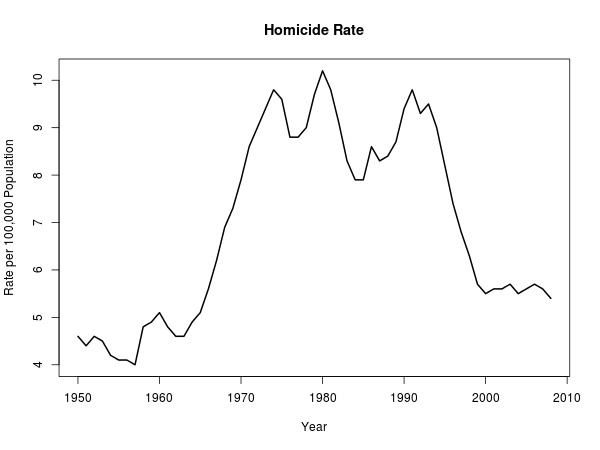
The first is the overall crime rate, which (as many, though not enough, people know) has been falling since the 1990s, with homicide rates basically back to pre-1960s crime wave levels. The second is the level of mortal danger faced by policemen in the line of duty, which has been declining steadily since its most recent, 1970s-era peak; according to one estimate, American cops are less likely to be killed in the line of duty than at any point since the 1870s. The third is the rate at which civilians are killed by police officers, which has been … well, there the data gets extremely cloudy, because we don’t have good official statistics on the subject. (Which is why “collect better statistics” reasonably topsa list of plausible reforms.) At the very least, though, we know that the overall number of homicides has dropped over the last decade, and the (again, problematic) statistics we do have show an increase in policemen killing civilians over the same period.
If you assume that a free society needs to strike a balance, needs to grant the police sufficient latitude to keep public order without granting them so much latitude that their powers are too easily abused, then these three numbers provide a decent heuristic for figuring out when the balance has tipped too far in one direction or the other.
 The Dish