A Bang-Up Jobs Report

nov_jobs.0

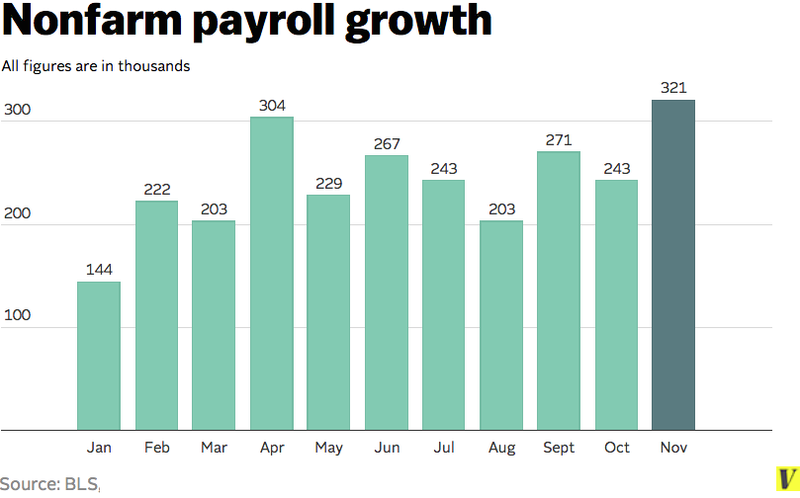
Can we get a meep-meep? The economy added 321,000 jobs in November, topping off “the best three-month period of labor market expansion since the financial crisis”:

The unemployment rate kept steady at 5.8 percent, its lowest mark since July 2008, according to the report from the U.S. Department of Labor. Some economists said that November’s data — across-the-board job creation, coupled with a slight uptick in wages — has put the American economy in its best position in years. The country has also been buoyed by plummeting global oil prices, which translate to a de facto raise for American consumers, who are now spending far less at the pump. …

So far this year, the United States has added some 2.65 million jobs — an average of about 241,000 a month. November marked the best single month for job growth since January 2012 and well exceeded the projection of economists surveyed by Bloomberg, who predicted that the economy had added about 223,000 jobs for the month. For 10 straight months now, the economy has added at least 200,000 jobs. That hasn’t happened since 1994.

September and October’s numbers were revised upward, adding another 44,000 jobs. Wages also ticked up a bit, but Ben Casselman cautions against getting too excited about that:

Average weekly earnings rose 2.4 percent from a year earlier, their fastest pace in a year. Note that’s weekly earnings. Hourly earnings are up a more modest 2.1 percent, only a bit faster than the rate of inflation. The growth in weekly earnings was driven by companies asking their employees to work more hours — a good sign for the economy but not evidence that employers are being forced to offer raises to hold on to workers. In any case, one month of solid wage growth isn’t enough to declare victory.

But let’s call a spade a spade: This month’s jobs report crushed it.

Robert Stein digs into some other encouraging details:

First, the median number of weeks of unemployment fell to 12.8, the lowest so far in the recovery. Second, the share of quitters among the unemployed increased to 9.1 percent. This indicator is important as Fed Chair Yellen has used it in the past as a sign of worker confidence. Third, and perhaps most important, was a 0.4 percent increase in average hourly wages, the largest gain in 17 months. Some analysts have been saying the Fed needs to see faster wage growth before it starts raising short-term rates. Well, there they go.

Combined with a 0.6 percent increase in total hours, total cash earnings were up 1 percent in November, the most for any month since 2006, and are up 4.8 percent versus a year ago. These gains are much faster than the roughly 1.5 percent increase in consumer prices and show growing consumer purchasing power.

But Neil Irwin curbs his enthusiasm:

The usual caveats have to come into play here. It’s one month. It will be revised multiple times. There is a wide error band around these numbers, and all this may turn out to be an aberration. Average hourly earnings are still up only 2.1 percent over a year earlier, just barely faster than inflation. And, lest we get too cheery, it’s worth at least pointing out a weaker spot in the report. The survey of households on which the unemployment rate is based painted a more stagnant picture of the economic situation, with the proportion of the population in the labor force and the proportion of the population with a job both unchanged.

And Matt O’Brien worries that numbers like these will inspire the Fed to raise interest rates, slowing down the jobs recovery:

The question now is whether this kind of job growth, if it continues, will get the Federal Reserve to start raising interest rates before they’re expected to next June. And the answer, unfortunately, is: maybe? Labor slack, after all, is declining pretty fast. Part-time workers who want full-time jobs fell by 177,000 last month. And so did long-term unemployment by another 101,000. Add in the possibility of people getting raises, which, again, is still in the nascent stage at best, and it’s clear that the economy is picking up speed.

But, as I said, it’d still be unfortunate to raise rates too soon, because there’s still a pretty deep hole to dig out of. It’s just that the hole we were in before was so cavernous that this seems normal-ish now. Remember, 2.1 percent wage inflation, which everyone is trumpeting as a sign of a real recovery, is still nothing.

(Chart via Danielle Kurtzleben)

A Witness To A Police Shooting

David Corn recounts his experience as one:

I went to the courthouse at the appointed hour and waited to be called into the grand jury room. My time in the drab conference room with the grand jury was brief. The jury was, as they say, a diverse group. But most of the jurors looked bored. A few seemed drowsy. The prosecutor asked me to identify myself and certify I had filed the statement. He asked me to describe where I had been and whether I had seen the full episode. But he never asked me to provide a complete account.

The key portion of the interview went something like this:

Prosecutor: You saw him start to run?

Me: I did.

Prosecutor: Did you see anything in his hand?

Me: No.

Prosecutor: Did you see him holding a knife?

Me: No. But I….

Prosecutor: Thank you.

I had wanted to say that I had seen him drop the heavy rock and bolt and that it was unlikely he had been able to grab and brandish a knife while sprinting. And I thought the grand jurors should know that he had not charged at any of the officers; he had been trying to dash through an opening between two of the cops in order to flee. And if they were interested in my opinion regarding the necessity of firing on him, I would have shared that, too.

But the prosecutor cut me off. He didn’t ask about about any of this. And not one of the jurors asked a question or said anything.

I left the room discouraged. This was not a search for the truth. It appeared to be a process designed to confirm an account that would protect the officer who had killed the man.

TNR RIP

Well, one thing you could always say about TNR. It has always done drama really well – and this morning’s editorial meeting could probably have been written by Aaron Sorkin. The mass resignations – nine of the twelve editors are out – are effectively the end of TNR. What will emerge in the future will be another new media start-up with close to no continuity with its recent or distant past. It’s as if the owner wanted to kill it, and the staff decided to commit pre-emptive suicide instead. Lloyd Grove provides lots of inside quotes, while portraying Chris Hughes as King Joffrey:

The New Republic was always a small political magazine that was trying to change the world,” said senior editor John Judis, who was trying to figure out late Thursday night if he could continue to work for the magazine. “My impression of what happened is Hughes and Vidra have decided to transform the magazine into a profit-making media center that is entirely different from what the magazine historically has been and what it has represented and entirely different from what The New Republic has been at its core–and this has led to this cataclysm where Frank and Leon have both left. I liked the old New Republic. I thought it had a really important role to play in America and I’m sorry if it’s no longer going to play that role.”

According to Lizza’s above tweet, Judis is among the second wave of resignations. Ezra puts TNR’s troubles in context:

Behind this fight is a deeper tension in digital journalism: the pressure for convergence is strong. We feel it at Vox, and sometimes give into it. It’s easy to see which stories are resonating with readers. It’s obvious that John Oliver videos do big numbers. And that’s fine. Right now, almost all successful digital publications are partially built on internet best practices and partially built on that publication’s particular obsessions, ideas, and attitude. Digital publications need to be smart about their mix of what everyone else does and what no one else does.

But what made the New Republic and its peer policy magazines so great was how restlessly, relentlessly idiosyncratic they were — that’s how they drove new ideologies and new ideas to the fore. They were worse at covering policy than their digital successors, but probably better at thinking. Part of this was because they simply cared less what the audience thought — they saw their role as telling their audience what to think, and they expected a readership in the low six or high five figures, not the mid-eight figures.

And isn’t there a place for just that – for a group of writers and thinkers to put out a publication that doesn’t seek to maximize pageviews or generate profits, but which dares to believe it has something to say, a point of view to fight over, and just gets on with it and hopes for the best? That was the formula we followed in the decade I worked there as editor and before. If you build it, they will come … and when I left it, we had over 100,000 subscribers. It didn’t matter that it wasn’t a million, or even 105,000. They were the right 100,000 – and built a shared community of ideas and a heritage to fight over. That’s what’s missing in this era of pageviews and clickbait and sponsored content: a self-confident team that, at some level, doesn’t give a shit what others or even readers believe, as long as the debate itself is rigorous, fair, open and reasoned. I remember Michael Lewis throwing back his head and giving that barking laugh of his as he marveled: ‘The is the first magazine I’ve ever been a part of that never asks what its readers want.” Where is that kind of publication now?

Yes, the era in which a handful of magazines were the effective gate-keepers for an entire national conversation is gone – and that is a good thing for the discourse and for the democracy. But only if what TNR did can be replicated in the new era. Josh Marshall notes that the “key is that 30 years ago, if you wanted to read meaty, smart and incisive writing about politics, policy and the political culture of the United States – written for people who were really into those things – there just were not many places to find it”:

TNR was also really good. Sometimes better than others, sometimes fantastic, other times pretty terrible. With the digital revolution, though, even if TNR were just as good as it had ever been there was just an avalanche of stuff out there that was a lot like it. And that made a huge, perhaps finally fatal, difference.

I’m not here to bewail what happened today. Maybe it’s a travesty; maybe it’s bowing to the inevitable; or maybe it’s a great thing. I’ve met Chris Hughes a couple times and enjoyed talking with him immensely. I’ve known Frank Foer quite well for at least 15 years. I may say more about these things and these guys later. But for now it’s simply worth saying that the changes Guy Vidra plans to make – with Hughes’ full backing – almost certainly mean the end of The New Republic as we’ve known it, as anything like how we’ve known it, for 100 years.

And what will replace it? Think of Vox, a young media start-up for the policy left and beyond. It has many skilled writers, has swift and shrewd pieces, and does indeed “explain” and add context to many news stories. For all those reasons, it’s a great addition to the discourse. But it is also, like most other new media outfits,  an ad agency, in which sponsored content revenues are now the alternative to a rich benefactor. Is that really much better? Does a magazine full of bloviating corporate p.r. campaigns made to look as indistinguishable from editorial as possible have a better chance at changing people’s minds and changing the broader culture than the earlier model? Do you get any sense from Vox that its editors are actually struggling to figure out the world, that there are battle-lines over policy and politics, that high culture and low culture are critical complements to a nothing-but-politics-and-policy view of the world? Say what you like about Marty Peretz – but there was more diversity of thought in one issue of TNR than there has been in one year of Vox. That’s what I’ll miss. Along with the contrarian refusal to go along with the latest left-liberal fad, or to cover for Democrats in office, for fear of giving “the other side” ammunition.

Ben Domenech sees the news as illustrating the danger “of being at a publication which is little more than a rich person’s hood ornament”:

Within the media experience, it’s always nice to have money. Being lean and frisky is all well and good, but who doesn’t want some rich backer to make everything easier, to fund the acquisition of big name talents, and eliminate the need to chase investors or respond to the whims of the marketplace? (Finally, we can get into video!) But inevitably they get the idea that they’re not a philanthropist backing an endeavor out of interest in the impact it will make on the country or the world, but that they’re someone with ideas too, good ideas, not dumb like people say. They take a few meetings and decide that they want to do something completely different with their toy, and before you know it you’re telling Leon Wieseltier that if he’s going to write about Walt Whitman again, he needs to use more cat gifs. And that’s no way to publish.

Jack Goldsmith simply sighs:

I am sad because book reviews are a dying art, Leon’s were the best, and now the back-of-the-book is certainly dead forever – probably along with the magazine as we knew it, which Hughes is moving to New York, cutting to ten issues per year, and turning in to a “vertically integrated digital media company.”

TNC tweeted his thoughts about TNR’s reputation among African Americans. Here’s a collection of his tweets strung together:

Sorry whenever [journalists] lose jobs, but some of us colored folk will always remember TNR with mixed feelings. In all seriousness, I understand people who worked at TNR feeling sad, it’s human and understandable. Some of us had a very different relationship, we also have our feelings. We will be as considerate of TNR as TNR was of us. When TNR wrote about felt like someone talking about you as though you weren’t in the room–because you literally weren’t. … When you hire fabulists to conjure stories about lazy black people who won’t work as cab drivers…it has effects. When you call tell people that the lives of their families and nation are cheap, it has effects. When you run cover stories questioning the intelligence of 40 million people, because of their skin color, some among them tend to remember.

Or misremember. That issue of the magazine had 20 separate pieces in it, and only one of them was a re-crafted excerpt from Charles Murray’s and Richard Herrnstein’s “The Bell Curve.” The rest were biting critiques. What TNR always did was debate questions others on the left would regard as taboo – because the debate was the thing, airing the questions was essential, and because a liberal sensibility is not the same as a progressive or leftist one. Noah Millman refuses to be a nostalgist:

Chris Hughes sounds like he’s trying to make TNR into something without much of a distinctive sensibility at all. I would have liked to see what TNR would have become with a fierce but critical young radical at the helm, someone who would recall the magazine’s younger years. That’s not what it has been for a very long time, and it’s not what it sounds like it’s going to be in its next incarnation.

But if it’s not going to be that, I still don’t want it to be what it was in the 1980s and 1990s. That time is gone. Chris Hughes seems determined to follow the extant media trends into the future. I’d prefer to see TNR lead than follow, but the future is where it has to go, one way or another.

And maybe that fierce but critical young radical deserves a magazine of her own to found.
Now This Will Get A Rise Out Of Seniors

Jason Millman highlights an effort in Congress to strip Medicare coverage for penis pumps:

So why did the federal government cover these devices in the first place? For one, penis pumps are a legit medical treatment for people with erectile dysfunction, especially as an alternative to taking pills.

As a result, Medicare covers the penis pumps — or vacuum erection systems (VES), if you want to be all scientific about it — under its durable medical equipment program, known as DMEPOS. The Inspector General report explains: “Because VES are used to treat impotence, and because impotence is a failure of the body part for which the diagnosis, and frequently the treatment, requires medical expertise, VES constitute a type of DMEPOS eligible for coverage under [Medicare] Part B.” …

As much as many people might not want to think about it, old people are having sex — and a lot more than you might imagine. A comprehensive 2007 New England Journal of Medicine survey on seniors’ sex lives found that more than half of people 64 to 75 reported having sex with a partner in the previous year, while it was 26 percent for people ages 75 to 85. For sexually active older men, their most commonly reported issue was erection trouble (37 percent).

We eagerly await Rush Limbaugh’s tirade against the federal government for subsidizing promiscuity among old men.

Don’t _______ While Black

In the wake of the Garner tragedy, Ijeoma Oluo tweeted out many examples of actions that prompted officers to use lethal force against African-Americans. A round-up of her tweets:

Don’t play in the park with toy guns and maybe they won’t kill you. Don’t ask for help after a car accident and maybe they won’t kill you. Don’t wear a hoodie and maybe they won’t kill you. Don’t cosplay with a toy sword and maybe they won’t kill you. Don’t shop at Walmart and maybe they won’t kill you. Don’t take the BART and maybe they won’t kill you. Don’t ride your bike and maybe they won’t kill you. Don’t reach for your cell phone and maybe they won’t kill you. Don’t go to your friend’s birthday party and maybe they won’t kill you. Don’t sit on your front stoop and maybe they won’t kill you. Don’t “startle” them and maybe they won’t kill you. Don’t “look around suspiciously”and maybe they won’t kill you. Don’t walk on a bridge with your family and maybe they won’t kill you. Don’t play “cops and robbers” with your buddies and maybe they won’t kill you. Don’t work in a warehouse repairing instruments and maybe they won’t kill you. Don’t stand in your grandma’s bathroom and maybe they won’t kill you. Don’t pray with your daughters in public and maybe they won’t kill you. Don’t go to your bachelor party and maybe they won’t kill you. Don’t have an ex boyfriend who might be a suspect and maybe they won’t kill you. Don’t call for medical help for your sister and maybe they won’t kill her. Don’t hang out in the park with your friends and maybe they won’t kill you. Don’t get a flat tire and maybe they won’t kill you. Don’t park in a fire lane and maybe they won’t kill you. Don’t reach for your wallet and maybe they won’t kill you. Don’t let your medical alert device go off and maybe they won’t kill you.

I’m done for today. My heart can’t handle any more.

Why Is Divorce In Decline?

About 70 percent of marriages that began in the 1990s reached their 15th anniversary (excluding those in which a spouse died), up from about 65 percent of those that began in the 1970s and 1980s. Those who married in the 2000s are so far divorcing at even lower rates. If current trends continue, nearly two-thirds of marriages will never involve a divorce, according to data from Justin Wolfers, a University of Michigan economist

Yet, it’s still conventional wisdom that half of marriage end in divorce. David Watkins largely blames that myth on social conservatives:

Obviously, one reason the myth persists is that is serves the purposes of social conservatives, and they promote it. First, in their search for a reason to deny marriage rights to same sex couples, they largely settled on “marriage is a fragile institution in crisis, and worked to make it immune from new evidence.

Second, though, and more importantly I suspect, it demonstrates rather clearly that to the extent that they were narrowly correct about a relationship between feminist advances and rising divorce rates, more recent trends show that those same advances are a big part of the story of the subsequent decline in divorce.

Dougherty focuses instead on how “marriage patterns are becoming more narrowly class-based than before”:

The data shows that people who already succeed in many aspects of their life are making successes of their marriages. Far from a progressive dream, we may be returning to the two worlds of aristocracy. A married upper class and an unmarried peasantry is exactly what you see when you look at the British Isles in the early 20th century. Those living in converted Abbeys could keep their marriages together, but 65 percent of Ireland’s population was unmarried at the same time, the highest portion in the Western world of that era. There’s just more incentive to hold together the “estate of marriage” when the married couple have property that might qualify as an estate.

It’s a downer, I know. But far from a trendline of unqualified marital bliss, the prospects for marriage look bleak. And the improved prospects for a certain class of married person may not be caused by liberal values at all, but may be a side effect of concentrated inequality.

Landrieu Is Toast

Molly Ball faces facts:

“She’s going to lose—it’s just a matter of how much,” Bernie Pinsonat, a pollster who works for both Republicans and Democrats, tells me. (Pinsonat began as a Democratic pollster, but that is no longer much of a viable occupation in this state.) Elliott Stonecipher, a Shreveport-based political analyst, adds: “She’ll have trouble doing better than the 42 percent she got in the primary, and it could be worse than that.” Many observers question Landrieu’s campaign strategy, from her muddled message to the way she has allocated her funds. But, says Bob Mann, a former Democratic staffer who now writes a newspaper column and teaches at Louisiana State University, “She could be the best swimmer in the world, and it wouldn’t matter. The tide is just too strong.”

Nate Cohn pens an obituary for the Southern Democrat:

In some states, the Republican advantage among white voters is nearly nine to one in presidential elections, a level of loyalty that rivals that of African-Americans for Democrats. What has changed is that Southern white voters are now nearly as hostile to born-and-bred Southern Democrats, like Ms. Landrieu, as they were to John Kerry or Barack Obama.

The Strangeness Of Our Love Of Our Pets, Ctd

Sophie Flack details Matthew Gilbert’s memoir, Off the Leash: A Year at the Dog Park:

A neurotic, death-obsessed, and socially uncomfortable television critic for the Boston Globe, Gilbert describes his evolution into a more open-hearted, playful person, thanks to his yellow photo.PNGlab, Toby, and the cast of characters who frequent the Armory Dog Park in Brookline, Massachusetts. Despite his initial efforts to distance himself, Gilbert not only becomes friends with the dog park freaks, he surrenders to becoming one himself.

While Off the Leash largely takes place in the dog park, its focus is primarily on human interactions and on Gilbert’s development as a dog owner: how his paternal instincts kick in when Toby is attacked by an aggressive dog; the awkwardness of seeing his sweet puppy being mounted by another dog for the first time; the politics of ball-sharing and picking up after your dog; coming to terms with the grim reality that he will probably outlive his beloved (canine) companion. It’s not until Gilbert embraces the playful recklessness of his dog that he’s ultimately able to open himself up to the messiness of human relationships.

Meanwhile, a reader joins the previous ones:

I’ve been contemplating this thread recently, as we recently lost our beloved, 11-year-old boxer to a brain tumor. He was such an empathic dog; he could have been a therapy dog.

He could sense our moods and would comfort us when we were down, play along with us when we were happy and was an all-around good dog. His deteriorating health and his death made me contemplate the relationship and love for our pets much more in-depth, especially as I lost my father earlier in the year. I was gauging my response to the boxer’s death versus my father. There was a similar but different intensity.

My thought is that the innocence of animals in general and our pets in particular really frames our relationships with them. Yes, children are also innocent, but not in the way animals are.  People with a love of animals will do anything to protect them because in our eyes they are innocent, perfect and it’s our responsibility to love and protect them. Similarly, I think those who wish to do animals harm or abuse them likely do so also because of their innocence. They feel threatened by the purity they see in animals and their own impurity they see in their reflection. I can’t say I’ve fully developed my theory here, but it struck a chord with me as I contemplated it.

Another reader:

I heard this poem by Garrison Keillor a while ago. It’s a keeper:

She was very old, our old dame,
Our cat, 17, Meiko was her name.
On Friday she was not herself at all.
She lay, her face turned to the wall
Silent and subdued
Saturday, she did not touch her food.
On Sunday she paced back and forth
Across the bedroom floor
And did not brush our leg or purr
Or make a sound. We petted her
And she seemed very far away.
We knelt by the bed where she lay
And felt desolate and sad
And told her, Good cat, good cat
And then this delicate creature
Of an affectionate nature
Had to be carried outside
And taken for a short melancholy ride
To the vet’s office where with gentle affection
She was given the merciful injection
As we stroked her and said,
“Good cat. Good cat.” And she lay down her head
On our lap
And took her nap.

We miss her gentleness and grace,
The little eyes, the solemn face,
The tail flicking where she lay
In a square of sun on a summer day.
It’s childish, to feel such grief
For an animal whose life is brief.

And if it is foolish, so it be.
She was good company,
And we miss that gift
Of cat affection while she lived.
Her sweet civility.
A cat has not much utility
But beauty is beauty: that’s
Why the Lord created cats.
We miss our cat of 17 years
And if you’ll sit down by my side
I’ll scratch you up behind your ears
Until you are well satisfied
And then bring you a plate of fish
And figs and dates fresh off the tree
Or any treat that you may wish,
In our old cat’s sweet memory.

Lullaby little cat, wherever you’re at
May you lie in the sun and be loved by someone
May you curl up and rest, with a quilt for a nest
May you run, may you leap, and be young in your sleep.

(Photo of Sophie Flack’s pup, Zeus)

Meme Of The Day

A reader’s take on it:

#CrimingWhileWhite is basically white people copping to crimes they committed and either weren’t arrested for or were let off with relatively minor punishment. It’s been a bit watered down considering how long it’s been trending, but my point isn’t so much the hashtag as what it means about crime statistics.

Your recent Chart of the Day was designed to demonstrate that blacks “commit” crimes at lower rates than whites perceive, though still at a disproportionately high rate for their (our) population. I think what #CrimingWhileWhite suggests is that not only do blacks commit crime at a lower rate than perceived, but that they are arrested for “criminal” behavior at a much higher rate than whites. In short, white people can engage in behavior that is technically illegal and not get ticketed or arrested and therefore their behavior is not recorded as a crime for statistical purposes. Whereas black people, especially poor black people, who engage in similar behavior are rarely extended that courtesy and as such they do become statistics.

For example, the reported rate of marijuana usage of is virtually identical across ethnic groups at around 11-13%. In fact, among young people, 18-25 years old, blacks use marijuana at a lower rate than whites. However, blacks are arrested for marijuana possession 3.5 times more often than whites. In the District, the arrest rate for blacks is a staggering 8 times as for whites! It doesn’t take long to criminalize an entire group of people when the game is rigged like that.

So when you casually stipulated that it’s natural that police officers might be wary of young black men because they do tend to engage in criminal activity at a higher rate than non-blacks, keep these statistical realities in mind. What someone living in Dupont Circle or Adams Morgan might take for granted being able to do in peace, e.g. have an ounce of weed and a pipe, would result in a felony possession charge for a poor black kid in Baltimore. I don’t need to say more about the effects of a felony charge on a person’s future employment and economic prospects.

I know you’ve been an outspoken advocate of marijuana decriminalization and I applaud your efforts on that front. But the deck is stacked against black and brown people in America and has been since its very founding.

Update from a reader:

I hate things like #CrimingWhileWhite. They are as unscientific as Hannity using a web poll of his own viewers to show that he is right about something. You don’t know if the person is lying or not, you don’t know if their friend mouthed off or not, you don’t know if their friend was carrying more or not, and you don’t know if the friend already had a rap sheet. And mostly you don’t know about the times that a black person got off with a warning because the cop was tired, it was the end of his shift and he just wanted to go home. Or the number of times the white person didn’t get off with a warning for the same action.

On the other hand, I do like the data that shows that while whites smoke pot as much as blacks they don’t get arrested as often. That’s actual data that shows the same point. #CrimingWhileWhite just make people feel good and reinforces existing perceptions but isn’t anything one can base a reasoned decision on.