Did The Nanny State Kill Eric Garner?

In Robert Tracinski’s opinion, the thing “most important about the Garner case is how stupid the reason was for arresting this guy”:

[H]e was being busted for selling single, “loose” cigarettes in order to evade heavy taxes on tobacco products. Basically, he was arrested for doing something that, in a previous era, thousands of people would have been doing in New York on any given day: selling goods on the streets of the city without any particular permission. It’s a low-grade form of entrepreneurialism.

But not in the nanny-state New York of today. In a city where everything is taxed and regulated and you can’t put trans-fats in your food or buy a soda that’s too large, it makes perfect sense that they would harass a guy for selling cigarettes on the streets without permission. After all, they’re bad for people. Somebody might die.

The meat of his argument:

We should remember that whenever the police use force, there is the danger that they will kill someone, whether through malice, poor judgment, poor training, or sheer accident. From time to time, they’re going to shoot the wrong person or wrestle a guy to the ground without knowing that he has serious health problems and can’t survive this kind of rough handling. That is one good reason (among many) to make sure that police are only authorized to interfere with someone whose actions are a threat to the lives and property of others, and not just to enforce some dumb, petty regulation.

The contradiction of the left is that they want to inject government into every little aspect of our lives and mandate that the police confront us all the time over everything—and then they scream when some of those confrontations go wrong. In this way, they are not only hoping for a new series of contentious, racially charged killings. By extending the reach of government and the omnipresence of police power in our lives, they are creating the conditions that make those cases inevitable.

A. Barton Hinkle wants to lower taxes accordingly:

Thanks to New York’s laughably high cigarette taxes ($4.35 state plus another $1.60 in the city) and higher prices generally, a pack of smokes in New York City costs $14 or more. That creates a powerful incentive to smuggle smokes in from states such as Virginia, where you can buy a pack for a third of that price. Fill a Ford Econoline van with a few hundred cartons and you can make a nice five-figure profit in a weekend. Some people do.

The robust cigarette smuggling irritates officials in New York, because they miss out on a lot of tax revenue. The trade irritates officials in Virginia for the same reason, because smugglers buy wholesale to avoid the retail sales tax. There’s an easy fix for all of this: Cut New York’s cigarette taxes.

Vinik responds to such complaints:

Are cigarette taxes smart policy? There are benefits to the lawit reduces smoking and makes Americans healthierand consequences to itthe costs of it fall disproportionately on the poor. There are also value judgments involved: libertarians will argue that the law is an undemocratic intrusion into the private lives of U.S. citizens. Liberals believe the health benefits of cigarette taxes outweigh any loss of freedom. That argument has been ongoing for years.

He finds that “Eric Garner is not dead because New York City imposes high cigarette taxes. He’s dead because a cop put him in a chokehold, in violation of NYPD rules, and held his head against ground.” But J.D. Tuccille sees the issue differently:

You want a society taxed and regulated toward your vision of perfection? It’s going to need enforcers. … Those enforcers aren’t an equal problem for everybody. They spare the people who pay them to look the other way. They give a pass to friends and relations. But they often take a dislike to individuals or whole groups that rub them the wrong way or cause them extra grief. Poor minorities, in particular, are always on the short end of the stick when it comes to dealing with cops. When they break petty laws, they don’t often turn enough profit to grease police palms enough to be left alone, they don’t have the political power to push back, and at least some of the enforcers have a hard-on for them anyway.

Government, at its core, is force. The more it does to shape the world around it, the more it needs enforcers to make sure officials’ wills are done. “The law is the law,” says New York City Mayor Bill de Blasio, but it’s creatures like him who make so much damned law.

Why Do NYC Cops Use Banned Chokeholds?

Chokeholds

Roberto A. Ferdman asks:

The answer might be because the department is not enforcing the rule stringently. A recent study (pdf) by the review board says that:

Put simply, during the last decade, the NYPD disciplinary decisions in NYPD administrative trials of chokehold allegations failed to enforce the clear mandate of the Patrol Guide chokehold rule. In response to these decisions which failed to hold offending officers accountable, the CCRB and NYPD Department Advocate’s Office [internal affairs] failed to charge officers with chokehold violations pursuant to the mandate of the Patrol Guide chokehold rule.

By failing to properly punish officers who have used a banned method of apprehension, the department effectively shapes the understanding of the rule by officers, the study says.

Josh Voorhees is unsurprised that Pantaleo wasn’t indicted:

While the officer’s use of the banned maneuver received significant scrutiny in the court of public opinion, it likely received much less in the court of law. As Eugene O’Donnell, a professor at the John Jay College of Criminal Justice, argued earlier this week, there is a difference between an act that is banned in the NYPD’s rulebook and one that is deemed criminal. “There is no explicit law that criminalizes the use of a chokehold on someone either by a police officer or someone else,” wrote O’Donnell.

Grand jury proceedings happen behind closed doors, so we may never know exactly what convinced at least 12 of the 23 jurors to vote against an indictment of any kind. But by deciding—despite the damning video—that there was not enough evidence to justify the case going to trial, the jurors are effectively declaring that Garner’s death was, at worst, a horrible mistake, one that might amount to misconduct but that falls short of murder or manslaughter.

Update from a reader:

I’m a lawyer in NYC (I hate it nearly as much as you do). You quoted Vorhees quoting a John Jay professor claiming “There is no explicit law that criminalizes the use of a chokehold on someone either by a police officer or someone else.” That’s just wrong. Section 121 of the Penal Law (pdf) provides:

§ 121.11 Criminal obstruction of breathing or blood circulation

A person is guilty of criminal obstruction of breathing or blood circulation when, with intent to impede the normal breathing or circulation of the blood of another person, he or she:

a. applies pressure on the throat or neck of such person; or
b. blocks the nose or mouth of such person.

Criminal obstruction of breathing or blood circulation is a class A misdemeanor.

The Garner grand jury certainly could have indicted for that.  Note too that it doesn’t matter whether it was a chokehold, meant to impede breathing, or a headlock, meant to impede blood flow.  Both are crimes.  I’ve seen some chatter on Fox News making a big deal out of the difference, Hannity included.

The NYT lists some “of the most notable deaths since 1990 involving New York Police Department officers.” Friedersdorf provides further context:

Even with the NYPD’s history of killing people with chokeholds that violate policy, hundreds of non-lethal violations of that policy every year, indisputable video evidence of multiple officers blithely ignoring the fact that a colleague was violating that policy, and their subsequent dishonesty about the chokehold when filing a report on the incident, Police Commissioner Bill Bratton still had the brass to say earlier this year that “he would not support a law to make chokeholds illegal, insisting that a departmental prohibition is enough.” He also said, “I think there are more than sufficient protocols in place to address a problem.”

In context, that’s sufficiently absurd to cast a shadow over the man’s honor. It’s hard to believe it won’t come up when New York City is sued for negligence. At minimum it undermines Bratton’s credibility. “Every time this happens,” Hamilton Nolan observes, “there’s a lot of talk about ‘training’ and ‘changing the culture’ of the police.” Yet chokeholds persist. “What will change this situation,” he adds, “is putting police officers in jail for killing and abusing people. And it’s abundantly clear that our current laws are too lax to accomplish that. The laws need to change.”

Historical context suggests he is absolutely right.

The Schumer Consensus, Ctd

A reader points out:

I agree with everything you said re: the myth of Obama not having “putting the economy first,” but I wanted to note that TARP was actually signed into law by Bush just before the 2008 election.

Many others look at recent history:

I think you are managing to get it exactly wrong about where and how President Obama jumped the shark with the American working class.  You cite TARP, the stimulus and auto bailout as three examples of how this is incorrect.  But consider an alternate take on these three pieces of legislation:

1) TARP: a massive giveaway to rich Wall Street Types who screwed us and the economy by being reckless, and bad at business.

2) The stimulus: a massive giveaway to unions and other Democratic constituencies that seems to have built precisely zero infrastructure or really any other lasting result.  (“Inflecting the curve” of a recession hasn’t cut it as an explanation.)

3) The auto-bailout:  a massive giveaway to failed businesses that were bad at what they were doing.  (See also, #1)

And here is the Democratic rude awakening:

if you add up the Wall Street bankers, the union members, and the employees of the Big Three auto companies … it doesn’t add up to very many voters. 

Finally, I would ask that you not indulge the liberal canard that the PR failure of these items was due to “perception,” i.e. the Americans can’t understand what is good for them.  Americans have judged that the cost-per-unit of any macro-economic benefit from 1, 2 and 3 above was simply much too high to be worth it. And they are correct about that.

But don’t forget that regarding the so-called “massive giveaway” of TARP, the big banks paid that money back. Another dissent:

I have to respectfully disagree with your narrative of the economic situation in 2009 and Obama‘s reaction to it. Let’s forget what the Republicans have to say on the issue, as they have no intellectual honesty on the matter. If we go back to the White House’s own predictions on economic growth during the 2009 debate, we see that the stimulus failed to hit its own expectations. We were told we would have GDP growth of 4% per year since, and we’ve gotten close to half. Ditto for TARP. Americans were told if not for the bailouts millions would lose their homes and jobs. But all of that happened anyway. It was only the banks themselves and their unscrupulous executives that benefited.

The common rebuke to this argument is “yeah, but without either program, things would have been worse.” Maybe, maybe not. But that’s not how these programs were sold. They were sold with specific promises by Obama and his supporters that did not materialize. And frankly, to tell someone that lost their house or their job, or the 50 million people currently on food stamps that they should be grateful because things aren’t as bad as they could be is an insult.

The same narrative problem exists with the ACA. People are upset because they were promised something that they didn’t get. I thought it rather odd that when Obama first launched that campaign in 2009 he talked about a program that would drastically increase coverage, help reduce costs, not add to the deficit and take on the insurance companies while also allowing people who were happy with whatever they had to keep it. It was an impossible goal, just as unlikely as a diet plan that says you could eat all the cheeseburgers you want and lose weight while living longer. That’s why people are upset. When they see the plan they liked get cancelled, the doctor they had get dumped or their premiums spike just as the health insurance companies report record profits thanks to the law they feel like they were sold a bag of goods. Even if that wasn’t the laws intentions, that’s what it became.

I wish you and other intelligent people would stop making the argument that this is all a communication or perception problem. It’s a cynical argument that presupposes tens of millions of people are too stupid to know what’s good for them, and the real work that lies ahead is for the smart people in charge to convince them otherwise.

Another reader broaches a new issue:

I largely agree with your analysis of Schumer‘s position and those like it, but there was one big area where Obama could have improved: housing policy. This is arguably the main reason perceptions like Schumer‘s exist in the first place. Obama’s housing policies were total failures in doing much of anything to unravel the mortgage mess left by the financial crisis. Obama could have forced a much more aggressive response from his administration towards the mortgage issues, breaking through institutional resistance to helping people refinance their homes, and begin to unwind the mortgage foreclosure process before robo-signing became a thing. Had he done a better job handling the mortgage crisis, he probably would have retained a lot more goodwill from whites than he has.

And, to be fair to Schumer, there was another way for Obama to possibly achieve more than he has, but it would have required a total surrender to Gruberism: he could have followed Chris Rock’s advice, let everything go to hell, and then used the ensuing panic with his popularity and control of Congress to pass anything he wanted. And honestly, considering the depth and breadth of the institutional rot in international finance, that might not have been such a bad thing (not that we knew about the numerous mafia-style schemes Wall St. had hatched at the time). Still, it’s impossible to picture a moral person choosing to dive into that chaos, letting everyone suffer massively for their own political gain. Can you imagine if everyone was like the House GOP?

Another also looks at housing:

It bears repeating that, despite the Tea Party’s current scattershot rhetoric, what galvanized the movement as a national force was Rick Santelli’s fierce opposition to Obama’s proposal of the Homeowners Affordability and Stability Plan in February 2009, under which the government would subsidize home mortgage refinancing.  In other words, within a little over a month of Obama taking office, it was clear that the full force of Republican opposition would be placed in front of any additional attempts to directly address the poor economy, especially demand-side solutions.

People also forget that, as recently as the fall of 2008, the entire country had broadly agreed that the U.S. healthcare system was broken and needed radical reform – Michael Moore’s Sicko had been nominated for an Oscar in 2007, and while McCain opposed mandates, he at least campaigned on the idea of universal coverage being a goal of national healthcare policy.  There was broad bipartisan consensus in late 2008 that our healthcare system was broken.

So, in mid-2009, the president shifted from the fight on the economy, which was prompting full-throated histrionics from the opposition party, to healthcare, proposing a Republican idea in a policy area in which there had weeks before been a bipartisan call for action. We all know what happened then.

A political wonk goes into great detail:

I’m broadly supportive of what you said, but let me add a few points.

1. Who is health care reform supposed to benefit if not working-class people on the way up? These are EXACTLY the people who lacked insurance, who were at risk from even small hospital bills, and so forth. To argue otherwise is just to dismiss what – and who – the facts on the ground actually are. Per Kaiser Family Foundation:

Who are the uninsured?

Most of the uninsured are in low-income working families. In 2013, nearly 8 in 10 were in a family with a worker, and nearly 6 in 10 have family income below 200% of poverty. Reflecting the more limited availability of public coverage, adults have been more likely to be uninsured than children. People of color are at higher risk of being uninsured than non-Hispanic Whites.

How does the lack of insurance affect access to health care?

People without insurance coverage have worse access to care than people who are insured. Almost a third of uninsured adults in 2013 (30%) went without needed medical care due to cost. Studies repeatedly demonstrate that the uninsured are less likely than those with insurance to receive preventive care and services for major health conditions and chronic diseases.

What are the financial implications of lack of coverage?

The uninsured often face unaffordable medical bills when they do seek care. In 2013, nearly 40% of uninsured adults said they had outstanding medical bills, and a fifth said they had medical bills that caused serious financial strain.  These bills can quickly translate into medical debt since most of the uninsured have low or moderate incomes and have little, if any, savings.

2. What were the elements of Schumer‘s extended economic package that Obama never took up? There never were any. You can demagogue on the minimum wage, but that is a political show more than an economic one, as justified as a minimum-wage hike might be. The remainder of Dem ideas on the economy in term one were mostly about community colleges and work-training subsidies – snooze. At best, they have a long-term impact. Mostly, they are just trifles – sops to public-worker unions Schumer spends too much time talking to. As for inequality, even Krugman begrudgingly and belatedly figured out that Obama raised taxes on the rich – in the fiscal cliff deal, in the ACA and elsewhere. All of that went, ultimately, to protect and expand spending on the middle and working class. Maybe this is Wall Street Chuck’s big problem. There never was a Democratic package for short-term stimulus that Obama didn’t sign on to in 2009-2010. Not one.

3. If the head of the Democratic Senate Campaign Committee wants to spread blame for this year’s election, ask him who picked Bruce Braley, the Iowa candidate who thought it would be a good idea to use “farmer” and “dumbbell” as synonyms at a fundraiser. Especially when talking about Chuck Grassley. Or ask him who told Senator Udall to never talk about the fact that Denver has the second-lowest unemployment of any US metro. Amy Klobuchar needed no prompting to say on Election Night that St. Paul-Minneapolis has the lowest. Udall also never managed to mention, in his Rachel Maddow interview or much of anywhere else, that the ACA cut the unemployed in CO by 45% AND provided a third of the profit growth at HCA, which has more CO hospitals than anyone else. He did manage to bring up at least three different kinds of gay rights and talk a lot about pot with Rachel. Was he overcompensating for who Maddow is, or does he really think gay adoption rights are a bigger deal than job growth and an historic expansion of health care that will save tens of thousands of lives a year?  Either way, Hickenlooper ran about six points ahead of this bozo, who couldn’t talk about much of anything but birth control for months, even after it was obvious that it wasn’t working.

4. When did Obama’s alleged dilution of focus due to climate change occur? He folded like a suit on the carbon tax in 2009, killing it off before it became a distraction and disappointing some liberals in his base, and cap and trade died in the Senate. He turned back to climate only in his second term. In the meantime, his stimulus and related legislation had funded a huge portfolio of programs that lay the groundwork for combating climate change, including financing Tesla’s first factory, Nissan’s Leaf factory and the lines that build Ford’s more efficient EcoBoost engines. All of these provided plenty of middle-wage jobs that are short in the economy overall (largely because construction and government employment are so weak) – but Schumer never had anyone campaign on them. All that and Obama made a very big deal with the industry on fuel-economy standards, and stayed out of the way of fracking, which proved to be enough encouragement to boost U.S. oil production by 80% (it will have doubled by next year from 2008 levels). I’d have approved Keystone XL both to get the “war on energy” talking point off the table, and because the oil is going to get used anyway.

Whatever political damage Obama took from climate issues is really about things that were happening anyway. Coal is getting killed by gas without any help from D.C – that help is just arriving now in the form of power-plant emission standards that were proposed in June and haven’t taken effect yet. Offshore drilling was barred for a few months after BP’s rig exploded off a state that has 4% unemployment today. That people campaigned against Landrieu based on that moratorium reflects something other than the idea that Louisiana job growth is slow under this administration. Look at the data. It’s really straightforward.

In Louisiana, the problem is that Obama, like oil, is black. And a Yankee, Harvard, wiseass, etc. But that’s all culture, not policy. And the culture is moving in Dems’ direction; the only real risk is that the GOP will figure out too soon for Dems’ liking that maybe they should lose the homophobia and the pretend belief in evolution and the rest. And the future certainly isn’t going to be found, economically or culturally, in West Virginia, Arkansas, or the like. There aren’t enough votes or House seats in the Dakotas to worry about much, though you should try for them and Montana. The game is the states that are now purple – North Carolina, Colorado, Virginia. And maybe some Dems  hope they  can make purple — GA, AZ and the like. If you have to pander, pander to the constituencies that are key to turning those states bluer, and then get them to vote.

One last thing: Pre-election polls showed the GOP with a large edge over Dems in trust over handling the economy, in sharp contrast to Ray Fair’s economic model, which said Dems should get 52% of the House vote. That’s absurd, a political failure the likes of which we’ve never seen. The economic policies didn’t fail. The politicians did. All Dems had to do was draw the charts: Stocks crashed under them, went up under us. Jobs crashed under them, came all the way back under us. And so forth.

In 1982, Reagan spun much worse short-term economic facts than these into his Stay the Course speech, which effectively fought that midterm to a draw. In 2014, the argument for Staying the Course was much stronger. And it’s on Chuck Schumer, as much as anyone else, that it never got made.

Did Broken Windows Theory Kill Garner?

Kai Wright marshals the evidence pointing to yes:

As WNYC’s Robert Lewis reported back in September, Pantaleo is a poster boy for broken windows policing. He’s been on the force since 2007, and in that time records show him as the arresting officer in 259 criminal court cases. They are overwhelmingly for minor crimes like pot possession; just 24 of them were for felonies. “Two-thirds of Pantaleo’s cases that made it to court ended with a dismissal or a guilty plea to a disorderly conduct violation,” Lewis reported, “which is a little more serious than a speeding ticket. He is one of the most active cops on Staten Island.”

This is what broken windows cops are supposed to do.

They beef up their ranks in priority neighborhoods and get in folks’ faces over anything and everything. I’ve lived in Bedford-Stuyvesant, Brooklyn, for about a decade. Our neighborhood has for many years been on NYPD’s list of target spots for broken windows—“impact zones,” as they’re called. It’s unexceptional here to swap stories of run-ins with bizarrely unreasonable cops—telling us stop lingering by the subway entrance, to get out of the street, to move along. Eric Garner’s frustrated response to that constant harassment will appear routine to anyone who’s lived in neighborhoods like ours. He’d just broken up a fight, and now here was NYPD in his face, again. “Every time you see me you wanna arrest me,” Garner snapped. “I’m tired of it. It stops today.”

Justin Peters is on the same page:

The cornerstone of effective policing is discretion. If the cops enforced every single law on the books in every single precinct at all hours of the day, New York City would become a police state. Is that what de Blasio and Bratton want?

For mayors and police commissioners, being “tough on crime” means actively implementing some specific policy. But given that violent crime seems to be declining on its own regardless of what they do, there’s a case to be made that de Blasio and Bratton are only making things worse. Here’s a suggestion for a new policing policy for New York City: First, do no harm.

“The Acquittals Of Their Killers Are Not Mistakes”

https://twitter.com/tanehisicoates/status/540225070090964994

Brian Beutler responds to TNC’s above tweet about the Eric Garner case:

[I]f Coates is right, then at least some of the effort expended on making police officers wear cameras has been misdirected. It should be redirected toward the source of the impunity, which isn’t the quantity or quality evidence, but the officials that so freely disregard it.

If prosecutors and police departments are too tightly linked for due process to mean anything, then puncturing the impunity requires breaking the link. One way to do this would be for citizens at the state and local level, through ballot initiatives, to take the authority for presenting evidence of police misconduct to grand juries out of the hands of local prosecutors. That authority could be handed to publicly accountable review boards staffed with civilian lawyers from within the jurisdiction, or to special prosecutors’ offices.

Along the same lines, Albert Burneko insists that it’s not our justice system that’s broken:

The murders of Michael Brown, Eric Garner, Sean Bell, Amadou Diallo, Sam Shepherd, and countless thousands of others at the hands of American law enforcement are not aberrations, or betrayals, or departures. The acquittals of their killers are not mistakes. There is no virtuous innermost America, sullied or besmirched or shaded by these murders. This is America. It is not broken. It is doing what it does.

America is a serial brutalizer of black and brown people. Brutalizing them is what it does. It does other things, too, yes, but brutalizing black and brown people is what it has done the most, and with the most zeal, and for the longest. The best argument you can make on behalf of the various systems and infrastructures the country uses against its black and brown citizens—the physical design of its cities, the methods it uses to allocate placement in elite institutions, the way it trains its police to treat citizens like enemy soldiers—might actually just be that they’re more restrained than those used against black and brown people abroad. America employs the enforcers of its power to beat, kill, and terrorize, deploys its judiciary to say that that’s OK, and has done this more times than anyone can hope to count. This is not a flaw in the design; this is the design.

How Coates thinks about the struggle to change America:

I’m the descendant of enslaved black people in this country. You could have been born in 1820, if you were black, and looked back to your ancestors and saw nothing but slaves all the way back to 1619, looked forward another 50 or 60 years and seen nothing but slaves. There was no reason to believe, at that time, that emancipation was 40 or 50 years off. And yet, folks resisted and folks fought on.

So, fatalism isn’t really an option. Even if you think you won’t necessarily win the fight today, in your lifetime, in your child’s lifetime, you still have to fight. It’s kind of selfish to say you will only fight for a victory that you will live to see. As an African-American, we stand on the shoulders of people who fought despite not seeing victories in their lifetime, or even their children’s lifetimes, or even in their grandchildren’s lifetimes. So, fatalism is not an option.

Vincent Warren believes that “affected communities – and youth of color in particular – must be at the center of the process of crafting reform solutions”:

The heart of the reform ordered after we won the stop-and-frisk case is a joint remedial process that brings community members and other stakeholders together to discuss and hammer out the actual law enforcement and accountability reforms.

A similar model was used in Cincinnati a decade ago, after the city was torn apart by scores of wrongful death lawsuits, a city-wide curfew, a boycott, a DOJ investigation and the most violent summer in the city’s recent history. Bringing those groups to the table yielded a decrease in the number of racially discriminatory stops and the number of civilian complaints, and an increase in black residents’ perception of fairness and professionalism by the Cincinnati police department.

The community-based reform processes in Cincinnati and just underway in New York are the models to follow. But we have to acknowledge that we need far more than a conversation, and right now, the protests in the street are bringing the pressure that will make real reform possible.

The protests are the road to reform.

The Right’s Response To Eric Garner

Yglesias observes that “early reactions suggest that anger over the decision not to prosecute [NYPD officer Daniel] Pantaleo spans the political spectrum.” Andy McCarthy, for one, freely admits that the Staten Island grand jury may have made a mistake:

I don’t think race had anything to do with what happened between Eric Garner and the police. I intend to keep an open mind until we learn all the evidence the grand jury relied on. And I continue to believe the NYPD is the best police force there is. But I also know, as good cops know, that there is a difference between resisting arrest by not cooperating, as Garner was doing in Staten Island, and resisting arrest by violent assaults and threats of harm, as Michael Brown did in Ferguson. Police deserve a very wide berth in responding to the latter, but less of one with the former. I thus cannot in good conscience say there was insufficient probable cause to indict Officer Pantaleo for involuntary manslaughter or criminally negligent homicide.

Many more conservatives are outraged. Sean Davis is one of them:

There’s an America where people who kill for no legitimate reason are held to account, and there’s an America where homicide isn’t really a big deal as long as you play for the right team. Unfortunately Eric Garner was a victim in the second America, where some homicides are apparently less equal than others.

Dreher echoes:

Maybe, just maybe, a trial would have found these cops not guilty of negligent homicide in Garner’s death. But based on that video, how can there not even be a trial? This is messed up.

It strikes JPod “as understandable that a grand jury would look at the events and not see something they would call a murder.” But even he sees the need for change:

The real question that is going to be asked, now, is just how aggressive law enforcement can and should be in an era of low crime, which is what we’re in now. If you defang cops, you are inviting a return to trouble. As I wrote last week, “if we send police officers the message that it is safer for their careers and reputations to stand down, stand down they will. We are the ones who will have to reckon with the results.” At the same time, no civilized society can view the tape showing Garner’s desperate pleading and not ask some very difficult questions of itself.

Jonathan Last adds, “It would be helpful if the country could let go of Ferguson and focus our attention on Garner.” And Pete Wehner has a typically humane response:

I get that when citizens don’t obey orders from a police officer, they will sometimes need to be subdued. But there’s also such things as judgment and discretion. In this case, Mr. Garner committed the lowest-level transgression imaginable, he wasn’t armed, and he wasn’t really violent. He certainly wasn’t a man who deserved to die. Most people watching this video and hearing Mr. Garner scream “I can’t breathe!” before his body goes limp will, I think, be disturbed by it. Call it basic human sympathy.

I’m not in favor of rushing to judgment, and I’ll be happy to revise my own views based on evidence, if that’s warranted. But for now, based on the evidence we do have, my reaction is that a lethal mistake, an injustice, and a genuine human tragedy happened on the streets of New York on July 17.

Shortly after he was killed, a woman at Mr. Garner’s home, who identified herself as a cousin named Stephanie, said: “The family is very, very sad. We’re in shock. Why did they have to grab him like that?”

That’s a very good, and a very haunting, question.

I know that some will cavil at my relief that conservatives and liberals can agree on something, but we have to treasure these moments while we can. The exception to all this was Fox News last night. Megyn Kelly’s coverage proved that there is almost no incident in which a black man is killed by cops that Fox cannot excuse or even defend. She bent over backwards to impugn protesters, to change the subject to Ferguson, to elide the crucial fact that the choke-hold was against police procedure, and to imply that Garner was strongly resisting arrest. Readers know I had very mixed feelings about Ferguson. I’m not usually inclined to slam something as overtly racist. But there was no way to interpret Kelly’s coverage as anything but the baldest racism I’ve seen in a while on cable news. Her idea of balance was to interview two, white, bald, bull-necked men to defend the cops, explain away any concerns about police treatment and to minimize the entire thing. Truly, deeply disgusting.

How Thrift Stores Became Cool

Until the 20th century, thrift stores were often scorned due to “a vague sense that such goods were sullied or unwholesome.” Caitlin Moniz and Zack Stanton mark the shift:

The secondhand business model was co-opted by Christian charities, which anti-Semitic Americans saw as more suitable and wholesome than Jewish secondhand shops.

In 1902, Reverend Edgar J. Helms founded what would later be known as Goodwill Industries, which employed the poor and disabled in gathering old goods for reuse. Located in New England, Helms sought to “take wasted things donated by the public and employ wasted men and women to bring both things and persons back to usefulness and well-being.” As Goodwill Industries declared with its new motto in 1922, it was “not charity, but a chance.”

“At the same time,” writes [Jennifer] Le Zotte, “as urban populations swelled, the size of residential living quarters shrank, as did the areas where unused goods might be stored.” Industrialization produced a more frequent turnover of household goods. These factors were accompanied by a boom in immigration, and an increased demand for secondhand goods by these new Americans, for whom it served as a means of assimilation.

The early 20th century was also a transition period for the ideals of giving. Philanthropists, often prominent capitalists, were interested in new theories of poverty that could reshape their approach to charity; thrift was not so much a Christian virtue as an economic one. Philanthropy, writes Le Zotte, was instrumental in “distanc[ing] secondhand exchange from its negative associations while simultaneously affiliating it with benevolence.”

Tax Overextenders

Tax extenders – those oddities of the US tax code that are technically temporary but which Congress renews year after year – are the subject of the latest drama on Capitol Hill. “No one thinks it’s a good policy,” Suzy Khimm explains, but these days, such a consensus is no obstacle to gridlock, and an effort to make the tax code a little less derpy looks like it will fall by the wayside:

Taxes ExpirationGOP Ways and Means Chair Dave Camp and Senate Majority Leader Harry Reid had been putting together a bill that would significantly expand the research and development tax break and make it permanent, along with tax breaks for commuting expenses, teacher expenses on school supplies, and a write-off for state and local taxes. The cost of the proposal, which would not be offset, topped $400 million. The emerging bipartisan proposal would have extended most of the temporary tax breaks for the next two years.

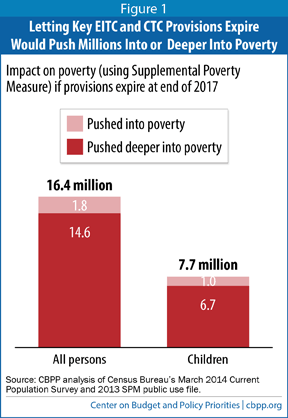
Instead, the House is now expected to vote on a bill that will simply continue most of the tax breaks for yet another year, after President Obama indicated last week that he was prepared to veto the emerging Reid-Camp deal. Along with Senate liberals, the administration objected to the plan for providing permanent tax relief to corporations while failing to provide relief to lower-income Americans as well. Expansions to both the Child Tax Credit (CTC) and Earned Income Tax Credit (EITC) are scheduled to expire in 2017, and Republicans left the provisions — which largely benefit lower-income, working Americans — out of their plan.

The reason given for this move by the GOP?  Republicans feared that the benefits of the expanded CTC and EITC would accrue to undocumented immigrants covered by Obama’s recent executive order:

For years, the GOP has railed against undocumented immigrants who claim the child tax credit, and Obama’s immigration order raised the prospect they would begin claiming the EITC, as well. If Republicans agreed to extend them now, it would look like they were voting to expand government benefits to illegal immigrants. What’s more, the EITC is notorious among Republicans for fraud. It has one of the highest rates of improper payments of any federal program. How would they sell that to rank-and-file Republicans in the House?

Chait doesn’t buy that explanation, though. The way he sees it, Republicans simply don’t want to cut taxes on the poor:

The idea that tax breaks for low-income workers amounts to a form of welfare is itself a somewhat contested premise within the Republican party. Large elements of the conservative party have spent the Obama years simmering with rage at the insufficiently high tax rates paid by low-income workers. Mitt Romney’s candid rant against the 47% percent who (allegedly) pay no taxes merely recycled a right-wing meme. Since Romney’s defeat, some Republicans have gently urged their party to ease up of their campaign to force low-income workers to pay more taxes. But adding the cultural-legal panic to the preexisting class-war panic was apparently enough to turn the GOP’s grudging acceptance of the low-income tax breaks into full-scale opposition.

So first Republicans made the tax breaks for business permanent, while allowing the tax breaks for low-income workers to expire at the end of 2017. Since they would no longer be tied to tax breaks for the more affluent constituencies that have influence with Republicans, this would mean they would almost certainly expire. Families earning $10,000 to around $25,000 a year would lose nearly $2,500 a year — a punishing blow to the working class[.]

Michael Tanner argues that Obama was right to threaten a veto of the Reid-Camp deal, most of which he calls “a grab bag of special-interest giveaways”:

Even the few provisions designed to help ordinary taxpayers are likely to have unintended consequences. For example, state income taxes have long been deductible from federal taxes, but this legislation would allow taxpayers to choose to deduct state and local sales taxes instead, meaning that people in states with no income tax would now benefit from the deduction as well.  But such tax breaks simply encourage states to raise their taxes. They are, in effect, a reward for high-tax states. Economists estimate that state taxes are 13 to 14 percent higher than they would be in the absence of federal deductibility.

Similarly, the American Opportunity Tax Credit, which allows parents or children to claim a tax credit for tuition and other education expenses during the first four years of college, is primarily passed through to higher tuitions. As a result, the credit may actually make it more difficult for non-qualifying families to afford college.

Danny Vinik urges the Dems to accept a short-term deal:

The Reid-Camp deal was flawed for a number of reasons: It was bad for the environment, bad for the deficit, bad for low-income Americans and very good for big business. But two reasons stand out above the others. First, it would have permanently lowered the long-term revenue baseline. By making certain tax breaks permanentlike the credit for R&Dwithout including a corresponding revenue offset, the deal would have lowered federal revenues in the future. Any revenue-neutral tax reform would leave less money for Democrats to spend on policies like universal pre-k. A short-term extension, on the other hand, would have little effect on future revenues, keeping the revenue baseline at its current level.

Howard Gleckman reviews why tax extenders are a bad way to make tax policy:

Real time-limited tax breaks are not necessarily bad. Congress may want to address a short-term problem, such as the recent recession, with a transitory tax cut. And, in theory, a short leash gives lawmakers an opportunity to review the subsidy each year. If it proves unnecessary or inefficient, it can be revised or dropped. In theory. But not in practice. Once one of these tax subsidies becomes law, it joins a tangled web of purportedly temporary tax cuts. They often have nothing in common besides their artificial temporariness and a tacit agreement among lobbyists and lawmakers that they will all be extended together. Thus, they become immortal.

(Chart from CBPP.)

Dudes On Diets

6102711029_0647cca974_b

Alice Robb argues that the new face of “it goes straight to my thighs” is increasingly male:

Calorie-counting has practically become shorthand for female vanity. It recalls Cher from Clueless whining about the “two bowls of Special K, 3 pieces of turkey bacon, a handful of popcorn, 5 peanut butter M&M’s and like 3 pieces of licorice,” that she’s pigged out on. Or Regina George, the villain of Mean Girls, studying nutrition labels in the school cafeteria in an effort to lose three pounds. (Down-to-earth Cady, on the other hand, nonchalantly loads her tray.) …

There is almost a cuteness element to the male diet. Perhaps it’s becauselike wearing skinny jeansit’s trendy, edgeing up to gender norms and then, ever so slightly, transgressing them. “Traditionally, men do not care about what they eat, and prefer a narrow meat-based diet,” says Brendan Gough, psychologist and co-author of Men, Masculinities and Health: Critical PerspectivesMen who do care, and who make a point of showing that they care, are advertising a sort of emotional and physical self-awareness. Weight-consciousness is also relatively new for men, and pop culture hasn’t yet given them a stock of unattractive Regina George–like figures to rebel against.

Or maybe it’s a reflection of the (stereotypically male) impulse to compete, and take things to an extreme. Some of the more all-consuming dietslike Paleo and Dukanare marketed primarily to men. (According to Grub Street, the Paleo diet is “most often associated with city-dwelling males who go around pretending they’re cavemen.) “Men aren’t just going to be healthy, they are going to be ‘super healthy,’” says Christopher Faircloth, a sociologist and author of Medicalized Masculinities. 

Update from a reader:

It is BS that men don’t diet.  My dad, a WWII vet, career naval officer, etc dieted.  I’ve known men all my life who dieted, including me from age 25 to the present (I’m 60).  My weight, when I let it, tends to go about 10% higher than is good for me or attractive to my wife.   I associate male dieting with complaints/criticisms from their wives/girlfriends.  My wife has asked me several times over the years “when are you due?”  That is a non-subtle hint that it’s time to shed some pounds and hit the gym.

I restarted my diet last Sunday.  I regained 21 of 27 pounds I’d lost two years ago (largely due to a very heavy trial docket this year and way too much hotel food while on the road).  Just finished a delicious protein shake.  Salad for lunch, lean meat and veggies for dinner after a workout.  And red wine.  For the heart.

(Photo by Nellies Beemster-Klaucke)

Will The FDA Ever Get Over Its Hemo-phobia?

The FDA is reconsidering its lifetime ban on blood donations by gay men. But, under the proposed reform, gay men would be able to donate only if they had gone one year without having any gay sex. “I hope none of us will qualify,” Tim Murphy snarks. Why he opposes the new rule:

The current test used to screen all donated blood for HIV can detect the actual virus as soon as 9 to 12 days after infection. (That’s compared to the first-generation test, which could only detect antibodies to the virus, and not until several weeks after infection.) Given that narrow window of “blind spot” risk on the newest test, the question all donors should be asked on the form they fill out should be something like: “In the past” — let’s make it six weeks — “have you engaged in HIV risk behaviors — including condomless anal or vaginal sex, or shared drug-injecting paraphernalia — with an HIV-positive person or someone whose HIV status you did not know?” (The same question should be asked about hepatitis B or C, which donated blood is also screened for, as well as all other known blood-borne pathogens.)

Jason Millman reviews the extensive evidence against the current policy, noting that other countries have found ways to screen out HIV-positive donors without excluding an entire segment of the population:

The scientific and medical communities have increasingly rejected the ban currently in place in the United States. The American Medical Association, the nation’s largest physician organization, voted last year to oppose the ban, calling it discriminatory and not based on sound science. Instead, the AMA urged federal policymakers to take a more personal approach assessing each individual’s level of risk. The approach recommended by an HHS advisory committee last month falls short of that standard. And it still falls short of what a number of other countries have done to allow blood donations from gay and bisexual men.

Countries, such as Italy and Spain, use an individual risk assessment for all would-be donors, regardless of sexual orientation. Italy’s blood donation policy, which has been in place since 2001, screens everyone for risk factors, like whether they’ve participated in prostitution, injected drugs or had multiple sex partners with unknown sexual behavior. The policy hasn’t resulted in a significant increase in HIV-positive gay and bisexual male blood donors, according to a study released last year.

And Mona Chalabi estimates how many more eligible blood donors we’d have if the ban were dropped entirely:

[B]ased on the CDC’s numbers on sexual orientation (and setting aside any other possible restrictions on those individuals giving blood), one could estimate that about 2.6 million U.S. men are currently prohibited from giving blood. But that’s a misleading calculation. The sexual orientation that a person states in a survey is not a perfect indicator of his sexual behavior. … Although less than 3 percent of U.S. men say they are gay or bisexual, in a separate survey almost 9 percent said they have had a male sexual partner. Researchers at the Williams Institute, a think tank on sexual orientation and gender identity, used data from the 2008, 2010 and 2012 General Social Survey (GSS) to estimate that 8.5 percent of men say they have had at least one male sexual partner since age 18.

Based on that figure, there would be about 4.2 million more eligible blood donors in the U.S if the FDA were to lift the ban entirely.

Previous Dish on the gay blood ban here and here.