When The Self Settles Down

Melissa Dahl observes that William James’ 1890 text The Principles of Psychology “is thought to be the first time modern psychology observed the idea that personality settles down, or stabilizes, in adulthood.” She points to the work of Paul T. Costa Jr. and Robert McCrae that seems to support that insight:

Costa and McCrae’s work has found that from about age 18 to 30, people tend to become more neurotic, more introverted, and less open to new experiences; they also tend to become more agreeable and more conscientious. After age 30, these same trends are seen, but the rate of change dips. “It’s not that personality is fixed and can’t change,” Costa said. “But it’s relatively stable and consistent. What you see at 35, 40 is what you’re going to see at 85, 90.”

This makes intuitive sense: It’s maturity he’s speaking of, really. In the body, physical maturity happens rapidly throughout childhood and adolescence, and then stabilizes once you’ve reached your adult height, for example. If at least half of personality has a biological basis, it makes sense that it would follow that developmental arc, too. And if many of our character traits are also influenced by our environment, well, think of all the changes that occur in adolescence and early adulthood: college, first jobs, first loves, frequent moves. Speaking (very) broadly, life tends to settle down in the 30s, so it makes sense that our personalities do, too.

“There’s nothing magical about age 30,” Costa said. “But if you look at it from a developmental view, you can see the wisdom of [William James’s provocative statement].” In adulthood, as our lives become more constant, “it’ll take some relatively powerful change in the environment” to change our behavior.

Recent Dish on life at mid-life here. Update from a reader:

I happened to read (again!) Patrick O’Brian’s Master and Commander last week. The passage below struck home, and now I see that it turns James’s science into poetry. It’s Dr. Maturin reflecting on a friend and former Free Irish co-revolutionary, James Dillon, whose personality has darkened with age, a life of secrecy, and increased responsibility as a naval officer:

What is more, it appears to me that this is a critical time for him, a lesser climacteric – a time that will settle him in that particular course he will never leave again, but will persevere in for the rest of his life. It has often seemed to me that towards this period (in which we all three lie, more or less) men strike out their permanent characters; or have those characters struck into them. Merriment, roaring high spirits before this: then some chance concatenation, or some hidden predilection (or rather inherent bias) working through, and the man is in the road he cannot leave but must go on, making it deeper and deeper (a groove, or channel), until he is lost in his mere character – persona – no longer human, but an accretion of qualities belonging to this character. James Dillon was a delightful being. Now he is closing in. It is odd – will I say heart-breaking? – how cheerfulness goes: gaiety of mind, natural free-springing joy. Authority is its great enemy – the assumption of authority. I know few men over fifty that seem to me entirely human: virtually none who has long exercised authority.
Why Doesn’t Ferguson Happen Abroad?

Lethal Shootings

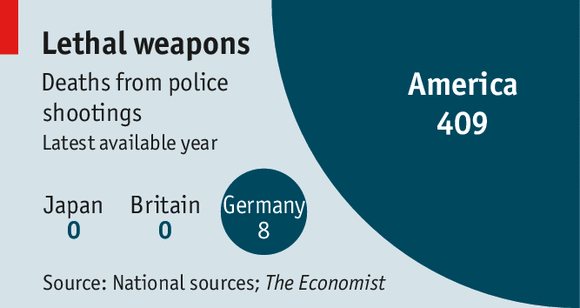
Yglesias connects police shootings to gun prevalence:

Ferguson is in many ways all about race and racism. But this chart reveals an important sense in which it’s not about that at all. If you know anything about the UK or Germany, you’ll know that these are not even remotely societies who’ve eliminated the problem of racism. If anything, having struggled with it for less time than the United States, they’re even worse than we are. Where they outperform us is in drastically reducing the civilian death toll without ending racism or entrenched poverty or any of the St. Louis area’s other problems.

A well-armed population leads to police shootings of the unarmed in two ways. One is that police officers have to be constantly vigilant about the possibility that they are facing a gun-wielding suspect. Cleveland police officers shot and killed a 12 year-old boy recently, because they not-entirely-unreasonably thought his toy gun was a real gun.

The other, more relevant to the Michael Brown case, is that when civilians are well-armed, police have to be as well. That turns every encounter into a potentially lethal situation.

Ed Krayewski thinks this theory too simplistic:

Matt Yglesias says the cops’ assumption Rice’s toy gun was real “wasn’t unreasonable.” For someone that spends a lot of time arguing from authority, he doesn’t hold the “experts” to a high standard. You can’t be deferential to cops’ judgment AND not expect them to make better judgments and then blame anything other than your attitude on the police violence that predictably follows. Boys, and girls, have been playing with toy guns for decades and somehow cops used to be able to handle it without arresting or shooting children.

Waldman joins the conversation:

The most common explanation is that since we have so many guns in America, police are under greater threat than other police. Which is true, but American police also kill unarmed people all the time — people who have a knife or a stick, or who are just acting erratically. There are mentally disturbed people in other countries, too, so why is it that police in Germany or France or Britain or Japan manage to deal with these threats without killing the suspect?

This is where we get to the particular American police ideology, which says that any threat to an officer’s safety, even an unlikely one, can and often should be met with deadly force.

Adam Ozimek suggests some reforms:

First, remove collective bargaining for police officers entirely. They should be employed at will, and should be able to be fired without any arbitration whatsoever. Workplace protections can be good for workers, but retaining the public’s trust in the police is far more important than making police officer be a nice job for someone.

Second, if a police officer shoots someone who is unarmed they should be fired even if they can prove they reasonably felt threatened. Self-defense can be a good reason to not bring criminal charges against a police officer for shooting someone, but it’s not necessarily a good reason to let them keep their jobs. The near constant stream of cases of police being too quick to shoot suggest their incentives right now lean too strongly towards shooting first and thinking later.

Update from a reader:

The graphic you posted puts US police killings at 409. It turns out no one knows what the number is for sure, but it is likely much higher, at least 1000 per year.

Giving Your All

Julian Savulescu argues that “few people if any have ever been anything like a perfect utilitarian”:

It would require donating one of your kidneys to a perfect stranger. It would require sacrificing your life, family and sleep to the level that enabled you to maximize the well-being of others. Because you could improve the lives of so many, so much, utilitarianism requires enormous sacrifices. People have donated large parts of their wealth and even a kidney, but this still does not approach the sacrifice required by utilitarianism. …

People think I am a utilitarian, but I am not. I, like nearly everyone else, find Utilitarianism to be too demanding. I try to live my life according to “easy rescue consequentialism” – you should perform those acts which are at small cost to you and which benefit others greatly. Peter Singer, the greatest modern utilitarian, in fact appeals to this principle to capture people’s emotions – his most famous example is that of a small child drowning in a pond. You could save the child’s life by just getting your shoes wet. He argues morality requires that you rescue the child. But this is merely an easy rescue. Utilitarianism requires that you sacrifice your life to provide organs to save seven or eight lives. Easy rescue consequentialism is, by contrast, a relaxed but useful moral doctrine.

“You Can’t Just Move Napa Or Bordeaux A Few Hundred Miles North”

anigif_mobile_15f184b445b9e9803e853ce865f5bd04-5

Sandra Allen examines how winemakers are adapting to climate change:

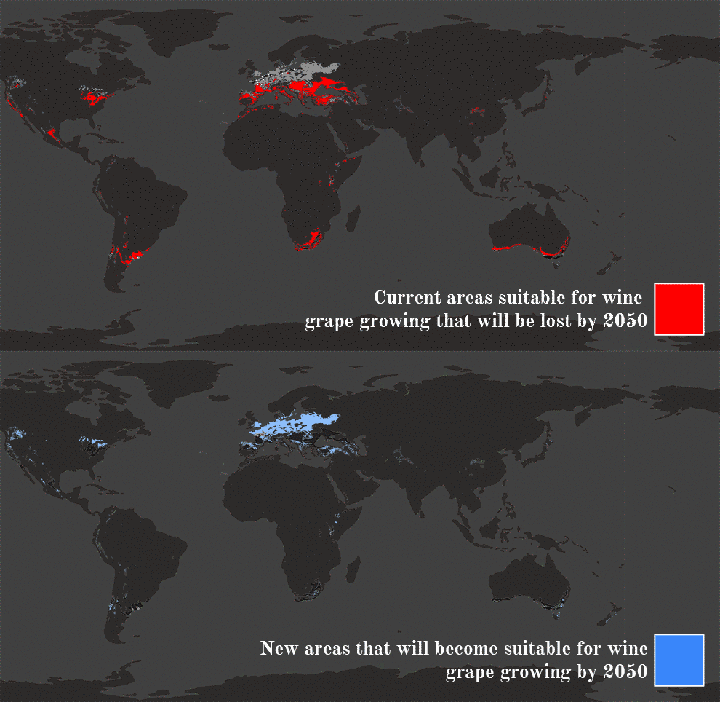
A splashy, controversial study published last year by the Proceedings of the National Academy of Sciences found that in major wine-producing regions, the area suitable for viticulture — wine-grape growing – is threatened. By 2050, such terrain will decrease by between 19 percent and 62 percent, under a business-as-usual carbon emissions scenario, and between 25% and 73% if carbon emissions increase, which some argue is more likely. The U.S. government’s 2014 National Climate Assessment, which lays out in spectacular detail and no uncertain terms what our country should anticipate in terms of climate change, summarizes American wine’s situation thusly: “The area capable of consistently producing grapes required for the highest quality wines is projected to decline by more than 50% by late this century.” …

Even a small change in overall temperature, or increased instances of extreme weather, will throw wrenches into the hard-won understanding producers have of their grapes, land, and climate – and of how to coax from that combination the best possible beverage.

A Massacre Of Jews At Prayer, Ctd

A reader rounds out our coverage:

In your most recent post, you cite Freddie deBoer in noting a double standard in the American media, wherein Palestinians are blamed collectively for such acts of violence while Israelis face no such censure for atrocities carried out by their government.  You cited Jonathan Tobin’s pushback, who cited Palestinian “political culture in which religious symbols such as the imagined peril to the mosques on the Mount have been employed by generations of Palestinian leaders to whip up hatred for Jews.”

I think a comparison to the religious reactions to mutual atrocities is very instructive.  Calls for revenge, vicious anti-Semitic and/or anti-Israel political cartoons are all part and parcel of the Palestinian reaction.  But the purpose of the email is that I dearly want to point out to you the Jewish Orthodox reaction to the four murders. You won’t see calls for revenge.

(Yes, you might see it in right-wing politicians, but not among the Jewish Orthodox whom you routinely label as fundamentalist).  The bottom line of these reactions are the same: we have our own choices on how to act, and that the best way to fight against darkness is to increase the light; the best way to fight against hate is to increase love.  The Jewish “fundamentalist” response to tragedy, throughout history, codified almost 900 years ago by Maimonides, is always the same: start with introspection.

You can start with a letter written by Rebbetzin Tzippora Heller, who’s 12-year-old grandson fled for his life from the massacre, but whose son-in-law was seriously injured and needs multiple surgeries.  In her first letter (published here), the harshest thing she can say about the attackers is:

Please continue praying for my son-in-law … and the other victims. Pray that God gives strength to the five new widows and 24 new orphans. Thank God that we are not like our enemies.

In her second letter, she reminded all that our reaction to the events are our choice.  She closed with:

You can choose light. You can choose learning. You can choose acts of kindness. You can choose closeness to the wounded by continuing to pray …. You can transcend your limitations and your attachment to materialism by giving charity.

Even more impressive was the reaction of the four new widows.  They released a letter just two days after burying their husbands.  In it, the grieving widows urged: “accept upon ourselves to increase the love and affection for each other, whether between a person and his fellow, whether between distinct communities within the Jewish people.”

In the article, “In Har Nof, introspection, but no religious war“, the writer summarized her findings: “In shadow of Tuesday’s terrorist attack, congregants dismiss the notion that Temple Mount tensions drove rampage, say they need to ‘be stronger, pray harder’”  She noted: A poster with a photo of a bloodied prayer shawl screams out “End the hatred!”

At site of Jerusalem terror attack, no calls for revenge, just grief, the Ha’aretz writer quoted an 18-year-old girl at the funeral:

We live our lives according to God’s commandments.  That is why most of us have returned to our regular duties – because our regular day is a way of praising God. In other places when this happens, there are calls for revenge, but not here, not in our neighborhood.

Quite the fundamenalists, eh?  The differences are stark and obvious.

Another adds regarding the first post in the thread:

Israel should never have released those types of photographs for publication.  I do not have a problem whatsoever with you publishing them, as they were provided by the government of Israel, but Israel can more than make its case without distributing those types of photographs.  Let Hamas engage in that type of gamesmanship.  The rabbis should be remembered for their scholarship and how they lived, not by how they died.  Those photographs rob the rabbis of their dignity.