As The World Warms

In a bizarre bit of political theater yesterday, Senate Democrats tried to force their GOP counterparts to go on the record about whether or not climate change is a hoax:

The Senate overwhelmingly voted, 98-1, in favor of an amendment stating that “climate change is real and not a hoax.” In an amusing twist, the chamber’s most notorious climate denier, Senator Jim Inhofe of Oklahoma, signed on to the amendment at the last minute, mostly because it didn’t attribute a cause to global warming. “The climate is changing. The climate has always changed,” Inhofe said. He then criticized supporters of man-caused climate change by saying that the real “hoax” was “that there are some people that are so arrogant to think” that they can change the climate. (The only senator to oppose that statement was Roger Wicker, a conservative from Mississippi.)

Phillip Bump sighs:

It was a nifty, if insincere, bit of politics. There’s no question that a vote against a flat statement that climate change is real could have been problematic for candidates down the road – especially for those various Republican senators quietly preparing for the big election in 2016. With Inhofe’s re-framing the question, the Democrats, trying to engineer a gotcha moment, ended up empty-handed on the vote, with neither the satisfaction of nailing down opposition to scientific consensus and without a point of leverage for future discussions of addressing the warming planet.

Nonetheless, Rebecca Leber applauds the Dems’ strategic trolling:

The Washington Examiner’Zack Colman reported Monday that Republicans are regrouping to consider a new strategy on climate. “They’re going to try to drag their feet as long as possible, but there are certain things out there that could bring the predominant GOP position to light,” Ford O’Connell, a GOP strategist and former adviser to John McCain, told Colman. “They want to at least have a unified position and they want to be able to have their ducks in a row. And if they have a solution, they want to have one that has the least impact on the economy.”

That the GOP is strategizing about climate change is itself an admission that they don’t have a climate plan. And until they actually come up with one, they’ll be easy marks for the environmentally minded Democrats who are laughing at their expense.

Can Congress Strike A Deal On Trade?

Obama hasn’t met his goal of doubling exports:

Trade

But this Congress could make progress:

There wasn’t a lot of overlap between the proposals in President Obama’s State of the Union address and those in Iowa Senator Joni Ernst’s Republican response. But here’s one thing they both advocated: trade deals. The Trans-Pacific Partnership, one of the big deals the administration is negotiating, has suddenly become one of the hottest topics in Washington, as it appears to be one of the few topics on which President Barack Obama and Republicans might be able to reach any sort of agreement in this session of Congress.

Edward Alden considers the benefits and drawbacks of more trade:

Trade does have a chance of passing, and should. The stakes are high. The United States needs to be deeply engaged in Asia in particular to help build an economic future for the region that is not dominated solely by China, and to make sure the United States has the most open access possible to the fastest-growing consumer markets in the world. President Obama, after many years of hedging on trade, has now clearly made that commitment. The White House has set up a whip operation to build support on the Hill, and the president has signaled that he is willing to work closely with Republicans to muster the votes he needs.

But there will be minimal support from Democrats. Most of the Democratic opponents are not protectionists wanting to run way from competition. Instead, they see a game being played in which too many Americans have little chance of winning. While highly educated Americans have been enormously successful in the more open global economy, building some of the world’s most innovative and dynamic companies, far too many are simply unprepared for that competition.

He argues that, if “even some of the proposals that President Obama urged last night were enacted by Congress, it would be far easier to expand support for trade liberalization”:

An American workforce that was better prepared for the rigors of competition would be far more enthusiastic about taking on new competitors. But until the United States addresses more of its competitive challenges head on – and that means in part new initiatives from the government in Washington — support for trade will continue to be far weaker than it should be.

Mr. Netanyahu Goes To Washington, Again

Kilgore isn’t impressed with the upcoming Bibi-Congress love-fest:

To be clear, the Speaker of the House can invite anybody he wants to address Congress, and the president cannot do much about it. So while the invitation is not a breach of protocol for Boehner, it’s a really bad idea for Bibi. Not only will it further alienate the people who actually conduct America’s foreign policies; it will also expose Netanyahu’s habit of indiscretion in seeking to manipulate partisan divisions in this country in pursuit of his own interests. I’m sure his defenders will make the plea that Iran’s nuclear program represents an “existential threat” to Israel, making all normal diplomatic rules disposable. But since everybody agrees that Iran’s a major global problem and disagree on how to deal with it, Netanyahu would be better advised to make his case in private. But bullying and excessively Machiavellian maneuvering do seem to be a basic part of his personality, I’m afraid.

Aaron David Miller thinks Bibi is mostly just focused on keeping his job:

Any time an incumbent has an opportunity to use the powers and prestige of office to burnish his prime ministerial image, particularly that close to an election, so much the better. It won’t be determinative. Israelis didn’t ride in on a bale of hay yesterday; they’re all too familiar with their politicians’ politicking.  But in a close election, being feted and supported by your country’s key ally with a focus on critical security issues in an age of jihadi terror, well…..that’s not a  bad photo op. And if Bibi wins? We probably can expect to see more of him as both Democratic and Republican candidates for president of the United States fight for the title of Israel’s best friend.

Along those lines, Larison grimaces:

The frequency with which Israeli leaders have been addressing Congress in the last decade is remarkable in itself. This will also be the third time overall that Netanyahu has addressed Congress as Israeli prime minister, and the second time in four years that he will have done so. It will be the third address to Congress by an Israeli prime minister within a decade, and fifth since 1995. No other country’s head of government has spoken so often to our Congress in the last twenty years. (It is not an accident that the last five appearances have taken place while the GOP controlled the House.) That might make sense if Israel were actually a treaty ally of the United States, but it isn’t. It also might make sense if the relationship with Israel were extraordinarily valuable to the U.S., but the U.S. gets almost nothing from this relationship except political and diplomatic headaches. It is one more example of how one-sided and strange the U.S.-Israel relationship has become.

Meanwhile, Juan Cole fumes over Bibi and the hawks’ ongoing and blatant attempts to block the Iran deal:

The US Joint Chiefs of Staff looked at this issue and have decided that only an Iraq-style invasion, occupation and regime change could hope to abolish the nuclear enrichment program. If that is what it takes, the US and Israeli hawks are perfectly all right with it. It would be good times for the military-industrial complex, and Israel’s last major conventional enemy (though a toothless one) would be destroyed. An irritant to US policy and a threat to Wahhabi Saudi Arabia, our big volatile Gasoline Station in the Sky, would also be removed.

Iran is three times as populous and three times as large as Iraq. So I figure this [war] enterprise would cost at least 15,000 troops dead, 90,000 seriously wounded, and altogether $15- 24 trillion dollars over time (including health care for the 90,000 wounded vets). Given the size of the country and the nationalism of the population, it could be much more like the US war in Vietnam than Iraq was, i.e. it could end in absolute defeat.

And again, Mossad isn’t game either.

The Transformation Of Judges Into Politicans

There is a case before SCOTUS on whether judges should be able to solicit campaign donations:

Mark Joseph Stern provides background on the case:

The dubious ethics of judicial elections hasn’t stopped 39 states from holding judicial races, but 30 of those states have at least tried to keep them as clean as possible by forbidding judges from personally soliciting contributions for their election campaigns. This seems like common sense: Judges aren’t politicians, and they shouldn’t be forced to act like them—especially when their donors could one day appear in their courtrooms.

But the court that brought you Citizens United v. Federal Election Commission is in short supply of common sense when it comes to campaign finance regulations. On Tuesday, the justices heard the case of Williams-Yulee v. the Florida Bar, a challenge to a Florida rule barring judicial candidates from personally requesting campaign contributions.

Lanell Williams-Yulee, a former candidate for county court judge in Hillsborough County, launched her campaign with a personalized mass-mail fundraising letter that asked for “an early contribution” to help her “raise the initial funds.” She promptly got charged with professional misconduct by the Florida Bar. The Florida Supreme Court upheld Williams-Yulee’s sanction. Now she’s appealing it to the Supreme Court, under the theory that the First Amendment protects her right to ask voters for campaign cash.

He expects that “Williams-Yulee will probably win this case.” AJ Vicens points out that judicial elections “are becoming increasingly more expensive”:

During just those two years, state high court, appellate and lower court judicial candidates raised more than $110 million, according to the National Institute On Money In State Politics (state judicial candidates raised just $83 million total in the 1990s). Justice At Stake, a nonpartisan judicial election watchdog group, points out that 20 states have surpassed records for judicial election spending since 2000. Independent spending on judicial elections is also booming, with more than $24 million being spent in the 2011-12 cycle compared to just $2.7 million a decade earlier.

Jeff Shesol looks at recent SCOTUS rulings on related issues:

It’s true that in 2009, in Caperton v. A.T. Massey Coal Co., Justice Anthony Kennedy joined the Supreme Court’s liberals in requiring a West Virginia Supreme Court justice to recuse himself from a case in which the defendant’s C.E.O. had spent three million dollars to get the judge elected. The decision showed at least some solicitude for judicial independence in the face of all that campaign money. Yet Kennedy, in the majority opinion, took pains to stress that the facts in this case were “extreme,” and less than a year later, in Citizens United, he made the blithe assertion that “independent expenditures, including those made by corporations, do not give rise to corruption or the appearance of corruption.” Indeed, he took it even further: “The appearance of influence or access,” he added, “will not cause the electorate to lose faith in this democracy.” This, as any legal scholar will recognize, is the doctrine of willful naïveté, a central element in all of the Roberts Court’s campaign-finance rulings.

Garrett Epps is disturbed by judges openly soliciting political donations:

I yield to no one in my appreciation for free expression, political or otherwise. But in the years since Citizens United, First Amendment dialogue has increasingly divorced itself from any practical considerations. When did preserving public confidence in the courts cease to be “compelling”? When did the appearance of unfairness become “mere”? Opponents of the rule argue that since states allow judicial campaign committees to raise funds, they have to allow judges to do the same. The logic of this argument is elusive; there is a difference between being asked by an employee to give money, and being asked by the judge himself. In addition, they argue, states that object to the influence of money can simply stop electing judges. They could, but in practical terms, judicial election is going to be with us for a long time. The question should be how states can retain their inherited systems and preserve some of the independence the federal judiciary guards for itself.

Noah Feldman wants to end judicial elections entirely:

In a perfect world, I think the justices would strike down judicial elections as inherently unconstitutional. Then they could make the whole problem go away. But the states are laboratories of democracy, as Justice Louis Brandeis once said. Within those laboratories, the experiment is allowed to go terribly wrong. Judicial elections have been with us for almost 200 years, and despite the efforts of retired Justice Sandra Day O’Connor, they aren’t going to disappear anytime soon. Until then, judicial elections are a classic example of a hard case. And you know what they say about hard cases: They make bad law.

Reity O’Brien hears that a narrow ruling is possible:

Ed Whelan, a former clerk to Justice Scalia and director of the conservative Ethics & Public Policy Center, said it’s possible that the court could leave the First Amendment question unresolved yet decide that Williams-Yulee did not actually violate Florida’s ban. The mass mailing was a decidedly impersonal solicitation and did not yield contributions, let alone the quid pro quo exchanges that judicial campaign donations may invite. It’s also possible the court could dismiss the case entirely, Whelan said. However, he noted, the court takes on cases “to resolve these grander issues, not to engage in error correction.”

Bloomberg View’s editors think there must be a better way:

As long as states elect rather than appoint judges, campaign contributions — no matter who does the asking — will allow interested parties to curry influence. Of course, moving to an appointed system of judges does not eliminate the potential for corruption. Governors can pick judges the same way that presidents pick ambassadors, with friends and fundraisers jumping ahead of more qualified candidates. But legislators can mitigate that threat by subjecting a governor’s appointments to their approval.

Legislators can also set judicial terms that are fixed and staggered, limiting any particular governor’s ability to stack the court. And they can impose mandatory retirement ages, which increases turnover. Mandatory retirement ages and fixed terms would give the public’s elected representatives more opportunities to influence the bench.

Quote For The Day

Even a Pope occasionally needs to clarify an off-the-cuff remark:

In theory we can say that a violent reaction in the face of an offense or a provocation, in theory yes, it is not a good thing, one shouldn’t do it. In theory we can say what the Gospel says, that we should turn the other cheek. In theory we can say that we have freedom of expression, and that’s important. But in theory we all agree.

But we are human and there’s prudence, which is a virtue of human coexistence. I cannot constantly insult, provoke a person continuously, because I risk making him angry, and I risk receiving an unjust reaction, one that is not just. But that’s human. For this reason I say that freedom of expression must take into account the human reality and for this reason it must be prudent.

It’s a way of saying that one must be educated, prudent. Prudence is the human virtue that regulates our relations. I can go up to here,  I can go up to there, and there, beyond that no. What I wanted to say is that in theory we all agree: there is freedom of expression, a violent aggression is not good, it’s always bad. We all agree, but in practice, let us stop a little because we are human and we risk provoking the other. For this reason freedom must be accompanied by prudence. That’s what I wanted to say.

The Mossad Sides With Obama Against AIPAC And Netanyahu

After Boehner’s crass attempt to have Netanyahu get even more standing ovations from the Congress in order to kill the negotiations with Iran, there’s some delicious irony in what has come next – and not least in Eli Lake’s and Josh Rogin’s prose:

The Israeli intelligence agency Mossad has broken ranks with Prime Minister Benjamin Netanyahu, telling U.S. officials and lawmakers that a new Iran sanctions bill in the U.S. Congress would tank the Iran nuclear negotiations … Evidence of the Israeli rift surfaced Wednesday when Secretary of State John Kerry said that an unnamed Israeli intelligence official had said the new sanctions bill would be “like throwing a grenade into the process.”

But an initial warning from Israeli Mossad leaders was also delivered last week in Israel to a Congressional delegation — including Corker, Graham, McCain and fellow Republican John Barrasso; Democratic Senators Joe Donnelly and Tim Kaine; and independent Angus King — according to lawmakers who were present and staff members who were briefed on the exchange. When Menendez (who was not on the trip) heard about the briefing, he quickly phoned Israeli Ambassador to the U.S. Ron Dermer to seek clarification.

Wouldn’t you have loved to have seen McCain’s face when the Mossad told him they do not think another war against a Muslim state in the Middle East is the best idea right now, when far more workable alternatives are still available? But the truth is that many inside the sane Israeli defense and intelligence communities – which were opposed to the Iraq War – really do believe that negotiating constraints on Iran’s nuclear capacity is in Israel’s interest and that war is not.

They don’t believe that new threats of sanctions will do anything but scuttle any chance of a peaceful deal. And that the subsequent war would actually accelerate Iran’s now-stalled and frozen nuclear weapon program, rather than remove the threat. America’s intelligence community believes the same, as does the British prime minister:

The Israeli view shared with Corker and other senators also mirrors the assessment from the U.S. intelligence community. “We’ve had a standing assessment on this,” one senior administration official told us. “We haven’t run the new Kirk-Menendez bill through the process, but the point is that any bill that triggers sanctions would collapse the talks. That’s what the assessment is.” Another intelligence official said that the Israelis had come to the same conclusion.

Everything else is dangerous ideological posturing that could up-end years of painful diplomacy and manage to unite the Iranian regime with the vast majority of its otherwise pro-American opposition. It would be lose-lose-lose rather than a still live possibility of win-win. And when the Mossad is saying that AIPAC is out of control, someone on Capitol Hill should perk up and notice.

A Political Earthquake In New York

New York Gov. Eliot Spitzer Linked To Prostitution Ring

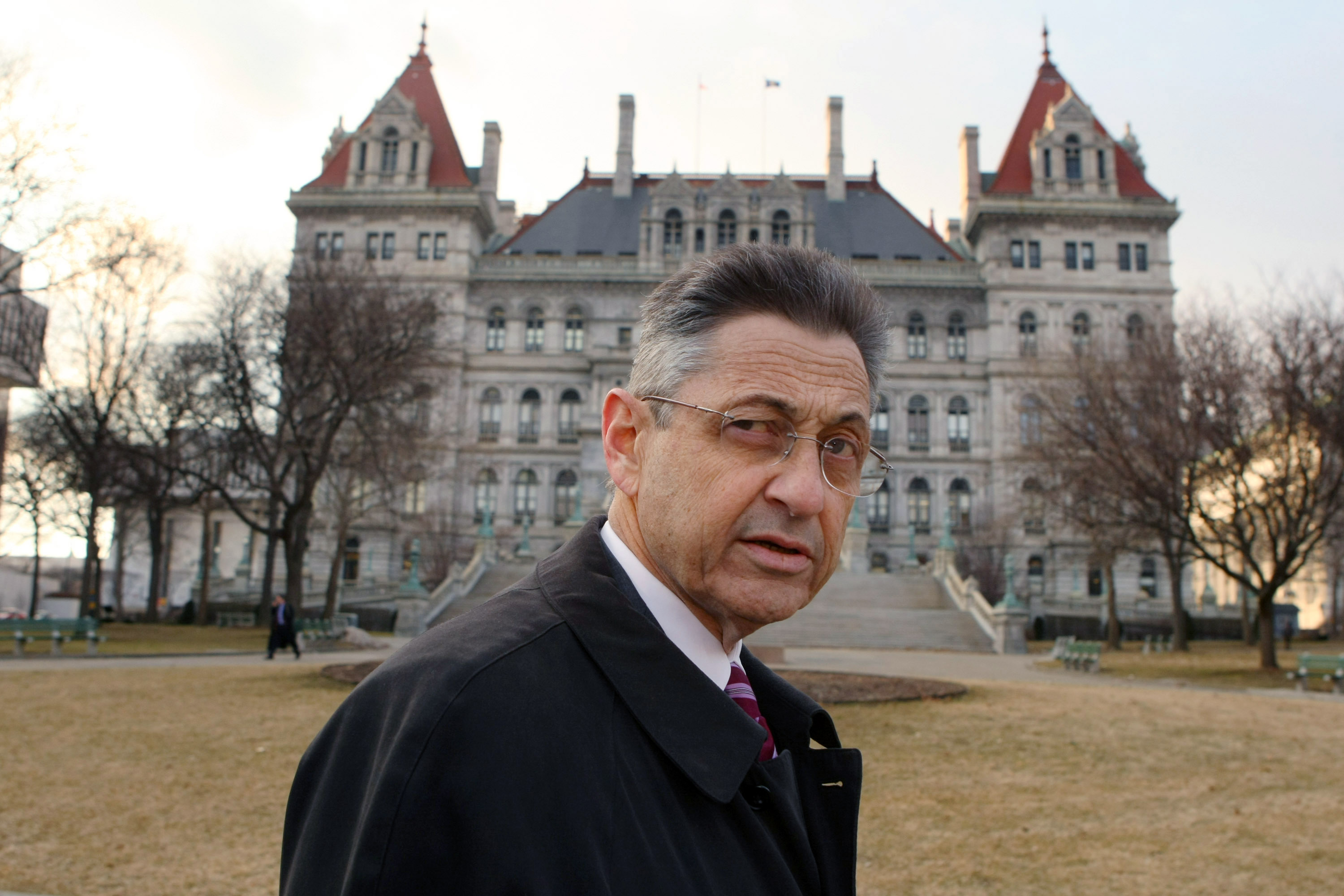
Sheldon Silver, who has been Speaker of the New York State Assembly for the past two decades, was arrested today on charges that he took millions in bribes and kickbacks. Yglesias highlights how Silver is “probably the single most important person in the past generation of New York politics”:

The saying in Albany is that decisions are made not by the voters or the legislature, but by “three men in a room” — the governor, the Speaker, and the leader of the New York State Senate. Over the past twenty years, governors and Senate leaders have come and gone but Silver has always been one of those three men in the room.

As such, he’s had a role in every major policy shift in the state. He’s also been the key defender of the institutional status quo in Albany, a status quo that is generally regarded as bathed in corruption and conflicts of interest. Discussions of state government in New York inevitably lead to invocations of the phrase “the mess in Albany” and Silver is, in a sense, the personification of that mess.

Jazz Shaw’s jaw drops:

The details of these “substantial” payments – which Silver somehow forgot to report – are not provided, and as far as I’m concerned, aren’t really important. That’s not the shocking part of this story. The truly amazing part is that anyone in New York was willing to cooperate with the Feds and actually make a move against him.

For those of you in other parts of the country and the world, Sheldon Silver has been the Speaker since before some of our younger readers were born. He is a legend in New York, and has long been acknowledged as the most powerful person in the state’s Democrat machine. Rumors have swirled for years about some of his more questionable dealings, but honestly there were few who ever thought that anyone could lay a finger on him. Nothing gets done in Empire State government dealings without Silver’s say so.

He tries to put the case in context:

So how does this apply on the national level? New York may be home to one of the oldest and most corrupt political machines in the nation, but it’s hardly unique. The real power in the U.S. does not reside in Washington, as we have seen over and over again. The state and local governments are where the policies which shape day to day life for citizens and businesses are crafted. And many of them have shady political dynasties holding on to power by any means possible, with plenty of money changing hands, frequently involving powerful unions and Democrat supporters. If you want to see change, that’s where it starts. And if Sheldon Silver can be taken down, then nearly anything is possible.

Ben Smith marvels at the federal prosecutor of the case, Preet Bharara, noting that the rising star has now “blown up his own political party”:

His frontal assault on the open secrets of New York political power has been a genuine shock to the state’s politics and even to its press, who missed the secret payments that appear to be at the heart of the reported Silver indictment. The process began last year, when Andrew Cuomo cut a particularly crude variety of the deal on which most statehouses operate: He shut down an ethics investigation into the state legislature in exchange for legislative support for his policies. His gambit became the subject of an excellent Times investigation — and then, to everyone’s surprise, Bharara essentially reversed Cuomo’s move, using his expansive power to seize the evidence Cuomo’s Moreland Commission had gathered and turn it over to his own investigators. …

Bharara was, briefly, among the figures mentioned last fall for another top job, attorney general of the United States, replacing a loyalist who served as President Obama’s “heat shield.” Obama went instead with the U.S. attorney for the Eastern District of New York, Loretta Lynch, a well-regarded prosecutor who has not shown the same eagerness to indict prominent Democrats. Bharara, with two more years in office, is that particularly dangerous and rare political figure: a federal prosecutor who doesn’t give a fuck.

(Photo: Speaker of the New York State Assembly Sheldon Silver walks in front of the State Capitol on March 12, 2008 in Albany, New York. By Daniel Barry/Getty Images)

Why I’m Jittery About SCOTUS On Marriage

US-JUSTICE-GAY-MARRIAGE

I was too sick to grapple with the recently revealed fact that the Supreme Court is going to decide some foundational issues with respect to marriage equality this spring and summer. And maybe because I’ve spent so long worrying about a premature decision that I cannot quite believe that the Fourteenth Amendment will find one more minority to protect. The power of the language and arguments in the Windsor decision would be very hard to take back, and with 36 states now offering marriage equality, the ruling would not be another Roe (there’s already a budding national majority for equal marriage rights and a huge generational shift, unlike abortion). I largely defer to those Court watchers and constitutional experts who seem to assume a done deal.

But I still have some jitters. Our post exploring some of the nuances is here. And Garrett Epps basically voices my concern thus:

[E]ven if Justice Anthony Kennedy’s vote seems foreordained, he must choose between the rights of gays and lesbians—an issue on which he has fashioned a historic legacy—and the prerogatives of the states, about whose “dignity” and honor he has often rhapsodized. He might be tempted to split the baby by holding for the states on the “celebration” issue but for the challengers on “recognition.” (The Court’s grant of review was careful to split the two questions.) That is, he might say, a state could refuse to perform marriages itself, but could not refuse those legally married out of state the benefits of marriage under state law.

In other words, the rapidity of the social change and the now hefty majority of states with marriage equality can cut both ways, it seems to me. The speed of change could indicate the Court could fudge the issue somehow, confident that democracy will continue to work its magic in the states. This was part of the Jeffrey Sutton ruling that occasioned the split in the circuit courts:

A principled jurisprudence of constitutional evolution turns on evolution in society’s values, not evolution in judges’ values. Freed of federal-court intervention, thirty-one States would continue to define marriage the old-fashioned way. Lawrence, by contrast, dealt with a situation in which just thirteen States continued to prohibit sodomy, and even then most of those laws had fallen into desuetude, rarely being enforced at all. On this record, what right do we have to say that societal values, as opposed to judicial values, have evolved toward agreement in favor of same-sex marriage? …

In just eleven years, nineteen States and a conspicuous District, accounting for nearly forty-five percent of the population, have exercised their sovereign powers to expand a definition of marriage that until recently was universally followed going back to the earliest days of human history. That is a difficult timeline to criticize as unworthy of further debate and voting. When the courts do not let the people resolve new social issues like this one, they perpetuate the idea that the heroes in these change events are judges and lawyers. Better in this instance, we think, to allow change through the customary political processes, in which the people, gay and straight alike, become the heroes of their own stories by meeting each other not as adversaries in a court system but as fellow citizens seeking to resolve a new social issue in a fair-minded way.

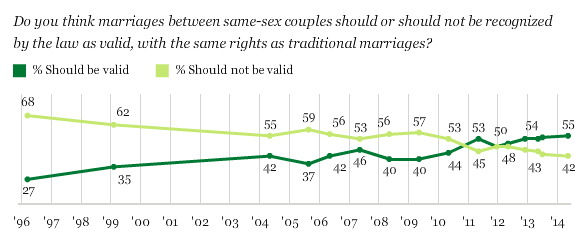
My italics. You have here a Burkean defense of federalism – something that will very much appeal to Anthony Kennedy, it seems to me. The problem, however, is that the pace of change has quickened so much after Windsor that Sutton is already out-dated. It’s now 36 states, not 19, representing 70 percent of the population, not 45. So his analogy to sodomy laws rather evaporates. If sodomy was upheld as a legitimate zone of privacy, when only 13 states retained such laws, why could not marriage for all couples be upheld as a constitutional right, when only 14 states ban it? Here’s the state of public opinion in the last two decades:

Screen Shot 2015-01-22 at 11.02.14 AM

The generational shift reveals nearly 80 percent support for marriage equality among the under 30s, and an even split among the over 65s. So whatever else a federal right to marry for gays would be, it sure wouldn’t be a judicial fiat of a fringe minority view. It would be a judicial confirmation of a major shift in public mores and beliefs. That’s the other Burkean argument that judicial intervention at this point is not premature.

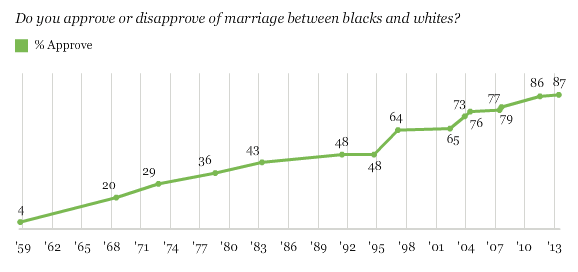
Consider the analogy with inter-racial marriage. In 1967, when Loving vs Virginia was decided, fifteen states retained active bans (about the same as those states that now ban gay marriage). But the polling back then was far more hostile to inter-racial marriage than to gay marriage in 2014.

While over 50 percent of Americans have backed marriage equality over the past few years, a mere 20 percent of Americans approved of miscegenation, when it was ruled unconstitutional. Approval of inter-racial marriage would not get above 50 percent until the mid-1990s, thirty years later:
Screen Shot 2015-01-22 at 11.07.13 AM

But what about the states’ rights argument? If public opinion is moving so fast, why not let federalism take its course? That’s my worry. Could Kennedy fashion a ruling that keeps marriage equality in those states that already have it, allow the minority to retain bans, but insist that any valid civil gay marriage in one state be recognized in any other? I don’t know how constitutionally you could do this – but I don’t doubt figuring out a balance between federalism and civil rights is what Kennedy (and maybe Roberts) will be assessing. A non-Fourteenth Amendment decision that nonetheless insisted on recognition, if not celebration, of same-sex marriages in every state might be a tempting middle way.

The case against this, it seems to me, is a simple one: confusion and complexity and timing. When a debate has been won so clearly in public opinion, when 36 states and DC already have marriage equality, and when the core dignity and equality of gay citizens is really at stake, why not just get it over with? To have your civil marriage in doubt when you travel across one country would be utterly unacceptable (and rightly so) to every heterosexual married couple). Why give the republic and gay citizens this kind of headache, when the argument is all but over? It wouldn’t be judicial over-reach; it might even be greeted with relief by many Republicans; and it would cement Kennedy’s standing as the champion of civil rights in our time. John Roberts might even be tempted to join Kennedy, if he wants to the Court to gain some respect from the next generation and exultation from millions of gay people and their families.

So maybe I’ve just talked myself out of a serious worry that something could go wrong. Or maybe I’m just jittery when so many seem to believe a triumph is a foregone conclusion. Or maybe I’ve been at this too long and am still psychologically unable to believe we have finally arrived. But as a Burkean federalist who believes in the value of slow incremental change through an emerging public consensus, but nonetheless believes that the right to marry is indivisible from core civil equality and basic human dignity, I think I can see Kennedy’s conflicts on this. But I also sense where his logic and his soul are: it’s time for a final decision. And a clear endorsement of a federal right to marry is the only one that really currently makes sense.

(Photo: Jewel Samad/Getty.)

The Popularity Of Paid Leave

Sick Time

Christopher Ingraham finds widespread support for paid sick leave. He flags a 2010 survey that “asked respondents how they felt about paid sick time, and then presented them with a battery of arguments for and against such legislation”:

[A]fter hearing these arguments, respondents’ views on sick leave legislation were unchanged — 75 percent supported mandatory sick time before hearing the arguments, while 74 percent supported it afterward. Even more telling, respondents rated the appeals about lower wages among the least compelling of the con arguments.

So, let’s take sick leave’s detractors at their word: If it really comes down to a choice between paid sick time and higher wages, Americans overwhelmingly choose the sick time. So why not give them that choice?

Talbot takes a closer look at research on family leave. She uses California and New Jersey as examples, states that “have both instituted six-week, partially paid family leave, funded by employees in the form of a small payroll tax”:

The New Jersey law went into effect in 2009, and three years later the Center for Women and Work at Rutgers conducted a study that showed some remarkably robust and positive results. Women who had taken the leave were far more likely to be working nine to twelve months after the birth of their child than new mothers who had not; they were also thirty-nine per cent less likely to be on public assistance, and fifty-four per cent more likely to have seen an increase in their wages. This finding is important: in some of the European countries that offer very long leaves—of a year or more—women who take advantage of the policies often pay a price in promotions and earning potential. But, based on the evidence here, shorter leaves seem to boost women’s wages.

In California, “people there took more and longer leaves”:

Meanwhile, most of the businesses surveyed in California reported either positive or no noticeable impact from the family-leave law. Presumably, their employees came back to work happier, healthier, and less distracted.