Tidal Warming

FT-150120-warmoceans.DISHCROP

Eric Holthaus points out that 2014’s heat record was based on ocean heat, not land heat, which was only the fourth hottest:

Here’s the basic physics: It’s very hard for Earth’s climate system to store heat year-to-year on land. That’s because the oceans can store energy much more easily than land and circulate it through the entire climate system. The global oceans act as giant heat reservoirs and add inertia to the steadily escalating push from human greenhouse gases.

He concludes that “it’s much less likely that this year’s global heat record was a one-off fluke – and that the extra ocean heat is probably here to stay.” Amy Davidson asserts that the denialists are running out of material:

The new numbers are so striking that they surprised even climate scientists; 2014 was, in science parlance, “an El Niño neutral year.”

El Niño is one of those “natural” forces that climate deniers say can account for fluctuations and for warming the ocean up; a reply might be that man-made climate-change may come to affect even the oceans’ currents. (It already appears to have affected their level of acidification; add to that a new report warning of impending mass oceanic extinctions.) But that point doesn’t even need to be made. This past year was hot without any room for disingenuous excuses.

Drum points to a popular one:

The year 1998 was an outlier, an unusually warm year. If you choose this as your starting point, the next decade will look pretty uneventful. You can do the same thing with lots of other decade-long periods. For example, 1969-85 looks pretty flat, and so does 1981-94. This is typical of noisy data. Planetary warming isn’t a smooth upward curve every year. It spikes up and down, and that allows people to play games with the data over short periods. Add to that the fact that warming really does appear to pause a bit now and again, and it’s easy for charlatans to fool the rubes with misleading charts.

But in the end, physics and chemistry will do their thing regardless. Earth is warming up, as any honest look at the data makes clear.

And there was another report out last week from 18 scientists working to determine how far the Earth can pushed:

The paper contends that we have already crossed four “planetary boundaries.” They are the extinction rate; deforestation; the level of carbon dioxide in the atmosphere; and the flow of nitrogen and phosphorous (used on land as fertilizer) into the ocean. … These are not future problems, but rather urgent matters, according to [lead author Will] Steffen, who said that the economic boom since 1950 and the globalized economy have accelerated the transgression of the boundaries. No one knows exactly when push will come to shove, but he said the possible destabilization of the “Earth System” as a whole could occur in a time frame of “decades out to a century.”

They warn against tech complacency as well:

Technology can potentially provide solutions, but innovations often come with unforeseen consequences. “The trends are toward layering on more and more technology so that we are more and more dependent on our technological systems to live outside these boundaries,” “[Earth systems expert Ray] Pierrehumbert said. “. . . It becomes more and more like living on a spaceship than living on a planet.”

(Chart from NOAA.)

Doggin’ It

Canine athletes would take exception to that expression:

Ben Richmond reads through Julie Hecht’s “great article over at Scientific American about dog athletes and how often they end up injured”:

Although all but the mellowest of pooches seem to enjoy a good wrestle with each other every now and again, it’s not like these athlete dogs are playing contact sports. While new dog sports like dock jumping and flyball are catching on, the most popular dog sport is the agility contest: running an obstacle course with only the vocal commands of their trainer to guide them. (The sport was just added to the Westminster Kennel Club Dog Show last year; a seven-year-old border collie named Kelso won.)

While they obviously aren’t injury free, I was surprised to find that dog athletes that are doing the agility course are generally healthier than their human counterparts.

Hecht cited two studies that appeared in Veterinary and Comparative Orthopaedics and Traumatology and Journal of the American Veterinary Medical Association which surveyed dog trainers and found that slightly less than one third of dog athletes develop some sort of agility injury. The most dangerous parts of the dog-agility course are the A-frame, where dogs have to run over a small pointy hill, and jumping over bars. The most common issues were sprains and strains, followed by injuries to their furry little shoulders, backs, necks, and phalanges. Slightly over the half of the injuries are considered mild, and don’t take more than a month to come back from.

Being brainy doesn’t appear to be a great help when handling the agility course obstacles, as border collies were the likeliest breed to be injured in competition, something the study attributes to how fast they are. Commenting on the research, the veterinarian Dr. Nancy Kay wrote in a blog post that, “I suspect this susceptibility to injury has more to do with the breed’s insanely intense work ethic than it does any inherent musculoskeletal weakness.”

Some have other weaknesses:

Losing Patients To Suicide

Sulome Anderson covers the subject:

According to many doctors I spoke with, there is also a severe lack of training for mental health professionals—not only on how to deal with suicidal patients, but how to process a patient’s death. Dr. Paul Quinett, a professor in the department of psychiatry and behavioral science at the University of Washington School of Medicine, is heavily involved in teaching clinicians how to do both. “I think most of us believe that when we hire a licensed mental-health professional, that they’ve had training in how to assess and manage suicidal patients, when in fact, the majority do not,” he says.

I mention a survey where a group of doctors and nurses were asked if they think it’s possible to prevent someone from committing suicide. More than half answered that they didn’t think it was. “Well, I don’t believe that,” he says firmly. “I believe that’s a convenient myth … but so many clinicians are not well-prepared for that outcome. There are lots of clinicians who lose patients to suicide in the course of their career … in a way it’s almost an occupational hazard. That’s why people need the very best training they can get, to learn how to work effectively with people considering ending their own lives.”

The SOTU 2015: Blog Reax

Brian Beutler contends that Obama is “priming the public for [Clinton’s] campaign” by “building a case before the public that Democrats have had better economic ideas all along”:

Tuesday’s State of the Union was thus a single component of a project that’s much more meaningful than budget brinksmanship or the 2016 campaignto establish the parameters of the economic debate for years and years, the way Ronald Reagan’s presidency lent supply-side tax policy and deregulation a presumption of efficacy that shaped not just Republican, but Democratic policy for two decades.

Seven years into Obama’s presidency, the U.S. economy is finally growing rapidly enough to boost his popularity and to sell the country on the idea that Obama’s peculiar brand of ostentatious incrementalismbuilding out and improving existing institutions, directing resources through them to the middle classhas worked, and should serve as a beacon not just for liberals, but for conservatives aspiring to recapture the presidency.

Chait calls the speech “the first expression of Democratic politics in the post-recession era”:

Republicans have formulated plans to benefit working-class Americans directly, but all these plans have foundered on the problem that Republicans have no way to pay for them:

they may be willing to cut taxes for the working poor, if that’s what it takes to win an election these days, but they certainly don’t want to raise taxes on the affluent. (“Raising taxes on people that are successful is not going to make people that are struggling more successful, insisted Marco Rubio recently.”) This means the money to finance the new Republican populist offensive must be conjured out of thin air.

Thus the blunt quality of Obama’s plan: he will cut taxes for the working- and middle-class by raising an equal amount from wealthy heirs and investors. Obama’s plan is not going to pass Congress, of course. Probably nothing serious can pass a Congress that still has no political or ideological incentive to cooperate with the president. The point is not to pass a law. It is to lay out openly the actual trade-offs involved.

John Fund, on the other hand, thinks Obama glossed over the trade-offs of his proposals:

All of the proposals enjoy majority support in polls — although that support tends to fall after people weigh the price tag.

Take paid sick leave. Obama mentioned that wherever the issue was on the ballot this fall it passed when people voted on it. But he was careful not to mention that the only state where it was on the ballot was Massachusetts. Yes, the state that hasn’t sent a single Republican to the U.S. House in 20 years and consistently votes Democratic for president by about ten points more than the rest of the country. Question 4, the Massachusetts ballot measure that mandated paid sick leave in the state, did pass but with only 60 percent of the vote — meaning that after a real debate the issue might be an even split nationwide.

Jonah Goldberg was also unimpressed by the address:

Like a lot of people, I found tonight’s speech a chore. That’s less of a criticism of Obama than it sounds. I find all State of the Unions to be tedious, particularly this late in a presidency. I do think it was better delivered than most of his State of the Union addresses. I didn’t, however, think it was particularly well-written. “The shadow of crisis has passed”? C minus.

Annie Lowrey watched a different speech:

[T]onight, we saw an Obama like the one we saw on the campaign trail – fired up, optimistic, discursive, happy-hearted, and historical. Tonight, we saw an Obama who decried Washington, but still seemed convinced in hope and change. Tonight, we saw Obama thunder, trumpet, and staccato-shout his policies, despite the nonexistent odds they have of passage. And the fact that the economy has turned around so much seemed to give him hope that the middle class would start feeling better, even if Washington never helps.

Jim Tankersley argues that some of Obama’s proposals have real promise:

Many economists say the preferential treatment for capital income has led to the excessive growth of Wall Street, which has robbed the broader economy of precious brainpower that would be better employed solving human problems and creating more high-paying jobs. This could eventually prove to be the key difference in Obama’s latest middle-class plan, compared to his past plans – a difference in policy and in politics. If you talk to American workers much, you find that, sure, they’d enjoy paying less money to the government. But mostly, they’d like a better-paying job.

Chris Cillizza was struck by Obama’s confidence:

For his allies and even many liberals who had grown sour on him, it was a triumphant speech in which both his own soaring confidence and his dismissal of his political rivals was fitting and appropriate. For his detractors, the speech was everything they loathe about him: cocky, combative and forever campaigning. Regardless of where you land on that confident-to-cocky spectrum, one thing was very clear tonight: Obama isn’t planning to go quietly over his final two years in office. Not quietly at all.

However, David Corn admits that “State of the Union speeches aren’t what they used to be”:

Once upon a time, a large chunk of Americans watched the chief executive unveil his plans in these ornate circumstances. After all, there was little else to see on television for that hour or so. But in our Internet-y days, there are no more captive audiences. So the reach of any State of the Union speech is limited. Yet this address did provide Obama with what is likely to be his biggest audience of the year (unless there is an emergency, a grand history-making event, or national tragedy). And he used the opportunity to effectively restate and reinforce his foundational views. Toward the end of the speech, Obama noted, “I have no more campaigns to run. My only agenda for the next two years is the same as the one I’ve had since the day I swore an oath on the steps of this Capitol.” And that seemed to be true. He yielded no ground to the ascendant Republicans, though he did again sidestep the depth of the opposition he has faced—and that he and his agenda will continue to face. This State of the Union address was no game-changer, but it was a signal from Obama that he will be sticking to his game.

Last but not least, Josh Marshall suspects Obama is playing a long game:

As Sahil Kapur explains, based on conversations with White House aides, President Obama wanted to be a Ronald Reagan of the Center-Left in tonight’s speech, not so much focused on passing laws in the next two years (which isn’t happening regardless) as embedding a clear blueprint of progressive activism into the structure and rhetoric of American politics for years or decades to come. So he’ll make his arguments, cheer successes and vindicated predictions and promises, take aggressive executive actions to the limits of his authority. But more than anything else he’ll try to push the whole package, the logic of his administration and his policies as a touch point and reference for the future.

He was talking over and past the new GOP majorities on many, many levels.

The SOTU 2015: Tweet Reax

https://twitter.com/nxthompson/status/557722152796164098

https://twitter.com/Doranimated/status/557731551044444163

https://twitter.com/AdamBlickstein/status/557748880348303361

https://twitter.com/JamesFallows/status/557743721115316225

https://twitter.com/jonlovett/status/557743029998845954

Live-Blogging The GOP Response

https://twitter.com/timkmak/status/557741729911431168

10.36 pm. I thought Senator Ernst gave about as strong a response as I have seen in years in terms of style and affect. Way better than Jindal or the usual suspects. Great pick for the GOP, but inevitably overwhelmed by the rhetorical mastery of what preceded her. But I see now why Iowans voted for her. She has great and broad appeal. And she’s a symbolic solution to the image of a party full of so many very wealthy white men, with whom many voters don’t identify with.

10.30 pm. She’s in favor of new trade deals that Obama backs as well. Easier tax filing and fewer loopholes: I’m for that. But not if it isn’t at least deficit neutral. Then, in stark contrast with Obama, an endorsement of the validity of fear vis-à-vis Jihadist terrorism. But no details on how to actually tackle terrorism. I note no mention of unemployment or economic growth or Putin. I als note no mention of immigration whatever, despite fighting the last campaign primarily on that issue.

10.28 pm. “Growing up, I had only one pair of shoes.” The appeal to a struggling middle class is now on. She’s for new solutions over an old mindset. And the policy goods? The Keystone Pipeline! That’s really all you’ve got?

10.25 pm. She has a great smile, although it doesn’t actually seem to end. And the beginning was a grace-note to the airing of alternative ideas.

Live-Blogging The SOTU 2015: Another Morning; Another America

President Obama Delivers State Of The Union Address

10.11 pm. This is a speech that revealed to us the president we might have had without the extraordinary crises – foreign and domestic – he inherited. I’ve always believed in his long game and in his bent toward pragmatism over ideology. Events can still upend things, but this is a president very much shaping the agenda past his own legacy. He’s showing Hillary Clinton the way, and has the midterms to point to as the result of the defensive crouch. If his standing improves still further, he will box her in, and she’ll have to decide if she’s going to be a Wall Street tool and proto-neocon or a more populist and confident middle class agenda-setter.

One of his best. And for the first time in his six years, he has the economic winds behind him. Stay tuned for my review of the GOP response, and for the Dish’s round-up of the blogosphere and Twitterverse.

10.07 pm. “I know because I won both of them.” Every now and again, the lamb shows his fangs. And that was spontaneous and a product of real confidence. Notice how utterly silent and hushed the chamber as gotten in the last fifteen minutes. He has them in his hands.

10.03 pm. “Basic decency over basest fears.” We’re in the John Lennon moment. And after a strongly partisan, Democratic speech, the quiet turn toward inclusion, humility and bipartisanship is a brilliant touch. One America:

Surely we can understand a father who fears his son can’t walk home without being harassed. Surely we can understand the wife who won’t rest until the police officer she married walks through the front door at the end of his shift.

10.01 pm. He reclaims the post-partisan identity he began with:

I still believe that we are one people. I still believe that together, we can do great things, even when the odds are long. I believe this because over and over in my six years in office, I have seen America at its best. I’ve seen the hopeful faces of young graduates from New York to California; and our newest officers at West Point, Annapolis, Colorado Springs, and New London. I’ve mourned with grieving families in Tucson and Newtown; in Boston, West, Texas, and West Virginia. I’ve watched Americans beat back adversity from the Gulf Coast to the Great Plains; from Midwest assembly lines to the Mid-Atlantic seaboard. I’ve seen something like gay marriage go from a wedge issue used to drive us apart to a story of freedom across our country, a civil right now legal in states that seven in ten Americans call home.

So I know the good, and optimistic, and big-hearted generosity of the American people who, every day, live the idea that we are our brother’s keeper, and our sister’s keeper. And I know they expect those of us who serve here to set a better example.

9.57 pm. This is candidate Obama on American values – not president Obama. On torture, he has backed the CIA all the way; on drones, I just don’t buy his claim of close targeting; on the NSA, he has not stood in the way of unprecedented spying on Americans. He has not earned this mantle. And it fits uneasily on his shoulders.

9.53 pm. The climate change emphasis – toward the peroration – is striking. His urgency is merited, as far as I can see. And a majority of Americans do believe the science, even as the GOP has dug in deeper with extreme skepticism at best and outright denialism. This time, he has the Pope on his side.

9.52 pm. A reader writes:

​I think this might finally be the speech when Obama will throw down the mic at the end.

9.50 pm. Even more tepid applause for his attempt to get a deal with Iran. But at least he actually articulated his case clearly and powerfully.

9.44 pm. He’s now making an argument – finally – for his foreign policy. He targets fear as our enemy, not our friend. And over-reaction and “bluster” are as dangerous as any enemies we are fighting. That’s the man I endorsed. But his optimism about Afghanistan seems delusional to me; as does his ISIL policy. I notice a very light round of applause after his call for a new AUMF for Iraq and Syria. Not exactly a ringing bipartisan acclamation. But I enjoyed watching McCain listen to Obama’s gloating over Putin’s over-reach.

9.43 pm. Note that he wants to tax the proceeds from accumulated wealth, not work.

9.40 pm. This is a future-oriented, optimistic speech. What I like about it is the final laying out of a distinctively Democratic agenda. I’d like to see these proposals discussed and examined and pushed back on. But he has broken out of the Washington defensive crouch which afflicts most Democrats and is almost trade-marked by his would-be successor.

9.37 pm. This is the most confident I’ve ever seen him. The appeal to hire veterans; the call for major infrastructure, while dissing the Keystone pipeline; and a new commitment to scientific research. Even some Republicans stood up.

9.31 pm. A reader notes:

This child care thing is a softball for Hillary to knock out of the park, if she has the sense.

Another dissents with my 9.15 pm post:

His remarks on family weren’t about Washington. He’s putting me and my Republican neighbor in the same boat of America. Painting that picture of a family is brilliant.

9.29 pm. The Democrats are lovin’ it. Boehner’s got a cold.

9.26 pm. A national economic priority for childcare – not a nice-to-have, but a must-have. And he frames it as not a women’s issue. He’s tackling the core issues of struggling middle class families. Seven days of paid sick leave seems more than a little helpful to me right now, after three weeks of fevers.

9.24 pm. A reader notes that Boehner’s face is actually darker than Obama’s.

9.22 pm. Warren is standing; Menendez looks really uncomfortable; Paul Ryan just let out a big sigh, it seemed to me. “Middle class economics” is a pretty good slogan too.

9.20 pm. He’s actually taking credit for the ACA. Imagine that. And wrapping it up in better economic data.

9.19 pm. I can’t help but feel that low gas prices are key to his polling recovery. Didn’t hurt to remind peeps.

9.15 pm. Could anything be less true than that America is one strong, united family? Good pitch; but still obviously untrue. We have been divided intensely during this slow and now accelerating economy.

9.12 pm. Another morning in America. Unemployment lower than before the Great Recession; growth strongest since the 1990s; more insured Americans; most troops brought back home. For the first time in any of his SOTUs, Obama is calling the state of the union “strong.”

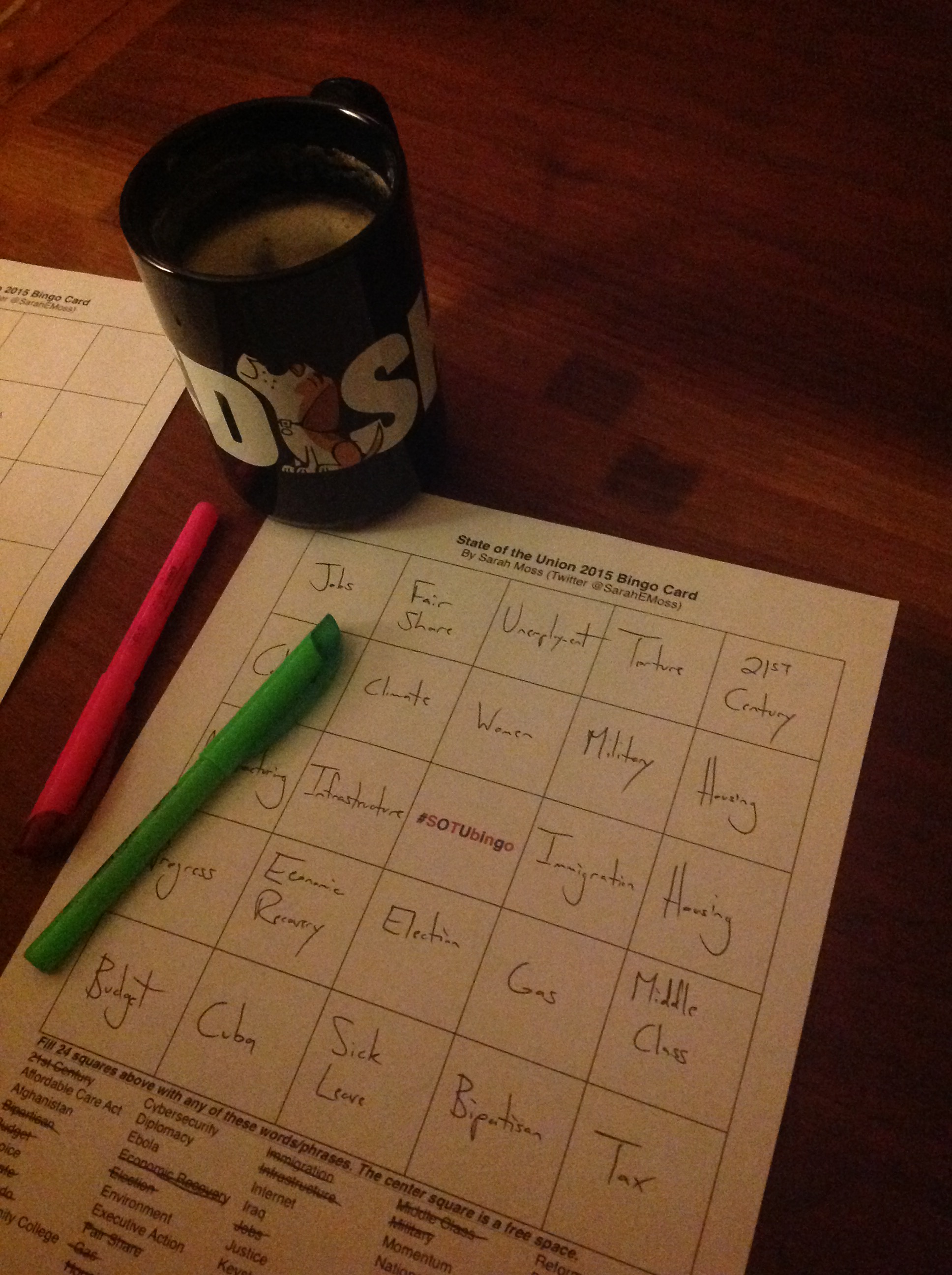
9.11 pm. Party like it’s 1999! One reader already is:

image1(1)

9.09 pm. I haven’t read the transcript yet because I want to respond to the address as it comes. This is theater as much as anything.

9.07 pm. For an introvert, he still knows how to work a crowd.

8.55 pm. On this auspicious and occasionally uplifting occasion, allow me to welcome Alex Pareene back to the punchbowl:

Here is some of [SOTU-writer Cody] Keenan’s hard-bitten, muscular prose, from a previous State of the Union address:

“Today in America, a teacher spent extra time with a student who needed it, and did her part to lift America’s graduation rate to its highest level in more than three decades,” Mr. Obama said in the opening lines of last year’s State of the Union address, written by Mr. Keenan. The president went on: “A farmer prepared for the spring after the strongest five-year stretch of farm exports in our history. A rural doctor gave a young child the first prescription to treat asthma that his mother could afford. A man took the bus home from the graveyard shift, bone-tired but dreaming big dreams for his son.”

That is boilerplate State of the Union rhetoric. Do you know what it doesn’t sound like? Good prose by a good author. Peggy Noonan could down two bottles of white wine and crank this kind of shit out in ten minutes before passing out. Paul Harvey would’ve been embarrassed to read this on the radio. It’s a storyboarding session for a TV commercial. If you actually imagine those images, the first thing that comes to mind is a soothing voice rapidly reading pharmaceutical contraindications.

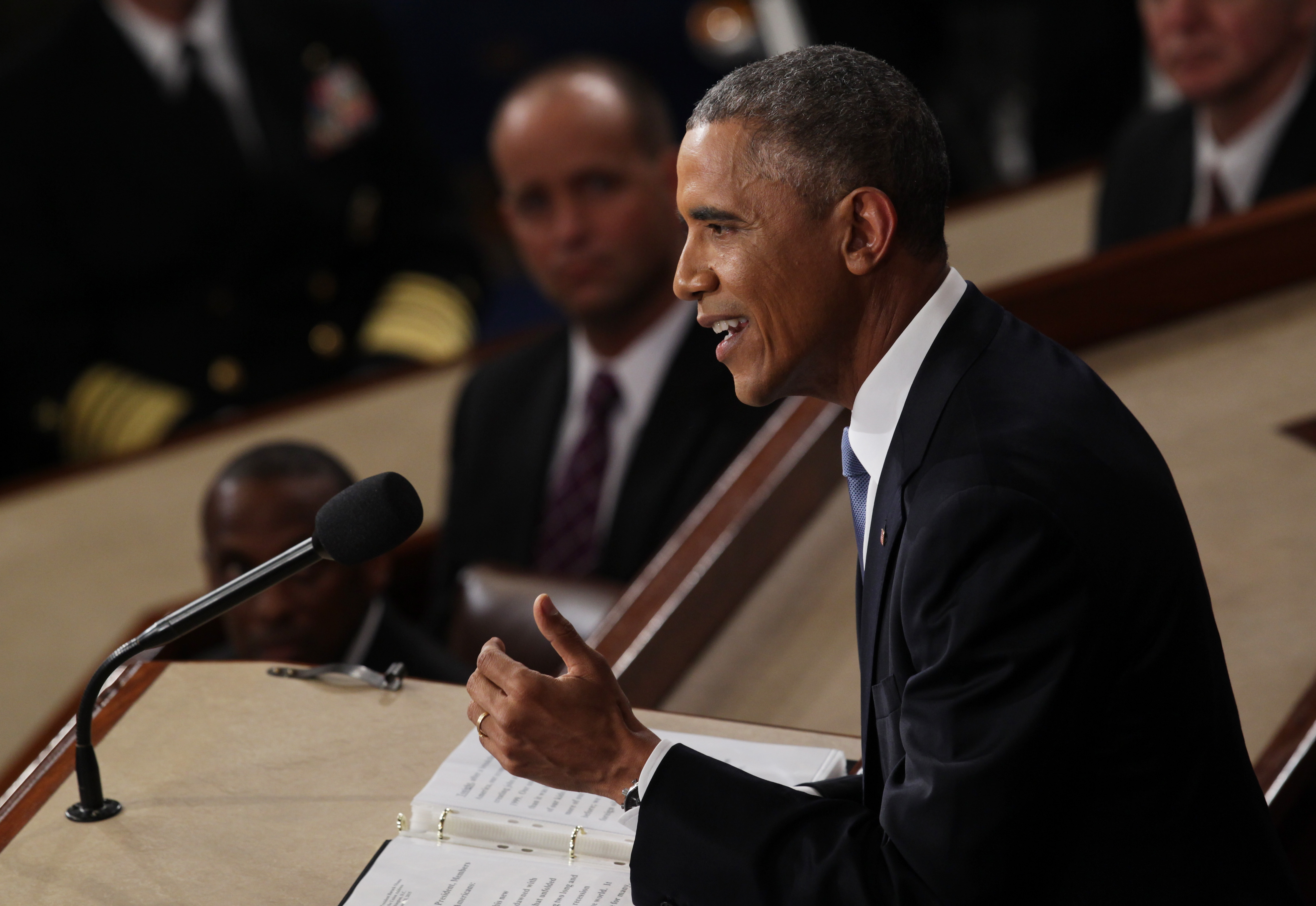
(Photo: Alex Wong/Getty.)

Pull The Plug On The SOTU?

Who Watches

Steve Chapman wants to:

Whether this event is still worth their time … is doubtful. If there was ever a time that direct exposure to presidential eloquence could melt the hearts of hostile legislators, it has passed. Even the public seems to have acquired immunity. The effort often backfires. “In a 2013 analysis of SOTU polling,” [Cato’s Gene] Healy has noted, “Gallup found that ‘most presidents have shown an average decrease in approval of one or more points between the last poll conducted before the State of the Union and the first one conducted afterward.'”

But Jack Shafer cheerfully thinks the annual address “isn’t completely useless”:

According to research conducted by political scientists Donna R. Hoffman and Alison D. Howard, about 40 percent of the requests a president makes in a State of the Union speech are enacted in some form as law—a batting average the major leagues haven’t seen since Ted Williams.

Perhaps presidents have inflated their batting averages by including sure-bet legislative proposals in addresses, but the addresses still frame the White House’s intentions, clarify the direction the president’s budget will take, focus press corps coverage, and help structure the legislative agenda. Language about an issue into the State of the Union also has a tendency to increase the public’s sense of urgency about it. One study of addresses from 1946 to 2003 found that every 50 words devoted by a president to an issue resulted in a 2 percentage point increase (sometimes temporary) in the public’s identification of the issue as America’s most important problem. Laugh if you want to, but political revolutions are won by 2 percentage point swings, even temporary ones.

I enjoy the spectacle, the set-speech and the tradition. But then I’m an English Tory deep-down. YouGov looks at who will tune in tonight:

[D]espite Democrats being the most likely to say they will watch it does not mean that the audience will be mainly comprised of Democrats. In light of how many more independents there are than Democrats, 40% of tonight’s audience is expected to be made up of independents and 40% will be Democrats. Only 19% of people tuning in will be Republicans.

Regardless, Jonathan Bernstein contends that Obama’s most important audience is his fellow Democrats:

The president doesn’t choose his proposals in a vacuum. His agenda is the Democratic Party agenda (or one version of it), and the party constrains what Obama can do. … Yes, the president has the single biggest vote — he’s the single most important party actor. But the best way to think of the State of the Union is as part of a continuing process, with the results today both an outcome of party battles and a factor in the next round of defining the party.

In Which The Democrats Finally Get A Clue, Ctd

A reader doesn’t pull punches:

Democrats are spineless cowards who did not dare to make this the theme of the last few election cycles. They would have won big. But instead they hid behind their Wall St donors and sat still.

Another is more even-handed:

Odd thing, isn’t it?  Since the midterms, Obama has been following his instincts, not the Congressional leadership that wanted to try to save Senate seats in deep red States, or the inside-the-Beltway CW that still thinks it’s 1984, that winning legacy media cycles is everything, and that Democrats must act like Republicans.  Would have been interesting to see what would have happened if he’d done this a year ago.

On the other hand, to move like this, maybe he needed an improving economy and a GOP hopelessly tied to its hardcore base.  Either the Republicans approve this basic plan, in which case Obama gets yet another major accomplishment, which will kill them with their Obama-hating base, or they stop it, which clearly puts them on the side of the super rich at the expense of every single middle-class American.  Maybe even the tools and lackeys who populate the panels of the Sunday talk shows will be able to understand just how shrewd this move us.

A few more readers sound off:

I think it’s important to note that this is not a Democratic redistribution of the wealth. This is a correction of 35 years of Republican redistribution policies.

For decades, the middle- and lower-classes have paid for the ever-shrinking percentage of taxes the wealthy pay with increases in state income and sales taxes (due to reduced federal outlays to states), increased fees for government services along with cuts to those same services. The GOP now wants to take the axe to Medicare and Social Security in the name of debt reduction, even though those programs are self-funded and do not affect the national debt. Future insolvencies in those programs can be easily corrected by raising the cap and making the super-wealthy pay their fair share, instead of just paying on the first $105,000 in income. If the super-wealthy cannot acquiesce to paying what is, for them, an easily manageable increase in taxes, they will end up losing more when economic unrest makes indulging their greed politically unpalatable and there is nothing left to steal from the 99%.

Another:

Can we dispense with the “meep, meep” comments?  This idea that the president has this grand diabolical plan, patiently laying in wait, scheming to overcome the opposition, and then striking out, grabbing the initiative, is an interesting one.  Perhaps he was laying in wait and biding his time when his policies caused the Democrats to get their asses handed to them in 2010.  Yes, losing all the state houses and governerships must be in this equation along with losing the Senate.  Next week President Obama will take out Tattalgia, Barzini, Strazi … all the heads of the Five Families.  Right after Connie’s kid gets baptised.

For all the talk about the Democratic Party’s demographic destiny, or the Republican presidential candidate to take 50%+ of the popular vote once over the past twenty years, the electoral success of the president is tied to timing and the complete and utter ineptitude of the opposition, not any Frank Underwood-like grand plan.  Despite six years in office, nearly five years of continued GDP growth, decreases in the unemployment rate, and so-called populist ideas, the president finds it nearly impossible to break the 50% approval rating barrier.

The US of A is still a right-of-center country, and culturally the president does not connect with the majority of Americans (I’ve always believed race is not the defining characteristic that the electorate finds divisive … name the last president to come from an urban/metropolitan area?), and the electorate doesn’t want overtly redistributive economic policies.

However, it is these cultural issues that hold the Republican Party back.  Every presidential primary it seems as if the Republican candidates are vying for the Forsythe County, Georgia school board instead of the Oval Office.  When the Republicans do nominate a relative social moderate, that candidate fits the stereotype of rich, out-of-touch white guy who is unable to draw sufficient votes from any of the Democrats’ core constituencies.  The Democratic party is still a coalition of competing interests, and if the Republicans would pull their heads out of their asses long enough to pluck just enough of those votes away they would be assured of victory.

The Hispanic-American population is more culturally conservative than the Democratic Party base.  The Asian-American population is more culturally and economically conservative than the Democratic Party base. One of George W. Bush’s lasting legacies, other than propelling the country into an avoidable war and being fiscally irresponsible, might be to undermine the ability of the party to grab those votes for the next several years by tainting his brother Jeb’s name and inhibiting him from carrying enough Hispanic-American and Asian-American votes to get into office.  Jeb was always the chosen one – to use the Godfather analogy, Michael to George’s Santino.

As for President Obama, his approval rating will probably creep up a few more points as gas prices stay low and the economy limps along.  Presidential approval ratings correlate to gas prices.  Now that the consumer has deleveraged from the household debt hangover, they have more disposable income.  Whoever is voted into office in 2016, Democrat or Republican, will find themselves in trouble in 2020 as the debt cycle sends us back into another recession after Americans once again charge up those credit cards, take out those HELOCs, and the federal government has to drastically reduce spending to cope with the federal debt.  Then we can start all over with inane arguments over how that president then in office “caused” that Recession.

Face Of The Day

Harry Reid Returns To Capitol Hill After Sports Injury

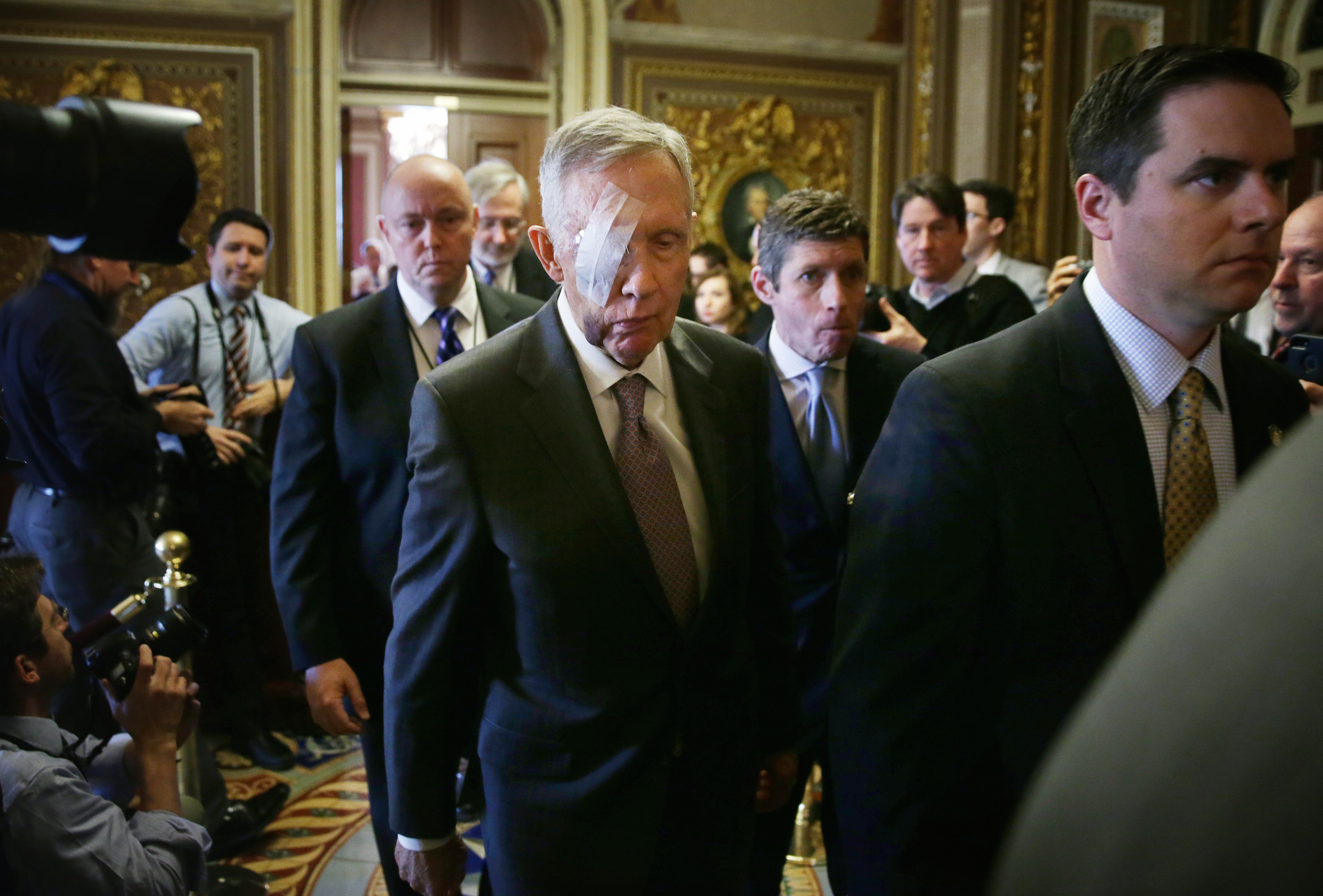
U.S. Senate Minority Leader Senator Harry Reid (D-NV) leaves after the Senate Democratic weekly policy luncheon at the U.S. Capitol on January 20, 2015. Reid returned to work today after he was injured from a New Years Day exercise accident, which caused broken bones and temporary loss of vision in his right eye. By Alex Wong/Getty Images.