The Neuroscience Of Narrative

Exploring the power of stories in our lives, Elizabeth Svoboda explains that “we’ve known intuitively that stories alter our thinking and, in turn, the way we engage with the world,” but that recent research has “begun to shed light on how this transformation takes place from inside”:

Our mental response to story begins, as many learning processes do, with mimicry. In a 2010 Proceedings of the National Academy of Sciences study, the psychologist Uri Hasson and his Princeton University colleagues had a graduate student tell an unrehearsed story while her brain was being scanned in an fMRI machine. Then they scanned the brains of 11 volunteers listening to a recording of the story. As the researchers analysed the data, they found some striking similarities. Just when the speaker’s brain lit up in the area of the insula – a region that governs empathy and moral sensibilities – the listeners’ insulae lit up, too. Listeners and speakers also showed parallel activation of the temporoparietal junction, which helps us imagine other people’s thoughts and emotions. In certain essential ways, then, stories help our brains map that of the storyteller.

What’s more, the stories we absorb seem to shape our thought processes in much the same way lived experience does. When the University of Southern California neuroscientist Mary Immordino-Yang told subjects a series of moving true stories, their brains revealed that they identified with the stories and characters on a visceral level. People reported strong waves of emotion as they listened – one story, for instance, was about a woman who invented a system of Tibetan Braille and taught it to blind children in Tibet. The fMRI data showed that emotion-driven responses to stories like these started in the brain stem, which governs basic physical functions, such as digestion and heartbeat. So when we read about a character facing a heart-wrenching situation, it’s perfectly natural for our own hearts to pound. ‘I can almost feel the physical sensations,’ one of Immordino-Yang’s subjects remarked after hearing one of the stories. ‘This one is like there’s a balloon under my sternum inflating and moving up and out. Which is my sign of something really touching.’

Marching Toward The Promised Land

When he was a child in the 1960s, Simon Yisrael Feuerman’s father told him that Jews and African-Americans, though both minorities, were not oppressed “in the same way.” He reflects on how that ambiguity worked itself out as Jews joined the civil rights movement:

Most notably, our cousin Rabbi Abraham Joshua Heschel famously marched in Selma in 1965. For religious and secular Jews alike, the cause was a moral imperative. Their story, the African-American story, was in some way our story. We knew what it meant to be hated. What’s more, they had their very own Moses, Martin Luther King Jr., a man who quoted and infused life into scripture better than any rabbi I ever knew.

But the fight for civil rights also offered the Jewish community an opportunity. It dovetailed with a deep messianic urge that had been both reborn and transfigured in 20th century America. American Jews had become mesmerized, intoxicated even, by the idea that we no longer had to live life in humiliating passivity waiting for the Messiah. Instead, we, like our black brethren, could become active in ‘forcing the hand of the Messiah’ through overt action and protest. In other words, we could shape our lives with our hands, feet, mouths, and hearts as American blacks did the same. And so we marched with them.

Perhaps the rift between blacks and Jews that began in the late 1960s was rooted in the idea that some African Americans sensed that with all our good intentions we had piggybacked on them. We had used the muscularity of their cause not purely out of a Jewish love of righteousness, but because it gave us a chance to establish our own house in America, cashing in our secularized messianic yearnings on their backs….

Quote For The Day

“It seems to me that almost all our sadnesses are moments of tension, which we feel as paralysis because we no longer hear our astonished emotions living. Because we are alone with the unfamiliar presence that has entered us; because everything we trust and are used to is for a moment taken away from us; because we stand in the midst of a transition where we cannot remain standing. That is why the sadness passes: the new presence inside us, the presence that has been added, has entered our heart, has gone into its innermost chamber and is no longer even there, – is already in our bloodstream. And we don’t know what it was. We could easily be made to believe that nothing happened, and yet we have changed, as a house that a guest has entered changes. We can’t say who has come, perhaps we will never know, but many signs indicate that the future enters us in this way in order to be transformed in us, long before it happens. And that is why it is so important to be solitary and attentive when one is sad: because the seemingly uneventful and motionless moment when our future steps into us is so much closer to life than that other loud and accidental point of time when it happens to us as if from outside. The quieter we are, the more patient and open we are in our sadnesses, the more deeply and serenely the new presence can enter us, and the more we can make it our own, the more it becomes our fate,” – Rainer Marie Rilke, Letters to a Young Poet.

Ralph Waldo Embarrassment

Micah Mattix lays into the celebrated American philosopher:

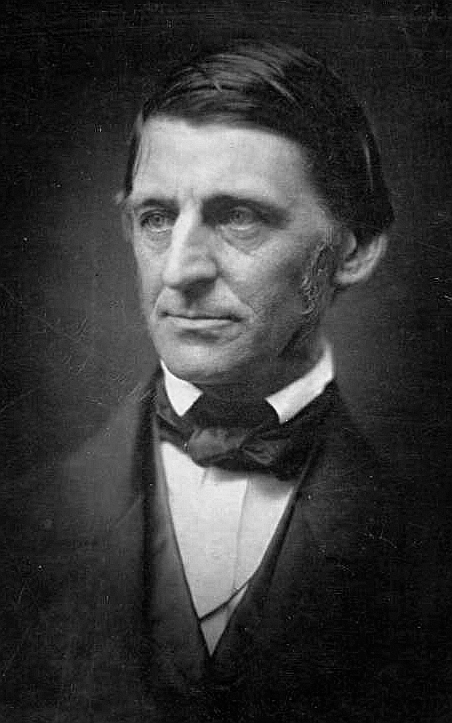
Ralph_Waldo_Emerson_ca1857_retouchedHis central idea, of course, is “Trust thyself.” In his earlier essays, he encourages his readers to disregard the past, institutions, and dogma, and to obey “the eternal law” within. “I will not hide my tastes or aversions,” he writes. “I will so trust that what is deep is holy, that I will do strongly before the sun and moon whatever inly rejoices me, and the heart appoints.” But in a later essay on Napoleon, who seems to have embodied the “deep” self-trust Emerson lauds, he states confusingly (after praising Napoleon) that what made Napoleon’s egoism wrong was that it “narrowed, impoverished and absorbed the power and existence of those who served him.” And whose fault is this?

It was not Bonaparte’s fault. He did all that in him lay to live and thrive without moral principle. It was the nature of things, the eternal law of man and of the world which baulked and ruined him.

Read that again. It was the “world” that ruined Napoleon, not Napoleon who ruined the world.

To live “without moral principle” is a bad thing for Emerson. He writes in “Self-Reliance” that the “rejection of popular standards” is not “a rejection of all standards.” Yet he refuses to state how we are to decide which ones are good and which ones are bad other than by, again, looking within. The “law of consciousness abides,” he writes—except, of course, when it doesn’t, which is why Emerson concludes his essay on Napoleon with a confusing warning on the dangers of being (you guessed it) selfish: “Every experiment, by multitudes or by individuals, that has a sensual or selfish aim, will fail.” In short: “Trust thyself, but not always!”

(Image: Emerson in 1857, via Wikimedia Commons)

Rubens’ Catholic Canvas

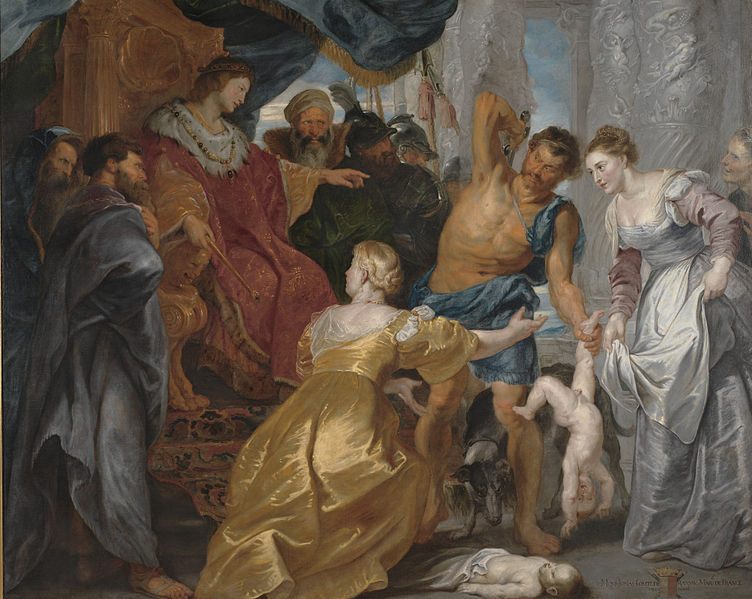
Salomons_dom

Robert Kiely praises Willibald Sauerländer’s The Catholic Rubens: Saints and Martyrs for reminding us that the painter’s “baroque passions” should not become “an excuse for ignoring his expression of religious and ethical sentiments and ideals”:

Many of his paintings are of religious subjects. Yet they are so bright and cheerful, so crowded with buxom women and muscular men caught in swirls of light and color, that his work, even his religious paintings, must be considered baroque (in the dismissive sense of the term)—decorative, theatrical, busy, pagan, and only superficially Christian. But, in the arts, as in life, simplistic classification gets in the way of actually paying attention. How refreshing it is, then, to read this scholarly, accessible, and beautifully illustrated book by the German art historian Willibald Sauerländer. …

According to Sauerländer, calling Rubens a master of “baroque passions” is not altogether wrong unless—as too often is the case—it becomes an excuse for ignoring his expression of religious and ethical sentiments and ideals. “It is only a slight exaggeration to say that art history has appropriated Rubens as one of its greatest figures by wresting his art free from the church”—that is, from theology, liturgy, history, and his own faith. Sauerländer’s project is to put the seventeenth-century church back into the picture by giving particular attention to Rubens’s paintings of subjects—the Eucharist, saints, and martyrs—that were criticized by Reformers and intentionally reemphasized by the church.

(Image: The Judgement of Solomon by Peter Paul Rubens, 1617, via Wikimedia Commons)

Face Of The Day

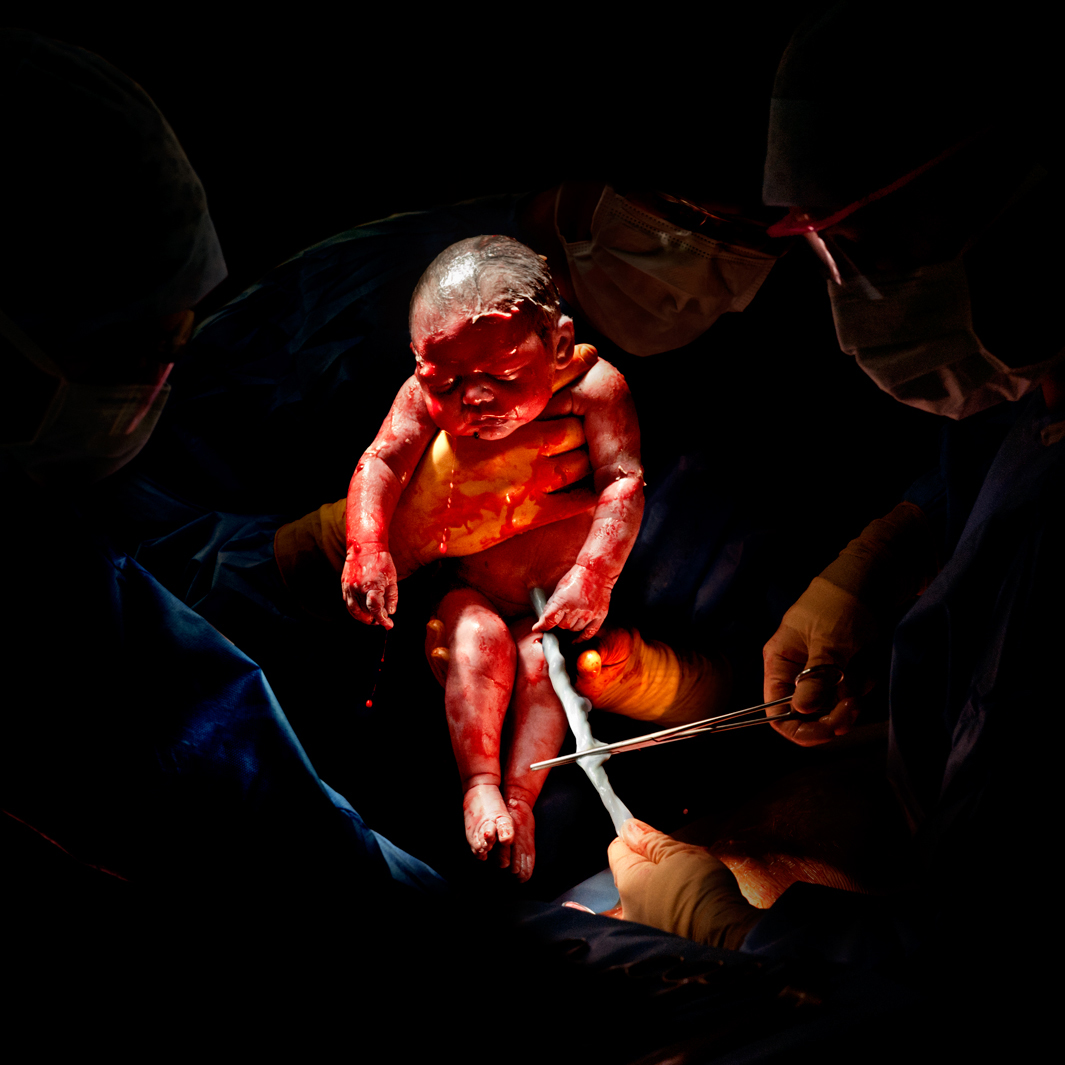
dish_under20seconds

Christian Berthelot photographed babies born by C-section in their first 20 seconds of life:

Berthelot said witnessing so many births has changed his perspective about the process and has decided to focus solely on the first few moments of life, though he knows viewers may find the images a bit raw and tough to look at.

“I know there are people who react very badly, who find it disgusting, they tell me that I do not have the right to show the children in the bloodstream,” he said.” Some even told me that it is not real, it is not true. This is absurd. Children are not born in cabbages or roses. And there are those who are fascinated, I give them the opportunity to observe in detail the violence of birth, but there are also people like my wife, who encouraged me to do this work, because caesarean is beautiful birth.”

“What continues to amaze me is that it never stops. With each passing moment, a child is born, from all over the world, all the time, births never stop.”

See more images from the series here. The project will be shown in Paris, France during the Festival Circulation(s) Exhibition from January 24 to March 8, 2015.

The Christian Case For Fighting Climate Change

Francis wants to make it with a new encyclical:

Its message will be spread to congregations around the world by Catholic clergy, mobilising grassroots pressure for action ahead of the key UN climate summit in December in Paris. The encyclical may be published as early as March, and may be couched in terms of the biblical parable of the Good Samaritan, which teaches that we have responsibilities to our fellow humans.

It will be the first encyclical to address concerns about a global environmental issue, and will provide “important orientation” to all Catholics to support action on climate change, says Bishop Marcelo Sánchez Sorondo, chancellor of the Pontifical Academy of Sciences and Social Sciences in Vatican City. Last May, he organised a workshop there discussing the science and impact of climate change. Participants issued a hard-hitting statement, which laid the groundwork and set the tone for the encyclical.

The most likely thrust of the pope’s appeal will be that failure to combat climate change will condemn the world’s poorest people to disproportionate harm. “The sad part is that the poorest three billion will be the worst affected by the impacts of climate change, such as sea level rise and drought, but have had least to do with causing it,” says Veerabhadran Ramanathan, a climatologist at the Scripps Institution of Oceanography in San Diego, California, and a scientific adviser to the Vatican on the encyclical.

Thursday, when asked if he thought mankind was mostly to blame for global warming, the Pope responded:

“I don’t know if it is all (man’s fault) but the majority is, for the most part, it is man who continuously slaps down nature,” he said. The words were his clearest to date on climate change, which has sparked worldwide debate and even divided conservative and liberal Catholics, particularly in the United States. “We have, in a sense, lorded it over nature, over Sister Earth, over Mother Earth … I think man has gone too far.”

When the encyclical was originally previewed late last month, Catholic Climate Covenant’s Dan Misleh put the move in context:

“It is the first time ever an encyclical letter has been written just on the environment,” Misleh said. “The faithful, including bishops, and all of us who adhere to the Catholic faith, are supposed to read it and examine our own consciences.”

Mobilizing believers to embrace climate action could be a very big deal, given the sheer number of people who identify as Catholic in the US—around 75 million—he said. “If we had just a fraction of those acting on climate change, it would be bigger than the networks of some of the biggest environmental groups in the US,” he said. “That could help change the way we live our lives, and impact our views on public policy.”

Plumer has more:

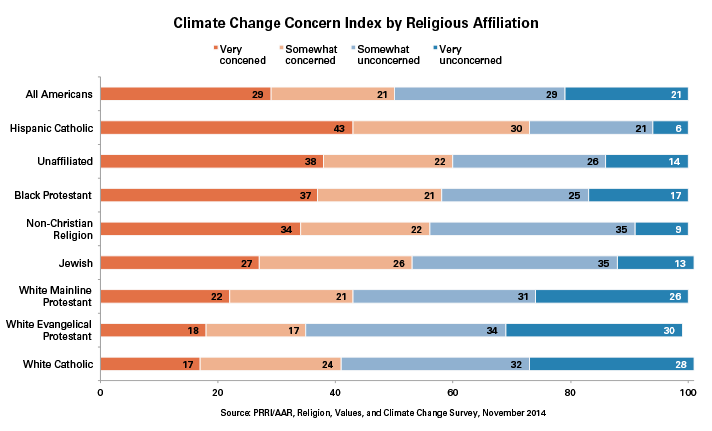
For what it’s worth, surveys in the US have found that white Catholics tend to be among the least concerned groups about climate change, whereas Hispanic Catholics are some of the most concerned. Here’s a PRRI poll from November 2014:
Figure3.0

But, of course, Catholics don’t just automatically follow the pope’s lead on every last political question. (Gay marriage is a perfect example.)

And of course with the Pope’s high approval rating around the world, he might also be able to influence Evangelicals, who, as Chris Mooney noted last month, are already moving toward more environmental action:

The biblically based stewardship or “Creation Care” message — which went very, very mainstream [last] year in the blockbuster film Noah — may not have won out with a majority of these believers. But it appears to have made substantial inroads. And evangelicals leaders like the climate scientist Katharine Hayhoe are working every day to convince more believers, by making theologically (and politically) resonant arguments for why they need to take climate science seriously.

He’s cautiously optimistic:

There’s no doubt that many religious people around the world cling to their beliefs (or, to what they think their beliefs require) in the face of evidence, and history shows science-religion conflicts popping up at regular intervals. But it also shows something else: Believers who find a way to reconcile faith and science.

If Pope Francis continues on his current course, he has the power to make this latter group a whole lot more prominent than it already is.

But seeking more than just rhetoric, Leber challenges Francis to pony up the Vatican’s fossil fuel investments as well:

There are two main arguments for divestment from fossil fuels, on moral and financial grounds. The former is that we have responsibility not to aid companies that imperil the planetGod’s creation, according to Catholicsespecially when it particularly impacts the poor. And while some financial experts claim divestment is impossible to detangle fossil fuels from a portfolio and retain balanced, stable growth, others argue that in a low-carbon world, fossil fuel stocks become worthless, risking ruin for those who retain too much faith in oil, gas, and coal. The head of England’s central bank, for instance, has already warned investors that their focus on short-term profits in the fossil fuel market may be foolish in the long-term. (Rolling Stone’s Tim Dickinson has a worthwhile read on the economics of divestment.)

One can see how the Vatican, which has an estimated $8 billion portfolio, could make wavessymbolically and financiallyif it were to divest from fossil fuels. Environmental group 350.org is pushing the Church to do exactly that, and claimed Wednesday that hundreds of protesters attended a divestment vigil just before Francis arrived in Manila. Now it’s time for the Pope to put his words into action. What better way to show the world that 2015 is the year for global climate action than to lead by example?

Regardless, the editors of New Scientist are nonetheless pleased to have the Vatican as an ally:

For all the railing of secularists against the idea that the church has any special claim over morality, and despite its influence being [on the wane], many people heed religious authority more readily than any scientific or economic argument. And the pope’s case is one that leaders of rich, carbon-intensive nations are reluctant to put forward: that they owe it to the world’s poor to cut emissions.

Not every churchgoer will be swayed. Evangelicals are among the staunchest of climate sceptics; even those who accept the reality often view it as God’s will. It remains to be seen if the pope can appeal to these recalcitrants – or if the jeering of denialists will take on a theological, rather than scientific, tone (to which we can only say: god help us).

It was 350 years before a pope admitted that the church had wronged Galileo, whose reputed parting shot was to say of the Earth: “eppur si muove”– “and yet it moves”. In contrast, it has taken the Vatican hardly any time to accept that Earth is warming. It helps that the Bible contains precious few verses pertinent to carbon emissions. Perhaps we will start to see evidence reshaping the Vatican’s views on other issues where scripture still holds sway: the role of contraception in tackling population growth, say. One can only pray it will.
A God Of Liberation

John Schad profiles the literary critic Terry Eagleton, noting the way his Catholic upbringing mingles with his radical politics:

There was a time, mainly in the 1980s, when Catholicism was all but invisible in Eagleton’s writing. For some time now, it has been very evident; nevertheless, to date, Christianity has seemed to be primarily a language for Eagleton’s Marxism, or communism, with the crucifixion being a way of unearthing what Eagleton seemed to think of as a tragic vision otherwise buried within communism. However, what I am hearing now, as he speaks, is not so much communism-via-Christianity but rather communism-and-Christianity, a genuinely double act.

Is Eagleton, then, back where he was 50 years ago when he would often refer to himself as a Christian? I am tempted to ask this rather dumb, card-carrying question but resist. I do, though, summon the stupidity to ask the “afterlife” question, the heaven question. Given that he makes so much of the crucifixion, what, I ask, should we make of the biblical account of resurrection? What, if anything, is its significance and does that in any sense include an afterlife? “No,” he says, “the after-life is not a Judaeo-Christian belief. As Wittgenstein says somewhere, ‘How strange that people believe that when you die eternity starts.’ The Christian belief is in an eternity that is here and now.” “But,” I ask, “is eternity limited to here and now?” To which he replies that “eternity does not mean we will live on and on – that would be hell”.

In a recent review of Eagleton’s latest book, Culture and the Death of God, Eugene McCarraher also emphasizes the theological views that undergird his politics:

The itinerant and crucified Jesus, not his Dad, is the apotheosis of Eagleton’s political theology. To the curer of leprosy and blindness, pain and disease are “unacceptable”; misery and despair are not “enviable opportunities to flex one’s moral muscles.” Jesus mends without compensation or moral inquiry; he never tells the afflicted to learn the edifying lessons the Almighty is teaching them, however inscrutably. If there must be suffering, it comes as the price of personal and collective transfiguration; our condition is so awry that the only way out is through a turbulent journey of self-dispossession. As Eagleton explains, the Christian life as portrayed in the Gospels is not that of the pious, hard-working, familial accumulator dear to the conceits of suburban believers. It is rather “homeless, propertyless, peripatetic, celibate, socially marginal, disdainful of kinsfolk, averse to material possessions … a thorn in the side of the Establishment and a scourge of the rich and powerful.” In the life and death of Jesus—resurrection goes unmentioned—Eagleton discovers the most stringent and fundamental rebuke to capitalism, as well as the point of departure for any future revolutionary politics. It is in that crucible of downward mobility that “a new configuration of faith, culture, and politics might be born.” This is unvarnished liberation theology, and here Eagleton returns to the prophetic Marxism that animated his earlier career.