Mauled By Climate Change

ARGENTINA-CANADA-ANIMALS-POLAR BEAR-ZOO

Polar bear attacks are on the rise:

[Biologist James Wilder’s] data is still incomplete. But two things are already clear: the number of people killed by polar bears is relatively small—so far, Wilder has found just twenty-one deaths in the last 140 years—but the number of interactions between humans and polar bears is rising. According to Wilder’s tabulations, there were fewer than ten attacks per decade in the 1960s and ’70s. But in the first four years of this decade, Wilder has already documented fourteen interactions. At this pace, he expects to see about thirty-five incidents by the end of 2019—nearly as many as the last forty years combined.

Why this is happening:

Ocean temperatures are climbing faster in the Arctic than anywhere else in the world, leading to a substantial decrease in sea ice. In September 2012, the Arctic sea ice level was 49 percent lower than the historical average from 1979 to 2000. The southern parts of the Arctic, including the Torngats, have had an ice-free summer season throughout modern times. But the ice-free period is growing longer. Since the late 1970s, the number of ice-free days in the area around the Torngats has increased from 125 days to 175 days. Less sea ice means polar bears must spend more time on land. To survive, they live off the body fat stored from their earlier kills on the ice. As the period when they have to live off that reserve grows longer, some eat goose eggs, grasses, or berries. But their foraging goes only so far—they can’t survive without the fat they get from seals. “As the bears’ body condition declines, more seek alternate food sources so the frequency of conflicts between bears and humans increases,” the scientists [Ian Stirling and Andrew Derocher] concluded.

(Photo by Andres Larrovere/AFP/Getty Images)

Busted With An Eggcorn, Ctd

The Dish thread that won’t quit:

My twenty-four-year-old daughter has Down syndrome. While she has plenty to say and can be understood by most people, her speech sometimes takes some interesting twists and turns. She does her own laundry, often when I’m not at home. Occasionally a sock or something else falls into the laundry tub, blocking the drain. As the washer empties into the tub, it fills up and the water ends up on the basement floor. The wash machine shuts down and won’t finish the cycle. I get home and she explains the problem. The wash machine, she says, is overfloating.

Another reader:

I came across my favorite eggcorn because I‘m a huge ice hockey fan.

In online chats I’ve seen many English-speaking fans lament the poor quality of their team’s defense “core.”  While every team in every sport probably has a defensive core in some sense, these folks have misheard broadcasters and analysts referring to a team’s defense corps, i.e., the group of the team’s defensemen as a whole. Kind of ironic for a sport that has so many French-speaking followers in North America.

Another:

I just read a blog post where someone was fighting “tough and nail” for a position.  Not one I’d heard before.

Another:

My 5-year-old just used an eggcorn and I felt compelled to email you. I gave him one of my parental “looks” in response to some mild misbehavior, and he asked me why “I was raising my eyebrowns”.

And another:

When Cardinal Ratzinger became Pope Benedict, I’d recently started working at an international organisation. At the canteen table over lunch some colleagues were discussing the new pope’s personal history and views on social issues.  We were joined by a colleague from Poland who I didn’t yet know very well. “Have you heard what the Italian media have nicknamed the new Pope?” she asked, in heavily accented English. We shook our heads. I heard: “Papa Nazi.”

“Ah,” I said. “We were just talking about how he was in the Hitler Youth. He does still seem to have pretty right-wing opinions, doesn’t he?”

My other colleagues looked down, embarrassed, while my Polish colleague launched into an impassioned defence of Benedict’s theology and how he’d been forced into the Hitler Youth against his will. I was confused: if she felt that way, why pass on a joke about it?

It was only an hour later, back at my desk, that the penny dropped. Polish – probably Catholic. Italian media – probably not making Nazi jokes. I went to Google, and discovered that they had in fact nicknamed him Papa Ratzi.

I penned an embarrassed email to my Polish colleague, who responded gracefully. But I’ve never been able to shake thinking of Benedict as Papa Nazi.

Another:

My friend used to think “miniature golf” was “minutes of golf.” I think a lot of eggcorns are the result of the Boston accent (“min-ah-tcha gawlf”).

Another:

Not sure if anyone has mentioned this one yet. My dad’s a doctor who specializes in cardiology and internal medicine.  As a kid, anytime he mentioned having to swing by the ICU (intensive care unit), I thought he was referring to the “I See You.”

One more:

I worked in land surveying for several years with a very bright crew chief. Unfortunately, he got it in his head that a “guy wire” (those wires that run from the top of a utility pole to the ground) was a “guide wire.”  I never corrected him, and even though I always said it correctly, he either didn’t notice, or thought I was an idiot. We’re still friends and I still don’t have the heart to tell him. (If you publish this, though, I WILL post it to Facebook).

The NYPD Turns Its Back On Civilian Control, Ctd

nypd3

George Packer fears that the rift between the NYPD and de Blasio is irreparable:

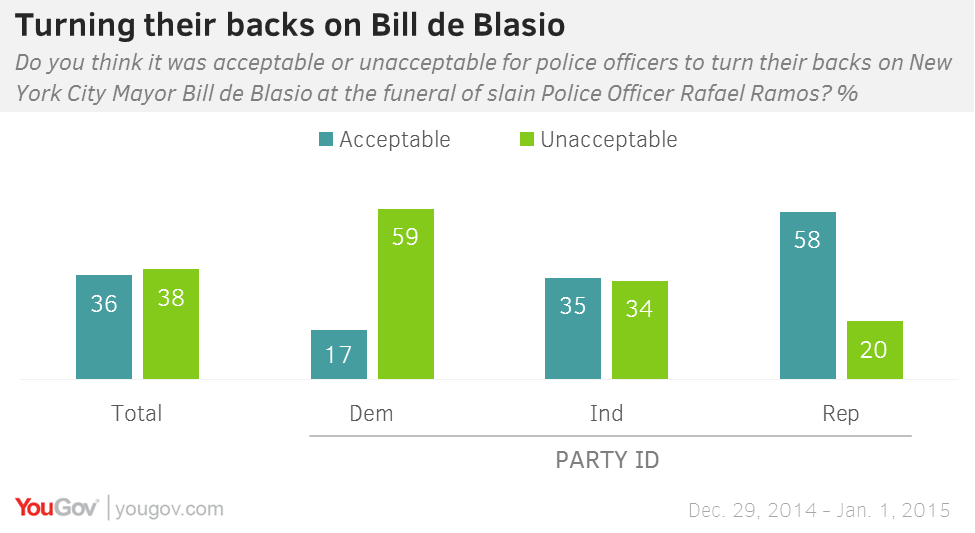
The Mayor is doing what he can to overcome ill will among police. It’s probably too late—in just a year he’s lost his department. This is a disaster for a city that elected de Blasio with seventy-three per cent of the vote, and that also—judging by the wide and deep sympathy expressed after the execution of two officers in Brooklyn—generally supports its police force. Patrick Lynch, the demagogue who leads the Patrolmen’s Benevolent Association, is playing a very dangerous game by inflaming his rank and file, politicizing funerals, countenancing an unprofessional work stoppage (imagine aggrieved nurses refusing to treat patients), and laying the two officers’ murders at de Blasio’s feet. If New Yorkers are forced to choose between the Mayor and the police, the result—already showing up in polls and public discourse—will be a racially polarized city. If the police who turned their backs on the Mayor imagine that this confrontation will bring the city around to their side, they’re deluded.

Linker is pissed that the NYPD is disregarding its civilian leadership and getting away with it:

It is absolutely essential, in New York City but also in communities around the country, that citizens and public officials make it at all times unambiguously clear that the police work for us. … When police officers engage in acts of insubordination against civilian leadership, they should expect to be punished. Just like insubordinate soldiers. The principle of civilian control of the military and police depends on it.

It also depends on cops who kill unarmed citizens being tried in a court of law. And on cops respecting the right of citizens to protest anything they wish, including the failure of the judicial system to hold police officers accountable for their use of deadly force in ambiguous situations. All of this should be a no-brainer. That it apparently isn’t for many police officers and their apologists in the media is a troubling sign of decay in our civic institutions.

Noah Millman mulls over what NYPD Commissioner Bill Bratton needs to do to heal the damage going forward:

Bratton does not need to turn against his own legacy – nor does he need to defend it aggressively. The consensus against allowing crime rates to go back up is overwhelming. What Bratton needs to demonstrate is that he has control over his department, and that he is committed both to keeping crime low and to reducing the perception that the police are an oppressive presence.

Which, however, genuinely represents a change of mission. It’s implicitly admitting that driving crime rates ever-lower is no longer the overwhelming priority – that the “change” goal is to lighten the police footprint. A change of that sort could very well be demoralizing – even threatening – to the NYPD. But Bratton surely remembers that CompStat itself was threatening when it was introduced – it meant telling beat officers that the computer knew better than they did how they should do their job.

Friedersdorf is exasperated at how many conservatives are quick to dismiss the outrage over police brutality as rabble-rousing racial politics when the evidence points to something much more concrete:

[T]he 90 percent of black voters who say that police brutality is a “very serious” or “somewhat serious” problem, the 59 percent of black New Yorkers who disapprove of the way the NYPD is doing its job, and the 81 percent of black New Yorkers who believe the NYPD is tougher on blacks than whites cannot be explained away by gesturing at a criminal mindset. Millions of law abiding people share these critiques. …

And despite the evidence of racial bias in New York City policing, the majority of people who disapprove of how the NYPD is doing its job don’t actually “hate” or “despise” the NYPD. They just desperately want it to be reformed so that bad policing is documented and punished rather than being ignored or covered up. Conservatives could argue that race isn’t actually the core of the problem, that the culture of unpunished misbehavior in the NYPD is driven by, say, the tribal mindset documented by Frank Serpico much more than any deliberate desire to disadvantage blacks. But too many NYPD defenders refuse to acknowledge widespread misbehavior of any kind.

The one bit of good news is that police violence in New York is far less prevalent than it was a few decades ago:

In 1971, NYPD officers shot and killed 93 people, which works out to 12 fatal shootings for every million residents. In 2013, by comparison, 8 people were fatally shot by the police, or one fatal shooting for every million residents—a decline of more than 90 percent. Also in 1971, 12 New York City cops were shot and killed—the same number as in all of the last fifteen years put together. Also, police-related violence in New York isn’t low just in relation to the city’s historical rates; it’s low compared to the rest of the country.

(Chart via YouGov)

Is Christie Too Liberal To Win?

The New Jersey governor may jump into the 2016 race sooner rather than later:

Bush’s aggressive entrance in the race has sped up the timing of [Christie], who is preparing to make a public move toward running at the end of this month rather than waiting until February or March, according to a person familiar with discussions.

But Nate Silver doubts that Christie has a shot at the nomination, largely because “Christie takes moderate positions on the very issues where Bush notoriously deviates from the party base – such as immigration and education – along with others where Bush lands in the GOP mainstream, like on gun control”:

In late 2012, his favorability rating was 45 percent nationally against just a 20 percent unfavorable rating, according to Huffington Post Pollster. But Christie’s popularity has waned considerably in the wake of“Bridgegate” and other controversies. Now his ratings have turned negative; he has a 33 percent favorable rating and a 43 percent unfavorable rating, according to HuffPost Pollster. His head-to-head numbers against Hillary Clinton are no longer any better than those of fellow Republicans Bush and Mike Huckabee.

This isn’t catastrophic unto itself. There are lots of unpopular politicians in both parties. The head-to-head numbers don’t mean much yet, and many Republican voters would come around to Christie were he to win the nomination. But Christie’s case to Republicans is especially dependent on his perceived ability to win the general election. That’s the reward the GOP would get for putting up with the baggage Christie carries. Without it, it’s hard to see the Republicans’ rationale for choosing him.

The Whole Damn Country Is Sick

Flu

Basically:

The annual influenza outbreak has reached widespread levels in 43 states – up from 36 states a week ago.

Flu season arrived early this year – reaching epidemic levels last week:

That the flu has reached epidemic status is not unexpected — this is a regular part of flu season — but it has reached epidemic levels somewhat earlier than it usually does. The last two flu seasons were declared to be epidemics in mid-January.

And this year’s flu vaccine isn’t well suited to the bug going around:

This season is looking particularly bad because the predominant strain, H3N2, is not completely covered by the current flu vaccine and tends to have more severe symptoms. H3N2 accounted for the majority of the strains tested by the CDC so far this season, according to a health advisory issued in early December.

Sarah Zhang explains why flu vaccines don’t always work:

A network of labs working around the world is always on the lookout for new and emerging viruses year-round. These viruses are then tested against human blood serum; the ones that provoke the least immune response are the ones that are most novel and dangerous to the population.

But flu viruses naturally mutate, which is, after all, why we have to formulate a new flu vaccine each year. This year, the H3N2 virus mutated faster than usual, so the vaccine we now have is less effective against the H3N2 virus that is circulating most widely. The new H3N2 was first detected in March of 2014, and it became common by September. And now it’s too late to add it to this year’s flu vaccines altogether, thanks to the decades-old process we use to create vaccines in the first place.

Kent Sepkowitz defends the flu vaccine, even if it’s somewhat less effective than normal:

25,000 to 40,000 people a year die of influenza—the vast majority of them unvaccinated. A simple halving of the number with today’s mediocre vaccine would represent a major public-health triumph. By way of comparison, about 14,000 people in the U.S. died of AIDS in 2011—a vaccine to cut that number in half likely would result in a Nobel Prize.

That’s why the CDC still wants you to get the shot:

[T]he vaccine is still effective in about one-third of cases. “While some of the viruses spreading this season are different from what is in the vaccine, vaccination can still provide protection and might reduce severe outcomes such as hospitalization and death,” said [Darlene Foote, a representative of the CDC].

(Chart from the CDC)

France’s South Park

A reader writes:

enhanced-27032-1420647847-2Here’s something I’d like to contribute re: the massacre. First, I went to high school with the daughter of one of the victims, a long time ago but still. I met him and knew him – a very nice and funny guy. So it’s shocking on a personal level.

Second, these things do not usually happen in France. Especially the part where a commando uses automatic weapons (AK-47). It’s very hard to procure AK-47s in France. It’s not on sale at Walmart, like here. So this means these are organized criminals (obviously).

Charlie Hebdo is an institution. Its humor was always very corrosive and harsh. The writers and illustrators have been active in one form or another since the late ’60s, making fun of everybody and angering everybody since then.

Its first incarnation, aptly called “Hara-Kiri” was the most scandalous weekly magazine you could find.

The week after the General de Gaulle died, they came out with the title: “Tragic ball at Colombey: one dead.” (Colombey-Les-Deux-Eglises was the village where the General’s private residence was located). After the scandal, they were forbidden to print and had to start another weekly under a new name.

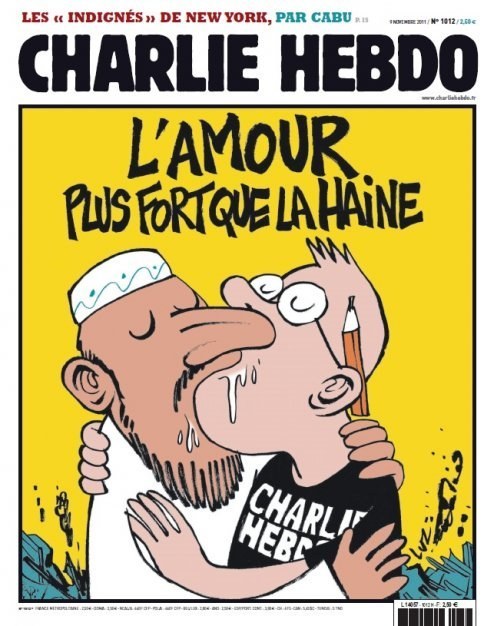
enhanced-22753-1420647659-17Charlie was always committed to intellectual anarchism, virulently anti-clerical and anti-religion and resolutely left wing. But always in a hilarious manner. There is no 40-year-old French person of all political persuasion who has not read and laughed along with Charlie’s weekly delivery of caricatures.

More recently, Charlie been printing lots of cartoons making fun of Islamists and their Prophet. They were already the target of a bombing a couple of years ago. So everybody is thinking what I am thinking. If it turns out to be the doing of an Islamist cell, this is almost like France’s 9/11. On a much smaller scale, but France is a much smaller country. To assassinate the comedians and the satirists is as big, if not bigger thing. It is a direct impact on France’s most cherished cultural trait: the active, public, vocal disrespect and skepticism towards any form of authority, political or religious.

I am crestfallen and scared. This is a very dark moment.

Amy Davidson adds:

Recently, the magazine had mocked the Islamic State in Iraq and al-Sham, or ISIS. Its last tweet before the attack was of a cartoon making fun of the group’s leader, Abu Bakr al-Baghdadi. That is not recklessness; it’s how one knows that ISIS has not won, and never will. There Charlie-Hebdo-Secondary2-320ought to be more such tweets. (Whether ISIS in particular had a role in this attack is a question that can’t be answered at this stage; its members are, sadly, not the only ones in the terrorism business.)

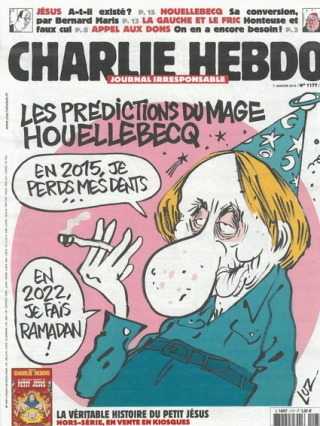
The current issue of Charlie Hebdo, published the day of the shooting, featured a caricature of the novelist Michel Houellebecq on the cover. Houellebecq’s new novel, “Submission,” also out Wednesday, according to the Times, “predicts a future France run by Muslims, in which women forsake Western dress and polygamy is introduced.” The drawing of Houellebecq, accompanied by a joke about Ramadan, is not flattering. The French police have added the protection of Houellebecq to their list of priorities on what is, by all accounts, a traumatic and disorienting day for the entire country.

Update from a reader:

I have to ask, does your reader who states:

Especially the part where a commando uses automatic weapons (AK-47). It’s very hard to procure AK-47s in France. It’s not on sale at Walmart, like here.

… understand that automatic weapons are not on sale at Wal-Mart? Granted, something of the point may stand – it’s not as if illegal firearms play no role in crime in the US – but it makes me question someone’s ability to expound on a topic of they’re willing to throw out factual inaccurate remarks in the process.

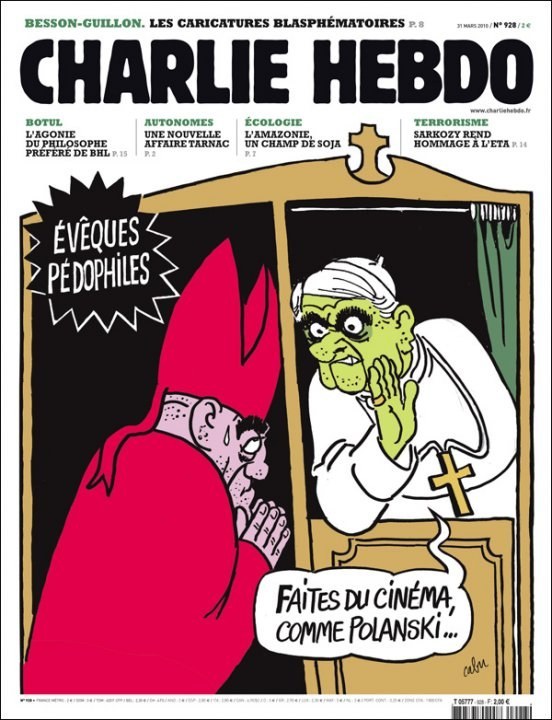
(Top cover translates to “Love: Stronger than hate.” Middle cover depicts Catholic bishops discussing how to get away with pedophilia. Bottom cover is the aforementioned one featuring a caricature of the Houellebecq.)

Slaughtered For Satire

The Paris offices of the French satirical magazine Charlie Hebdo, which has in the past been condemned and firebombed for its satirical depictions of the prophet Muhammad, were ambushed this morning by two gunmen, who killed 12 people before fleeing the scene. A massive manhunt is now underway throughout the French capital:

Visiting the scene of the country’s worst atrocity in decades, the French president, François Hollande, described it as “a terrorist attack, without a doubt”. Hollande said the assault, which happened at about 11.30am on Wednesday after the magazine’s staff had gathered for their weekly editorial meeting, was “an act of exceptional barbarism”. Warning that several other attacks had been foiled in recent weeks, the president called for national unity and convened an emergency cabinet meeting. The French government raised the terror alert level in the greater Paris region to the highest level possible. …

A spokeswoman for the Paris prosecutor’s office, Agnes Thibault-Lecuivre, confirmed that 12 people had been killed in the attack. Police said three attackers were involved, two who entered the building and a third who drove a car to the scene, in rue Nicolas Appert in the 11th arrondissement in eastern Paris. The gunmen escaped in the car before abandoning it in the 19th arrondissement, where they hijacked another car, ordering the motorist out.

The Guardian is live-blogging. As of this writing, the gunmen have not been identified or apprehended, and no group has claimed responsibility for the attack, though ISIS had previously threatened to target France. Katie Zavadski speaks with a terrorism expert on what made this attack unusual:

That the attackers sped away instead of fighting to the death, however, means that Wednesday’s attack is different in style from the suicide attacks often deployed by terror organizations. Mia Bloom, a professor of security studies at the University of Massachusetts, Lowell, tells Daily Intelligencer that the highly-trained gunmen may have been too valuable to waste on such a mission — especially given that a suicide attack would have only required one bomber. “This is a far more dangerous kind of attacker because the terrorist group invests heavily in their training and preparation, and will be able to have a second or even a third strike if they want to really spread terror and panic beyond the magazine and the 11th arrondissement,” she said, referring to the area of Paris where the attack occurred.

Max Fisher stands up for Charlie Hebdo’s dedication to pushing Islamists’ buttons:

The magazine was not just criticized by Islamist extremists. At different points, even France’s devoutly secular politicians have questioned whether the magazine went too far; French Foreign Minister Laurent Fabius once asked of its cartoons, “Is it really sensible or intelligent to pour oil on the fire?”

It is, actually. Part of Charlie Hebdo’s point was that respecting the taboos strengthens their censorial power. Worse, allowing extremists to set the limits of conversation validates and entrenches the extremists’ premises: that free speech and religion are inherently at odds (they are not), and that there is some civilizational conflict between Islam and the West (there isn’t). These are also arguments, by the way, made by Islamophobes and racists, particularly in France, where hatred of Muslim immigrants from north and west Africa is a serious problem.

Michael Rubin comes to a similar conclusion:

Satire and ridicule are like carnival caricatures. They may exaggerate, but they strike a chord because their basis in fact resonates with a wide audience. Such is the case also with satire. Islamists cannot handle free thinking at the best of times, but ridicule is their kryptonite, for it shows that the would-be caliphs have no clothes.

Free speech can be a powerful tool, and so Western liberals should rally around Charlie Hebdo. To suggest that the satirical outlet brought violence upon itself is to suggest women wearing bikinis invite rape. Do not blame the victims, but rather the perpetrators. Recognize that free speech is under assault, and that it is a value worth protecting. Let us hope that no government or publisher responds to today’s violence with self-censorship, as some commentators and journalists have counseled under similar circumstances. If they do, the Islamists have won and all man’s progress since the Enlightenment is at peril.

But Massie despairs of the aftermath of this attack:

Doubtless some will still, even now, find a way to blame the victims. Doubtless some will do anything they can to avoid looking reality squarely in the face. Doubtless some will pretend that reality can be wished away or that responsibility can be transferred to someone, anyone, other than the perpetrators. Shame on those people. Shame. 

Doubtless, too, there will be the usual calls on all Muslims everywhere to condemn these attacks as though they bear some inchoate communal responsibility for the barbarous actions of their co-religionists. This too will be drearily predictable and familiar and, most of all, desperately unfair. Their Islam has nothing to do with this even if it is also true that other subscribers to the faith do not share their views. The platitudinous suggestion Islam is a religion of peace is evidently, abundantly, true for the vast majority of Muslims while being utterly untrue for some. And so what? Where does that leave us? Only in a state of dread that’s matched only by its inadequacy.

The Wrong Way To Chip Away At Obamacare

Suzy Khimm examines the GOP’s plans:

One of the first items on their agenda in January is President Obama’s signature health care legislation. But Republican’s won’t be pushing for a full repeal of Obamacare. They’re not even pushing for partial repeal. Instead, they’re angling for a seemingly incremental change: to be counted as full-time, workers should need to rack up 40 hours a week, not 30 hours. …

But the GOP’s proposed change is hardly a minor tweak to Obamacare—and not all conservatives agree it’s the best way forward. It would effectively gut the employer mandate, reducing employer-sponsored coverage by 1 million people and costing $74 billion in lost penalties, according to the Congressional Budget Office and Joint Committee on Taxation. But it would also make it even more likely that the Affordable Care Act will have negative consequences for ordinary Americans, according to Larry Levitt of the Kaiser Family Foundation.

Paul Van de Water likewise warns that “raising the threshold from 30 hours a week to 40 hours would make a shift toward part-time employment much more likely — not less so”:

That’s because only a small share of workers today — 7 percent — work 30 to 34 hours a week and thus are most at risk of having their hours cut below health reform’s threshold.  In comparison, 44 percent of employees work 40 hours a week, and another several percent work 41 to 44 hours a week.  Thus, raising the threshold to 40 hours would place many more workers at risk of having their hours reduced.

In short, it’s the House Republican bill, not health reform, that threatens the traditional 40-hour work week the bill’s sponsors say they want to protect.

Jason Millman argues along the same lines:

[S]etting the ACA workweek at 40 hours puts far more employees at risk of having their hours reduced, according to a Commonwealth Fund analysis. Compared to the 30-hour definition, “there are more than twice as many workers at high risk of hours reductions because they are within five hours of the full-time definition at firms that do not offer health insurance coverage,” the analysis found. Commonwealth also concludes raising the full-time threshold will increase reliance on public coverage through the ACA.

The National Review’s Yuval Levin also took note of the Commonwealth findings, writing in November that adjusting the 40-hour workweek “seems likely to be worse than doing nothing.” Instead, the conservative pundit wrote, the GOP should focus on repealing the employer mandate entirely.

Our Hottest Year Yet

Trend Line

2014 set a new record:

The Japan Meteorological Agency (JMA) has announced that 2014 was the hottest year in more than 120 years of record-keeping — by far. NOAA is expected to make a similar call in a couple of weeks and so is NASA.

As the JMA graph shows, there has been no “hiatus” or “pause” in warming. In fact, there has not even been a slowdown. Yes, in JMA’s ranking of hottest years, 1998 is in (a distant) second place — but 1998 was an outlier as the graph shows. In fact, 1998 was boosted above the trendline by an unusual super-El Niño. It is usually the combination of the underlying long-term warming trend and the regional El Niño warming pattern that leads to new global temperature records.

Mooney adds important context:

[I]n a technical sense 2014 is just another year and just another data point. Despite the January ritual of tallying up each year’s temperatures and ranking it against prior years, what actually matters (as always) is the trend, not the individual year. But as we’ve seen, the global warming trend is intact — 2014 may just be an exclamation point on top of it.

Indeed, this year — 2015 – the temperatures of 2014 could take on major significance. After all, the world is now racing to complete a global climate agreement this December in Paris. A new temperature record for 2014 would surely light a fire under negotiators.

Meanwhile, there remains a 65 percent chance that we’ll see an El Niño — which could also help drive a new temperature record — in 2015.

The Weird Liberal Love Affair With The Draft, Ctd

Several readers sound off:

military draft would help with our current segregation problem.  No, not race, but segregation by income and ideologies.  It is easy to hate “the other” when one has never met the “the other”.  It is harder to hate them when they are an okay guy or girl you spent two years with bonding over how horrible the food is and that time it rained all day on a twenty-mile hike.

From a veteran:

The book, now out of print, is Chance and Circumstance.  The authors (a Republican and a Democrat) worked on the draft issue on Capitol Hill.  The conclusion: The one overriding factor in deciding who got drafted was family income.  High school graduates from locally wealthy families were less likely to be drafted than college graduates from low-income families.

I saw this firsthand in Vietnam.

I was Commandant of Faculty at a language school for Vietnamese signalmen where all the teachers were American soldiers with G.T. scores (comparable to I.Q. scores) of at least 120. The average education for my teachers was five years of college, including a couple of Ph.Ds. Every one of my teachers had the same story.  He was from a blue-collar family, went to a public college (frequently the first in his family to do so), ran out of money, dropped out of college or grad school and was promptly drafted.

From the book and my own experience, I am convinced that reinstating the draft will simply replace the financial incentives of an all-volunteer military with compulsion.  The same people will enlist, but from lack of economic clout and not voluntarily for economic incentives.

Another boomer:

Although I often agree with Daniel Larison, he is dead wrong about the impact of the draft on the Vietnam War. As a veteran (of the peace movement), it was quite clear to me that it was the draft (more than Walter Cronkite) that turned Americans against the war.  Yes, the Vietnam War went on for years whilst the draft took place, but Larison neglects to mention that the overwhelming number of draft age middle class white men had 2S college deferments.  It was a draft mostly off the poor and blacks – the voiceless.

In late 1969, student deferments ended, replaced by a random lottery of 365 dates where the first third were drafted.  This touched off a firestorm in reaction against the war.  I drew a number in the high 200’s, and I will never forget listening to the lottery numbers announced live on radio – a macabre spectacle if ever there was one.  I was lucky.

The parents of those drafted in the first third, many of whom never gave a whit about the war, joined the peace movement in droves with money and political muscle bringing even the likes of Henry Kissinger to the Paris peace table.

The Iraq/ Afghanistan/ Libya fiascos barely stirred an anti-war movement. Does Larison actually think those wars would have continued as long as they did if those body bags were filled with middle-class draftees, including the sons of congressmen?  I think not. And at the least there would have been a national debate, something that never happened.

Another reader shifts focus:

Forget the draft.  The way to make both politicians and the electorate think more carefully about our use of military force would be a war tax.  Imagine if every foreign military intervention automatically triggered substantial increases in income tax rates, especially in the top tax brackets.  It could be arranged so that multiple simultaneous foreign interventions would cause multiple increases, with two or more interventions leading to essentially confiscatory taxes on incomes over $1M.

I don’t know whether a draft would really cause anyone to think more about their foreign policy choices, but if I know Republicans, confiscatory taxes would definitely do the trick.  It also seems more just: the draft idea deprives young people of their freedom and possibly their lives in an attempt to influence the donor class’ political choices, while the war tax would leave young people alone and directly target the kinds of people who hold influence over politicians.