Faces Of The Day

Lawmakers Convene For Opening Of The 114th Congress

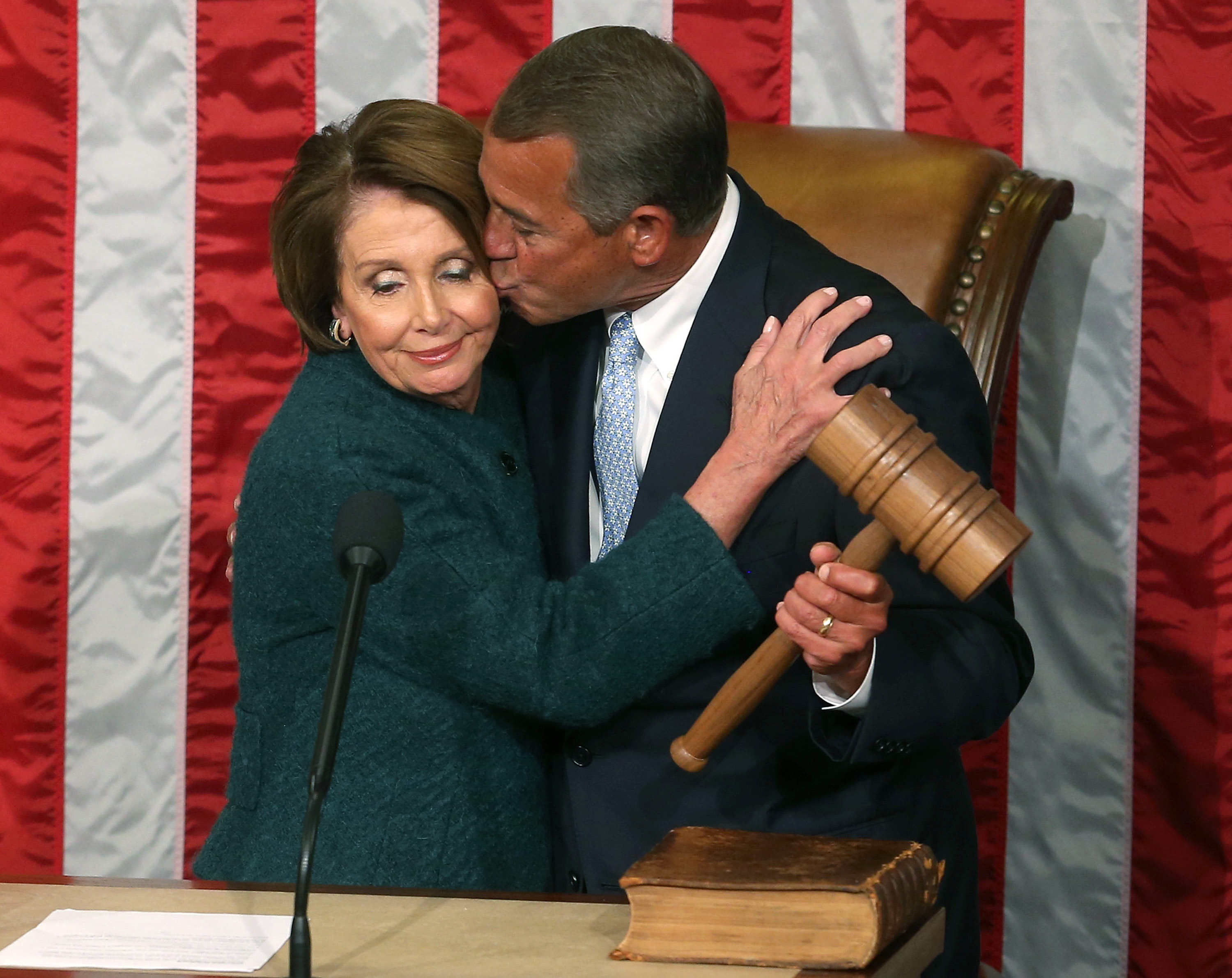
House Minority Leader Nancy Pelosi (D-CA) hands Speaker of the House John Boehner (R-OH) the speaker’s gavel during the first session of the 114th Congress in the House Chambers January 6, 2015. Boehner maintained his speakership but with two dozen House Republicans voting against him. Today Congress convened its first session of the 114th Congress with Republicans controlling both the House and Senate. By Mark Wilson/Getty Images. Update from a reader:

Good Lord, at first glance I thought this was Obama and Pelosi. Why is Boehner so dark in this photo?

A Misadventured, Piteous Overthrow Attempt

Few would shed few tears if Gambian dictator Yahya Jammeh, who recently signed a law criminalizing “aggravated homosexuality” and who once claimed to have discovered an herbal cure for AIDS, were to come to some bad end. However, the two Gambian-Americans who recently tried to pull off a coup in Banjul clearly didn’t think it through:

The men, Cherno Njie, 57, of Austin, and Papa Faal, 46, of Brooklyn Center, Minn., were part of a ring of approximately a dozen co-conspirators who agreed to participate in the coup, according to a criminal complaint. In an interview with the FBI, Faal admitted playing a role in the coup and identified Njie, a businessman, as one of the leaders and main financiers of the plot, the complaint alleges. Faal told the FBI that Njie intended to serve as the interim leader of the country after they deposed 49-year-old Yahya Jammeh, the president of Gambia. …

The group had originally planned to ambush the president’s convoy but instead decided to target the government State House in Banjul, the country’s capital. Split in two teams, the group descended on the State House, the complaint says, before encountering heavy fire and taking serious causalities. Some of the attackers were killed.

Pointing to fraying ties between Jammeh and his military, which have underlain many previous coup attempts, Maggie Dwyer isn’t surprised to see diaspora dissidents trying to bump off the strongman:

Despite the fate of past coup plotters in the Gambia, military personnel have continued to try to oust Jammeh. He has endured at least eight alleged coup attempts during his 20 years in office. Many of the accused plotters had served at the highest military positions, including Army Chief of Staff and Director of the National Intelligence Agency, suggesting divisions at the most senior levels. It should be noted that there is speculation as to whether some of the attempts were real or simply ways to purge members of the military. The ambiguity of these events is another cause of uncertainty and fear within the military. These tensions, divisions, and dissatisfaction within the Gambian military probably contributed to the most recent and past coup attempts against Jammeh.

Keating comments:

Coup plots against brutal West African dictators tend to attract a certain kind of overambitious adventurer. Most memorable was the misbegotten 2004 “wonga coup” attempt against Equatorial Guinea President Teodoro Obiang Nguema, a tangled mess involving British and South African mercenaries and—allegedly—Margaret Thatcher’s son. Faal, at least according to his statements, appears to have been a bit more idealistic than the wonga plotters, motivated by concern over the dire state of affairs in his country, even if he didn’t really think through the consequences of what he was getting involved in.

In case you’re wondering, it’s legal in many cases for U.S. citizens to fight in another country’s war, but plotting aggression against a nation “with whom the United States is at peace” from U.S. soil is prohibited under the Neutrality Act, which dates back to George Washington’s presidency.

While Jammeh downplayed the coup attempt as a terrorist operation backed by foreign governments, he also reshuffled his cabinet and launched a crackdown on local dissidents in response:

“There have been massive arrests in Banjul and there’s a heavy security presence in the capital Banjul and around the presidential palace,” a Gambian journalist told DW. He spoke to DW on condition of anonymity and confirmed that both serving and former military personnel had been arrested and that security had been vamped up in the capital Banjul. He however said that life in the city was back to normal on Friday (02.01.2015). … Gilles Yabi, a researcher based in Dakar, warned that the attempted coup could result in the wider repression citizens in Guinea-Bissau. “There are fears the regime could take advantage of the situation by blaming people who had nothing to do with it.”
Suicide Leaves Behind Nothing, Ctd

A reader merges the Leelah Alcorn thread with another popular one:

You’re no doubt unsurprised that I disagree with your reader who characterized Leelah’s suicide as “the worst and most selfish way to get satisfaction.” I can imagine far worse and more selfish ways of receiving satisfaction over grievances. In fact, I don’t have to imagine them, because we’ve seen them at Sandy Hook and earlier this month in Arlington, Texas, when Veronica Dunnachie killed her estranged husband and his daughter. Leelah didn’t shoot up her church or kill her parents – two choices that would have been far worse and more selfish than stepping in front of a truck.

I’m doing more than just objecting to the hyperbole. This loops us back to your “Suicide Leaves Nothing Behind” thread. People who have calmly, rationally decided that death is their best option should have better, more dignified, less violent options. They shouldn’t be forced to put loved ones at legal risk or involve anonymous third parties like that truck driver.

And, yes, it should include counseling, and in the case of minors, consent from either parents or a judge. But if at the end of the counseling the person is still resolved to die, they should have a painless dignified option of doing so on their own timetable. Martin Manley should have a more dignified exit available to him than a bullet to the head in a parking lot, and teens like Leelah should have a place to go to get the support she needs to make a better choice that won’t start by calling her decision to die awful and selfish.

An expert weighs in:

As a psychotherapist, I’d like to push back a bit on the notion expressed by some readers that Leelah Alcorn’s suicide, or that suicide in general, is selfish.

Or that it’s in any way an extension of the “typical” “selfish” behavior of teenagers. I think selfishness is not a helpful adjective to use in this conversation. Suicide is the last, most desperate act of person who is suffering beyond what most of us can imagine. Suicide is no more selfish than having major depression or a terminal illness plus chronic pain is selfish.

And it is developmentally normal for teens and young adults to be somewhat more self-focused than middle-aged or older adults. There is nothing useful to be gained by labeling teens as selfish with the moral sanctimony that conveys.

My reading of the data is that suicide is less common among adolescents than older age groups, which would suggest that it’s misguided to associate the normal increased self-focus of teens with the act of suicide, speaking at the level of trends. At the level of the individual, increased sensitivity to self-image in a teen may be one additional risk factor for those who are already struggling with depression and lack of social support. But the idea that teen behavior is “selfish” and teen suicide an example of this “selfishness” is a terrible and inaccurate notion to perpetuate.

Suicide represents a systemic failure, not an individual failure. It often reveals a lack of adequate family and social support of the individual who is suffering, and often also a lack of access to adequate healthcare and counseling. Suicide is a collective failure that manifests in an individual’s actions. Which isn’t to say that individuals have no responsibility to get help; we all have choices. Of course some of us have more choices than others because of economic of social privilege.

Talk of suicide always makes me think of both David Foster Wallace and a close friend of mine, also a writer, who committed suicide around the same time. Both of these individuals were well into adulthood when they killed themselves and had struggled with depression for many years. They pursued multiple, invasive, and costly treatments, were hospitalized, did talk therapy, and as far as I can tell worked hard to love and be loved in their daily lives. They were people with significant economic resources to avail themselves of all these treatments and with substantial social supports. And yet, after many years of steady, hard work to recover from their depressions, they both took their lives.

If DFW and my friend had been diabetes patients, we would say they did all the right things to safeguard their health, and the illness still took them. If they had been cancer patients, we would have praised them for fighting courageously against their disease before succumbing to it. We would never think to call them selfish. It continues to astonish me how much stigma we still tolerate being assigned to serious and devastating mental health issues.

The Rise And Fall Of Music Genres

It’s connected to the complexity of the songs:

We show that changes in the instrumentational complexity of a style are related to its number of sales and to the number of artists contributing to that style. As a style attracts a growing number of artists, its instrumentational variety usually increases. At the same time the instrumentational uniformity of a style decreases, i.e. a unique stylistic and increasingly complex expression pattern emerges. In contrast, album sales of a given style typically increase with decreasing instrumentational complexity. This can be interpreted as music becoming increasingly formulaic in terms of instrumentation once commercial or mainstream success sets in.

Lenika Cruz reads through the research:

Perhaps most interesting is the study’s tracking of “complexity life cycles.” For one, “experimental,” “folk,” and “folk rock” consistently maintained high levels of complexity through each time period studied. Others weren’t so lucky: “Soul,” “classic rock,” and “funk” started out high on the complexity scale but have since plummeted.

At different points in time, styles such as “euro house,” “disco,” and “pop rock” decreased in complexity, but enjoyed higher average album sales, while “experimental,” “alternative rock,” and “hip hop” became more complex, but saw overall sales decline. “This can be interpreted,” the researchers said, “as music becoming increasingly formulaic in terms of instrumentation under increasing sales numbers due to a tendency to popularize music styles with low variety and musicians with similar skills.” (In terms of instrumentation being the key here—and the study only looked at complexity factors that lent themselves to quantitative analysis such as acoustics and timbre).

Consent Of The Nudged

Steve Teles worries about it in his review of Cass Sunstein’s Why Nudge? The Politics of Libertarian Paternalism, asserting that “for a book supposedly on the politics of libertarian paternalism, there is very little here on the core of politics, which is principally about the mobilization of consent”:

Sunstein says nothing about how his favored range of interventions can be expected to generate the power necessary to overcome the opposition one would expect from changes sufficient to alter significant social outcomes. Why? Because it is fairly obvious that you will not get masses of ordinary Americans flooding the streets with signs saying, “Nudge Me!” or “Stop Me Before I Snack Again!” The liberalism of nudgers is a recipe for an unmobilized citizenry, not only because these sorts of interventions are unlikely to attract citizens to ensure their enactment, but also because their relatively low-profile, under-the-radar quality will attract, at best, modest interest group support from professional nudgers and those who stand to be economically advantaged by the nudge in question. The more liberalism seeks its ends through nudging, the more it both depends upon and generates a prostrate citizenry—one insufficiently mobilized to actually challenge deep structural inequalities, let alone to explicitly recognize who has leased its consent.

Due Process For The Devil

Jury selection began yesterday in the trial of the accused Boston Marathon bomber Dzhokhar Tsarnaev. Reporting from the courtroom, Seth Stevenson touches on why it is significant that he is being tried in the same city where the bombings took place:

Judge [George A.] O’Toole has refused to move the trial to another location. It’s worth remembering that the most comparable act of domestic terrorism, Timothy McVeigh’s bombing of a federal building in Oklahoma City, was not tried within walking distance of the site of the crime. It was shifted to Colorado in search of a less biased jury pool. Some of the circumstances in that case were different, but there’s no doubt there are parallels in how these two attacks cut at the heart of the regions they damaged.

Whatever the final makeup of this jury, the hardest question they face will have little to do with simple guilt or innocence. It’s safe to assume Tsarnaev will have no hope of disproving his involvement in the bombing. There are videotapes. A rumored confession. A revealing, anti-American screed written in the boat cockpit where he lay bleeding.

The gut-wrenching decision for this jury will come later, during the penalty phase, when Tsarnaev faces execution. This is a state where a firm majority opposes the death penalty on principle. But Tsarnaev’s jurors, to be chosen, will need to state that they are willing to impose a death sentence if they determine one is justified.

Noah Feldman can’t see him getting a fair trial in Beantown:

The Boston Marathon bombing poses a new challenge. It’s not just that many and maybe most Bostonians know one or more of the thousands of people who ran in the marathon and were targets of the attack. (I certainly do.) The search for the bombers actually shut down the city and several suburbs after they killed a police officer for the Massachusetts Institute of Technology and exchanged fire with Watertown police. Having been in lockdown, with the sound of Black Hawk helicopters overhead and the children barred even from the backyard, was an experience not easily forgotten. And it affected hundreds of thousands of people who might be in the jury pool.

Deepening the problem of a fair trial is the collective response to the bombings. The “Boston Strong” campaign, which featured everyone from then-Mayor Thomas Menino to the redoubtable Red Sox slugger David Ortiz (the latter mere popular even than the former) united greater Boston like no other public outpouring in my lifetime.

Masha Gessen agrees:

[T]he eighteen jurors who are eventually seated will face the difficult, if not impossible, task of separating their duty of representing the community as jurors from the outrage they may feel as members of a community that was attacked, by proxy, when the bombs went off at the Boston Marathon. The prosecution and, likely, its witnesses will repeatedly stress this sense of collective injury. Tsarnaev is accused of attacking America, and he may believe he did. The government will, in effect, ask the jury over and over again, “Are you with us or against us?”

Oil Prices Keep Falling

Mooney watched as oil dipped below $50 per barrel yesterday:

So when does the oil price decline actually stop? Brian Youngberg, a senior analyst at Edward Jones who focuses on the energy sector, says he’s expecting an oil price bottom in the first half of 2015 — but more downside pressures are definitely possible in the interim. The reason is simple: supply, supply, supply.

“Russia is producing at the highest levels since the Soviet Era, and Iraq is producing at its highest levels since the 80s,” says Youngberg. “There’s just plenty of oil to go around right now, and not enough places to put it.”

Plumer says much the same:

Whenever new data shows an unexpected boost in oil production or an unexpected drop in oil demand, prices go down. For oil prices to go up, we’d need to see either an unexpected drop in supply — say, new fighting flares up in Iraq, or US shale projects start going offline faster than expected, or Saudi Arabia switches its stance and decides to cut back on output to prop up prices. Or we’d need to see a surprising rise in demand — say, China starts growing faster than expected or the euro zone somehow fixes its economic woes.

Drum imagines how this will impact the fight over Keystone XL:

Prices have plunged, OPEC is engaged in a production war, and gasoline is selling for two bucks a gallon. Does the American public really care very much right now about a pipeline that makes it easier for Canadians to ship their oil to Japan via the Gulf of Mexico?

I’m not sure, but I suspect Republicans may be choosing the wrong moment to take a stand on Keystone XL. Democrats can probably hold it up in the Senate without paying any real price, and even if they can’t, Obama can veto it without paying any real price. It’s lost its salience for the time being.

What We Lose When Magazines Fade Away

The historian David A. Bell, who resigned as a contributing editor of The New Republic last month, considers the intellectual ramifications of the decline of dead-tree magazines:

In this new digital universe where words have broken free of their traditional covers — and reading so easily turns into skimming — arguments flow faster and fiercer than ever, but they dean20and20obamaare atomized, and hyper-accelerated. A group of authors may momentarily coalesce to argue a particular point — the way commentators from Ta-Nehisi Coates to Corey Robin came together to say “good riddance” to TNR. But then the molecules of argument break apart again in the constant flow. In this universe where unified magazines are dissolving, it is becoming far harder for a group of editors and writers to have the sort of durable influence that TNR acquired at moments in its past, notably in the 1980s. For all the excellent articles that the surviving weekly magazines still publish, their existence as distinct editorial projects jibes poorly with the way more and more of its readers actually read.

Worse, the structure of this new universe further reinforces the tendencies toward ideological polarization that began in America well before the age of social media, and that has led to what the sociologist Paul Starr calls the “ideological sorting out” of the major political parties, with conservatives flocking to the GOP and liberals to the Democrats. In the personalized info-feed that makes up more and more of my own daily reading, it has become rarer and rarer to encounter arguments that challenge me to think in a fundamentally different way about an important issue.

Did Fox News Put Bush Over The Top?

A new working paper argues that former President George W. Bush’s popular vote total would have been 1.6 percentage points lower in his race against former Vice President Al Gore if Fox had not launched four years earlier. The paper provides new evidence that Fox and MSNBC have a real influence on how their audiences are likely to vote.

Cass Sunstein declares that the study authors’ “evidence is the most compelling to date that cable news has a major influence on viewers”:

The researchers estimate that in 2004 and 2008, if there had been no Fox News on cable television, the Republican vote share (as measured by voters’ expressed intentions) would have been 4 percentage points lower. And if MSNBC had had CNN’s more moderate ideology, the Republican share of the 2008 presidential vote intention would have been about 3 percentage points higher. (In general, Fox has more success in converting viewers than MSNBC does; it also has a much larger audience.)

Drum wonders why Fox is better than MSNBC at persuading viewers:

I’ve always believed that conservatives in general, and Fox in particular, are better persuaders than liberals, and this study seems to confirm that. But why? Is Fox’s conservatism simply more consistent throughout the day, thus making it more effective? Is there something about the particular way Fox pushes hot buttons that makes it more effective at persuading folks near the center? Or is Fox just average, and MSNBC is unusually poor at persuading people? I can easily believe, for example, that Rachel Maddow’s snark-based approach persuades very few conservative leaners to switch sides.