Rouhani The Democrat

On Sunday, Iranian President Hassan Rouhani suggested invoking a provision of the Islamic Republic’s constitution that would allow him to put issues of major national import to a popular referendum:

Rouhani, speaking during a conference on the country’s economic problems, said that Iranians were entitled to have major issues put to a nationwide vote, as described in the 1979 Constitution. “It will be good to, after 36 years, even for once, or even every 10 years if we implement this principle of the Constitution, and put important economic, social and cultural issues to a direct referendum instead of to the Parliament,” Mr. Rouhani said.

In the opaque world of Iranian politics his remarks are a clear warning to hard-liners, who control the Parliament, key decision-making councils, the state-run media, the security forces and the intelligence services, but who have a shrinking base of support in the country.

While Rouhani didn’t refer to the nuclear negotiations specifically, many Iran watchers interpreted the speech as a signal that he might try to use the referendum process to bypass hard-line opposition to a deal with the US. “Rouhani’s gambit is very clever,” Juan Cole writes:

Likely there are people in his circle who have been influenced by the California referendum system. Rouhani is popular, and his policies are for the most part welcomed by the general public, however much the hard liners despise him for his shift to the left. If he does conclude a deal with Barack Obama this summer, allowing Iranian nuclear enrichment but forestalling any weaponization of the program, Rouhani could confront a risk of the deal being undone by hard line opposition. A popular referendum would give him the proof of popular backing he would need to over-rule the hawks.

But his opponents were quick to push back:

In an interview with Fars News Agency, conservative Kayhan newspaper’s editor Hossein Shariatmadari said that Rouhani misunderstood the two articles in the constitution pertaining to referendums. He said that Article 59 refers to a “legislative referendum” that needs two-thirds approval by the parliament to be put to the people. The second reference, Article 177, concerns appealing or revising laws. Rouhani appears to have invoked Article 59, which outlines a “legislative referendum” and not an “executive referendum.”

Conservative Mashregh News reported that instead of distracting the public, Rouhani should “give the reasons for the ineffectiveness” of his foreign policies. Its article read that many people are wondering why despite Iran’s “suspending a great deal of the nuclear program, the price of the dollar has increased and the price of oil has dropped? Why have the sanctions increased? What is the limit of [Rouhani’s] confidence-building with the enemy? And finally, when are the people going to see the results of a different diplomacy in their lives?”

In the same speech, Rouhani also called for opening up the largely state-controlled economy and ending Iran’s international isolation—another implicit criticism of his conservative rivals:

His appeal in a speech to 1,500 economists appeared to be critical of hardliners who oppose his efforts to deliver Iran from years of erratic economic management by the previous administration of Mahmoud Ahmadinejad. “Our economy will not prosper as long as it is monopolized (by the government). The economy must be rid of monopoly and see competition,” he said. “It must be freed of insider speculation, be transparent, all people must be aware of the statistics. If we can bring transparency to our economy, we can fight corruption.” He added: “Our political life has shown we can’t have sustainable growth while we are isolated.”

Here’s hoping the Iran hardliners in Washington can see past the turban and understand that this is a man we can work with. On that front, though, Derek Davison is bearish:

Senator Lindsey Graham (R-SC) visited Israel late last month and told Israeli Prime Minister Benjamin Netanyahu that there would be a vote on the previously stymied Kirk-Menendez bill (to impose additional sanctions on Iran) sometime in January, and that the new Congress would “follow [Netanyahu’s] lead” on dealing with Iran and the nuclear talks. Putting aside the astonishing sight of a US senator pledging allegiance to a foreign leader, sanctions are a clearly decisive issue for Tehran. The imposition of another round of broad US sanctions, even if they are made conditional on Iran abandoning the talks or breaking its obligations under the existing negotiating framework, would strengthen hardliners in Tehran who have long argued that Washington cannot be trusted. The Obama administration has pledged to veto any additional sanctions on Iran so long as talks are ongoing, but that may not matter; Senator Marco Rubio (R-FL) told reporters last week that he expects the new Congress to pass a new sanctions bill with veto-proof majorities in both the House and the Senate.

Sledding Runs Into Legal Trouble

Dubuque, Iowa is banning sledding in 48 of its 50 parks. And they aren’t the only ones:

Local governments can be held liable for injuries that occur in parks and other public areas—and with at least 20,000 sledding injuries occurring in the US each year, public officials have plenty of potential lawsuits to be wary of. For this reason, as the Associated Press recently reported, a growing number of US cities are banning sledding on public property. Following sledding accidents, one Nebraska family won a $2-million payout from the city of Omaha and another family secured a $2.75-million settlement from Sioux City, Iowa. Both cases involved individuals who survived their accidents but were paralyzed for life.

Wilkinson disapproves of being so cautious:

Americans are not so much unusually litigious as unusually fearful, and this fearfulness extends to the prospect of lawsuits.

The occasional jaw-dropping award in a personal injury or class-action lawsuit creates, like the occasional terrorist attack, a salient sense of pervasive danger. It’s not that Dubuque or Des Moines suddenly faces a new and extraordinary risk of getting sued into oblivion. It’s just that the risk, as small as it is, now looms larger in the imagination, becoming too great for the no-longer-bold American spirit to bear. Shutting down sledding hills is inspired by the same sort of simpering caution that keeps Americans shoeless in airport security lines and, closer to home, keeps parents from letting their kids walk a few blocks to school alone, despite the fact that America today is as safe as the longed-for “Leave It to Beaver” golden age.

As an American (and Iowan!) I find this sort of flinching risk-aversion profoundly embarrassing. We might like to locate the blame for things like sledding bans somewhere out there in the unruly tort system (and indeed Messrs Ramseyer and Rasmusen do), but we must face the possibility that the blame also lies within. Perhaps it’s better to be safe than sorry, but one wonders whether we won’t become sorry to have made such a fetish of staying safe.

Update from a reader:

Dubuque is actually my hometown. Most of the parks aren’t sleddable (is that a word?) anyway. Some are tucked away in residential neighborhoods and fairly flat. Those that aren’t don’t boast hills as much as rolling terrain or they are boxed by homeowner’s landscaping and fences. The only two with decent sledding are the two that the ban doesn’t include – Bunker Hill, which is part of the public golf course and Allison Henderson, where the sledding hills lead to what used to be the outdoor ice rink.

But the heyday of public sledding hills – in Dubuque anyway – ended long ago. I have an old home movie of my parents, uncles and cousins sledding at Bunker Hill one Christmas back in the early 1960s. It includes a shot of my Uncle Jimmy and my mother narrowly avoiding a collision with another sled piloted by a child. The hills resembled a ski resort crowded with adults, teens and kids. Conditions that really haven’t existed for years. Probably not since I was a young adult myself.

I wonder if the “uproar” is really just nostalgia rather than actual despair. Who takes their kids sledding anymore? What kids venture out of their homes to sled on their own?

When I was a kid, we were out on the hills all day and back out in the evening with back porch lights on at nearly every house to light our way. The proliferation of fenced yards in the late ’90s eventually closed down my old winter sledding heaven but there were few sledding in any case. The winter activities that survive are “sports” now like skiing and snowboarding. Activities that require expensive equipment, memberships or day passes.

Sledding was just fun. Maybe that’s why it faded away and became a liability?

The View From Your Window Contest: Winner #237

VFYW-C-237

Difficult contests often bring out the sci-fi guesses:

This wretched hive of scum and villainy is obviously Mos Eisley on Tatooine.

And the snark:

Judging from the lone stars on those minarets and generally dry looking environments, this is obviously Texas.  I’ll pinpoint it to Laredo, Texas, though I’m comfortable to leave it at that.

A serious guess:

Burgas, Bulgaria. Thinking this due to red roofing tiles, and would have to be in the southern coastal region of the county for palm trees.

Or further east?

My wife, who is Han Chinese, is from Kashgar, Xinjiang.  I’ve never visited there but it looks like a Uighur guy walking in the foreground.  There appear to be Chinese license plates on the car.  The mosque has what appear to be Chinese stars on it.  And the buildings look like those in Kashgar.  Anyway, a WAG for what it’s worth.

This reader goes wide:

Hmmm. Sub-Saharan Africa? That’s as good as I’m doing this week. Watch the answer be “not Africa.”

It’s Africa. A rookie contestant tries her luck there too:

I always follow but seldom play.  I thought it had to be a mosque in Africa (like there are few of those).  License plate white on black: the Gambia?  No standing sign, so former English colony: the Gambia?

I have spent maybe two hours trying to track down mosques in the Gambia, with a detour to Sierra Leone on Open Street Map and Google Maps aerial view, but no dice finding this nice domed mosque with two brick minarets.  Oh well. This is why I don’t play!!

Our contest poet is finally wrong:

If this can be guessed,
then I gave up too soon.
Alas! Minarets,
Of the star and the moon!

Well … maybe the web,
is suff’rin’ amnesia.
I only can venture:
….. some place in Tunisia?

Tunisia was the most popular incorrect country:

As Chini would say (while backpacking 200 miles to escape Hurricane Sandy), it’s all in the Clues:

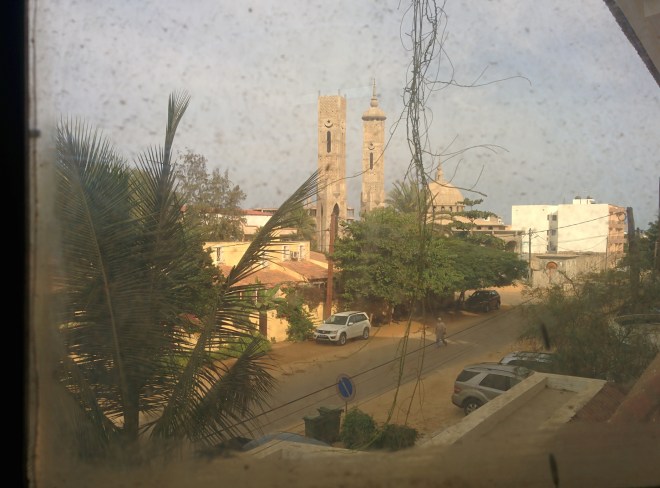
A window. In dire need of washing.
Four late model cars produced by Suzuki and Toyota.
A license Plate, white on black.
A man dressed as if in an Arab country or as an Afghani Pashtun.
A domed mosque under construction with the star and crescent motif on its minarets that mimics the flag of Mauritania.
A wall split air conditioner that, based on the red logo was probably made by Chinese company Ningbo AKL Electric.
A round top orange door.
A European style “No Parking” sign.
Trash bins for regular pick up.

Ok, so the license plate says we are in Tunisia, but where in Tunisia? After seven hours of searching, I have no freaking idea. Only Chini and the person who took the picture know.

BUT… I’m counting in the facts that:
1. The mosque is still under construction so doesn’t show up on any Google search and …
2. A certain group of VFYW contestants who insist that everything they can’t figure out comes from “Tatooine” and you being JUST snarky enough to hoist them on their own petard because there IS a Tataouine, Tunisia.

So I’m stating that the picture was taken from the Hotel el Ghazel, Tataouine. I hate you all.

The most popular incorrect city was Nouakchott:

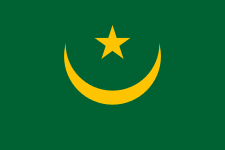
Way to wrap up the year, you clever bastards. The crescent/star on the minarets are Flag_of_Mauritania.svgdistinctive in the way the moon faces up. This is pretty distinct and is used the flag of Mauritania. After plugging away online looking for mosques in that country I looked at the original again and saw that the second tower isn’t “different,” it’s unfinished. It won’t show up because, until recently, it hasn’t been there.  The building behind the minarets is a mere skeleton. Clever bastards! I hope someone has more luck than I did looking up hotels and guest houses to find that street.
The license plate got this reader into the right country:

Mosque in the background. Man in Islamic garb, appears clearly African. Dry but tropical. Coastal vibe. Signage suggests British colonial history. Cars and garbage cans suggest relative wealth. Appearance of license plates resembles Senegal. Can’t find the specific towers shown, but I’m going with Saint Louis, Senegal.

And this globe-trotting reader was one of only ten to get the right city:

Since the building in the picture is clearly a mosque, and there is an African-looking man in a prayer cap walking in the street, I’m going to go with Dakar, Senegal. The buildings look like Dakar to me (I was there back in 1990) and Senegal has blue license plates. Looking closely, it seems like the front two letters of the plate are DK for Dakar. So that’s my guess. I can’t identify the neighborhood, I just know it doesn’t look like the Grand Mosque so presumably it’s a smaller local one.

Another:

A shot in the dark here. Looks very much like my home country of Senegal.  There’s a few clues pointing towards Dakar the capital:

1. Blue license plate plate on the white SUV. Couldn’t focus in too much but I think I can make out the ‘DK’ for Dakar.
2. Reddish color of the sand.
3. Mosque in the background.  Senegal is approximately 92% Muslim.
4. Dakar is often in a state of construction. Lots of unfinished home improvements and construction projects.

This could possibly in the Almadies neighborhood near my parents’ home.

That’s indeed the right neighborhood. One more:

Well, normally I don’t even try these contests, as I know I won’t be able to get very close. The only one I was able to recognize before this was the Alhambra, Granada, and I wasn’t able to discern the precise window. However, your announcement that this week’s contest was very difficult piqued my interest.

I teach Islamic Art, so was able to quickly identify the mosque as North African. After looking up license plates online, I was able to identify the country as Senegal. The soil color and vegetation support this conclusion. I spent much too much time today looking at fuzzy mosques in Senegal on Google Maps, but wasn’t able to firmly identify any as this mosque. There are an awful lot of mosques to look at! Dakar is a reasonable guess just due to its sheer size, and I wasn’t able to find anything at all similar in other towns. The closest mosque to the one in the picture (grey dome, two square minarets) is Grande Mosque Hann Maristes I, but I don’t think it is the same – that mosque is a bit larger and in a more built-up area. The street it is on does not have a name in Google Maps. Nevertheless, I can tell the view is from the south because of the mosque’s orientation.

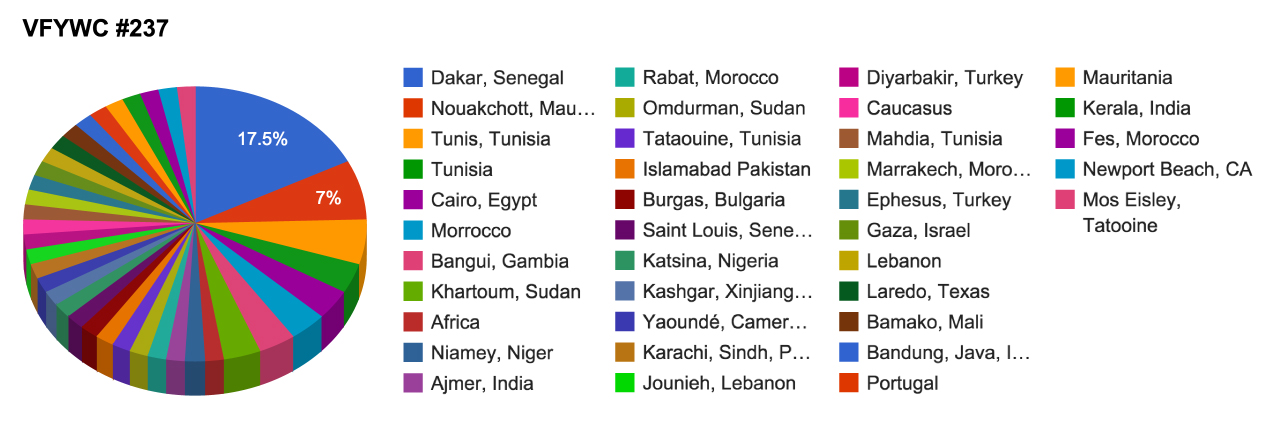
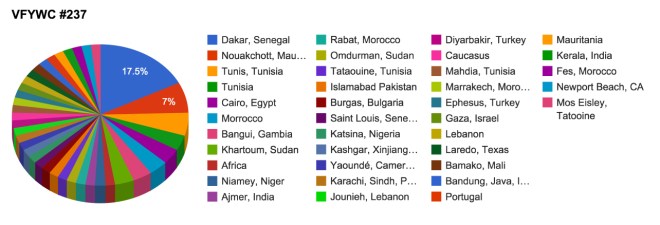
In all, players guessed a whopping 38 different locations this week:

This embed is invalid
vfywc-237-pie-chart

And a handful of our veterans really earned their stripes:

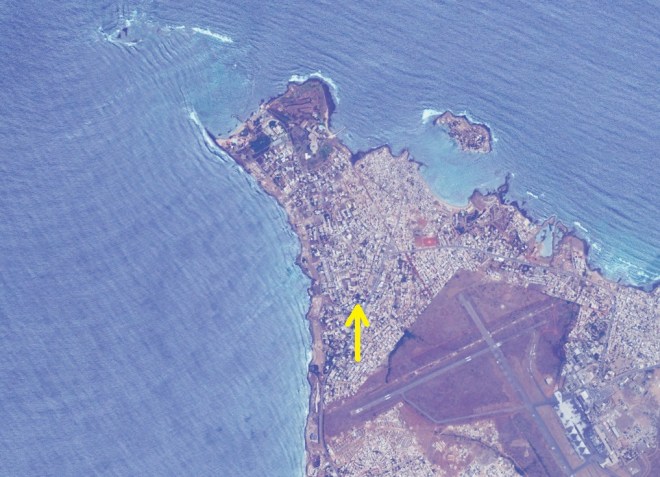
This week’s view comes from the La Demeure B&B in Dakar, Senegal.  Rather than an address, the hotel website provides GPS coordinates:  Latitude 14°44’07.74″ (North), Longitude -17°30’26.66″ (West).   We are looking northeast out from the hotel’s Zanzibar room towards a mosque that is under construction.  La Demeuere is located in the Ngor neighborhood of the Almadies Arrondissement on Cap-Vert (NASA Earth Observatory image of the day here), the western most point in Africa.

The picture looked like it was taken in Africa, particularly a coastal area in or near the Sahel.  And the license plate seemed like it came from Senegal.  Once in Senegal, it took a bit of time to find the mosque and hotel; mostly because the mosque is too new to appear on maps yet.
Untitled

Another:

“Oh no!” I cried, when I realized what was in this week’s picture. Another still-in-construction mosque, as in contest #235. In other words, a mosque whose pictures are very hard to find, like that mosque in Antalya. This time, however, there weren’t other clues; yes, I could tell that the photo was shot somewhere in the Sahel region, in Africa (Islam, palms, sand, the gentleman’s outfit), but the decisive clue to guess the view was doubtless the mosque. And the prospect of spending the next few hours sifting through hundreds of photos of mosques, probably in vain, was very unpleasant, to say the least. What could I do? “What would Chini do?” I asked myself.

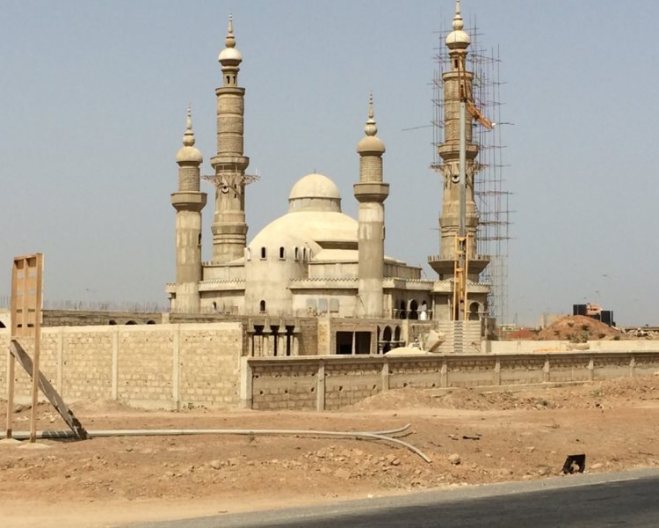
Here’s the answer I gave me. First of all, let’s cast a wide net and google “Africa ‘new mosque’”. The aim is not to directly find our mosque (unless we were very lucky), but to find a similar looking one, in order to nail the right country. As expected, the mosque in the picture is not among the results; but there is something almost as valuable…
a-new-mosque-going-up-on-the-entrance-of-Dakar

This is a mosque which is being built in Dakar, Senegal. See the upper part? It’s exactly the same as our mosque’s. So let’s turn to Google Maps, looking for mosques in Dakar. Sixty mosques later, we come to the conclusion that our mosque is not labelled as such in the map – which was to be expected, if it really is still in construction – or that it is somewhere else. A quick search in the other major cities of Senegal gives no results, so we are soon back to Dakar. What comes next? Almost all of the contest pictures are taken from a hotel’s window. This time we are lucky: not only are there fewer hotels than mosques in Dakar, but the third hotel in the list is the one we were looking for.

This week’s picture was taken from the Zanzibar suite, on the second floor of La Demeure hotel, in the Almadies neighbourhood, Dakar, Senegal.

Don’t worry, Chini had a work for it too:
VFYW Dakar Overhead Far Marked - Copy

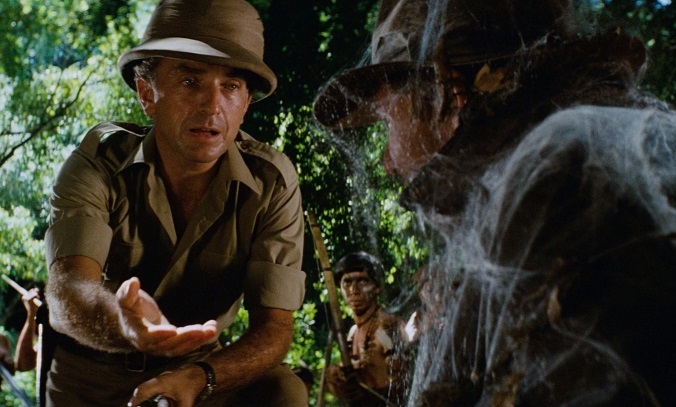
I hate ones like this. You track the location down, bit by bit. Then, at the end of a long hunt, just when you think you’ve got a real toughie on your hands, you discover that there was a dead simple, five minute way to find the location. It’s like running out of the tomb, idol in hand, only to find Belloq waiting for you outside. There goes my fortune and glory …
VFYW Dakar Chini Wuz Robbed - Copy

Another former winner who got the guesthouse and window:

At first glance, this one felt like North or West Africa. Looking more closely at the mosque architecture, it reminded me of some West African mosques I’d come across working on previous contests. (I think I may have learned more about regional Islamic architecture than anything else in the time I’ve been doing the contest.) Looking at the clothing on the man in the frame also made me think West Africa. The positioning of the crescent and star on the minarets is like that on Mauritania’s national flag, but the other aspects looked closest to images I’d found from neighboring Senegal. (Also the front license plate that is visible looks like it could be Senegalese but it’s too blurry to tell for sure.) I came across an in-progress mosque in Dakar that really similar. I Googled “new mosques under construction in Dakar Senegal” and found views like ours on TripAdvisor.

I am thinking this was taken from the La Demeure Hotel/Guest House in Dakar, Senegal. My guess is from this window, which I think might be the Zanzibar room:
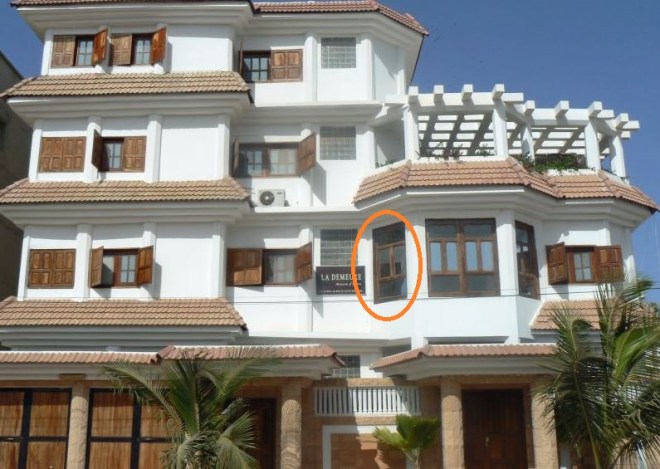
La Demeur Dakar

Only one reader without a previous win was able to ID the right city, hotel and room this week. Bravo:

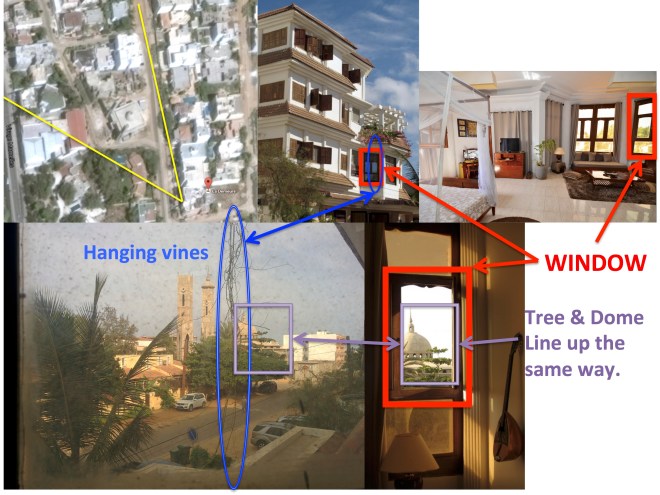
This week’s picture was taken from the Zanzibar Suite at the La Demeure Bed & Breakfast on Route de Ngor in Dakar, Senegal, looking north-northwest towards the mosque on the same street:
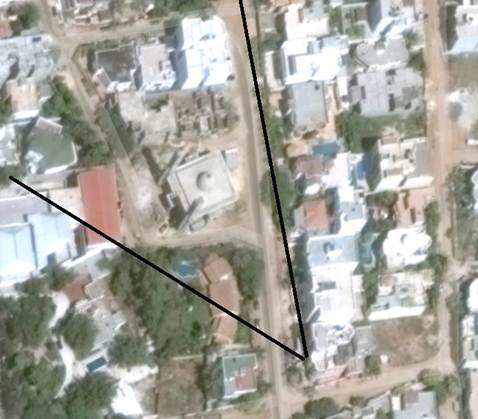
w01

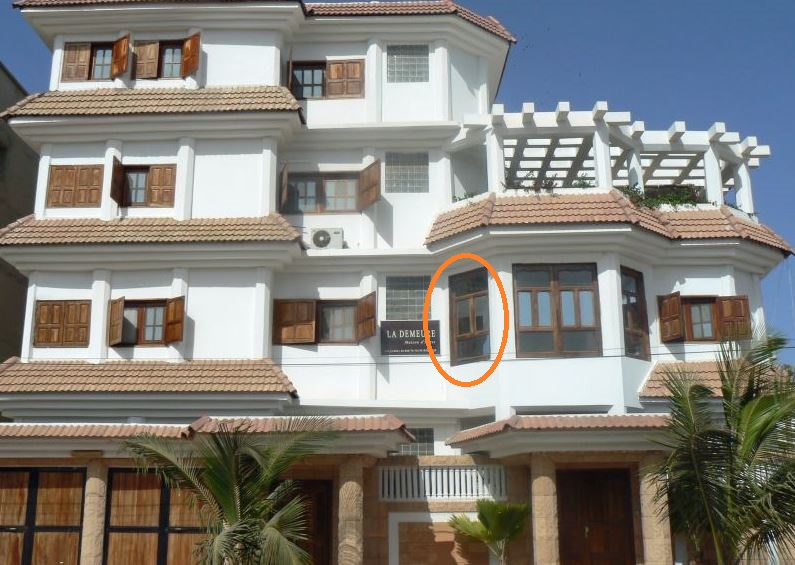
Here is an external photo of the window, in which you can see the vine hanging down from the terrace on the level above which appears in the foreground of this week’s photo:
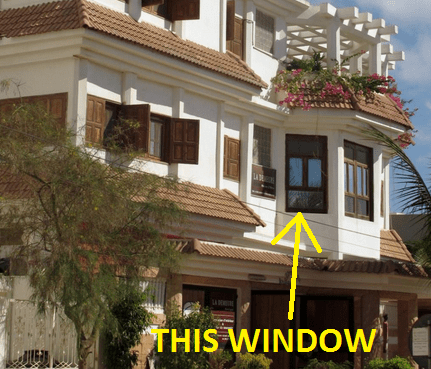
w02

Here is a shot of the window from another angle, which shows the palm tree which appears in the left of this week’s photo:
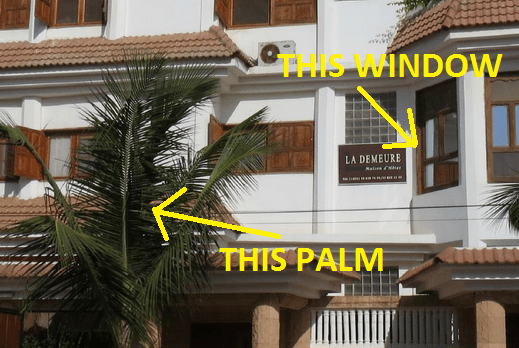
w03

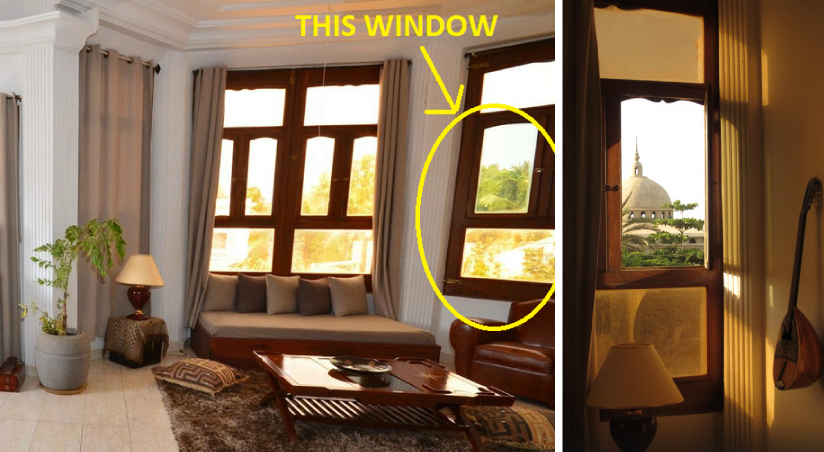
Here is are a couple of shots from inside the room showing which window the photo was taken from and the view of the mosque in the centre of the photo:
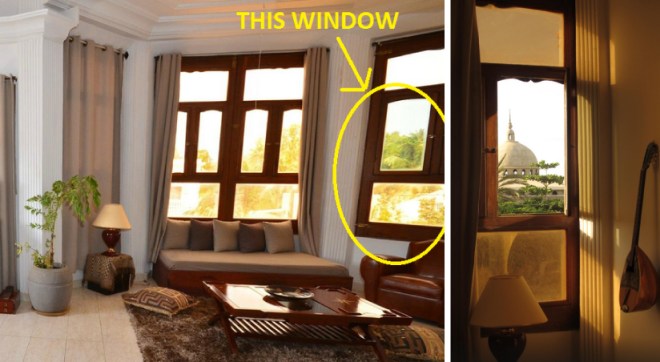
w04

I found the location of this week’s photo in the traditional VFYWC manner – hours of fruitless searching combined with a few moments of luck.  The photo appeared to be taken in a part of Africa with an Islamic population.  The European-style street sign in this week’s photo resulted in a brief spell researching the African signatories to the Vienna Convention on Road Signs and Signals (surely the UN has more pressing matters to address?!) and cross-referencing pictures of licence plates from those countries.  Once I convinced myself that the first two letters on the licence plate of the car in the photo were “DK”, I then focused on Dakar in Senegal as the most likely candidate.  After a searching through photos of mosques in Dakar for way too long, I changed course and stumbled across the above photo which shows the dome of the mosque.  This lead me to Le Demeure, where it was easy to identify the correct room as the Zanzibar.

Thanks for an enjoyable way to pass some time at work during the first couple of days back at work after the Christmas/NYE break.

A very well-earned win. From the reader who submitted the view:

I’ve been visiting Dakar periodically for work and to visit friends since 1989. In earlier years I used to stay in or near downtown Dakar, including a couple of times at the funky Lagon II, which gives the impression of being on a cruise ship. However, as work and friends have moved out towards Fann, Mamelles, and Almadies, I now usually stay at La Demeure Guesthouse.

Don’t let the dirty window fool you. It is very charming and well maintained where you can easily feel at home during long stays. They seem to be replacing windows one by one, although I haven’t figured out their criteria for choosing windows to replace. The view is facing northwest and is taken from the Zanzibar room. Just before leaving Dakar I went to a Christmas party with friends at the house on the corner where the red vehicle is. As for the unfinished mosque, I don’t know the full, or possibly even accurate story, but apparently it was begun as a private project from the previous mayor of Dakar, but came to a halt at some point after he lost the last mayoral election.

Knowing that there are other Dish readers in or passing through Dakar and that this place isn’t really off the beaten track, I expect you will have several correct guesses. Hopefully someone else can fill in the details about the mosque.

Huckabee Flirts With A Run, Ctd

Douthat contemplates the former governor’s fledgling campaign:

I see him almost inevitably as a spoiler rather than a true contender — as a figure who’s likely to split the vote that might otherwise consolidate around a single conservative rival to Jeb or Christie or whomever, but whose own chances at the nomination are exceedingly low. Since this “Huckabee as splitter/spoiler” narrative is basically conventional wisdom, I should add a wrinkle: In a crowded field he might also be helpful to a sui generis figure like Rand Paul, because he could weaken a movement candidate like Ted Cruz among evangelicals while Paul takes votes from Cruz from the libertarian side.

Dougherty is unsure who Huckabee’s candidacy will hurt:

The most fascinating question to my mind is which of the other viable 2016 GOP candidates Mike Huckabee will dislike the most.

He is a capable assassin. In 2008, his distaste for Romney was obvious — and often hilarious. Like a lot of Evangelicals who grew up on books describing Mormonism as a “cult,” Huckabee couldn’t restrain himself from making less-than-respectful comments about Latter-Day Saint theology. He considered Romney “presumptuous and arrogant,” and in the most memorable line of the 2008 GOP primary, said Mitt looked more “like the guy that fired you” than the one who hires you. Huckabee did more than anyone to create a McCain comeback, certainly more than McCain himself.

In this way, Huckabee has a kind of veto power. He’s able to prevent his opponents from consolidating social conservatives as part of a primary coalition. Who will be the next victim?

Sally Kohn respects Mike:

[P]erhaps the most dangerous thing about Mike Huckabee is that some of those firm beliefs, those clear convictions, appeal to liberal voters. In a post-Occupy moment, when even Democrats are desperate to strike the chord of economic populism—fueling, for instance, the clamoring for Elizabeth Warren to mount a challenge Hillary Clinton—Huckabee spouts populist rhetoric with ease. …

In campaigns that are more about more about ads and appearances and personality, and sadly less about substance—even though substantive disagreements exist and are key—the sense that Huckabee is a Republican who knows there are poor people, knows how to talk about them, and apparently wants to do something to help could be very appealing. As evidence, Huckabee is pro-government enough—which is to say, at all—that already the arch anti-tax Club for Growth is pledging to oppose his potential 2016 candidacy because he “increased state spending” in Arkansas and “raised the minimum wage.”

But Linker sighs at Huckabee’s populism:

[Huckabee’s schtick] is the irritable mental gesture of a provincial (rural or exurban) white America that can’t tell the difference between cultural signaling and a cogent argument. And it treats the details of public policy as an afterthought or a matter of indifference.

Would-be Republican reformers can look for a better vehicle than Mike Huckabee for the populism they favor, but they’re unlikely to find one. Huckabee — or someone like him — is the only game in town. The authentic reform of the GOP — its refashioning into a genuinely national party — requires more than the shedding of its plutocratic image. It also requires that the party’s leading lights give up on their impossible populist dreams.

And Enten calculates that Huckabee has little chance at the nomination:

The vast majority (70 percent) of Republican delegates are fromoutside the former Confederate states. Given that many non-Southern states have minimum thresholds to win delegates or will be winner take all, Huckabee would win few delegates in them if he performs anything like he did in 2008. In fact, his path to a majority of delegates would probably be shut out no matter how well he does in the South.

Busted With An Eggcorn, Ctd

vine

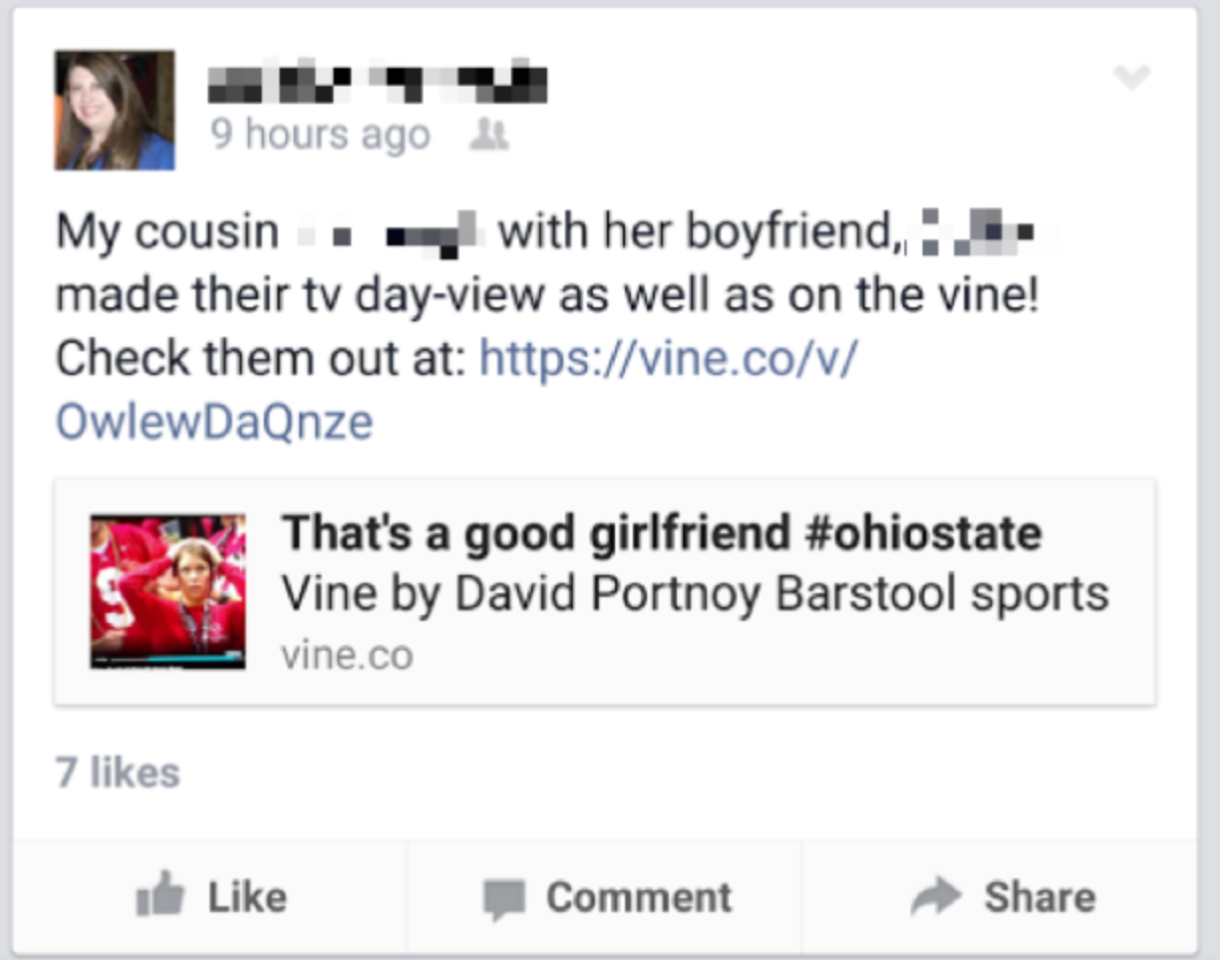
Quality eggcorns from readers keep coming in. One sends the above screenshot:

A strangely intriguing but short-lived Internet meme/mystery meets up with an eggcorn of “TV day-view”, as opposed to “TV debut”, by one of the solvers of the mystery. It’s also strange how someone’s random reaction on TV can become the focus of millions of investigators.  I have to admit, I watched the Vine video over and over and I don’t exactly know why …

Several more eggcorns below:

As young child I was out to dinner with my family at a fairly nice restaurant.  I was very excited to order all by myself.  When the server came to ask about my order I was very clear, and then she had to go and ask a question.  “Would you like soup or salad with that?”  I heard “Super Salad” and oh boy did that sound well super. Needles to say my family got a good laugh as I proudly proclaimed, “I will have the super salad!”

Another:

When I was taking drivers ed in the early 2000s, nearly all of my classmates thought the term “right of way” was “right away” – as in, “Pedestrians always have the right away,” because they get to go “right away” and the cars have to wait. So if you’re the first person at a four-way stop, you have the “right away” to go first. I remember the instructor getting agitated, “no, no, no it’s right OF way.” Many students still didn’t understand the difference when both meant that the person with the right of way gets to go right away.

Another:

I am a Christian minister who was was invited to speak at a community interdenominational worship service. Our small-town newspaper, always hungry for anything to fill its pages, sent a reporter who wrote a lengthy article about the service, including a surprisingly good summary of my sermon. He did slip in an eggcorn, though, when he transcribed my phrase “the pole star of faith” as the pulsar of faith. Because both are metaphors, one is almost as good as the other, I suppose.

Another:

Recently we brought on a new staff member to our IT department.  She had no IT background but was a go-getter and adept at using our EHR system and making corrections.  (I will take a known entity over a “good interviewer” any day). On one of her first days, she was answering our help desk phone.  She wrapped up a call by saying that a tech would be right over to twerk her computer.

I know I have tweaked a computer, but I’m still working on the twerking.

Do Cops Treat Blacks And Whites Equally? Ctd

Another reader joins the discussion:

As an Afro-American, I want to address the cop who said “of course there are racist cops – there are racists in every profession – but I don’t think cops as a whole are more racist than other professionals”. I don’t know if this is true or not, but while it does seem plausible, it completely misses the point.

First, cops aren’t just “any other profession.” They are armed and have enormous power. When they take a life, there is a implicit presumption of innocence that most other professions do not have. Because of this, we need to hold them to a higher standard. Further, being a cop is a very dangerous profession, so rightly so, cops are always on the lookout for their own safety. This makes the the consequence of their bias far greater than that of most other professions.

Second, to really understand this situation you have to realize that some of the worst racism that many blacks have received have been at the hands of other black people.

In fact, this very often comes from black people who live in black neighborhoods and have only black friends and married to their black spouse. This may seem strange and rare thing, but it is actually quite common. The reason is that there is an implicit message in our culture that to be black is somehow to be less worthy and less beautiful and just less in general. There’s no conspiracy to teach this, but rather it is an insidious legacy that we carry from our past. The truth that no one wants to say is that it is hard for any of us (including blacks) to avoid learning these deeply flawed lesson. I’m convinced that for most, the only way to truly not being racist is admit that these false images exist in our culture and do the personal work it takes to say “no” to it.

Lastly, we’re discussing this topic as if there is actually a debate. There have been studies performed about this and the numbers don’t lie. One example that comes to mind is the statistic that blacks and whites use marijuana in near-equal percentages, but blacks are incarcerated at a much higher rate. This is the very injustice that has fueled the decriminalization across the country. I believe I’ve also read something similar regarding NYC’s use of stop-and-frisk tactics.

So there’s really no question as to whether blacks and whites are treated equally. The only thing we learn from the Post/ABC poll is that most whites either don’t know the facts or choose to deny them. This isn’t really surprising, as it is only natural to understand the complexities of struggles that you have experienced while completely not understanding the struggle of others.

Leelah Alcorn’s Last Words, Ctd

A reader focuses the Dish discussion:

There’s a pretty basic point that may deserve explicit mention. A major purpose of puberty-blocking drugs, in particular, is to DELAY the moment of decision until one is prepared to decide. One can discontinue these drugs and undergo puberty later on, with no further intervention. I understand fully why people would be worried about young children making complex irrevocable decisions about their own well-being. What I can’t understand is why those people are against puberty-delaying drugs, rather than being fervent advocates!

Here’s a helpful NPR interview of two doctors who specialize in these issues. Money quote:

How long do you use the hormone blockers to suppress puberty?

Until around 16. Then you use the cross hormones to bring on the characteristics of the opposite sex. And remember, if you just stop the hormone blockers at 16, the person will go right back to genetic puberty within months. So the beauty of the suppressant is not as a treatment but for prolonging the evaluation phase … ’til a young person has greater ability for abstract reasoning. It buys you time without a tremendous fear of their body getting out of control.

That interview was from 2008. From September:

[A] new study finds that the results of such treatments are very positive. … Lead Author Dr. Annelou de Vries explained to CBS News that puberty suppression is a “fully reversible medical intervention” and the extra time allows the young people to work out their struggles related to gender dysphoria before taking permanent steps toward a transition.

Back to the in-tray:

I think many readers are missing Leelah’s point regarding appearance.  The question is not attractive versus unattractive, but rather being “visibly trans” versus “not-visibly trans.”

Transitioning early does not ensure you look like Cindy Crawford, to utilize the example of one reader.  Rather, it helps to ensure that the transgender person is not thrust into a life where merely walking down the street threatens their physical safety.  A trans woman was stabbed on a bus in San Francisco the other day while simply minding her own business – all because the perpetrator (correctly) assumed she was trans from her appearance.  In a perfect world, “looking trans” wouldn’t be a problem, wouldn’t lead to violence or discrimination – but it does. To subject a person to a life with that type of physical and economic hardship because of an abstract point about beauty is cruel.

And again, early transitioners aren’t guaranteed “beauty.”  And it’s not nearly as superficial as some readers suggest – quite the contrary. Additionally, the mere outset of puberty and the ensuing physical reactions (body hair, lowering of voice) induces the medically demonstrable experience of gender dysphoria.  Denial of access to transition related medical care is a leading contributor to suicide, not merely because of the potential long-term consequences outlined above, but because the real-time denial of an identity is emotionally traumatic for transgender people.

Puberty blockers are reversible, but, even still, are only prescribed after a thorough medical process, extended gender identity assertion, and conversations between parents, children, and their doctors.  That’s why this process is quickly becoming the medically and psychologically recommended course.  I understand the initial negative gut reaction to allowing a child to transition genders.  It seems like a big step, and kids are fickle, after all.  Indeed, I’m sure many of the parents who eventually let their kids transition initially feel that way.  People are obviously entitled to their own opinions, but not their own facts.  The facts, and, thus the growing medical consensus, is on the side of allowing children to transition.

Update from a reader:

I have been wanting to share my experience (and my partner’s) on this topic for some time. We are both lesbians. We are both very comfortable with our gender. When we were growing up, however, we both wanted to be boys.  We dressed like boys.  We played mostly with boys. We always chose to play the boy role. It wasn’t until puberty that those feelings changed. I am not sure why that was, but they did. We no longer wanted to be boys. All this is to say that blocking/delaying puberty, which for me, and other lesbians I know, changed the way we felt about ourselves, isn’t risk free.

Another:

Your reader describes how she and her female partner both “wanted to be boys” until puberty, and then got comfortable being females. It may not be possible to know for sure, but this sounds very different from the transgender experience. I do not hear about such people “wanting to be boys” (or girls) as children, but always as insisting that they are boys (or girls). That seems like a fundamental difference.

Another notes:

This entire discussion reminds me again of why I’m so grateful you curate comments for discussion of a topic, rather than have an open comments section. I’ve never seen anything like he cesspool that is the Leelah thread going on at Datalounge. I have no doubt this is what a Dish “comments section” would look like right now if one existed, not because most of your readers share these views (or most Dataloungers share these views), but because this is how it always goes with open comment sections on hot button topics. The rational and reasonable on all sides of a debate flee in droves because of the vitriol, and then the bottom feeders really take over, racing to outdo each other in saying the most repulsive things about each other and people like Leelah.

Headline Of The Day

A reader nominates it:

Disco Clam Freezes Prey With Toxic Snot

How 

Known as “the disco clam,” this six-centimeter shellfish has tentacles that flash like a strobe light. At first, researchers thought the light was a type of bioluminescence like fireflies or deep-sea angler fish. But last year marine biologist Lindsey Dougherty from the University of California, Berkeley, found that the flashing lights are caused by highly reflective silica spheres in the clam’s bright orange lips. They initially thought the glow attracted mates, but now, new research from her team suggests that the light display may ward off would-be attackers.

St. Fleur provides some great footage of the clam defending itself from the formidable mantis shrimp. The above video shows off the disco clam’s light show.

The Revolt Against Boehner

Bernstein calls bullshit:

A real uprising against the speaker would have happened back in November, when House Republicans met and instead endorsed him for another term. Had conservatives been unhappy with Republican leadership, they could have rounded up the votes and made it clear that Boehner was finished. They could even have proposed a plausible replacement. But they didn’t have the votes or an alternative then, and they won’t have them now.

Yes, Louie Gohmert of Texas has proposed himself as a new speaker, but the last thing any of the radicals want right now is Boehner’s job – which entails, more than anything else, cutting deals with Barack Obama on must-pass items such as the debt limit and next year’s appropriations. House Republicans aren’t really unhappy with how Boehner has handled those negotiations; that’s why they supported another term for him. This “revolt” is nothing more than a tantrum against the inescapable fact of compromise.

Another reason Boehner is likely to keep his job:

The defections Tuesday appear as though they could be more significant than at any point since 1923, but Boehner has one major advantage amid the revolt: the biggest GOP majority since the 1929-30 Congress. The GOP’s 246-188 advantage means Boehner can lose 29 votes before we can even talk about him being in real trouble.

Beutler believes that Boehner was more vulnerable two years ago:

Republicans had just lost an election badly. The Republican House majority had been diminished to the point where a small, determined group of rebels could conspire to force a second ballot, and a third ballot, and as many ballots as it might take to shake up the leadership ranks. Assuming Boehner would neither seek nor find aid from Democrats, the logic of a voluntary exodus would have become difficult to resist. That’s more or less what Newt Gingrich realized early on after presiding over the poor GOP showing in the 1998 midterms.

Today, a sneak attack is neither plausible, nor theoretically sound. Under Boehner’s leadership, Republicans expanded their majority in the midterm. He has a much bigger cushion this year than he did in 2013. Pulling off a surprise upset wouldn’t be in the cards, even if House conservatives were the adroit operators everyone knows they aren’t.

How Ben Jacobs thinks about the vote:

[T]his episode serves as a clear test of how Boehner can manage what will be the biggest Republican caucus in the House since the Hoover Administration. If he manages to pull through while limiting the number of dissidents it’s a sign that the speaker might be able to finally enforce party discipline in his caucus. But a close run contest would indicate the opposite and point to yet another Congress where Boehner would have to tiptoe around conservatives in his party to accomplish anything of substance.