“Thought Crime Now Exists In This Country”

Last week, Scottish police examined “complaints about Ebola comments tweeted by controversial TV personality Katie Hopkins”:

After news that a Scots nurse was being treated for the virus, Hopkins wrote: “Sending us Ebola bombs in the form of sweaty Glaswegians just isn’t cricket.” Another tweet said: “Glaswegian ebola patient moved to London’s Royal Free Hospital. Not so independent when it matters most are we jocksville?” Police confirmed they were looking into an unspecified number of complaints.

Massie, who is quoted in this post’s headline, is disturbed by the police reaction:

Morons post moronic comments on Twitter or Facebook or wherever and other morons report them to the police who in turn waste their time deciding whether a given tweet is grossly offensive or merely run-of-the-mill offensive.

But regardless of whether people are grossly offended by such posts or not it is plain that, in the absence of direct harassment or threats of specific harm, they’re simply expressions of opinion. Distasteful opinion, perhaps, but still only opinion. Which ought not to be enough to trigger an investigation, far less arrests and prosecutions. This is so even if – no, especially when – a reasonable person might conclude the tweets (or whatever) were racist, sectarian, homophobic or anything else. The freedom to be a moron is an important one. Ditto for bigots.

Charles C. W. Cooke discovers that the policing of thought is widespread in Britain:

I would like to report that this represents little more than an idle threat, or, perhaps, that it is merely the product of a rogue and overzealous intern. But, alas, I cannot. As The Independent’s James Bloodworth noted this week, this is in fact rather typical. “Around 20,000 people in Britain have been investigated in the past three years for comments made online,” Bloodworth confirms, “with around 20 people a day being looked into by the forces of the law, according to figures obtained under the Freedom of Information Act.” Worse, some of these people have actually been imprisoned: among them, a “woman found guilty of a public order offence for saying that David Cameron had “’blood on his hands,’” a man named “Azhar Ahmed, who was prosecuted for an online post mocking the deaths of six British soldiers killed in Afghanistan,” and a young man named Liam Stacey who tweeted something unprintable at a top-flight soccer player and was incarcerated for two months in consequence.

Elizabeth Nolan Brown puts the news in its greater context:

Of course, the British have always been more censorship-happy than Americans—why should we worry too much about their current speech-limiting antics? Because they come at a time when countries around the world—from Japan to India to Turkey—have been debating (and legislating) the handling of hate speech, and the European Union’s Council on Human Rights has been taking up the “no hate speech” mantle more vociferously. The United Nations is also pressuring countries, particularly Japan, to enact anti-hate speech laws. I’m really afraid that speech penalties of the past are the wave of the future.

If The Earth Were To Stop Orbiting …

… we would slowly fall into the sun. Aatish Bhatia provides a timeline. Here’s what Day 35 would look like:

It’s been over a month of Earthfall, and we’re now 20% of the way to the Sun. The Sun in unbearably bright and intense, and noticeably larger in the sky. At 58 C (137 F), the average global temperature now exceeds the historic hottest temperature recorded on Earth, which was 56.7 C (134 F) measured in Death Valley, CA.

For most people on the planet, it’s now impossible to stay alive without air conditioning, and the electricity infrastructure is either tapped out or failing. Forest fires are ravaging through the wilderness. Land animals that can’t burrow in to the soil to get respite from the heat are going extinct. The insects, too, are feeling the heat and dying out. The increasing water temperature will cause fish to start dying out, because warmer water holds less oxygen and more ammonia (which is toxic to fish), and because the entire marine food chain would be disrupted and collapsing.

It’s so hot that even the Saharan silver ant, one of the most heat resistant land animals on Earth, can no longer survive the heat (for it can stay alive up to 53.6 C). However, the Sahara desert ant is thriving – it can survive surface temperatures of up to 70 C. As scavengers, these ants feed on the corpses of other creatures that have died from the heat, and there’s now plenty of food to go around.

Update from a reader:

I’m sure I won’t be the only person to point this out, but I think the title “If The Earth Were To Stop Spinning …” is a bit misleading.  The hypothetical scenario that the post presents is where the speed of the Earth’s orbit around the Sun is reduced to zero, not if the Earth stops spinning around its own axis, which is what the title sounds like. Now, it wouldn’t work out so well for us either if the Earth stopped spinning around its axis, but at least it’s a different sort of problem.

Is “Broken Windows” Broken?

NYC police commissioner Bill Bratton and criminologist George Kelling, two of the earliest advocates of the “broken windows” theory, have published a lengthy piece defending it against fresh critics outraged by Eric Garner’s death:

Our experience suggests that, whatever the critics might say, the majority of New Yorkers, 9722024610_f768258614_kincluding minorities, approve of such police order-maintenance activities. After all, most of these activities come in response to residents’ demands, which are made to patrolling officers directly, to precinct operators by telephone, to precinct commanders at community meetings, and via the 311 and 911 call centers. Contrary to conventional wisdom, citizens almost invariably are more concerned about disorderly behavior than about major crimes, which they experience far less frequently. We have attended countless meetings with citizen groups in high-crime areas, and, almost without exception, disorderly behavior and conditions are the central concerns. …

[E]ven in this highly charged context [of Garner’s death], support for Broken Windows [in an August 2014 poll] remained high. African-Americans supported it by 56 to 37 percent, whites by 61 to 33 percent, and Hispanics by the largest margin of all—64 to 34 percent.

Emily Badger finds that Bratton and Kelling “make some fair points”:

Randomized experiments have supported the argument that “broken windows” can work. And crime has notably declined in New York since the philosophy was first embraced there. But in making this case, Bratton and Kelling overstate the role that “broken windows” has played in making New York a safer place — or, at least, they understate the very likely possibility that many factors far beyond the control of law enforcement have contributed to making it so. This is the weakest part of their argument.

She points to many of those other factors:

The Marshall Project recently rounded up 10 of the most popular theories for why urban crime has declined. So many exist — from the rise of legal abortion to the decline of lead-based fuel and paint — precisely because the phenomenon has proved so difficult to explain. Can we really dismiss, for instance, the fact that anti-theft technology in vehicles has grown much more sophisticated? Or the fact that the crack epidemic finally waned? Or that our increasingly cashless economy makes people harder targets for crime? We recently wrote about a Chicago summer-jobs program that appears to have cut down on violent arrests by at-risk teens.

Drum backs up Badger’s basic point with data:

blog_violent_crime_six_large_cities_3It’s true that crime in New York is down more than it is nationally, but that’s just because crime went up more in big cities vs. small cities during the crime wave of the 60s through the 80s, and it then went down more during the crime decline of the 90s and aughts. Kelling and Bratton can dismiss this as ivory tower nonsense, but they should know better. The statistics are plain enough, after all.

Take a look at the [two charts]. The top one shows crime declines in six of America’s biggest cities. As you can see, New York did well, but it did no better than Chicago or Dallas or Los Angeles, none of which implemented broken windows during the 90s.

The bottom chart is a summary of the crime decline in big cities vs. small cities. Again, the trend is clear: crime went up more during the 80s in big cities, but then declined more during blog_crime_big_small_cities_1985_2010the 90s and aughts. The fact that New York beat the national average is a matter of its size, not broken windows.
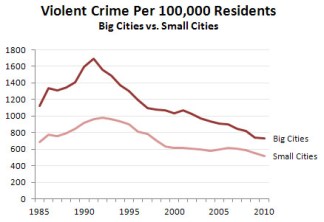
Now, none of this is evidence that broken windows doesn’t work. The evidence is foggy either way, and we simply don’t know. My own personal view is that it’s probably a net positive, but a fairly modest one.

Christina Sternbenz adds:

When University of Chicago professors Bernard Harcourt and Jens Ludwig revisited broken windows [in 2006 – pdf], they reported criminologists knew very little about the theory’s effectiveness. Their paper found no evidence outside of Kelling’s work to support the notion that cracking down on minor offenses leads to a decrease in more serious crime.

Much of the new research claiming to debunk broken windows has also found that targeting minor crimes harms poor people and minorities. For example, a later paper, again by Harcourt and Ludwig, found that the policy, albeit indirectly, led to a disproportionate number of drug arrests for blacks, the New Republic reported.

Charles F. Coleman Jr. chimes in:

As a former prosecutor, I found the most common reasons people committed crimes to be connected to their own finances and/or rooted in the economic constraints of their surrounding environment. The threat of a summons for riding a bicycle on the sidewalk is hardly a deterrent for larger crimes when those crimes might help make ends meet for unemployed or underemployed people. This is the problem with broken-windows policing: The theory fails because it attributes the cause of crime to the “tolerance” and escalation of lesser crimes rather than acknowledging that crime rates are higher in poorer communities primarily because people do not like being poor.

But Matthew Hennessey defends Bratton and Kelling from such critics:

Broken Windows is a key part of the difference between a proactive police force and a reactive one. It’s the difference between cops that look for ways to stop criminals from victimizing neighborhoods and ones that sit in patrol cars drinking coffee and waiting for a 911 call to come in. That commitment to dynamic policing permeated the department, from the cop on the beat to the commissioner. Now, thanks to a year of official slander, public protests, and outright lies, the culture of results and accountability that made the NYPD the finest police force in the world could be at risk.

Another defender of Broken Windows may surprise you:

“Because of the broken-windows approach, we are the safest we’ve ever been. I lived through the 1980s in this city and the early ’90s, and I don’t ever want to go back there,” de Blasio said. And: “If I said, ‘Do you want responsive policing?’ ‘Do you want the police to come when you call?’ ‘Do you want small problems addressed, or do you only want big problems addressed?’ I think the vast majority of New Yorkers would say, ‘Yes, we want the police to come when we call.’ ‘Yes, we want order kept.’ ‘Yes, we want small things addressed and big things addressed.’ ”

Recent Dish scrutinizing Broken Windows here.

(Photo by Nick Harris)

Face Of The Day

Florida Federal Judge Issues Ruling Allowing Gay Marriages Across The State

Juan Talavera and Jeff Ronci (L) celebrate after receiving their marriage license from the Clerk of the Courts – Miami-Dade County Court on January 5, 2015. Gay marriage is now legal statewide after the courts ruled that the ban on gay marriage is unconstitutional and the Supreme Court declined to intervene. By Joe Raedle/Getty Images.

The Morals Of Modern Economics

Christina McRorie urges us to rethink them, going back to Adam Smith to show that there’s more to economic analysis than narrow, self-interested calculations. She reminds us that Smith wrote The Theory of Moral Sentiments before he turned to The Wealth of Nations:

Smith’s moral psychology is decisively operative in The Wealth of Nations, and approaching his economic treatise with that in mind can helpfully challenge the tendency to read it, as Chicago school economist George Stigler does, as “a stupendous palace erected upon the granite of self-interest.” Although a growing number of intellectual histories now bring into question this once dominant interpretation of Smith’s work, Stigler is hardly alone in his interpretation.

In fact, this misreading remains the single greatest reason for Smith’s popular reputation as a conservative neoclassical economist whose pessimism about governments, regulation, and human nature was matched only by his optimism about market outcomes, and who accordingly proclaimed that free markets tidily channel individual selfishness toward the greater public good, as if by an “invisible hand.” Although the heyday of the conservative sartorial phenomenon of “Adam Smith neckties” has passed, most invocations of his name in contemporary politics still focus on his alleged discovery that free markets lead to the greater good by shaping selfishness through some unseen force.

Connecting Smith’s philosophy with his economics militates against this caricature by helping us see the moral ambivalence in his evaluation of commercial society. Take, for example, his claims regarding that “certain propensity in human nature…to truck, barter, and exchange one thing for another.” Pointing out that no one has ever seen two dogs make a “fair and deliberate exchange,” he noted that this uniquely human ability rests on the art of making contracts that are advantageous to both parties: “It is not from the benevolence of the butcher, the brewer, or the baker that we expect our dinner, but from their regard to their own interest. We address ourselves, not to their humanity but to their self-love, and never talk to them of our own necessities but of their advantages.”

With all due respect to George Stigler, I find that reading these famous lines with Smith’s moral psychology in mind reveals that it is the faculty of sympathy on which exchange is built, not self-interest. Understanding another’s advantage through sympathy is what allows bargaining in the first place. Why talk about engaging the butcher’s self-love at all, unless we can imagine and therefore anticipate it? Along with reason and rationality, it is this imaginative capacity that distinguishes humans from animals, and allows us to bargain with each other toward mutual advantage. The two dogs certainly have self-interest, but they don’t have this.

Firebombs And “Love Bombs” For Swedish Mosques

Over the holidays, Sweden’s Muslim community was shaken by a string of attacks on mosques in several cities:

Swedish police launched a manhunt Thursday after the third arson attack against a mosque in a week, amid growing tensions over the rise of a far right anti-immigration movement.”People saw a man throwing something burning at the building,” police in Uppsala said in a statement, adding that the mosque in eastern Sweden did not catch fire and that the suspect had left behind “a text on the door expressing contempt for religion.” …

Thursday’s attack in Sweden’s fourth-largest city came just three days after a late-night blaze at a mosque in Esloev in the south, which police suspect was also arson. On Christmas Day, five people were injured when a petrol bomb was thrown through the window of a mosque in Eskilstuna, east of the capital Stockholm.

Local residents in Uppsala responded to the attack by “love-bombing” the damaged mosque with notes of support. Amanda Taub applauds:

The demonstration and “love bombing” were a powerful way for ordinary Swedes to reject racism and show support for Muslims. But the march also carried broader political significance, because it showed that Swedes felt a duty to publicly reaffirm the country’s identity as a place that is tolerant and welcoming towards immigrants.

In many countries, anti-immigrant populism dominates the public conversation about immigration not because it necessarily represents the majority view, but because people with more moderate and tolerant views don’t make it a priority to speak up publicly. These demonstrations suggest that Sweden may be different: thousands of people took to the streets to say that they are not willing to stay silent, and will not allow extremists to dominate the debate.

Still, many Muslims throughout Europe have reason to be wary of their neighbors; a new poll finds that one in eight Germans would join an anti-Muslim march if one were organized in their hometown:

The survey highlighted growing support in Germany, as in other European Union countries including Britain and Sweden, for parties and movements tapping into voter fears that mainstream politicians are too soft on immigration.

Some members of Chancellor Angela Merkel’s conservative bloc worry that they risk losing support to the euro-sceptic Alternative for Germany (AfD) party, which has shifted its focus to immigration and includes many who also back the PEGIDA protest movement — Patriotic Europeans Against the Islamisation of the West. PEGIDA is holding weekly rallies in the eastern city of Dresden, and attracted more than 17,000 people to a Dec. 22 rally. A few small marches have taken place in other towns, and it plans to stage further rallies in other German cities.

The NYPD Turns Its Back On Civilian Control

At Sunday’s funeral for slain police officer Wenjian Liu, hundreds of New York’s Finest turned their backs on Mayor de Blasio for a second time:

The silent protest against de Blasio came after a Friday memo from New York Police Commissioner Bill Bratton specifically asking officers to refrain from turning their backs on the mayor at Liu’s funeral, as they had at the funeral of his partner, Officer Rafael Ramos. “A hero’s funeral is about grieving, not grievance,” Bratton wrote. Urged by their unions, NYPD officers have also sharply reduced their law enforcement duties to protest what they view as de Blasio’s lack of support.

Calvin Wolf sympathizes with the NYPD’s sensitivity to the increased scrutiny and criticism it’s facing, but urges the cops to change tactics before their petulance comes back to bite them:

Police officers, I understand. But you must not turn your backs.

Though it is tempting to turn your back on a mayor who has insinuated that you are brutal racists, and may be trying to score cheap political points, you must use the power of your voice instead. Turning one’s back on the mayor may be mistaken as turning one’s back on the entire citizenry. Critics will use this gesture against you. You must show the people that you are not turning their back on them. You must step forward, not turn your back. You must use your words to explain, not to condemn. Do not let your critics have a monopoly on the heart-wrenching op-eds.

How TNC frames the NYPD’s recent actions:

If the public appetite for police reform can be soured by the mad acts of a man living on the edge of society, then the appetite was probably never really there to begin with. And the police, or at least their representatives, know this. In this piece, by Wesley Lowery, there are several amazing moments where police complain about things Barack Obama and Eric Holder have not actually said. There simply is no level of critique they would find tolerable.

Denis Hamill, meanwhile, rips the police union chief a new one for not speaking up against the department’s “virtual work stoppage“:

If you agree with Patrolmen’s Benevolent Association President Patrick Lynch that the blood of Officers Rafael Ramos and Wenjian Liu is on Mayor de Blasio’s hands, then is the blood of Zbigniew Truszkowski, 37, stabbed to death protecting his teenage stepdaughter from a drunken stalker on Dupont St. in Brooklyn on Monday night, on the hands of Lynch? By not condemning an apparent police work slowdown, Lynch has essentially sanctioned a mass breach of the NYPD oath to protect and serve the public.

I think it’s completely unfair, of course, to smear Lynch with Truszkowski’s blood. But if you apply Lynch’s twisted logic of de Blasio’s culpability in the two police assassinations, you can make the case that in the police work slowdown, suggested by a reduced number of summonses and arrests, Lynch with his silence gave the killer the means and opportunity to commit the only murder in Greenpoint in 2014.

While others have noted that the “work stoppage” has had little noticeable effect on crime rates, and that lighter-touch policing might actually be beneficial, the fact that the police made this decision unilaterally makes Charles Ellison nervous:

[A]ctive work stoppages … add a whole new ugly dimension to the dispute and could create a slippery slope towards bad police practices in New York City and beyond. That ventures into a future no one would want and no one benefits from: a scenario where distressed and underserved communities are left to fend for themselves once police departments consider “quality of life” crimes as too much hassle and not worth the headache. Is that where we’re headed? A world where police, who already know the dangers and risks of their profession, suddenly want to skip out or provide lower levels of service because they feel under-appreciated and targeted? Not sure if it’s a good idea to get comfortable with that.

Anyone who grew up in a working class urban neighborhood can tell you how minor offenses and “broken windows” can quickly add up into crime-ridden nightmares for the residents. Policy makers should figure out a approach that’s less punitive on folks who can’t afford it. But allowing the dramatic slashing of local police presence out of police fear and arrogance is an insane proposition.

The Kims Get Even Ronerier

While security experts have been skeptical of the US government’s claim that North Korea was behind the Sony hack, Washington is sticking to its guns and leveling new sanctions against the already isolated regime of Kim Jong Un:

The United States on Friday sanctioned 10 North Korean government officials and three organizations, including Pyongyang’s primary intelligence agency and state-run arms dealer, in what the White House described as an opening move in the response toward the Sony cyber attack. The sanctions might have only a limited effect, as North Korea already is under tough U.S. and international sanctions over its nuclear and missile programs. President Barack Obama also warned Pyongyang that the United States was considering whether to put North Korea back on its list of state sponsors of terrorism, which could jeopardize aid to the country on a global scale.

North Korea has already been under severe US sanctions for some time, Foster Klug observes, but that hasn’t done much to deter it from making mischief:

Some analysts say Washington and others have the ability, should they choose, to apply more severe financial measures to hurt the North’s leadership. But many others point out that a raft of multilateral penalties from the United Nations, as well as national sanctions from Washington, Tokyo and others meant to punish the government and sidetrack its nuclear ambitions, have done nothing to derail Pyongyang’s pursuit of a nuclear tipped missile that could reach America’s mainland.

The most recent sanctions, which target 10 North Korean government officials and three organizations, including Pyongyang’s primary intelligence agency and state-run arms dealer, will have a limited impact because North Korea will likely assign other people or organizations to take over the work of those targeted, analysts say.

And even if the new measures had sharper teeth, Matt Schiavenza points out that there’s not much chance of them damaging the Kim regime as long as Beijing remains willing to prop it up:

The country does have one important ally on the global stage: China, which provides Pyongyang with nearly 90 percent of its energy needs and occasionally thwarts U.S.-led attempts to impose sanctions. In recent years, Beijing has grown increasingly impatient with North Korea’s intransigence on the nuclear issue, and, in a pointed rebuke, President Xi Jinping has not yet met with North Korean leader Kim Jong-un since the former assumed China’s highest office in 2012. But even if China’s relationship with the North has chilled, it is unlikely to sympathize with the U.S. over the Sony hacks. When the New York Times uncovered evidence in early 2013 that a unit of China’s People’s Liberation Army conducted cyber-espionage against American interests from an unmarked building outside Shanghai, Beijing argued that the U.S. is no less guilty.

Max Boot, who is pretty sure that “the spooks have some highly classified clue pointing the finger of blame at Pyongyang”, approves of tightening sanctions but also wants the US to commit to a grander objective of regime change:

In the final analysis, beyond sanctions, the real solution to the North Korean threat lies in peaceful reunification of the Korean peninsula. That won’t happen overnight but it is a goal that the U.S. should dedicate itself to–as urged by the noted North Korea watcher, my friend Sue Mi Terry, and more recently by my boss, Richard Haass. If President Obama truly wants the right answer not just to the cyber-attack but to other North Korean outrages, this is it: Come up with a strategy to hasten the eventual implosion of Communist North Korea, the worst human-rights violator on the planet, and the creation of a single, democratic, unified Korean state.

But Bershidsky joins the chorus of those who find it hard to swallow the claim that Pyongyang was behind the hack:

The biggest problem with blaming North Korea is that Kim Jong Un’s dictatorship gained nothing from the hack. Because of the phenomenon known as the Streisand effect, “The Interview,” the Sony comedy spoofing Kim, became a major hit on download and streaming services, pulling in $18 million in just a couple of days. All the free publicity the movie received is likely to make other film makers consider attacking Kim — of course, after taking measures to take their sensitive information offline. Are North Korean spies so stupid that they couldn’t predict the explosion of interest in “The Interview” after the hack? I doubt it: no one should be so dumb.

Collectibles Made Of Ones And Zeros, Ctd

A reader sits up:

Woah woah woah! To the reader who wrote “now we can add baseball cards to the list of digital collectibles such as … nothing else, because people don’t collect digital goods,” I would counter with “Magic the Gathering”, a trading card game (famous enough for a recent South Park homage) with an online collecting / playing community that might rival its cardboard sibling.

Remember when the missing Bitcoins at MTGOX made headlines? MTGOX, or “Magic the Gathering Online Exchange” was an online marketplace for exchanging online MtG cards? There is no way to turn physical cards into digital ones, and (for the most part) there is no way to trade digital ones for physical. And yet, as of 2007, MTG Online accounted for upwards of 50% of total MTG revenue. That’s roughly $125 Million a year! In digital-only collectible objects!

At the end of the day, digital collections just make sense for some markets. They don’t lose value due to wear, they are easier to maintain, and trade/sales are much easier to setup. I’m not saying go burn all your hardbacks and buy Kindle copies; just don’t be surprised when the digital collection becomes the norm and not the deviation.

Update from a reader:

You’re reader ignores a few crucial differences between the different “digital objects” he describes.

First, we’ll take Magic cards. Magic: The Gathering is a trading card game with two general ways to play: limited (opening fresh cards to build with) and constructed (using decks built by the player before the tournament). Both of these require particular “packs” or “cards” to build the appropriate deck. Without paying for the digital objects, you literally can’t play the game. Similarly, Kindle books have real utility: you have no other way to read the book short of buying it in some other format.

Baseball cards, however, have no such “use value” outside of looking at pictures and statistics. Unfortunately for Topps, pictures and statistics for major sports figures are easily found via Google, ESPN, or any number of great online resources. While there are also ecosystems of Magic and Book-related content, none of them replaces the actual activity of reading/playing in the way that these sources do for baseball cards.

TL;DR: Digital books and digital magic cards have use value. Digital baseball cards are just digital Beanie Babies.

Another:

Your “update from a reader” gets some major points wrong about digital Magic the Gathering (MtG) cards. Buying online, digital-only cards is not the only way to get that use value out of those cards.  There are any number of web sites where I can play “Constructed” or “Limited” or any of the other variants (there are a lot) without paying a single penny for a card, digital or otherwise.  They implement the entire library of available cards and all of the various rules.  No different than I can look up stats of baseball players on any website.

The only reason to purchase those cards is the same reason a person purchases baseball cards: to get them from the official licensed vendor where scarcity is real (if artificially introduced).  This is the classic definition of a collectible and digital MtG cards are in no different.  I collect digital MtG cards for the same reason someone collects baseball cards, there’s just happens to be a game you can play with your MtG collection if you choose.

The Weird Liberal Love Affair With The Draft

One of the many curiosities of our age of open-ended war is how reinstating the draft has become a cause célèbre among some anti-war liberals. Joseph Epstein makes the case for conscription as a way to wean America off interventionism:

The first effect of restoring the draft would be to make the American electorate generally more thoughtful about foreign policy. It’s well and good to call for boots on the ground, but all of us might make a mental adjustment if some of those boots were to be filled by our own youthful children and grandchildren. A truly American military, inclusive of all social classes, might cause politicians and voters to be more selective in choosing which battles are worth fighting and at what expense. It would also have the significant effect of getting the majority of the country behind those wars in which we do engage.

The last war fought by America that had the durable support of the nation was World War II. This was so in part because of the evil nature of the enemy. But the war was also vigorously supported because the troops who fought in it, owing to the draft, came from all social and economic classes.

Larison pushes back on Epstein’s logic:

It is possible that a draft might make it harder for policymakers to continue ill-advised wars for a very long time, but it won’t stop them from starting or joining them.

Even with the draft, U.S. forces were stuck fighting in Vietnam for the better part of a decade, and U.S. involvement in Southeast Asia in one form or another lasted much longer than that. If the U.S. has plunged into unnecessary, pointless wars with the All-Volunteer Force, it also did the same thing when it had the draft. … Drafting people to serve in the military isn’t going to fix what is at its core a problem of bad policymaking, and focusing on the composition of the military distracts us from the reality that the recurring problem is with the civilians we elect and their appointees. Resuming the draft wouldn’t prevent the U.S. from engaging in unnecessary, pointless wars, and the problem would likely be made worse by making those wars larger and costlier.

The other side of the liberal pro-conscription coin is the notion of National Service – a non-military draft. Over the holidays, Dana Milbank argued that such a program would help stem the decline of America’s volunteer workforce:

In mid-December, the National Conference on Citizenship released its annual “civic health indicators” (volunteer work, contact with friends and family, confidence in institutions) and found a “broad decline” in 16 of 20 areas. The study was backed by the Census Bureau and the Corporation for National and Community Service. Similarly, Census and the Bureau of Labor Statistics found that volunteering in 2012 (the most recent data available) was at the lowest percentage (25.4 percent) since the government started counting in 2001. The cause of this is fairly clear: Americans are not being asked to serve their country.

But Matt Welch quibbles, noting that while fewer Americans are volunteering their labor, charitable giving is at an all-time high. Why, he asks, is it considered more noble to give time than money? By way of example, he considers how his own charitable endeavors have shifted from the former to the latter:

As it happens, probably like a lot of Americans, over time our charitable giving has gone up substantially, while our hours volunteered are probably on net lower, even with the increases for school/kid-related stuff. That’s because in the great Division of Labor called life, this actually makes sense if you think about it even for one minute. If you are fortunate enough to be able to increase your earnings as you get older (especially when you have some mouths to feed and plan for), you spend your time doing just that, then sending off checks to charitable organizations you have confidence will spend some of the excess wisely. Meanwhile, volunteering and networking are actually pretty valuable ways for starving freelancers (to name one category of non-richies I have familiarity with) to spend their otherwise not-very-well-remunerated time.

Long story short, if you are going to make the consequentialist argument that declining volunteerism requires more tax money to be conscripted for “National Service,” you should probably explain why you care more about volunteering labor than volunteering hard-earned cash.