The Best Poems From The Year

[Re-posted from December 22. Today is the last day to take advantage of The Poetry Society of America’s holiday membership drive. Please consider supporting their work here. Review all of our poetry picks from 2014 here.]

There isn’t another political or current affairs blog I know of that has poems suddenly poking up all over the place. It’s one of the things I’m proudest of here at the Dish – because it makes the implicit alicepoint that wisdom comes in many guises and that there are more ways to understand life than explainer-journalism. All of this is very fine and dandy in theory, but none of it would be possible in practice without our Poetry Editor, Alice Quinn. In the world of poetry, Alice is a legend. Her impeccable taste and depth of knowledge, her passion for the form, and her dedication to its survival and its necessity are the stuff of literary lore. And sometimes it seems not only that she knows a poet’s work, but that she actually knows him or her, and is or was a friend. So when I think of how we can sustain the kind of culture that the now-dying liberal arts magazines once did, I hope the integration of poetry into blogging is one small sally into the prevailing winds.

Alice was Knopf’s poetry editor from 1976 – 1986 and the New Yorker’s poetry editor for the next twenty years, and is now the executive director of the Poetry Society of America. And, every Christmas, we invite our poetry-loving readers to express their appreciation by joining the Society. This year, they are running a special year-end membership campaign from now until January 2nd. While supplies last, anyone who joins at the basic membership level gets a signed, limited-edition broadside of “Frogs” by Gerald Stern with an extra $10 donation. Any donation is tax-deductible – and for a short time, you also get a beautiful broadside in the bargain.

Sign up for your membership here.

Taking A Stand On The Can, Ctd

IMG_0662

A reader responds to our recent post on bathroom graffiti:

Oh, I think you’ve started a whole new thread here. My personal favorite, from an old-style English public convenience: “Here I sit broken-hearted; paid a penny and only farted.”

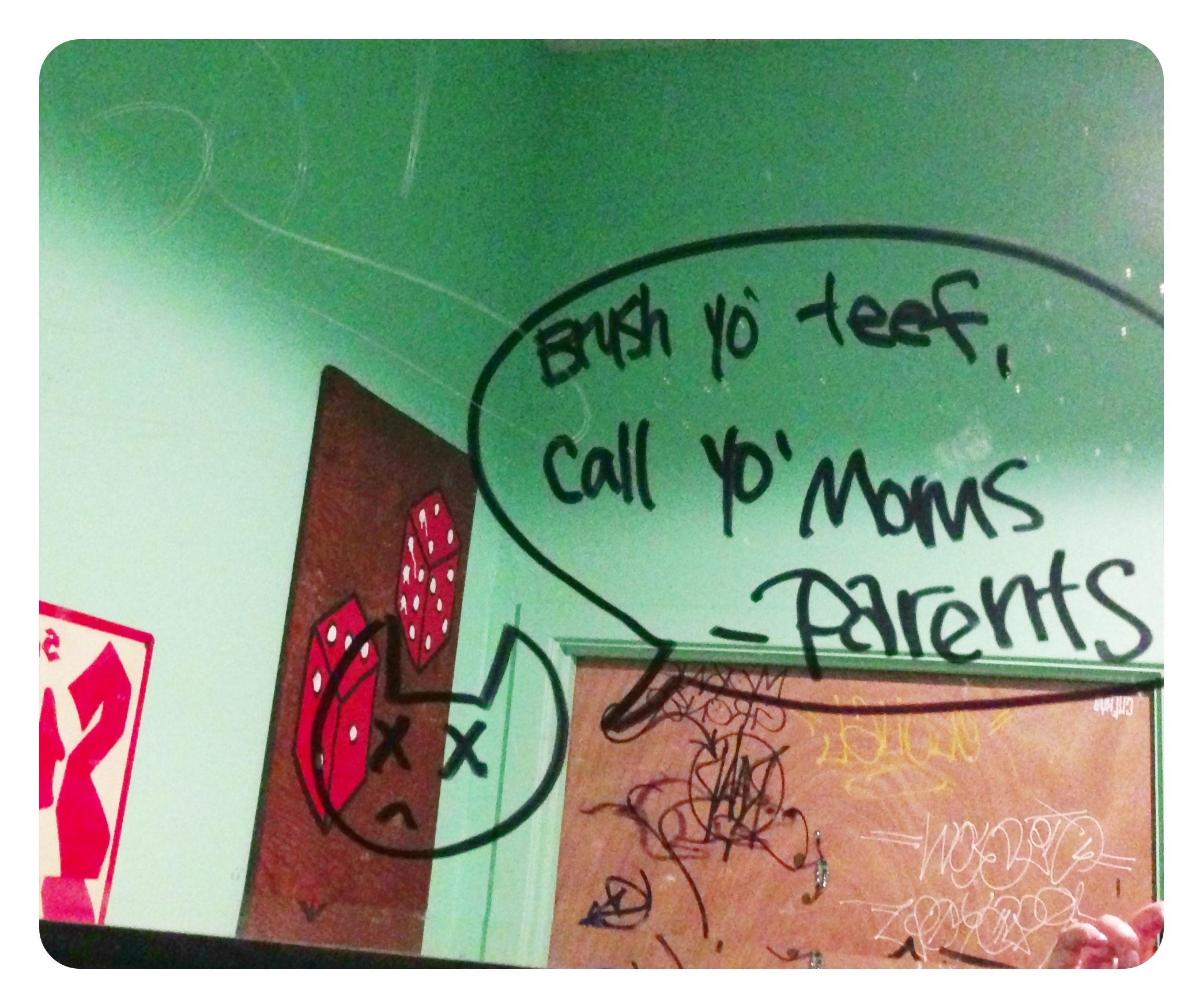
Another sends the above photo: “Here is my favorite from a mirror at Telegraph Beer Garden in Oakland, from ‘parents'”. Another reader:

Do I have what it takes to turn this one into a thread? Let’s find out.  I want to add another dimension to why people scrawl bathroom graffiti, which is group identity.

When I’m in the bathroom at a trendy or well-known bar or club, I often notice a big difference in tone and quality of the wall scrawling, compared to the average truck stop or gas station. Jokes that are actually funny, bits of poetry, or even running conversations are much easier to find. It seems like patrons want to demonstrate the value of their establishment in the kinds of things they write. Sometimes the jokes are so good that I wonder if some of the paid staff were instructed to write them to contribute to ambience.

Spontaneous case in point: at my small, very bookish liberal arts college, someone penned, in the grout between the tiles above a urinal, a pun playing off of the word “grout.” Other students found this so delightful that they started contributing additional grout puns along other parts of the grout. “Grout Expectations,” “The Grout Books,” etc. After a few years of many people adding more puns, it got to the point where you had to be very lucky, or have a very full bladder, to successfully think of a new one before your purpose at the urinal was spent.

Eventually, the grout puns spread to other men’s rooms on campus. I never discussed these puns aloud with anyone at school, but it was clear that all of the male students knew about them and that many of us contributed at one point or another. (I never found out if they spread to the women’s rooms.) How can one explain this popular, leaderless explosion of puns on the unlikely word “grout”? How else but that it nicely conformed with our self-conception as a student body of being clever, non-conforming nerds who read too many books?

Do Cops Treat Blacks And Whites Equally? Ctd

A reader close to the question responds:

Of course there are racist cops – there are racists in every profession – but I don’t think cops as a whole are more racist than other professionals. As a white male cop, I’ve been accused of being a racist by black people and Hispanics and of reverse racism by whites.

On multiple occasions I’ve pulled black people over because their brakes lights, taillights, or headlights are out; it’s one of the more common reasons to stop someone. Most times you are following the car and don’t even know the race or sex of the driver. On several occasions, after explaining why they’ve been stopped, they tell me what a racist I am and they know their lights work. When that happens, and if it’s safe, I’ll have them exit their car and show them which light(s) is out. Even after I prove I’m not racially profiling, they insist I’m still a racist.

One of those times involved a black cop from Camden, NJ.

Every single one of his rear lights was out and he thought I was a racist for stopping him. Once, before I was even a cop, I was shopping at Target, browsing the DVD section. There was a middle-aged black man in the same area. After a few minutes we both walked away. About 5 minutes later, I happened to find myself near the same man browsing the electronics section. Apparently the man assumed I was store security and was purposely following him because he was black. He approached me, made a comment I no longer remember, and left the store angry.

Finally, I once stopped an older white male for multiple reasons. As soon as I walked up to him, he accused me of stopping him because he was white and saw him as a chance to raise money for the town through tickets. He was irate and told me I should stop real crimes.

The truth is, people perceive racism when there is none in order to avoid taking responsibility for their actions. While off duty, I’ve been pulled over at gunpoint and have been treated like crap and yelled at for no reason by cops. Every time it was my fault because I had committed a traffic violation.

Why We Mishear Lyrics

Maria Konnikova explains:

Human speech occurs without breaks: when one word ends and another begins, we don’t actually pause to signal the transition. When you listen to a recording of a language that you don’t speak, you hear a continuous stream of sounds that is more a warbling than a string of discernable words. We only learn when one word stops and the next one starts over time, by virtue of certain verbal cues – for instance, different languages have different general principles of inflection (the rise and fall of a voice within a word or a sentence) and syllabification (the stress patterns of syllables) – combined with actual semantic knowledge. …

A common cause of mondegreens, in particular, is the oronym: word strings in which the sounds can be logically divided multiple ways. One version that [Steven] Pinker describes goes like this: Eugene O’Neill won a Pullet Surprise. The string of phonetic sounds can be plausibly broken up in multiple ways – and if you’re not familiar with the requisite proper noun, you may find yourself making an error. In similar fashion, Bohemian Rhapsody becomes Bohemian Rap City. Children might wonder why Olive, the other reindeer, was so mean to Rudolph.

Speaking of mondegreens, or misheard song lyrics, many readers submitted examples of them during our long-running thread on eggcorns:

The classic one is from Purple Haze, where Jimi Hendrix sings “Excuse me while I kiss this guy.” Or Elton John’s famous chorus “Hold me closer, Tony Danza.” Hotel California has that great line about the “warm smell of fajitas, rising up through the air.” And I swear in the Rush song “Free Will,” Geddy Lee sings “You can choose a bathysphere. I will choose free will.”

I’m sure some of your readers can find a few more.

To say the least:

My favorite is my aunt Anne’s version of a Beatles refrain: “She’s got a tic in her eye/she’s got a tic in her eye/she’s got a tic in her eye/and SHE DON’T CARE!”

Another:

Whenever someone slipped up in our house, we just sang the Rolling Stones hit: “I’ll never leave your pizza burning.”

Another:

I suppose I was fantasizing about threesomes when I heard the line from The Young Rascals’ “Groovin'” that goes “life will be ecstasy/you and me endlessly” as “you and me and Leslie.”

Another:

As a longtime radio DJ, I have a lifetime of mondegreens from our request line.  For example: “Hey, man, let’s hear some Kiss, ‘I Wanna Rock & Roll All Night, And Part Of Every Day!'”

And I recall reading in Art Linkletter’s book Kids Say The Darndest Things that he heard a child singing “God Bless America” that included, ” … stand beside her, and guide her, through the night with a light from a bulb.”

Another

My cousin Erika thought that “America the Beautiful” was about her. (She’s now a speech and language pathologist. Funny how that works.)

Another from that song:

“O beautiful for spaceship guys…”

Another patriotic tune:

The last line of the Star Spangled Banner starts “O’er the land of the free”, yet almost everybody sings it, “for the land of the free”.  The line refers to the flag (which is the point of the song) flying OVER (poetically contracted) the land of the free and home of the brave, not flying for it.  Get it right people; it’s the National Anthem for goodness sake!

And another:

In my elementary school we sometimes sang “My Country ‘Tis of Thee” in the mornings along with the Pledge of Allegiance. I always thought the “of thee I sing” part was “of the icing”, as in the icing on the cake.

From Down Under:

I’m reminded of a line in Australia’s national anthem, which goes “Our land abounds in nature’s gifts.” My dad always sang, “Our land abounds in nature strips”. In Australian English, that’s the strip of grass between the sidewalk and the road, which you find all over suburbia.

Another cautions:

If you value your sanity, do not get sucked into the “mishearing” mire. In the San Francisco Bay Area where I used to live, we had a columnist who started writing about mondegreens several years back, and after inviting reader submissions, it quickly degenerated into what has become an annual bacchanalia of really bad puns. Be forewarned!

This will probably be the only batch of reader submissions we’ll post, since a thread on misheard song lyrics would be never-ending flood to the in-tray. But here’s one more:

In Winter Wonderland, I thought the line “we’ll conspire as we dream by the fire” was “we’ll perspire as we dream by the fire.”

Lastly, a reader looks to the origin of the word:

The mondegreen takes its name from the misheard last line of a 17th century ballad, where the last two lines are “They hae slain the Earl o’ Moray, And laid him on the green”, but an American author heard “They hae slain the Earl o’ Moray, And Lady Mondegreen.”  There’s a great Wiki discussion of the term here. And there are billions of entertaining examples here.

How Dangerous Is NYC These Days?

With its police force in a “virtual work stoppage“, Ben Wallace-Wells takes stock of the city’s crime rates:

Nearly every New Yorker now lives, in some meaningful way, in a post-peak-crime city marked by gentrification and safety, even in what were very recently very poor neighborhoods. The statistics that de Blasio rattled off at the Ingersoll Houses were astonishing: 80 percent reductions in murder and robberies since the early ’90s. (Perhaps even more amazing is the statistic that the criminologist Frederick Zimring of the University of California-Berkeley likes to cite, that auto thefts have declined by 95 percent.)

The mayor is, as my colleague Chris Smith astutely pointed out, lying low right now. But when he reemerges, one way to further de-escalate tension might be to continue in the cooler vein he displayed at Ingersoll: talk about the achievements of the NYPD in reducing crime; about the accomplishments of the last year as the department has scaled back stop-and-frisk while seeing continued declines in violence [homicide down 7 percent and robberies down 14 percent since 2013]; about the false choice of the trade-off between security and freedom.

What other policies has the mayor put into place this year? From Margaret Hartmann’s list of “43 Ways New York Has Changed Under Mayor de Blasio”:

4. NYPD officers are starting to use body cameras.
About 60 officers in six precincts throughout the city began testing wearable video cameras in December as the first step toward outfitting the entire force with body cameras. The pilot program is one of the reforms ordered by Judge Scheindlin, but the NYPD said it was proceeding “independent of the order,” and it moved up the launch date after protests in Ferguson, Missouri made body cameras a national issue.

5. New York police officers are being retrained.
In the wake of the chokehold death of Eric Garner, Mayor de Blasio announced that all 35,000 NYPD officers would be retrained. The three-day program, which started in November and will end in June, covers physical tactics, such as how to properly take down a suspect, and various “de-escalation” techniques, including a lecture on self-regulating emotion in stressful situations.

6. Carrying a small amount of weed will probably result in a ticket, not an arrest.
In November, Mayor de Blasio and NYPD Commissioner Bill Bratton announced a shift in the city’s marijuana policy: Now, in most circumstances, those caught with a small amount of marijuana (25 grams or less) will only be ticketed. While marijuana possession has been decriminalized in New York since 1977, the NYPD had skirted the rule by having suspects turn out their pockets, bringing their pot into “open view.” Within two weeks, low-level marijuana arrests were already down 60 percent.

And how is the NYPD faring in this continued decline in crime and drug arrests? Adam Chandler looks at a new report on cop safety:

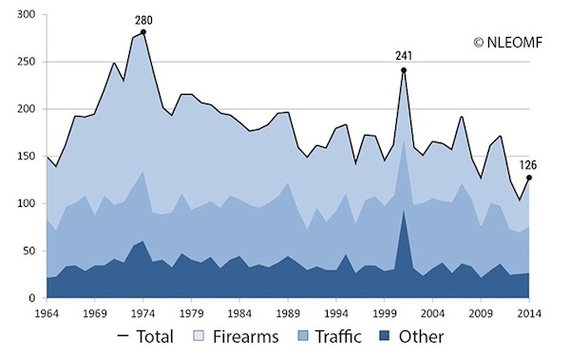
On Tuesday, the National Law Enforcement Officers Memorial Fund, a pro-police nonprofit, released its preliminary 2014 report on officer deaths, which listed the total number of fatalities at 126. Most striking was the number of firearms-related deaths in 2014 (50), which was a 56 percent jump from 2013 (32). The second-leading cause of death for police were traffic-related fatalities (49), an increase from last year (44), when it was the year’s leading cause, according to the group’s data. NBC added that, despite the increase, 2014’s total of 126 is well below the average of 151 for the past decade.

cops

Max Ehrenfreund adds, “Fifteen of those officers died in ambushes, including Officers Rafael Ramos and Wenjian Liu in New York this month.” But Dara Lind raises several caveats for the supposed spike in cop deaths:

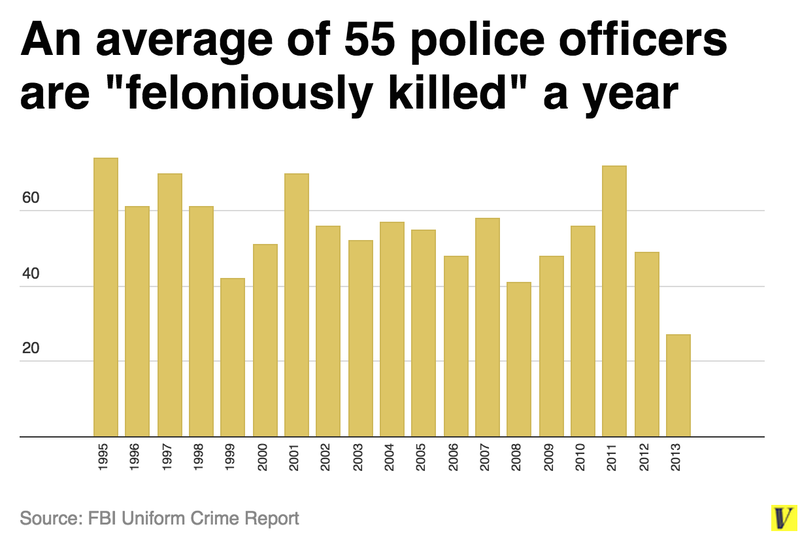
The Memorial Fund doesn’t distinguish between officers who are killed by suspects — what the FBI calls “felonious killings” of police — and officers who are killed by accident (for example, during training exercises). But the FBI’s annual report on Law Enforcement Officers Killed and Assaulted does count the two separately — and it consistently finds that more than half of all officer fatalities are accidental.

When the FBI counts felonious deaths alone, the number of officers killed each year is well within double digits:

Screen_Shot_2014-12-21_at_1.42.15_PM.0

Even counting accidental deaths, the FBI’s numbers are lower than the Memorial Fund’s: the FBI reported that 78 officers were feloniously or accidentally killed in the line of duty in 2013, for example, while the Memorial Fund says that 102 were. Two factors that could help explain the disparity: the FBI doesn’t collect data from every law enforcement agency in the country (its 2013 report covered 78.2 percent of America); and the Memorial Fund counts deaths from “job-related illnesses” as officer fatalities.

But even with the discrepancy between the two data sources, it’s reasonable to assume that many of the 126 officer deaths the Memorial Fund says happened in 2014 were accidents.

The Anti-Clinton Who Stayed In New York

Many remembrances of the three-time governor, who died yesterday at the age of 82, have focused on his oratory:

https://twitter.com/jonfavs/status/550818345600036864

Jonathan Alter adds that Cuomo’s allegory “of the United States as a family whose members take care of one another remains a more soulful and coherent governing philosophy than anything Democrats have managed since.” Former Clinton speechwriter Jeff Shesol elaborates:

That metaphor—the nation as a family—was a favorite of Cuomo’s, and, though it’s as timeworn and trite as a trope can be, Cuomo gave it new meaning—as a moral summons, as a philosophy of government, and as a rejoinder to Reagan’s emphasis on the individual above all. “We believe in a single fundamental idea that describes better than most textbooks and any speech that I could write what a proper government should be: the idea of family, mutuality, the sharing of benefits and burdens for the good of all, feeling one another’s pain, sharing one another’s blessings—reasonably, honestly, fairly, without respect to race, or sex, or geography, or political affiliation,” Cuomo declared. “We believe we must be the family of America, recognizing that at the heart of the matter we are bound one to another.” This, he said, was the Democratic credo: “We believe in only the government we need, but we insist on all the government we need.”

On the floor, the speech brought catharsis. It was all the things that Democrats wished themselves to be but no longer felt they were as a party. It was bold, in its willingness to take on a popular President directly; it was unapologetic, stating its beliefs clearly and without equivocation; it drew its indignation from some inner store of strength and conviction, not from mere calculation.

How rare that is among Democrats today. Tomasky prefers another Cuomo speech, about the separation of church and state:
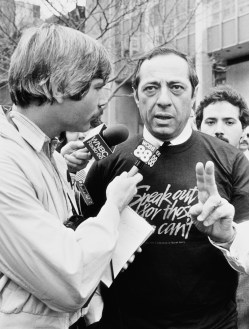
Mario CuomoGo read it. Called “Religious Belief and Public Morality: A Catholic Governor’s Perspective,” it was learned and even profound here and there, and it was honest in a way I don’t think any politician would dare to be today. The seedlings of his potential greatness as a leader are sprinkled throughout it. He could have been the inheritor of what Bobby Kennedy was becoming when he was assassinated—the kind of pol who, through a combination of intellect and street sense, had that cross-racial demotic touch that too few liberals have. His track record as governor didn’t give us reason to think he’d have been a great president, but then, neither had Franklin Roosevelt’s; maybe the power would have made him more resolute.

But he was too ambivalent to seek that power. I know he was a big reader of Augustine, and it’s been many years for me since I cracked The Confessions, but I seem to recall something about the centrality of self-doubt. It was always sure central with him. I’m not saying he was a tender little flower. He did become governor, after all, in one of roughest-and-tumblest political environments in the country, and he lasted three terms. But self-doubt, while a healthy quality for human beings to have, is alas not a plus for politicians. (His son appears to have learned this lesson in spades.) Maybe that’s always what Cuomo wanted deep down: to be a good public citizen first and good politician only second. Would that more of them were like that.

How Fallows remembers the liberal giant:

Among politicians of the past generation-plus seen as national-level contenders, he was the most accomplished and engrossing public thinker.

(This is also Obama’s strength, and presumably he will overtake Cuomo through the scale of the issues he has been involved in.) Most public officials know, or fear, that they need to buff away the complicated or challenging parts of their views before presenting them in public. That’s assuming they ever had, or kept, such thoughts. Mario Cuomo was notable in trying always to talk up to his audience, not down. You see that especially in his Notre Dame speech [on church-state]. It’s an example worth reflecting upon.

Rhetorical success, like presidential effectiveness, involves more separate elements than you might think. It helps to have a good voice and physical bearing; to have actor- or announcer-type skill in presentation; to have an ear for sentence-by-sentence euphony; and to understand the intellectual and emotional shape of speech. Mario Cuomo had all of these, and our public life was richer when he was an active part of it.

Elaborating on that sentiment, Joe Klein’s favorite memory of Cuomo remains his principled opposition to the death penalty during the 1982 gubernatorial primary:

[Though the polls and and his opponent, New York Mayor Ed Koch, were for it,] he made it the central issue of his campaign. We went from town to town in upstate New York, just a few of us—all the press and smart money were with Koch at that point. Mario would hold town meetings, knowing viscerally that he could only win their votes if they knew what kind of man he was. And he needed the death penalty for that. If they didn’t ask him about it, he’d ask them, “Doesn’t anyone want to ask me about the death penalty?”

He would tell them whether they wanted to hear it or not. He would tell the story of how one of his daughters was accosted by a thug on the street in Queens who burned her breast with a cigarette. “Did I want to murder that guy? Absolutely. My son Andrew got into the car with a baseball bat, looking for the guy. I would have torn him apart with my bare hands if I’d ever found him … But would have that been the right thing? No. It would have been the barbaric thing to do. That’s what we have government for—to protect us from the barbaric side of human nature.” The state, as an exemplar of moral rectitude, had to abide by the commandment, “Thou shalt not kill.”

People would come up to him after the meetings and say, “I’m still not sure I agree with you on the death penalty, but I certainly respect your position.” In the end, they decided to vote for him. They voted for him because Mario Cuomo was a man to respect, a man who respected them well enough to tell them what they didn’t want to hear.

Ken Auletta insists that Cuomo was “incapable of faking conviction” but acknowledges that he “had flaws”:

History will not record that he was a great governor. His budgets were almost always late. His reflectiveness and reclusiveness did not dazzle legislative leaders. And his flight from San Francisco [after his 1984 convention speech], like his choice not to run for President in 1992, may have indicated a reticence that would not have served him well as President. Or maybe it camouflaged insecurity that was both disabling and wonderfully human. Unlike most politicians, who have no interior lives, he was worthy of a novel.

Reflecting on Cuomo’s would-be rise to the national stage, Ben Smith tries to understand why his legend has endured:

Cuomo was a giant of the 1980s, in some sense the truest leader of the opposition. It would have been natural to imagine then that when the pendulum swung back to the Democratic Party, Cuomo and his policies would be elevated. Instead came Bill Clinton, who ran against his own party’s left and promised something new, something a little more respectful of Ronald Reagan than you would have expected, and something divorced from the party whose hero Cuomo had been. Clinton would have run against Cuomo, of course, had Cuomo run. But Cuomo’s son went to work for Clinton, and Andrew Cuomo — sworn in for his own second term in Albany the day his father died — has governed like a man who learned from his father what not to do. Andrew is an expert in the raw and unapologetic use of power, and a master of triangulation.

Morrissey is skeptical of all the what-if arguments about Cuomo and the presidency:

The bigger question was whether Cuomo and his brand of progressive politics would have succeeded in a general election. CBS played the clip from Cuomo’s 1984 speech, but that misses the context and the aftermath. The context was a double-dip recession that had created a high unemployment rate early in Reagan’s first term, but the economy had turned the corner months earlier. The roaring economy would create the greatest post-war expansion in American history and set the stage for a quarter-century of low unemployment and solid growth. Walter Mondale offered a slightly more moderate version of Cuomo’s progressivism … and lost 49 states in the election a few months after that convention speech, even before the economic turnaround had occurred.

Mondale’s experience had to have served as a cautionary tale to Cuomo. The results of the 1984 election exposed just how marginal his and Mondale’s politics actually were with the American people. His reticence turned out to be correct; Massachusetts governor Michael Dukakis lost 40 states to George H. W. Bush. Bush successfully painted Dukakis as an out-of-touch Northeastern liberal — a charge that would have stuck even more to Cuomo.

Nick Gillespie wasn’t impressed by Cuomo:

He was an unreconstructed liberal who was able to push through bad policies on the strength of his oratory and put-downs. I was in Buffalo to attend SUNY for grad school and a number of the profs there (all Democrats of course) loved that Cuomo had pushed to keep tuition constant for years and years. At the same time, they didn’t understand why more and more wealthy kids were filling the classes (duh, it was a great education at a huge discount) and why there was less money coming into the school. A serious governor would have allowed tuition to rise to market value and then used the extra dough to help the people who really needed it. Instead, Cuomo helped beggar the whole system while giving a nearly free college education to middle and upper class New Yorkers.

The unworkability of his policies is precisely the reason why Cuomo became one the last of the unreconstructed liberals to hold a high place on the national political stage. For all his gifts in talking and fighting for his point of view, his policies in general didn’t work very well. And when he had the opportunity to punch up to the next weight class, he refused to leave his corner.

Frum finds that the Italian-American was a “heroic failure” to his supporters:

Cuomo never forgot his origins in the immigrant working class that idolized Franklin Roosevelt and elected John F. Kennedy. Cuomo memorably compared Walter Mondale to polenta, the bland, mushy cornmeal staple of the Italian poor. Cuomo’s most famous speech ended with this haunting evocation of his deceased father: “I watched a small man with thick calluses on both his hands work 15 and 16 hours a day. I saw him once literally bleed from the bottoms of his feet, a man who came here uneducated, alone, unable to speak the language, who taught me all I needed to know about faith and hard work by the simple eloquence of his example.”

Yet the huge majority of Italian-American voters, like the huge majority of Irish Americans, Polish Americans, and all the other white ethnic groups who once rallied to Roosevelt and Kennedy have now deserted Roosevelt’s and Kennedy’s party—not to return unless they have earned a college degree and gained comfortable professional work.

Elizabeth Kolbert concludes:

There were a lot of phrases that Cuomo liked to repeat, and most had a melancholy cast. “You go from stone to stone across the morass” was one. “You campaign in poetry; you govern in prose” was another. Cuomo’s dark broodiness, his affinity for suffering, lent him moral gravity. His great gift—and it was an important one at the time—was to make listeners feel that politics was a serious business and that civic life matters. … [Another oft-used phrase] concerned his own death. Many times, I heard him say that the inscription on his gravestone should be a short one: “He tried.”

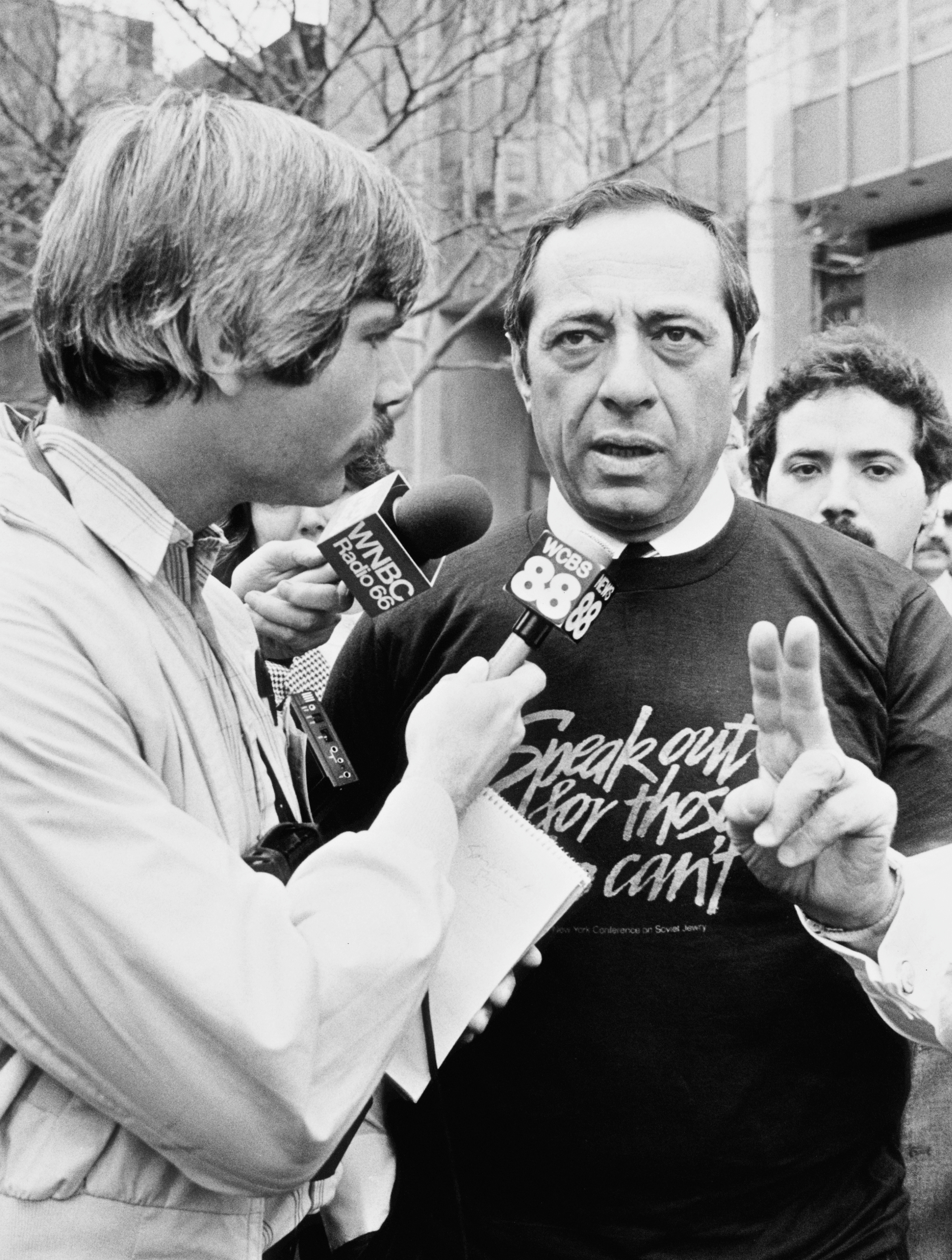
(Photo: American politician and member of the Democratic Party, Mario Cuomo, talks to journalists at a march for Soviet Jewry in New York City on June 5, 1984. By Barbara Alper/Getty Images)

What Fairy Tales Teach Us About Hope

Rowan Williams, the theologian and former Archbishop of Canterbury, explores their meaning:

One way of understanding the fairy tale is to see it as dramatising the human confrontation with nature and “the impenetrability of destiny”. Our environment, the fairy tale says, is unpredictably hostile and destructive; it is also unpredictably full of resource. Family members may turn out to be murderous and treacherous, ordeals may face us in which our life is at stake, horror and suffering may bear no relation to merit or innocence. At the same time, animals turn out to be saviours, winds and waves mobilise to rescue us, lost parents speak to us through trees in the garden and forgotten patrons (“fairy godmothers”) turn up to support.

The amoral scheme of the world can work in our favour; we never know when help is at hand, even when we have gone astray. The message is not just that there is the possibility of justice for downtrodden younger sisters or prosperity for neglected, idle or incompetent younger sons. There is indeed, as [scholar Marina] Warner … makes clear, a strand of social resistance running through much of the old material, a strand repeatedly weakened, if not denied, by nervous rewriting. But this depends on the conviction underlying all this sort of storytelling: that the world is irrationally generous as well as unfairly hurtful. There is no justice, but there is a potentially hopeful side to anarchy, and we cannot tell in advance where we may find solidarity.

Or, to put it in more theological terms, there is certainly a problem of evil in the way the world goes; yet there is also a “problem of good” – utterly unexpected and unscripted resources in unlikely places. And at the very least this suggests to the audience for the tale a more speculatively hopeful attitude to the non-human environment as well as to other people. Just be careful how you treat a passing fox, hedgehog or thrush….

Would You Report Your Rape? Ctd

Another reader provides yet another angle:

I’ve been reading this thread with fascination, thinking back to events from my own college time. This fits into the category of “men supposedly can’t get raped, plus there’s that grey zone…” We were dorm buddies. She was coming on to me. I didn’t want sex. She did. I said no. She persisted. I got hard – at that age, nothing much stopped me from getting hard (“oh, she’s wet, that must mean she wants it” – ummmm). The details honestly aren’t important. She ended up fucking me. I just lay there and waited for it to be over.

I told her a few days later that she hadn’t listened to me saying no, and she suddenly looked at me in horror.

She was a pretty radical feminist at the time. I never had another conversation with her, even though we lived in the same dorm. I have no idea who she is now.

But non-consensual sex is what it is. I recognize how easy it is to end up in that position. I wasn’t going to push her aside, like some might suggest. I was ridiculously larger than her, but use force? Um, no, not in a sexual situation when two people are naked. Plus, I didn’t trust her to not turn the tables and accuse me of forcing her. So I kept quiet. I just let it happen, passively. Lots of bad sex happens at that age. Mine came attached to the words, “Look, I don’t want to do this, stop, okay?” and then it happening anyway.

People end up in situations they don’t want. Then they just act to end the situation as best possible. I think it’s human nature. I have told a few people, but reporting it otherwise didn’t make sense. What was there to report? Sure, saying No and getting fucked anyway, but she wanted to get laid – whatever, it wasn’t the end of the world.

It’s interesting that the event never really bothered me that much. I had non-consensual sex. I will do better next time. My wife and close friends know, and they agree that I don’t seem traumatized, and I trust them. I have friends (male and female) who experienced something similar, and we all agree that it’s not rape, and also not consensual, and we aren’t too bothered by our past. (Hell, plenty of us married folks admit to plenty of times of having sex when we kind really don’t want to and do anyway – and 95% of the time it ends up fine, and the other 5% is because your spouse really needed that moment, and none of that is rape, when we talk about it, either.)

In no way am I minimizing rape, nor the reactions to non-consensual moments that others have experienced. Not at all. A close family member was brutally gang raped and beaten and left for dead in a forest and survived. (Notably, she doesn’t carry her trauma with her, having chosen to carry her life, based on the miracle of still having it.) A close close friend was raped by her (former) best friend and is still totally freaked out by it. There are spectra of events, spectra of reactions.

I realize that in writing, you might end up publishing, but I doubt you will. Kind of a boring story. But there’s a link to a tumblr I want to share, because it might help those whose reactions are different from mine. It’s a really rough read, but reading there has helped me as I’ve stood by people who have gone through trauma. By reading and learning, I can embrace and help them, bring compassion to my interactions with them, listen to voices saying what they aren’t ready to say yet. If you could share the link, maybe it would help some folks. Thanks.