On this issue, the left in France sounds … well a little like the American anti-marriage equality left of the 1990s. But with a new twist:
An important current of French thought, which has no real American equivalent, has maintained that while women deserve equal rights, these rights must not entail the supposed erasure of sexual difference. Historians and philosophers such as Mona Ozouf and Philippe Raynaud have seen a particular threat in American-style protections against sexual harassment, which they have labeled “sexual Stalinism.” The sociologist Irène Théry has called for a féminisme à la française that acknowledges the “asymmetrical pleasures of seduction.” The philosopher Sylviane Agacinski goes so far as to call sexual difference the true basis for sexual equality in law. …
This spring, precisely the same concerns have dominated the manifestos against “marriage for all” issued by groups of law professors and psychologists. And interviews with ordinary protesters have shown just how effectively the arguments of philosophers have filtered down to street level, with one figure after another explaining their opposition to the reform in the same way. To quote a popular protest banner: “Un père et une mère c’est élémentaire” (“A father and a mother is elementary”). And the 60 percent support for same-sex marriage has not changed the fact that a majority still favors banning child adoption by homosexual couples. In short, although religion and homophobia obviously fed into the recent protests, the rhetoric employed by the opposition has trickled down from the intellectuals (as one might, indeed, expect in France).
Liel Leibovitz senses religious and distinctly Talmudic themes in the rebooted series of Doctor Who:
Without getting too theological—although the show has, casting [villainous species] The Silence as a religious order devoted to ancient prophecies—it is hard not to think of the whole affair as a meditation on God, a riff on that old Exodus chestnut in which the Creator insists that no man shall see his face and live. Learning the Doctor’s name—in 796 episodes, it is not mentioned once, and it is strongly suggested that he himself neither knows it nor wishes to know it—means unlocking all of the universe’s secrets, shedding light on its mysteries, closing the distance between mere mortals and other, higher beings whose job it is to watch over us humans and shower us with kindness and light.
And yet this is precisely what is going to happen next week. Steven Moffat, the creative force behind the series’ current reincarnation, has promised that the revelation will shake the show to its core, sending fans into fits of speculation: Once we know the Doctor’s name, does he cease to be the wondrous being that he is?
They’re naming the Doctor! Noooo!!! It ruins the irony of the very title of the show. I was almost going to say blasphemy, but that might have only proved Leibovitz’s point.
Leibovitz’s point is that Doctor Who is actually Doctor Jew – a wanderer, beset by enemies, with a strong dose of ethics. The Doctor is indeed a form of god – he is close to immortal – and he does adhere to some core ethics. But, although I can see Leibovitz’s point, he is essentially English, not Jewish. He is very far from devout, and always traveling (as the English always have done). He’s a passionate supporter of intelligence over superstition, of nonviolence over violence, and of doubt over faith. In his post-Tom-Baker incarnation (there I go again), he also has an almost unbearable lightness of spirit, capable of looking at pure evil in the eye … and chuckling. He disarms his foes; and outwits them; while remaining aloof from everyone. He is, after all, a non-human for whom the entire past and future is always present. And he has a sense of humor.
Such a god has no name. Just a scarf and a screwdriver and a police box. I can’t believe they’re going to mess with this. For some of us who are Whovians – the show was born the year I was – he will always be the hidden god, the Jesus of the Home Counties.
One hundred years later, David Mikics recounts the last recorded trial of blood libel in the West—Mendel Beilis, falsely accused of draining the blood of a young boy killed by gangsters, in Kiev:
In his trial, Beilis was defiant when he needed to be. He answered one of the judge’s opening questions, “To what religion do you belong?” with, he remembered [in his memoir], “something approaching a shout”: “I am a Jew.” As the trial went on, the prosecution’s case collapsed. The workers that Beilis supervised testified to his honesty; they knew he was incapable of murder. A 10-year-old boy, a friend of the dead [victim] Andrei, had been primed by the Tcheberiak gang to testify that Andrei had often played near the brick factory and had been chased off the factory grounds by Beilis. Instead, the boy stated that Andrei had never gone near the factory. The student who had distributed the anti-Semitic leaflets at Andrei’s funeral fainted when he took the stand. Then, in a moment of high drama, the lamplighter who had originally said that Beilis had chased Andrei from the brickyard recanted his testimony, proclaiming, “I am a Christian and fear God. Why should I ruin an innocent man?”
Withstanding bears, frostbite and potential madness, Brian Phillips recently tracked the Iditarod by land and air. At one point his plane, named “Nugget”, froze up on the ground during a visit to the Diomedes Islands, the border between Russian and US territory:
We were stranded out there for three hours. It was the first time I ever understood why freezing to death is sometimes described as peaceful or soothing or just like falling asleep, descriptions that had always seemed to hint at some unfathomable mind-transformation within the freezing person, some power extreme cold had to enchant the brain’s basic mechanisms of homeostasis. It didn’t feel violent, that was the thing. Even with the wind ripping past you. It was like certain parts of your body just accrued this strange hush. Like you were disappearing piece by piece. I thought I’d be warmer outside and walking around than inside Nugget, so I would sort of exaggeratedly move one limb at a time, my left arm or whatever, and while I was concentrating on my left arm my right leg would start to be erased.
More than affecting my sense perceptions, though, the cold seemed to affect the way I thought about my sense perceptions. I’d take my glove off to adjust a zipper and lose feeling in my hand almost immediately and instead of thinking Holy no I need to get my glove back on right this second I’d sort of pause and go My, how interesting that my hand feels as though it’s visibly translucent. Then my brain’s inbox would gently ding. PLEASE DON’T DIE.
A personal anecdote: the priest who gave me my first Holy Communion and Sacrament of Reconciliation, and whom I served as an altar boy, died a couple of years’ ago. He was walking home on a cold night and was discovered the next day dead on the street. He had died of hypothermia. He was one of the gentlest priests I ever knew – a quietly devout and simple fellow – and it seemed horrifying that this man died on a street, alone, perhaps after a fall. But it’s also a relief to think that freezing to death is not as painful and as wretched as one might imagine. One reason I have not given up the faith is because of the kind of humility and sincerity I saw in that first priest. Others were not so lucky. But we shouldn’t let evil obscure the great good so many priests do every day, in ways others will never know about, but that, bit by bit, begin to heal the broken world.
(Photo: A herdsman whose fingers were injured by frost bite lies in a hospital January 9, 2006 in Fuyun County of Altay Prefecture, Xinjiang Uygur Autonomous Region, northwest China. A blizzard that swept in from Siberia and plunging temperatures to as low as 43 degrees below zero centigrade forced the evacuation of almost 100,000 people and stranded a further 220,000 in Xinjiang, according to the National Disaster Reduction Centre. By China Photos/Getty Images)
Friday on the Dish, we were up in the early hours following the shooting at Cambridge, MA that quickly moved into nearby Watertown and turned into a showdown between the perpetrators and the police. We stood by as information trickledin, until the suspects were eventuallyrevealed to be the Boston bombers, the Tsarnaev brothers. After one of them was killed and the dust settled temporarily, we hoped the policed could catch the other alive for full questioning.
As more became known about the brothers’ religious fascination, Andrew tried to figure out their homegrown brand of stoner jihadism (with reader pushback) and we started to look into what their Chechen connection might mean. We heard from a reader who knew the younger bother at large, Dzhokhar, and pointed toward his Twitter account.
By the afternoon we were askingwhether Boston and Cambridge should be put through total lockdowns to catch the remaining bomber, and continued processing the religious factor. Christopher Dickey, Eli Lake and Daniel Klaidman researched where the pair could have gotten the materials to pull off these attacks while Philip Bump explained how they became citizens.
News broke in the evening of a final standoff between Dzhokhar and the police after authorities found him in hiding in a boat parked in a Watertown resident’s backyard. Before long he was taken alive.
In commentary and analysis, Toobin doubted that we can effectively guard against this kind of lone-wolfism, Lt. Col. Robert Bateman advised against vigilante videotaping of shootouts, and Julianne Hung warned about indiscriminate blacklash against Muslims in light of a beating in Massachusetts this week. Ben Smith explained the basis of paranoia from the brothers’ parents and vocal aunt as we continued to learn details from the remarkable hero of Monday’s bombing, Jeff Bauman, who helped identify the bombers from his hospital bed.
Throughout, we factored the events into politics going forward, and of course there was a good deal of partisan mudslinging on immigration and some more on guns. We gavecredit where it was due to the MSM and new media, and kept shaming the New York Post for its nonstop atrocious coverage.
In the bigger picture, Andrew considered what this all might mean for the national psychology and terrorism (to dissent from readers), homed in on two quotes worth pondering, and reflected on the president’s remarks and the other fatal explosion that took place this week in West, Texas. Finally, we glanced at the exhaustion of a Cambridge resident in the Face of the Day and melted during a much needed Mental Health Break, as The Onion summed up America’s collective exhale from this week.
–B.J.
The rest of the week after the jump:
this high res pic is good news. super clear. someone could actually recognize this bro from this pic: twitter.com/ravisomaiya/st…
Thursday on the Dish, Andrew reflected on the meaning of the word ‘terrorism’ after Boston, shamed the New York Post for its unhinged, libelous coverage of the bombing, and chided both Obama and the right for unanimous silence on the most recent report of America’s torture regime. Elsewhere, he defended masturbation, answered readers on the perks of living in New York, and awardedboth Glen Reynolds and Kevin Williamson Malkin Award nominations for their ill-advised swipes at Gabby Giffords.
We gathered coverage of the fertilizer plant explosion in West, Texas and Dreher focused on the sacrifices of volunteer firefighters at the scene. On the Boston bombing beat, security cameras caught the actual suspects in the Faces of the Day while Tim Murphy connected skills learned Iraq to those used by EMS in the aftermath of the explosion.
In political coverage, Douthat speculated why the US experiences so few bombings, we probed the connections between location, gun ownership and suicide, and we rounded up reax to the death of the gun-control bill and the President’s remarks. Rubio took heat from right-wingers for his much-hailed immigration bill, Laura Murphy highlighted the lack of due process in deportation, and we tried to parse the legal significance of keeping one’s mouth shut under interrogation lights. Reinhart and Rogoff struck back, we took a subway ride through New York’s inequality gap, and George Packer gave voice to friends of the US trapped in Afghanistan after we leave. Finally, Noam Scheibler followed former Obama aides into the lobbying business and Dreher clarified why he doesn’t belong to the GOP as readers flooded the inbox in response to yesterday’s email from a would-be gay Republican.
In miscellanea, Adam Kirsch dove into the journal of Holocaust survivor Helga Weiss, we found out what’s keeping US soldiers awake at night, and Dishheads weighed in on one reader’s story of hydrocephalus. Melissa Holbrook Pierson described the hobby of ‘found photography,’ and we considered the message of Jackie Robinson’s new Hollywood treatment while George Soros received the Tom Sawyer treatment in the Headline of the Day. Patton Oswalt delivered a tour de force in fan-fic filibustering while six literary titans workshopped Moby Dick. We took in a strong commercial for gun legislation in the Cool Ad Watch, joined Iron and Wine for a light show in the wilderness in the MHB, and enjoyed a floral view in Washington, DC for the VFYW.
Wednesday on the Dish, Andrew tore into Bill Keller’s latest excuses for refusing to print the word ‘torture,’ reluctantly voiced potential support for Hillary in 2016, and sighed at the ongoing clout of the gun lobby. He speculated on the political intrigue behind the immigration bill, paused to listen to New Zealand’s parliament erupt into song over marriage equality, gave credit to the military men who helped fellow runners in Boston. He also talked blogging on a GigaOM panel with Andrew Ross Sorkin and Maria Popova.
We tried to keep track of today’s media derp over Boston, Alexis set vigilante investigators on Reddit straight, and we awed at the strength of those injured in the bombing and the hospitals that took them in. Later, we gathered reflections on the proper reaction to this kind of terrorism while Greenwald pleaded for more global empathy.
In other political coverage, a gay reader seriously considered throwing in with the GOP, Yglesias made a second pass over the flawed Reinhart-Rogoff report and Susan Porter doubted the effectiveness of anti-bully laws. Washington residents said yes to pot legalization as we took a trip to the marijuana farmer’s market. We tipped our hats to the news crew that won this year’s Pulitzer for national reporting, took note of Lady Thatcher’s funeral proceedings, and Jerry Coyne disapproved of patenting genomes. Daniel Pipes actually recommended we fund mass murderer Bashar al-Assad while Ford Vox encouraged a hi-tech check on health care acquired infections.
In assorted coverage, a reader and eyewitness to the Boston bombing shared a flash of levity from that day, while another shared sorrow. Readers asked Rod Dreher about the toll of cancer treatment, Thane Rosenbaum said a good word for revenge, and Tara Clancy tore it up at the Moth. Cowen ran a thought experiment if our lights went out in middle age, we scanned the Louvre for secrets and leafed through Woody Guthrie’s sole attempt at fiction.
Elsewhere, we got up close and personal in a sketchy Cool Ad Watch and remembered an old folk remedy for bed bugs. Finally, we visited Lothersdale, England in the VFYW, witnessed the power of lighting in the MHB, and stared down the barrel of a gun at the Face of the Day.
Tuesday on the Dish, Andrew zeroed in on the damning report on the Bush administration’s use of torture and took aim at Obama’s ongoing hypocrisy on Gitmo. He also urged stoicism in the face of tragedy in light of the events in Boston, remembered the skill and bravery in the work of Tim Hetherington, and allowed readers to ask Steve Brill anything.
In further Boston coverage, we heard from longtime residents in the aftermath of the bombing, Madrigal spotted a resource for synthesizing all the home videos of the explosion for evidence, and we found the most affecting images from yesterday and tracked down the status of one victim in particular.
In political news, Seth Stephens-Davidowitz challenged Nate Cohn’s dismissal of racism affecting Obama’s electoral fortunes, we said goodbye to Palestinian PM Salam Fayyad, and checked in with Venezuela after fresh, post-Chávez elections. Ross Pomeroy looked through studies on the psychological effects of terrorism as we pondered why these kinds of attacks are so rare in the US and considered options other than gun control to address violence. As Felix greeted the news of gold’s price drop, we surveyed the unemployment cliff and explored the consequences of an unfortunate Excel error in the Reinhart-Rogoff report. Later, Stephanie Mencimer reported on the LDS Church backing off on LGBT rights, Jonathan Cohn diagnosed the ills of daycare and we shined a light on nonprofit fraud.
In assorted coverage, a reader shared a deep personal narrative on hydrocephalus, we took a second look at the life of Zelda Fitzgerald, and reminisced on Thatcher’s faith. Readers asked Rod Dreher about misconceptions of Dixie, we exalted the many faces of David Bowie, and C. G. P. Grey filmed an explainer of Vatican City. We located a town where WiFi and radio are banned for the sake of the residents, readers shared some expertise on nature’s odder floral fragrances and we revealed last week’s VFYW contest in Karachi, Pakistan. Finally, we gazed into the eyes of a hologram in the Face of the Day, spent a moment in Apex, Nunavut for the VFYW, and received a timely rendition of the Star Spangled Banner in the MHB.
Monday on the Dish, we rounded up coverage of the Boston Marathon bombing, from reax onTwitter to commentary and context in the blogosphere, while holding out further analysis until more information emerges. Patton Oswalt had the last word on the tragedy for today.
In other coverage, Andrew took apart Paul Wolfowitz’s retrospective of the Iraq War and pondered whether Pope Francis will drag the Church into the light of modern day. He also questioned our modern fixation on life-extending medicine despite the pain it can bring and wondered how soon news orgs will face the music of a new era. Elsewhere, Andrew responded to TNC’s thoughts on Rand Paul trip to Howard University, and shook his head at the ongoing merger of Christianity and Ayn Rand’s Objectivism in certain quarters of the GOP.
In more political news and views, Andrew Solomon expressed mixed feelings on North Dakota’s new law restricting abortion as we studied the frequency of cross-confessional marriage and cut subsidies for electric cars down to size. Readers filled in the media’s gaps on the horrific story of Kermit Gosnell as we gathered increasing commentary on the case. We met the rare souls who enjoy filling out tax forms while Heritage illustrated where your tax dollars ended up this past year. Finally, Marc Lynch rationalized the Muslim Brotherhood’s irrational track record while a reader took on Susan Jacoby’s reasons to leave religion.
In miscellanea, readers asked Rod Dreher about hometown blues, Willie Nelson spoke for the moment, in the moment, we found a reason for our ‘ums’ and ‘uhs,’ and remembered the first VFYW, in Los Angeles. Michael Wolf awed with his photographs of Hong Kong high rises as we ate breakfast overlooking the Earth and listened closely to the sound of the universe being born. Later we put away our dreams for an invisibility cloak, shopped for germs and browsed some risqué botany. Lastly, we spent a moment in Rome for the VFYW and witnessed the shock following the Boston bombing in the Face of the Day.
Last weekend on the Dish, we provided our usual eclectic mix of religious, books, and cultural coverage. In matters of faith, doubt, and philosophy, Marilynne Robinson remembered Dietrich Bonhoeffer, Francis Spufford thought about Jesus and self-righteousness, and Rachel Held Evans pondered the perils of sharing your faith. Eve Tushnet reflected on the religious imagery of pre-Raphaelite paintings, Karen Armstrong offered a meditation on science and religion, and Susan Jacoby explained how and why people convert to atheism. Ashley Makar reflected on what her cancer diagnosis taught her about Jesus in the Garden of Gethsemane, Erich Fromm taught us how to love, and Barry Lenser found life’s mysteries at the heart of Rod Dreher’s new book. Costica Bradatan reminded us of why failure matters, Jonathan Haidt examined the morals of business students, Priscella Long recoiled at a neuropsychologist’s experiment on human decision-making, and Leanne Ogasawara answered a timeless cocktail party question.
In literary and arts coverage, Robert Silvers divulged the muddled phrases that drive him crazy, David Yezzi provided a searing critique of contemporary poetry, and Ian Crouch wondered if the writer can truly retire. Jeff Sharlet considered the phrase “reads like a novel,” Tom Jokinen recalled Graham Greene’s dream diary, and a transgender woman appeared in the pages of DC Comics’ Batgirl. Stephen Akey praised the French poet Baudelaire for confronting our failures, Lydia Kiesling searched for the great tech novel in San Francisco, and Ann Napolitano toured Flannery O’Connor’s childhood home in Georgia. Maureen O’Connor proclaimed the death of the celebrity sex tape and a new documentary explored Stanley Kubrick’s The Shining. Read Saturday’s poem here and Sunday’s here.
In assorted news and views, DVD technology held promise for cheaper HIV testing, Evan Hughes looked back at the first stirrings of discomfort about New York’s gentrification, Oklahoma football coach Bob Stoops dismissed the need for college athletes to get paid, Jessica Freeman-Slade reviewed Rosie Schaap’s memoir, Drinking with Men, and the conversation continued about Jay-Z and Beyoncé’s trip to Cuba. MHBs here and here, FOTDs here and here, VFYWs here and here, and the latest window contest here.
Today on the Dish, Andrew zeroed in on the damning report on the Bush administration’s use of torture and took aim at Obama’s ongoing hypocrisy on Gitmo. He also urged stoicism in the face of tragedy in light of the events in Boston, remembered the skill and bravery in the work of Tim Hetherington, and allowed readers to ask Steve Brill anything.
In further Boston coverage, we heard from longtime residents in the aftermath of the bombing, Madrigal spotted a resource for synthesizing all the home videos of the explosion for evidence, and we found the most affecting images from yesterday and tracked down the status of one victim in particular.
In political news, Seth Stephens-Davidowitz challenged Nate Cohn’s dismissal of racism affecting Obama’s electoral fortunes, we said goodbye to Palestinian PM Salam Fayyad, and checked in with Venezuela after fresh, post-Chávez elections. Ross Pomeroy looked through studies on the psychological effects of terrorism as we pondered why these kinds of attacks are so rare in the US and considered options other than gun control to address violence. As Felix greeted the news of gold’s price drop, we surveyed the unemployment cliff and explored the consequences of an unfortunate Excel error in the Reinhart-Rogoff report. Later, Stephanie Mencimer reported on the LDS Church backing off on LGBT rights, Jonathan Cohn diagnosed the ills of daycare and we shined a light on nonprofit fraud.
In assorted coverage, a reader shared a deep personal narrative on hydrocephalus, we took a second look at the life of Zelda Fitzgerald, and reminisced on Thatcher’s faith. Readers asked Rod Dreher about misconceptions of Dixie, we exalted the many faces of David Bowie, and C. G. P. Grey filmed an explainer of Vatican City. We located a town where WiFi and radio are banned for the sake of the residents, readers shared some expertise on nature’s odder floral fragrances and we revealed last week’s VFYW contest in Karachi, Pakistan. Finally, we gazed into the eyes of a hologram in the Face of the Day, spent a moment in Apex, Nunavut for the VFYW, and received a timely rendition of the Star Spangled Banner in the MHB.
–B.J.
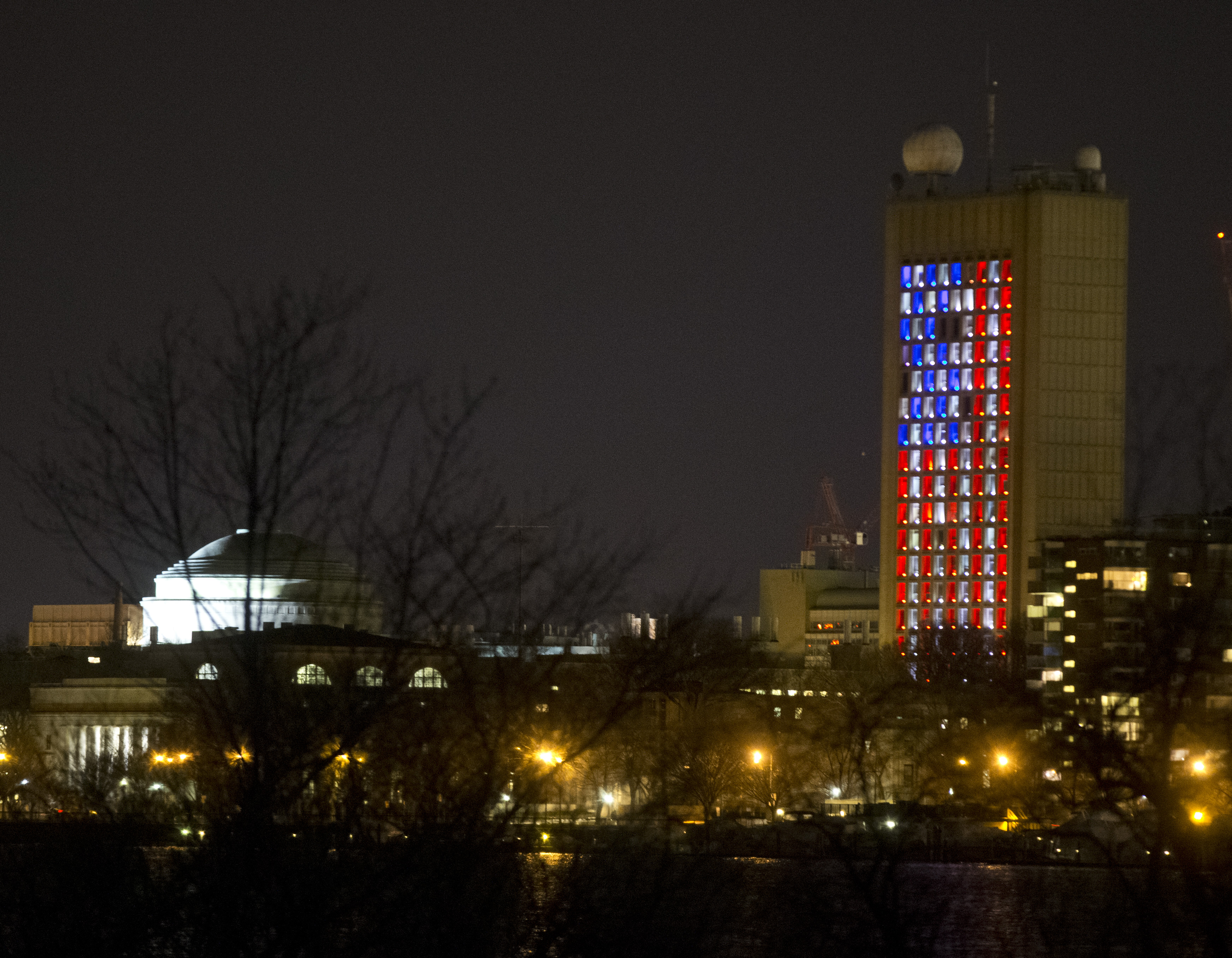
(Photo: A building on the campus of MIT in Cambridge, Mass. was lit up like an American Flag after two explosions went off near the finish line of the 117th Boston Marathon on April 15, 2013. By Matthew J. Lee/The Boston Globe via Getty Images)
Today on the Dish, we rounded up coverage of the Boston Marathon bombing, from reax onTwitter to commentary and context in the blogosphere, while holding out further analysis until more information emerges. Patton Oswalt had the last word on the tragedy for today.
In other coverage, Andrew took apart Paul Wolfowitz’s retrospective of the Iraq War and pondered whether Pope Francis will drag the Church into the light of modern day. He also questioned our modern fixation on life-extending medicine despite the pain it can bring and wondered how soon news orgs will face the music of a new era. Elsewhere, Andrew responded to TNC’s thoughts on Rand Paul trip to Howard University, and shook his head at the ongoing merger of Christianity and Ayn Rand’s Objectivism in certain quarters of the GOP.
In more political news and views, Andrew Solomon expressed mixed feelings on North Dakota’s new law restricting abortion as we studied the frequency of cross-confessional marriage and cut subsidies for electric cars down to size. Readers filled in the media’s gaps on the horrific story of Kermit Gosnell as we gathered increasing commentary on the case. We met the rare souls who enjoy filling out tax forms while Heritage illustrated where your tax dollars ended up this past year. Finally, Marc Lynch rationalized the Muslim Brotherhood’s irrational track record while a reader took on Susan Jacoby’s reasons to leave religion.
In miscellanea, readers asked Rod Dreher about hometown blues, Willie Nelson spoke for the moment, in the moment, we found a reason for our ‘ums’ and ‘uhs,’ and remembered the first VFYW, in Los Angeles. Michael Wolf awed with his photographs of Hong Kong high rises as we ate breakfast overlooking the Earth and listened closely to the sound of the universe being born. Later we put away our dreams for an invisibility cloak, shopped for germs and browsed some risqué botany. Lastly, we spent a moment in Rome for the VFYW and witnessed the shock following the Boston bombing in the Face of the Day.
–B.J.
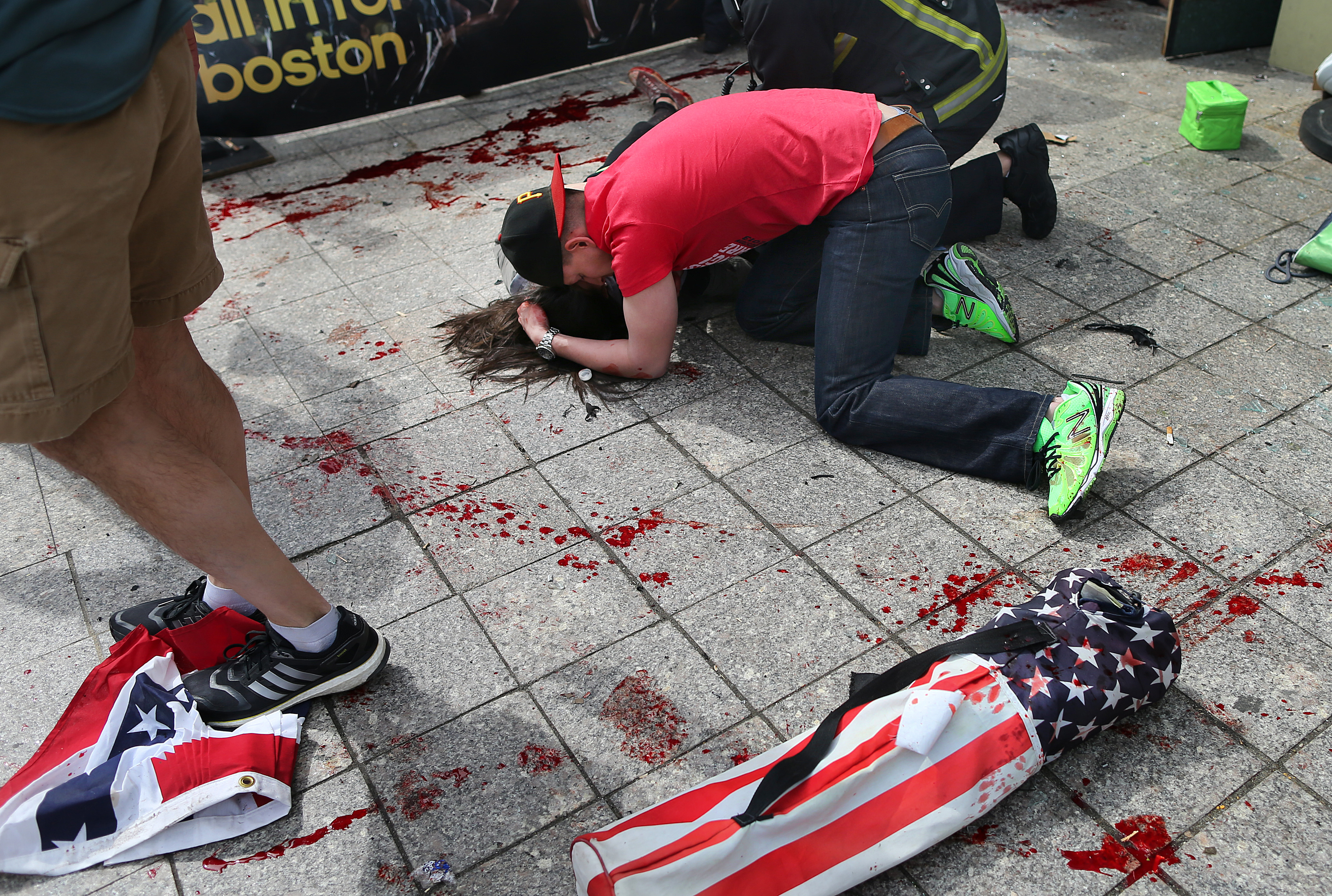
(Photo: A man comforts a victim on the sidewalk at the scene of the first explosion near the finish line of the 117th Boston Marathon. By John Tlumacki/The Boston Globe via Getty Images)
Friday on the Dish, Andrew shined a light on the gruesome trial of Kermit Gosnell, brought up the threat and answered readers’ alarm over North Korean nukes. He considered the conservative split between Burke and Buckley, and noticed some progress on marriage equality at the latter’s old journal, even if the GOP is now globally behind on the question. Later Andrew aired a suggestion to Prince Charles, catalogued San Francisco’s gay bar scene, and gave a peek into his recent dinner with Rod Dreher
In political coverage, a reader reacted to our first post on the plight of American veterans, Nate Cohn dismissed the suspicions of racism chipping away at Obama’s electoral victories and Shikha Dalmia revealed another economic boon illegal immigrants contribute. Barro asked liberals to think of education like health care, Derek Thompson compared teen spending to adult spending, and Ann Friedman found reasons some women are staying home.
We found that the Senate’s gun control bill hasn’t lost all potential and readers remained vocal about silencers. Henry Barbour earned an Yglesais Award for his realkeeping on GOP and marriage equality as Caleb Cain did the tax math on what gay couples have missed out on.
In assorted overage, explored the latest scene of synthetic drugs, gobbled down some red meat, and Boris Johnson dribbled a bit. Alan Sepinwall questioned the massive surplus of TV programming, Alyssa praised the social commentary of District 9 and the coming Elysium and a Youtube sensation snagged an amateur a contract. We bemoaned a new rule of the National Spelling Bee and learned that running a country can itself be a manner of speaking.
We dug deeper into the heap of recycling, took stock of the publishing industry and Kmart channeled Cartman in the Cool Ad Watch. Jason Vorhees gave a deep sigh in the Face of the Day, we looked out at snowy Sioux Falls, South Dakota and Google Street treated us to a timelapse in the MHB.
–B.J.
The rest of the week after the jump:
Thursday on the Dish, Andrew drew attention to the state of America’s veterans, sunk his teeth into the new budget offer, and gave Rand Paul some credit for attempting outreach to black Americans. He extolled Maggie’s sensible position on Israel, described Thatcherite counterculture from his youth (underlining the vitriol of her enemies) and yet noted that critique of her relationship with Augusto Pinochet is totally valid. Later, Andrew saw the end of gay culture watch and explored the possibilities of monetizing blogs.
In political coverage, we checked in with the upcoming consequences of the sequester, gathered reax to the trials of the bitcoin, and pointed to the next possible push for marriage equality. Waldman was skeptical of the gun control bill in the Senate, readers continued to hash out the right to bear arms, and pushed back against Goldblog on silencers. Nate Cohn remained positive that the Republicans are facing demographic trouble as we revisitedBrown Vs. Board of Ed and heard an anecdote on Thatcher’s modern attitude toward same sex couples. Readers countered the idea that only women are objectified in politics and the New York Times made a Freudian slip.
In miscellanea, Chris Oates spotted a reflection of the British Empire in Doctor Who, Noah Berlatsky rebutted Alyssa’s critique of Romeo and Juliet, and Jeffery Overstreet pondered the Cohen brothers’ theological streak. We found more tributes to David Kuo, awed at the reality TV flooding over Alaska, and readers sounded off on the novelization of the small screen.
Later we saw a super secret social network, readers weighed the nutritional value of guinea pig and Seth Rogen went Breaking Bad for a Cool Ad Watch. Finally, we got a taste of summer movies in the MHB, visited Banner Creek, Alaska for the VFYW and recognized a chubby control freak in the Face of the Day.
Wednesday on the Dish, Andrew shared his experience of attending the David Kuo’s funeral and expressed his feelings on a reasonable, Christian understanding of life and death. He took on more criticism from readers for his take Thatcher’s legacy, posted the results of our reader survey on Dish policy of featuring graphic war imagery, and paid respects to Goldblog.
In political coverage, we debated MSNBC’s TV spot calling for collective responsibility of your kids, provided an introduction for those bamboozled by the bitcoin and wondered how long it will take for the rest of us to join Jay and Bey in Cuba. Bobby Jindal’s stock crashed as News Corps put Fox News on notice. Millman reassured us that our trade deficit is a red herring, China and Brazil clocked in richer but tubbier, and we questioned whether we owe the Arab Spring to the Iraq War. Also, the navy drew up designs for a doomsday laser.
Ambider sensed incoming relief in Congress’s partisan stalemate, McWhorter unpacked the terminology of immigration, and Drum supplied some data to back up the backlash against Obama’s remark on Kamala Harris’s attractiveness. Finally, Goldblog pointed out the NRA’s unhelpful stance on silencers and readers fleshed out more contrasting views of the second amendment.
In assorted coverage, Ashley Fetters expected a cameo from Ralph Nader in Man Men, Brad Leithauser relayed stories of his grandfather’s casual catchphrases, and we learned that e-books can be bound study-ready. Balko pointed out that cops don’t have it as bad as they used to, Ben Smith vouched for the success of Sheryl Sandberg’s Lean In, and we charted the ongoing plummet of newspaper ad revenue.
Waldman queried our fascination with listicles, we asked whether life is about creating life and sampled a taste of guinea pork. We played out a quick day with the band the Real Ones in the MHB, checked in with the Syrian rebels for the Face of the Day and peeked out at Matamata, New Zealand in the VFYW.
Tuesday on the Dish, Andrew responded onscreen to critics of Thatcher, and revealed how foreign the Baroness would have been to the Republican program, from climate change to AIDS. Andrew also implored us not to wait for politicians to spearhead social change, pointed out one such case (of gay rights in Uganda), and considered the Obama administration’s role in the change sweeping America. Elsewhere, Andrew continued to express hope for Pope Francis, gave an interview with Vanity Fair, and daydreamed of a future career as a canna-critic.
In political coverage, we tried to measure what racial animus cost Obama in both elections, located the GOP in the 12-step plan, and explored some new ideas of class in Britain. We discovered most scandals don’t torpedo careers and reassessed animal rights’ victory on horse slaughter as Francesca Mari peeked between the grand moments and figures in history. Reading up on WWII, TNC pushed back on lofty assurances against barbarism, as we granted certain elements of the nanny state a second look.
In miscellanea, Laura Bennet and Willa Paskin panned Vice’s new HBO show, Tom Shone triangulated the elements of good cinema, and we counted music sharing as just one new struggle over intellectual property. We uncovered the history of the suicidal dogs of war and considered whether loneliness is a killer while the world markets craved red hot chili peppers. We came across a Fargo-style self-kidnapping service, looked beyond calories for healthy eating, and studied elite chic.
Later we read David Foster Wallace on Fyodor Dostoevsky, spotted the difference between hardcovers and their paperbacks, and wondered if the art gallery is becoming history. Things got beardy in the MHB, we met the gaze of an anti-Maggie Briton celebrating Thatcher’s death for the Face of the Day, spotted a shadowy VFYW in the East Village, and tracked down Rohrmoos-Untertal, Austria in the results of the latest VFYW contest.
Monday on the Dish, Andrew returned from vacation to reflect at length on the death of his hero and idol Margaret Thatcher. He measured the scorn of her enemies, contemplated the fruits of her legacy, and praised the strength and savvy that made her the first woman to become Prime Minister. Also, readers asked Andrew if he regrets his attacks on leftists over Iraq. On an even more personal note, he eulogized as his dear friend David Kuo who died last week.
Meanwhile, we rounded up reax to the death of Lady Thatcher, as well as a batch of her one-liners. On the home front we gathered analysis on Obama’s new budget proposal while the administration’s FDA scored a win in the contraception battles, and Josh Marshall suspected that money talks in the struggle for marriage equality. And on the foreign beat, Osnos parsed China’s stance on North Korea as Pat Buchanan gritted his teeth at America’s presence over the border.
In miscellanea, we let more readers ask Rod Dreher anything, considered whether the advantages of a college degree are shrinking and tallied up the lives saved by nuclear plants. Readers caught up with the debate over randier sex and learned that sometimes in space, no one can see you cry. Owen King pondered book titles that might have been, Nathan Bransford expected books to end up over our eyelids and we browsed the prints left on Americans over the years. Brian Jay Stanley took on a new dimension of life in fatherhood as we imagined what it would mean to lose a twin and surveyed the punishment of deserters throughout history.
We explored the history of verminous myth, got real about CPR, came across a spoiler firewall, and considered whether stupid is as stupid says. We peered out at Tokyo, Japan for the VFYW, spent a moment with a few fans at Fenway in the Face of the Day, and slow-jammed alongside snails in the MHB.
Last weekend on the Dish, we provided our usual eclectic mix of religious, books, and cultural coverage. In matters of faith, doubt, and philosophy, Gary Gutting urged us to put love first, Wesley Hill contemplated the crucified God, and Matthew Sitman defended Christian Wiman’s new religious memoir. Damon Linker considered the theocons’s case against same-sex marriage, Scott Galupo analyzed the compartmentalization of the fundamentalist mind, and Andrew Cohen revisited a brilliant essay on God and evolution. Lauren Winner realized doubt is essential to the religious life, The Economistmused on the footwear of the faithful, and Rachel Johnson paid a visit to a kibbutz she spent time at in her youth. We also featured a video series from John Corvino about the morality of homosexuality, including what the Bible really says about the matter, here and here, while Marc Ambinder reminded us of the tragic lives that still await many gay teenagers. In the latest installment of The Mind Report, Charles Randy Gallistel made the case that we don’t really know how memories are stored.
In literary and arts coverage, Elizabeth Wurtzel pondered the fate of the rock star, Michael Leary unpacked Terrence Malick’s To the Wonder, and Christina Pugh argued for the conservatism of poetry. Michael Kimmage found Philip Roth to be the last of a dying breed, Justin Ellis applauded the NYT’s serendipitous poetry, and Doug Allen explained his minimal social media presence. Rodney Welch read a mediocre play by Nabokov, Patrick Feaster found a way to recover the audio of old records, and Alexander Huls described the profound impact of the special effects developed for Jurassic Park. Read Saturday’s poem here and Sunday’s here.
In assorted news and views, Emily Urquhart chronicled her daughter’s albinism diagnosis, Joseph Stromberg provided the science behind the smell of rain, and women proved to be thought the hornier sex for much of history. Rose Surnow profiled a novel approach to matchmaking, Colin Lecher examined your sense of smell’s role in dating, and the demand for American sperm increased. William Breathes reviewed pot dispensaries in Colorado, Seth Masket wondered where the Youtube politicians were, Bijan Stephens was pessimistic about his post-Yale job prospects, and Josh Horgan thought the social sciences are still struggling to find their place in the shadow of the hard sciences. MHBs here and here, FOTDs here and here, VFYWs here and here, and the latest window contest here.
Today on the Dish, Andrew drew attention to the state of America’s veterans, sunk his teeth into the new budget offer, and gave Rand Paul some credit for attempting outreach to black Americans. He extolled Maggie’s sensible position on Israel, described Thatcherite counterculture from his youth (underlining the vitriol of her enemies) and yet noted that critique of her relationship with Augusto Pinochet is totally valid. Later, Andrew saw the end of gay culture watch and explored the possibilities of monetizing blogs.
In political coverage, we checked in with the upcoming consequences of the sequester, gathered reax to the trials of the bitcoin, and pointed to the next possible push for marriage equality. Waldman was skeptical of the gun control bill in the Senate, readers continued to hash out the right to bear arms, and pushed back against Goldblog on silencers. Nate Cohn remained positive that the Republicans are facing demographic trouble as we revisitedBrown Vs. Board of Ed and heard an anecdote on Thatcher’s modern attitude toward same sex couples. Readers countered the idea that only women are objectified in politics and the New York Times made a Freudian slip.
In miscellanea, Chris Oates spotted a reflection of the British Empire in Doctor Who, Noah Berlatsky rebutted Alyssa’s critique of Romeo and Juliet, and Jeffery Overstreet pondered the Cohen brothers’ theological streak. We found more tributes to David Kuo, awed at the reality TV flooding over Alaska, and readers sounded off on the novelization of the small screen.
Later we saw a super secret social network, readers weighed the nutritional value of guinea pig and Seth Rogen went Breaking Bad for a Cool Ad Watch. Finally, we got a taste of summer movies in the MHB, visited Banner Creek, Alaska for the VFYW and recognized a chubby control freak in the Face of the Day.
Today on the Dish, Andrew shared his experience of attending the David Kuo’s funeral and expressed his feelings on a reasonable, Christian understanding of life and death. He took on more criticism from readers for his take Thatcher’s legacy, posted the results of our reader survey on Dish policy of featuring graphic war imagery, and paid respects to Goldblog.
In political coverage, we debated MSNBC’s TV spot calling for collective responsibility of your kids, provided an introduction for those bamboozled by the bitcoin and wondered how long it will take for the rest of us to join Jay and Bey in Cuba. Bobby Jindal’s stock crashed as News Corps put Fox News on notice. Millman reassured us that our trade deficit is a red herring, China and Brazil clocked in richer but tubbier, and we questioned whether we owe the Arab Spring to the Iraq War. Also, the navy drew up designs for a doomsday laser.
Ambider sensed incoming relief in Congress’s partisan stalemate, McWhorter unpacked the terminology of immigration, and Drum supplied some data to back up the backlash against Obama’s remark on Kamala Harris’s attractiveness. Finally, Goldblog pointed out the NRA’s unhelpful stance on silencers and readers fleshed out more contrasting views of the second amendment.
In assorted coverage, Ashley Fetters expected a cameo from Ralph Nader in Man Men, Brad Leithauser relayed stories of his grandfather’s casual catchphrases, and we learned that e-books can be bound study-ready. Balko pointed out that cops don’t have it as bad as they used to, Ben Smith vouched for the success of Sheryl Sandberg’s Lean In, and we charted the ongoing plummet of newspaper ad revenue.
Waldman queried our fascination with listicles, we asked whether life is about creating life and sampled a taste of guinea pork. We played out a quick day with the band the Real Ones in the MHB, checked in with the Syrian rebels for the Face of the Day and peeked out at Matamata, New Zealand in the VFYW.





 The Dish