Legal scholar Sarah Swan considers the argument that spectators should be held responsible for certain types of crimes:
One interesting student note [pdf] I encountered while researching this article [pdf] identifies a category of “audience-oriented crimes,” in which the presence of the audience profoundly affects the wrong, and thus participation through spectating may attract criminal liability or other penalties. For these audience-oriented wrongs, the “presence and reaction of the spectators” is a “motivating factor” that encourages the underlying activity. The author argues that drag racing and dog-fighting already fall into this category, and that gang rape or group sexual assaults should be included as well.
One Canadian province is taking the principle one step further – to the Internet, in the form of cyberbullying:
In the province of Alberta, new legislation [pdf] dictates that students must “refrain from, report, and not tolerate bullying or bullying behavior directed towards others in the school, whether or not it occurs within the school building, during the school day or by electronic means.” Failure to perform these obligations may result in penalties like suspension or expulsion. Currently, the “duty to report” piece of this legislation has received much critical attention, as has the fact that the legislation clearly extends to things that happen off school grounds and outside of school hours. But the duty to “not tolerate bullying” is pretty remarkable, too. Arguably, spectating is a form of tolerating, meaning that in addition to a duty to report, the legislation may also target the wrong of watching the bullying.
“It’s essentially saying that as adults, we’ve left the playground, and that it’s up to kids to police bullies on behalf of the school and parents,” says Peter Jon Mitchell [of the Institute of Marriage and Family Canada], the report’s author. “Certainly there might be room for bystanders’ (involvement), but I hope we’re not passing the buck to kids and saying, ‘Solve your own problems.'” …
Brenda Morrison, associate professor of criminology at Simon Fraser University, says the misstep with the new legislation is that it threatens students into reporting bullying rather than empowering them to do so – a strategy she believes exacerbates the problem. “These heavy sanctions actually create more of a culture of fear in schools,” says Morrison, a bullying expert. “We want kids to voluntarily step up for all the right reasons, because they’re good citizens.”
What do we have to go on? Boxy architecture, A/C units, and radio towers as far as the eye can see. So it’s a warm climate that’s not very affluent, but still forward enough that people can afford air conditioning. I’m going to go out on a limb and guess a suburb of Jakarta. (I’m probably completely wrong and this is Venezuela or some other Central or South American country, which was my other instinctual reaction.)
Another:
Post-Soviet concrete, plus lots of antennae and cisterns – and an abundance of balcony foliage and reckless power lines. I’d put this somewhere in Anatolia, Turkey. And since Syria might be getting some more public attention this week, I’ll say it’s Gaziantep.
Another:
This has to be Japan, and somewhere reasonably north, judging by the winter sky and vegetation. There’s no other clues to its location other than the large number of masts in the background. It looks like Tokyo, and there’s a US communications station in Fuchu, so I’m going to guess there.
Another:
Isn’t it the dream city at the end of Inception? I think the buildings are about to fall …
Another:
I have no idea what city this week’s VFYW shows, but I am just glad I don’t live there.
Another:
A tough one with not much to go on. I can’t wait to find out what city it is and if anyone can guess the actual window. I’m guessing Barcelona, Spain. And since I’m guessing, and it’s a big city, I’m going with the Ciutat Vella neighbourhood. The only things I had to go on: 1) I thought the city had a vaguely European or possibly South American feel – based on the flower boxes and some architectural clues. 2) It obviously has weather extremes, as there are lots of chimneys and A/C units. 3) It appears to have water issues, as there are several water tanks visible. With that little bit of information I deduced Barcelona, but for the life of me couldn’t find the right view. I found a few that were close but missing the cell phone tower (and a map of cell phone towers for Barcelona didn’t help, as there are well over 100).
Another reader:
Arrgh!
I’ve gone from Albania to Romania to Moldova to Lebanon … I think I’m settling on Athens, Greece. I’ve been, but not long enough to have a solid memory of this kind of vantage point. It’s the only place I’ve found with windows that look right on buildings that are densely packed enough, along with the stair-shaped buildings. Pictures of Athens seem to feature more awnings over apartment balconies than I see in the contest picture, but I am drained. Athens! The window is a needle in a haystack, but if I had to guess I’d say somewhere in the Zografou area.
Another:
I know this is Beirut – it just has to be! There aren’t any discernible clues to my eyes in the photo – so it COULD be somewhere like Istanbul or even somewhere in Eastern Europe. And one has to consider, if you did Amman last week, why would you choose another neighboring city in the region like Beirut. But I know the city skyline in Beirut, and a considerable portion of it (especially in the suburbs) looks like that. The difficulty is pinpointing an area of the city. I’m going to guess Hamra Stree area in downtown Beirut just because some of the apartments in this photo look pretty nice and upscale – which is typical of this area. This is only the second VFYW that I have entered and I’m finding it a challenge!
Another gets in the right area:
I’m pretty sure this is São Paulo, Brazil because I live there. Looks like a decent neighborhood, but I don’t know more specifically.
Another nails the right country and city:
The photo shouted out Latin America, and closer inspection gives clues that this is Buenos Aires, Argentina (BA). Aside from the traditional and heavily built-up urban aesthetic, the barren vines on the lot-line wall on the left indicate this this is their comparatively mild winter. The balconies at the high-rise to the right are installed right up to the corner – a Latin-American speciality – while the location of several ACs in through-wall sleeves at the center-right building is a particularly New York City approach that harks back to the first buildings retrofitted with air-conditioners, something only likely in a city that was already highly urbanized in the ’50s. Finally, I recall from my youth reading National Geographic that BA is a city spiked with these funny sorts of television towers spaced at odd intervals, and recent photos confirm that this is still the case.
Now as soon as Google gets around to driving their Streetview vehicles around BA’s streets, uploads and stitch together all of the views and includes it in their maps, I’ll be able to tell you where exactly this is. Unfortunately, since my lovely wife isn’t patient enough to have me look through the thousands of user-submitted Google photos of BA (apparently this thing called “dinner” is calling), the best I can do today is look at the wide expanse of city in the background, observe the shadows from the sun in the north, and conclude the view is taken in the southern part of the city; I’m guessing the neighborhood of Constitucion.
Am I close?
Very close. Another guess:
The balconies full of plants make me think of Buenos Aires. I lived there for seven months and that is one of the strongest lasting visual impressions I have of the city: green in every balcony. The lack of Victorian-era architecture makes me think it’s the outskirts as opposed to the city center. The prevalence of air conditioners would put it at one of the richer suburbs. Shot in the dark: Ramos Mejia.
Another gets the right neighborhood:
I believe this is Recoleta, Buenos Aires, Argentina. I know because I am here right now on vacation and it is sunny and cold, and this sort of all-floor apartment building architecture is very common.
Another:
I’m fairly certain this is Buenos Aires, though I suspect identifying the precise window will be fairly difficult even for your most skillful VFYW maniacs. The entire central part of the city has a skyline that looks very similar. I’m leaving from LA to Buenos Aires on Monday. When I arrive there Tuesday I’ll look for the exact location.
One of the earliest winners of the window contest – #9 from Sarajevo – nearly gets the exact location:
I haven’t entered one of these in a couple of years, but I wanted to write because I recognized it in about 5 seconds. This is a view from relatively high up in a building in the lower 1600 block of calle Montevideo in Recoleta, Buenos Aires between Guido and Quintana, looking North-East. (Unfortunately, Google Streetview has not made it to Argentina, so I can’t identify the exact number.)
Last November, my husband and I stayed at the Algodon Mansions, a couple of doors down the street, during our honeymoon. It was fabulous. Best memory is probably lingering over a sublime steak at a parrilla in San Telmo before stumbling on one of the local gay clubs on the way home and stopping by to demonstrate Gangnam Style to some rather befuddled locals, staying out to 6am – first time in about a decade!
The clear winner this week:
I’ve never submitted to a VFYW competition and I’m amazed by the investigative powers (and time commitment) of your readers who do. But I had to submit this time, because this picture is clearly Buenos Aires. I’m from New York, but I live in BA part-time for work. The architecture, strung cable lines from building to building, the nature of the sky – they all scream Buenos Aires. I also pretty quickly guessed Recoleta, given the architecture (I myself live in Palermo Soho, and it doesn’t look like this).
Having narrowed it down substantially, how does one go about getting an address and even perhaps a window location? There are not a lot of landmarks to go by – a couple of cell phone towers. I’ve been through the experience of living in temporary apartment rentals here, researching the apartments online. They often have shots out the window or from a terrace that I thought might help orient me against those landmarks. Scanning a Google images search on Recoleta apartment rentals, I somewhat quickly came across an airbnb apartment rental picture that I thought might have the same cell tower in the background. Clicking through to the actual ad on airbnb, I realized I got luckier than I thought:
A bit of scrolling through the pictures – the 11th photo specifically – revealed nearly the exact same view, although possibly one or two floors above the VFYW window. There isn’t the plant near the window of the airbnb ad, so I don’t think this is precisely the same apartment – but clearly in the same vertical line. The building is the Concord Callao, Avenida Callao, 1234. The view is western – toward Riobamba and away from Callao. The view is out the living room window. I would guess about the 10th floor.
That was fun!
From the submitter:
Evidence that I’m a hardcore Dishhead (or that I just don’t get out much): I was hugely gratified when I saw you’d used my photo! It’s evidence of the limitations of photography, as well, because the actual view out that window is much prettier than what you see here. I couldn’t get the lens to see what my eyes saw.
I’ll be surprised if people get this one, as it’s an internal/courtyard view. The apartment building is 1234 Callao, in the part of Buenos Aires where Recoleta meets Barrio Norte (not too far from Palermo, not too far from Once) but the apartment (1210) is on the back side of the building. I spent a wonderful month here, researching a new book project and eating too much bitter-chocolate ice cream. (Unfortunately, Buenos Aires’ three main ice cream chains, Persicco, Freddo, and Volta, all have outposts within a block of this building.)
A reader dissents over an incredibly popular chart we posted comparing federal dollars given to Detroit versus foreign countries:
One fairly serious flaw: That $108.2 million is not the only bit of federal money that Detroit receives. How much is paid out in Social Security, Medicare, Medicaid, and any number of federal subsidy programs? As someone who works in international development, comparing the $670 million spent in Jordan to the $108.2 million of direct federal aid Detroit is receiving hits a nerve. Both of those sums are token amounts in the federal budget. But that $670 million is going towards stabilizing a region where we have serious national security interests. It’s also being used for programs in an entire country which, incidentally, is in the midst of conflict and a developing economy. And, to use another example, the $122 million we spend in Somalia is a tiny amount to spend on development programs that are important contributions to counter-terrorism efforts.
Detroit has a complicated and sad story, for sure. But why exactly is it of strategic importance to the well-being of America that Detroit be kept alive with federal subsidies?
Update from a reader:
I would just add that not only does Detroit get a shit-ton more benefits than that chart indicates, but Israel, Egypt etc. are getting “aid” in the form of money that is, for the most part, turned right back around and spent on American weapons. I wish Israel was a little more grateful for the money it received, and I understand the many reasons to cut foreign aid back given the crises at home, but let’s be clear here: when Israel gets $1b American, it spends the vast majority of that on buying warplanes and missiles from American corporations. The foreign aid given to many of these countries is simply a federal payment to certain major corporate interests, funneled through Jerusalem, Cairo, Amman, etc.
A reader reminds us of a popular and now-controversial classic:
Here’s an Oscar-winning film that Disney has tried to flush down the memory hole for years: 1946’s “Song of the South.” It features former slave Uncle Remus, a shuffling stereotype who nonetheless is the most decent person in the film. Disney has refused to release the movie on DVD, even though Remus’ stories about Br’er Rabbit are thinly veiled tales of a black person’s ingenuity and cunning against arrogant crackers. A website dedicated to preserving the film’s memory is here. The song from the film that won the Oscar, “Zip a Dee Doo Dah,” is here.
Update from a reader:
Just one word of correction for the description that the reader provided for “Song of the South”. Anyone who has seen the film knows that, for all Br’er Rabbit’s cleverness, he is not triumphing over “arrogant crackers”. The primary dynamic in the animated scenes is between Br’er Rabbit, Br’er Fox and Br’er Bear, all of whom are voiced by black actors. It’s an animated version of Amos and Andy. To be honest, what strikes me most of all is how much this dynamic reminds me of the Ice Cube movie Friday. When Chris Tucker is jumping for joy that the neighborhood bully has been knocked out, it is very much reminiscent of the joy these animated characters take in seeing each other bested.
I would also like to add that the idea of the clever African American triumphing over the arrogant whites does not carry over to the live-action portion either. While Uncle Remus does teach the lesson, it is the young aristocrat who applies this lesson to best the local racist white trash. It should also be noted that the main tension in that part of the story is between the land-owning whites and the poor whites who occupy the lowest rung in this world, though it doesn’t stop them from disrespecting Uncle Remus.
I was lucky enough to find a company in Georgia that distributes remastered (though not restored) copies of the film on DVD. From what I’ve read, this is not sanctioned by Disney in any way and may even be a pirated copy. It will be interesting to see if Disney fights to retain the rights to this film and prevent it from entering the public domain, even though it does not want to have anything to do with the film.
Another sends the above video, which brings sexism into the mix:
I’m loving this thread. Eddie Cantor is one of my favorite old movie stars. Fast-talking and action-packed, his movies were early examples of screwball comedy, but most are virtually unairable on television today and thus nearly forgotten. Like so many other performers of the era, Cantor came up from vaudeville, with its traditions of blackface, “coon shouting” and racial humor. Most of his movies (like Whoopee!, Roman Scandals, The Kid from Spain) rely on some form of broad racial humor. The best one can say is that he didn’t target any group in particular; black, Jewish, Asian, Hispanic and Native American stereotypes all enjoy ample screen time.
I remember AMC’s Bob Dorian introducing Whoopee! in the mid 1990s, prefacing it with a plea not to focus on the racial stuff, but to look at it as an “indicator of how far we have come.”
Patrick added his two cents to an analysis of the escalating talk of intervention in Syria, which was further jolted by the hawkish speech delivered today by Kerry. A snapshot of the inferno in Yosemite here. A second round of commentary on the capitulation of a conservative Catholic on gay marriage here.
By far the most popular post on Facebook today was on a study showing that Starbucks locations were better for their customers than independent coffee shops.
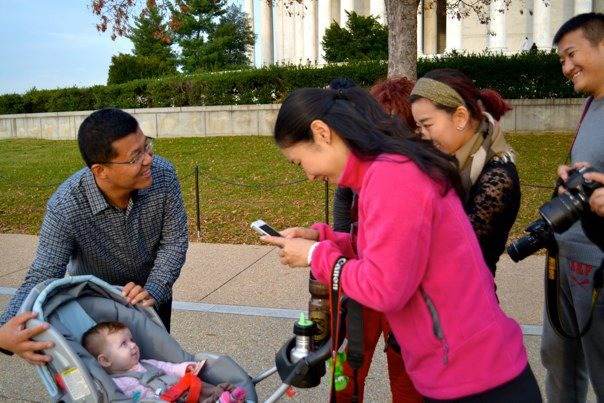
I’m really enjoying the Chinese tourist anecdotes. I live in DC and have small children. I take advantage of the amazing tourist attractions here and often take my kids to the various museums and memorials downtown. My children are also very white. Like, Norman Rockwell-white. Despite an ethnic heritage which would seemingly produce darker kids, our recessive genes have created a blonde and a redhead, both with fair skin. These kids are, for some reason, a tourist attraction unto themselves.
On multiple occasions I have been downtown and an Asian tourist or ten (not all Chinese) have gestured to my child and then to his camera and nodded hopefully at me. At first, I would just shake my head and walk quickly in the other direction, but one day I nodded back. I am not sure why. At that point the man (who was in a business suit touring the U.S. Botanic Garden) handed his camera to his friend, squatted next to my son, gave a big “thumbs-up” to his friend, and told the friend to snap the picture. My son was totally perplexed, as was I.
This happens with relative frequency, though I have only consented to it that one time. And it is always Asian tourists. I have attached a picture of it happening to my daughter. I stepped back from the stroller for a moment to document the phenomenon. In this case, none of the tourists asked to photograph my baby. They just started clicking.
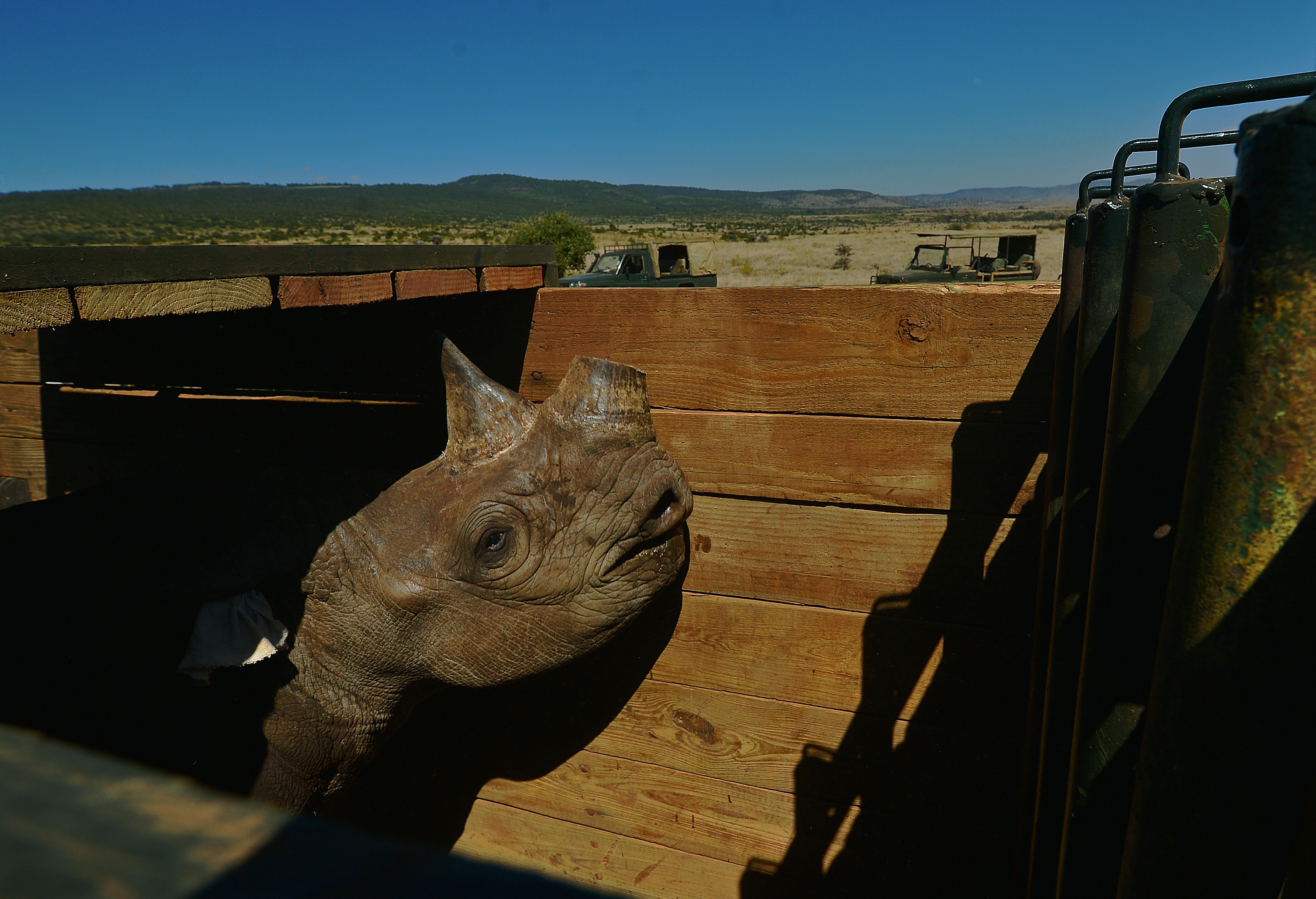
A captured wild male black rhino named Sero at Lewa Wildlife looks out from its crate at Lewa conservancy on August 26, 2013. Eleven of Lewa’s total 73 endangered black rhinos are being relocated to neighboring Borana conservancy to afford them more space. The horn of each relocated rhino is cut and a tracking device is fitted to monitor its movements and to help combat poaching. Lewa has suffered severe poaching in the past. Illegally poached rhino horn is sold for large sums as an ingredient in some traditional Chinese medicine. By Carl de Souza/AFP/Getty Images.
Excerpts from a stimulating speech by Kevin Spacey on the shortcomings of the TV pilot system, the upsides of the Netflix model, and the evolving nature of storytelling in the Internet age:


 The Dish