How Graphic Should War Coverage Be? Ctd

by Chris Bodenner

Add your two cents to our survey:

This embed is invalid

A reader continues the thread:

When I was a journalism student, a visiting professor once told us a story. His editors had sent him to cover a state execution, where he sat with members of the victim’s family and various representatives of the state. He watched this man die and returned to his office with a grisly story full of graphic details. His editor told him there was no way the paper could print something so horrifying, to which the then-reporter asked, “Then why did you send me?”

Another:

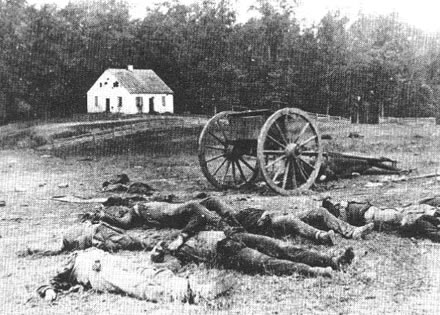
Going back even further than WWII, the intensely graphic photos that Matthew Brady and his team took on the matthew_brady_photobattlefields of the Civil War showed civilians, for the very first time, the true horror of war.  These photos are present at nearly every National Historic Battlefield and are an important reminder of what young men on both sides of the Civil War were willing to face for four years.  To my knowledge no one has protested to the NPS to take down the interpretive signs that show these pictures because they are too disturbing or violent.

It is easy to point to the people today who do not want to see modern-day war photos and say that they want to hide their heads in the sand – that they want to deny what is happening halfway around the world.  But there is also a key difference between battlefield photos now and then: Color.

Color photos of a dead soldier are much different than black and white photos.  How much more vivid and horrific would that photo of Kim Phuc been had it been published in color?  It is easy to overlook the blood, gore and trauma of a battlefield injury in black and white.  The mind knows it is there, but the emotions react more to the presence of the person in the photo, empathy and horror that this man or woman was gunned down in the prime of his life.

But color forces a person to see, first and above all else, the blood.  Red will draw the eye immediately.  No longer is the viewer looking at the person’s face and imagining being in that situation or sympathizing with the family left behind.  Rather, like watching a slasher movie, the viewer is simply looking at the grotesqueness of the injury, wherever that injury is.  I would argue that color in fact dehumanizes a battlefield photo so much that it DOES become obscene in a way.  It turns a very human tragedy into a Hollywood set piece.

That is not an excuse not to publish these kinds of photos.  But I do think we need to examine what we want to really show in these photos, what emotions we want to evoke, and whether or not the photos that show intense and graphic war violence in very living color will really accomplish what we’re setting out to do.

(Photo of Antietam by Matthew Brady)

The NRA’s Unlikely Role Model, Ctd

by Chris Bodenner

A reader writes:

This Winkler person trying to gin up the idea that the NRA got its ideas about strutting their gun culture in public from the Black Panthers … please. I was politically awake in California at that time.  There was a HUGE cultural backlash, from racist gun-culture-loving whites, against the “nerve” of those Black Panthers appropriating white conservative ideas – which were already long-cooked in the 1960s – of patriotic militias defending their rights against oppressive big governments. The idea that today’s West Coast NRA types who delight in congregating at their local Starbucks, armed up, to rile the local liberals, took this idea in any way from a now-obscure Black Panther model, instead of from their own generations of intense culture-worship of founding fathers with guns, backwoods pioneers with guns, cowboys with guns, American soldiers with guns, and John Wayne (and many others) playing at cowboys-and-soldiers with guns on the silver screen, is truly nonsensical.

Another is on the same page:

The NRA was singing the 2nd amendment tune long before there were Black Panthers.  I went to summer camp in the late 1950s, where we did archery and riflery, each under the banner of a national association, from which we earned kiddy honors, complete with sew-on patches and medals. So I became a junior member of the NRA, and read The American Rifleman, the NRA magazine.  It was full of the same bullshit still put forth: the only thing standing between the upstanding US citizen and government tyranny was the fact that some of the citizens were packing heat.

I proudly repeated this stuff to my father.  I figured he’d appreciate my attention to the Constitution, since he taught Constitutional Law.  He slapped it all down pretty quicky. “Read the amendment, and tell me what a militia is.  If gun control is really unconstitutional, they could get a ruling on that.  But the courts have always read the ‘right’ as related to militias.  It doesn’t work for them, so they just lobby against any laws they don’t like.  That ‘bulwark against tyranny’ line is just John Birch stuff.”

Well, the NRA finally found a Court that was willing to ignore the word “militia” and the concept of “well-regulated” – overturning 230 years of jurisprudence.  It’s a Court that claims to be traditionalist and modest in its reach.  Oh, sure: The Court said, “Let any unstable jerk be a militia, and let him regulate himself.” And the Court saw that it was good.  And the Court said “Let the corporations be people”.  And the Court saw that it was good.  This Court is detached from reality, lost in the swamps of theory, and radical.

The following passage is from the same email by the reader who said he prevented his rape in a hotel room by pulling out a gun:

By the way, your coverage of the ongoing gun debate has been nothing short of terrible and incredibly one-sided.  But I understand different people have different opinions.  And nothing being proposed so far would have impacted my ability to defend myself in that situation, so it’s a bit irrelevant to the gay rape issue.

But it’s worth pointing out.  The Frum quote you posted about the Black Panthers was particularly distressing. Reading his larger piece, he calls hunting an “increasingly marginal” activity, since only 6% of Americans have purchased a license, seemingly indicative of Mr. Frum’s long-term feeling that guns aren’t worthy of constitutional protection.  What then does that mean for Jews like himself, who are a nearly statistically irrelevant 2% of the population.  Or gays, who are likely closer to to 6% than the previously claimed 10%.  Are gays a marginal population?  Six percent of Americans is 20 million people, which doesn’t include all those over 65 or with their own land who generally don’t need a license to hunt. By way of comparison, 7% of Americans (25 million) played golf last year. Does David Frum think golf is an increasingly marginal activity??

Nothing in Winkler’s book should be a surprise to anyone who spent time examining the issue beyond merely reciting the talking points of the Bloomberg activism machine.  In fact, the reaction to the Black Panthers by the establishment (with the NRA’s support) passing onerous gun control laws designed from the outset for enforcement in a discriminatory fashion against blacks is the very reason the NRA’s membership erupted and split. All the Democrats these days pining for the NRA to return to the NRA of old, or Republicans to emulate Ronald Reagan (who oversaw the passage of those and other laws), are really asking for a return to the terrible days when it was considered acceptable to pass laws as long as the intent was only to impact those “other” people.  It’s reprehensible, and indicative of the deep distrust Americans have, for any attack on our rights.

Previous Dish on Winkler’s wonderful 2011 Atlantic piece here. Money quote:

The day of [the Black Panthers’] statehouse protest, lawmakers said the incident would speed enactment of Mulford’s gun-control proposal. Mulford himself pledged to make his bill even tougher, and he added a provision barring anyone but law enforcement from bringing a loaded firearm into the state capitol.

Republicans in California eagerly supported increased gun control. Governor Reagan told reporters that afternoon that he saw “no reason why on the street today a citizen should be carrying loaded weapons.” He called guns a “ridiculous way to solve problems that have to be solved among people of good will.” In a later press conference, Reagan said he didn’t “know of any sportsman who leaves his home with a gun to go out into the field to hunt or for target shooting who carries that gun loaded.” The Mulford Act, he said, “would work no hardship on the honest citizen.”

Yet another example of how Reagan is such a false idol for the contemporary GOP base.

Where There’s Smoke, You’re Fired, Ctd

by Chris Bodenner

A reader writes:

I am an ex-smoker (I quite a three-pack-a-day habit almost 40 years ago), so I have great sympathy for nicotine addicts.  I have worked for a major corporation that had a no-smokers policy (the boss had quit and thought it was a good idea; it was his company).  But I have no space for UPenn’s irrational policy with respect to smokers.

If health and its associated costs are the criteria for hiring, then are they hiring people with high BMIs, high LDL-low HDL, high blood pressure, diabetes, alcoholism or any other health issue?  Likely yes, because the ADA won’t let them discriminate.  Well, I believe there is enough evidence available now to include nicotine addiction under the illness rubric.  I won’t go into serotonin and dopamine reactions, but a quick Google search will yield a lot of information that you would expect PennMed to already possess. It would seem that just because they can discriminate against smokers (and not any of the other health issues), PennMed is discriminating.  That may be good for the bottom line.  It will not do anything for smokers.  And it stinks worse than cigarette haze.

Another also goes after “nanny-state paternalism”:

So are they going to stop hiring obese people as well?

You know, I get that there is an externality on the health care system now that we are all buying in, but they could just pass the premium increase on to the employees. ObamaCare specifically allows insurance companies to charge smokers more, and even though we pay ridiculously huge taxes on our smoking already, I’d be OK with paying double the Pigovian tax rate.  It’s not economically efficient, but it’s ok – a bit of tax-incentive nudging by the government in health policy isn’t the worst thing in the world.  We encourage home-ownership and retirement savings as well, and I think we should tax the hell out of pot too, so fine.

But this is just stupid.  It is not about health.  It is about image and heavy-handed, nanny-state paternalism which is different not just in degree but in kind from small price incentives or public health campaigns (even if these are incentives are larger than the economically “optimal” level).  Somehow it has become OK for people to find pleasure in excessive food or alcohol or risky sexual behavior (all of which induce the same kinds of public health externalities), but not in tobacco.

So here’s my deal: don’t hire smokers, but don’t hire overweight people, drinkers, or anyone who enjoys recreational sex either (or for that matter, anyone who risks their body in expensive ways playing soccer or mountain climbing or doing anything vaguely dangerous and fun).

Update from another:

It seems to me that readers complaining about “nanny-state paternalism” in private companies are trying to have their ideological cake and eat it too. Last I heard, no one was talking about making it illegal to hire smokers – and in fact I imagine that in the end, the nanny-state paternalism of the ADA will strike down no-smoker policies. But for libertarians, why does their right to smoke trump my right to run a company with just the “image” I want?

Can’t We Get An EZ-Pass For Restaurants? Ctd

by Chris Bodenner

This embed is invalid


A reader writes:

I was going to save this topic for my own blog but this thread at the Dish has compelled me to write in. Other countries have already solved this “waiting for the cheque” problem years ago and they did it with a very low-tech solution.

In the past five months I’ve traveled to Australia once and the UK twice. One thing I noticed about some of the restaurants / pubs I visited was that they make you pay at the bar. Each food / drink purchase is a discrete transaction. You go to the bar where you give and pay for your order. You then take your drinks right away and if you ordered food they give you a marker and when it’s ready they bring your meal to your table. You repeat the process if you want more.

What I like about this approach is that it scales very well. The bar is optimized for taking orders and the customers transport their own drinks. One or two guys drop off the food and collect the empty glasses. Compare this with back home where servers in most restaurants and pubs will keep track of drink and food orders throughout the evening and give individual cheques when one or all of the patrons are ready to leave. The North American system only works well if it’s a small group where everyone is sitting in a fixed location for the whole evening and everyone has a car to get them home.

I’m the organizer of a social group that meets every Wednesday for a cinq-à-sept (five-to-seven), which is French Canadian for “happy hour” (note to all you Dishheads who think you’ve just improved your foreign language skills: be careful. In France it means something completely different.) On any given week between 30 and 60 people will show up. I’ve organized over a hundred of these evenings at a dozen different pubs / restaurants and I can say without hesitation that a system like they have in the UK / Australia would greatly improve our Pub Night events.

The North American system doesn’t just waste 20 minutes at the end of your evening; it’s the source of a bunch of other problems too. Orders for large groups take much longer and sometimes people forget to pay (intentionally or not). Sometimes customers don’t have enough money (this can’t happen if you have to pay before you order). It’s also hard on the servers who have to keep track of everything. And it breaks the rhythm of the evening if you want to move locations. You can’t just get up and leave; you have to wait for everyone to pay and this can take a long time depending on the size of the group.

Tabbedout looks promising but it only speeds things up if everyone in your party is using it which is unlikely to happen if you’re more than four people. What I would like to see is more restaurants adopt the UK / Australian model.

Another broadens the discussion:

When someone suggests that there’s an app for that, I wish the blog post or article would say how many people have smart phones, how many people have cell phones that aren’t smart phones, and how many people have land lines.

An app won’t help my father-in-law, who doesn’t have a cell phone. He eats out pretty regularly. An app won’t help my mother, because she only has a regular cell phone, not a smart phone. OK, they’re in their 80s. An app wouldn’t have helped one of my kids until recently, because of their phone contract. Thankfully, the contract expired. I’m in my early 60s. I would like to convert my cell phone to a smart phone, but if I do that, the monthly cost will have to come out of my restaurant budget. If I had to use an app to get efficient service, I couldn’t afford to eat out.

I spend too darn much on technology. There’s television, broadband and land line phone bundled into a big package with a big bill, plus a cell phone bill every month for just one person. Being a single person is expensive; I’m a widow, but I am a lot more sympathetic to the comments of single friends these days. I could get rid of the land line phone, but that would save almost nothing. I can’t do without the broadband because I work from home some of the time. I don’t watch much television and don’t get HBO, so I don’t feel I’m being extravagant even though I only spend a few hours a week in front of the set.

If I only had to pay for a phone, I’d have a smart phone. But I need other services, too. They cost money and they don’t seem to be included in consumer price indexes. When I was growing up, television was free and in our geographically difficult area, a good signal was hard to get. My husband grew up in a region with good signals and access to more than one metro area, and he heard a much wider selection of music on the radio and saw more television than I did as a kid – when I got a transistor radio in high school, there was only one station that really came in clearly. Now I have to pay to have things come in clearly, and I also have to pay to have Internet access. I’m dreading the day when a smart phone becomes a necessity, because then my monthly budget will be more expensive even though my income isn’t increasing.

Technology is making our lives very different, but it is a heck of a lot more expensive than writers from the national media acknowledge. Let’s take a sort of Suze Orman moment. Not saving for retirement? How much would you have in that retirement account if you relied on an antenna for television and never got cable? Kids need a college fund? How much could you have saved by not buying computers or paying for broadband? (Yeah, that brings up the issue of how the kids could get into college without access to computers and the Internet, so why aren’t those costs considered part of the market basket of essential expenses?) You know a senior citizen who needs more money for medications or a poor family that needs more cash for medical care? What would Suze say – “Ditch those cell phones and save, people”? Maybe the 47 percent have just had a hard time keeping up with the additional cost of supporting Microsoft, Apple, Verizon, among others, along with the cell phone and cable companies.

While I know it is possible to do without television, I think the time has come to agree that Internet access and basic cell phone service are, well, basic requirements. But a smart phone to pay a restaurant bill quickly is not a basic requirement. Find another way to serve all the credit card customers, not just the ones with pricey phone plans.

I wish I wasn’t turning into a curmudgeon, but money is a dimension often left out of discussions of technological solutions. Figure out the cost of the shiny new app and the equipment it runs on before recommending it to all of us.

Mental Health Break

by Chris Bodenner

Fraggle Rock was even more morbid than you remember:

Update from a reader:

I loved Fraggle Rock when my kids were small in the ’80s. It was soooo well done. It was genuinely amusing for them and for me. There was always a thoughtful issue – something concerning the competing populations or something universal to all of them – gently introduced in each episode in interesting and sympathetic ways kids could consider. I’ve thought many times over the years that it’s really quite amazing that it hasn’t come back for subsequent generations. Beats any of the programming available to my grandson today hands down! It’s a great loss.

(Hat tip: Scott Beale)

Sexy Sneezing, Ctd

by Chris Bodenner

A reader writes:

I can’t tell you how happy I am to hear of the 2008 paper on “sneezing induced by sexual ideation.” I have “suffered” with this problem my whole life and have made futile web searches to understand this issue. (I use quotations around “suffered” because it isn’t that big of a deal.) For as long as I can remember, sex and sexual arousal – literally just thoughts of sex – have made me sneeze and get a runny nose. If I am very mentally aroused, I might sneeze 6-8 times and my nose just gets flooded, so this doesn’t have to be associated with any physical contact whatsoever.

It’s not a big deal in that I have been married for over 20 years and have a rich and rewarding sex life. When we were first dating, my wife thought I was allergic to her – quite the opposite, I can assure you dear! Nevertheless, it’s not exactly convenient to get a runny nose during intercourse. When you fancy yourself a smooth player, it kind of kills the fantasy each time you have to stop and blow your nose (“oooh, does that feel good, yeah, yeah – oh, just a sec – [grabs tissue] HOOORRNK!”).

However, after all these years, I think it bothers me more than it does my wife – i.e., I will forever be super self-conscious of this odd affliction where she is just fine with me as I am (or at least does a good job of not making me feel weird about something that cannot be helped). So the thing that sucks the most about sneezing associated with arousal is that it makes it almost impossible to hide what you are thinking.

Thankfully I have entered my mid-40s and occasionally think about something other than sex (occasionally). Because of this privacy issue I have obviously not shared this with other people even though I am generally a very open person and not even remotely prudish. I ask, would you want your kids, parents, or friends thinking you were being a horn dog every time you sneezed! “Whew, lot of pollen in the air today.” Of course I sneeze infrequently for all kinds of reasons unrelated to sexual arousal and the last thing I want is everyone in the room wondering why I am being such a pervert over an innocent sneeze while I watch The Antiques Roadshow. It’s bad enough that every time I sneeze I get that “boy, I know what you are thinking” look from my wife.

Ultimately, I guess I should just be pleased to report that, after 20 plus years of marriage, my wife can still make me sneeze like nobody else!

From The Archive: The First Face Of The Day

by Chris Bodenner

Scores Killed In Baghdad Market Bomb Attacks

Andrew published it on February 13, 2007:

With this photo, I’m going to try to introduce a new feature, made possible by the Atlantic’s Getty Images subscription. I hope to take the time each day to review as many of the news photographs in the past 24 hours and find a simple face to express something somewhere that is going on in the world. This is a depressing start, but I hope to include the full variety of human experience captured by Getty’s superb photographers. The criteria are simply a face and the past day.

The caption:

An Iraqi man injured in a car bomb explosion lies on a hospital bed February 12, 2007 in Baghdad, Iraq. On the anniversary of the attack on the Al-Askariya Mosque, five explosions went off in Baghdad including at least two car bombs at the Shorja market killing at least 80 people and wounding approximately 190. By Wathiq Khuzaie/Getty Images.

The Dish Model, Ctd

by Chris Bodenner

German Funnies

Josh Luger at Business Insider interviewed Andrew over the Dish experiment:

BI: How do you wrap your ahead around the meter concept?

AS: Back in the day I would go to Harvard Square bookstore. When I was there in 1984, having left England, there was no way for me to know what was going on back home except in the British papers. I would go there and flip through the newspapers. At some point the dude had every right to say “Either buy the magazine or put it down.” That’s basically what the meter is.

That’s a good analogy but a tad exaggerated for the Dish, since about 80% of our content – the stuff above the read-ons – will always be free for everyone; we’ll never make you put down the Dish. But yeah, if you’ve enjoyed our work over the years for free and haven’t yet chipped in 2 bucks a month, we hope the meter will nudge you into doing so. As one reader puts it:

I have been reading your blog for several years (since it was at the Atlantic). However, I hadn’t subscribed until you offered the $1.99/month model. Why? Hard to say, really. Part of it is that I am a perpetually broke student. But mostly, I think it feels like a lower commitment threshold. Sure, $20 to enjoy a year’s worth of a blog I have enjoyed for six or seven years is not much of a stretch. But the bite-size $2/month just seems more manageable, particularly for the iTunes generation. Even though I’m paying more in the long run (and glad to do it), each small payment is so negligible that it feels like nothing – unlike $20, which feels like handing over a crisp $20 bill out of my dwindling wallet. I wouldn’t be surprised if you get more young readers signing up on the monthly plan. We’re much more accustomed to buying our media in single servings rather than handing over a lump sum up front, as in the dying magazine subscription model.

Anyway, thank you for your writing, Andrew. You have been a role model for me for what it means to grapple with being both gay and Catholic. Keep fighting the good fight!

More feedback from readers on the new pricing option here. Subscribe [tinypass_offer text=”here”] if you haven’t already. And thanks to everyone for their support and feedback, positive and critical. Another reader:

As a cognitive therapist, I’m always interested in people’s belief systems – and the actions they take to maintain them.

Along those lines, I imagine that many of your readers have an underlying belief that says, “Content offered online should be free,” or even, “Paying for content online is wrong. It’s a slippery slope. If we start paying for content, we restrict the flow of information.” Or something along those lines. If they make an exception for you by subscribing, they’ve weakened that belief system. And the mind resists weakening its self-protective beliefs.

In your “pitch,” you might want to invite a discussion about the underlying belief  system at work here. Should all online content indeed be free? If so, what else should be free? Coffee at coffee shops? Dinners out? Video games? Therapy sessions? Car repairs? Or just online content? And if so, why?

I myself waited a few weeks to subscribe, just to see how my mind would react to the process. I ended up realizing that I am an enormous consumer of your material and would probably value it at somewhere around $300/year. Compared to that value, a $20 price is a no-brainer.

You might ask your readers: What value (specific, numerical) would you place on one year of content from the Dish? If you value it at more than $20, how does that square with your belief system? At the least, it could be an interesting discussion.

Luger actually asked Andrew a similar question:

BIHow much would you pay for The Dish? How much do you think its worth? I ask because it’s very conceivable that, at some point, you may need to raise subscription prices on existing subscribers to hit your desired revenue goal.

AS: [Laughs] I pay $50 to Talking Points Memo so that will tell you something… I think its worth it. I’d happily pay $50 a year and I can prove that I did.  And I asked readers to do so.

I am too falsely modest to say how much I’d pay for The Dish and way too close to even understand the concept. It’s very hard for me to see The Dish as some option for me to read. I, generally speaking, hate everything I write and say its all crap. But, every now and then I go on vacation and I look at it and read it. And I go “that’s not bad, is it?” If I was a general reader and wanted to find out about the world, it’s pretty comprehensive and kind of fun.

Update from a reader:

Reading the discussions about how and why people pay how much for The Dish brings to mind a theory of mine about the value of technology, and how much people are willing to pay for it. I call this John Halbert’s Three Laws of Technology Economics:

First Law: People will pay trivial amounts for convenience, and be conscious of small differences. They will pay $1 for a newspaper, but not $2, for example.

Second Law: People will pay out of cash flow for enhancements to their existing abilities or equipment. They will pay $100 for more memory for their computer, or $50 for a software upgrade. This amount is roughly equivalent to what they carry in their wallet on a daily basis.

Third Law: People will make substantial financial commitments for the ability to do something that they could not otherwise do. In other words, they will go into debt for power. Buying a car, or going into debt for an education, are examples.

This theory is particularly useful when there is a differential between cost and value. For example, a plane ticket is Second Law cost (no one goes into debt to buy a plane ticket), but Third Law value: you can go somewhere faster than you otherwise could. The Internet is a two-law differential: First Law cost ($30/month for Internet access), but Third Law value: you can do many things on the Internet you could not otherwise do.

The Dish straddles the line between First and Second Law cost and value. For some people, $20 is a trivial amount, and they wouldn’t particularly care if it was $20 or $50. For some people, it’s also Second Law value: it’s not just convenience (First Law); it’s an enhancement to their existing abilities or equipment. There is a lot of information/discussion on The Dish that would be difficult to find anywhere else. If I absolutely had to, I’m sure I could find a good discussion of prosecutors vs. public defenders, but I doubt it would be as succinct as your recent discussion. So for some people, reading The Dish is a great timesaver. If you’re a high-powered lawyer who charges $800/hour, saving a couple of minutes a day adds up very quickly.

But for other people, it’s strictly First Law cost and value. Paying $20 all at once may represent the difference between going out on a Friday and staying home. It’s also something many people read occasionally, but that they don’t really need. They can read Talking Points Memo, Daily Kos, or any number of newspaper sites. So those people are reading it for convenience, and they are conscious of small differences.

(Photo: A German boy leans against the wall next to a magazine stand to read a comic book, circa 1955. By Evans/Three Lions/Getty Images)