The Mystery Of Memory

by Matthew Sitman

Charles Randy Gallistel is a cognitive psychologist at Rutgers who challenges the entire way that neuroscientists have been trying to understand the brain. In this clip, he makes the case to Jonathan Phillips of Yale that the we really don’t know how memories are stored:

This embed is invalid

Watch the entire video here, and subscribe to The Mind Report here.

The Crucified God

by Matthew Sitman

Wesley Hill struggles with the German theologian Jurgen Moltmann’s approach to “the death of God”:

Moltmann drew on Elie Wiesel’s story (found in Night) of the dying boy in Auschwitz, hanging from a gallows. Someone in the crowd witnessing the execution said, “Where is God?” And another voice replied, “He is there, hanging on that gallows.” God is dead, in other words. Or if God is not dead, he deserves to be. Moltmann takes that story and says, in effect, “Yes, that is exactly right. God has come to Auschwitz, through his death in Jesus Christ. God has suffered with us. God has died with us.” Only such a God—only a God who suffers—can be believed in.

If you wish to read the Gospel of Mark that way, then many people, Moltmann included, think that you need to marginalize Luke’s Gospel. Hans Urs von Balthasar, while, in my view, treating these issues far more subtly than Moltmann, saw this clearly. Luke’s Gospel has no cry of dereliction. Instead of screaming out in agony, Luke’s account has Jesus’ final words as: “Father, into your hands I commend my spirit.” And therefore, it seems, Luke’s Gospel isn’t as well suited as Mark’s is for meeting the challenge of protest atheism. Here’s von Balthasar: “Christ’s cross… must not be rendered innocuous as though the Crucified, in undisturbed union with God, had prayed the Psalms and died in the peace of God.” In other words, we cannot continue to allow Luke’s version of the story to be read alongside Mark’s as though a harmonization were possible. At least, not anymore. Not after the Holocaust.

This passage from Walter Moberly helped Hill see the problem differently:

[O]ne should not so romanticize the process of moral and spiritual struggle that the Lukan depiction of Jesus as one who maintains apparent serenity and trust amidst suffering is downgraded; as though an anguished and in some ways vacillating struggle for faith is intrinsically superior to a steadily trusting faith; or as though a steadily trusting faith did not involve its own kind of moral and spiritual struggle.

Up To The Second Cinema

http://www.youtube.com/watch?v=g-t3l6T53V8

Michael Leary unpacks Terrence Malick’s latest film, To the Wonder:

[T]he great scandal of To the Wonder is its utter sense of the present. It takes place in a generic version of now, rather than in a mythic version of the past. But then there is also Ben Affleck lumbering across most of his frames doing that thing with his jaw to indicate terse, conflicted male. Olga Kurylenko bounds through rapid changes of camera position and exquisitely framed patches of light and shadow similar to the dance of Q’orianka Kilcher through the dappled forests of The New World. But here the rustle of grass and reed are traded for the track of sunlight across freshly laid carpet and the swish of blinds and bedsheets. …

I had the uncanny sense while watching the film that Malick has caught up with history itself, his past forms of sacred curiosity deployed in our very midst. It is disconcerting to have his cinema erupting in our contemporary tense of the everyday, as if he is pushing his sense of history as myth into the prophetic mechanics of the present.

The Compartmentalization Of The Fundamentalist Mind

by Matt Sitman

Scott Galupo holds up the latest right-wing folk hero, Dr. Ben Carson, as an example of it. How Galupo reconciles Carson’s brilliance as a neurosurgeon with his creationist views:

For the vast majority of human beings, even modern cosmopolitan professionals, beliefs about the geologic timescale, the processes of biological adaptation, paleontology, cosmology, etc. exist comfortably outside the scope of their core competencies. I get twitchy when scientific illiteracy creeps into the top ranks of our political class, but, at the same time, I’m forced to recognize that a country in which only four in 10 people believe in theory of evolution seems to function pretty well on an everyday basis.

On Christian Wiman’s “My Bright Abyss”

by Matthew Sitman

By now, Dish readers probably know something about Christian Wiman – we’ve featured his work, especially incisive passages from his sterling essays, many times over the last few months. This week his new book, My Bright Abyss: Meditation of a Modern Believer, was released, a book many of us anxiously have awaited for some time. The basics of his story are, by now, well-known: a brilliant young poet who, since 2003, has edited Poetry magazine, he was diagnosed with an extraordinarily rare, incurable form of cancer, and My Bright Abyss reflects on his Christian faith in the face of extreme suffering and death.

My copy arrived Tuesday afternoon and I finished reading it late Thursday night around 3am, carried through its final pages on the basis of pure exhilaration. It is no exaggeration to say that I’ve waited my entire adult life to read a book like this. It is impossible to summarize or even categorize. Though personal, it is not really a memoir – there only is the barest narrative arc to it. (In this sense, the term “meditation” truly was apt.) The book is written aphoristically, filled with short, dense examinations of God, love, Christ, suffering, poetry, and more. In terms of organization and structure, it most reminds me of Simone Weil’s Gravity and Grace, a book Wiman frequently references. It also is astonishingly learned – the range of Wiman’s reading, the abundance of literary and theological references, is remarkable. I will have to read it many more times to fully absorb its import.

As such, reviewers likely are to be baffled by it. Dwight Garner’s NYT piece particularly seems to miss the mark. My jaw dropped when I read this line from his review: “…there are many moments in ‘My Bright Abyss’ where he preaches as broadly — and, to my ears, as gratingly — as Joel Osteen.” I can say, without hesitation, that there is not a figure more different from Osteen in the firmament of American Christianity than Wiman. Again and again in the book, you can feel Wiman pushing up against the limits of language when trying to grapple with God; indeed, this constitutes one of his great themes. A paradoxical statement from Wiman, or an aphoristic declaration, surely has no real connection to one of Osteen’s gauzy, sentimental one-liners. It makes me think Garner just did not read the book carefully, or felt some strange need to concoct objections to Wiman’s efforts. Garner simply has no feel for what Wiman is trying to do.

Such a suspicion is borne out when Garner asserts the following:

[Wiman] writes things like the following, about himself and his wife: “Last night we wondered whether people who do not have the love of God in them — or who have it but do not acknowledge it, or reject it — whether such people could fully feel human love.”

This strikes me as smug and aggressive nonsense, of the sort that made Richard Dawkins declare, “I am against religion because it teaches us to be satisfied with not understanding the world.”

Of course, Wiman is not “smug and aggressive” in the least, and it is impossible to read Wiman’s book and believe he is not, desperately, trying to understand the world. Wiman is ruminating on a passage from Hans Urs von Balthasar, the great 20th century theologian, not making a bald assertion. And he immediately says, right after the lines Garner quotes, that “I have a complicated reaction to this.” Meaning, a complicated reaction to the very sentiment Garner reads so simplistically. Indeed, the entire section that Garner lifts this one sentence from is a puzzled, complex meditation on how human love relates to divine love. Wiman writes this about himself and the woman who would become his wife:

I don’t think the human love preceded the divine love, exactly; as I have already said, I never experienced a conversion so much as a faith that had long been latent within me. But it was human love that reawakened divine love.

This seems to me a significant addendum to what so bothers Garner, a hesitation about cause and effect, and – as the rest of the section makes clear – an acknowledgment he and his wife’s shared religious search added intensity and force to the love that exists between them.

If I were to suggest why, whether believer or not, you should read My Bright Abyss, it would be because Wiman asks the most difficult questions I can imagine about life and death with unflinching honesty. As he admits above, it is not a simplistic “conversion” account. You do not finish the book with a sense of closure, that you can put your anxieties and uncertainties aside for pat answers. Wiman makes the skeptic confront uncomfortable possibilities – he asks the doubter to doubt even his doubt. And he makes the believer realize how much of what passes for faith is idolatrous nonsense, evasions and wishful unthinking.

In short, Wiman’s book is the beginning of a conversation we very much need to have, and he clears away so much of the accumulated ridiculousness that has grown-up around discussions of religion in this country. He clarifies the questions we should be asking more than he offers “solutions.” Please read this book – for now, I only can urge that you approach this elegant, difficult testimony to what faith – always mingled with doubt, and always seeking to connect with lived experience – can mean in the modern world with honesty and an open heart. It truly is an essential book for our times.

For more, see Casey Cep’s very smart review in TNR here, and check out some brilliant selections from the book here.
Putting Love First

by Matthew Sitman

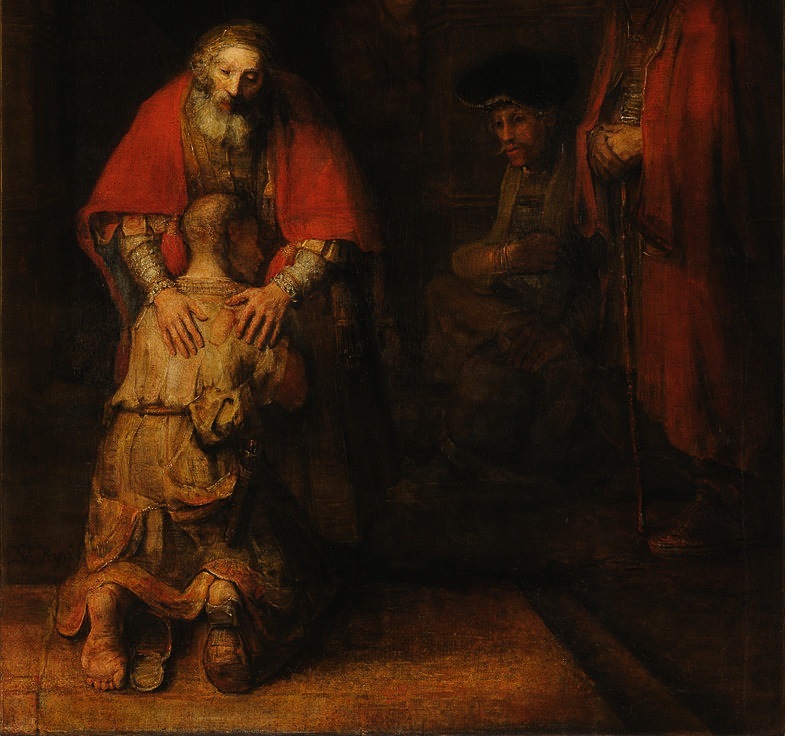
rembrandt-son-return

Gary Gutting explains how he remains a Roman Catholic while also being a philosopher who reveres Enlightenment thought:

The ethics of love I revere as the inspiration for so many (Catholics and others) who have led exemplary moral lives.  I don’t say that this ethics is the only exemplary way to live or that we have anything near to an adequate understanding of it.  But I know that it has been a powerful force for good.  (Like so many Catholics, I do not see how the hierarchy’s rigid strictures on sex and marriage could follow from the ethics of love.)  As to the theistic metaphysics, I’m agnostic about it taken literally, but see it as a superb intellectual construction that provides a fruitful context for understanding how our religious and moral experiences are tied to the ethics of love.  The historical stories, I maintain, are best taken as parables illustrating moral and metaphysical teachings.

Traditional apologetics has started with metaphysical arguments for God’s existence, then argued from the action of God in the world to the truth of the Church’s teachings as revealed by God and finally justified the ethics of love by appealing to these teachings.  I reverse this order, putting first the ethics of love as a teaching that directly captivates our moral sensibility, then taking the history and metaphysics as helpful elucidations of the ethics.

I think this is a very helpful way of putting the matter – it articulates, more or less, inchoate thoughts I’ve been turning over for awhile. Another way of framing Gutting’s arguments is that they are a critique of traditional apologetics, trying to rationally prove the core tenets of a faith. How many people really have been moved by, say, the ontological argument for God’s existence? And its always important to recognize that God is not an object outside ourselves, a being on the same metaphysical plane as other things we might “know.” Whatever knowledge of God we might have, its a very particular kind of knowledge, and to reduce a transcendent, ineffable God to the elements of syllogism not only is a philosophical mistake, it means the God you are describing no longer is recognizable as the God attested to by Christianity.

I would argue it’s far more compelling, when affirming Christianity, to claim, with Francis Spufford, that Christianity “makes emotional sense” – to point to the ways it is a meaningful framework for understanding our suffering and our joy, the gritty realities of what we experience as we move through life. Christianity is not a set of propositions, and it does serious damage to the faith’s credibility in the modern age when it is turned into such propositions. You end up trying to meet modern, rationalist and scientific claims on their own terms, reading the Bible for knowledge about geology and the age of the earth or turning to Revelations as a concrete, literal guide to how human history will unfold. It’s important to remember, as Gutting has, that the central “revelation” of Christianity is not really a sacred text or a creed, but a person – Jesus – who lived a life of self-giving and radical love. Asking how such a life connects with our deepest longings as human beings should be the point of departure for dialogue and conversation, and Gutting eloquently confirms the value, intellectual and otherwise, to such an approach.

(Detail from Rembrant’s “Return of the Prodigal Son” via Wikimedia Commons)

Gay Bashing Is Still With Us

by Matthew Sitman

Marc Ambinder laments one of the more intractable problems facing young gay kids, wondering how to help those “slipping through the safety net that the gay community is building for its most vulnerable”:

Since moving to Los Angeles, I’ve met a lot of younger gay men who have been kicked out of abusive households. The most heartbreaking of the stories was told to me by a talented young clothing designer. Upon learning he was gay, he was severely beaten, given $500, driven to the airport, had a one-way plane ticket bought in his name, and was abandoned.

1980?

No: 2007.

He was 16.

The cycle of violence is merciless.

In the six years he spent here in West Hollywood, my young friend was raped twice — and lest you think that he was exaggerating to evoke sympathy, I’ve seen the medical and police records. He was also assaulted numerous times. He resorted to escorting to make ends meet. His ability to form meaningful friendships is fractured. His life is not very stable.

He concludes:

Political rights are critical. But social equality is probably more meaningful. Parents who abuse children are abominable. But parents of gay children can get away with it more, because there’s a stigma, because everyone just wants the problem to go away, because we still lack the guts to challenge some of our brother’s darker secrets.

Relatedly, Bill Gardner flags research on the abuse of LGBT children:

Mark Friedman and his colleagues have published a meta-analysis in the American Journal of Public Health that looked at whether sexual minority adolescents were more likely to experience childhood sexual abuse, parental physical abuse, and peer victimization. Again, these abuses are not matters of hurt feelings: they are often crimes, and even where they do not result in direct physical harm they are powerful risk factors for educational failure, mental illness, and physical illness.

I do not believe I have ever read a meta-analysis in which the results were so clear cut: Gay, lesbian, and bisexual kids are far more likely to be the targets of abuse than their straight peers. A meta-analyses seeks to evaluate the strength of a pattern of data by looking for consistency of results across the published literature. Friedman et al. found that 19 of 19 published results showed that sexual minority children were more likely to be the victims of parental physical abuse. 65 of 65 studies found that sexual minority children were more likely to be the victims of sexual abuse. Peer victimization was, by comparison, a bit less clear cut. Only 79 out of 81 results showed that sexual minority children are more likely than to be bullied than their straight peers.

Unsurprised By Doubt

by Matthew Sitman

Lauren Winner, author of the religious memoir Still, reflects on what she’s learned since the book’s publication:

What has changed is:  I didn’t really know, even when writing the book, that many Christian communities in times gone by would have said “Oh, this is normal, this dark night of the soul, this doubt. This is part of the expected choreography of a Christian life.”  If I had known that, while writing Still, there probably would have been a chapter: “dark night choreography,” or somesuch.

It is only in the last year or so that I have begun to read and study and learn that many, many wise saints from times gone by would say, about a season of doubt or alienation from God or despair, “This is not an aberration.  This is one of the well-established patterns of Christian life.” Not every Christian lives through such a season, but for many people, it is simply part of the architecture, part of what we can expect along the path to God, the path to true intimacy with God and self and neighbor.

Words Against Time

by Matthew Sitman

Reflecting on the life and work of Paul Petrie, Christina Pugh muses on one aspect of the poet’s temperament:

“Poets are conservative,” Paul the nonconformist used to say, 
hastening to explain that this conservatism had nothing to do with politics. “They want to conserve memory and experience.” The drive toward poetic conservation is occasional, I’d argue, whether we’re conserving something personal, historical, or neither. It can transform a previously unnoticed moment — a patch of red wing, or television noise, or a sentence in Kant’s Critique of  Judgment — into the occasion for language. Where is the poet, of any aesthetic stripe, who doesn’t rush to conserve even a fraction of the spark that might blaze as a poem? This need to preserve moments of a perceptual, emotional, or intellectual life in poetic lines does constitute, again in Paul’s words, a “race with time and the devil” — a race that none of us can win. As Sharon Cameron says, writing of  Dickinson’s work in particular, “the poles of death and immortality are thus those states that poetic language shuttles between.”