This year marks the fiftieth anniversary of the publication of Frank O’Hara’s Lunch Poems, which Micah Mattix lauds as a love letter to New York City:
With its references to Park Avenue, Times Square, Pennsylvania Station, liver sausage sandwiches, the Five Spot, the Seagram Building, the opening of the American Folk Art Museum, and much more, it is a very New York book. O’Hara walks around the buzzing city, buys “a chocolate malted” or “a little Verlaine,” remembers a friend’s birthday, and talks to the Puerto Rican cabbies before rushing back to his desk at the MoMA with a copy of Reverdy’s poems in his pocket. Born in Baltimore and raised in Grafton, Massachusetts, O’Hara moved to New York in 1951 and stayed until his untimely death in 1966. The city offered freedom, possibility, movement, all of which O’Hara associated with life. “I can’t even enjoy a blade of grass,” he once wrote, “unless I know there’s a subway handy.” It also offered him a community of fellow outcasts, poets, and artists who became, as Lytle Shaw notes, a surrogate family.
Lunch Poems is still popular with New Yorkers today: In 2012, when the Leonard Lopate Show asked listeners to vote on 10 objects that “best tell New York’s story,” it came in at number six—just above the Brooklyn Bridge.
Even more, Mattix finds the collection has “an appeal that reaches beyond the time and place it was written,” remaining popular, in part, because of the way O’Hara’s language resonates with our own:
Casual, sardonic, funny, and full of pop-culture references, Lunch Poems has all the brevity, informality, irony, and at times chatty pointlessness of modern discourse without having been influenced by it. The volume has never gone out of print, in part because O’Hara expresses himself in the same way modern Americans do: Like many of us, he tries to overcome the absurdity and loneliness of modern life by addressing an audience of anonymous others.
O’Hara’s Lunch Poems—like Facebook posts or tweets—shares, saves, and re-creates the poet’s experience of the world. He addresses others in order to combat a sense of loneliness, sharing his gossipy, sometimes snarky take of modern life, his unfiltered enthusiasm, and his boredom in a direct, conversational tone. In short, Lunch Poems, while 50 years old, is very a 21st-century book.
Last spring the Dish featured one of O’Hara’s poems here.
The last few weeks we have trackedtheresponses to Adam Begley’s Updike, the new biography of the late novelist and critic, who also was an accomplishedpoet and short story writer. Today’s featured story is “The Varieties of Religious Experience,” which Updike published in The Atlantic just over a year after the September 11th terrorist attacks. Here are its memorable opening paragraphs:
There is no God: the revelation came to Dan Kellogg in the instant that he saw the World Trade Center South Tower fall. He lived in Cincinnati but happened to be in New York, visiting his daughter in Brooklyn Heights, with a top-floor view of Lower Manhattan, less than a mile away. He was still puzzling over the vast quantities of persistent oily smoke, and the nature of the myriad pieces of what seemed to be white cardboard fluttering within the smoke’s dark column, and who and what the perpetrators and purpose of this event might have been, when, as abruptly as a girl letting fall her silken gown, the entire skyscraper dropped its sheath and vanished, with a silvery rippling noise. The earth below, which Dan could not see, groaned and spewed up a cloud of ash and pulverized matter that slowly, from his distant perspective, mushroomed upward. The sirens filling the air across the river continued to wail, with no change of pitch or urgency; the mob of uninvolved buildings, stone and glass, held their pose of blank, mute witness. Had Dan imagined hearing a choral shout, a cry of protest breaking against the silence of the sky—an operatic human noise at the base of a phenomenon so pitilessly inhuman? Or had he merely humanized the groan of concussion? He was aware of looking at a, for him, new scale of things—that of Blitzkrieg, of erupting volcanoes. The collapse had a sharp aftermath of silence; at least he heard nothing for some seconds.
Ten stories below his feet, two black parking-garage attendants loitered outside the mouth of the garage, one seated on an aluminum chair, carrying on a joshing conversation that, for all the sound that rose to Dan Kellogg, might have been under a roof of plate glass or in a silent movie. The garage attendants wore short-sleeved shirts, but summer’s haze this September morning had been baked from the sky. The only cloud was man-made—the foul-colored, yellow-edged smoke drifting toward the east in a solid, continuously replenished mass. Dan could not quite believe that the tower had vanished. How could something so vast and intricate, an elaborately engineered upright hive teeming with people, mostly young, be dissolved by its own weight so quickly, so casually? The laws of matter had functioned, was the answer. The event was small beneath the calm dome of sky. No hand of God had intervened, because there was none. God had no hands, no eyes, no heart, no anything.
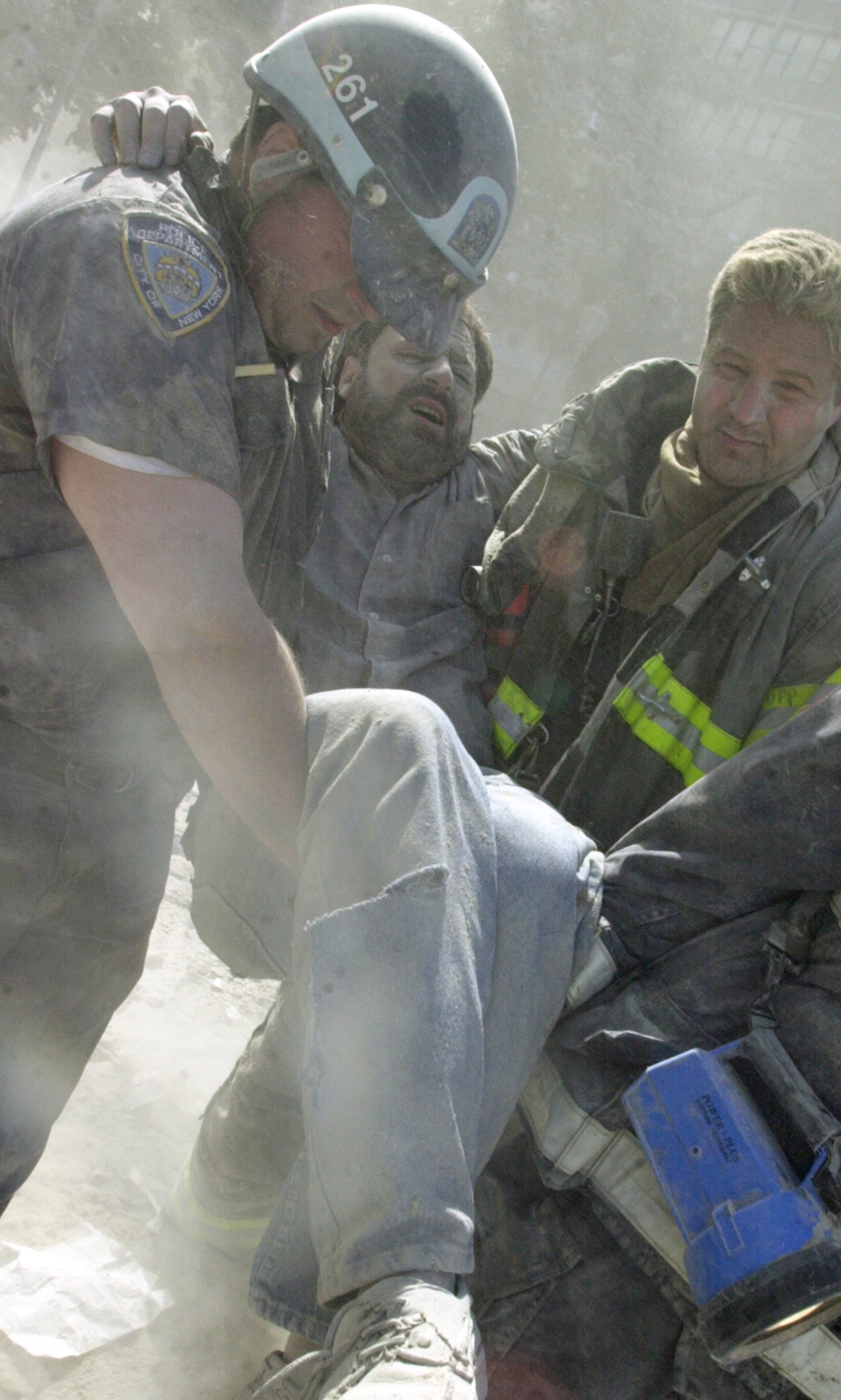
(Photo: New York Daily News staff photographer David Handschuh is carried from site after his leg was shattered by falling debris while he was photographing the terrorist attack on the World Trade Center on Tuesday, September 11, 2001. By Todd Maisel/NY Daily News Archive via Getty Images)
Dostoevsky and Tolstoy are Vladimir Putin’s two favorite writers – but the wrong one has influenced his understanding of Russia’s role in world affairs:
Dostoevsky believed that Russia’s special mission in the world is to create a pan-Slavic Christian empire with Russia at its helm. This messianic vision stemmed from the fact that Dostoevsky thought Russia was the most spiritually developed of all the nations, a nation destined to unite and lead the others. Russia’s mission, he said in 1881, was “the general unification of all the people of all tribes of the great Aryan race.”
This sort of triumphalist thinking was anathema to Tolstoy, who believed that every nation had its own unique traditions, none better or worse than the others.
Tolstoy was a patriot—he loved his people, as is so clearly demonstrated in War and Peace, for example—but he was not a nationalist. He believed in the unique genius and dignity of every culture. One of the hallmarks of his writing from the beginning was his capacity to uncover the full-blooded truth of each one of his characters, no matter their nationality. In his Sevastopol Tales, which were inspired by his own experiences as a Russian soldier fighting against the combined forces of the Turks, French, and British in the Crimean War of the 1850’s—in the very region recently re-annexed by Russia—Tolstoy celebrates the humanity of all his characters, whether Russian, British, or French.
Unfortunately, amid all the spiritual turmoil following the fall of the Soviet Union, Russians have tended to cling more to the starker, messianic vision of Dostoevsky than the calmer vision of universal humanity Tolstoy espoused, finding the latter perhaps a tad too democratic, humanistic, and soft for their hardened tastes. After all the tragedies of 20th century Russian history, and the humiliations of the past 20 years in particular, many ordinary Russians are seeking unequivocal proof of their national worthiness—indeed superiority—among the family of nations.
In an interview about her debut novel, Cutting Teeth, which follows a group of thirty-something Brooklyn parents and their young children on a weekend trip to the beach, Julia Fierro explores how being a woman and young mother informed the story she told:
The focus of the book is on relationships, and I’m always surprised when women writers complain about their book being tagged by bookstores, book sites, and blogs with “relationships” and “women.” I understand the larger issue that’s upsetting them, and thank goodness we have the VIDA numbers to act as a neon sign broadcasting the truth about gender inequality in the literary world, but I am a woman, and I will always write about relationships. I am inspired by psychology and emotion, conflict and drama. The world is most significant to me as a web of relationships. If a story isn’t filtered through a psychological lens, you’ll have trouble keeping my attention. Humanity’s individual, and collective, fears and needs and desires are the only religion I’ve got and I am obsessively devoted. So I try to embrace the fact that I am a woman writer writing (mostly) about women, although the male characters in my work are often “liked” most by readers (even if they commit the worst crimes—how about that?). Recently, I even had a brief thought—maybe I am writing with women readers in mind? I am, after all, living a life that only another woman could truly understand. I am going through a phase of life—early motherhood—that is complex in a way that is unique to a woman’s experience. What I feel in my body, in my thoughts, and the ways I interpret the world uniquely, all stem from my experience as a woman. But I have to think more on that before I commit.
In a self-interview, Fierro explains how she wrote a novel and founded the Sackett Street Writers’ Workshop, all while raising two children:
My lifelong insomnia has been a blessing in disguise. I pretty much sleep four hours a night, and am doing my best to ignore conspiracy theories like this, that simultaneously attempt to cut my productivity in half and promise my inevitable doom.
It is amazing what you can accomplish if you abandon all household chores that aren’t absolutely essential. Sure, we’re living in chaos, but mom’s making great progress on her next novel and the number of Sackett Street writers attending classes has doubled in the last three years. It turns out that women can “have it all”—they might be miserably tired, suffer from high blood pressure, and not have enough time to eat well, exercise or have meaningful relationships, but you can do anything when you don’t give yourself a reason not to.
There is no way for a thinker—or indeed, a user of language—to eschew abstraction entirely, of course, but Camus was deeply attuned to the dangers of excessive abstraction. This may not sound particularly heroic, but it can be, and it certainly was in Camus’s day. Camus’s peers, mid-century French intellectuals, were all too susceptible to the raptures of abstraction. The Left Bank bien pensants were, with few exceptions, stalwart armchair Marxists, obliquely aware that the divine dream of the worker’s paradise was exacting a brutal toll on the actual humans of the Soviet bloc, but blissfully unmoved by this fact. Camus publicly, angrily, charged that their fixation on beautiful ideas made them insensate to the ugly cost such ideas imposed on the much-beloved proletariat. And indeed, it is now difficult—impossible—to think Camus wrong.
Zaretsky quotes the French philosopher Maurice Merleau-Ponty, who writes of the Stalinist horrors with chilling coolness, explaining that only the unfolding of history will “give us the final word as to the legitimacy of a particular form of violence.” Camus righteously fumes in response that “man has been delivered entirely into the hands of history … because we live in a world of abstraction, a world of bureaucracy and machinery, of absolute ideas and of messianism without subtlety.” Camus’s rejection of blood-draining Stalinist abstraction put him far out of favor with his peers, most notably his once-close friend Jean Paul Sartre, who publicly denounced him for his political apostasy.
Claire Messud picks up on another aspect of Camus’s thought – his complicated relationship to Christianity. She praises Sandra Smith’s recent translation of The Stranger for realizing the subtly religious aspects of his prose:
Camus, of course, was more complex in his atheism than we might commonly expect: he was an atheist in reaction to, and in the shadow of, a Catholicism osmotically imbued in the culture (of the French certainly, but of the pieds noirs in particular). The inescapable result is that his atheism is in constant dialogue with religion; in L’Étranger no less than in, say, La Peste.
Sandra Smith has, in her admirable translation, plucked carefully upon this thread in the novel, so that Anglophone readers might better grasp Camus’s allusions. Here is but one key example: the novel’s last line, in French, begins “Pour que tout soit consommé,...” which [Matthew] Ward translates, literally, as “For everything to be consummated.” But as Smith points out, the French carries “an echo of the last words of Jesus on the Cross: ‘Tout est consommé.’” Her chosen rendition, then, is “So that it might be finished,” a formulation that echoes Christ’s last words in the King James translation of the Bible.
Nick Rynerson praises one of my favorite bands, the Drive-By Truckers, for the way they “write songs about real people having bad days — or bad lives.” He thinks Christians could learn from their honesty:
Life is hard — for everybody. Well, maybe not everybody, but more people than you think. Pastors, accountants, students, baristas, and cashiers are all trying to keep their head above water, just like you. And Christianity is not a quick fix emotional high that takes away all of our sin, problems and struggles. And in the fight of faith, sometimes we just need to be reminded that what we are going through is normal.
Christians aren’t immune from hard marriages, toxic jobs, and alcohol problems. Instead of judging our brothers and sisters or at least pretending that we aren’t as bad off as everybody else, we can empathize. The Truckers write and live in the world we know so well, but are afraid to tell anybody about.
Jesus isn’t typically in the business of saving people who have it all together; in fact, it’s usually the misfits, failures and screw-ups who best understand grace. Following Drive-By Truckers, we can learn from people who are hurting. And we can admit that we rank among their numbers. In sharing the garbage of our lives, we can do more good than if we pretend to have all the answers.
Reviewing the Truckers’ just-released album English Oceans, David McClister highlights “Primer Coat,” a song about “a factory foreman, a Southerner, sitting by his pool and thinking about his twentysomething daughter leaving home,” that exemplifies the kind of writing described above:
This is an unusual subject for a rock ‘n’ roll band, which is more likely to focus on freewheeling characters in the no-man’s land between school and marriage/career. But the Truckers have always specialized in characters with jobs, spouses, little glamour and lots of debt.
This song is sung by the foreman’s son, who knows more than he’d like about painting houses. His mother may be as plain as a primer coat, he realizes, but there’s a clarity and necessity in that undercoat of paint that shouldn’t be underestimated. In four minutes, [guitarist Mike] Cooley lets us know all four members of that family, while his Keith Richards-like, just-ahead-of-the-beat guitar riff and Morgan’s Charlie Watts-like, just-behind-the-beat drumming supply all the tension the story needs.
“I had this image of this guy, middle-aged and working class, sitting by his swimming pool,” Cooley explains. “I didn’t know what he was thinking about, but I liked that image. I thought he might be thinking about politics and how working class families can’t afford pools like they used to. But that wasn’t it; he was thinking about his daughter. The mother of the family’s almost always stronger, especially when it comes to things that kick you in the gut. She’ll do what she has to do; she won’t be moping by the pool.”
In a remarkable review of Darling, Rodriguez’s recent “spiritual autobiography,” Paul J. Griffiths ponders the question:
He is, by the account of this book (a more detailed account of his raising and formation can be had from Hunger of Memory and Days of Obligation) a regular Mass-goer; a lover of the Church; one who intends to stay in and with the Church until death; one who rarely goes to confession (he notes a thirty-two-year span when he did not go at all); one who loves the Sisters of Mercy, the Sisters of Perpetual Indulgence (a gay-transvestite group that performs corporal works of mercy while also publicly mocking the Church), and Mother Teresa; and one who has deep and principled disagreements with some of the Church’s doctrinal positions on the nature and place of women, and on the acceptability of homosexual acts and the loves that accompany them. More important than all this, informing and subtending all this, is that he is the kind of Catholic who understands, represents, and tries to respond to the love of the Lord in a devastated world of pain.
Griffiths goes on to grapple with how Rodriguez approaches the fraught issue of homosexuality and the Church:
I don’t agree with every position taken in Darling, or with every argument offered. On Islam, I suspect that what’s needed at the moment isn’t emphasis on the similarities among the three so-called Abrahamic religions as desert faiths, real though these are, but rather on difference and complementarity. The recent work of Rémi Brague on this, especially On the God of the Christians (and on one or two others), is especially instructive. On homosexuality and homosexual acts, by contrast, I think Rodriguez much closer to being right than not. Insofar as such acts are motivated by and evoke love, they are good and to be loved; insofar as they do not, not. In this, they are no different from heterosexual acts.
There are other interesting differences between the two kinds of act. But if you think, as Rodriguez seems to, and I do, and all Catholics should, that we live in a devastated world in which no sexual acts are undamaged, free from the taint of sin and death and the concomitant need for lament, then the fact that homosexual acts have their own characteristic disorder is no ground for blindness to the goods they enshrine. Gay men should, of course, darling one another; those of us whose darlings are of the opposite sex should be glad that they do, and glad of instruction in love by the ways in which they do. Love is hard enough to come by in a devastated world without encouraging blindness to its presence.
That last sentence is an almost perfect way of putting it, made all the more heartening because the review is from First Things.
Previous Dish on Darling here. Listen to Andrew’s Deep Dish conversation with Rodriguez here.
David Mihalyfy offers a theologically-inflected take on the film Gravity, noting that in addition to the “survival narrative” of astronauts Ryan Stone and Matt Kowalski (played by Sandra Bullock and George Clooney, respectively) struggling to make it back to earth, there’s another story going on:
[I]n the parallel and primary narrative of “rebirth as a possible outcome of adversity” (to use [director Alfonso] Cuaron’s words), the emotionally remote Stone works through the death of her young daughter. In what film critic Stephanie Zacharek calls “as apt and unsentimental a metaphor for prayer as I can think of,” Kowalski has to persuade Stone to keep talking during a communications blackout with Houston mission control since “if someone is listening they might just save your life.” After the two astronauts are separated, Stone in a desperate moment confesses her inability to pray since “no one ever taught me how,” but a hallucination of the dead Kowalski ends her reticence and she pours out messages for her daughter. When, finally, she is back on earth, she says a single “Thank you” as the very last words of the film.
This parallel narrative rebuts popular arguments that the existence of evil prove that there is no God. As Dawkins has written in his book, The God Delusion, attempts to “justify suffering in a world run by God” are “beyond satire.”
For Cuaron, however, the greatest unexpected gift trumps the worst unexpected evil. “Your kid died, doesn’t get any rougher than that,” the dead Kowalski tells Stone in her hallucination. But Stone’s improbable return to earth finds her renewed spiritually and thankful for her life.
Mihalyfy doesn’t quite make this explicit, but what he’s doing in this essay nicely connects to how I would argue religious people, especially Christians, should grapple with the problem of evil and suffering.
On the one hand, there’s the perennial temptation to try to explain the ways of God to men, to produce a philosophical or theological argument that somehow squares the existence of an all-powerful, all-loving God with the tragedies and hardships, both great and small, we see and experience. Some of these arguments are more persuasive than others, but they tend to leave me cold. They often seem to rely, at least implicitly, on an understanding of the divine that makes God a bigger, more powerful version of ourselves – when we ask why God “allows” evil in the world, we impose a model of choice and decision onto God that’s extracted from our own experiences. God figures in these debates like a character in one of those ethics problems you encounter in an introductory philosophy course, which is exactly the kind of anthropomorphism classical theism strives to avoid. Note how Dawkins, in the quote above, writes that God “runs” the universe, as if God were a CEO or president. As Mihalyfy asks in his essay, “Of all people, who better than an astronaut to understand that there is not a physical God sitting up somewhere in the sky?”
The better question, then, is not why does God permit suffering, but how do we respond to it? What resources do we – whether religious or not – have to deal with suffering when it inevitably comes? The Christian answers by pointing to Jesus, the suffering servant. The Christian God is a God who suffered with us and for us in the person of Jesus, who knows in full what it means to experience pain, loneliness, anguish, and death. And, even more, in the mysterious accounts of Jesus’ resurrection, we are told that suffering does not have the final word. This does not really “make sense” of suffering, but it does make Christianity a faith that has solidarity with, and deep compassion for, those who suffer at its core. It means that Christians can say to sufferers that they are understood and loved in the midst of their suffering, not just by those around them, but by God – and that this understanding and love is not the mere whim or benevolence certain people might choose to exhibit, but acts of mercy that point to what is ultimately deepest and truest about our existence.
Here’s one more passage from Mihalyfy, a gloss on Stone’s gratitude at the end of the film:
As the script specifies, Stone “drags herself from the water, like the first amphibious life form crawling out of the primordial soup onto land.” After she stands, she looks around, and then, as the music swells in a major key, she tilts her head upward. The camera-shot from below emphasizes Stone staring into the heavens. Yes, evolution exists, Cuaron communicates, but when the odd phenomenon of life is comprehended by the life-form that has become sentient, the fact that there is life at all confirms the activity of a benevolent God.
The Christian vision is one in which suffering is real and terrible but not, ultimately, the deepest element of our lives. Our hope is that there’s a goodness and love more enduring than our trials and tribulations that, paradoxically, suffering actually can reveal. This is not to claim Gravity is a “Christian” film – indeed, Milhalfy notices that both Christian and Buddhist imagery figures in the movie. Instead, it seems that spiritual resources – something like prayer, especially – allow Ryan Stone to endure suffering, and to cultivate gratitude for her life despite such suffering. I’m far more interested in how that actually happens, how faith and spirituality can connect with the suffering person to allow them to move forward and live, than I am in debating the theodicy problem with atheists whose view of God is as crude as the fundamentalists they so frequently deride.
“Honestly, I think if I were in your situation, with what I take to be your beliefs and aspirations and attractions, the odds are that I’d end up seeking exactly what you’re seeking — a stable, long-term same-sex relationship. And I don’t think there’s anything in my political worldview that would deny that aspiration a place in society, or deny you the opportunity to pursue happiness. …
I don’t see a way for my church — and yours by baptism — to bless same-sex unions absent a true doctrinal revolution, which if it happened would essentially involve Catholicism becoming a very different kind of church and faith than the one that I understand it to be. (The issue isn’t just a matter of reinterpreting a few biblical passages; the conjugal, procreative view of marriage is woven into Christian doctrine in ways that would require truly radical revisionism to undo.) So the position of gay people who are raised Catholic or Christian, or feel drawn — or in your case, perhaps someday drawn back — to Christianity is, I expect, going to continue to be fraught and complicated and uniquely challenging, at least barring some sort of shift that I can’t conceive of at the moment.
This fraughtness will take (and already takes) various forms in a post-closet world:
There will be churches that bless same-sex unions, but they will have an at-best-uneasy relationship to their own scriptures and traditions; there will be gay Christians who attend more orthodox churches while maintaining relationships that conflict with their faith’s official teachings, and who live (like all of us, but more so than many) with unresolved tensions in their spiritual life; and there will be gay Christians who embrace some sort of celibate vocation, and try to carve out or revive (as various gay Christian writers are trying to do) forms of religious community that are specific to their situation.
If I were attracted to men and otherwise held exactly the same theological views, my beliefs would impel me toward the third option. But as I suggested at the beginning of this response, it’s entirely possible that under those circumstances my beliefs would bend or break, and I’d end up in a different situation, a different church, or simply end up lapsed, skeptical, secular.
What I’d want for society, though, is for all of those different possibilities to be available, and for them not to be necessarily set against each other: For the love and fidelity of gay couples to be respected, and for gay people to be free to pursue happiness the way most straights pursue it, but for the door to still be open to other ideas and possibilities as well,” – Ross Douthat, answering a question from a gay, lapsed-Catholic reader.
Last week the Dish featured an interview with Peter Watson, author of The Age of Atheists, an intellectual history of European and American thought since Nietzsche’s 1882 proclamation that “God is dead.” Emma Green accuses Watson of “intellectual snobbery” for believing that because “intellectual history trends toward non-belief, human history must, too.” Why she objects:
For one thing, it suggests that believers are inherently less thoughtful than non-believers. Watson tells stories of famous thinkers and artists who have struggled to reconcile themselves to a godless world. And these are helpful, in that they offer insight into how dynamic, creative people have tried to live. But that doesn’t mean the average believer’s search for meaning and understanding is any less rigorous or valuable—it just ends with a different conclusion: that God exists. Watson implies that full engagement with the project of being human in the modern world leads to atheism, and that’s just not true.
We know it’s not true because the vast majority of the world believes in God or some sort higher power. Worldwide, religious belief and observance vary widely by region. It’s tough to get a fully accurate global picture of faith in God or a “higher power,” but the metric of religiosity serves as a helpful proxy. Only 16 percent of the world’s population was not affiliated with a particular faith as of 2010, although many of these people believe in God or a spiritual deity, according to the Pew Research Center.
Green goes on to cite a litany of statistics, broken down by region and country, showing just how many people still believe in God, even in Europe. I find this a puzzling and unpersuasive retort.
To begin with, the distinction between “intellectual history” and “human history” is a strange one – isn’t the former part of the latter, and might it not portend the shape of things to come? Even more, large numbers of people across the globe still having a “religious affiliation” doesn’t mean such social facts will be durable, or indicate how strong such affiliations are, or predict how the ongoing churn of the modern world will impact areas outside the United States and Europe. That 30 percent of the religiously unaffiliated in France believe in God, a number Green trots out, seems irrelevant to me; one can imagine a survey respondent shrugging and saying, “Sure, I believe in God,” with that belief being of no practical import to that person. The Pew study she cites specifically notes that such numbers only deal with the self-identification of those surveyed, and “does not attempt to measure the degree to which members of these groups actively practice their faiths or how religious they are.”
Most of all, in her own summary of his book, Green describes Watson as implying that “full engagement with the project of being human in the modern world leads to atheism.” That means he’s making an argument that an array of forces in contemporary life – from modern science to capitalism to the overturning of traditional ideas about sex and morality – mitigate against religious belief, or at least make it more tenuous and difficult. In other words, there are reasons, intellectual and cultural, that make Watson predict an atheistic future. I’m not convinced Watson is right, but responding with rather weak survey data does nothing to address these deeper issues. That’s why John Gray’s review of The Age of Atheists (along with Terry Eagleton’s Culture and the Death of God) is so on point, getting at the true intellectual and moral alternatives at stake. Here’s why he praises Watson and Eagleton as the rare exceptions who take Nietzsche as the “central reference point” in their books:
There can be little doubt that Nietzsche is the most important figure in modern atheism, but you would never know it from reading the current crop of unbelievers, who rarely cite his arguments or even mention him. Today’s atheists cultivate a broad ignorance of the history of the ideas they fervently preach, and there are many reasons why they might prefer that the 19th-century German thinker be consigned to the memory hole. With few exceptions, contemporary atheists are earnest and militant liberals. Awkwardly, Nietzsche pointed out that liberal values derive from Jewish and Christian monotheism, and rejected these values for that very reason. There is no basis – whether in logic or history – for the prevailing notion that atheism and liberalism go together. Illustrating this fact, Nietzsche can only be an embarrassment for atheists today. Worse, they can’t help dimly suspecting they embody precisely the kind of pious freethinker that Nietzsche despised and mocked: loud in their mawkish reverence for humanity, and stridently censorious of any criticism of liberal hopes.
I want more discussions prompted by this line of thought, more atheists who have absorbed the full import of what rejecting Christianity really might entail, especially the faith’s deep, if not uncomplicated, impact on the West’s moral and political heritage. To the extent Watson’s book, along with Eagleton’s, contribute to this happening, I rather enthusiastically welcome them.
 The Dish