The White Man Who Marched On Washington

by Matt Sitman

reuther

Michael Kazin revisits a neglected episode in the Civil Rights movements:

The 1963 March on Washington featured just one prominent white speaker. “We will not solve education or housing or public accommodations, as long as millions of Negroes are treated as second-class economic citizens and denied jobs,” declared Walter Reuther, the legendary president of the United Auto Workers. “This rally is not the end, it’s the beginning of a great moral crusade to arouse America to the unfinished work of American democracy.” Thus did he confidently link the goals of organized labor to those of the black freedom struggle.

[This week] will mark the 50th anniversary of the march, and Reuther’s seven-minute address is all but forgotten. Most Americans think of the great event, which ended with Martin Luther King, Jr.’s transcendent speech, solely as a proud landmark in the toppling of legal segregation and the building of a more racially tolerant society. It might even seem odd that King and his associates would have given a featured spot on the program to perhaps the most powerful labor leader in the country—one whom Barry Goldwater, then the leading Republican candidate for president, considered “more dangerous than Soviet Russia.” What was such a controversial white man doing up there?

The answer? Labor unions had been on the right side of the race question for decades:

Today, even in their weakened condition, unions remain the only institutions in America in which working people of every race routinely act together to improve their lives. But they have no Reuther or King to sing their praises and hardly any labor reporters in the mainstream media to describe and analyze what they do or who have a sense of their historical significance.

Update from a reader:

Great piece on Walter Reuther. He was my grandfather’s roommate for four years in Detroit in the 1920s. They did not agree on politics, since my grandfather was seriously to the right of Reagan. He had started out working on the line at Ford (where he met Walter), but owned his own tool-and-die shop, so he hated unions. But he always said that Walter Reuther was the most honest man he ever knew. One of the cheapest, too: they would double-date, and Gramps always had to drive, because Walter didn’t want to pay for gas.

(Photo: Walter Reuther, second from right, at the March on Washington, August 28, 1963, via Wikimedia Commons)

Metaphors That Ought To Be Misdemeanors

by Matt Sitman

In a review of Wretched Writing: A Compendium of Crimes Against the English Language, Matthew Walther confirms the perils of writing about sex:

[T]here is plenty here to delight readers who enjoy seeing made plain the reasons that body parts and the sexual act should probably never be described. The editors’ heading “breasts, strange” is a bit of an understatement: under it we see these organs compared to snakes, pastries, gymnastic equipment, and eyeballs; we find them behaving like flags and speakers, lungs, and grain elevators. A related section shows us a certain biological structure common to all male higher vertebrates being referred to as a salmon, a cucumber, a lump of excrement, and, in what must surely be the silliest bit of anatomical description I have ever read, a cashew, a banana, and a sweet potato—all in the course of a single John Updike sentence.

Quote For The Day

by Matt Sitman

isherwoodqt

“To live sanely in Los Angeles (or, I suppose, in any other large American city) you have to cultivate the art of staying awake. You must learn to resist (firmly but not tensely) the unceasing hypnotic suggestions of the radio, the billboards, the movies and the newspapers; those demon voices which are forever whispering in your ear what you should desire, what you should fear, what you should wear and eat and drink and enjoy, what you should think and do and be. They have planned a life for you – from the cradle to the grave and beyond – which it would be easy, fatally easy, to accept. The least wandering of the attention, the least relaxation of your awareness, and already the eyelids begin to droop, the eyes grow vacant, the body starts to move in obedience to the hypnotist’s command. Wake up, wake up – before you sign that seven-year contract, buy that house you don’t really want, marry that girl you secretly despise. Don’t reach for the whisky, that won’t help you. You’ve got to think, to discriminate, to exercise your own free will and judgment. And you must do this, I repeat, without tension, quite rationally and calmly. For if you give way to fury against the hypnotists, if you smash the radio and tear the newspapers to shreds, you will only rush to the other extreme and fossilize into defiant eccentricity,” – Christopher Isherwood, from Exhumations.

(Photo by Johnny Ainsworth)

Fictionalizing The Foreclosure Crisis

by Matt Sitman

NPR interviews Patrick Flanery about the backdrop to his new novel, Fallen Land, a thriller that “plays out in a half-built subdivision where construction ground to a halt during the housing crisis”:

I came to thinking about the housing crisis as the natural setting for the story that I wanted to tell. Because I had this vision of somebody who was in a house that was no longer theirs. And it seemed logical to set it against the backdrop of the housing crisis and think about how that was affecting very different kinds of people and the very different situations they find themselves in after foreclosure auctions and things like that…

I wanted the book to speak to a kind of crisis in neighborliness, and thinking about the ways in which people are becoming so inward-looking, and the ways in which it’s incredibly easy — I think in part because of technology — not to think about what’s happening around us. And that’s not just thinking about security but thinking about who needs help. So it’s almost about a crisis of empathy with the people that we should be looking out for but who we fail to look out for in fairly fundamental ways.

Matt Hartman finds the political and social context of the novel an occasional liability. He observes that, in the first couple pages, the book touches upon “the prison-industrial complex, suburban sprawl, strip malls, the prevalence of fast food, industrial farming, and obesity”:

Fallen Land is a sprawling novel about a sprawling house, built in an unnamed state in America’s heartland, and the three generations who owned the land the house sits upon. The novel is unquestionably a novel of the housing crisis, intently focused on the places we make our homes, the machinations that keep us there or force us out against our will, and the connections to the land we’ve gained and lost in the process.

The problem with Fallen Land is that Flanery takes these issues to be novel, as though by speaking of them at all he is “revealing new surfaces for growth.” His everyman character, Nathaniel Noailles, works for a private security firm that concocts ways to increase the profits from their prison labor system. Though this is certainly a crucial issue for America, Flanery approaches the topic without the irony someone like Don DeLillo has used to such great effect, and as a result his earnestness becomes heavy-handed, especially early in the work.

Saints On Display

by Matt Sitman

Relic Display

Jason Byassee pens a Protestant appreciation of relics, or the bones and possessions of Christian saints, arguing that to reject them puts you “dangerously far away from the presence of one whose resurrection was so unbearably physical that it will draw our bodies from their graves too one day”:

The church in the Middle Ages built elaborate reliquaries for bones, clothes, and other physical objects related to the bodies of the saints. The reason was simple: saints are those on whom God has provided an especially gracious dose of holiness. In a faith like ours that is built on the incarnation, holiness comes not despite but through the physical body. The great Peter Brown’s book on this, The Cult of the Saints, shows that ancient Christians’ veneration of bodies came in marked contrast to their pagan and Jewish neighbors. Both rival groups viewed the dead as unclean in a way that was contagious for those who came in contact with them. Christians, on the other hand, viewed the saints as holy and their dead bodies or earthly possessions (see here Acts 19:12) as making others holy. So rather than flee cemeteries, we Christians built churches on top of them.

He continues:

To some extent, we are our bones. What we do with the bones of those before us shows who we are. We shouldn’t treat them like talismans, as though independent of our own pursuit of biblical holiness they can magically whisk us into heaven. Neither should we denigrate them. We should honor them, even, to use ancient Christian language, venerate them. I remember seeing the top-hat of President Lincoln in his museum in Springfield, Illinois, with two fingermarks worn clean where he used to doff the thing. I felt my heart bow. How much more in the presence of the body of a holy one?

(Image by Ramón Cutanda López.)

What Your Smile Says About You

by Matt Sitman

Kevin Corcoran reviews Christopher Peterson’s Pursuing the Good Life: 100 Reflections on Positive Psychology, noting these insights into happiness:

Peterson references a study of 114 photographs from a late 1950s women’s-college yearbook. Researchers studied the faces of the women pictured. All but a few were smiling, but of those who were smiling, only some showed evidence of what is called a “Duchenne” smile (named after Guillaume Duchenne, a French physician who discovered that smiles indicative of joy and happiness engage muscles around the eyes as well as those around the corners of the mouth; fake or forced smiles do not produce crinkles around your eyes like involuntary or Duchenne smiles do). Decades after the yearbook photos, researchers could predict which of the women were married and, of those, which were satisfied with their marriage. And yes, you guessed it: those who were both married and happy wore a Duchenne smile in their yearbook picture. Moreover, another study, this time of photographs of major league baseball players from the 1952 season, showed that those players who did not smile at all lived, on average, 72 years. Those who showed evidence of Duchenne smiles lived, on average, 80 years. Now, the claim is not that Duchenne smiling causes you to live longer. The claim is that a genuine Duchenne smile is an indicator of happiness and, apparently, longevity.

Fatherly Writing Advice

by Matt Sitman

Brian Doyle reflects on becoming a writer:

In almost every class I am asked how I became a writer, and after I make my usual joke about it being a benign neurosis, as my late friend George Higgins once told me, I usually talk about my dad. My dad was a newspaperman, and still is, at age 92, a man of great grace and patience and dignity, and he taught me immensely valuable lessons. If you wish to be a writer, write, he would say. There are people who talk about writing and then there are people who sit down and type. Writing is fast typing. Also you must read like you are starving for ink. Read widely. Read everything. Read the Bible once a year or so, ideally the King James, to be reminded that rhythm and cadence are your friends as a writer. Most religious writing is terrible whereas some spiritual writing is stunning. The New Testament in the King James version, for example.

Note how people get their voices and hearts and stories down on the page. Also get a job; eating is a good habit and you will never make enough of a living as a writer to support a family. Be honest with yourself about the size of your gift. Expect no money but be diligent about sending pieces out for publication. All money is gravy. A piece is not finished until it is off your desk and onto an editor’s desk. Write hard and then edit yourself hard. Look carefully at your verbs to see if they can be energized.

Recent Dish on writing advice here.

Laughter Is His Only Lord

by Matt Sitman

http://youtu.be/l6o1K67mQjo

In an interview, Paul Provenza, a standup comedian and atheist, reflects on the figures who influenced his approach to both religion and his routine:

Even though George Carlin never self-identified as an Atheist, his perceptions on critical thinking had a profound influence [on] me. When I was a young comic just starting out, I was very cautious, as I didn’t want to alienate people. George Carlin’s bravery became a benchmark. I became perfectly fine with alienating some people in the audience. That just comes with the territory. I had a conversation once with George Wallace after a show where, as usual, he won everyone over in the room with such fervor. I wondered how he was always able to create such a love in the room and asked him what his motivation was in doing comedy in the first place. He said, “I just want to make them happy that they were in the room that night.” That’s when I realized what I really wanted for the audience was for them to get into arguments on the car ride home. I’m not sure why, but that just makes it more interesting for me.

His take on how comedy can upend conventional beliefs:

Comedy is inherently subversive because it turns the normal reality on its head. The art form is all about these questions and contradictions. In comedy, we’re dealing with language that we all understand, but words can have a dozen other things around them that alter or affect meaning. Andy Kaufman was a great example of this dynamic. What made him the Picasso of stand-up comedy is that he played with two- and three-dimensionality, in a way. Part of what made Andy so funny is that half the audience didn’t understand what was going on, which was the “punch line” for the other half of the audience. He moved the joke from being onstage to being the experience of it in the audience.

Advice To The Freshmen Faithful

by Matt Sitman

Kevin O’Brien, a Jesuit priest at Georgetown University, reflects on how going to college can challenge the faith of young people, arguing that often “we have to let go of a familiar, tried-and-true way of praying or believing in order to embrace another way of relating to God”:

We have to let ourselves feel incomplete, even empty sometimes, so that we can be filled in unimaginable new ways. This spiritual longing – like homesickness for our loved ones at home – means that in our emptiness, we still love God deeply.

Doubts are natural. Jacob wrestled with his angel. Thomas did not believe the good news of the resurrection. Even Jesus hesitated in the garden and questioned on the cross. To doubt does not mean to lack faith. To the contrary, doubt can be a sign that one’s faith is very much alive. We care enough about our relationship with God to wrestle with the Divine. Questions are a way of keeping the conversation going.

His advice:

[Y]oung adults transitioning to college need to be gentle with themselves and others. Parents do well to model that patience. The devout high school son may come home at Thanksgiving and announce his love for Nietzsche and his conviction that he is now an atheist. The once church-going daughter may return home a “seeker,” having experienced a variety of religious communities with her new friends. I recall that during my freshmen year at Georgetown, after taking the first required theology course, I fell into a deep spiritual funk, which felt very uncomfortable in my Irish Catholic skin. In the class, I addressed unsettling and age-old questions about the existence of God and the problem of evil. I got through it after a few months, with a stronger, more grounded, more deeply personal faith – and a life-long desire to learn more.

A Serious House No Longer

by Matt Sitman

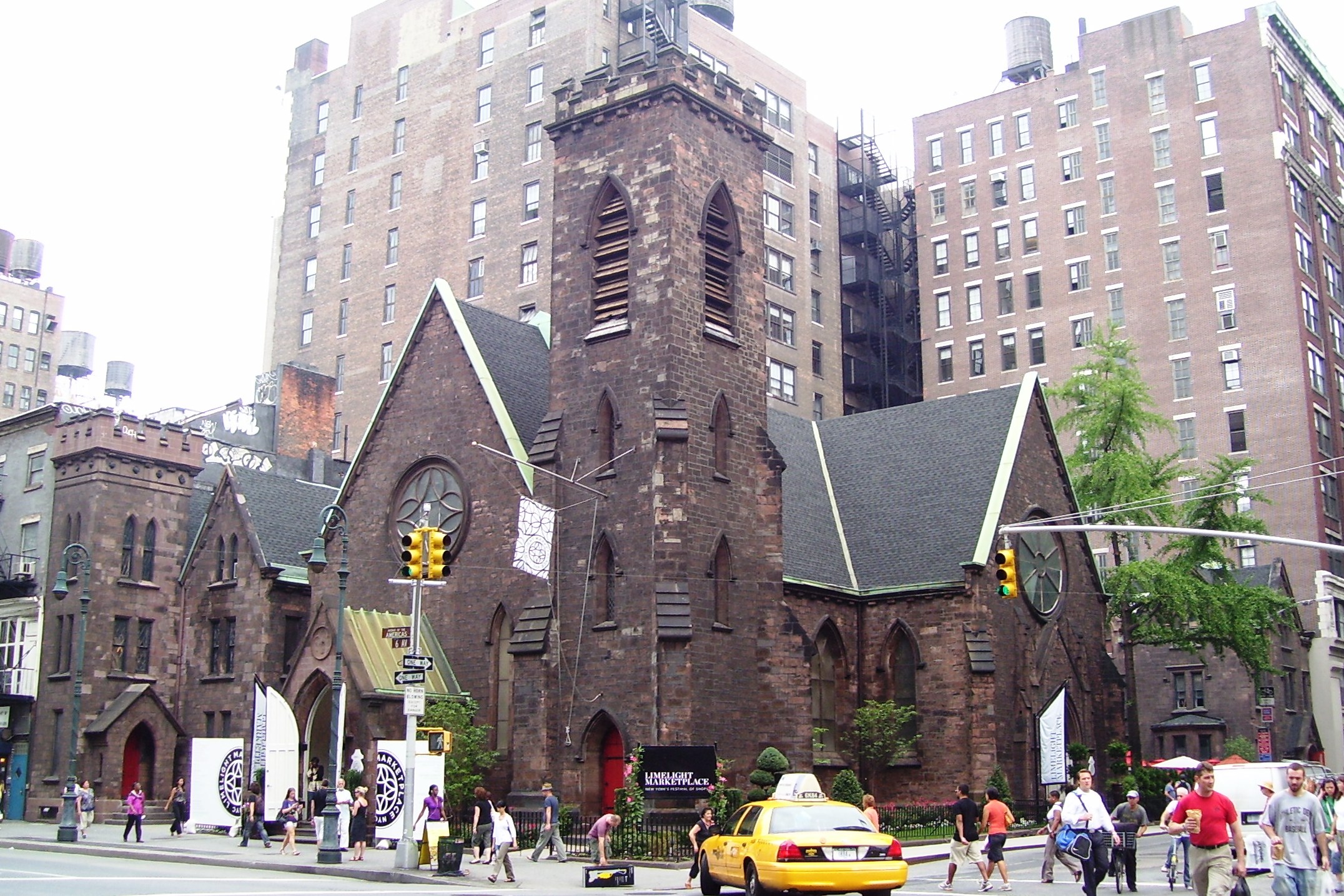
Limelight

Spurred by a chance encounter with the former Episcopal Church of the Holy Communion, now a retail mall called Limelight Marketplace, B.D. McClay considers the fate of deconsecrated churches, wistfully concluding with these thoughts:

A deconsecrated church is just a pile of stones, I guess, no different from any other. Its not wrong to live or work or do business in that space, or sacrilegious; and yet, the space is too full of its past. I can never get used to them; I walked past a church that had been made into an apartment building every day for almost two years, and I never did stop feeling a little surprised.

Back in 1976, when the Church of Holy Communion was deconsecrated, they covered up some of the reminders that the church had once been a holy place. According to the Marketplaces website, as part of transforming the building into a Festival of Shops,” these details were restored as historically significant.”

Well-yes, in one way. But really, they’re only significant insofar as they aren’t historical, and only historical insofar as they aren’t significant. And that is the trouble with deconsecrated churches; they mean too much, even when they no longer mean anything at all.

(Photo of The Limelight, formerly the Episcopal Church of the Holy Communion, via Wikimedia Commons)