Why Is The Anti-War Movement AWOL?

by Patrick Appel

Rosie Gray reports on the subject:

“The Democrats are missing in action because of course the president is a Democrat,” said David Swanson, a longtime antiwar activist and author of War Is a Lie and When the World Outlawed War, who works with Roots Action, a progressive nonprofit. “That’s the biggest factor, I think. What’s tamping down the activism is partisanship.”

Reihan subscribes to this theory. Keating pushes back:

First, there’s the issue of timing. At the time of the largest Iraq protests, war talk had been growing steadily for months and the actual invasion wouldn’t happen for another few weeks. In this case airstrikes didn’t seem likely until last Friday and will probably come in the next few days. That’s not much time to mobilize anyone beyond Code Pink’s existing membership.

Second, a major premise of the anti-Iraq movement was that the Bush administration was hyping the intelligence on weapons of mass destruction. Yes, Saddam Hussein had also used chemical weapons (with the U.S. government’s knowledge), but that was years earlier. In this case the attack happened last week and the photos of its aftermath are still being plastered on the news. You can argue that Assad’s use of chemical weapons is a bad reason to attack, but it’s harder to argue that the Obama administration is simply inventing a reason to invade a country it has been wanting to invade for years.

The NFL Tackles The Greatest Threat To Its Survival

by Patrick Appel

NFL Head Injuries

Yesterday, the NFL settled the head injuries lawsuit brought against it by thousands of former players. Jonathan Mahler thinks the settlement is puny:

It was inevitable. Of course, the National Football League wasn’t going to enter into a lengthy discovery process in which it would have to tell the world what it knew — and when — about the dangers of playing professional football. Of course, the NFL wasn’t going to risk a multibillion-dollar verdict. Of course, the NFL wasn’t going to go into another season with this massive lawsuit — featuring at least 10 members of the Hall of Fame as plaintiffs — still hanging over its head.
What is surprising is the paltry size of the settlement that the NFL has gotten away with. The lawyer for the plaintiffs, Christopher Seeger, has said that avoiding litigation will allow players and families in need to get urgent medical care sooner rather than later. Fair enough. But it’s still a sweetheart deal for the NFL: just $765 million, paid out over 20 years. To put that figure into context, the NFL’s 2012 revenues totaled $9.5 billion. Better yet, the league’s estimated revenue for 2025, when it will still be handing out loose change to the families of players who committed suicide after suffering from chronic traumatic encephalopathy, are projected at $25 billion.

Ben McGrath makes related points:

The rough per-capita payout—given that all of the N.F.L.’s current retirees are eligible for compensation, and that it is estimated that there could be as many as twenty thousand of them—could come to less than forty thousand dollars, to be disbursed over a period of a couple decades.

(And not all of the money is actually going to compensation—$75 million will be spent to pay for medical exams, and $10 million is earmarked for research and education. The $675 million that the players will receive won’t be distributed equally; some will get more, up to a maximum of $5 million—others, presumably, much less.) No, it’s not “chump change,” but neither is it much of a hit to the bottom line of the world’s most profitable sports league, an organization that was being sued by almost a quarter of its former athletes. The rights to televise “Monday Night Football” alone are worth one and a half billion dollars a year to the N.F.L., or about twice the size of the settlement. The league’s annual revenues approach ten billion dollars. What’s more, in settling early, the league escaped discovery and depositions that might have revealed more about what it knew, and when. The terms are explicitly agnostic on the subject of whether the plaintiffs’ injuries were caused by football; the N.F.L. admits no liability. What concussion crisis?

Sean Gregory explains why the NFL’s players accepted the settlement:

“[The NFL] is going to say, ‘did your brain damage come from your college hits?’” says Christopher Seeger, co-lead counsel for the plaintiffs.  ”From your pro hits? Do you have a documented history of concussion? Can you prove you were concussed? Can you prove concussions even caused your neurological problem?” In this settlement, players just have to show signs of impairment in order to receive a payout. “They don’t have to prove any of those things,” says Seeger.

Daniel Engber wishes more money had gone to research:

In the past few years, the NFL has disbursed more than $100 million on concussion research, and the Player’s Association has been spending money, too. Still, it’s troubling that as part of its final deal with plaintiffs, the league set aside just $10 million more for purposes of “research and education.” We’re talking about barely more than 1 percent of the total pot, and not all of it will go towards doing science. According to the settlement, that fund will also pay for outreach projects such as one promoting “safety initiatives in youth football.” In light of what we know—and don’t know—about concussions, these are almost guaranteed to be a waste of money. You can’t promote “safety” in football, youth or otherwise, until you understand—scientifically—how dangerous it really is.

And Travis Waldron wonders what the NFL will do next:

While it’s a small step forward, larger questions remain about the future of the game. The NFL has taken significant actions in recent years to help reduce concussions and brain injuries in its game, changing rules, requiring evaluations from independent doctors, and improving testing and treatment procedures. It has couched much of that in gibberish as it refused to explicitly acknowledge the dangers of concussions, but perhaps the absence of major litigation will now allow it to speak frankly about the need to make its game safer — and about the need to improve safety at the college, high school, and youth levels too.

The Dish’s thread on pro-sports head injuries is here.

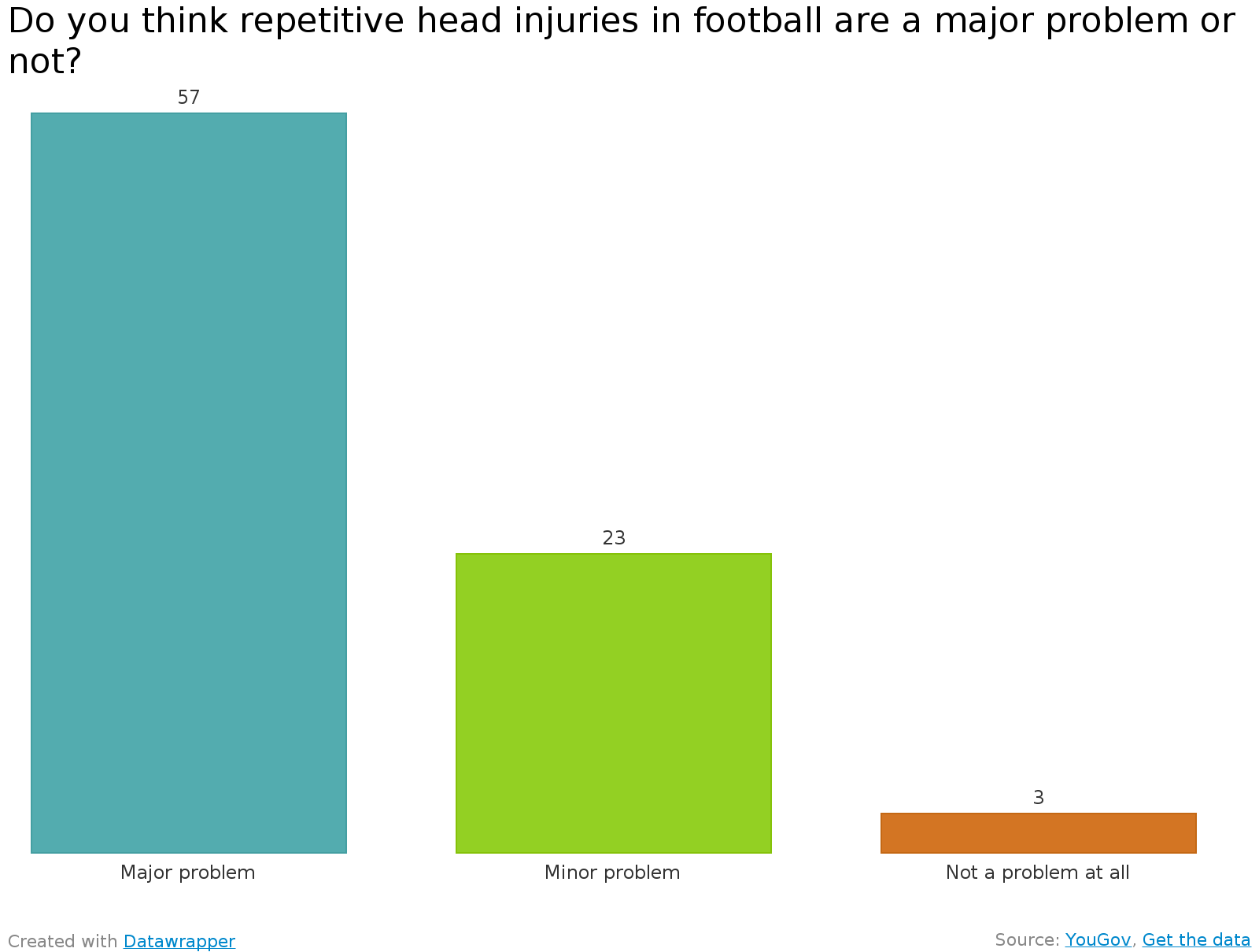
(Chart from YouGov)
The Embarrassing Lead-Up To War

by Patrick Appel

Gregory Djerejian’s denunciation of the Obama administration deserves to be read in full. It begins:

Several days ago I wrote I was extremely conflicted on the question of punitive action in Syria, but no longer. I am now staunchly opposed having better detected an utter lack of true seriousness by the Obama Administration. The myriad leaks around what type of mission, the palpable trigger-happiness among some, the British debacle (they won’t even have their poodle this time, the cat-calls will ring!) and the ‘shot across the bow’ nonsense showcases an Administration unready for an invigorated course correction of its flailing Syria policy. Frankly, I am astonished by the lack of seriousness and mediocrity on display.

Flattery Is A Winning Argument

by Patrick Appel

According to science:

One line of research has found that self-affirmation—a mental exercise that increases feelings of self-worth—makes people more willing to accept threatening information. The idea is that by raising or “affirming” your self-worth, you can then encounter things that lower your self-worth without a net decrease. The affirmation and the threat effectively cancel each other out, and a positive image is maintained.

A 2006 study led by Geoff Cohen, for example, found that when pro-choice people had their partisan identities made salient, affirmation made them more likely to compromise and make concessions on abortion restrictions. Similarly, a study by Joshua Correll found that affirmation led people to process threatening political arguments in a less biased way. More recently, research by Brendan Nyhan and Jason Reifler (PDF) found that self-affirmation made people who supported withdrawing from Iraq more likely to agree that the Iraq troop surge of 2007 saved lives, and made strong Republicans more likely to agree that climate change is real. The takeaway from all three studies is that information is more likely to have the desired effect if, on net, it doesn’t lower a person’s self-worth.

The Administration Mellows On Marijuana

by Patrick Appel

DOJ Marijuana Memo by tpmdocs

This embed is invalid


Yesterday the DOJ released the above memo, which indicates that it won’t sue to prevent Colorado or Washington state from legalizing marijuana. Sullum analyzes the document:

There is plenty of wiggle room there for the Justice Department, which can decide at any point that “state enforcement efforts are not sufficiently robust” and move to shut down state-licensed growers and retailers. The experience with medical marijuana, where promises of forbearance led to a “green rush” of cannabusinesses that prompted a crackdown, suggests no one should get too excited about the Obama administration’s willingness to tolerate deviations from prohibitionist orthodoxy. Furthermore, no matter how intrusive the Justice Department turns out to be in practice, all bets are off in the next administration. Still, this wishy-washy yellow light for legalization is better than might have been expected based on Obama’s broken promises regarding medical marijuana.

Kleiman’s read on the situation:

This makes it somewhat safer to be a state-licensed cannabis grower or retailer, but it doesn’t make it safe.

Today’s policy statement – as opposed to a binding rule, which would be part of the U.S. Attorneys Manual explicitly does not constrain the discretion of the United States Attorneys in Washington and Colorado. It creates no rights or remedies. It is subject to revision at any time, and that revision would have retroactive effects.

Pete Guither’s view:

Some of you surely are questioning the sanity of those who are releasing statements of exuberance about this announcement. However, I do understand at least one reason for doing so. Since the administration is playing the “game” of appearing to be reasonable while not actually committing to anything real, a tactic by the other side can be to publicly accept that “appearance” as something real, in order to cement that impression with the public. Thus, when the administration acts in a contrary manner, the public will view the administration as double-dealing once again.

Sullum rounds up other responses to the announcement.

Equality Before The Taxman

by Patrick Appel

This is wonderful news:

According to a big new announcement from the IRS and the Treasury Department, if you’re a legally married gay couple, the federal government will recognize your marriage — even if you live in a state where your marriage isn’t legal.

The statement, released by the Treasury Department Thursday, says that department and the IRS will use a “place of celebration” rule in recognizing same-sex unions (recognition that was illegal before the Supreme Court struck down part of the Defense of Marriage Act last month). That means that the U.S. government recognizes a marriage if the union was legally recognized in the place where it occurred, where it was celebrated. That’s true even if the married couple then lives in a state where gay marriage is illegal.

Steve Benen spells out why this a big deal:

The new policy applies to all federal tax provisions where marriage is a factor, including filing status, claiming personal and dependency exemptions, taking the standard deduction, employee benefits, contributing to an IRA, and claiming the earned income tax credit or child tax credit.

This is no small development.

Under the old policy, if a same-sex couple in Vermont gets married, then moves to Florida, they would no longer be treated as married under tax law. Now, no matter where a same-sex married couple lives, that family can take comfort in knowing they’ll be treated equally under federal tax law.

June Thomas considers other consequences of this decision:

As Matthew Yglesias recently wrote, a willingness to relocate is essential in times of high unemployment, and married gay men and lesbians shouldn’t suffer a loss of rights if they need to move to a state without marriage equality. It’s also good news for the 13 states that, along with the District of Columbia, perform same-sex marriages: Any same-sex couples who want to tie the knot but live in a marriage-denying state would be well-advised to give up on waiting for their state to see sense and spend their wedding dollars in a more welcoming jurisdiction.

Barro notes that same-sex married couples can amend old returns:

[O]ne key component of today’s announcement is that the IRS will accept amended tax returns from gay couples going back as far as 2010. If you filed previous years’ taxes as single because the IRS didn’t recognize your marriage, you can go back and change old tax returns to say you’re married—but only if you want to.

Gay couples will presumably only take this option if doing so gets them a tax refund. Typically, that would happen for one of two reasons. If the spouses had highly unequal incomes, it’s likely they missed out on a marriage bonus, because graduated tax brackets kick in at higher levels for couples than singles. Or, if one spouse put the other on his or her employer-provided health plan in previous years, amending old returns will allow the couple to deduct the cost of that spousal health benefit from tax.

Since only couples getting refund checks will be likely to amend, the IRS decision is likely to cause a short-run revenue loss. But it will be made up in the future, when same-sex married couples have to file their taxes as married whether they want to or not.

Finally, Linda Beale examines remaining legal inequalities:

In spite of the relief this federal ruling provides, same-sex couples will still face enormously complex legal issues because of the states that discriminate against such couples.  They may have adopted children in the state in which the marriage was celebrated, but they may move to a state that doesn’t recognize gay marriages and doesn’t permit gay adoptions.  What kind of issues will that raise?  They may be able to transfer property at death without probate in their home state, but not in their new state of domicile.  All of these issues continue to argue for an equal protection right to gay marriage and the rights and obligations that correspond to it, as well as sister state comity in recognizing gay marriages conducted in other states.

Flirting With Polarization

by Patrick Appel

Is online dating creating fewer politically-mixed couples?

People who use Internet dating sites are choosing who to date based on criteria that are highly correlated with political preferences, according to a study published in the most recent edition of the academic journal Political Behavior. As a result, the study suggests, there may be long-term consequences for political polarization: not only are such couples more likely to move to the ideological extremes because they lack access to contradictory opinions, they also are likely to produce children who hold ideologically extreme positions. The end result is a more polarized America where more and more people cannot understand how others could possibly think differently from themselves.

America’s Reputation Isn’t On The Line

by Patrick Appel

Back in May, Jonathan Mercer spelled out why national “credibility” is a terrible reason to go to war:

Do leaders assume that other leaders who have been irresolute in the past will be irresolute in the future and that, therefore, their threats are not credible? No; broad and deep evidence dispels that notion. In studies of the various political crises leading up to World War I and of those before and during the Korean War, I found that leaders did indeed worry about their reputations. But their worries were often mistaken.

For example, when North Korea attacked South Korea in 1950, U.S. Secretary of State Dean Acheson was certain that America’s credibility was on the line. He believed that the United States’ allies in the West were in a state of “near-panic, as they watched to see whether the United States would act.” He was wrong.

When one British cabinet secretary remarked to British Prime Minister Clement Attlee that Korea was “a rather distant obligation,” Attlee responded, “Distant — yes, but nonetheless an obligation.” For their part, the French were indeed worried, but not because they doubted U.S. credibility. Instead, they feared that American resolve would lead to a major war over a strategically inconsequential piece of territory. Later, once the war was underway, Acheson feared that Chinese leaders thought the United States was “too feeble or hesitant to make a genuine stand,” as the CIA put it, and could therefore “be bullied or bluffed into backing down before Communist might.” In fact, Mao thought no such thing. He believed that the Americans intended to destroy his revolution, perhaps with nuclear weapons.

Similarly, Ted Hopf, a professor of political science at the National University of Singapore, has found that the Soviet Union did not think the United States was irresolute for abandoning Vietnam; instead, Soviet officials were surprised that Americans would sacrifice so much for something the Soviets viewed as tangential to U.S. interests. And, in his study of Cold War showdowns, Dartmouth College professor Daryl Press found reputation to have been unimportant. During the Cuban Missile Crisis, the Soviets threatened to attack Berlin in response to any American use of force against Cuba; despite a long record of Soviet bluff and bluster over Berlin, policymakers in the United States took these threats seriously. As the record shows, reputations do not matter.

Who Does War Punish?

by Patrick Appel

In a 2011 paper (pdf), David Luban made the case against punitive war:

War is a blunt instrument. Despite easy talk about “surgical” strikes and “precision” attacks, the fact is that warmaking wreaks damage across entire towns, cities, and territories. Wars are the equivalent of natural disasters like floods and hurricanes, and even the most discriminate war breaks whatever it touches. Thus, if war is retributive punishment, we must acknowledge that it is collective punishment, indeed collective corporal punishment.

Joshua Keating adds:

Obama probably won’t use the word “punishment” when he presents the case for war to the American public, but given that no demands have been made of Assad—no one is suggesting that if he surrenders his chemical weapons or comes to the negotiating table in the next few days, the whole thing will be called off—this certainly does feel like punishment for a blatant human rights abuse and for crossing the “red line” Obama specified last year. Whether you agree with Luban’s take or not, that’s a more radical notion than I think people realize.

What Would Attacking Syria Accomplish?

by Patrick Appel

Obama claims that he hasn’t made a decision regarding Syria, but he emphasizes that “the international norm against the use of chemical weapons needs to be kept in place”:

Fisher thinks that this is the primary rationale for using force:

The U.S. decision to move toward possible strikes appears, rightly or wrongly, wisely or unwisely, to be all about reinforcing international norms. It’s not about us; it’s not about “because Obama said so.” It’s about “because international norms say so.”

Alex Massie wants to know exactly what we are trying to achieve:

We are clear that we do not wish to remove Bashar al-Assad from power. So we do not think his use of chemical weapons is that big a deal. Certainly not a big enough deal to make the case for regime change.

The plan, in as much as there is one, seems to be to put him in detention rather than expel him. But to what end? Will bombing Syria persuade Assad to modify his behaviour? Is our objective to make him offer the rebels a “fairer fight”?

… How, having intervened once, can the United States and its allies walk away? Shoving Assad onto the naughty step seems an insufficient response to his misdeeds. If the aim is simply to persuade Assad that any further use of chemical weapons will bring additional consequences it might be wise to consider what those consequences might be.

Marc Lynch likewise worries that intervention will lead to more intervention:

[T]he administration’s loud protestations of limited aims and actions are only partially reassuring. Much the same language was used at the outset of the Libya campaign. Everybody knows that it will be excruciatingly difficult for Obama to hold the line at punitive bombing after those strikes inevitably fail to end the war, Assad remains publicly defiant, the Geneva 2 diplomatic process officially dies, and U.S. allies and Syrian insurgents grumble loudly about the strike’s inadequacy. Once the psychological and political barrier to intervention has been shattered, the demands for escalation and victory will become that much harder to resist. And what happens when Assad launches his next deadly sarin attack — or just massacres a lot of Syrians by non-chemical means? This too Obama clearly knows. But that knowledge may still not be enough to save him.