Obama Ought To Listen To Himself

by Patrick Appel

Jack Goldsmith asks why Obama doesn’t get Congressional approval to attack Syria:

Why is President Obama going to act unilaterally?  Why doesn’t the man who pledged never to use force without congressional authorization except in self-defense call Congress into session to debate and authorize the use of force in Syria?  Why doesn’t he heed his own counsel that “[h]istory has shown us time and again . . . that military action is most successful when it is authorized and supported by the Legislative branch,” and that it is “always preferable to have the informed consent of Congress prior to any military action”?  Why is he instead rushing to use force in a way that will set a novel constitutional precedent for presidential unilateralism that will far outlive his presidency?

Since U.S. intervention in Syria portends many foreseeably bad consequences, and because there is so little support in the nation for this intervention, why not get Congress on board – not just to legitimate the action, but also to spread political risk?  Why exacerbate the growing perception – justified or not – of a presidency indifferent to legal constraints?  Why not follow the example of George H.W. Bush, who sought and received congressional authorization for the 1991 invasion of Iraq, or George W. Bush, who did the same for the 2003 invasion of Iraq?  Or to take an example more on point, why not follow David Cameron, who (embarrassingly for the President) recently called Parliament into session to debate and legitimate Britain’s planned involvement?

Fallows is on the same page:

Even if Obama has already made up his mind to launch a strike, and even if that operation goes perfectly, something about it will go wrong. Messages will get blurred and bungled; the fog of war will interfere; innocents will be killed. How many people planning the bomb-Serbia campaign in 1999 imagined that it would create a crisis between the U.S. and China, because of the mistaken bombing of the Chinese embassy in Belgrade?

Obama can’t know what exactly will happen if he launches a strike. But he should know, for sure, that even the cleanest intervention will bring mistakes, tragedies, and eventual blame. Therefore it should be 100% in his interest to share responsibility for the decision before it is solely his.

The Credibility Argument Isn’t Credible

by Patrick Appel

Reuel Marc Gerecht claims that “America’s credibility in the region — which is overwhelmingly built on Washington’s willingness to use force — will be zero unless Obama militarily intercedes now to knock down the Assad regime”:

If the president intends to maintain American influence, which means maintaining a credible threat to go to war to stop Iran’s quest for nuclear weapons, then Washington’s response to Assad’s challenge must be devastating. The entire regime must be targeted: elite military units, aircraft, armor and artillery; all weapons-depots; the myriad organizations of the secret police; the ruling elite’s residences; and other critical Alawite infrastructure.

Military interventions don’t automatically make future threats to use force more credible. The wars in Iraq and Afghanistan drained the treasury, exhausted the American military, and lowered the public’s support for wars of any kind. If we never fought those wars, Iran and Syria would have much more reason to fear our saber-rattling because America would still have the will and resources to launch a real war should the need arise. Getting bogged down in Syria makes our threats to Iran less credible, not more. Larison sighs:

If the “credibility” argument is nonsense, and it is, how ridiculous is Obama’s willingness to make policy decisions on the basis of it?

If Obama knows that the military action he’s about to order is useless, it is that much more indefensible if he proceeds to order it. The fact that the attack will be brief and relatively low-risk for U.S. forces is its only redeeming feature. An attack on Syria has the potential to trigger retaliation, lead to military escalation, or possibly even spark a regional war, and yet it is entirely unnecessary for U.S. or allied security. Obama’s readiness to use force obviously isn’t in doubt, but each time he yields to the impulse to intervene militarily when no U.S. interests are at stake his reputation on foreign policy takes a well-deserved hit.

Walt makes a similar argument:

What is most striking about this affair is how Obama seems to have been dragged, reluctantly, into doing something that he clearly didn’t want to do. He probably knows bombing Syria won’t solve anything or move us closer to a political settlement. But he’s been facing a constant drumbeat of pressure from liberal interventionists and other hawks, as well as the disjointed Syrian opposition and some of our allies in the region. He foolishly drew a “red line” a few months back, so now he’s getting taunted with the old canard about the need to “restore U.S. credibility.” This last argument is especially silly: If being willing to use force was the litmus test of a president’s credibility, Obama is in no danger whatsoever. Or has everyone just forgotten about his decision to escalate in Afghanistan, the bombing of Libya, and all those drone strikes?

From The “Experts” Who Brought You The Iraq War

by Patrick Appel

Waldman mocks the Weekly Standard‘s call for war:

[I]n case you were on the fence about whether the American government should take military action in Syria, Kristol has returned with an open letter urging President Obama to get bombing post-haste, and go big. You can find the letter on the Weekly Standard‘s website, where it runs under the not-sarcastic headline, “Experts to Obama: Here is what to do in Syria.” Among the “experts” are not only Kristol himself, but a whole bunch of folks with a nuanced grasp of the subtleties of Middle East politics and a track record of wise counsel on matters of war. People like Iran-Contra criminal Elliot Abrams, evangelical leader Gary Bauer, former seat-warming senator Norm Coleman, French gadabout Bernard-Henri Levi, foreign-policy genius Karl Rove, and presidential laughingstock Tim Pawlenty, not to mention the hilariously named Arch Puddington, who apparently is an actual person and not a character from a children’s book.

Scott Lemineux piles on:

I’m not 100% sure that military intervention in Syria is wrong. But it is true that 1. al-Assad is terrible 2. ????? 3. Bomb lots of stuff! is a terrible argument, and the arguments — really assumptions — in the above letter have scarcely more meat on them. There should be a very strong presumption against military action, but instead it’s the one form of government action that doesn’t seem to face any kind of cost-benefit analysis in our political discourse at all.

Conor joins the chorus:

I’d never claim to be a foreign policy expert. But I know enough to scoff when The Weekly Standard grants ”expert” status to Karl Rove, and to discount the prognostication skills of everyone that urged American intervention in Iraq without the faintest idea of what would follow. But in D.C., expert status is never taken away for being repeatedly, catastrophically wrong.

In response to the Weekly Standard, Fallows names the military thinkers he trusts:

Whose advice would I like to hear? Andrew Bacevich’s, for one. And it turns out he has already weighed in.  For another, Jim Webb. I’ll ask him, but there is this clue from last year. Or Anthony Zinni, whom I will try to locate. Significantly, unlike virtually all of the experts urging “surgical” intervention, these are people who have fought in wars themselves or been responsible for their aftermath. Perhaps Robert Gates too — and now that I look, I see how he is leaning. Or James Mattis — and, as it turns out, his instincts are the same. Also Gary Hart, who has just written in a similar vein, for instance: “The use of force is not a policy; it is a substitute for policy.”

So: the men who gave us Iraq on one hand, the people who were against it or far more cautious on the other. Let’s give the tie-breaking vote to Dwight Eisenhower, from up in heaven. One guess about what he would recommend.

The Sectarianism Of Syria

by Patrick Appel

Levant_Ethnicity_

Max Fisher explains the map above, which “shows the different ethnic and linguistic groups of the Levant, the part of the Middle East that’s dominated by Syria, Lebanon and Israel”:

Ethnic and linguistic breakdowns are just one part of Syria’s complexity, of course. But they are a really important part. The country’s largest group is shown in yellow, signifying ethnic Arabs who follow Sunni Islam, the largest sect of Islam. Shades of brown indicate ethnic Kurds, long oppressed in Syria, who have taken up arms against the regime. There are also Druze, a religious sect, Arab Christians, ethnic Armenians and others.

Syria is run by Alawites, a minority sect of Islam whose members include President Bashar al-Assad and many in his inner circle. They’re indicated in a greyish green, clustered near the Mediterranean coast. Although Alawites make up only 12 percent of the Syrian population, they are playing a crucial role in the war, fighting to prop up Assad’s regime.

He uses the map to discuss Fareed Zakaria’s argument, from June, against intervention in Syria:

Zakaria’s thesis is that what we’re seeing in Syria is in some ways the inevitable re-balancing of power along ethnic and religious lines, with the Sunni Arab majority retaking control from the Alawite minority. He compares the situation to post-2003 Iraq, when members of the Shiite majority violently took power from the Sunni minority that, under Saddam Hussein, had ruled them. That would explain why so much of the killing in Syria has been along sectarian lines. It would also suggest that there’s not much anyone can do to end the killing because, in his view, this is a painful but unstoppable process.

(Map from the Gulf/2000 Project)

Who Will Become The Face Of The GOP?

by Patrick Appel

Beinart feels that Ted Cruz is gaining steam:

Cruz is eclipsing Rubio, it’s worth recalling, at a time when the American people’s biggest complaints about the GOP are that it’s “too unwilling to compromise” and “too extreme.” (PDF) Were the Republican Party’s shrinking cohort of right-wing activists not sheltered from the rest of America by the informational cocoon Fox News has built for them, they would see in Rubio’s immigration work a politician struggling, not always coherently but with a degree of humility and good will, to show younger, poorer, newer, less white Americans that the GOP gives a damn about them. They might also realize that this kind of inclusive gesture, combined with Rubio’s natural charisma, offers the chance to partially undo the GOP’s reputation as a party beholden to blue bloods and bigots. Instead, they’ve discarded Rubio in favor of Cruz, a man who combines Sarah Palin’s worldview, Richard Nixon’s commitment to fair play, and Al Gore’s folksy charm.

Enten focuses, instead, on Christie, who he dubs the establishment candidate. He sees elite support for Christie as evidence that the GOP hasn’t completely lost its mind:

Christie’s scoring on the two rankings we have available place him more toward the center than any other candidate to win a Republican nomination since 1964. Some of you might say that Christie is more conservative than these scores indicate. But it seems to me that for every issue where Christie takes a conservative stand, he takes a moderate stance. So that while he’s conservative on taxes, he’s for campaign finance reform and green energy.

The point is he’s more toward the center than previous nominees. He no doubt will move somewhat towards the right, once he wins a second term in November. Still, even a hard turn right would still leave him as relatively moderate. A Republican leadership that was looking to move more towards the right would not be interested in nominating this man or nominating the committee chairmen they are in congress. This is a party that wants to win. It’s a party leadership that at least right now is following the historical pattern of wanting to nominate a more moderate candidate, after losing the the presidential election in two consecutive cycles.

Intervention Usually Does More Harm Than Good

by Patrick Appel

Yglesias flags research finding that, in general, “intervening on behalf of rebels increases the number of civilians who are killed by increasing the desperation of government forces”:

Now of course just because intervention typically fails to reduce civilian deaths doesn’t mean that intervention fails in all cases. But proponents of helping-by-killing seem to me to be mighty blithe in their estimates of the upsides of these endeavors. And you can see why that is. A mission is undertaken to help the good guys and stop the bad guys. If the bad guys kill even more good guys once your mission starts, the tendency is to put that in the “evidence that the bad guys are really bad” file rather than the “evidence that this intervention didn’t work very well” file. By the same token, proponents of helping-by-killing are generally very eager to assert that killing bad guys (and their subordinates) will set valuable precedents for the future and tend to discount the risk that interventions create perverse incentives for rebel groups. For example, did this fierce civil war in Syria break out in part because the intervention in Libya led opposition figures to believe that even a low-probability-of-success military uprising stood a good chance of receiving a NATO bailout?

Paving Over NIMBYism

by Patrick Appel

Reihan wants NYC to bring down rents by encouraging more construction. He touts the proposals of David Schleicher, “a law professor at George Mason University and a leading expert on the politics of local land-use regulation”:

Opposition to new development, in New York and elsewhere, usually flows from the sense that current residents won’t actually benefit from an influx of new arrivals. The fear is that big new developments will lead to traffic congestion and crowded subways, and much else besides. With this in mind,  Schleicher’s work places heavy emphasis on getting current residents to embrace new development by, in effect, bribing them to get with the program.

In his paper, “City Unplanning,” Schleicher calls for “TILTs,” or tax-increment local transfers. The idea behind TILTs is that because new developments generate new property tax revenue, the city can buy off fretful neighbors by giving them a cut of this revenue. The citywide benefits of new development are thus shared with neighbors to the project, but there are no new taxes on development, so costs don’t rise. And while property tax abatements shrink the tax base, TILTs will spur new construction that will increase the overall property tax pie from which taxes are drawn, even after residents in affected neighborhoods get their cut.

Obama Wants A Little War

by Patrick Appel

SYRIA-CONFLICT

Fisher outlines what appears to be the administration’s Syria plan:

[W]hat the Obama administration appears to want is a limited, finite series of strikes that will be carefully calibrated to send a message and cause the just-right amount of pain. It wants to set Assad back but it doesn’t want to cause death and mayhem. So the most likely option is probably to destroy a bunch of government or military infrastructure – much of which will probably be empty.

Drum labels this course of action “useless”:

All the evidence suggests that Obama is considering the worst possible option in Syria: a very limited air campaign with no real goal and no real chance of influencing the course of the war. You can make a defensible argument for staying out of the fight entirely, and you can make a defensible argument for a large-scale action that actually accomplishes something (wiping out Assad’s air force, for example), but what’s the argument for the middle course? I simply don’t see one.

Franklin Spinney argues that this plan relies on the “marriage of two fatally-flawed ideas”:

1. Coercive diplomacy assumes that carefully calibrated doses of punishment will persuade any adversary, whether an individual  terrorist or a national government, to act in a way that we would define as acceptable.

2. Limited precision bombardment assumes we can administer those doses precisely on selected “high-value” targets using guided weapons, fired from a safe distance, with no friendly casualties, and little unintended damage.

This marriage of pop psychology and bombing lionizes war on the cheap, and it increases our country’s  addiction to strategically counterproductive drive-by shootings with cruise missiles and precision-guided bombs.

Fallows seconds Spinney:

For 20 years now we have seen this pattern:

1. Something terrible happens somewhere — and what is happening in Syria is not just terrible but atrocious in the literal meaning of that term.

2. Americans naturally feel we must “do something.”

3. The easiest something to do involves bombers, drones, and cruise missiles, all of which are promised to be precise and to keep our forces and people at a safe remove from the battle zone.

4. In the absence of a draft, with no threat that taxes will go up to cover war costs, and with the reality that modern presidents are hamstrung in domestic policy but have enormous latitude in national security, the normal democratic checks on waging war don’t work.

5. We “do something,” with bombs and drones, and then deal with blowback and consequences “no one could have foreseen.”

Larison suspects that a bombing campaign will quickly escalate:

Since almost everyone concedes that the planned strikes are virtually useless, it is hard to believe that the administration won’t feel compelled to launch additional attacks on the Syrian government when the first strikes fail to change regime behavior. There will presumably be increasing domestic and international pressure for an escalation of U.S. involvement once the U.S. begins attacking Syria, and once Obama has agreed to take direct military action of one kind he will have greater difficulty resisting the pressure for even more. There is also always a possibility that Assad and his patrons could retaliate against U.S. forces or clients, in which case the pressure to escalate U.S. involvement will become much harder to resist.

And Gregory Djerejian, who is conflicted over whether or not to intervene in Syria, argues that we “should not simply bomb for 36 hours, and then go away again”:

This would likely prove worse than doing nothing. We need to re-engage in a holistic Syria policy that squarely grapples with broader regional dynamics and that ultimately leads to a negotiated solution, a task we’d shirked, but where Assad’s use of [chemical weapons (CW)] appears to have forced a reluctant President to more forcefully engage. So if we are going in, we’re going in for more than a few Tomahawks so everyone can get a late August pat on the back that ‘something was done’. It’s not quite Colin Powell’s old so-called Pottery Barn rule: ‘you break it, you own it’. It’s perhaps more here, ‘you bomb it, the breakage is yours too’. Are we up to this? Our national security team? The strategic follow-through? The countless hours of spade-work with allies and, yes, foes? I just don’t know.

I am straddling the fence and unsure, but it is one man ultimately who will decide. My thoughts are with him, this may be a more momentous decision than he may wholly realize. I would not begrudge him standing aside, if he feels the ‘roll-in the cavalry’ noises to date have caused Assad to blink already creating a sufficient enough deterrent impact (though this is dubious). He must also ask himself, when he thinks honestly taking his private counsel, whether he believes he and his team really have the appetite and abilities once embarking on this course to actually succeed in it. These are not easy questions. Yet they demand answers and realistic appraisal. As part of that analysis, one must honestly reckon too with the emerging school of thought that we can bifurcate a military action aimed purely to deter on CW, but without enmeshing ourselves in the conflict and attempting to influence broader outcomes. One doubts it could play out so neatly, and such assumptions should be amply stress-tested.

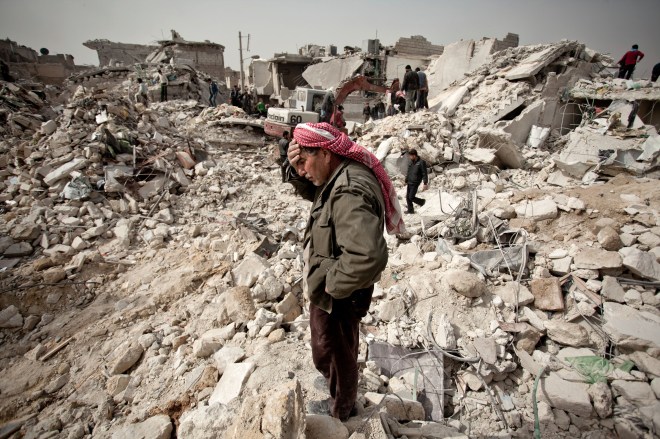
(Photo: A Syrian man reacts while standing on the rubble of his house while others look for survivors and bodies in the Tariq al-Bab district of the northern city of Aleppo on February 23, 2013. Three surface-to-surface missiles fired by Syrian regime forces in Aleppo’s Tariq al-Bab district left 58 people dead, among them 36 children, the Syrian Observatory for Human Rights said on February 24. By Pablo Tosco/AFP/Getty Images)

YouTube In The War Room

by Patrick Appel

Matt Steinglass thinks the “decisive factor” propelling America’s to intervene in Syria is “the rapid availability of mesmerisingly horrifying video imagery of the gas victims” (such as the video above):

In Iraq, video imagery of Saddam’s Kurdish gas victims ultimately came out, but it took years; there was no sense of urgency or an ongoing threat. Even so, the imagery of the massacres ultimately seeded a longstanding American sympathy for the Kurdish cause and remained the clearest indictment of Saddam as a mass murderer. The impact of such video images rests partly on the unique horror of poison gas in the Western imagination.

Waldman makes an important point about these images:

If you’ve watched the coverage of these events on television, you’ve no doubt heard the warnings from anchors: “The images we’re about to show you are disturbing.” And indeed they are, particularly the ones of children—a child being washed down in a dingy hospital while crying out in anguish, rows upon rows of dead children’s bodies, and so on. But it’s precisely because chemical weapons leave no visible injuries that these images can be shown. If the same number of children had been blown apart by bombs, you’d never see the pictures at all, because the editors would have considered them too gruesome to broadcast. And not having seen the images, we might be just a little less horrified.

Erik Voeten identifies one reason the taboo against chemical weapons exists:

Historically, chemical weapons have been heavily associated with poison; the quintessential weapon of the weak, which undermines proper battles for political power based on physical strength. This makes chemical weapons usage easy to associate with cowardice.

Earlier Dish on chemical weapons here.

Does America Plan To Oust Assad?

by Patrick Appel

Micah Zenko asks:

Even a limited cruise missile strike will not be merely an attack on Assad’s chemical weapons capabilities, but an attack on the regime itself.

Subsequently, the United States will be correctly perceived by all sides as intervening on behalf of the armed opposition. From there, it is easy to conceive how the initial limited intervention for humanitarian purposes – like Libya in 2011 – turns into a joint campaign plan to assure that Assad is toppled.

If this is the strategic objective of America’s intervention in Syria, President Obama should state it publicly, and provide a narrative of victory for how the United States, with a small number of partner countries, can and will achieve this.

Bret Stephens, for one, wants Assad eliminated:

The world can ill-afford a reprise of the 1930s, when the barbarians were given free rein by a West that had lost its will to enforce global order. Yes, a Tomahawk aimed at Assad could miss, just as the missiles aimed at Saddam did. But there’s also a chance it could hit and hasten the end of the civil war.

Larison pushes back:

One of the persistent flaws in hawkish thinking about foreign conflicts is that the foreign strongman is treated as the embodiment of everything wrong with the country, and consequently hawks tend to think that by removing the strongman the country’s problems will be remedied very easily. Killing off the leadership of the regime likely wouldn’t hasten the end of the conflict.

Would killing Assad prevent the U.S. from being drawn into the conflict? That seems implausible. If the U.S. killed regime leaders, it would probably invite retaliation that sooner or later would make U.S. involvement in the conflict almost unavoidable. Having taken the dramatic step of striking at the top levels of the Syrian government, would the U.S. then be content to leave Assad’s successor in peace? Not very likely. Stephens’ proposal is a recipe for sucking the U.S. deeper into an intense sectarian conflict.

Gillespie :

I don’t doubt Stephens desire to kill Bashar Assad; indeed, the world would not weep a single tear over that tyrant’s death, or the demise of his regime. But the cavalier attitude toward war is stunning, isn’t it, as is the foam-flecked invocation of “civilization.”

Indeed, if the best case for a U.S. war with Syria is that “the future of civilization” is at stake, it’s clear that pro-war forces have no argument other than overheated rhetoric. The simple fact is that Syria’s civil war (and that’s what we’re facing here) is not the test case for civilization, Western or otherwise.