The Resistance To Republican Rebranding

by Patrick Appel

Chait wonders whether House Republicans will prevent the GOP from nominating a candidate who can rebrand the party:

Republicans can escape the damage inflicted by its Congressional wing by nominating a candidate who runs against it in 2016. That’s what the party did in 2000: George W. Bush made a few comments distancing himself from Congress, and that was enough to clear him of all the branding damage the Republicans Revolutionaries had done for a half dozen years and position himself as a moderate. It didn’t stop Bush from governing hand-in-glove with the selfsame Republican Congress once in office.

So the danger for Republicans isn’t that they’ll lose the House. It isn’t even that they’ll irrevocably poison their own brand. It’s that they’ll create an intra-party orthodoxy so strong it will prevent them from nominating a candidate who can distance himself from Steve King’s racial ideology and Paul Ryan’s economic ideology. In the meantime, they can inflict an awful lot of damage to the country at very little cost to themselves.

Humphreys thinks that the GOP has stopped listening:

As Mark Kleiman has noted, the American left lost on the crime issue starting in the 1960s and 1970s because it stopped listening to the public (not unlike how the left later lost the public education issue).

The extraordinary surge of crime that began in the 1960s caused enormous suffering. And when Americans are suffering, they get very angry when politicians tell them their suffering is no big deal (“Many neighborhoods are as safe as ever!”), or is really due to something else (“We don’t have a crime problem, we have a poverty problem!”), or that the public should apologize for being upset (“Complaining about crime is just coded racism”). Americans who feel unheard often express their anger by voting for some politician — any politician — who seems to be listening. And when it came to crime, for many years most of those politicians were conservative.

Liberals were in shock on crime policy for a long time afterwards. They had been talking amongst themselves when they should have been listening to people outside the bubble. California Republicans made the same mistake when they decided to go anti-immigrant in the 1980s. The Tea Party is committing the same blunder right now as they plan out where they will store all the roses the public will supposedly buy them if the federal government is shut down on October 1. Failure to listen isn’t a left or right thing. Rather, it’s a thoroughly human weakness about which political parties should be constantly vigilant.
What Happens If We Cut Off Egypt?

by Patrick Appel

Noah Millman is unsure:

America already has had the experience multiple times of cutting off clients who have crossed a red line of one sort or another. For example, we abandoned the Shah when he had plainly lost the support of his people. This did not win us any goodwill once the Iranian revolution brought to power a profoundly anti-American regime – because the Iranians had not forgotten America’s longstanding support of the Shah, and because the Ayatollahs had their own reasons for setting themselves up in opposition to America.

For another example, in response to Pakistan’s escalating program of nuclear weapons acquisition – and, not incidentally, in response to the collapse of the Soviet Union – beginning in 1990 the United States increasingly distanced itself from Pakistan. Over the course of the next decade, Pakistan still developed a nuclear arsenal, a generation of Pakistani officers grew up without relationships with the United States, and Pakistan became deeply involved in the Taliban regime in Afghanistan. We all know what happened next.

His larger point:

On a relative basis, Egypt is much less-influential than it was fifty years ago. On an absolute basis, though, it’s a much, much bigger country. If we decide that Egypt doesn’t much matter to us, I think we can safely say that we’ve decided that the Middle East doesn’t much matter to us.

Which it well might not. But I am not shocked that the American government is reluctant to decide on the fly and under the pressure of rapidly-changing circumstances in one country to significantly reorder its priorities in this part of the world.

A Shooting Victim Against Stop-And-Frisk

by Patrick Appel

Brian Beutler reflects on getting shot and nearly dying back in 2008:

[T]he moment I woke up in the hospital I promised myself I wouldn’t let what happened change the way I approached life. I wouldn’t flee the city. I wouldn’t start looking over my shoulder. I wouldn’t let it affect my views on race or crime or guns, both because I liked the way my life had been taking shape, but also because at a fundamental level I knew I’d just been profoundly unlucky. Even in a high crime city like D.C. most people going about their business on any given day or year or decade don’t get shot. Mugged, maybe, not shot.

The experience hasn’t made him a supporter of racial profiling:

You can’t tell victims how they should react to the crimes committed against them. That’s wrong, and anyhow it’s largely out of their control. But to anyone whose instinct is to crouch defensively and treat everyone who resembles their attackers like criminals, I’m living proof that there’s another way.

Everyone who’s ever shot me was black and wearing a hoodie. There just aren’t any reasonable inferences to draw from that fact.

Will Conservatives Come Around On Climate Science?

by Patrick Appel

Dave Roberts, in one of his final posts before his internet hiatus, doubts it:

I just don’t think there’s any way to make the facts of climate change congenial to the contemporary U.S. conservative perspective. Once they accept the facts, the severity and urgency of the climate crisis, they are committed to either a) supporting vigorous government policy meant to diminish the power of some of their wealthiest constituents, or b) passively accepting widespread suffering.

Cognitively speaking, that’s an untenable position for them. That’s why they avoid it by rejecting the science. There’s no way to package the science in a way that avoids this dilemma. It is today’s hyper-conservatism, not climate communications, that is ultimately going to have to change.

A Year Off From The Internet

by Patrick Appel

Dave Roberts is taking one:

I enjoy sharing zingers with Twitter all day; I enjoy writing long, wonky posts at night. But the lifestyle has its drawbacks. I don’t get enough sleep, ever. I don’t have any hobbies. I’m always at work. Other than hanging out with my family, it’s pretty much all I do — stand at a computer, immersing myself in the news cycle, taking the occasional hour out to read long PDFs. I’m never disconnected.

It’s doing things to my brain.

I think in tweets now. My hands start twitching if I’m away from my phone for more than 30 seconds. I can’t even take a pee now without getting “bored.” I know I’m not the only one tweeting in the bathroom. I’m online so much that I’ve started caring about “memes.” I feel the need to comment on everything, to have a “take,” preferably a “smart take.” The online world, which I struggle to remember represents only a tiny, unrepresentative slice of the American public, has become my world. I spend more time there than in the real world, have more friends there than in meatspace.

Connor Simpson rounds up reaction to Roberts’ decision:

Some people were dismissive to Robert’s plight, calling it as another trend story we’ve seen before. And those notions aren’t exactly wrong. The Verge’s Paul Miller concluded his year-long absence from the ‘net this year, revealing that it’s didn’t make him any happier. He had modest goals of looking at the flowers and reading and writing more, just like Roberts. It didn’t work out that way, though. He ended up slitting his time doing other just-as-meaningless things.

Others were much more sympathetic. “I relate entirely to [Robert’s] story of total internet-writing burn out and have no idea how so many don’t have it,” wrote The Guardian‘s Jim Newell, who then compared the difficulties of quitting to a smack addiction.

Voting Shouldn’t Be A Privilege

by Patrick Appel

Bouie examines the effects of felony disenfranchisement laws:

You can see the effects most clearly in black turnout rates. The nation’s 27 million African American voters are concentrated in the South and in Northern urban centers. Almost two-thirds—66 percent—voted in last year’s presidential election, giving African Americans higher turnout than any other racial group. But unlike with other groups, there was an odd gender gap: While more than 70 percent of black women voted, only 60 percent of black men went to the polls. The difference, according to Bernard Fraga of Harvard University, is explained entirely by the huge number of black men who are disenfranchised.

Supporters of disenfranchisement seek to purify the body politic, to punish wrongdoers who don’t “deserve” to vote. But this desire for punishment sidesteps whether felon disenfranchisement actually accomplishes anything of value. I’ve never seen good evidence that it does. Why the laws have survived legal scruitiny:

Most of the South’s restrictive voting laws were outlawed and overturned by the courts—but for the most part, felony disenfranchisement measures were not. In the 1974 case Richardson v. Ramirez, the Supreme Court ruled that denying felons the right to vote was permitted under Section 2 of the 14th Amendment. Section 2 spells out penalties for states that deny citizens the right to vote for any reason “except for participation in rebellion, or other crime.” Because of that exemption, the Court determined that—unlike with other voting laws—states did not have to prove they had a “compelling interest” in denying felons the vote, making these laws tough to challenge. Six years later, the justices set the bar even higher, ruling that it wasn’t enough for plaintiffs challenging the laws to prove that they had discriminatory results; they also had to prove discriminatory intent.

Meanwhile, Chait argues that voter ID laws, like felony disenfranchisement laws, are aimed at repressing the minority vote:

[I]f voter-I.D. laws were solely designed to prevent fraudulent voting, rather than to winnow minorities and other Democratic-leaning constituencies from the electorate, why would they be paired with a host of other measures that do not prevent voter fraud but do winnow Democrats from the electorate? In addition to imposing a photo-I.D. requirement, North Carolina Republicans reduced early voting periods (which minorities disproportionately use), prohibited voting stations from extending voting hours when lines are too long, prevented voters who mistakenly go to the wrong precinct from casting a provisional ballot, and a host of other measures.

Realism Isn’t Always Realistic

by Patrick Appel

Egypt Public Opinion

Douthat makes smart points:

I think in general, the kind of realism on display in our relationship to Egypt has been a better model for dealing with problematic governments in unstable regions than some of the alternatives, from Iraq to Libya, that recent presidencies have experimented with.

But there also moments when the ground moves, and you have to take a step back and reassess whether the approach that realism seems to dictate is actually realistic. So, for instance: There is a difference between supporting a longstanding, creaking dictatorship on terms negotiated during the Cold War and supporting a second-generation junta that’s just deliberately overturned a democratic election. There is a difference between supporting a leadership, however corrupt, with a proven record of delivering relative stability and a leadership that so far is mostly delivering bloody chaos. And there’s a difference between supporting a government that’s willing to bend to your wishes at crucial moments and a government that seems intent on embarrassing you while telling the world it doesn’t need your help.

Larison adds:

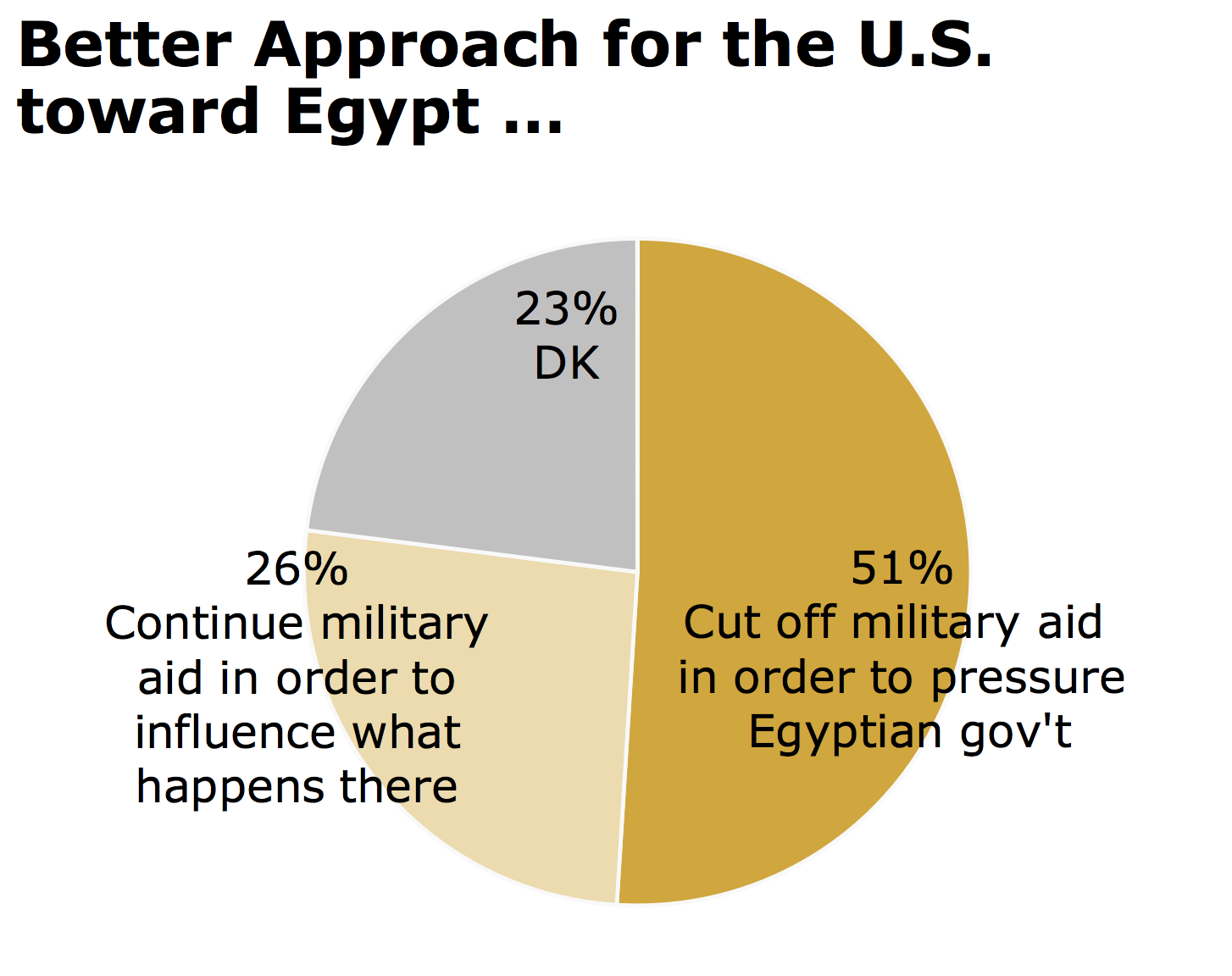
When a client is engaged in behavior that seems both self-destructive and dangerous to us, it is irresponsible for the U.S. to continue the relationship as if nothing is amiss. That’s a standard that the U.S. ought to apply to all of its client relationships, but it certainly applies in the case of Egypt.

(Chart showing that the public supports cutting aid to Egypt from Pew)

How Many People Does The World Need?

by Patrick Appel

Gary Becker highlights the economic advantages of population growth:

To be sure, if higher birth rates lead to lesser education and other human capital investments in each child, they may result in lower, not higher, per capita incomes. Malthus fear of lower per capita incomes explains his strong opposition to high birth rates. However, the rapid growth in world population during past 250 years has been accompanied by unprecedented high per capita incomes all over the world. Whatever the Malthusian negative effects of greater population, they have been dominated by factors that raised per capita incomes, including the benefits of increasing returns and other advantages from having a larger population.

Richard Posner disagrees:

There is no necessary connection between population and economic growth. The sharp decline of Europe’s population because of the Black Death is thought to have increased per capita incomes significantly by reducing the ratio of people to arable land, resulting in improved nutrition. A larger population can, as Becker points out, increase the rate of technological progress by increasing the number of geniuses and other very creative people. But so can assortative mating, which has become much more common in the advanced countries as a result of falling discrimination and Internet dating search. At some point there may be diminishing returns to the increasing number of computer engineers.

Is Coffee Healthy Or Harmful?

by Patrick Appel

A reason why research on the subject has been mixed:

Heavy coffee drinkers in the study were more likely to be smokers – which makes sense, since the data was collected beginning more than 40 years ago. [Rob van Dam, an epidemiologist at the Harvard School of Public Health] thinks the research didn’t do enough to control for smoking. In fact, as we’ve previously reported, lots of studies in the 1980s failed to control for the link between coffee drinking and smoking, which is one big reason why early research appeared to give coffee a bad rep. Evidence suggesting health benefits from coffee began to emerge only as studies separated the two habits.