Healthy Fast Food

by Patrick Appel

Bittman taste-tests it:

Veggie Grill, Lyfe Kitchen, Tender Greens and others have solved the challenge of bringing formerly upscale, plant-based foods to more of a mass audience. But the industry seems to be focused on a niche group that you might call the health-aware sector of the population. (If you’re reading this article, you’re probably in it.) Whole Foods has proved that you can build a publicly traded business, with $16 billion in market capitalization, by appealing to this niche. But fast food is, at its core, a class issue. Many people rely on that Tendercrisp because they need to, and our country’s fast-food problem won’t be solved — no matter how much innovation in vegan options or high-tech ovens — until the prices come down and this niche sector is no longer niche.

Can Fracking Be Green?

by Patrick Appel

Fracking Leaks

Brad Plumer captions the above chart, from a World Resources Institute report on fracking:

What does this chart show? The red line is WRI’s best current estimate of greenhouse-gas emissions (including methane) from all natural gas activities. The blue line shows WRI’s estimate of future emissions after recently proposed air-pollution regulations at fracking wells take effect. (The steps that drillers will have to take to reduce volatile organic compounds from these wells will also curb methane leaks.)

The purple line, meanwhile, shows estimated future emissions if the EPA and state agencies required just three new technologies throughout the natural-gas infrastructure: plunger lift systems, leak detection and repair, and low-bleed pneumatic devices. And, with an additional five technologies, the country could get down below hoped-for 1 percent methane leakage rate. That’s the green line.

The Stigma Against Cheap Weddings, Ctd

by Patrick Appel

Readers’ stories of their small, simple weddings continue to trickle in. The contrast with how wedding celebrations are typically depicted in pop culture is striking. There is nothing inherently wrong with big weddings (my own wedding, which I loved, wasn’t particularly small), but there is something perverse about how our culture focuses more attention on having an ideal wedding, which lasts a day, than on having an ideal marriage, which lasts a lifetime. Another reader shares:

Our family has a long history of avoiding big weddings. My husband’s grandparents ran off to New York City back in the 1920s and got married quietly at the Little Church Around the Corner. My parents were married back in the 1950s in my grandmother’s living room with no more than half a dozen participants (including the minister). Around the same time, my husband’s parents were married in a church with two friends of the bride in attendance as legal witnesses. In each of these cases, the decision to go small was based largely on family dynamics—the mother of the bride objected to the groom—but each of these marriages lasted for many decades until the death of one of the spouses. (And no, nobody was pregnant, in case you were wondering.)

So when my husband and I got married almost 26 years ago, we continued the family tradition and had an extremely small wedding of our own, saving a lot of money and stress in the process.

We gathered at the Justice of the Peace’s tiny office right across the street from the courthouse. The wedding party consisted of ourselves and four immediate family members. I wore a largely white summer dress, and my husband wore his suit. The Justice of the Peace was a veteran lawyer who clearly had done this many times before and played his part to perfection, even changing into a special suit coat for the occasion. That evening, we invited a dozen close friends and immediate family members to dinner and champagne at our favorite Afghan restaurant, followed by homemade cake and present opening at our apartment. I don’t remember how much all of this cost, but it was well under five hundred dollars. Everyone had a great time. And we’re still happily married today.

We sometimes joke about doing it all over again in a more scenic location like a beach or park, and I would definitely have invested a little more money in the wedding rings and gotten solid gold bands instead of bottom-of-the-line gold-plated ones. (Mine was so cheap and so light weight that it fell off my finger a few years later and got eaten by a lawn mower.) But we have no regrets about the size and scope of the wedding.

The funny thing is that even today, most people are shocked when I share this story with them. They simply cannot wrap their brains around the idea that a couple could possibly get legally and happily married with fewer than 200 people in attendance. Perhaps it’s time for us ultra-small wedding supporters to come out of the closet and let people know that it is possible to get—and stay—married without spending a lot of money.

Another reader’s story:

We held our wedding and reception in a community center located in a lovely historic building which cost us a quarter of what we might have spent to rent a generic room in a hotel. We had a potluck reception; rather than our friends and family looking down on us for not spending $50 or $75 a head for banquet food, they loved the chance to be part of the day and it added to the community spirit of the celebration. The food was great and the atmosphere festive. Be true to yourselves and trust those who love you to be happy for you. And if you think someone is going to judge you for how much you are spending on your wedding, is it really worth having them there?

Another reader:

After more than twenty years together, my wife and I found ourselves in Iowa (just after marriage equality arrived there) visiting friends, and got married in a simple ceremony with a magistrate. Our friends and family were irate: how could you have gotten married and not invited us?? So that fall, we had a blow-out wedding for almost 200 of our closest friends and family. I made the invitations myself. Generous friends with a big house and yard hosted, and we also set up a tent outside with tables and chairs for extra room. We asked for no gifts, but made the event pot-luck for local people (we asked out-of-towners to donate to our church’s food and clothing cupboard). We bought wine and beer, and a friend served as bartender. Another friend served as DJ. A couple of family members footed the bill for flowers, and another friend arranged them. Yet another friend took photos. Our church choir, which my wife directs, sang. The food was amazing, the music super danceable, and many folks declared it “the best wedding ever.” We spent about $5000 — for a wedding for 200, that included food and drinks!

Another:

It seems crazy to me that so many people let the intensely intimate act of committing one’s life and love to another person get overshadowed, or consumed, by so many distractions – how much to spend per guest, the politics of guest lists, selfish parents who insist in hijacking the ceremony for their own ends, etc. My wife and I ‘eloped’, but not in a sneaky way. We told (we did not ask) our families, friends and work colleagues we were doing it that way well in advance. We were married in New Orleans before a judge and 2 witnesses. Our wedding day was completely calm, stress-free and focused on each other. We had multiple celebrations with various family members over the next several weeks that were likewise intimate and memorable. Six months later we hosted a big party with a very relaxed guest list – we cared a lot less about who to include and not include for a cocktail party than we would have had it been an invitation to a wedding.

This was definitely not an economically driven decision. This was the way we wanted to do it. I would highly recommend foregoing the traditional wedding for a private exchange of vows and a party later for any couple. Who gives a rat’s ass what other people think about how you do it? It’s your moment as a couple, nobody else’s.

A No Good, Very Bad Jobs Report

by Patrick Appel

Jobs Report

Neil Irwin summarizes today’s report:

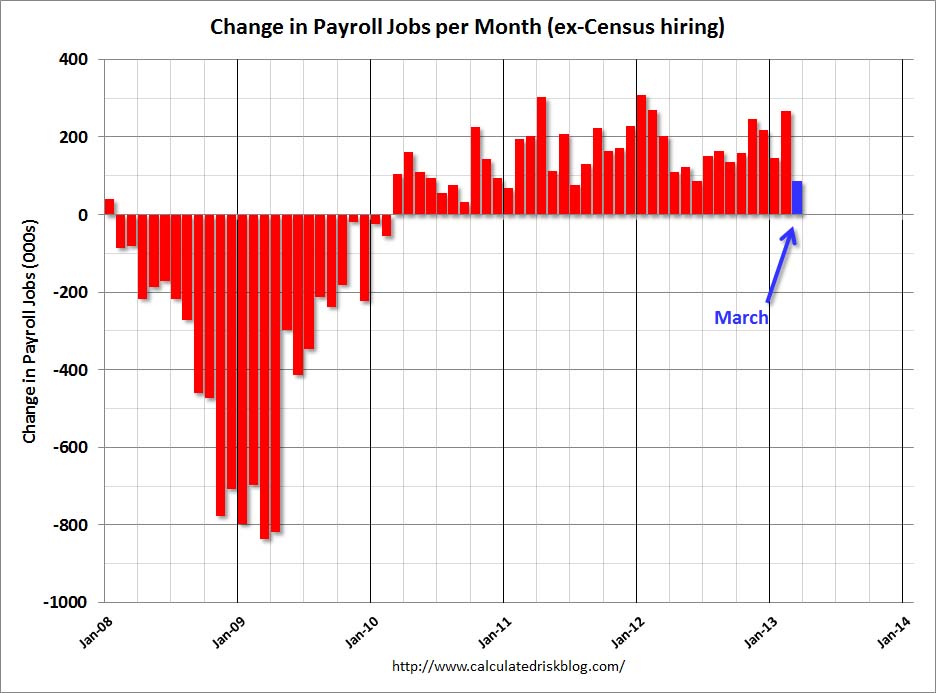
The 88,000 net jobs added in March, if that or a similar figure holds up through revisions, is a tragedy: Nearly four years into the economic recovery, with the unemployment rate still close to 8 percent, the nation recorded a month in which too few jobs were added to keep up with the growing American workforce (that number is more like 125,000). The headline read that the unemployment rate fell to 7.6 percent from 7.7 percent, but it was almost entirely for bad reasons. A whopping 496,000 people dropped out of the labor force, and 206,000 fewer people reported having a job, meaning that the proportion of Americans currently working actually ticked down, not up.

Kevin Drum makes the numbers look even worse:

The American economy added 88,000 new jobs last month, but about 90,000 of those jobs were needed just to keep up with population growth, so net job growth was actually slightly negative at -2,000 jobs. That’s terrible. It’s yet another spring swoon, but even earlier than usual. Ever since the end of the Great Recession we’ve been stuck in an odd pattern where employment growth looks promising in winter and then falls off a cliff in spring, but usually the dropoff doesn’t happen until April or May. We’re early this year.

Ryan Avent’s perspective:

[T]o some extent, this report simply drags expectations back to where they were early in the year, when it was anticipated that fiscal policy would meaningfully slow growth in the first half of the year but allow for an improvement later on. If surprisingly good numbers led some to believe that the American economy could shake cuts off without any effect, then perhaps they were a bit overoptimistic. Hopefully just a bit.

Tomasky fears that the worst is yet to come:

The sequester is not in these March numbers, the pros say. Too early. So that doesn’t necessarily augur well for April. Or May. There are going to be more job losses, particularly in the public sector. Good, you say? Question: How many public-sector jobs have been shed in the last three years? Answer is 648,000. That’s 18,000 every month. I don’t think this has ever happened since the birth of the welfare state, not under any Republican president or Democratic one.

Derek Thompson compares the stock market to the jobs market:

On Tuesday, the S&P 500 and the Dow closed at nominal all-time highs. Three days later, the Bureau of Labor Statistics reported that the economy added a shockingly low 88,000 jobs in March. How bad is 88K? Well, put it this way, we’re theoretically in the midst of an accelerating recovery, and 88K new jobs per month won’t get us back to full employment for another 20 years, or more. I suspect that this will be one of the defining national stories of 2013, and beyond: The big, sustained, and accelerating gap between the working opportunities of most Americans and the profits produced at the top.

And Krugman asks why Washington is focused on budget cuts.

(Chart from Calculated Risk)

A Different Sort Of Adulterer?

by Patrick Appel

Noah Millman compares Mark Sanford to other politicians who cheated on their wives:

We are willing to forgive our politicians for a multitude of private sins, because really what we care about is that we come first. They can treat their spouses and children abominably if we know that at the end of the day all they really care about is winning. Because to win they have to do what we want. Or at least convince us that they have.

But a man who might throw it all away because he’s convinced he’s finally found his soul mate? That doesn’t sound like an alpha dog people are going to want to follow slavishly. Nor does it sound like somebody ruthlessly determined to stay on the right side of his constituents. It sounds like somebody who can be overcome by emotion. It sounds almost . . . human.

Nate Cohn thinks that Sanford could cost the GOP an easy seat.

The Senate’s Evolution On Marriage Equality

by Patrick Appel

Nate Silver expects it to slow down:

[I]f the recent cavalcade of endorsements is caused in part by senators perceiving that same-sex marriage has potentially become the national majority position, endorsements will begin to decelerate once it has become unambiguously the majority stance. Some senators will continue to oppose it, either because it does not yet constitute a majority position in their states (like Senator Heidi Heitkamp of North Dakota, they may say it should be decided at the state level), or because they oppose it on moral grounds, or because they are more concerned about a primary challenge than the general election.

In other words, the past year or two has been a good time for senators to jump on the same-sex marriage bandwagon, and most of the stragglers (i.e., Democrats from blue or purple states) have been rounded up. The remaining senators who have not taken the opportunity yet may have good political reasons for it, and may wait some time before they do.

Meanwhile, National Journal names the five Republican senators most likely evolve on marriage equality.

The Novelization Of TV, Ctd

by Patrick Appel

Alyssa Rosenberg and Scott Meslow contrast HBO’s Game Of Thrones with its source material:

This embed is invalid


Alyssa further ponders the comparison over at her blog:

I absolutely agree that television shows can function like novels, in that they can tell long-arc stories, develop characters in a rich way, and play with large themes. But there are technological divides that separate what they can do. In a book, you can stay within the medium and flip back and forth if you don’t remember who a character is, or need to check back in on an event that happened previously. Increasingly, large books hold character guides and world maps. The entire universe of the story is there in a single volume. And that means you can throw an enormous amount of material at a reader. But in a television show, if the world gets big enough, you may need to venture outside of the medium to refresh yourself, whether you’re checking Wikipedia for a character name, switching disks to see an old scene, or skimming through Netflix to find the right moment. If you can’t remember something, you may have to break the spell.

Is Gun Control Doomed?

by Patrick Appel

Bouie takes the long view:

What’s important to remember is that most things in American politics are slow moving; even with a major, galvanizing event the pendulum won’t swing immediately in the other direction. It took more than a decade for “guns” to become an issue that cowed liberals and Democrats. Since 1994, when an activist position on gun control — remember the assault weapon ban? — helped cost Democrats the house, they began retreating from an issue that seemed like a political loser. After Al Gore’s gun position helped cost him New Hampshire, and with it the presidency, in 2000 and wedge cultural issues again benefitted Bush in 2004, Democrats became, pardon the pun, gun shy.

What we need to see with Sandy Hook and its aftermath isn’t whether it yields immediate legislation, but whether it helps build support for future political coalitions that actually have the power to secure new national gun laws.

The Foreign Correspondent Formula

by Patrick Appel

Shafer wishes North Korean coverage wasn’t so predictable:

Pyongyang reliably remains defiant; talks have resumed or been proposed, canceledor stalled, while a U.S. envoy seeks to lure the North back to those talks to restart the dialog; North Korea is bluffing, blustering, or is engaging in brinksmanship; tensions are grim, rising, or growing—but rarely reduced, probably because when tensions go down it doesn’t qualify for coverage; North Korea seeks recognitionrespect, or improved or restored relations, or to rejoin the international community, or increased ties to the West that will lead to understandingdeals with North Korea are sought; North Korea feels insulted and is isolated by but threatens the West; the Japanese consider the North Koreans “untrustworthy“; the West seeks positive signs or signals or messages in North Korean conduct but worries about its intentions; diplomats seek to resolvesolverespond toovercomedefuse, the brewingseriousreal crisis; the escalating confrontation remains dangerous; the stakes are high, but the standoff endures.

Your Creations Can Get You In Trouble

by Patrick Appel

Brendan Koerner profiles Alfred Anaya, who created hi-tech “traps,” hidden compartments in cars. Making traps, in and of itself, is not illegal, but Anaya is serving a more than 24 year sentence because some of his clients used his traps to transport drugs:

A common hacker refrain is that technology is always morally neutral. The culture’s libertarian ethos holds that creators shouldn’t be faulted if someone uses their gadget or hunk of code to cause harm; the people who build things are under no obligation to meddle in the affairs of the adults who consume their wares.

But Alfred Anaya’s case makes clear that the government rejects that permissive worldview. The technically savvy are on notice that they must be very careful about whom they deal with, since calculated ignorance of illegal activity is not an acceptable excuse. But at what point does a failure to be nosy edge into criminal conduct? In light of what happened to Anaya, that question is nearly impossible to answer.