We’re Failing The Long-Term Unemployed

by Patrick Appel

Suzy Khimm summarizes key parts of a new Brookings paper:

Three Princeton University economists found that only 11% of Americans who are long-term unemployed find steady, full-time work a year later, according to data from 2008 to 2012. What’s more, only 39% have found work at all during that year—even for a brief period of time, “highlighting that the long-term unemployed frequently are displaced soon after they gain reemployment,” the authors Alan Krueger, a former Obama economic adviser, Judd Cramer, and David Cho wrote in their paper.

What has happened to everyone else? Of those unemployed for six months or longer, about 30% are still looking for work and failing to find it a year later. But even more people have simply stopped looking for work altogether: 34% are no longer in the labor force, according to the paper presented at the Brookings Institute Thursday.

Danny Vinik wishes Congress would get serious about this problem:

This is the most frightening consequence of the Great Recession: working-age, able-bodied Americans who have given up. Instead of contributing to the economy, they will collect benefits from the government, such as Social Security Disability Insurance, for decades to come.

Congress can prevent this. On the supply side, unemployment benefits keep the long-term unemployed in the labor force by requiring them to continue searching for work if they want to collect unemployment. House Speaker John Boehner is blocking an extension of unemployment insurance for no legitimate reason. On the demand side, Congress could offer employers financial incentives—like a tax credit—for hiring the long-term unemployed. Even better, the government could set up a jobs program that targets the long-term unemployed. Neither side seems particularly eager for that.

Tyler Cowen considers the paper “evidence for a notion of zero marginal product workers”:

Furthermore, in my view (I am not speaking for the authors here), right now further inflation is as likely to harm as to help these individuals. To ask whether the Fed “should give up” on the long-term unemployed is a biased framing which is more likely to mislead us than anything else.

Ylan Q. Mui highlights another finding from the paper:

There is no sign that long-term unemployed will make a big career switch. Despite lots of discussion about retraining workers for jobs in fast-growing industries such as health care, they tend to find employment in the fields they know best.

Binyamin Appelbaum also notes the “striking evidence that few people are finding jobs in new industries”:

Professor Krueger and his colleagues draw the conclusion that government may be able to help. The authors write, “These results suggest that assisting unemployed workers to transition to expanding sectors of the economy, such as health care, professional and business services, and management, is a major challenge.” But if long-term unemployment is more common in industries recovering more slowly, because would-be workers are trapped in those industries, this too suggests that the problem may be economic rather than personal.

There is a way to resolve the question. Fiscal and monetary policy makers could try to help, and we could all see what happens.

Instead, the debate seems increasingly likely to remain purely academic, and the long-term unemployed permanently lost.

Deflating The Rand Paul Hype

by Patrick Appel

Kevin D. Williamson cuts Paul down to size:

Nearly every election cycle, a poll comes out suggesting that many Americans, and a big chunk of swing voters, think of themselves as “fiscally conservative but socially liberal,” and therefore possibly open to libertarian candidates who want to police the deficit but not your sex life. These voters are the political equivalent of people who describe themselves as “spiritual but not religious.” It’s basically an empty formulation to avoid picking a side or a fight; it’s shallow, but it sounds good. The problem, at least for Rand Paul, is that “fiscally conservative but socially liberal” is not a long way of saying “libertarian.” Paul’s libertarianism is intended to offer a little something for everybody, on the left and right—spending cuts for the Republican base, legal relief for potheads, a presidential pat on the head for gay people. But if he gets serious about substantive reform along these lines, his libertarianism is instead going to offer something to outrage everybody.

Jonathan Bernstein predicts that Paul will lose in the primaries:

Think Paul has a chance? Then either convince me that he’s acceptable to the Republicans who support the policies he opposes – or show me that those people have little clout. He can win only if one of the above is true. These days, you can’t be nominated by accident.

Obama Lowers The Boom On Russia, Ctd

by Patrick Appel

Ioffe sizes up the sanctions announced yesterday:

These sanctions will not just ban travel to the U.S. or freeze assets (most of which these guys keep in Europe and in various tax shelters around the world), but will effectively bar them from participation in the world financial system. That is going to sting and it’s going to hurt, and it’s going to hurt in the exact right places. Sources inside the administration say that Europe’s list of sanctions, which is forthcoming, overlaps very significantly with the American one. The administration is also discussing whether to distribute the sanctions to family members, given that these men officially may own very little themselves, but have stashed their wealth in shell companies, and wives and children who function as shell companies. But just having a last name that’s on the U.S. Treasury sanctions list may be hurt enough. And, as the White House has emphasized repeatedly, this is only the beginning.

But there are people who are not on the list who are already cringing at the anticipation of the blow: Russian liberals. They were largely horrified by their country’s invasion of Ukraine and are happy to see Putin’s cronies punished by the West, but they know that the Kremlin, unable to lash out at Washington, will take its fury out on them.

Bershidsky doubts Europe’s sanctions will be as harsh as America’s:

Most of the Putin cronies on the list have known assets in Europe and Caribbean offshore areas. They will suffer serious damage only if the European Union puts them on its list of sanctioned individuals — which is doubtful because of the U.K.’s desire to avoid damage to London banks and the city’s reputation as an international financial center. The U.S. sanctions are also designed to cause minimum economic damage: They don’t touch Russia’s major government-owned companies, such as Gazprom or Rosneft, headed by long-time Putin associate Igor Sechin. Keeping them out of the U.S. would be a heavy blow.

The sanctions’ intent is easily readable to Putin. Even if he is not as close to the men on the list as their history and the government contract breakdown suggest, he will know Obama wanted to strike at those who are, to the best of his knowledge, his best friends, possibly even the keepers of his personal fortune.

Charlemagne also looks at Europe’s response:

In the bureaucratic jargon of Brussels, the annexation of Crimea merits only “Stage 2” sanctions: visa bans, asset freezes and political wrist-slapping. The latter includes suspending G8 meetings, halting formal bilateral summits and stopping negotiations on Russia’s membership of the OECD, a rich-world think-tank, and the International Energy Agency. Stage 3 sanctions, comprising unspecified “far-reaching consequences for relations on a broad range of economic areas”, would be triggered by further Russian actions “to destabilise the situation in Ukraine”.

Larison asks about the purpose of America’s sanctions:

One thing that the administration should have also learned by now is that it gets little or no credit from its critics for its hawkish measures, and most of its critics will continue to condemn its response as “weak” no matter what it does. It won’t matter to those critics how much the U.S. tries to punish Russia, because it will never be seen as good enough. Meanwhile, punitive measures can inflict damage on Russia, but there is no good reason to believe that sanctions will ever cause it to change its behavior in the way that Washington wants. Punitive measures have to be aimed at forcing Russia to give up Crimea, and if they’re not then they don’t serve much of a purpose other than riling Moscow and provoking retaliation. Since that goal seems entirely fanciful, what are these punitive measures supposed to be achieving?

Anne Applebaum calls the new sanctions “only a signal”:

Far more important, now, are the deeper strategic changes that should flow from our new understanding of Russia. We need to reimagine NATO, to move its forces from Germany to the alliance’s eastern borders. We need to re-examine the presence of Russian money in international financial markets, given that so much “private” Russian money is in fact controlled by the state. We need to look again at our tax shelters and money-laundering laws, given that Russia uses corruption as a tool of foreign policy. Above all we need to examine the West’s energy strategy, given that Russia’s oil and gas assets are also used to manipulate European politics and politicians, and find ways to reduce our dependence.

The GOP Votes As One

by Patrick Appel
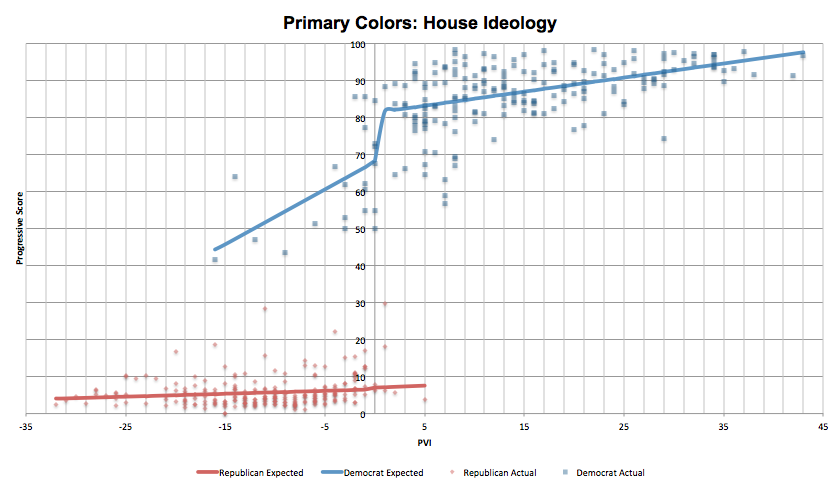
Primary Colors

Ryan O’Donnell explains the above chart, which shows the relationship between political districts’ ideology and their representatives’ votes:

Obviously we’d expect Democratic politicians to vote more conservative the more conservative their district gets, and more liberal the more liberal their district gets. And by-and-large, they do. But Republicans don’t really follow that trend, as you can see in red on the graph [above] … If you only take away one thing from this graph, it should be that the expected value for Republicans is nearly a perfect horizontal line. Translated into plain English, that means Republicans vote conservative almost no matter what. It doesn’t matter what type of districts they represent.

The lesson Matt Steinglass draws from this:

This doesn’t predict what might happen if Republicans gained control of the Senate, or of the presidency. It’s possible that with more power Republicans would feel freer to disagree with each other. With their backs to the wall, out-of-power Democrats might feel the need to present a more united front. But basically Democrats have less voting discipline than Republicans. …

In other words, if all else fails, the gridlock of the American government will probably end the next time the country elects a Republican president, since Republican legislators have the discipline to stonewall Democratic presidents while Democrats are more willing to compromise. That asymmetry is probably infuriating to Democrats, but unless their legislators adopt different voting behaviour, it’s not going to change.

A Case Of Technophobia

by Patrick Appel

David Blumenthal explains why the health care industry hasn’t embraced digital medical records:

The reason why the medical profession has been so slow to adopt technology at the point of contact with patients is that there is an asymmetry of benefits. From the patient’s perspective, this is a no-brainer. The benefits are substantial. But from the provider’s perspective, there are substantial costs in setting up and using the systems.

Until now, providers haven’t recovered those costs, either in payment or in increased satisfaction, or in any other way. Ultimately, there are of course benefits to the professional as well. It’s beyond question that you become a better physician, a better nurse, a better manager when you have the digital data at your fingertips. But the costs are considerable, and they have fallen on people who have no economic incentive to make the transition. The benefits of a more efficient practice largely accrue to people paying the bills. The way economists would describe this is that the medical marketplace is broken.

Richard Gunderman provides another perspective:

[Dr. Paul] Weygandt [a VP at a medical communications firm] believes that contemporary medicine has allowed too many intermediaries—financing, technology, and the way practices are structured—to come between patients and doctors. Too much time is focused on generating revenue rather than quality. Too many technological systems are built in ways that make sense to computer engineers but not to doctors. And too much time is spent pointing and clicking rather than capturing the essence of a patient’s story.

What can be done? Weygandt argues that doctors need to play a more active role in all aspects of healthcare’s future, not just implementing but also designing it. Too often, such decisions are currently being made by people who do not take care of patients, and in many cases, have never cared for patients.

Creative Sparks

by Patrick Appel

Sterns 2

How Phillip Sterns describes his series, High Voltage Image Making:

Through the application of high voltage and various chemical agents, this project explores and extends the expressive capacity of instant photographic film technology beyond its ability to capture images of the world. These treatments approach the film technology as a recording media, capable of creating images from physical, electrical, and chemical transformations.

Joseph Flaherty provides more details on the process:

The light from the sparks accounts for some of the bluish colors in the background of the shots, but the electrical “tree” structures, technically called Lichtenberg figures, are created when the electricity vaporizes the silver halides embedded in the film. Stearns adds blooms of chemical color to the compositions by pouring liquids like bleach, vinegar, hydrogen peroxide and rubbing alcohol onto the film and arcing electricity through them. Electrified bleach, for instance, reacts with dyes to produce some nice yellow and magenta hues.

More images of Sterns’s work herehere, and here. You can help fund Sterns’s work through his Kickstarter.

The Bigot Everyone Loved To Hate

by Patrick Appel

Westboro Baptist Church Case to be Heard by Supreme Court

Matt Sigl calls Fred Phelps “a great friend to the gay rights movement”:

In his outrageous lunacy, his relentless desire for media attention, and the purity of his hatefulness, Phelps did something that the gay rights movement couldn’t accomplish on its own: expose the utter depravity and heartlessness of homophobia. … Phelps probably secretly troubled the pious and faithful more than he ever got underneath any homosexual’s skin, for in him the conservative Christian had to confront just what God really thought of homosexuals after all. The subject is not a pleasant one for many leading religious leaders; just watch the milquetoast Joel Osteen wince when forced to comment on it. Or Cardinal Dolan for that matter.

Alyssa Rosenberg is on the same page:

[A]s the gay rights movement has worked to define lesbian, gay, and bisexual Americans as people who want the same things as their heterosexual counterparts, including marriage and family stability, Fred Phelps and his followers gave organizers a perfect image to organize in opposition to. If Americans had to choose between getting comfortable with the idea of homosexuality or being seen as extreme, hateful, and rude, in increasing numbers, they seem to be choosing the former. Fred Phelps has caused many people enormous amounts of agony. But in doing so, he played a critical role in defining the choice between hatred and acceptance, and in accidentally expanding the tolerance of the very people he feared so much.

Jay Michaelson adds:

As symbol, Phelps was the reductio ad absurdum of many conservative beliefs. Tea Partiers think Obama is a socialist, Birthers think he’s a Kenyan, and Phelps said he was the antichrist. Tea Partiers think America has lost its way, Glenn Beck thinks it’s time for revolution, and Phelps said America will be destroyed by God for losing its moral grounding.

Erica Cook is against cheering Phelps’s death:

This is the chance to show the world how we are better people. We aren’t people who make the death of a man the reason to celebrate, no matter who that man is. We are the better people. And no matter who he is to us, he was someone’s father, grandfather, brother, and uncle. We may still be fighting against them, but today they need the respect they didn’t have the capacity to give when it was us. If we act in any way other than respectful we become no better than them. In stooping to that we relinquish the right to call what they do wrong.

Russell Saunders is declares to “hell with all that”:

Fred Phelps was a blight.  He was a receptacle for the absolute worst, most despicable kind of hatred humanity is capable of producing.  The god of his imagining was a demon of bile, and his appearance before the public eye was a festering sore.

I do not regret the happiness I feel knowing I no longer share an oxygen supply with him.  I do not believe in the existence of a hell, even for the likes of people like him.  If there is a judgment that awaits him, let his loved ones hope it is before a judge more merciful than the one he worshiped.

Richard Kim unpacks Phelps’s worldview:

Especially in recent years, he possessed almost no followers, no influence, no allies. What distinguishes him from any other raving street-corner prophet is the simple-mindedness of his message. In the place of the modern religious emphasis on God’s love, Phelps ranted on about God’s hate—for fags, for America, for Muslims, for Catholics, gun massacre victims and US troops. If American exceptionalism is in some way an attempt to sacralize the profane (America is blessed, its soliders and citizens blessed), Phelps merely reversed polarities, swapping in eternal damnation. It was a juvenile substitution. And to discuss Phelps as if he were a morally vexing and profound evil is to dignify him with a complexity he lacked. His hatred was banal.

Tom Junod met the Westboro Baptist Church clan once:

I don’t remember anything they said. What I do remember was how their children looked, and the keen and nearly overwhelming sense of loss the appearance of their children elicited. There were so many of them, for one thing; the Westboro congregation turned out to be a young one, and even some of the lank-haired women holding signs and spitting epithets turned out be, on closer inspection, teenagers. And they were all so poor. I’m not speaking simply of their clothes, and their teeth, and their grammar, or any of the other markers of class in America. I’m speaking of their poverty of spirit. Whether they were sixteen or six, they looked to be already exhausted, already depleted, with greasy hair, dirty faces, and circles under their eyes that had already hardened into purplish dents. They looked as if they were far from home, and didn’t know where they were going next. They looked, in truth, not just poorly taken care of, but abused, if not physically then by a belief inimical to childhood—the belief that to be alive is to hate and be hated.

Dave Weigel notes the relationship Phelps had with the media:

We can agree on this: He was hilariously stupid, and stupid people provide good copy. For a generation, ever since his flamboyant “God Hates Fags” signs went viral (before there was even a modern Internet for things to go viral on), journalists would explore Phelps’ sad little world and bait him.

David Von Drehle wishes Westboro hadn’t gotten so much coverage:

As a reporter and editor in some big newsrooms over the past 30 years, I watched as one journalist after another took Phelps’s bait, then tried to spit out the hook once the dishonesty and shabbiness of the man’s enterprise grew clear. You could fill a gymnasium with the scribes who swore off coverage of Westboro over the years. The only problem was, new and naïve reporters were being minted all the time, ready to believe that Phelps represented some larger darkness beyond the pit of his own person.

Donald McCarthy joins the conversation:

When even Rush Limbaugh rejects the group, you know it’s a rather pathetic target to take on. At this point, saying you hate the Westboro Baptist Church is about as easy as saying you hate the Ku Klux Klan; not exactly a profound statement worthy of approval. A blasting of the WBC is the equivalent of a late night talk show host joking about Kim Kardashian.

The WBC is a target that makes everyone feel good and allows them to ignore mainstream religions’ homophobic tendencies that are more subtle than the signs the WBC members hold. It’s great that the church has provided such a horrible face for homophobia that people now balk from homophobia much more than they used to, but at some point the group’s exposure helps them infinitely more than it helps society.

Scott Shackford hopes the media will finally stop paying attention to the Phelps family:

[T]he death of Fred Phelps probably won’t result in any changes from the family, but it’s a good excuse for the rest of us to move on. I’m sure that right now some dreadful editorial cartoonist is sketching Phelps being met at the pearly gates by all the soldiers his family picketed. It’s true that the solution for bad speech is more speech. But the solution to crazy obsession is not becoming obsessed right back at them. Stop picking at this scab.

(Photo: Fred Phelps, former leader of the Westboro Baptist Church in Topeka, KS. By Michael S. Williamson/The Washington Post via Getty Images)

Refusing To Treat The Unvaccinated

by Patrick Appel

Sydney Spiesel considers the choice that pediatricians like him face when dealing with anti-vaxxers:

What do we do about vaccine refusers? It’s a difficult question. If we don’t allow unimmunized kids in our practice, where will they get medical care? That’s the reason that many (though I’m not sure how many) pediatricians allow unimmunized kids in their practice. But others refuse to see any patients whose parents won’t vaccinate them.

Spiesel’s stance:

Personally, I draw the line at vaccines protecting against diseases that kids might catch from exposures in my office.

If parents want to withhold protection from hepatitis B or cervical and oral cancer, I think it’s not so smart, but I’ll still care for their children because not even the friskiest teen is likely to transmit these diseases in my office. MeaslesWhooping cough? These are another matter. My sense of responsibility to the health of the vast majority of kids coming to see me says “no.”

I didn’t come to this decision easily. After all, it’s the parents, not the children, who make the choice to avoid vaccines—what is my responsibility to those kids? Maybe I’m deluding myself, but I sort of believe that my clear policy may be beneficial to them, too. It’s a statement of how important I think immunization is (and why I think so). It encourages families to think about responsibility to others in the community. And it sometimes provokes people to rethink the question. (I’ve had families who left my practice because of my policy, but later came back, perhaps in spite of it—or perhaps, finally, because of it.)

Recent Dish on anti-vaxxers here.

Pinning The Blame On Black Culture

by Patrick Appel

Last week, the left pounced on Paul Ryan for saying that we “have got this tailspin of culture, in our inner cities in particular, of men not working and just generations of men not even thinking about working or learning the value and the culture of work.” TNC asks why only Ryan was called out:

What Ryan said here is not very far from what Bill CosbyMichael Nutter, Bill Clinton, and Barack Obama said before him. The idea that poor people living in the inner city, and particularly black men, are “not holding up their end of the deal” as Cosby put it, is not terribly original or even, these days, right-wing. From the president on down there is an accepted belief in America—black and white—that African-American people, and African-American men, in particular, are lacking in the virtues in family, hard work, and citizenship … From what I can tell, the major substantive difference between Ryan and Obama is that Obama’s actual policy agenda regarding black America is serious, and Ryan’s isn’t. But Ryan’s point—that the a pathological culture has taken root among an alarming portion of black people—is basically accepted by many progressives today. And it’s been accepted for a long time.

Chait counters:

Coates treats the cultural explanation for African-American poverty and the structural explanation as mutually exclusive.

“I can’t think of a single credible historian of our 500-year tenure here,” he writes, “who has concluded that our problem was a lack of ‘personal responsibility.’” Not even Paul Ryan, whom Coates argued yesterday holds similar views to President Obama on this issue, believes personal responsibility is the singular, root cause of the African-American predicament. The argument is that structural conditions shape culture, and culture, in turn, can take on a life of its own independent of the forces that created it. It would be bizarre to imagine that centuries of slavery, followed by systematic terrorism, segregation, discrimination, a legacy wealth gap, and so on did not leave a cultural residue that itself became an impediment to success. ….

Coates is committing a fallacy by assuming that Obama’s exhortations to the black community amount to a belief that personal responsibility accounts for a major share of the blame. A person worries about the things that he can control. If I’m watching a basketball game in which the officials are systematically favoring one team over another (let’s call them Team A and Team Duke) as an analyst, the officiating bias may be my central concern. But if I’m coaching Team A, I’d tell my players to ignore the biased officiating. Indeed, I’d be concerned the bias would either discourage them or make them lash out, and would urge them to overcome it. That’s not the same as denying bias. It’s a sensible practice of encouraging people to concentrate on the things they can control.

Stacking The Deck Against 538

by Patrick Appel

Leon Wieseltier attacks Nate Silver’s new site:

Many of the issues that we debate are not issues of fact but issues of value. There is no numerical answer to the question of whether men should be allowed to marry men, and the question of whether the government should help the weak, and the question of whether we should intervene against genocide. And so the intimidation by quantification practiced by Silver and the other data mullahs must be resisted. Up with the facts! Down with the cult of facts!

An opinion with a justification may be described as a belief. The justification that transforms an opinion into a belief may in some instances be empirical, but in many instances, in the morally and philosophically significant instances, it will not be empirical, it will be rational, achieved in the establishment of the truth of concepts or ideas by the methods of argument and the interpretation of experience. A certain kind of journalistic commentary, when it is done rightly, is a popular version of the same project, an application of thoughtfully (and sometimes wittily) held principles to public affairs, and is therefore an essential service to a free society. The intellectual predispositions that Silver ridicules as “priors” are nothing more than beliefs. What is so sinister about beliefs? He should be a little more wary of scorning them, even in degraded form: without beliefs we are nothing but data, himself included, and we deserve to be considered not only from the standpoint of our manipulability. I am sorry that he finds George Will and Paul Krugman repetitious, but should they revise their beliefs so as not to bore him? Repetition is one of the essential instruments of persuasion, and persuasion is one of the essential activities of a democracy.

Michael Brendan Dougherty sticks up for Silver:

Wieseltier’s form of critique has been paraphrased elsewhere: Numbers can’t tell us everything. They cannot tell us what kind of policies we should have. They cannot tell us what to love or hate or aim for in life. This is a truism pretending to contradict something.

When Silver writes, “We’re trying to just do analysis. We’re not trying to sway public opinion on anything except trying to make them more numerate,” he is obviously defining the limited scope of his website’s mission; he is not revising downward the entirety of worthy human knowledge, judgment, and endeavor. Silver writes, “Our methods are not meant to replace ‘traditional’ or conventional journalism. We have the utmost admiration for journalists who gather original information and report original stories.”

Somehow after reading this “aw-shucks” manifesto in which Silver rather self-deprecatingly defines a niche for his site, Wieseltier has in his mind a totalitarian threat. Shortly thereafter he commands his readers to resist the “intimidation by quantification” by Silver and other “data mullahs.”

When FiveThirtyEight authors start writing articles titled “Math Wants Us to Commit Genocide,” then I’ll worry about them exceeding their intellectual remit. Until then, it seems long overdue that in a media world overpopulated with fluff projectsideological anvil-pounders, outrage porn, and a million and one precious niches, one little corner would dedicate itself to numerical investigation, train some of its journalists in statistical programming languages, and run some data visualizations.

Jon Fasman piles on:

The unspoken attitude underpinning Mr Silver’s project—I will lay the facts as I understand them before you, explain why I think the facts matter, show you where I think they lead, and leave you to your own conclusions—surely is preferable to the unspoken attitude underpinning much American political discourse, which is: My opponents are imbeciles or racists who hate freedom and decency, and if you agree with them surely you must also be mentally deficient and hate the same things.

Second, some things that present themselves as moral questions are not, and are (or should be) amenable to factual suasion. There is, in fact, a near-total consensus among scientists that climate change is happening and is “unpredictable” and “highly damaging”. Many people deny this. Best to lay the facts before them, over and over again.

Krugman fears that 538 will commit the error of “letting the data speak for itself — because it never does.” Matt Bruenig shares those concerns:

It is a bit early to say whether Silver’s project will actually be worthwhile. With that said, people should be skeptical of anyone who says they can cover politics in a just-the-facts, data-driven way (and I say this as someone who heavily relies upon data crunching, probably more so than 95% of political writers). There are political and economic topics for which pure data is interesting and illuminating, but not very many. The rest are deeply entangled with normative judgments that you cannot avoid.

Perusing the site as it currently exists, things don’t look very promising at this very early stage.

Not every 538 post has been up to snuff, but the site’s batting average is respectable for a blog that just increased its staff significantly. It takes months for an editorial team to gel. And Silver’s analysis has always capitalized on big events; a relatively slow political news week probably isn’t the best time to size up the new 538’s editorial chops. Note that Silver himself has focused mostly on March Madness this week, a big story that the political blogosphere is relatively uninterested in and therefore gives him no credit for covering well. The greatest danger to any data-driven site is being too dull. The 538 crew has avoided that thus far by having fun with the content – applying data analysis to subjects like toilet seat covers. And this post on Hugo Chavez’s economic legacy was excellent. Drum worries that Silver’s model won’t scale:

My basic take is that Silver’s data-driven approach to journalism works well with subjects that satisfy two criteria:

  1. They lend themselves to analysis via number crunching.
  2. They are currently underserved by serious number crunchers.

Both sports and poll aggregation fit this model, and Silver made a reputation with both of them. But they’re the exceptions, not the rule. Economics? It doesn’t satisfy #2. Science? Ditto. “Life”? That’s a pretty broad category, but I suspect it mostly fails #1.

Alyssa Rosenberg, writing at her new digs, disagrees about that last point:

While I am not persuaded that data analysis is a substitute for criticism, there are an enormous number of subjects that fall under “Life” where data-driven journalism would actually be a profound public service. The entertainment industry holds up as sacred any number of assumptions that deserve a rigorous, numbers-based fisking, among them that female leads cannot carry movies and that international audiences dislike black actors (Will Smith and Denzel Washington are treated like, dare I say it, magical exceptions to an otherwise hard rule). In television, as the Nielsen ratings increasingly fail to capture Americans’ actual viewing patterns, a deep dive into those practices and the TV ad sales business that returns to the surface with viable suggestions for a new measurement that advertisers would trust and outside analysts could deliver would be high-level service journalism.