What’s Russia’s Next Target?

by Patrick Appel

Daniel Berman eyes Estonia:

Putin needs three things in a target at this point. First it needs to be of less strategic value than the Crimea so that the arguments for fighting for it are even less. Second it needs to be politically vital, preferably as part of both NATO and the EU so that if the West chooses not to fight for it both organizations will be shattered. Thirdly, Russia’s moral case must be so impeccable that in the game of political chess that will precede the Western defeat, Russia at all times maintains at least a moral deadlock if not a moral ascendancy. In effect, he needs an Eastern European Verdun.

Estonia meets all of these criteria.

It is poor and geographically isolated. Furthermore, more than a third of its population is Russian, a legacy of Soviet rule, and that minority, unlike that in the Crimea, has legitimate cause for complaint. … Estonia is a member of both the EU and NATO. If Russia is able to stir up chaos in the form of riots and unrest within a member of both organizations it will discredit them totally. It makes no sense for Europe to risk destruction to defend Estonia, less than it did over the Ukraine, but the EU and NATO are based on the lie that an attack on one is an attack on all. Putin’s goal is to exploit this as a lie; Estonia is Verdun, a strategically worthless target that political factors forced the French army to defend to the death. In this case its Putin’s goal to draw NATO and the EU into a battle not of armies, but of political capital, and to destroy that capital in the open fields of the Baltic shore.

Andrew Connelly instead selects Moldova as possibly the “next Crimea”:

In November 2013, the country signed an association agreement with the European Union—the same treaty that led to Yanukovych’s downfall in Ukraine. Moldova is considered poor even in comparison to neighboring Romania and Bulgaria, and with the average Moldovan currently taking home around $200 per month, access to EU markets could be a huge boon. Moldova is home to the largest wine cellars in the world and exports around 3 million bottles to Russia each year, though after Chisnau’s flirtations with the EU last year, Moscow jealously banned their import. Gas is exclusively imported from Russia and hence vulnerable to politically motivated disruptions.
Why Did Russia Lash Out?

by Patrick Appel

Timothy Frye focuses on economic issues:

One big question is whether the anticipation of a slowing economy and lower personal popularity in the future will make Russia more likely to repeat a Crimean scenario in Eastern Ukraine, Transdniestr, Kazakhstan or the Baltics as a way to divert attention from deeper problems or whether these negative trends would moderate Russian foreign policy.  Empirical support for the diversionary theory of war is mixed at best, but this is a question that bears watching.  It also bears remembering that while attention is focused on President Putin’s skyrocketing approval ratings and his triumphant speech in Moscow, events in Crimea will likely divert Russia from addressing its most important problems.

Sarah Sloat uses psychology to explain Putin’s recent behavior:

Earlier this month, NPR’s Shankar Vedantam floated the idea that something called “prospect theory” could explain Russian President Vladimir Putin’s invasion of Crimea. A behavioral economic model developed in the late 1970’s, the theory states that people are more cautious when they have the upper hand and riskier when they don’t. If this indeed explains Putin’s actions, it would mean he perceives Russia as losing power in the world, and is willing to take risks—like annexing Crimea, and perhaps even more of Ukraine—to recover what his nation once lost.

An Obamacare Price Hike?

by Patrick Appel

Elise Viebeck warns of one:

Health industry officials say ObamaCare-related premiums will double in some parts of the country, countering claims recently made by the administration….” … I think everybody knows that the way the exchange has rolled out … is going to lead to higher costs,” said one senior insurance executive who requested anonymity. The insurance official, who hails from a populous swing state, said his company expects to triple its rates next year on the ObamaCare exchange.

Cohn throws cold water:

As usual, the real news here is more complicated and ambiguous.

The possibility of higher-than-normal rate increases in some parts of the country is real enough, for several reasons. Chief among them: Insurance companies may have expected a better mix of beneficiaries—in other words, more healthy people and fewer sicker ones. If so, the companies could discover that the premiums they set for this year are too low to cover the medical bills they must pay to doctors, hospitals, pharmacies, and the like. If that happens, the insurers could respond by raising premiums next year, perhaps substantially. Serious, honest people are worried about this scenario unfolding, based in part on rumblings they are picking up from within the insurance industry. “There is extensive concern about rate increases next year,” Caroline Pearson, vice president of Avalere Health, told the Fiscal Times. “Particularly since exchange enrollment is skewed toward older enrollees, some are concerned that plans will need to raise prices in 2015.”

But as Pearson also pointed out—and as all the “could”s and “if”s in the above paragraph imply—nobody really knows what’s going to happen.

Mcardle is somewhat skeptical of Viebeck’s report:

Insurance executives have every incentive to be as alarmist as possible. The administration and the insurers are now engaged in a lengthy negotiation about what you might call “The Obamacare Exchange Rescue Package of 2014.” In response to public outcry, the administration has made a bunch of changes to the rules — allowing people with “grandfathered” plans, for instance, to keep their policies. Those rule changes are going to cost the insurers a considerable sum. So the administration is proposing more rule changes, this time to funnel money to the insurers.

The insurance industry would like the funnel to be as big as possible. One way to encourage this is to tell reporters that you’re planning to triple policy premiums in “a populous swing state” — during an election year.

Obama Lowers The Boom On Russia

by Patrick Appel

https://twitter.com/b_judah/status/446684476807340032

https://twitter.com/Max_Fisher/status/446669982127366144

Today Obama announced new sanctions:

President Obama took new steps Thursday to intensify the economic isolation of Russia following its “illegal” annexation of Crimea, which could have a “significant impact on the Russian economy,” the president said. Speaking from the White House on Thursday, Obama said the U.S. will move “to impose sanctions not just on individuals but on key sectors of the Russian economy.” Senior White House officials say the sanctions will apply to 20 senior members of the Russian government and other “cronies.” They will also apply to St. Petersburg-based Rossiya Bank, which will be “frozen out of the dollar,” making it difficult for the institution to operate internationally.

The sanctions will target Russia’s financial services, energy, mining, and engineering sectors, officials said Thursday.

Miriam Elder thinks the sanctions have teeth:

The first round of sanctions announced by Obama on Monday was symbolic but ultimately toothless, targeting people with big mystiques but little power in today’s Kremlin … These sanctions are different. They hit as close to Putin without targeting the man himself. There are a couple notable absences from the list — Alexei Miller, the CEO of Gazprom, and, more importantly, Igor Sechin, the CEO of the state oil company Rosneft and one of Putin’s hardline advisors. But by reaching to his favorite oligarchs, the U.S. has hit Putin where it hurts. There’s a reason most outside Russia have never heard of these people — in Russia those with the real power stay in the shadows.

Drum expects “we’ll quickly get a pro forma response about how weak and vacillating this is from Bill Kristol, John McCain, and Charles Krauthammer.” Prior to the sanctions announcement, Fred Kaplan put America’s spat with Russia in perspective:

What’s going on now is not Cold War II.

The Cold War split the entire world in two factions. Scads of civil wars, regional wars, and wars of national liberation were, in some sense, “proxy wars” in the titanic struggle between the United States and the Soviet Union. China was used as a lever for playing one side off the other—and China played off both. Nothing like that is going on now. Nothing like it could possibly go on now. Neither side has the leverage to do it. Russia has no global reach whatsoever. Russia has no support for its actions in Ukraine; China has evinced no interest in it.

Right now, then, this is at most a regional conflict, not a global one, and the best thing that Obama can do—in both his threats and his inducements—is to keep it that way. Certain Republicans on Capitol Hill could help. Senators like John McCain and Lindsey Graham, who used to know better, could lay off their absurd yelping about Obama’s “weakness” and “feckless leadership.” For one thing, it’s not true; at least when it comes to this crisis, they’ve recommended very few steps that Obama hasn’t already taken. If they’re really worried about Putin’s perceptions of America, instead of merely clamoring to make political points with GOP extremists, they should stand by the president and make sure Putin understands that, on this issue, there are no domestic fissures for him to exploit.

Russia also sanctioned US officials today:

The Russian response has been received as less potent than the new U.S. sanctions. The United States announced a round of sanctions targeting officials and oligarchs with close ties to Putin as well as Bank Rossiya — individuals and entities that many Russia watchers never expected to be hit with sanctions.

Egypt Is Still Smoldering

by Patrick Appel

Eric Trager covers the Muslim Brotherhood’s “campaign of lower-profile violence against various governmental and civilian targets, aiming to stir chaos and thereby weaken the post-Morsi regime”:

This low-profile violence will likely to continue indefinitely and worsen, because young Muslim Brothers are unlikely to find other, more formal, avenues for advancing their ideology anytime soon. Egypt’s military-backed government fears that permitting the Brotherhood to participate politically will enable it to return to power and seek vengeance, and by the same token Muslim Brothers are unwilling to participate in the current transition and thereby accept Morsi’s ouster. The most likely outcome, at least in the short-run, is thus a desperately unpleasant stalemate: The Brotherhood cannot beat the post-Morsi regime through its current strategy, nor can the regime achieve anything approximating stability.

Pot Polling Update

by Patrick Appel

Colorado doesn’t regret legalization:

Two months after legal marijuana sales began in Colorado, its legalization has become more popular in the state. 57% of Colorado voters now say they think marijuana usage should be legal to only 35% who think it should be illegal. That 22 point margin in support represents an increase since the November 2012 legalization ballot measure that passed by 10 points with voters in the state.

Jon Walker adds his two cents:

The results are very similar to the Quinnipiac poll from February which also found support for legalization edging up since implementation. It would seem that once voters get a firsthand experience with legalization and realize the sky hasn’t fallen they become more supportive.

A Search Engine With A Bug

by Patrick Appel

Google Flue Trends

According to a recent report, Google Flu Trends has major problems:

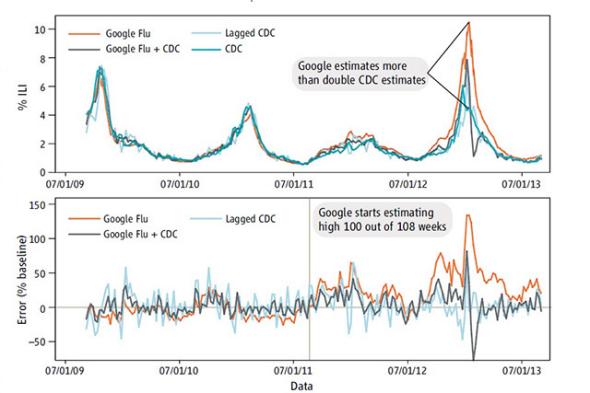
Flu Trends has gotten it badly wrong in at least two cases. The reason for these errors is remarkably simple: the flu was in the news, and people were therefore more interested and/or concerned about its symptoms. Use of the key search terms rose, and, at some points, Google Flu Trends predicted double the number of infected people than were later revealed to exist by the Centers for Disease Control data. (One of these cases was the global pandemic of 2009; the second an early and virulent start to the season in 2013.)

On its own, this isn’t especially damning. But the authors note that flu trends have consistently overestimated actual cases, estimating high in 93 percent of the weeks in one two-year period. You can do just as well by taking the lagging CDC data and putting it into a model that contains information about past flu dynamics. And, unlike the Flu Trends algorithm, they point out that this sort of model can be improved.

David Auerbach takes Google to task:

One of the main problems is that Google’s data is private—very private. Google does not release its raw data or the details of its analyses or even the set of keywords it uses for a particular result. This makes the studies impossible to replicate or check . . . Even if Google’s methodology is perfect—and there’s reason to believe it’s not—there needs to be validation. Here Google’s corporate and research agendas come into conflict: If it wants credit for scientific research, it needs to show its work, even at the cost of compromising competitive advantage.

But the project can be salvaged:

As a test, the researchers created a model that combined Google Flu Trends data (which is essentially real-time, but potentially inaccurate) with two-week old CDC data (which is dated, because it takes time to collect, but could still be somewhat indicative of current flu rates). Their hybrid matched the actual and current flu data much more closely than Google Flu Trends alone, and presented a way of getting this information much faster than waiting two weeks for the conventional data.

“Our analysis of Google Flu demonstrates that the best results come from combining information and techniques from both sources,” Ryan Kennedy, a University of Houston political science professor and co-author, said in a press statement. “Instead of talking about a ‘big data revolution,’ we should be discussing an ‘all data revolution.'”

Vegas Hits A Dry Spell

by Patrick Appel

Statewide Drought Forces Californians To Take Drastic Measures For Water Conversation

Eric Holthaus checks in on the Sin City’s water supply:

The driest city in America still uses more water per capita than just about any other city in the country. This despite years of steady efficiency improvements and the resounding success of its “cash for grass” program that pays residents for each square foot of lawn they rip out and replace with rocks. Front lawns are now illegal in Las Vegas, yet verdant golf courses are still commonplace. About 70 percent of the city’s nearly maxed-out water diversion from Lake Mead still goes to landscaping.

Don’t get me wrong: The city has made major improvements in water efficiency, using about 40 percent less water per person over the past 25 years or so. The problem is the city’s population has tripled over that same time, and total water usage is up (though down from its peak about a decade ago—an improvement due at least partially to the economic downturn). It’s like a one-ton man patting himself on the back for losing 400 pounds. Great news, but there’s still a long way to go.

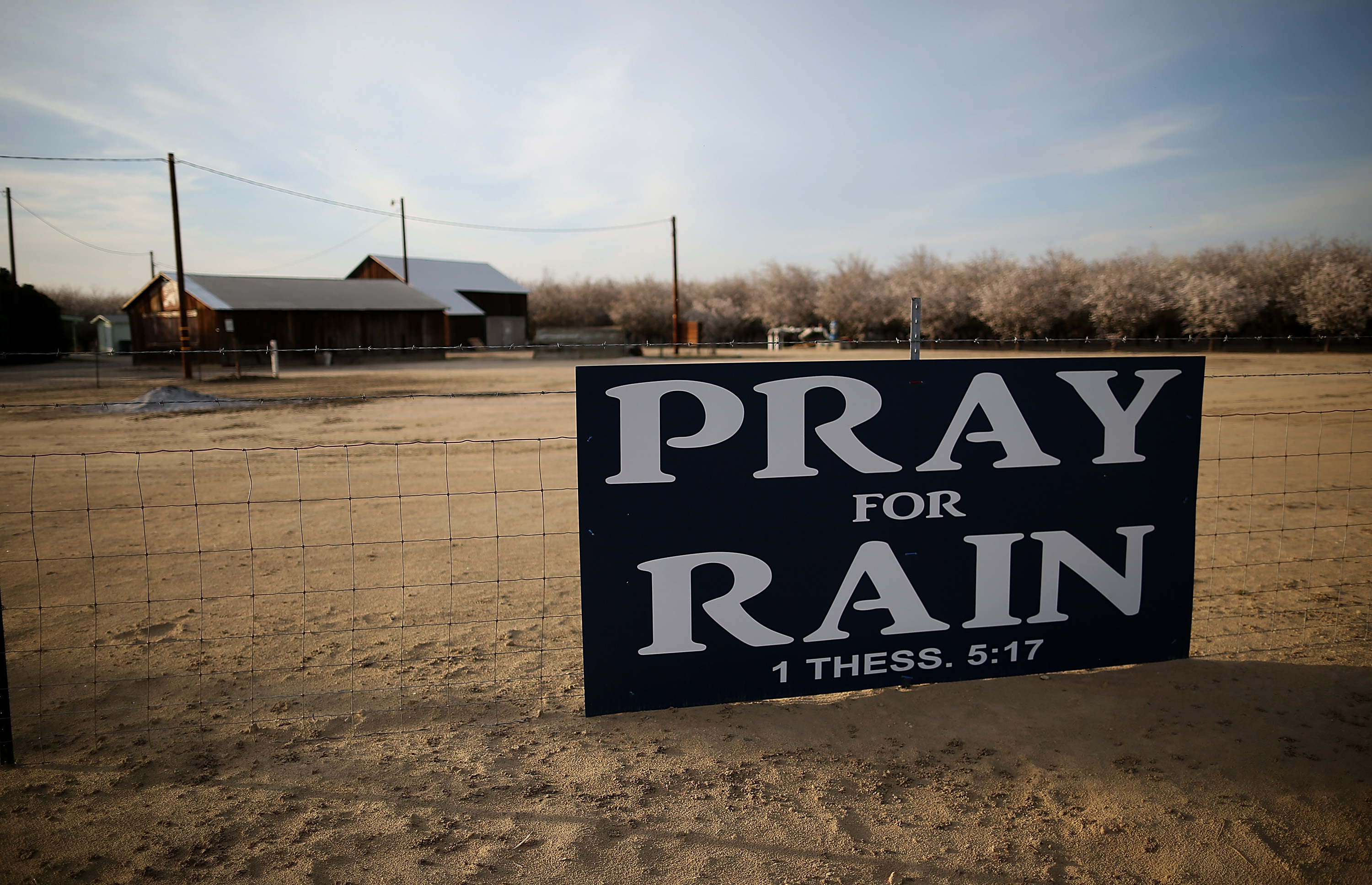
(Photo: A sign is posted near an almond farm on February 25, 2014 in Turlock, California. By Justin Sullivan/Getty Images)

The Conspiratorial Sort

by Patrick Appel

Megan Neal summarizes a study on the spread of fake news through Facebook:

[A] team of researchers at Northeastern University, led by Walter Quattrociocchi, decided to study how it is that erroneous information jumps the credibility fence and becomes widely believed to be true. Their theory, published on the arXiv preprint server last week and unearthed by MIT Technology Review, is that it has something to do with the kind of people who read “alternative” news, because they’re generally mistrustful of the mainstream media. …

Logically enough, the folks who were more prone to reading alternative websites (defined as “pages which disseminate controversial information, most often lacking supporting evidence and sometimes contradictory of the official news”) were also more likely to buy into a conspiracy theory. The thinking goes that those radical readers are A) ​less adept at parsing accurate information and B) already skeptical of mainstream journalism, and looking for an different take.

Relatedly, Mary Elizabeth Williams flags a “a new study from the University of Chicago that reveals that nearly half of all Americans believe medical conspiracy theories”:

The findings, published this week in JAMA Internal Medicine, are culled from a study of 1,351 adults who were polled about their beliefs on six popular theories: “The CIA deliberately infected large numbers of African Americans with HIV under the guise of a hepatitis inoculation program,” “Doctors and government still want to vaccinate children even though they know these vaccines cause autism and other psychological disorders,” “The FDA is deliberately preventing the public from getting natural cures for cancer and other disorders because of pressure from drug companies,” “Health officials know that cell phones cause cancer but are doing nothing to stop it because large corporations won’t let them,” “Public water fluoridation is really just a secret way for chemical companies to dump the dangerous byproducts of phosphate mines into the environment,” and “The global dissemination of genetically modified foods by Monsanto is part of a secret program launched by the Rockefeller and Ford foundation to shrink the world’s population.” As the study’s authors write, “49% of Americans agree with at least one medical conspiracy theory and 18% agree with three or more.”

Cass Sunstein lists reasons individuals believe in conspiracy theories:

Here’s an excellent predictor of whether people will accept a particular conspiracy theory: Do they accept other conspiracy theories? If you tend to think that the Apollo moon landings were faked, you are more likely to believe that the U.S. was behind the 9/11 attacks. (With a little introspection, many of us know, almost immediately, whether we are inclined to accept conspiracy theories.)

Remarkably, people who accept one conspiracy theory tend to accept another conspiracy theory that is logically inconsistent with it. People who believe that Princess Diana faked her own death are more likely to think that she was murdered. People who believe that Osama bin Laden was already dead when U.S. forces invaded his compound are more likely to believe that he is still alive.

The second set of explanations points to the close relationship between conspiracy theories and social networks, especially close-knit or isolated ones. Few of us have personal or direct knowledge about the causes of some terrible event — a missing plane, a terrorist attack, an assassination, an outbreak of disease. If one person within a network insists that a conspiracy was at work, others within that network might well believe it.

Legalizing The Scientific Method

by Patrick Appel

Researchers have finally scored some weed to test it as a treatment for PTSD:

As more states move to legalize all or some marijuana use, reform has remained stalled not just by outright federal prohibition, but also by federal policies that have suppressed research on cannabis. On Friday, the federal government took a potentially momentous step back from this position, granting researchers who have for years borne the brunt of this policy access to a legal supply of marijuana. The decision means a psychiatry professor at the University of Arizona who specializes in treating veterans may for the first time be able to perform a triple-blind study on marijuana and post-traumatic stress disorder.

Rick Doblin speculates about FDA recognition:

We’d need $15 or $20 million to make marijuana into a prescription medicine, approved by the FDA. That will probably take five to seven years. What does that $15 to $20 million go toward? This is just a Phase II pilot study, an exploratory study. We’re figuring out what the doses are, whether CBD helps, whether THC is effective on its own, what are the side effects. The money would go then to what is called the Phase III study, and those are the ones that are used to prove safety and efficacy. With that we’ll probably have to treat 400-500 people or more.

This study will give us results and we’ll see how clear the signals that we get are. Is there marijuana helpful a lot or a little? If it’s helpful a lot, then you need fewer people for the bigger study.