Putting Justices Out To Pasture

by Patrick Appel

Erwin Chemerinsky begs Justice Ginsburg to retire this year:

So long as the Democrats control the Senate, President Obama can have virtually anyone he wants confirmed for the Supreme Court. There has been only one filibuster against a Supreme Court nominee, and that was to block Justice Abe Fortas’ elevation to chief justice, not to block his initial appointment. There were 48 votes against Thomas and 42 against Alito, but Democrats filibustered neither. Besides, if Democrats have control of the Senate, they could change the rules to eliminate the filibuster for Supreme Court nominees, just as they did for lower federal court judges and presidential appointments to executive positions.

In the end, the only way to ensure that President Obama can pick someone who will carry on in Justice Ginsburg’s tradition is for the vacancy to occur this summer. Indeed, Justice Stephen G. Breyer, who will turn 76 this summer, should also carefully consider the possibility of stepping down this year.

Bernstein agrees. Garrett Epps suspects that Supreme Court Justices “just don’t see the issue the way the rest of us do, as a straightforward matter of presidential elections and judicial votes”:

 Since the retirement of Justice John Paul Stevens in 2010, she has been the senior justice on the liberal side of the Court. This is an important job—when the Court’s conservatives vote together as a five-member bloc, the senior liberal justice assigns the task of preparing the liberal dissent. The purpose of such a dissent is to discredit the majority’s reasoning and offer future courts grounds to distinguish or overrule the case. Ginsburg often assigns that duty to herself; her major dissents are masterpieces of the genre.

If she were to retire at the end of this term, that leadership role would, for the next few years, fall to Justice Stephen Breyer, 75. (Chemerinsky also suggests that Breyer “consider” stepping down.) Though Ginsburg and Breyer are both “liberals” on this Court’s spectrum, they are a study in contrasts. Where Ginsburg fights, Breyer dithers; where her ideas are clear, his are mercurial; where she draws lines, he wanders across them; where her dissents are straightforward, his tend to be—well—incomprehensible. In the showdown over the Affordable Care Act, Breyer, along with Justice Elena Kagan, crossed the aisle to support Chief Justice John Roberts in limiting Congress’s Spending Power; Ginsburg’s s opinion dripped contempt for this newly minted limit on a crucial federal power. I wouldn’t be surprised if she thought that her departure would leave the liberal wing without real leadership.

Steven Mazie adds:

Whatever Justice Ginsburg’s reasoning for resisting the chorus—maybe she expects Hillary to win the White House in 2016, and would like to have her replacement appointed by a President Clinton, just as she was—Emily Bazelon is right that she “has made it more than clear that she isn’t going to retire because columnists and law professors think she should.” There is something strange and unseemly about public calls for a vigorous justice to retire. Does anyone really think the justice has yet to think through her decision? Isn’t the doomsday scenario of a 6- or 7-justice conservative bloc screamingly obvious to her? Should any of us really counsel Justice Ginsburg on her major life decisions?

A Bang-Up Job, Ctd

by Patrick Appel

Megan Garber reminds us that the big Big Bang news hasn’t yet been through peer review:

Scientists are, like the rest of us, impatient. They are, much more often than the rest of us, justified in this. Imagine dedicating your career to learning something new about the mechanics of the world—the gravitational forces exerted on a cell membrane, the flappings of a bee’s wings, the earliest churnings of the cosmos—and then imagine actually finding that thing. Now imagine that, instead of doing what every impulse would guide you to do (share that news with everyone you know/share that news with everyone you don’t know/shout that news from the rooftops or at least your Facebook page) … you are made to wait. And wait. And wait. Until, many months later, your work has been deemed acceptable for proper publication.

… The Big Bang news is simply emblematic of a larger trend. As the philosopher David Weinberger puts it: “Scientific knowledge is taking on properties of its new medium, becoming like the network in which it lives.”

Lawrence Krauss puts the significance of the discovery, should it hold up, in layman’s terms:

If it turns out to be confirmed by other experiments, think about what this discovery implies for our ability to explore the universe (besides the other remarkable implications for physics): when we use light to look out at the distant universe, we can only see back as far as three hundred thousand years after the Big Bang, when the universe cooled sufficiently to become transparent to light. But gravitational waves interact so weakly that even waves produced less than 10-35 seconds after the Big Bang can move through space unimpeded, giving us a window on the universe at essentially the beginning of time.

Extraordinary claims require extraordinary evidence, and the current result is in some tension with earlier claimed upper limits from other experiments, so we will need to wait for the results of a host of other experiments currently operating that can check this result.

For some people, the possibility that the laws of physics might illuminate even the creation of our own universe, without the need for supernatural intervention or any demonstration of purpose, is truly terrifying. But Monday’s announcement heralds the possible beginning of a new era, where even such cosmic existential questions are becoming accessible to experiment.

Communicating The Climate Consensus

by Patrick Appel

The AAAS is campaigning to debunk the idea that scientists disagree about climate change:

The report points to a 2013 Yale paper that found around a third of Americans thought that “there is a lot of disagreement among scientists about global warming.” Twenty percent said they didn’t know enough to say, and only 42 percent knew that “most scientists think global warming is happening.” The truth, the AAAS repeatedly states in its campaign, is that 97 percent of climate experts agree that climate change is happening.

“Based on well-established evidence, about 97% of climate scientists have concluded that human-caused climate change is happening,” they state unequivocally. “This agreement is documented not just by a single study, but by a converging stream of evidence over the past two decades from surveys of scientists, content analyses of peer-reviewed studies, and public statements issued by virtually every membership organisation of experts in this field.”

Yet according to one recent survey, an unparalleled 23 percent of the general public still doesn’t get it.

Christopher Flavelle considers the reasons Americans disbelieve in global warming:

The available polling data suggests Americans’ views on climate change increasingly have more to do with politics than science.

As I wrote in December, Republicans and Democrats used to agree about the need for stricter laws to protect the environment: More than 90 percent of respondents from both parties supported the idea in 1992.

Two decades later, the share of Democrats who said they support stricter environmental protections was still above 90 percent. But the share of Republicans who said the same had dropped by half, to 47 percent. The Pew Research Center, which performed the survey, called environmental protection arguably “the most pointed area of polarization” over that period.

What’s interesting about that change is that whatever you think about the strength of the scientific consensus on climate in 2012, it was leagues stronger than in 1992. So even as the science was becoming clearer, Republican support for doing anything about it was plummeting.

Is Libya’s Government Losing Control?

by Patrick Appel

Bombing in Libya

The Guardian worries about the situation:

There can be few better symbols of Libya‘s post-Gaddafi trauma than the plight of the oil tanker Morning Glory. On 11 March, the North Korea-registered ship slipped out of the Libyan port of Es Sider during a storm and headed out into the Mediterranean. It was under the command of a group of rebels from Libya’s most oil-rich region, Cyrenaica, who intended to sell its £20m cargo of crude to help fund an autonomous government.

The Libyan navy, whose capital ships are mostly at the bottom of the sea following Nato’s 2011 air campaign, was unable to stop it, as was the air force, which was in a state of near-mutiny. After Morning Glory had shouldered its way out into international waters, the Islamist-dominated Congress in Tripoli sacked the country’s long-suffering prime minister, Ali Zeidan, with whom it had been at loggerheads, and he fled to Germany. On Monday, US navy Seals seized control of the Morning Glory near Cyprus, and began to sail it back to a Tripoli-controlled port.

Christian Caryl weighs in:

Libya is in urgent need of help.

The post-Qaddafi government, chosen by the people in free and fair elections, is struggling to survive challenges to its power from myriad armed militias, Islamist death squads, and regional separatists. All of these forces share an interest in keeping the central government destabilized and weak. None of them wants to see democracy succeed. So even though it can genuinely claim a genuine democratic mandate, the government’s writ is shrinking by the day.

Recently, the biggest challenge to the central government’s authority has come from so-called “federalists,” armed groups who are demanding far-reaching autonomy for Cyrenaica, Libya’s easternmost region. The federalists, led by Ibrahim Jathran, don’t seem to be especially interested in negotiating with the government in Tripoli; instead they’ve tried to blackmail it into accepting their demands by seizing oil installations in the region and declaring that they’re going to sell off the resources under their control.

Wayne White thinks “it’s time for Western and Arab governments that came together to support Muammar Qadhafi’s overthrow so robustly to make a strenuous effort to help salvage the mess that has developed since”:

Of concern to the international community is that as long as so much of the country remains beyond central authority, a large amount of arms from Qadhafi’s former arsenals will continue flowing across Libya’s borders.  A panel of UN experts recently submitted a 97-page report to the Security Council stating that Libya has “become a primary source of illicit weapons.” The panel is investigating alleged shipments to 14 countries. A number of its findings relate to attempts to transfer particularly dangerous shoulder-fired surface-to-air missiles. One such shipment, stopped by Lebanon, was bound for Syrian rebels.

Moreover, especially lawless portions of Libya like the desert southwest and some areas in the east adjacent to Egypt serve as safe havens for Islamic extremist elements staging from Libyan territory into neighboring states or assisting foreign jihadists. This has been true of al-Qaeda in the Islamic Maghreb (IQIM) elements lunging into Algeria and Mali, other groups supplying munitions to militant elements in Egypt following the suppression of the Muslim Brotherhood, and shipments into Tunisia aiding terrorist cells there.

Meanwhile, Raphael Cohen and Gabriel Scheinmann tally the costs of America’s intervention in the country:

The President may have billed the war as less costly than a fortnight in Iraq—approximately $1.65 billion with no American lives lost—but the total cost of the war and its aftermath is far higher. First, Libyan oil and gas production, which accounts for 96% of total government revenue, remains far below pre-war levels. Having produced on average 1.65 million barrels per day (bpd) of high-quality light, sweet crude oil before the war, Libya’s oil production today is at 230,000 bpd as militias and protests over revenue distribution have wreaked havoc on the energy industry. Just last week, after being ousted for failing to stop the independent export of oil by Eastern rebels, Libyan prime minister Ali Zeidan fled, seeking refuge in Europe. Second, without an effective means of securing Gaddafi’s fifteen to twenty thousand Soviet-era MANPADS, many of these weapons have found their way into other regional conflicts. They are likely responsible for the downing of an Egyptian military helicopter in the Sinai and have been used by militant groups across the region. More broadly, Libyan-trained extremists have found their way into conflicts from Syria to Mali.

(Photo: Wreckage from a car bomb that killed at least 8 and injured many others in Benghazi, Libya on March 17, 2014. By Mohammed Elshaiky/Anadolu Agency/Getty Images)

It Doesn’t Feel Like A Recovery

by Patrick Appel

Economy Impressions

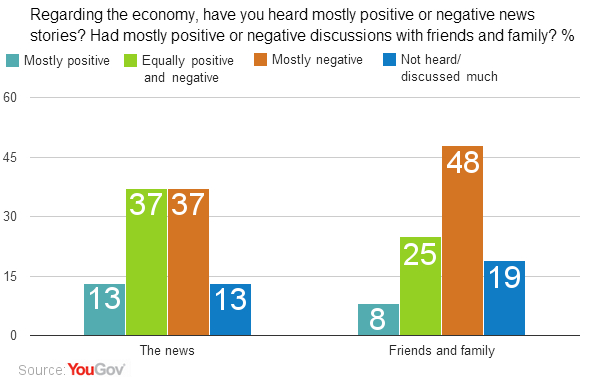
Americans mostly hear bad news about the economy:

Frequently, assessments of the economy have a partisan dimension – and in this week’s poll that is true when it comes to overall judgments.  But that isn’t the case when it comes to what people are hearing.  For example, 58% of Republicans say the overall economy is getting worse, and only 6% say it is improving.  Democrats say the economy is improving, by 35% to 23%.  While that is a much smaller margin in the positive direction than the Republicans’ negative evaluation, it is still positive. But both Democrats and Republicans hear bad news more than good news – and from both the news media and from friends and relatives.

Last week, Josh Barro tackled why many Americans incorrectly believe we’re still in a recession:

Two trends are responsible. The labor market is still slack, meaning millions who would like to work can’t, and those who do work have limited ability to demand higher wages …

For four decades, even in stronger economic times, wage gains have not kept pace with economic growth. Wages and salaries peaked at more than 51 percent of the economy in the late 1960s; they fell to 45 percent by the start of the last recession in 2007 and have since fallen to 42 percent.

When the economy does grow, that growth disproportionately accrues to the owners of capital instead of to wage earners; and in the last few years, weak growth and abundant labor have made that pattern even stronger than normal.

Arnold Kling adds a caveat:

I would note that a very important part of that trend is the shift from “straight” wages and salaries to other forms of compensation, notably health insurance. Higher payroll taxes also play a role. The share of total compensation to GDP held up fairly well until recently.

Will Hillary Remake The Mistakes Of ’08?

by Patrick Appel

David Corn wonders:

Does she now have the ability to pull together and lead a cohesive team that can function smoothly as it oversees an operation that will conceivably spend hundreds of millions of dollars? And how will she handle what one Democratic strategist calls the “Bill problem and opportunity”? … One of the first necessary steps of a successful presidential candidate is to assemble an infrastructure that can serve the candidate and develop an effective strategy. Hillary Clinton muffed that seven years ago, and resentments still linger, with Penn symbolizing that particular failure. So some members of Hillaryland are holding their breath, looking to see what happens with Mark Penn. Although he appears to be comfortably ensconced at Microsoft, they fear he may either return to Hillary’s side or, perhaps worst, play an informal but close-in role, casting a dark shadow over the enterprise.

“I would do anything for Hillary,” one Democratic operative says. “I love her. I think she’d be a great president. Anything. Except work with Mark Penn.”

First Kiss, Take Two

by Patrick Appel

Hye Yun Park remade last week’s mega-viral video with “with more color, dust, dirt, curves, spark and queer juice”:

http://vimeo.com/89189517

Amanda Hess, who hated on the original, describes Park’s version:

“Ahhhhhhh,” one participant says after she takes off her blindfold and immediately averts her eyes from her kissing partner. “This is very awk—OK, awkwaaaard.” Other icebreakers include, “Do you like, do you, like, um, do you like food,” “I like your, um, sweatshirt,” and “I like Jewish people.” Like Pilieva’s version, Park’s video is overlaid with a romantic pop track, but it’s not loud enough to drown out the disquieting squishy noises. The stilting side-eye that one woman gives her partner when he goes in for the kiss at the 2:15 mark is a video highlight, as is one man’s acknowledgment that he totally has a boner. Then there’s the dude who asks his partner “how deep” she wants it, grazes her boob without warning, then grasps her hand a little too long after the kiss is completed. Pilieva’s version peddled the fantasy that when you sign up to kiss a stranger, you’ll be paired with a gorgeous French model, but let’s be honest—it’s a lot more likely that that guy is gonna show up.

A commenter pushes back:

The first video, despite being an ad, was still really sweet. And the more “honest” and “awkward” video shown here is likewise totally sweet and endearing. Why are you so creeped out? I don’t get it.

Vice also got normal people to kiss. In London, they “went out into the street and found 20 strangers who aren’t models of any description to stick their stiff British upper lips together for £20 (about $33) a pop”:

Chart Of The Day

by Patrick Appel

Low Wages

Ben Casselman puts the low-wage workforce under the microscope:

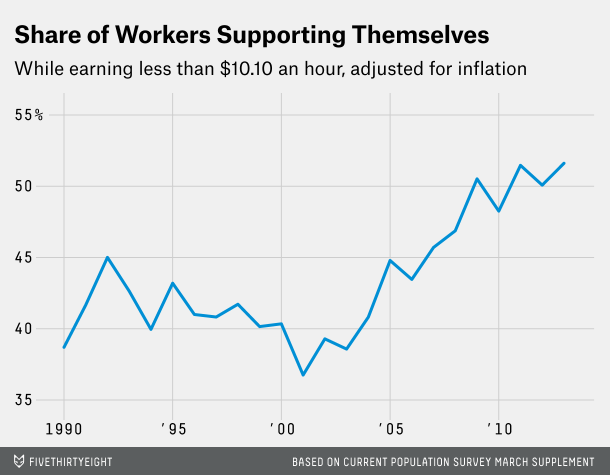
[O]ne thing is clear: A larger share of low-wage workers are trying to support themselves today than in past years. About 39 percent of workers earning under $10.10 an hour — adjusted for inflation — were supporting themselves in in 1990, compared to more than half today. Back then, nearly a quarter of low-wage earners were teenagers, compared to just 13 percent today.

He goes into more detail in a second post:

Someone working full time for the federal minimum wage earns about $15,000 a year. Only about a fifth of all minimum-wage earners made less than that in 2013, according to data from the Census Bureau. But about half of minimum-wage workers had family incomes of less than $40,000, and nearly 70 percent had incomes below $60,000, which is roughly the national median.

Most minimum-wage workers, in other words, have other sources of income. Still, most are solidly in the bottom half of the income spectrum.

Putting The Midterms On Cruise Control

by Patrick Appel

Ponnuru warns Republicans against it:

Take a look at the Huffington Post’s poll averages. Obama’s net job-approval rating is slightly up since the start of February. His rating on the economy has been improving since early December. He has been rising on foreign policy since late September. While the president is still “upside down,” as the operatives say, on all those measures, Republicans would be foolish to assume that the trend is their friend.

And even if Republicans succeed by taking the path of least resistance, they will be storing up future trouble. What if they win the Senate? In that case, Congress will have to move legislation. Republicans will have to come up with attractive conservative bills then, so that Obama will either feel it necessary to sign them or pay a political price for vetoing them. They will be in much better shape if they have campaigned on some of these ideas.

He is interested in the GOP “coming up with an agenda, selling it to the public and refining it as they go.” Douthat doubts that will happen:

I don’t think you’re likely to see real movement until after the 2016 campaign. The House Republican caucus is just too dysfunctional to unite around anything except modest budget deals and insufficient alternatives, and if they did unite around something more substantial they’re too distant from the White House ideologically to cut a deal. That’s probably still going to be the case after the midterms, and the lame duck phase of presidencies rarely produce much policy movement anyway. So for the ideas currently circulating to actually come up for votes that mean something, I think you’d need a change in the correlation of forces in Washington D.C. – and in particular, you’d need a clear leader capable of pushing them, which basically can only happen if there’s a Republican in the White House.

As for what happens to these kind of proposals if it’s Hillary Clinton in the White House instead, with a Republican House and a divided Senate? Honestly, I no idea – but I can’t say I’m optimistic.

Chart Of The Day II

by Patrick Appel

Streaming Growth

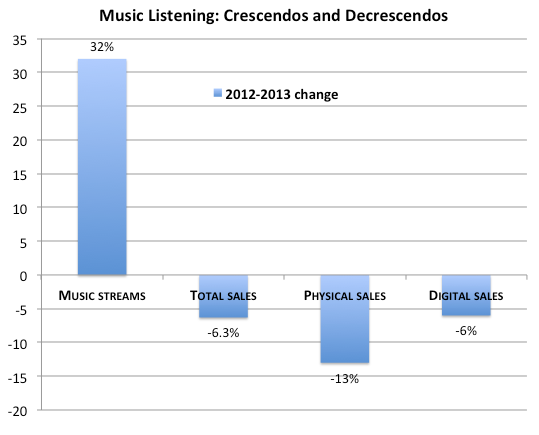
Derek Thompson covers the growth of music streaming:

This is at least the third destructive wave for the music industry in the last decade and a half. First, Napster and illegal downloading sites ripped apart the album and distributed song files in a black market that music labels couldn’t touch. Second, Apple used the fear and desperation of the record labels to push a $0.99-per-song model on iTunes, which effectively destroyed the bundling power of the album in the eyes of millions of music fans (even though country album sales are still pretty strong). For a decade, music sales plummeted. Third, digital radio and streaming sites got so good that now many music fans wonder why they need to buy albums in the first place. So, they don’t.