The Whiteness Of Poverty

by Patrick Appel

Race Poverty

Yesterday, a reader took Paul Ryan to task for ignoring rural poverty. Waldman makes related points:

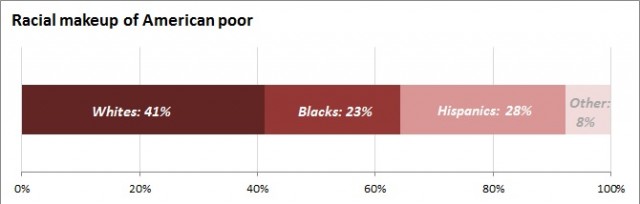
Everyone knows that minority populations in America, particularly blacks and Hispanics, suffer from disproportionate levels of poverty. For the moment, we don’t have to go into why that is and what can be done about it. I just want to note something that seldom gets mentioned: the actual racial makeup of America’s poor. In fact, when I tried to find a chart laying it out to paste into this post, I couldn’t find one. So I took poverty data and population data and made one myself (this is as of 2012) … The point of this chart is that even though blacks and Hispanics are disproportionately poor, the largest group of poor people in America is … white people.

Despite that fact, when you say “the poor,” what pops into most people’s heads is an image of a black person, probably due in no small part to the fact that poverty in America is represented in the media as a largely black phenomenon (I’m not just saying that; there’s research backing that up).

Bad Ideas We’ve Seen Before

By Patrick Appel

On Sunday, Robert Costa floated a new Republican GOP health care plan. Kevin Drum points out that the proposal is nothing the GOP hasn’t proposed a thousand times. Jonathan Cohn focuses on the interstate insurance sales component:

[I]f the GOP were to get its way, scrapping Obamacare and replacing it with the yet-unpublished plan Costa describes, the insurance industry would likely evolve just like the credit card industry did, with carriers relocating to states with the least regulations. That would be good news for healthy people willing to carry bare-bones coverage, and for people with enough money to pay for a plan, would love this arrangement. But people with preexisting conditions, the ones who were only able to buy coverage thanks to the ACA’s rules, would be back to the bad old days.

Bob Laszewski piles on:

A new carrier could conceivably come into the market with much lower rates––because it is offering fewer benefits––attracting the healthy people out of the old more regulated pool leaving the legacy carrier with a sicker pool. Stripping down a health plan is a great time tested way for a predatory insurance company to attract the healthiest consumers at the expense of the legacy carrier who is left with the sickest.

He suggests that “supporters of this idea first ask the leaders of the insurance industry if they would even do this under the best of circumstances.”

America’s Foreign Policy Is Bankrupt

by Patrick Appel

Literally:

If America and Europe have failed to adequately defend Ukraine, it’s not for lack of guns. It’s for lack of money. Over the last year, the real contest between Russia and the West hasn’t been a military one (after all, even McCain knows that risking war over Ukraine is insane). It’s been economic. In part because of two wars that have drained America’s coffers, and in part because of a financial crisis that has weakened the West economically, the United States and Europe have been dramatically outbid. …

Whenever the United States debates using its money to buttress democracy and Western influence in a strategically important part of the world, commentators offer comparisons with the Marshall Plan that America offered Europe after World War II. But in today’s dollars, according to one estimate, the Marshall Plan would total roughly $740 billion. That kind of money would certainly enable far-reaching economic reforms in Ukraine, and likely anchor the country in the West for years to come. But, of course, the suggestion is absurd. Today’s Senate can barely pass an aid package 740 times as small.

The Wealth Chavez Wasted

by Patrick Appel

Venezuela Oil

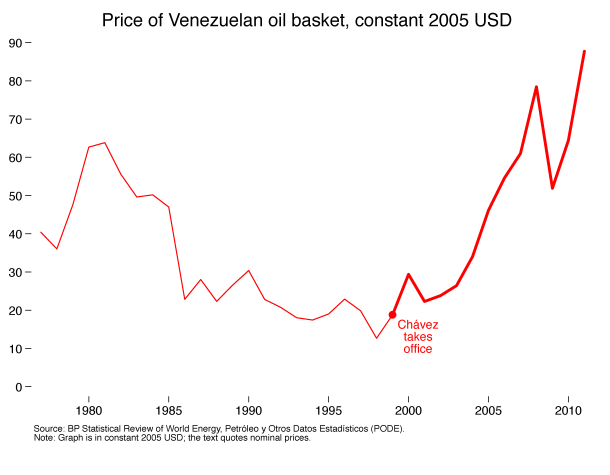
Dorothy Kronick trashes Hugo Chavez’s economic legacy using a series of charts:

Nature handed Chávez by far the biggest resource windfall in Latin America (Figure 4), yet compared with its less-lucky neighbors, Venezuela experienced slow economic growth (Figure 5) and high inflation (Figure 6). Nor did Venezuela eclipse many of its neighbors in lowering infant mortality (Figure 7), slashing poverty, reducing inequality or improving school attainment during Chávez’s tenure. Many of the countries that surpassed Venezuela in these social achievements did so in part by implementing innovative anti-poverty programs called conditional cash transfers, in which the government pays poor women who take their children to school or the doctor. While Mexico, Brazil, Peru, Colombia and other countries pursued these highly effective policies, Venezuela scaled up projects that “one will be hard-pressed to find [evidence of] in human development statistics,” in the words of a prominent Venezuelan economist who evaluated the programs.

Kronick goes on to compare Venezuela’s economic failures with Bolivia’s successes. Greg Weeks adds:

What she does not address, though, is the “why” question. Why did Evo Morales, who uses similar rhetoric, professes a similar ideological orientation, and faces a similarly elite opposition, go in such a different and more successful direction? Perhaps because it’s so uninterestingly stable at the moment, Bolivia gets no attention paid to it at all.

Win The Senate, Lose The Country

by Patrick Appel

If the GOP retakes the Senate, Scott Galupo fears the party will sabotage its presidential nominee:

[T]he seeming tranquility in Washington is simply the sound of two parties behaving well until a midterm election. If and when Republicans retake the Senate, the intraparty feud, now simmering, will begin to boil anew. The rightmost flank, flush with victory, will need to be appeased. And the ideological toxicity; the demographics of death; the lack of a viable national standard-bearer — these factors and others will conspire to elect the next President Clinton.

Waldman imagines how Republican control of Congress might play out:

The senators accept that the ACA is law and are thinking about how they’d like to change it. The House members are coming up with another way to make a futile, symbolic shaking of their fists in the general direction of the White House. And this may offer a clue to how legislating would proceed in a Republican Congress. The House, still dominated by extremely conservative Republicans for whom any hint of compromise is considered the highest treason, could continue to pass one doomed bill after another, while the Senate tries to write bills that have at least some chance of ever becoming law.

And that would be just fine with Barack Obama. If he’s faced with both houses controlled by the opposition, there’s nothing he’d rather see than them fighting with each other and passing only unrealistic bills that he can veto without worrying about any backlash from the public.

Chart Of The Day

by Patrick Appel

The Prison Policy Initiative (PPI) sizes up the prison population:

Prison Population

Jon Fasman adds important context:

PPI reckons the United States has roughly 2.4m people locked up, with most of those (1.36m) in state prisons. That is more than the International Centre for Prison Studies estimates, but it’s in the same ballpark.

Remember, though, that number is static: it does not capture the churn of people in and out of incarceration during a given year. For the population in local jails, PPI used the information in Table 1 of this report, which shows how many people were locked up in jails on June 30th 2012 (the last weekday in June), and came up with 721,654 in local jails, as well as another 22,870 immigration detainees housed in local jails under contract with Immigration and Customs Enforcement (ICE). Around 60.6% of jail inmates have been convicted; 39.4%, which includes the immigration detainees, have not been convicted, either because they had only recently been arrested or because they are awaiting trial and don’t have the money to make bail. Look one page earlier in the report, however, and you’ll see that local jails admitted a total of 11.6m people between July 1st 2011 and June 30th 2012.

Let The Teens Sleep In

by Patrick Appel

It’s better for them (NYT):

New evidence suggests that later high school starts have widespread benefits. Researchers at the University of Minnesota, funded by the Centers for Disease Control and Prevention, studied eight high schools in three states before and after they moved to later start times in recent years. In results released Wednesday they found that the later a school’s start time, the better off the students were on many measures, including mental health, car crash rates, attendance and, in some schools, grades and standardized test scores.

Suderman uses this research to lobby for school choice:

Sure, it’s nice to see that some school districts are taking note of the evidence in favor of later start times for high schools. But it would be even nicer to imagine a world in which the evidence didn’t take 20 years to filter into school systems’ decision-making processes, in which small bands of school-board bureaucrats weren’t making one-size-fits-all decisions for thousands of students, and in which teenagers and their families had a variety of meaningful options available—options that might include, among other things, variable start times, and perhaps even school days that weren’t constructed on the traditional seven-hours-starting-in-the-morning schedule at all. In other words, it would be nice if there were choice and competition in public education, and if innovations and adjustments like later start times weren’t news.

America’s Religious Exceptionalism

by Patrick Appel

pew_morality

Waldman notes the America’s unusual religiosity for a wealthy country:

The relationship is pretty clear: countries with higher levels of development are less religious and more accepting of those who don’t believe in a deity, with two outliers. China is obviously where it is because of communism, and the United States? Well, we’ve always been the most religious of the wealthy countries, which is the product of multiple factors but can largely be explained by the fact that unlike in European countries, where a sclerotic state church lost more and more adherents over time, we’ve always had a dynamic, competitive religious marketplace. Like just about everything when it comes to religion, on this question we’re the exception among similar countries.

Ross Douthat argues that, “relative to many other countries and cultures, we’ve managed to reap the benefits of religious idealism – through our many religiously-motivated reform movements, from the abolitionists to the populists to the civil rights movement to (or so I would say) the pro-life movement, and then also through the social, civic benefits of a thriving religious marketplace– without enabling the worst forms of religious intolerance.” He fears that America’s political relationship to religion is changing:

My general anxiety, underlying the specific religious-liberty issues that we’re debating these days, is that this achievement may be slipping away from us – that as the country has become somewhat less religious overall, and as the two parties have become not only ideologically but religiously polarized, a sort of Europeanization of American church-state issues has become visible in our politics. You can see this on the religious right, in the appeal of an ahistorical nostalgia for a Christian America that never really was, and then you can see it on the irreligious left, in the appeal of an ahistorical view that the Constitution somehow bars religious people from bringing their theological convictions into politics. And I think the latter impulse is pushing liberalism in an increasingly anti-clerical direction, toward a narrowed view of religious freedom in which that freedom stops when the Sunday (or Saturday) service ends, and a narrow view of religious pluralism that sees religious schools and charities and hospitals mostly as potential threats to individual liberty, rather than important non-state servants of the common good. How far this impulse will take liberalism I don’t know – you should ask a liberal! But I don’t think current trends are good news for what Robert Putnam calls the “grace” that religious freedom has offered our society these last few hundred years.

But Katherine Franke believes that the new religious liberty cases are pushing the envelope:

In many respects, the people or companies who claim these religious exemptions are asking that they be entitled to travel through life—both their private life and their public life—surrounded by a bubble that defines their faith. What does it mean to be a citizen if you can say, “My bubble basically inoculates me from having to answer to your law”? But in the United States, we say everyone is governed by the same law. To say “my religious law trumps your secular law” is a radical idea.

Emily Bazelon makes related points:

[R]ooting against Hobby Lobby or anti-gay bills doesn’t have to mean rooting against religious liberty. When Congress passed [Religious Freedom Restoration Act in 1993], liberals helped take the lead. The law was a disapproving response to a 1990 Supreme Court ruling in the case Employment Division v. Smith, a suit brought by two drug counselors who were fired after taking peyote in a Native American religious ceremony and couldn’t get unemployment benefits because their use of the drug violated state law. Could the state do this, or did their constitutional right to religious freedom mean they should be allowed to use peyote in a religious ceremony without penalty?

The Supreme Court said the answer to that question was no: The employees didn’t have the rights here. Justice Antonin Scalia wrote that since peyote is illegal, and since that law is “neutral” in applying to everyone, the state could impose it. At the time, the ruling read as insensitive to the lack of power religious minorities have relative to the majority. “In law school, I saw Smith as a conservative decision,” Brooklyn law professor Nelson Tebbe remembered when I called him this week. “And when Congress passed RFRA in response, it was about protecting potentially persecuted minorities. But now, in an amazing shift, it’s the most powerful religious organizations in the country that are invoking this law—the Catholic Church and Protestant evangelicals.”
#WithSyria, Without A Solution

by Patrick Appel

The Syrian conflict turned three on Saturday. Marc Lynch wishes the #WithSyria activists had clearer goals:

The premise of the “With Syria” campaigns is that the United States hasn’t acted to resolve the conflict in Syria because people aren’t aware of its horrors. But that’s probably wrong. To get a sense of how Americans think about Syria, I looked at every Syria question in the public opinion surveys collected in the Roper Center for Public Opinion Research database since January 2011 – 281 questions in all. Those surveys paint a pretty clear picture of an American public that knew perfectly well what was happening in Syria and whom to blame, and generally wanted to help, but absolutely rejected anything that smelled like military intervention. The activist campaigns might have more success translating a stand “with Syria” into meaningful action if they proposed specific ways for concerned individuals to make a difference without supporting war.

Borzou Daragahi expects the war to continue for the foreseeable future:

As the Syria war enters its fourth year, no question is perhaps more pertinent to the calculations of combatants inside the country and policy makers abroad than who is winning. Ominously for the prospects of ending the conflict that has left up to 140,000 people dead and displaced more than 9m in what the UN describes as the worst humanitarian catastrophe since the second world war, both sides claim they are.

“The fact that we’re in this intermediate situation where both sides can hope to win, but it’s not clear that they will, is the worst of all worlds,” says Jean-Marie Guehenno, former UN and Arab League deputy envoy to Syria. “Because all sides have an interest in continuing the fight rather than going for a political solution, all sides believe they can win.”

Vice is embedded with Syria’s rebels. Their first video dispatch is here.

A New And Improved 538

by Patrick Appel

528 Update

Nate Silver introduces us to his new site:

The breadth of our coverage will be much clearer at this new version of FiveThirtyEight, which is launching Monday under the auspices of ESPN. We’ve expanded our staff from two full-time journalists to 20 and counting. Few of them will focus on politics exclusively; instead, our coverage will span five major subject areas — politics, economics, science, life and sports.

Our team also has a broad set of skills and experience in methods that fall under the rubric of data journalism. These include statistical analysis, but also data visualization, computer programming and data-literate reporting. So in addition to written stories, we’ll have interactive graphics and features. Within a couple of months we’ll launch a podcast, and we’ll be collaborating with ESPN Films and Grantland to produce original documentary films.

The site won’t be all data all the time:

We’re not planning to abandon the story form at FiveThirtyEight. In fact, sometimes our stories will highlight individual cases, anecdotes. When we provide these examples, however, we want to be sure that we’ve contextualized them in the right way. Sometimes it can be extraordinarily valuable to explore an outlier in some detail. But the premise of the story should be to explain why the outlier is an outlier, rather than indicating some broader trend. To classify these stories appropriately, we’ll have to do a lot of work in the background before we publish them.

All of this takes time. That’s why we’ve elected to sacrifice something else as opposed to accuracy or accessibility. The sacrifice is speed —  we’re rarely going to be the first organization to break news or to comment on a story.