Who Uses The Library?

by Jonah Shepp & Patrick Appel

Gracy Olmstead reflects on the findings of a Pew report:

A picture of the library frequenter begins to emerge: a civic-minded, well-educated individual who has strong ties to community, culture, and information. Also, interestingly, both the library lovers and information omnivores tended to lean liberal or Democrat. … [I]t seems that those using libraries are somewhat homogenous: they’re mostly wealthy, well-educated, and well-informed. Yet the library ought to reach a diverse population: it ought to offer resources to those from lower incomes, without many community connections, or to those lacking technological or informational resources. Yet many such individuals are the library’s rarest frequenters—or never use it at all.

David Harsanyi is discouraged:

The census says we have around 17,000 libraries in the United States (this doesn’t include far more useful school libraries).  These libraries spend much of their $11 billion yearly budgets subsidizing the entertainment needs of people who can afford to do help themselves. Some of us are comforted knowing that there are buildings in nearly every town that are filled with books. But if they’re not helping Americans who need it the most, what’s the point?

The Rise Of The Robo-Journalists

by Jonah Shepp

The LA Times was the first to report on the earthquake that hit LA on Monday. But reporter Ken Schwencke didn’t write the piece on his own, as Will Oremus explains:

“I think we had it up within three minutes,” Schwencke told me. If that sounds faster than humanly possible, it probably is. While the post appeared under Schwencke’s byline, the real author was an algorithm called Quakebot that he developed a little over two years ago. Whenever an alert comes in from the U.S. Geological Survey about an earthquake above a certain size threshold, Quakebot is programmed to extract the relevant data from the USGS report and plug it into a pre-written template. The story goes into the LAT’s content management system, where it awaits review and publication by a human editor.

And it’s not just earthquakes:

It’s just one of several bots that the LA Times uses to produce stories. The site also automates the opening sentence for its Homicide Report, a story for every homicide in the Los Angeles area, as Journalism.co detailed. Another bot sends a daily email of the LAPD’s arrests, alerting journalists to any high-profile arrests, such as ones with particularly high bail or with newsworthy occupations.

Other similarly automated stories would be just as simple, especially for data-heavy news like the monthly employment numbers, sports results, or company IPO filings. The idea of using automatic computer programs to craft stories is not new — all you need is a set of facts and few rules about sentence structure — but few large news organizations have actually resorted to using them.

Relatedly, Derek Mead examines a recent study in which students evaluated sports recaps written by robots as more trustworthy than those written by humans:

Now, there are some clear caveats to the study, which [researcher Christer] Clerwall notes. First, the sample sizes are small. (Clerwall writes that it’s a pilot.) Its limitation to sports game recaps is the main concern, as they’re largely expected to be formulaic, which means that a human adding a bit of flair might be a negative for readers looking for straight numbers. Asking a computer to sort out Malaysia Airlines Flight 370 is a much taller task, and one that still requires a human journalist’s nose for bullshit.

But that’s the beside the point. Software will only get better, and as it does, it’ll continue to encroach on the role of journalists as aggregators and repackagers of available information. (The day that computers get into actual reporting is the day the robots fully win.) And as it becomes even more widespread, reporting software will continue to highlight the essential tension of journalism today: What’s the role of a reporter?

The Eurasian Idea

by Jonah Shepp

Pankaj Mishra explores the anti-Western, chauvinist ideology that Putin’s Russia reflects:

Eurasianism is presently articulated by the political scientist Aleksandr Dugin, the son of a KGB officer, who reportedly has many attentive listeners in the Kremlin and the Orthodox Church. Dugin and his acolytes acknowledge that centuries after Tamerlane’s conquests, which redrew the map of the world, Eurasia remains, as U.S. policy maker Zbigniew Brzezinski put it in 1997, “the chessboard on which the struggle for global primacy continues to be played.” Accordingly, Dugin has advocated a new anti-Western alliance between Russia and Asian countries. Revanchists such as Dugin have enjoyed a fresh legitimacy in the post-Yeltsin era, when the empire created by Soviet Communists fragmented and a struggling Russia appeared to have been deceived and undermined by a resurgent and triumphalist West. …

Putin himself rose to high office on a wave of support from the Russian masses, which had been exposed to some terrible suffering caused by Russia’s westernization through economic “shock therapy.” Bending Crimea to his will, or calling for a religious revival, Putin seems to be realizing the old Eurasian fantasy of a strong ideological state dedicated to restoring Russia’s distinctive national and civilizational “otherness.”

With that ideology in mind, Timothy Snyder notes that Putin’s view of the Ukrainian revolutionaries is more than a little ironic:

It is deeply strange for an openly right-wing authoritarian regime, such as that of Vladimir Putin, to treat the presence of right-wing politicians in a neighboring democracy as the reason for a military invasion. Putin’s own social policy is, if anything, to the right of the Ukrainians whom he criticizes. The Russian attempt to control Ukraine is based upon Eurasian ideology, which explicitly rejects liberal democracy. The founder of the Eurasian movement is an actual fascist, Alexander Dugin, who calls for a revolution of values from Portugal to Siberia. The man responsible for Ukraine policy, Sergei Glayzev, used to run a far-right nationalist party that was banned for its racist electoral campaign. Putin has placed himself at the head of a worldwide campaign against homosexuality. This is politically useful, since opposition to Russia is now blamed on an international gay lobby which cannot by its nature understand the inherent spirituality of traditional Russian civilization.

Crimea, Russian Federation

by Jonah Shepp

Unrest in Ukraine

Russia annexed the peninsula this morning:

Last night, the Kremlin website posted an approval of Crimea’s draft independence bill, recognizing Crimea as a sovereign state. Today, Putin spoke for close to an hour about the history of Russia, Crimea, and the West, before overseeing the signing of document, citing the will of the Crimean people as justification and decrying the West’s attempt to stop the union.

In the speech, Putin made the expected point that there’s not that much the international community can do to prevent two willing, sovereign entities to merge. He made the case that Russia has acted in accordance with international law, and that thousands of Russian troops on the ground in Crimea had nothing to do with it.

John Cassidy parses Putin’s speech at the annexation ceremony, in which he said Russia had been “robbed” of Crimea in 1954:

At least as regards Crimea, and give or take a few rhetorical flourishes and judgments, this is a roughly accurate representation of what happened, or, at least, of what recent history felt like to many Russians. (It felt quite different to the Crimean Tatars.) Thus the strong public support for Putin’s actions. To some in the West, and to certain liberal Russians, such as Garry Kasparov, this looks eerily like Hitler’s grab of the Czech Sudetenland in 1938. Most Russians, and even Mikhail Gorbachev, beg to differ.

Crimea’s return to Russia “should be welcomed and not met with the announcement of sanctions,” the former Soviet leader said in a statement that was released on Monday. “If until now Crimea had been joined to Ukraine because of Soviet laws that were taken without asking the people, then now the people have decided to rectify this error.”

Putin’s defenders are skating over the fact that Russia has violated Ukraine’s sovereignty; stomped on international commitments it made during the nineties; destabilized the eastern part of Ukraine by shipping in agitators; and even, quite possibly, broken its own laws, which stipulate that new lands can join the Russian Federation only after the country to which they used to belong has made an agreement with Moscow. For all these reasons, sanctions are justified.

But there is still the strategic point. If Crimea’s status as part of Ukraine is regarded as an accident, or a blunder by Khrushchev, the sight of it rejoining Russia can be regarded as a tidying up of historical loose ends—a delayed but inevitable part of the redrawing of boundaries after the collapse of the Soviet Union.

Timothy Garton Ash rallies the West to defend what remains of Ukraine:

Putin scored a few telling hits on US unilateralism and western double standards, but what he has done threatens the foundations of international order. He thanked China for its support, but does Beijing want the Tibetans to secede following a referendum? He recalled Soviet acceptance of German unification and appealed to Germans to back the unification of “the Russian world”, which apparently includes all Russian-speakers. With rhetoric more reminiscent of 1914 than 2014, Putin’s Russia is now a revanchist power in plain view.

Without the consent of all parts of the existing state (hence completely unlike Scotland), without due constitutional process, and without a free and fair vote, the territorial integrity of Ukraine, guaranteed 20 years ago by Russia, the US and Britain, has been destroyed. In practical terms, on the ground, that cannot be undone. What can still be rescued, however, is the political integrity of the rest of Ukraine.

Stewart M. Patrick fears the precedent that Crimea’s accession to Russia sets:

Hundreds of minority populations around the world might in principle insist on secession, throwing existing borders into chaos. Not for nothing did Woodrow Wilson’s Secretary of State Robert Lansing bemoan that the principle of national self-determination advanced by his president was “loaded with dynamite.”

Moreover, Russia’s aspirations are not limited to Crimea, and its successful annexation could clear a path for the Kremlin to seek to regain de-facto sovereignty over territories in the former Soviet Union with large Russian minority populations, under the pretext of protecting “oppressed” compatriots. We have seen this movie before, most obviously in Georgia. In 2008, the Russian military intervened to assist two breakaway republics, Abkhazia and South Ossetia. In the aftermath of that intervention, Moscow pledged to remove its troops. They remain there today. Or consider Moldova, where Moscow has for more than two decades supported the statelet of Transdniester, allowing it to become a veritable Walmart of arms trafficking.

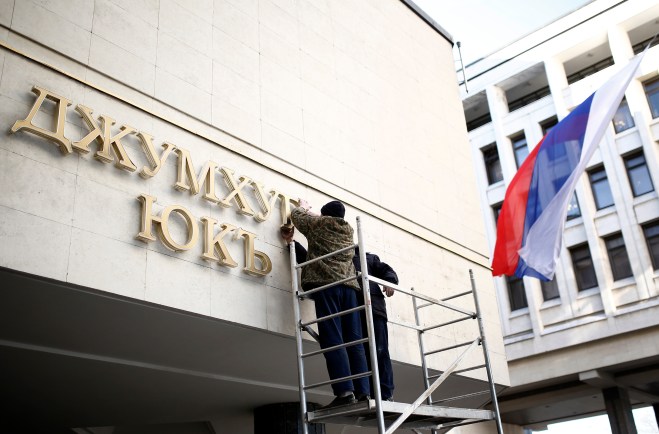
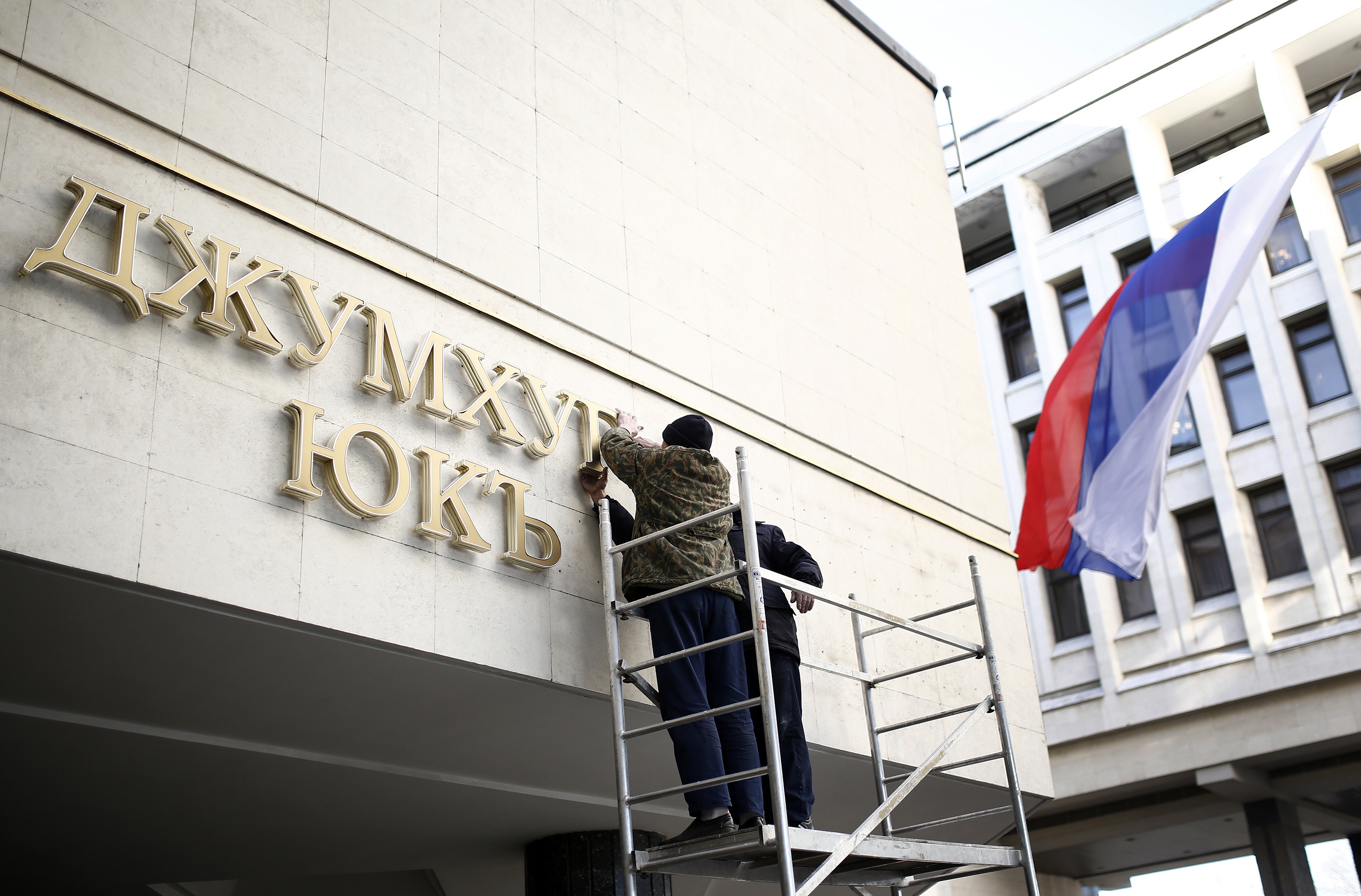
(Photo: Name plates on the walls of the Crimean parliament building are removed after the annexation of Crimea by Russia on March 18, 2014. By Bulent Doruk/Anadolu Agency/Getty Images)
The Poverty The Right Doesn’t Want To See

by Jonah Shepp

Agunda Okeyo reviews Maria Shriver’s HBO documentary Paycheck to Paycheck: The Life and Times of Katrina Gilbert:

What makes Gilbert’s story so compelling is that she challenges almost every stereotype underpinning right-wing rhetoric about poverty, single mothers and the underemployed. Gilbert isn’t looking for a government “handout,” and she doesn’t blame others for her plight. She’s also remarkably patient and affectionate with her children, even as she raises them by herself. (As we learn, a significant portion of her childcare burden is relieved by the Chambliss Center , a 24-hour, seven-day-a-week childcare facility that offers a range of educational and counseling services for low-income families on a sliding scale. “If it wasn’t for them,” Katrina declares, “I wouldn’t be able to work because I would just be paying for daycare. How would you pay your bills? It’s impossible.”)

Gilbert’s tale also offers a refreshing reminder to conservative politicians that economic hardship is not the exclusive domain of ethnic minorities. Like Monica Potts’ illuminating feature in The American Prospect, “What’s Killing Poor White Women,” “Paycheck to Paycheck” explores the complex texture of inequality — and examines why white women are an oft-ignored face of poverty in modern America.

But L.V. Anderson worries that by focusing on an exemplary individual like Gilbert, the film undersells the many more imperfect Americans also in desperate need of a leg up:

[F]ew people, be they rich or poor, behave with as much forbearance, compassion, and hopefulness as Gilbert does in Paycheck to Paycheck. This isn’t a criticism of Gilbert—she truly is amazing. But the poor people who are less extraordinary and less overtly likable than Gilbert need help, too. Watching Paycheck to Paycheck, I couldn’t help thinking about the New York Times’ gripping “Invisible Child,” Andrea Elliott’s recent profile of an 11-year-old homeless girl in New York named Dasani. Dasani is surrounded by adults who often make bad decisions, and Dasani makes some bad decisions, too—but Elliott makes it clear that they would all benefit considerably from robust social safety nets.

Earlier Dish on poverty and the GOP here and here.

The Wear And Tear Of Police Work

by Jonah Shepp

Nineteen years after her friend Sangeeta Lal was murdered by her ex-boyfriend, Erika Hayasaki connected with Brian Post, the police officer who responded to the shooting. Over the years, the beat has taken a serious toll on Brian’s health:

In squad rooms full of cops, Brian would compare blood pressure meds with his colleagues. Most, if not all, of the police he knew with more than 10 years of service were dealing some kind of medical or psychological issue.

At night, Brian would hide his drinking from his wife. He went from sipping whiskey, to downing cheap 100-proof vodka.

“You see nothing but bodies, I swear, dead people,” he said. “Car accidents, hangings, suicides, murders, SIDS deaths.” He remembered a diabetic who killed himself by overdosing on chocolate. And then there was the conversation with a tongue-pierced meth user with an enlarged heart who had told Brian, “I’m white trash until the day I die.” He assaulted people in a parking lot and died in custody after deputies restrained him. The next day, Brian found himself close to fainting after viewing the autopsy photos of the same kid’s esophagus, and pierced tongue.

“I was so angry at this one woman for dying, that I yelled at her,” he said. “I just didn’t want to see another dead body…I should have recognized at that point, it’s time for me to back up.”

Busting The For-Profit College Racket

by Jonah Shepp

college_default_rates_by_sector

The Department of Education on Friday proposed new regulations (pdf) intended to address the high rate of student loan defaults among graduates of for-profit colleges. Ashlee Kieler outlines the proposal:

Programs would be deemed failing if loan payments of typical graduates exceed 30% of discretionary income or 12% of total annual income. Programs would be given a warning if a student’s loan payments amount to 20 to 30% of discretionary income, or 8 to 12% of total annual income. Discretionary income is defined as above 150% of the poverty line and applies to what can be put towards non-necessities.

Passing along the eyebrow-raising chart above, Danny Vinik praises the crackdown on for-profit colleges:

Students at for-profit colleges drop out at an alarming rate and those that do graduate have much higher levels of debt than students in public and private non-profit colleges. For-profits also receive a substantial share of their revenue—more than 80 percent to be exact—from loans and grants from the federal government. In 2012, the Senate Health, Education, Labor and Pensions Committee, led by Senator Tom Harkin, completed a two-year report into for-profit universities to investigate whether this taxpayer money was being well spent. Across the board, degrees and certificates from for-profit colleges cost significantly more than those from non-profits[.]

Those extra costs are not leading to high graduation rates though. Fifty four percent of students who enrolled during the 2008-2009 school year had withdrawn from the institution by 2010. Only 18 percent had earned their degree or certificate.

Sanctions For Sanctions’ Sake, Ctd

by Jonah Shepp

Yesterday, the US slapped sanctions on seven Russian and four Ukrainian officials for their involvement in the Crimean secession, including ousted Ukrainian president Viktor Yanukovych, but not on Vladimir Putin himself. The EU also announced similar sanctions on targeted individuals. Adam Taylor takes a closer look at the names on our list:

These people may not be household names in the United States or Western Europe, but they hold real power in Russia, which may not be apparent from the one-line descriptions given by the White House.

For starters, there’s Vladislav Surkov, described as a presidential aide to Putin. Surkov is notorious in Russia-watching circles as the theater director who later became a PR man for Mikhail Khodorkovsky. He eventually came to the Kremlin and used his understanding of publicity and image to help sustain and strengthen Putin’s presidency, with some even suggesting that he was the real power behind the throne. He was called “Putin’s Rasputin” in the London Review of Books, and the “Gray Cardinal” by many others. While he apparently fell out of favor after anti-Putin protests in 2012, he was brought back last fall to help deal with Ukraine and other situations.

Bershidsky slams the list, which he says doesn’t include the real culprits:

If the U.S. authorities’ purpose was to punish people responsible for Putin’s Ukrainian escapade, they should have started with the Russian president himself: He alone decides what Russia will or will not do. They also could have gone to the trouble of finding out who commanded the unmarked Russian troops that spread across Crimea, and who sent goons to foment unrest in southeastern Ukraine. Punishing Putin, however, must have seemed like a scary idea, and identifying those who did his dirty work turned out to be too challenging.

The EU, in fact, did a better job on that front. On Monday, it revealed its own list of 21 people targeted for sanctions, and it includes the commanders of Russia’s Black Sea Fleet and southern and western military districts, as well as a longer list of pro-annexation legislators and separatist Crimean officials.

Russia plans to retaliate with sanctions of its own:

[W]hile the final list is still being crafted, it will include top Obama administration officials and high profile U.S. senators, in an effort to roughly mirror the U.S. sanctions against Russian officials and lawmakers, according to diplomatic sources. At the top of the list in Congress is Senate Majority Whip Dick Durbin, who recently co-authored a resolution criticizing Russia’s invasion of Crimea.

Durbin’s inclusion on Putin’s list would mirror Obama’s naming of Valentina Matvienko, the head of the upper chamber of the Russian Duma. Senate Majority Leader Harry Reid and Minority Leader Mitch McConnell are not expected to be on the Russian sanctions list.

Scott Clement notes that sanctions are the only response to Russia most Americans support:

Americans’ reluctance was laid bare in a CNN poll last week. Obama’s current policy is widely popular, with almost six in 10 supporting economic sanctions on Russia (it was 56 percent support  in a Post-ABC poll). But at least half of Americans opposed all five other potential actions asked in the survey: economic assistance to Ukraine’s government (52 percent opposed), canceling an international summit (58 percent), sending weapons to Ukraine’s government (76 percent), U.S. air strikes (82 percent) and ground troops (88 percent).

Larison reiterates the futility of sanctions:

When the U.S. passed the Magnitsky Act, did this cajole Russia into adopting reforms of its legal system or force it to commit fewer abuses? Obviously, it did nothing of the kind. All that it achieved was to irritate Moscow and convince them of American hostility, and it led to a series of Russian retaliatory measures that damaged relations with the U.S. and made the situation inside Russia significantly worse than it was before. Attempting to compel desired changes in Russian behavior contributed to a deterioration in the conditions that the attempt was supposed to ameliorate. These tactics almost never work, but Westerners keep trying them out of a misguided belief that anything that the other government dislikes must be the right and the smart thing to do. All sanctions are ultimately “unserious” in that they are reflexive responses to international events that often achieve nothing good. Sanctions frequently can’t deliver the results that their advocates claim that they can, but they can be dreadfully serious in their ability to wreck relations with other states and make bad situations worse.

Previous Dish on sanctions here.

Don’t Bite The Hand That Buys Your Gas

by Jonah Shepp

James Surowiecki contends that when ” it comes to natural gas [Putin] isn’t thinking enough moves ahead”:

You might take Putin’s brandishing of the gas weapon as a shrewd geopolitical move. But it’s a classic case of putting short-term interests ahead of long-term gain. Although the region’s need for Gazprom supplies may strengthen his hand in the present, the strategy is forcing Europe to end its reliance on Russia.

After the crises of 2006 and 2009, Europe increased imports from Norway and Qatar. It built new facilities for receiving liquefied natural gas, and upgraded storage capacity, so that supplies could be stockpiled in case of a cutoff. It imported more coal. Pipeline connections within the E.U. were improved, making shortages easier to alleviate. The Crimea crisis will give new impetus to these efforts. The U.K.’s foreign secretary has said that the crisis is likely to make Europe “recast” its approach to energy. A draft document prepared for a forthcoming E.U. summit deplored the Continent’s “high energy dependency” and called on E.U. members to diversify their supplies. These moves are reminiscent of what happened after the oil crises of the nineteen-seventies made it clear to the West and Japan that relying on opecsuppliers was foolish. Europe installed energy-saving technologies and invested heavily in nuclear energy and natural gas. France built fifty-six nuclear reactors in the fifteen years after the oil embargo of 1973.

A Prejudicial Policy Toward The Poor

by Jonah Shepp

In an interview with Nora Caplan-Bricker, Harold Pollack explains why drug testing welfare applicants, as Mississippi is set to start doing, is “among the worst ideas in American social policy today”:

NCB: What’s the greatest harm you see programs like this cause?

HP: These programs build upon, and perpetuate, harmful myths about parents who seek cash assistance. Illicit drug disorders can certainly be found among TANF recipients. Yet these disorders are not particularly widespread among participants in this program. Young men of college age are more likely to have substance use disorders than welfare recipients are.

Drug testing does have an appropriate role when individuals face particular problems in the criminal justice system, sometimes in the workplace, or in particular family situations. Such testing should be provided as part of an evidence-based set of interventions to improve parents’ well-being and their ability to successfully navigate their work and family roles. A diffuse, poorly-targeted political effort like this will not accomplish these goals. Instead it dissipates scarce resources.

by Jonah Shepp

Like Mississippi, most of the nine other states that have adopted drug testing regimes are deep red, and all have Republican governors. That the so-called party of limited government and individual freedom sanctions such heavy-handed state interference in the bodies and personal choices of “those people” says something about that party’s real priorities: specifically, that its abiding contempt for the poor overrides its supposed principles every time.

Though his supposed solutions are deeply misguided, Paul Ryan is right to suggest that public assistance is degrading and demoralizing. Perhaps, then, he should take a look at his fellow partisans’ ongoing efforts to make it even more so.